how information relates to power, according to C.V. Wedgewood

C.V. (Veronica) Wedgewood’s The Thirty Years War is almost a century old, but it remains an inexhaustible source of insights. TaNahisi Coates loves it, too: “Take this for whatever it’s worth but she writes better than any historian I’ve ever read. Like all of my favorite writers she paints in all colors. … This is just a thrilling book. Sometimes it’s too pretty, and the details are too on point, but the insights are so thorough and the narrative so gripping that it’s hard to turn away.”

Here’s an example. Wedgewood asks how dynastic politics–births and marriages–could have been so influential. The Hapsburg Empire, for example, was the greatest power in Europe and it formed because of royal weddings. “The dynasty was, with few exceptions, more important in European diplomacy than the nation. Royal marriages were the rivets of international policy and the personal will of the sovereign or the interests of the family its motive forces. For all practical purposes France and Spain are misleading terms for the dynasties of Bourbon and Hapsburg.”

(Wedgewood doesn’t mention the Ottomans, but they were also a family, not a people. The Ottoman Empire was proudly multinational, not Turkish, and it was defined by the fact that the Sultan was the lineal descendant of Osman I [1258-1326]. In Topkapi, marriages weren’t relevant, but it mattered which heir obtained the throne.)

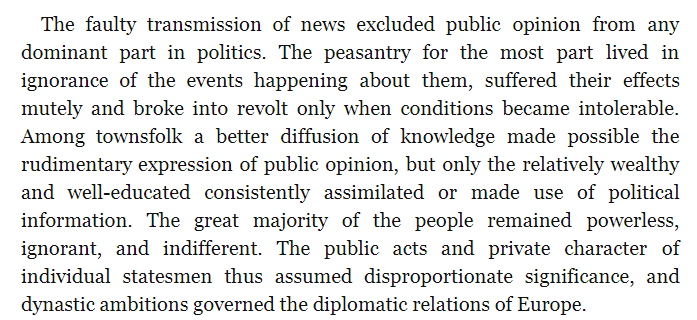
How could the fates of millions be determined by who married whom in a few families?Wedgewood thinks the reason is information:

This is an interesting explanatory thesis. Perhaps it could be restated thus: Everyone has political interests. But in order to act on their interests, people need information and the ability to coordinate. Without information, the peasants and most of the middle class were rendered powerless ca. 1600. That left the great aristocrats to govern, and they could best understand and use their own relationships to shape the world. (They presumably had poor information about things like economics and demographics.) Their relationships were transparent to the masses–for example, everyone knew when the king got married–so the most likely point for popular involvement was in supporting or blocking a dynastic union.

This thesis also raises questions about our own time. Today, we have information by the gibibyte. What we lack is the ability to focus attention on the important stuff. It’s easier to grasp Donald Trump’s marital and extramarital relations than to follow how HHS is undermining Obamacare. One dominant man holds extraordinary power–and celebrity–in China, Russia, India, Turkey, and many other countries. It’s conceivable that the 21st century will look more like the 16th than the 20th in this respect.

Citizens in a Global Society (Connections 2016)

The eight-page article, “Citizens in a Global Society” by David Mathews was published in Kettering Foundation‘s 2016 edition of their annual newsletter, Connections – Kettering’s Multinational Research. This is the initial article in the newsletter that introduces the theme for the whole publication which centers around Kettering’s multi-national work.  Below is an excerpt from the article and Connections 2016 is available for free PDF download on Kettering’s site here.

From the article…

The foundation’s multinational research falls into two broad categories or groups. In the first category, the foundation collaborates with nongovernmental organizations outside the United States that are interested in what Kettering is studying about how people do or don’t become engaged as citizens who exercise sound judgment, the work citizens do in communities to solve problems and educate the young, and productive ways that people can engage large institutions, both governmental and nongovernmental, as those institutions try to engage them. This research is the way the foundation organizes its study of democracy.

At the heart of the word democracy is the demos, or “citizenry,” and Kettering refers to the ways citizens go about their work as “democratic practices.” (Kratos, or “power,” is the other root of democracy.) The democratic practices that Kettering studies require self-responsibility, which can’t be exported or imported. So the focus of our research is on the United States, not other countries. Yet our studies have been greatly enriched by what the foundation has learned from nongovernmental organizations in some 100 other countries spread across the globe.

Organizations in other countries interested in this research come to summer learning exchanges called the Deliberative Democracy Institutes (DDIs) to share their experiences with one another and the foundation. Some of the participants come back to enter Kettering’s multinational residency program, which now has a large alumni group. These alumni often return as faculty for the institutes. Kettering’s second category of multinational research is on citizen diplomacy, and it centers on three countries—Russia, China, and Cuba. The governments in these countries have or have had serious differences with the government in the United States; communications have broken down or been problematic.

The premise of the studies, as the late Hal Saunders, Kettering’s longtime director of international affairs, explained to the New York Times, is that we live in a time when governments face a growing number of problems they cannot deal with alone, so citizens outside government have to fill that void. Citizen diplomacy is not intended to replace or compete with government diplomacy but to supplement it. And from Kettering’s perspective, this research gives the foundation a way to study dangerous conflicts, which are, unfortunately, an inescapable part of politics.

This is just an excerpt, you can read the rest of the article by clicking here.

About Kettering Foundation and Connections
KF_LogoThe Kettering Foundation is a nonprofit operating foundation rooted in the American tradition of cooperative research. Kettering’s primary research question is, what does it take to make democracy work as it should? Kettering’s research is distinctive because it is conducted from the perspective of citizens and focuses on what people can do collectively to address problems affecting their lives, their communities, and their nation.

Each issue of this annual newsletter focuses on a particular area of Kettering’s research. The 2016 issue of Connections, edited by KF program officer and senior writer/editor Melinda Gilmore; KF senior associate Philip Stewart; and KF vice president, secretary, and general counsel Maxine Thomas, focuses on our year-long review of our multinational research.

Follow on Twitter: @KetteringFdn

Resource Link: www.kettering.org/sites/default/files/periodical-article/Mathews-2016.pdf

Register to Join Harwood Institute’s Spring Virtual Lab

For those working in community, NCDD member org – the Harwood Institute, has an exciting training just around the corner. Their Spring Virtual Public Innovator Lab extends their signature 2.5-day training over an 8-week interactive online course which teaches participants how to deeper engage in your community. NCDD members receive $50 off the training and to the receive the discount code, email keiva[at]ncdd[dot]org.  Register to join this educational series ASAP, which starts April 5th. You can learn more about the training in the post below and find even more details on Harwood’s site here.


Virtual Public Innovator Labs

Our training platform is built for you.

The Virtual Lab is a robust multi-week online course offered several times each year. Attend sessions from the comfort of your own computer, participate in structured discussions, and practice your new skills with other amazing people. Through our online course, you and/or your colleagues will learn our time-tested approach to creating deeper and more meaningful impact in your community.

Spring Virtual Lab: April 5 – May 24, 2018
Registration Open

Fall Virtual Lab: September 27 – November 1, 2018
Registration Open

WHO SHOULD ATTEND
The Lab is for people who are leading or supporting work to help address community problems. We call these individuals public innovators. They can come from nonprofits, faith organizations, businesses, government, academia and other areas. Their organizations can be any size from any size community.

  • We are looking for people who run programs or initiatives, are part of the senior staff, or lead organizations.
  • If you already use our approach but have new staff, this is a great, cost-effective way for them to get trained.

WHAT WILL I LEARN?

  • How to engage and understand your community the right way
  • How to use what you learn from the community to gain new allies
  • How to improve your programs and strategies so they work for your community – not just for the experts
  • How to get work moving with the right partners in the community when it seems like everyone is stuck and there’s talk but no action
  • How to be a more intentional community leader that exercises genuine authority, authenticity and accountability

WHAT WILL I GET?

  • An action plan that you can start on as soon as you get home
  • A toolkit with all the materials you can copy and use with your colleagues
  • A library of videos on topics we cover in the Lab
  • Regular updates from the Institute through our newsletter

THE FORMAT

  • The Virtual Lab is structured as an 8-week online course.
  • This program will take place every Thursday from 1:30-3:00 PM Eastern Standard Time for 8 weeks.
  • The online sessions are highly interactive. You’re expected to participate in discussions.
  • In between sessions, you will participate in online discussions and have about 30 minutes of “homework” to do so you can apply what you are learning as you are learning it.

You can learn more about the Spring Virtual Lab on Harwood Institute’s site at www.theharwoodinstitute.org/virtual-labs.

Nicole Doerr, Political Translation: How Social Movement Democracies Survive

A century ago, Robert Michels observed what he called the “Iron Law of Oligarchy” at work in the socialist and revolutionary labor parties and movements of Europe. He argued that these groups provided “the best field of observation” for the problem of oligarchy, because they were committed in principle to equality and democracy (p. 11). If even they turned into oligarchies, it was “probable that this cruel game will continue without end” (p. 408).

This was the pattern he observed:

Democracy is inconceivable without organization. [But] Organization implies the tendency to oligarchy. In every organization, whether it be a political party, a professional union, or any other association of the kind, the aristocratic tendency manifests itself very clearly. … As a result of organization, every party or professional union becomes divided into a minority of directors and a majority of directed. … All power thus proceeds in a natural cycle: issuing from the people, it ends by raising itself above the people (pp. 21, 32, 38).

Since about 2003, the University of Copenhagen Sociologist Nicole Doerr has been observing the successors of Michels’ socialist and revolutionary movements–the heterogeneous leftist organizations that have come together in contexts like the European Social Forum, the US Social Forum, and a low-income city in California. She observes many of the same specific dynamics that struck Michels, and she adds new ones.

For example, experienced, professional organizers tend to know one another and give each other much more attention than they give to newcomers (pp. 33-34). Representatives of “New Left” organizations that demand loose, horizontal interactions appear to union organizers to be “arrogant and upper-class” (p. 32). Questions that matter to marginalized people–such as whether the location of the next meeting will be accessible to them–get tabled as irrelevant (p. 56). Despite strong leftist convictions, leaders reveal unconscious bias against people unlike them, such as women from Turkey and Eastern Europe (pp. 54-5). Decisions laboriously reached in earlier meetings become sacrosanct, even though newcomers have reasons to object to them. The need to translate for–or to speak more slowly to–linguistic minorities is perceived as a mere nuisance (p. 39). Gatherings tend to grow more “ideologically homogeneous” over time (p. 54), as those who don’t agree drop out.

But Doerr also contributes a fascinating positive finding. She first noticed that a multilingual meeting was more equitable and deliberative than meetings in which translation was unnecessary (p. 25). That seemed paradoxical. One would assume that if some participants require simultaneous translation, a layer of inequality will be added.

But then she started noticing the translators. Although they were easily dismissed as providing a mere technical support service–and one that inconvenienced the speakers of the dominant languages–they also became involved in advocating for inclusion. They were professionally resistant to entering the discussion of substance, since their job was to translate for others. But they were also professionally committed to making sure that the people they served could be heard. Thus they often intervened on matters of process.

The translators suddenly took center stage when they went on strike during a Paris gathering, with the terse announcement, “we translators now collectively interrupt our linguistic service” (p. 42). Their demand was to change the list of official speakers so that more immigrants were included. They quickly prevailed, thanks to their leverage over the entire meeting.

At the US Social Forum in Atlanta, there were again linguistic translators. But by now, Doerr had begun using the term more broadly. Translators are people who enter a discussion without having substantive views of their own but with the goal of making sure that certain specific people, vulnerable to being ignored, are heard and understood. One of the activists in Atlanta “often intervened when established NGO staffers working on immigration reform had trouble not only understanding the language but also the content and importance of demands by undocumented immigrants.” She told Doerr, “What we did for the US Social Forum was translation … But it’s not just about linguistic translation. It’s also about emotion. It’s a translation of space, of class, of gender” (p. 59).

These translators–linguistic or otherwise–emerge for Doerr as a “third voice within deliberation” (p. 10), neither participants nor facilitators.

She recognizes that they have the power to advance their own interests (pp. 47-9). In the words of the old Italian pun, “traduttore, traditore” (translator = traitor). Their value is dependent on their motivations.  Doerr devotes a chapter to a California example in which bilingual elected officials favored their self-interests: “translation had turned into representation and domination” (p. 97). In meetings at city hall, these officials “repeatedly interrupted, disciplined, marginalized, and implicitly stigmatized residents,” especially those who spoke in Spanish.

But then a grassroots organizing group created community forums and invited the same city leaders to participate on its turf. Volunteer translators played essential roles in designing these forums, in preparing the city officials to be respectful at the meetings (pp. 102-3), and then intervening to demand that specific questions be answered (p. 110). While literally translating between Spanish and English, the organizers also explained technical matters in understandable terms. Although the votes at these community forums had no legal force, the city council made some concessions in response.

I’d like to emphasize four larger themes:

First, we are used to a dichotomy between direct and representative democracy. But translators (linguistic or otherwise) complicate that. They represent individuals in order to permit direct participation.

Second, the beneficial cases in Doer’s book depend on organized power. The translators in Paris struck, withholding their services all at once. The community organizers in the US case engaged sufficient numbers of voters that they could compel city officials to attend their meetings. It’s not just the act of translating that matters; it’s the translators’ connection to organizations. (At this point, Michels would ask how organized translators can avoid becoming a new oligarchy.)

Third, translators sometimes escape notice; their influence is unseen because all they seem to be doing is translating someone else’s words (p. 126). I imagine that listeners literally look at the original speakers, not the translators. This invisibility can be problematic if translators misuse their power. But it’s also a strategic asset, because they can get away with influencing the powerful when others would fail.

Finally, these acts of translation are classic examples of “public work,” in my friend Harry Boyte’s sense: “self-organized efforts by a mix of people who create goods, material or symbolic, whose civic value is determined through an ongoing process of deliberation” (Boyte and Scarnatti, p. 78.). Thinking of political translation as a form of work is helpful because it brings out the translators’ professional commitments and values and the craft-like skills that they contribute to make democracy work better.

References

  • Boyte, Harry C. & Scarnati, Blase. 2014. “Transforming Higher Education in a Larger Context: The Civic Politics of Public Work,” in Peter Levine and Karol Edward Soltan, eds., Civic Studies: Approaches to the Emerging Field. American Association of Colleges & Universities, 2014
  • Doerr, Nicole. 2018. Political Translation: How Social Movement Democracies Survive Cambridge: Cambridge University Press.
  • Michels, Robert. 1915. Political Parties: A Sociological Study of the Oligarchical Tendencies of Modern Democracy, trans. Eden and Cedar Paul. New York: Heart’s International Library

Apply for Technology and Democracy Fellowship by 4/15

As NCDD reflects on the ways in which technology can support face to face D&D in today’s Tech Tuesday, we wanted to share this fellowship opportunity which supports the technological work that enhances democratic governance. [By the way, you can still join the free Tech Tuesday here!] Harvard Kennedy School’s Ash Center for Democratic Governance and Innovation, an NCDD member, recently announced they are offering an unpaid, non-resident Technology and Democracy Fellowship; to create space for participants to build relationships, develop their work or research, and have a unique opportunity to dig into the bigger questions behind their practice. The fellowship deadline is April 15th, so apply now if you are interested! Learn more about the details of the fellowship in the post below or find the original here.


Technology and Democracy Fellowship

Applications are now open for 2018 Fellowships. Applications can be found here

The Technology and Democracy Fellowship is part of an Ash Center initiative to explore technology’s role in improving democratic governance—with a focus on connecting to practice and on helping Harvard Kennedy School students develop crucial technology skills.

Over the course of the fellowship, participants design, develop, or refine a substantive project that is salient to their field. This project could entail research, writing, and developing strategy relating to each fellow’s work, or could take the form of a new platform, service, app, or idea.

Technology and Democracy Fellows form a virtual community through which they share ideas and resources, pose questions, offer feedback, and help one another with solving challenges in their projects or other work. The Kennedy School serves as a unique space for these technologists to take a step back from the day-to-day minutia working in the world of practice to discuss, research, and write about the bigger questions their work addresses.

Fellows also help students, staff, faculty, and other members of the HKS community to develop their understanding of major concepts and to build skills related to technology and governance. This knowledge sharing is primarily delivered through a hands-on, skill-building workshop that each fellow designs and leads once during the year on a topic of interest to the fellow (see past workshops here).  Fellows can also develop personal relationships with faculty, staff, and fellows at HKS in the form of consultation and mentoring, event/speaking opportunities, and more.

The Technology and Democracy Fellowship is an unpaid, non-resident fellowship, so Fellows are not expected to reside or work locally. We invite Technology and Democracy Fellows to Cambridge at least twice during the course of the fellowship year (at the Ash Center’s expense) to give workshops, present their work, and meet with members of the HKS community.

Eligibility
The Fellowship welcomes mid-career practitioners with an interest in leveraging technology to improve democratic governance. Each cohort of fellows includes technologists with an interest or background in democratic politics and governance or public and civic leaders with technology expertise.

How to Apply
Applications are now open. Please apply here.  The deadline for completed applications to be submitted is April 15, 2018. For questions, please contact Teresa Acuña at Teresa_Acuna@hks.harvard.edu.

Current Technology and Democracy Fellows
The 2017-18 Technology and Democracy Fellows are below.

Fatima Alam, Researcher on Trust and Safety at Google

Tiffani Ashley Bell, Founder and Executive Director of The Human Utility

Jeff Maher, Software Engineer for CivicActions

Marina Martin, Public Interest Technology Fellow at the New America Foundation

Aaron Ogle, Director of Product for the OpenGov Foundation

Mjumbe Poe, Co-founder and CTO of FixList

You can find the original version of this article on the Ash Center for Democratic Governance and Innovation’s site at www.ash.harvard.edu/technology-and-democracy-fellowship.

The Florida Joint Center for Citizenship at the Lou Frey Institute has joined the Civics Renewal Network!

CRN2

You may have noticed a new logo, similiar to what is above this post, appearing on the FJCC homepage. That is a sign of some exciting news! The Florida Joint Center for Citizenship is excited to announce that our parent organization, the Lou Frey Institute, was recently welcomed as a member of the Civics Renewal Network! 

CRN1

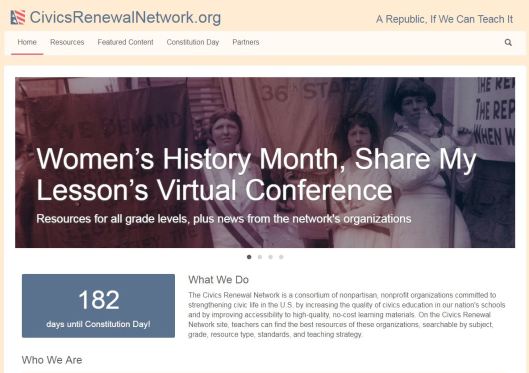
The Civics Renewal Network is a resource-sharing network made up of civics education organizations from across the country. The Florida Joint Center for Citizenship at the Lou Frey Institute is currently in the process of curating some of our quality resources to share on the CRN website, and we look forward to sharing and posting the resources of other civics education folks across all of our platforms! We are excited to be a member of this consortium, and look forward to sharing with you some of the quality work being done across the country!

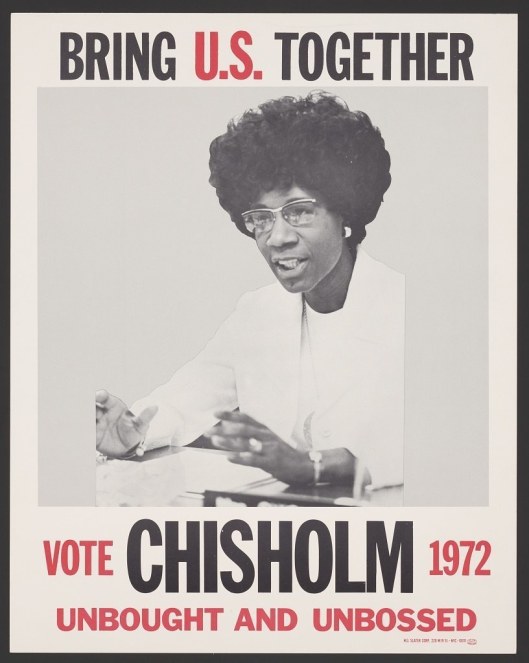
Women’s History Month: Shirley Chisholm, Trailblazer

SH1

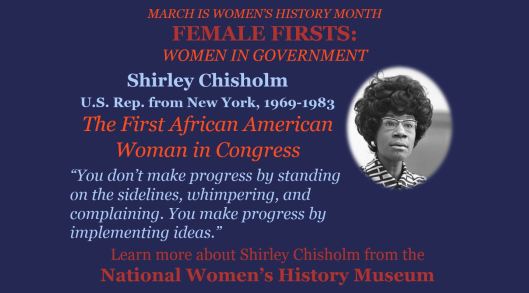
What does it mean to be involved? How can we make a difference in the lives of those who depend on us, and in the lives of those who seek only to have a voice? Shirley Chisholm, the first African-American woman elected to Congress, asked these questions. In addition to being the first African-American woman elected to Congress, she also ran for the Democratic nomination for President in 1972.

Chisholm_campaign_poster-816x1024

Her ‘Unbought and Unbossed’ campaign, while unsuccessful stands as a challenge to those who would sacrifice ideals for power, and stands even now as an example for those women and African-Americans who would follow in her footsteps.

You can learn more about Congresswoman Chisholm at the National Women’s History Museum. The Smithsonian Magazine also has an excellent piece on her presidential campaign. 

PPT Slide for Shirley Chisholm

Advertisements

come work at CIRCLE (and two other great jobs involving civic engagement)

We are hiring a researcher for the CIRCLE team, which I supervise.

Researcher – Tisch College  (18001131)

The Researcher will work with CIRCLE (The Center for Information and Research on Civic Learning and Engagement), a research-based think tank that studies how young people in the United States develop knowledge, skills and dispositions for effective democratic engagement. CIRCLE’s work covers a broad range of disciplines and fields, from K-12 civic education, youth voting, youth organizing, youth and civic media, to community characteristics that promote civic development. CIRCLE currently works on major initiatives in partnership with organizations that focus on low-income youth. Although CIRCLE studies civic development and engagement of all youth, the central focus of its work is on expanding access to civic learning and engagement opportunities especially for marginalized youth from various backgrounds. CIRCLE is an influential force and a premier source of information —facts, trends, assessments, and practices—related to youth civic engagement. CIRCLE reaches both academic and practitioners audiences through both academic and popular media, including a large number of features in major news outlets. Founded in 2001, CIRCLE has been part of Tisch College since 2008 and CIRCLE staff are fully integrated into the organizational life of Tisch College and Tufts University, offering CIRCLE staff a number of opportunities to develop skills in and outside of research.

The Jonathan M. Tisch College of Civic Life prepares students in all fields of study for lifetimes of active citizenship, promotes new knowledge in the field, educates Tufts students and beyond for a life of active citizenship, and applies our research to evidence-based practice in our programs, community partnerships, and advocacy efforts. Tisch College’s work is central to Tufts University’s mission. Tisch College offers several opportunities to engage Tufts students in meaningful community building and other civic and political experiences, explore personal commitments to civic participation, and take on active and effective roles in public life and to engage faculty in expanded active citizenship research and teaching. Tisch College also seeks to influence higher education in the US and abroad to embrace active citizenship mainly through its work via Institute for Democracy in Higher Education.

The Researcher, in collaboration with a broad array of professionals, contributes to the development and execution of all phases of research & evaluation projects and technical assistance activities, including survey design, implementation, data preparation, analysis, data visualization and report preparation. The Researcher will work on multiple projects simultaneously and support CIRCLE’s overall operation, and will support management of project timelines and deliverables.

Basic Requirements:

  • 3 years of related experience.
  • Bachelor’s degree or demonstrated competencies in relevant skills.
  • Proficiency using a statistical software package such as: SPSS, SAS, or STATA, and Microsoft Office Suite.
  • Keen attention to details and ability to manage multiple project deliverables and timelines.
  • Passion for using research to achieve equity in civic learning opportunities through systemic changes.
  • Demonstrated ability to manage complex projects.
  • Knowledge of logic models, research design, statistical analysis (multivariate statistics), and qualitative and quantitative research methods.
  • Experience with graphic software, and in developing and maintaining data management systems.
  • Effective verbal, written and interpersonal skills.
  • Demonstrated ability to work on several projects simultaneously and meet demanding timelines.
  • Compose accurate and clearly written reports and documents.
  • Work independently within basic guidelines and parameters.
  • Gather and analyze available data and draw logical conclusions.
  • Establish and maintain effective collaborative working team relationships.
  • Engage in proactive problem solving and critical thinking/analysis.
  • Engage with diverse stakeholders of varied educational and professional backgrounds and perspectives.

Preferred Qualifications:

  • Expertise with data visualization software and/or website management.
  • Direct experience with community engagement through community organizing, national service, etc..
  • Direct experience with young people in diverse communities.

Apply here.

And here are two other good jobs:

Democracy Research & Writing Associate, Small Planet Institute

12 Eliot St., Cambridge, MA (In Harvard Sq. across from the Kennedy School)
Compensation: modest, based on qualifications
Hours: 8-10/week, flexible.

Description: The Associate will work collaboratively with author-and-institute principal Frances Moore Lappé to contribute to developing the Institute’s Democracy & Dignity Project, a messaging initiative building on her new book, coauthored with Adam Eichen, Daring Democracy.

Responsibilities include:

  1. keeping Lappé up to date on, and critically evaluating, developments in the Democracy Movement as well and in the ongoing assaults on democracy.
  2. helping to frame messages for, and assisting in the production of, op-eds, blogs, videos and radio interviews that challenge inaccurate frames and generate empowering ones. 3) becoming familiar with arguments in critical new books and other resources, brainstorming and researching specific topics, helping to shape arguments, and providing fact-checking and feedback on drafts.

Apply HERE

Graduate Research Assistant for a Project Involving Arts and Community

The Pao Arts Research Collaborative is a community-based research project looking at the relationship between arts, culture, and gentrification in Chinatown. Using the new Pao Arts Center as the field site, this research is looking at whether arts and culture helps to support and sustain social networks and social cohesion in a rapidly shifting neighborhood impacted by development and displacement.

We are looking for a graduate research assistant interested in working on this project. The research assistant will have the opportunity to be involved in a variety of research tasks including conducting the literature review, doing data entry, developing a survey, conducting qualitative interviews and performing qualitative and quantitative data analysis. There may also be opportunities for participating in manuscript writing in the future. We are looking for a research assistant who can work 5-8 hours/week and provide at least a 6 month commitment.

We are looking for someone who is interested in working on community health in Chinatown, is interested in community-based participatory research, is organized, flexible, and detail-oriented, and has either quantitative or qualitative research skills. Applicants should have completed an introductory research methods course in their respective field.

This research is a collaboration between the Boston Chinatown Neighborhood Center, Tufts University Department of Public Health and Community Medicine, Tisch College of Civic Life and the Drama Department at Tufts University. This research is funded by Art Place America.

I am involved, but please send a resume and letter of inquiry to Carolyn Rubin (Carolyn.Rubin@tufts.edu.) .

The United States’ Democratic Promise (IF Discussion Guide)

The 36-page discussion guide, The United States’ Democratic Promise, was published by Interactivity Foundation in 2011 and edited by Dennis Boyer. For this discussion guide, IF brought together panelists to explore what democracy has come to mean in the US, why we value it, and to guide further discussion by offering contrasting public policy possibilities. Below is an excerpt from the guide, which can be downloaded as a PDF for free from IF’s site here, both in English and in Spanish.

From the introduction…

In this project, the two panels met in Madison, Wisconsin, from September 2010 to May 2011. This included a period of significant political turmoil in Wisconsin, including two months of protests by citizen groups and labor unions and an occupation of the state capitol. Several panelists played a role in these protests while several others opposed them. Needless to say, conditions on the ground provided a very interesting backdrop to the fundamental issues involving democratic governance and democratic government.

Panelists considered democratic governance to involve those elements of civil society that contribute to the conversation on the direction a democratic society should take, the cultivation of skills that contribute to democratic citizenship, and the formation of public opinion on choices that democratic citizens must make. Panelists saw these governance areas as important, or more important, than the formal systems of elections and processes that make up democratic government. It was the sentiment of the panels that a discussion of democracy in modern society must take both governance and government into account.

The panels started with a recognition that the United States’ experiment with democracy has been shaped by many forces and that our understanding of what democracy is has grown steadily. It was noted early on that the United States was founded as a republic with constitutional features that did not guarantee wide participation or majority rule. There was much struggle over who could participate as a citizen and the extent of the rights of that participation. Along the way, most U.S. citizens developed a sense of government of, for, and by the people, which many interpret as a promise of democracy.

Panelists felt that this promise of democracy has numerous aspects—some in contention with others. For some, the most important elements were freedom from arbitrary and heavy-handed government. For others, the central features had more to do with enlarging the community of citizenship and fostering participation. Many saw a complex web of rights and responsibilities that need to function as a democratic “ecosystem.” Almost all thought that attention must be paid to honest elections and fair democratic processes that inspire confidence and deal with democratic citizenship in the face of changing social conditions and expanding technological capabilities.

By the end of the project, panelists had arrived at the items that make up the possibilities in this report. Panelists recognized that some citizens might not want to enlarge democratic participation and that some public discussions of this report might focus on the reasons not to pursue these possibilities. The possibilities are contrasting approaches to the search for a democracy that goes beyond periodic elections and lip service to encourage participation. The possibilities value the consent and informed involvement of citizens. The possibilities also value the proximity of decision making and action to citizens…

Interactivity Foundation Fellows conduct discussion projects based on a process that relies on two panels (one of citizen-generalists and one of expert-specialists) to explore and develop areas of concern. These projects ask questions, develop answers, and complete other developmental tasks that assist in the drafting of contrasting policy possibilities that, hopefully, serve as discussion starting points for the public.

If you are interested in further information about the process used to develop IF reports or IF’s work in general, we invited you to consult our website at interactivityfoundation.org

The PDF version of this report is available for download here

About the Interactivity Foundation
The Interactivity Foundation is a non-profit, non-partisan organization that works to enhance the process and expand the scope of our public discussions through facilitated small-group discussion of multiple and contrasting possibilities. The Foundation does not engage in political advocacy for itself, any other organization or group, or on behalf of any of the policy possibilities described in its discussion guidebooks. For more information, see the Foundation’s website at www.interactivityfoundation.org.

Follow on Twitter: @IFTalks

Resource Link: www.interactivityfoundation.org/discussions/the-united-states-democratic-promise/

Reminder to Join Tomorrow’s Tech Tues Feat Synaccord!

In case you missed our original announcement, our next Tech Tuesday featuring David Fridley of Synaccord is tomorrow, March 20th from 2:00-3:00pm Eastern/11:00-Noon Pacific. You don’t have to be an NCDD member to participate, this free call is open to all. Make sure you save your spot by registering ASAP to join!

David Fridley, the founder of Synaccord LLC and an NCDD member since 2015; has been taking the best practices of face to face deliberation and translating them into online experiences to enhance and expand face to face deliberative discussion. David will demonstrate the latest release of tools for online deliberation and explain the discussion stages in terms of their face to face comparisons.  He will show where face to face discussions and online discussions add value to each other, by creating better results than either can achieve separately.

He will lead a discussion of the challenges facing online discussion and the concerns public bodies have, and how they are overcome. David also has a special offer for NCDDers who want to help a public body discover awesome solutions with tremendous support.

This is sure to be an educational webinar on how to improve engagement results, by utilizing online deliberative tools to augment the deliberative experiences that take place face to face – don’t miss out, register today!

About NCDD’s Tech Tuesdays

Tech Tuesdays are a series of learning events from NCDD focused on technology for engagement. These 1-hour events are designed to help dialogue and deliberation practitioners get a better sense of the online engagement landscape and how they can take advantage of the myriad opportunities available to them. You do not have to be a member of NCDD to participate in our Tech Tuesday learning events.