
The Birth of a Poop/Drug Cartel?

I’ve always been amazed at the things and activities around which commons have been unexpectedly developed – noncommercial theater, humanitarian rescue maps, specialized scientific microscopes. Little did I suspect that I would encounter a commons based on....human excrement. Even more surprising is that this valiant little commons, dedicated to using the human biome to benefit everyone, may soon be enclosed by Big Pharma. Yes, there is big money in turning our shit into branded, proprietary product.

First, a little background (from an excellent NYT article on the topic). OpenBiome is a Cambridge, Massachusetts stool bank that provides people with bottles of a “mud-colored slurry” used in fecal transplants. In recent years, physicians have made the amazing discovery that transferring the microbiota of healthy donors into the guts of people with certain illnesses can rescue them from death’s door and cure them. OpenBiome assists in this process by collecting stool donations from the public, processing them in safe and reliable ways, and making them available to patients and doctors for F.M.T., or fecal microbiota transplantation.

Tens of thousands of people suffer from the bacterial infection Clostridiodes difficile, or C. diff, for example. Fecal transplants have proven to be effective in 80% of these patients. Some feel much better within hours. Working as a nonprofit, OpenBiome helps such people by producing between 900 and 1,000 fecal transplant treatments each month, for about $800 apiece.

But now many pharmaceutical companies see fecal transplants as the Next Big Thing: a new way to deliver their drugs to treat diabetes, cancer, obesity, autism ulcerative colitis, and Alzheimer’s and Parkinson’s diseases. As the Times put it, “Human feces, it turns out, are a potential gold mine, for both medical researchers and drug makers.”

Based on the huge success of fecal transplants for C. diff, drug companies would love to extend and control this drug-delivery system for other diseases. Naturally, this would mean pharmaceutical companies destroying the fecal transplant commons and creating a new market order that they could dominate.

Ah, but how to achieve this goal? Answer: Through the strategic use of government regulation.

If the Food and Drug Administration can be persuaded to classify fecal transplants as a “drug” (rather than as organs, tissues, or blood, or some entirely new category), then FDA regulations would greatly favor drug companies and markets as the way to provide fecal transplants. The US Government would in effect create a regulated market for feces, to the exclusion of other potentially reliable, safe, and affordable options, such as commons.

Naturally, policymakers are not likely to regard a fecal commons of the sort facilitated by OpenBiome as the preferred option. Pharmaceutical companies don’t like that kind of competition, and Big Pharma calls the shots in Washington. In the name of rigorous health and safety, federal regulation is likely to be invoked by industry as the most effective way to invent a new market for itself. This would eclipse OpenBiome and preempt the idea of a viable fecal commons.

The drug industry would surely find this option attractive because it is currently having trouble getting patients to participate in clinical trials for fecal transplants – a necessary step for getting FDA approval. Sidelining OpenBiome could only help. The FDA has already stepped up its oversight of OpenBiome, which has caused its prices for fecal treatments to double to $1,600. It doesn’t take much imagination to see how prices would soar much higher -- and OpenBiome would suffer -- if Big Pharma truly got its claws into this market, selling our own excrement back to us as branded product.

In short, we may be about to witness an historic moment -- the market enclosure of human excrement as a medical treatment. Or as one gastroenterologist put it, the rise of the “poop drug cartel."

Such enclosures are a familiar pattern of capitalism. To meet an important need, commoners demonstrate the feasibility of an innovation through their hard work and mutual aid. Then for-profit businesses swoop in to monetize, privatize, and marketize everything. Commoners lose control of what is theirs, pay more for what they used to get for free or inexpensively, and suffer under the extractive terms of a market order, with the blessings of industry-friendly regulation.

Another path is feasible, but will the FDA make it illegal?
will the Democrats keep talking to their young voters?

According to CIRCLE’s latest analysis of its own survey data, young people who were contacted by candidates and parties in the 2018 election cycle were much more likely to vote. Some of this is probably selection-bias: campaigns try to contact the most likely voters. But there is also accumulated evidence that contact is effective: it boosts turnout, even for low-propensity voters.

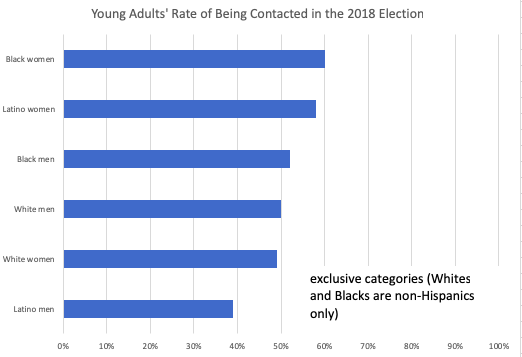
Democrats contacted substantially more youth than Republicans did in 2018. Demographics influenced who received the most contact:

based on CIRCLE data

These differences do not track disparities in political power and SES. On the contrary, young Black women generally face compounded disadvantages in America, yet 60% were contacted in 2018 (presumably by Democrats, for the most part). They top the list. Meanwhile, young white men were ten points less likely to be contacted.

What does this mean? It all depends on the nature of the contact and the follow-up. If Democratic candidates were simply trying to mobilize a reliable segment of their base by sending one-way messages before the election, and if African American women don’t hear from politicians again until October 2020, then the graph demonstrates political opportunism.

On the other hand, if the contact involved some listening and learning by campaigns, and if elected officials now recognize their debt to Black women and continue to engage them between elections, then the graph offers grounds for optimism.

I wouldn’t bet on the more optimistic interpretation, but it’s something to work for.

It’s also worth focusing on young Latino men, who really are left behind. I think this is partly because they are (for the most part) less involved in conventional organizations where people can be found and reached. In social science jargon, they have less “social capital” than the other categories of young Americans.

Finally, I don’t think it’s good news that’s young white men were contacted at low rates. From a partisan Democratic perspective, it could be a reasonably good sign. Democrats, who did most of the outreach to youth in 2018, directed their resources to people of color for a mix of tactical and principled reasons. But we also know that many young white men live in “civic deserts,” where they are generally disconnected from civic and political institutions. That can reinforce combustible forms of alienation. If the low contact rate reflects low levels of membership and belonging, it is evidence of a problem.

See also: Civic Deserts and our present crisis; new research on “civic deserts”; and democracy is coming to the USA.

Weekly Online D&D Roundup – March Confab Announced!

As part of this week’s roundup of online D&D events, we’re excited to include the announcement we shared yesterday for the upcoming NCDD March Confab call on Wednesday, March 13th in collaboration with Net Impact, National Issues Forums Institute, and the National Conversation Project. This free 1-hour webinar will be from 3-4 pm Eastern, 12-1 pm Pacific, and will be an opportunity to learn more about Net Impact’s youth engagement work, the new national debt issue guide they created with NIFI, information on a paid opportunity to host forums, and more about the upcoming National Week of Conversation. Register ASAP to save your spot on this dynamic and informational call here. We encourage you to check out the webinars below from the following NCDD member orgs Living Room Conversations, Bridge Alliance, and IAP2.

Do you have a webinar or other event coming up that you’d like to share with the NCDD network? Please let us know in the comments section below or by emailing me at keiva[at]ncdd[dot]org, because we’d love to add it to the list!


Online Roundup: NCDD March Confab, Living Room Conversations, IAP2, Bridge Alliance

Living Room Conversations webinar – Police-community Relations

Thursday, March 7th
2 pm Pacific, 5 pm Eastern

Join us for a free online (using Zoom) Living Room Conversation on the topic of Police-community Relations. Please see the conversation guide for this topic. Some of the questions explored include: What has been your personal response to instances of police-citizen shootings, if any? What do you think is contributing to the police-citizen shootings right now? What role, if any, do you see racism playing in our current attention to law enforcement?

REGISTER: www.livingroomconversations.org/event/online-living-room-conversation-men-victims-perpetrators-and-allies/

Living Room Conversations webinar – Mental Health

Saturday, March 9th
11 am Pacific, 2 pm Eastern

Join us for a free online (using Zoom) Living Room Conversation on the topic of Mental Health. Please see the conversation guide for this topic. Some of the questions explored include: What experiences in your life, your work or your family inform your thinking about mental health? Is mental health an important issue in your community, and if so, why? In your experience, how are mental health issues affecting young people? (If you are a young person, how do mental health issues affect you and your peers?)

REGISTER: www.livingroomconversations.org/event/online-living-room-conversation-mental-health-3/

IAP2 Monthly Webinar – Visual Engagement

Tuesday, March 12th
11 am Pacific, 2 pm Eastern

Encouraging members of the public to take part in an engagement process is challenging. How do you provide them with the information they need to make an informed decision without bogging them down with data, policy and jargon? For that matter, how do you attract their attention in the first place?

The Visual Engagement Awards — a new Core Values Award presented by IAP2 Canada in conjunction with the Dazzling Notice Awards — rewards public entities which have made that extra effort to get people’s attention and make sure their many voices are heard. In 2018, the first awards went to the Region of Waterloo, Ontario, for its Biosolids Strategy, and the District of Squamish, BC, for its Official Community Plan Update. Watch the Waterloo video here. Watch the Squamish video here.

REGISTER: www.iap2canada.ca/event-3093147

NCDD March Confab with Net Impact, NIFI, and National Conversation Project

Confab bubble image

Wednesday, March 13th
12 pm Pacific, 3 pm Eastern

This free one-hour webinar will be a great opportunity for anyone passionate about cultivating the next generation of leaders, those interested in learning how to apply for the microgrant to host forums, more about the new national debt issue guide, and/or hosting a conversation during the upcoming National Week of Conversation. You won’t want to miss out on this discussion – register today!

REGISTER: http://ncdd.org/29225

Living Room Conversations Training (free): The Nuts & Bolts of Living Room Conversations

Thursday, March 14th
12 pm Pacific, 3 pm Eastern

Join us for 60 minutes online to learn about Living Room Conversations. We’ll cover what a Living Room Conversation is, why we have them, and everything you need to know to get started hosting and/or participating in Living Room Conversations. This training is not required for participating in our conversations – we simply offer it for people who want to learn more about the Living Room Conversations practice.

Space is limited to 12 people so that we can offer a more interactive experience. Please only RSVP if you are 100% certain that you can attend. This training will take place using Zoom videoconferencing. A link to join the conversation will be sent to participants by Wednesday 10am (PT) / 1pm (ET).

REGISTER: www.livingroomconversations.org/event/training-free-the-nuts-bolts-of-living-room-conversations-3/

Living Room Conversations webinar – American Culture: Melting pot or salad bowl or something else?

Saturday, March 16th
11:30 am Pacific, 2:30 pm Eastern

Join us for a free online (using Zoom) Living Room Conversation on the topic of American Culture: Melting pot or salad bowl or something else?. Please see the conversation guide for this topic. Some of the questions explored include: What is your cultural heritage? Have you experienced cultures other than your own? What did you appreciate? What made you uncomfortable? What value do you see in having a single, shared American culture? What would that culture look like?

REGISTER: www.livingroomconversations.org/event/online-living-room-conversation-american-culture-melting-pot-or-salad-bowl-or-something-else/

Bridge Alliance webinar – Peer Learning Session: Get to Know the 116th Congress with the Congressional Management Foundation *this webinar is for Bridge Alliance members only – learn more here

Monday, March 18th
10 am Pacific, 1 pm Eastern

A new Congress means new committee and subcommittee chairs, new alliances, and significant changes in the political terrain on Capitol Hill. With the shift in power, and term limits for committee chairs in the House and Senate, an advocate who may have been represented by an anonymous back-bencher last year might now be the conduit to the most important legislator for your cause. This webinar will offering a snapshot of the 116th Congress, offering participants a window into how to build relationships with lawmakers. The presentation will be conducted by Bradford Fitch, President and CEO of the Congressional Management Foundation (CMF).

RSVP: www.bridgealliancefund.us/cmf_peer_learning_session

approaching deadlines for summer opportunities at Tisch College

March 31 is the application deadline for three opportunities:

1. The Summer Institute of Civic Studies

The Summer Institute of Civic Studies is an intensive, selective, interdisciplinary seminar that brings together faculty, advanced graduate students, and practitioners from many countries and diverse fields of study. Topics for the readings and discussions include:

  • How do social systems look from the perspective of people who want to change them?
  • How can people form and maintain functional groups that improve the world?
  • How can people reason together about what is right to do?
  • What practices and institutional structures promote these kinds of citizenship?
  • How should empirical evidence, ethics, and strategy relate?

The Summer Institute was founded and co-taught from 2009-17 by Peter Levine, Associate Dean of Academic Affairs at Tisch College, and Karol So?tan, Associate Professor in the Department of Government and Politics at the University of Maryland. This year it will be led by Peter Levine alone. You can read more about the motivation for the Institute in the Civic Studies Framing Statement.

The 11th annual Summer Institute will start with the Frontiers of Democracy Conference (see below) on June 20-22 and then continue as a seminar until June 28 at 5pm.

Daily sessions take place on the Tufts campus in Medford, Massachusetts. Tuition for the Institute is free, but participants are responsible for their own housing and transportation. One option is a Tufts University dormitory room, which can be rented for $69/night (single room) or $85/night (double room). 

The application consists of a resume, a cover letter about your interests, and an electronic copy of your graduate transcript (if applicable). Please send those materials to Peter Levine, peter.levine@tufts.edu no later than March 31, 2019

2. Proposals for the Frontiers of Democracy Conference

Frontiers of Democracy is an annual conference hosted by the Jonathan M. Tisch College of Civic Life at Tufts University since 2009. It convenes practitioners and researchers who work on strengthening democracy in the US and around the world. The format combines short talks with interactive sessions for smaller groups. This year, it will take place from June 20 (evening) until June 22 (midday) at the downtown Boston campus of Tufts University

In 2019, participants in the Summer Institute of Civic Studies, the APSA Institute for Civically Engaged Research (see below), people involved with the Deliberative Democracy Consortium and Cities of Service, and 40 new fellows of the Lead for America program will attend Frontiers, along with others who register. You can register to hold a spot now. Proposals are also being accepted for individual talks, panels, and other kinds of sessions, such as moderated discussions, workshops, planning meetings, etc. Please submit proposals here by March 31 for best consideration.

3. The first annual American Political Science Association Institute for Civically Engaged Research (ICER)

The APSA Institute for Civically Engaged Research will begin in summer 2019. ICER is intended for advanced graduate students in political science and for political scientists at any stage of their careers who wish to shift to using civically engaged research. (It is not meant for scholars who are already experienced in that approach.)

Approximately twenty participants will meet each day from June 17-20 for intensive discussions. Participants are then expected to attend the Frontiers of Democracy conference from the evening of June 20 until noon on June 22 in downtown Boston.

Tisch College Academic Dean Peter Levine is the organizer. Other confirmed speakers and visitors include: Valeria Sinclair Chapman (Purdue), Archon Fung (Harvard), Taeku Lee (Berkeley), Robert Lieberman (Johns Hopkins), Jamila Michener (Cornell), Amy Cabrera Rasmussen (Cal State-Long Beach), Pearl Robinson (Tufts), and Rogers Smith (Penn). 

Thanks to support from the APSA, participation in the Institute and the conference is free, and scholarships are available to defray costs of travel, food, and housing in dormitories on the Tufts campus. Applicants are expected to seek financial support from their home institution, but admission to the Institute for Civically Engaged Research will not be affected by financial need.

To apply, please complete this form.

In addition, applications are due by March 15 for …

4. The European Summer Institute of Civic Studies

Herrsching, near Munich, Germany, from July 14th to July 27th 2019

The fifth annual European Summer Institute of Civic Studies will take place in Herrsching, near Munich, Germany, from July 14th to July 27th 2019. This Institute is open to applicants from Armenia, Azerbaijan, Belarus, Georgia, Germany, Kazakhstan, Kyrgyzstan, Moldova, Poland, the Russian Federation, Turkmenistan, Ukraine and Uzbekistan. It is funded by the German Government’s Academic Exchange Service (DAAD), which covers travel, food, and lodging costs. The organizers are Prof. Karol Soltan (University of Maryland) and Prof. Tetyana Kloubert (Catholic University Eichstätt-Ingolstadt); Peter Levine will join for 2-3 days.To apply, send a letter of interest, a curriculum vitae, and an academic transcript (if applicable) to Prof. Kloubert at Tetyana.Kloubert@ku.de by March 15, 2019 for best consideration.

Announcing a Blockbuster March Confab!

We are pleased to announce an exciting March Confab call happening next week in coordination with Net Impact, National Issues Forums Institute, and the National Conversation Project! On the call, we will learn more about Net Impact’s youth engagement work, their collaboration with NIFI on a new National Debt issue guide, a paid opportunity to host forums with the guide, and how this all plays into the upcoming National Week of Conversation (NWOC). Join us for this dynamic call on Wednesday, March 13th from 3-4 pm Eastern, 12-1 pm Pacific.

This free one-hour webinar will be a great opportunity for anyone passionate about cultivating the next generation of leaders, those interested in learning how to apply for the microgrant, and/or hosting a conversation during NWOC. You won’t want to miss out on this discussion – register today!

reg-button-2

On this call, we will be joined by Net Impact’s Program Manager Christy Stanker who will share about Net Impact’s work to nurture youth into emerging leaders, their stand-out program Up to Us, and how to apply for the microgrant to host forums on the national debt.

The issue guide, A Nation in Debt: How Can We Pay the Bills? was published by the National Issues Forums Institute (NIFI) in partnership with Up to UsUp to Us, an initiative of Net Impact and the Peter G. Peterson Foundation, is a rapidly growing, nonpartisan movement of young people who recognize that when it comes to securing their economic and fiscal future, they have no better advocates than themselves.

Amid high-profile debates over jobs and the economy, social mobility, healthcare, and tax reform, Up to Us is the only nationwide, campus-based campaign focused on building a sustainable economic and fiscal future for America’s next generation. Net Impact’s programs help new leaders broaden their thinking, build their networks, and scale their impact beyond just individual actions.

Net Impact is excited to offer a microgrant of $150 to moderators* who host a forum using the newly updated A Nation in Debt issue guide and NIFI’s Chief Administrative Officer Darla Minnich will join the call to share details on the offer. *Moderators must be affiliated with an accredited US-based college or university to be considered eligible for the microgrant.

This microgrant opportunity also coincides with the upcoming National Week of Conversation, happening April 5-13. Our co-hosts at the National Conversation Project, Jaclyn Inglis, Partnerships Director, and Pearce Godwin, Executive Director, will share more about this upcoming initiative to get people engaged in conversations and how you can get involved. We hope many of you will consider combining the microgrant opportunity and contributing to the National Week of Conversation!

Make sure you register today to secure your spot!

About Our Confab Co-Hosts

Net Impact is a nonprofit that inspires and equips emerging leaders to build a more just and sustainable world. Net Impact’s programs help new leaders broaden their thinking, build their networks, and scale their impact beyond just individual actions.

National Issues Forums Institute (NIFI), is a nonprofit, nonpartisan organization that serves to promote public deliberation about difficult public issues. Its activities include publishing the issue guides and other materials used by local forum groups, encouraging collaboration among forum sponsors, and sharing information about current activities in the network.

National Conversation Project is an overarching, collaborative platform that aggregates, aligns, and amplifies the efforts of more than 175 partners to mainstream conversations in which we #ListenFirst to understand. NCP promotes National Weeks of Conversation, #ListenFirst Fridays, and any conversation inviting people of all stripes to revitalize America together.

About NCDD’s Confab Calls

Confab bubble imageNCDD’s Confab Calls are opportunities for members (and potential members) of NCDD to talk with and hear from innovators in our field about the work they’re doing and to connect with fellow members around shared interests. Membership in NCDD is encouraged but not required for participation. Confabs are free and open to all. Register today if you’d like to join us!

the Historovox

Corey Robin’s essay, “Why Has It Taken Us So Long to See Trump’s Weakness?,” is mainly interesting as an argument about trends in reporting. Robin criticizes

a new genre of journalism that forgoes the pedestrian task of reporting the news in favor of explaining it through the lens of academic research. Ensconced at Vox, FiveThirtyEight, dedicated pages of the Washington Post and the New York Times, and across Twitter, the explainers place great stock in the authority of scholarship — and in journalists who know how to wield the authority of scholars

He argues, “There’s a bad synergy at work in the Historovox — as I call this complex of scholars and journalists — between the short-termism of the news cycle and the longue durée-ism of the academy. … When academic knowledge is on tap for the media, the result is not a fusion of the best of academia and the best of journalism but the worst of both worlds.”

An obvious objection is that there are more than just two genres of writing about politics (academic analysis and pedestrian journalism). I’d place Robin’s “Historovox” on a longer list.

  1. Old-school deadline-driven political reporting: The writer tells you what happened yesterday. The lede is an event: a speech, an endorsement, a vote, an indictment. Subsequent paragraphs tell (or remind) you what happened earlier, leading up to this new event. To the extent that the news is explained, the available explanations include: what the actors and their spokespeople say happened, how their critics reply, and the tactical advantages that will result for each. An imaginary example: “The Senator traveled to Wisconsin today to talk about jobs. This follows on the heels of her speech about the environment in Los Angeles last week. People involved in her campaign said that she is engaging two important constituencies. Her opponent charged that she wants ‘to rake in the dollars from spoiled Hollywood liberals.’ Of course, prospective presidential candidates always test their support in key states.”
  2. Positivist, mostly quantitative academic scholarship: The writer looks for statistically significant patterns in representative samples of data (rather than “anecdotes”). She poses and tests explicit hypotheses. She situates her original results in the context of peer-reviewed literature. For instance, “Some previous studies suggest that candidates mainly appeal to donors. Other studies suggest that they focus on ordinary voters. Our analysis of 256 campaign events finds that donor-appeal explains 11% more of the variance in decisions about candidate travel.”
  3. Ideological advocacy: The writer hopes to advance conservatism, or socialism, or environmentalism, or whatever, and uses recent political events as evidence and as a “hook” to persuade the unconvinced and mobilize the base. “The Senator made a great speech about jobs in Wisconsin but needs to remember why unions have declined. It’s no accident that wages have fallen as union membership has fallen: these are the results of neoliberal policy choices.” This style extends from opinion magazines and op-ed pieces deeply into academic journals.
  4. Theory-building: The writer is primarily interested in developing and defending general social theories, which may have both normative and explanatory components. She is trying to develop, for example, a new version of civic republicanism or intersectional feminism or social capital theory. As in #3, recent examples serve as illustrations and “hooks,” but the argument is less predictable, less topical, and may be considerably more complex.
  5. The “Historovox” is a fusion of #1 with #2 and/or #4. Its typical style is to “explain” a concrete recent event by summarizing some relevant positivist social science (#2) and adding an interesting social theory (#4). The very bright, broadly-educated reporter works by searching the scholarly literature and interviewing academics. This style claims to avoid #3, which is seen as politically biased, in favor of “research.”

Robin offers a subtle defense of #1–traditional deadline journalism–by way of quotations from political theorists who might be seen as “particularists”: highly skeptical of generalization and concerned with attending to details:

Everyone knows and cites Orwell’s famous adage: “To see what is front of one’s nose needs a constant struggle.” Less cited is what follows: “One thing that helps toward it is to keep a diary, or, at any rate, to keep some kind of record of one’s opinions about important events. Otherwise, when some particularly absurd belief is exploded by events, one may simply forget that one ever held it.”

and

the job of the scholar is to recall and retrieve what the Marxist critic Walter Benjamin described as “every image of the past that is not recognized by the present.” The task is not to provide useful knowledge to the present; it is to insist on, to keep a record of, the most seemingly useless counter-knowledge from the past — for the sake of an as-yet-to-be imagined future.

If I read him right, Robin is not saying that we need writers to express opinions about each event and record what they have opined. Rather, we–readers, citizens–should do that. Journalism gives us the raw material for our daily opinion-formation, and we should hold ourselves accountable by checking our views as new data arrive.

As a bit of a particularist myself, I find these quotes resonant, and I start with the premise that we badly need paid professional reporters to cover events. But the objection to #1 is that it was never theory-free, never just a record of what happened yesterday. Instead, it always embodied a problematic general theory, according to which history results from explicit decisions by self-interested professional politicians who compete with each other. Absent are deeper causes, issues ignored by the major parties, areas of agreement, and the work of citizens. Thus deadline journalism never served citizen-readers as well as it should have. It served up the wrong mix of “news events” for us to form opinions about.

#2 is valuable but has its limitations. As I argued right after the 2016 election, positivist social scientists mostly failed to predict Trump because their job is to detect trends in data collected already (i.e., the past). They can’t see that something is about to shift fundamentally, and when that happens, they retain a bias in favor of treating the new event as one outlying datapoint that doesn’t threaten the theory. A classic version of that critique is Robert C. Lieberman, “Ideas, Institutions, and Political Order: Explaining Political Change.” American Political Science Review 96.4 (2002): 697-712.

Another problem with #2 is tempo. The process of collecting representative data, analyzing it, and publishing it in peer-reviewed form takes many months or years, by which time events have moved on. Citizens cannot benefit from analysis unless they can use it in time.

Everyone criticizes #3–editorializing in support of an ideology–yet ideologies are indispensable heuristics, and each case of advocacy can contribute to a rich public sphere as long as you read it critically along with other views.

The advantage of #5 is translation. It connects social theory and empirical data to the news, allowing readers/citizens to learn from scholarly expertise. The big disadvantage is that there are theories for every fact. As Robin observes, when Trump looks strong, it’s time to cite the literature on authoritarianism. When he’s weak, we dust off the literature on the weak presidency. Historovox writers have a Malcolm-Gladwellish tendency to discover a new idea and find evidence of it everywhere for a while. Then events change, interests wander, and they find a new idea. As he argues, this is no way to learn.

But I think several commentators on Crooked Timber are right that explanatory journalism strives to address a real need. If we only had the first four categories listed above as separate streams, we’d be crying out for linkages. Sites like Vox and FiveThirtyEight (and The Conversation) don’t do this perfectly, but they seem fairly self-reflective and dedicated to self-improvement, and nobody could pull it off perfectly at first.

See also: why political science dismissed Trump and political theory predicted him; why political science dismissed Trump and political theory predicted him, revisited;

Who Will You Invite? An Exploration of Stakeholder Selection in Dialogue and Deliberation

A NCDD Listserv synopsis of the conversation entitled: How to pick stakeholders for a stakeholder dialogue

Listserv Contributors: Tom Altee, Adrian Segar, Peter Jones, Marjo Curgus, Peggy Holmes, Chris Santos-Lang, Betsy Morris, Eric Simley, and Sally Theilacker

Synopsis by: Annie Rappeport, NCDD Intern

“The approach to stakeholder selection is the most critical step in the design of fair and inclusive dialogues that reflect a community’s contributions and perspectives” ~ Peter Jones, NCDD Member

In your dialogue and deliberation work do you find yourself struggling as much about who to invite to a dialogue as how to set the agenda? Are you wanting to include many but worried about sacrificing the needed intimacy of the conversation?  If so, you are not alone.

In September 2018, NCDD member Tom Altee began a conversation with an inquiry to the greater NCDD community about the different considerations for and ways to select community stakeholders gathering because they all care about a particular issue.  Although Tom Altee’s questions were for a specific project related to community transit and the varying interests of bicyclists, walkers, and drivers, the responses quickly broadened this important conversation about dialogue. Tackling who will be included in a dialogue has valuable impacts on what will be discussed as will the overall size of the group and any present uneven power dynamics.

Our NCDD community responded with resources and ideas aplenty. Here are some contributions we believe may serve others well as they craft an approach for their specific local needs and contexts.

  1. Peter Jones has dedicated much of his work and scholarship to the importance of stakeholder selection. He recommends a technique entitled “evolutionary stakeholder discovery” whereby there are multiple waves of invitation and a creation of optimal criteria that the participating stakeholders may represent. This is a time-consuming and worthwhile approach. Marjo Curgus also uses a specific technique that combines network analysis and stakeholder analysis to craft a preferred list of included stakeholders. Marjo notes the importance of conducting this process with a committee and to prioritize levels of influence.
  2. Peggy Holmes mentions different models including the diversity promoting “faultlines” conceptual framework from The Maynard Institute. A handy guide to the faultlines approach is provided on the Society for Professional Journalists website (2019). She also mentions the work of Sandra Janoff and Marv Weisbord as providing useful criteria considerations.
  3. Chris Santos-Lang illustrates impossibility of creating the perfect gathering of stakeholders and the significant issue in dialogue and deliberation work to include stakeholder representation when the needed stakeholder may be physically, mentally or technically (i.e. language barriers) unable to participate at the needed level themselves.
  4. Adrian Segar recommends the 2013 John Forester book Planning in the Face of Conflict. This book features a dozen profiles of planning practitioners that serve as exemplary cases of stakeholder selection for practical problem solving in communities.

What we can continue to take from this discussion overall is the importance of questioning how we invite and who we invite in community discussions. The tools and approaches vary, but many times our goals remain constant–to have high quality and effective dialogues that are so because they are diverse, inclusive, and a size that enables everyone to contribute.

We hope this discussion may continue! Please post your thoughts and ideas for stakeholder selection in your work.

a civic approach to free speech

I argued in a recent post that libertarians, social democrats, American liberals, and most US Constitutional scholars share a sharp distinction between the state and the private sector–but this distinction does not reflect our actual experience of the social world.

One result is a certain way of thinking about freedoms of speech, the press, assembly, religion, and petition (the Five Freedoms of the First Amendment, which are also important rights in other democracies).

A typical first step is to identify which institutions are public or state bodies. They should be prevented from interfering with other people’s speech and assembly, and they should be constrained from expressing themselves in certain ways. For instance, the US government may not express support for any specific religion, although anyone else in the society may.

The next step is to safeguard the freedoms of non-public groups, including their freedom to discriminate and exclude. For instance, the Catholic Church is not required to ordain non-Catholics (or women) as priests. Such requirements would violate its freedom of assembly and religion.

Then we face two recurrent debates. One is whether various private associations (universities, web platforms) should act like states, even though perhaps they don’t have to under the Constitution. For instance, should a private university accord its students untrammeled freedom of speech? The other debate is whether hybrid institutions (state universities, political parties, public broadcasting services) are more state or private. Do they have First Amendment rights or must they safeguard others’ rights, or both?

The debate about the role of speech in our democracy thus centers on questions like comment-moderation, inviting or disinviting speakers, speech codes, hate speech–all of which have a legalistic flavor. The question is who has a right to say what, where.

If I actually had any influence, I would not seek to upset the apple cart of American constitutional thought. The categories that we have drawn (public/private, freedom/restriction) reflect some accumulated wisdom and offer some practical advantages. I would give a Burkean justification for how we employ the First Amendment: it is how we have learned to operate.

But the distinction between state and private sphere is at odds with the reality of how institutions work. They are almost all hybrids, partly public and partly private, exercising power but also allowing voice, including some and excluding others.

So what if we started instead with a population of people–individual human beings–who come together in a wide range of organizational forms to define, discuss, and address problems? I think these are the important points for them to consider in relation to freedom of speech:

  1. They need structured, reflective discussions that encompass a diversity of views and respond to good reasons or insights, not to power. They don’t need consensus, but they must continuously learn from others.
  2. Good discussions take institutional forms, from op-ed pages to seminars to town meetings. All institutions have rules, norms, resources, and incentives. Incentives are necessary because participation in a discussion has costs. It takes time and energy to discuss, and the conversation may cause discomfort. Individuals don’t have to participate. Successful institutions for communication or discussion find ways to lure people in. A classic example was the package of the local daily newspaper: comics and sports to encourage subscriptions, and a sober front page to direct your attention to serious matters. The demise of this business model is an important example of what we should worry about.
  3. Any good discussion is a common-pool resource. It requires voluntary contributions, it serves all who participate, but it is easy for individuals to ruin. There are principles for the management of fragile common-pool resources.
  4. On the list of principles you will not find a requirement to discuss all the rules and incentives all the time. On the contrary, groups must economize on disagreement. They can’t handle too much of it. And any discussion assumes a prior solution to a problem of collective action. People didn’t automatically want to show up and talk; they were drawn in. This means that discussions generally rely on founders, small groups of leaders, or past generations of participants. We don’t make our own discussions; we join them. The structure of the institution constrains the discussions that take place within it, but there is no such thing as an unstructured discussion.
  5. Given the fragility of institutions for discussion and the importance of building institutions that match various needs and interests, they must be plural. We need lots of overlapping but heterogeneous forums–face-to-face, online, big, intimate, ideologically coherent and ideologically diverse. Each one will set rules for what speech it allows, but the rules will also determine who participates, the costs and benefits of participation, the scale, and a range of other issues. No set of rules is ideal; it’s the whole ecosystem that matters.

None of this is original. It reflects well-developed lines of argument from the sociology of communication and other fields. But it is an alternative to the US discourse of free speech, which is all about rights and restrictions. It focuses instead on the design of multiple institutions for communication–their resources, boundaries, rules, and norms.

Preparing Students for the Civics EOCA

FLcivicsteachersfb
Recently, on the Florida Civics Teachers Facebook page, a colleague asked a simple but important question: how far out do you start reviewing for the EOC? There is, of course, no one right answer to this question. Personally, I would suggest that reviewing begins as soon as instruction begins. Integrate previously learned materials into warm-ups throughout the year, to continue to reinforce what is supposed to have been learned. This can also give you a sense of what kids have retained! That being said, participants in the conversation on the Facebook page provided some interesting and potentially beneficial review approaches! This post is a means for us to share them with other folks, and if you have an approach you think folks might appreciate, please drop a comment, join the Facebook group linked above, or shoot me an email! So what did teachers suggest? Let’s take a look!

Rachel suggested that data should guide the review approach. What do student test scores suggest about what they have and have not retained, or what might need a bit more reinforcement? And if you are looking for an assessment that might help you get some data, you can use the online assessment at Civics360, or email me for a hard copy!

Joel has already started his review, and uses a spiral review as bell work, a similiar approach to what was described above. He checks what students know, and can use it as a data collection method to see what he might need to come back to!

Sharon starts her review in mid-April, but she has the great pleasure of having her kids multiple times a day, thanks to a critical thinking class, so she actually began having them play with practice questions! That’s definitely one way to approach things. One thing with practice questions that I have seen done in successful classrooms is having students actually identify the three wrong answers rather than the correct one, and explaining WHY they are wrong. If they can do that, identifying the correct answer should be cake!

Denise and Robert both give themselves about 3 weeks to review the content and course with their students. Denise described it as a boot camp approach, and that is definitely something that can work well as a means to reinforce content!

Jaclyn uses the reporting categories to review with her kids, spending a week on each category, and offering students after school tutoring around each of the 35 assessed benchmarks. She uses a study guide/ vocabulary check for each category, has the kids take the test on Civics 360 for each category, and has her kids tally strong standards with tough standards. She also pairs students up for peer coaching!

Megan does a 2 week review, with week one focused on, as she describes it, “a crash course of notes and vocabulary”, and week two serving as a one giant review game.

We know that there are lots of review approaches out there! You can find some other examples here and here. Are there approaches that you like to use?

Special Offer Available on “A House Divided” NIFI Guide

In case you missed it, National Issues Forums Institute in partnership with the Kettering Foundation – both NCDD member organizations, have a special offer available for their new Issue Guide, A House Divided: What Would We Have to Give Up to Get the Political System We Want. They are offering folks interested in convening forums around this issue guide with complimentary digital versions and hard copies of the guide, and request for coveners and moderators to provide NIFI with report back on the experience. You can read the announcement in the post below and you can find the original on NIFI’s site here.


Special Offer on Newly Released Issue Guide for 2019 – Join the Conversation about “A House Divided: What Would We Have to Give Up to Get the Political System We Want?”

In partnership with the Kettering FoundationNational Issues Forums Institute (NIFI) is offering the following to forum conveners:

Digital Versions
The digital version of A House Divided Issue Guide and A House Divided Issue Advisory is available for complimentary download. The Issue Advisory is a shorter version of the Issue Guide and offers the same options and trade-offs for deliberation. Both the issue advisory and the issue guide versions are available here.

Hard Copies
Prefer hard copies for forum participants? NIFI is offering a set of 20 Issue Advisories and 2 Issue Guides for free.

Starter Video
The 5-minute companion video is a valuable tool since some participants may not have read the issue guide before the forum. The starter video is available for unlimited streaming and downloads.

  • You will need to create a Vimeo account to access the video.
  • Use promo code AHD2019 for free unlimited streaming and downloads.

What NIFI Requests From Conveners and Moderators:

How to Request Hard Copies
To request hard copies, please complete this form.
The advisories will be shipped to you from NIFI’s fulfillment house.

MODERATOR’S TOOLKIT
Deliberative Facilitator Cheat Sheet

-Editable cheat sheet for moderators to use during a forum
Questions that Can Support Deliberation
-A series of questions that can help spur deliberation in any forum, sourced from hundreds of pages of training materials from a variety of centers for public life
Fostering Deeper Deliberation
-A brief handout that discusses some of Kettering Foundation’s basic research findings on how to foster deeper deliberation
Nine Key Elements of Deliberative Forums
-A short course in NIF moderating

Download the entire kit in a single PDF here.

Download editable, individual elements of the kit here.

WEBINAR
Watch a Webinar about Moderating “A House Divided” presented by Kara Dillard. Kara discusses the three options in depth, outlines questions to ask in the personal stake section as well as in the options sections, and ways to help your participants reflect on this topic. Click here to watch the webinar.

NIFI Event Calendar
Please let us know about your forum and we’ll include it on the NIFI web site in the events section. Please log in at www.nifi.org to submit an event or send your forum details (contact name, email address, date, time, location, city, state, zip code) to info@nifi.org.

How will NIFI and the Kettering Foundation use the responses to the post-forum questionnaires and moderator reports?
The Kettering Foundation and their research partners will analyze insights from the forums held nationwide throughout 2019 and prepare a cumulative report. The report will be shared during briefings with elected officials and other policymakers in Washington DC and nationwide, along with highlighting the NIF network’s activities to promote deliberation and dialogue on a variety of issues. The report will be available on the NIFI and Kettering Foundation web site in early 2020.

Questions About the Special Offer?
Please contact Darla Minnich at dminnich@nifi.org or 937.439.9834 or info@nifi.org

You can find the original version of this announcement on the National Issues Forums Institute’s site at www.nifi.org/en/special-offer-newly-released-issue-guide-2019-join-conversation-about-house-divided-what-would-we.