New IAP2 Trainings Schedule for 2017 from TCP

If you are looking for D&D trainings to kick off your year, we encourage you to check out the new calendar of trainings offered by NCDD member organization The Participation Company. TCP offers certification in the International Association for Public Participation‘s model, and dues-paying NCDD members get a discount on registration! We encourage you to to read more about the trainings in the TCP announcement below or learn more here.


The Participation Company’s 2017 Training Events

If you work in communications, public relations, public affairs, planning, public outreach and understanding, community development, advocacy, or lobbying, this training will help you to increase your skills and to be of even greater value to your employer.

This is your chance to join the many thousands of practitioners worldwide who have completed the International Association for Public Participation (IAP2) certificate training.

Foundations in Public Participation (5-Day) Certificate Program:

Planning for Effective Public Participation (3-Days) and/or *Techniques for Effective Public Participation (2-Days)

  • Jan. 23-27 in Phoenix, AZ
  • Feb. 6-10 in Arlington, VA
  • Mar. 27-31 in Austin, TX
  • Apr. 24-28 in Oakland, CA
  • May 1-5 in Orlando, FL
  • Jun. 5-9 in Denver, CO
  • Jun. 26-30 in Chicago, IL

*The 3-Day Planning training is a prerequisite to Techniques training

IAP2’s Emotion, Outrage and Public Participation – Moving from Rage to Reason (2-Days)

  • Apr. 27-28 in Austin, TX
  • Jul. 20-21 in Phoenix, AZ
  • Aug. 17-18 in Chicago, IL

Register online for these trainings at www.theparticipationcompany.com/training

Introducing TPC’s newest course offering “FP3”

Facilitation for P2 Practitioners – FP3 (3-Days)

Building on best practices from both the International Association for Public Participation (IAP2) and the International Association of Facilitators (IAF), this course introduces the basics of facilitation in the public arena. Participants learn how to design and conduct successful facilitated public involvement events. It is designed as a small, intensive interactive learning opportunity. For more information go to: www.theparticipationcompany.com/training/facilitation.

Is your organization interested in hosting a training event? Host discounts are provided. Contact us at melissa@theparticipationcompany.com.

Please check our website for updates to the calendar.

The Participation Company (TPC) offers discounted rates to NCDD members. 

TPC can also assist you and your organization in other endeavors! Our team of highly experienced professionals help government and business clients manage public issues to accomplish client’s objectives. We can plan and manage your participation project from start to finish. We can provide strategic advice and direction. We can coach and mentor your staff and managers. We help you build agreements and craft durable and defensible decisions.

why the global turn to authoritarian ethnonationalism?

It seems impossible to explain why Donald Trump won the 2016 election. For one thing, he lost the popular vote. Besides, a single election is an “n” of one with numerous contingent circumstances, in this case including the FBI’s last-minute intervention, Hillary Clinton’s gender, and the behavior of cable news. We often think of a cause as something that would yield a different result if it were changed. In this case, changing any of a dozen or more factors might have put Clinton in the White House.

More valuable is to consider why authoritarian, illiberal nationalists either dominate or (like Trump) have narrowly missed winning majorities in many countries: at least in Austria, China, Hungary, India, Israel, the Philippines, Poland, Russia, South Africa, Turkey, and the United States–with England and France also looking at risk. Across the 34 OECD countries, true right-wing parties still capture only about 8 percent of total popular support, but that’s steadily up from five percent in the 1970s. This graph from Funke, Moritz & Schularick shows the recent shift in nine major European nations.

Vote Share for the Far Right Since 2004
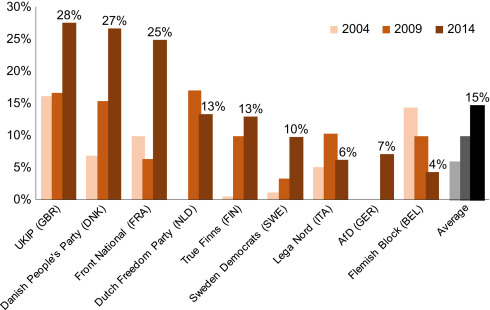
At the global level, the “n” is much greater than one, and we can rule out certain explanations for the trends. For instance, in other counties, an authoritarian leader hasn’t replaced a person of color or defeated a female opponent.

I cannot estimate the relative impact of the following factors, but they seem plausible to me across the whole range of cases:

Oligarchy: Many of the authoritarian leaders are billionaires or closely associated with billionaires. Their supporters are personally wealthy individuals rather than multinational public companies, which are more comfortable with predictable centrists like Hillary Clinton. A billionaire can know political leaders personally, can trade wealth for influence, and can profit from disruptions in the larger economy. Several of the key billionaires are media personalities. I think some of them develop authoritarian expectations by being the barons of large private enterprises, within which their word is law. Billionaires have almost tripled their share of global GDP since 1996, and their inflation-adjusted total assets have risen by 7.5% annually over those two decades. They represent a global force that was absent in 1996.

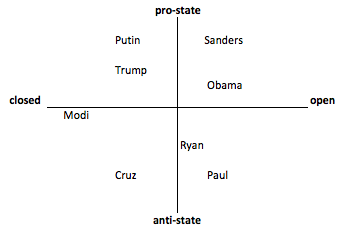
A gap in the ideological landscape: For this purpose, let’s categorize ideologies along two dimensions. They are either pro-state or anti-state/pro-market. And they either favor a narrowly defined ethnocultural group or they support diversity and globalism. I’ll call the latter spectrum closed versus open.

Since the 1950s, the dominant parties and movements in the wealthy democracies were all fairly open, at least in principle; the debate was about how much the state should intervene. We often thought of the US ideological spectrum as one-dimensional, from pro-state to pro-market, with everyone giving lip-service to openness. Some conservatives claimed to be pro-market and nationalist, but it’s not clear that that was a coherent position. The whole structure ignored the possibility of a pro-state, explicitly closed position. Like entrepreneurs who have discovered a market niche, authoritarian nationalists have filled the corner previously occupied by fascism. To be sure, Trump may govern like a market libertarian if he turns things over to Paul Ryan and contents himself with symbolic nationalism, but that’s not what he promised to do.
You would think that nationalist authoritarians wouldn’t cooperate much across international borders, because they are xenophobic. But there was a short-lived Fascist International in the 1930s, and we definitely see some coordination today.

Al Qaeda/ISIS: Before explaining why I think these terrorist organizations share causal responsibility for the global turn to authoritarianism, I want to stipulate that we are morally responsible for how we have responded to them. We did not have to invade Iraq, pass the Patriot Act, or turn Guantanamo into a prison. Those stupid and harmful acts are our responsibility as American citizens. Still, it seems both naive and misleading to omit the intentional acts of Al Qaeda and ISIS from our causal theory. They sought to provoke antidemocratic reactions, and they succeeded. An admired friend of mine recently summarized her qualitative research with Muslim teenagers in suburban New Jersey over the past decade, explaining that they have moved from a comfortable feeling of being Americans to a sense of vulnerability and alienation. This is an injustice that is up to remedy. But it struck me as a mistake not even to mention Al Qaeda as a major cause of the change. Osama bin Laden got what he wanted when he sent those planes into the Trade Towers. Although the US leadership of 2001 (including H. Clinton) proved monumentally stupid, Al Qaeda found a vulnerability that would have been hard to defend.

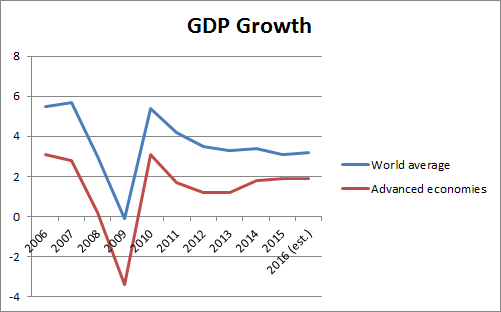
The 2007-8 financial crisis: Funke, Moritz & Schularick show pretty compellingly that voters shift to the far right after financial crises. This has been a pattern across many nations for at least a century. The 2007-8 collapse was an especially terrible one. It hit the advanced economies particularly hard, thus giving their voters a sense that they were losing comparative advantage as well as absolute wealth. It was followed by fiscal austerity that punished ordinary people, while no elites were held accountable for the trillions of dollars of waste and disruption. My sense is that Barack Obama got a pass from a majority of Americans because he wasn’t responsible at the time of the crisis, and he has been seen as laboring to repair the damage. But Hillary Clinton was part of the governing elite that was on duty when the fateful decisions were made.
Cultural backlash: Pippa Norris proposes that cultural liberalization (marriage equality, improving sexual equality, growing racial diversity, etc.). have produced a backlash rooted in the White working class of OECD countries. She clearly favors the trend of cultural liberalization and abhors the backlash, but a different take is Nancy Fraser‘s: people are rightly rejecting a form of “progressive neoliberalism” that unites “new social movements (feminism, anti-racism, multiculturalism, and LGBTQ rights)” with the cultural agendas of “high-end ‘symbolic’ and service-based business sectors (Wall Street, Silicon Valley, and Hollywood).” That is the coalition that delivers diversity in schools and workplaces along with “the weakening of unions, the decline of real wages, the increasing precarity of work, and the rise of the two–earner family in place of the defunct family wage.”

A hollowing out of democracy: People have died or placed themselves in terrible danger in the name of democracy and liberal values, whether on Omaha Beach or the Edmund Pettus Bridge. But an inspiring vision of democracy means more than the right to choose among professional politicians every few years. Even a call for equality isn’t inspiring enough, because how much should each of us care whether our share of power is as great as everyone else’s? Democracy must mean working together to create a better world.

Instead, the US rightwing has abandoned the sometimes inspiring pro-democratic rhetoric of Ronald Reagan to claim that we are not a democracy at all, but a republic. Similar rhetorical shifts away from democracy are evident in other countries as well. Meanwhile, the technocratic center presents democracy as a system of regular elections along with transparent information. Even defenders of the EU admit that it demonstrates a severe “democracy deficit.” Democratically governed associations, such as unions and congregationalist churches, are in decline. And several strands of the left are reflexively critical of any pro-democratic project that emerges in the US or elsewhere in the wealthy global North. People seem increasingly sophisticated about democracy’s drawbacks (misinformation, majority tyranny, cultural bias, etc.) and decreasingly inspired by its promise. That leaves the field open for explicitly illiberal and antidemocratic movements.

Reinventing Politics via Local Political Parties

It’s an open secret that political parties and “democratic” governments around the world have become entrenched insider clubs, dedicated to protecting powerful elites and neutralizing popular demands for system change.  How refreshing to learn about Ahora Madrid and other local political parties in Spain!  Could they be a new archetype for the reinvention of politics and government itself?

Instead of trying to use the hierarchical structures of parties and government in the usual ways to “represent” the people, the new local parties in Spain are trying to transform government itself and political norms. Inspired by Occupy-style movements working from the bottom up, local municipal parties want to make all governance more transparent, horizontal, and accessible to newcomers. They want to make politics less closed and proprietary, and more of an enactment of open source principles. It’s all about keeping it real.

To get a clearer grasp of this phenomena, Stacco Troncoso of the P2P Foundation recently interviewed two members of Ahora Madrid, a city-based party comprised of former 15M activists who forged a new electoral coalition that prevailed in Madrid in 2015. (The full interview can be found here.)  The coalition’s victory was important because it opened up a new narrative for populist political transformation. Instead of the reactionary, anti-democratic and hate-driven vision embodied by Brexit, Trump and the National Front, this one is populist, progressive and paradigm-shifting.

Below, I distill some of the key sights that surfaced in Troncoso’s interview with Victoria Anderica, head of the Madrid City Council’s Office of Transparency, and Miguel Arana, director of Citizen Participation. The dialogue suggests how a social movement can move into city government without giving up their core movement ideals and values.  Implementation remains difficult, of course, but Ahora Madrid has made some impressive progress.

First, a clarification:  To outsiders, the political insurgency in Spain is usually associated with the upstart Podemos party.  That is a significant development, of course, but Podemos is also much more traditional.  Its party structure and leadership are more consolidated than those of Ahora Madrid, which considers itself an “instrumental party.”  It qualified to run in the 2015 elections as a party, but it does not have the internal apparatus of normal parties.

read more

NCDD Launches D&D Training Partnership with Am. Library Association

As we begin the new year, NCDD is excited to announce we are launching a two-year partnership with the American Library Association (ALA) that will train library staff across the country to use methods and processes from the dialogue and deliberation field to support their communities. Our Libraries Transforming Communities: Models for Change partnership will take the form of both online and in-person trainings that we hope will help strengthen the capacity for libraries to serve not only as places of learning and research, but also as hubs for dialogue, engagement, and healing our divides.Libraries Transforming Communities: Models for Change

We see this partnership as a chance to broaden the reach and the impact of our field’s work, as well as an opportunity to create new audiences and collaborative potentials for D&D practitioners in the future. We’ll be sharing more info on the partnership soon, but for now, we encourage you to read more about the upcoming trainings in the ALA announcement below or to find the original here.


Facing a Divided Nation, ALA Offers Free Training for Libraries

The ALA Public Programs Office and the National Coalition for Dialogue & Deliberation (NCDD) invite library professionals to attend a free learning series to explore various dialogue facilitation approaches and position themselves to foster conversation and lead change in their communities.

“As our nation becomes increasingly divided, ALA sees tremendous opportunity for libraries to be a leading force for reconciliation, progress, and common ground,” said ALA President Julie Todaro. “We are proud to make community engagement resources available to all libraries, free of charge, through this initiative.”

Through Libraries Transforming Communities: Models for Change, a two-year project, ALA and NCDD will produce ten webinars and three in-person workshops. Change-making leaders, such as Everyday Democracy, National Issues Forum, and World Café, will develop and lead the trainings, which will be customized to meet the needs of various library types and sizes: large public library systems; small, medium-sized, and rural public libraries; and academic libraries.

First four sessions announced

Registration is currently open for four learning sessions.

Representatives of public libraries serving large or urban communities are invited to attend the following three-part series:

Each session will be recorded and archived for free on-demand viewing on the Programming Librarian Learning page.

Individuals who view all three webinars, live or recorded, will be invited to attend a free pre-conference workshop at the 2017 ALA Annual Conference in Chicago.

Future sessions for academic libraries and small, mid-sized, and rural public libraries

Future learning sessions will be designed for academic libraries (Fall 2017) and small, mid-sized and rural public libraries (Spring 2018). Details for future sessions will be announced in 2017. To stay informed about future offerings, sign up for the Programming Librarian e-newsletter.

Libraries Transforming Communities: Models for Change follows up on Libraries Transforming Communities (LTC), a two-year initiative offered in 2014-15 by ALA and the Harwood Institute for Public Innovation that explored and developed the Harwood Institute’s “Turning Outward” approach in public libraries.

With this second phase of LTC, ALA will broaden its focus on library-led community engagement by offering professional development training in community engagement and dialogue facilitation models created by change-making leaders such as Everyday Democracy and National Issues Forums.

LTC: Models for Change is made possible through a grant from the Institute for Museum and Library Services (IMLS) Laura Bush 21st Century Librarian Program.

You can find the original version of this announcement on the ALA’s Programming Librarian site at www.programminglibrarian.org/articles/facing-divided-nation-ala-offers-free-training-libraries.

NCDD Members to Lead Deliberative Democracy Consortium

We are so pleased to share that three of our great NCDD members – Wendy Willis (who is also an incoming NCDD Board member), Bruce Mallory, and Kyle Bozentko – have been named as the new leadership of the Deliberative Democracy Consortium starting in 2017. The DDC has been a key organization in the D&D field for years, and we are excited for these three heavyweights to revitalize it. You can read more about the change in DDC’s announcement below or on their Facebook page here (while their website revamp is in the works).


The Deliberative Democracy Consortium’s New Leadership

DDC logoDear Friends of the DDC:

We are pleased and proud to announce that DDC has new leadership! Starting January 1, Wendy Willis will become DDC’s Executive Director, while Bruce Mallory and Kyle Bozenkto will begin their terms as co-chairs of the Executive Committee.

Wendy succeeds long-time director Matt Leighninger, who will continue to serve on the Executive Committee and assist Wendy with the transition. Wendy will attend to immediate tasks such as restoring the DDC web presence, communicating with Committee members and institutional partners, and reaching out to potential sponsors interested in advancing our mission. Her appointment comes at a critical moment for deliberative, participatory democracy in the US and around the world. DDC is honored to have Wendy help us set our course in these rough seas.

Wendy Willis joins DDC from Kitchen Table Democracy, where she has served as Executive Director for the past five years. Wendy will also continue as Director of Oregon’s Kitchen Table in the National Policy Consensus Center at Portland State University. Prior to joining Kitchen Table Democracy and the National Policy Consensus Center, Wendy served as Executive Director of City Club of Portland, as a Federal Public Defender in the District of Oregon, and as a law clerk to Chief Justice Wallace P. Carson, Jr., of the Oregon Supreme Court. She is also a widely published poet and essayist. Her first book of poems, Blood Sisters of the Republic, was published in 2012, and she has had poems and essays published in Utne Reader, Poetry Northwest, New England Review, Oregon Humanities, ZYZZYVA, and numerous other places. Wendy holds a J.D. from Georgetown Law Center, an M.F.A. in poetry from the Rainier Writing Workshop at Pacific Lutheran University, and a B.A. from Willamette University.  Wendy is an incoming board member for the National Coalition for Dialogue and Deliberation and is the incoming chair of the board for Tavern Books.

Bruce Mallory is a professor of education at the University of New Hampshire. He was appointed Provost and Executive Vice President at the University of New Hampshire in July 2003 and served until July 2009. Previously, he served on the faculty and as Dean of the Graduate School at UNH. From 2011 to 2014, he was director of the Carsey Institute. He teaches in the areas of higher education, education and poverty, and social change.  He is co-founder of New Hampshire Listens and The Democracy Imperative, and serves on the Paul J. Aicher Foundation (Everyday Democracy) Board of Directors. Dr. Mallory received the Ph.D. in Special Education and Community Psychology from Peabody College of Vanderbilt University.

Kyle Bozentko is the Executive Director of the Jefferson Center in St. Paul, Minnesota. His work on citizen participation, democratic reform, and civic engagement has been published in GOVERNING Magazine, MinnPost, and InDaily (Adelaide, South Australia) and on the Independent Sector blog. He received his BA in Political Science and Religious Studies from Hamline University in Saint Paul and his Masters of Theological Studies from the Boston University School of Theology with an emphasis on sociology of religion and politics. He currently serves on the Board of Directors of International Association of Public Participation USA (IAP2 USA) and on the Advisory Board of Forum dos Cidadaos (Portugal).

Please join us in welcoming Wendy and Bruce and Kyle!

Leaders or Leaderfulness? Lessons from High-achieving Communities

The 21-page report, Leaders or Leaderfulness? Lessons from High-Achieving Communities (2016), was written by David Mathews and supported by the Cousins Research Group of the Kettering Foundation.

The report discusses how communities become stronger and more resilient through more “leaderfulness” of its community members, as opposed to having just a few of active leaders. What Mathews means by “leaderfulness”, is that people are engaged within a community and show leaderfulness by taking initiative to participate. Through years of research, Kettering has found that the serious problems that face a community require active participation from the people within it. There is a largely untapped civic energy in this country, this report shares information on how community members can be more leaderful and what that can look like.

Below is an excerpt of the report and it can be found in full at the bottom of this page or on Kettering Foundation’s site here.

From the guide…kf_leaders_cover

There is a widely held belief that change only occurs when a few courageous leaders step forward to take charge and overcome entrenched power. History is full of examples of great leaders who have been agents of change: Susan B. Anthony, Martin Luther King Jr., Abraham Lincoln, George Washington. You can complete the list. Could “just citizens” working with just citizens ever change anything?

Kettering began to think about this question as a result of a study of two communities that, although similar, were quite different in what they achieved.3 However, the more dysfunctional of the two actually had the best leaders, as leadership is traditionally understood. They were well educated, well connected, professionally successful, and civically responsible. Yet what stood out in the higher-achieving community was not so much the characteristics of the leaders as their number, their location and, most of all, the way they interacted with other citizens. The higher-achieving community had 10 times more people providing initiative than communities of comparable size. The community was “leaderful.” And its leaders functioned not as gatekeepers but as door openers, bent on widening participation.

Beginning Where We Live
Because we are facing an array of daunting domestic problems and a morass of international uncertainties, many Americans think we need to make basic changes in the way the country operates. We believe that the chances for change are best beginning at the local level, in communities where we can get our hands on problems. Change has to start there before it can take place nationwide. At the same time, we are deeply worried about what is happening to our sense of community, to our ability to live and work together. As Benjamin Barber put it, we worry that “beneath the corruptions associated with alcohol and drugs, complacency and indifference, discrimination and bigotry, and violence and fractiousness—is a sickness of community: its corruption, its rupturing, its fragmentation, its breakdown; finally, its vanishing and its absence.”

Calls for reform come from every quarter and touch every facet of American life—ranging from the way we organize our businesses to the way we raise our children. People say they want more than a few improvements; they want to change the “systems” that seem to control their lives—the criminal justice system, the welfare system, and, most of all, the political system. Some also want to change their community in fundamental ways—in the ways people work, or often don’t work, together.

When I say “community,” I don’t mean just a place or a collection of individuals; I mean a group of diverse people joined in a variety of ways to improve their common well being. And by change, I mean the process by which people redirect their talents and energies or reorder their relationships so as to realize their vision of the best community. So community change means a change in a community itself, and only a community can do that. For me to change myself—my weight or habits or ways of relating to others—I have to do something. The change has to come from within. So when a community wants to change itself—to be more of what it would like to be—the same principle holds. For there to be fundamental change, the citizens in a community have to act. Large groups of people can’t sit on the sidelines.

How Communities Can Become Leaderful
Leaderful communities are necessary because change is a journey of the many steps it takes to move a community from one place to another. Anyone who takes any one of those steps has provided leadership. This kind of leadership isn’t the prerogative of a few; it’s the responsibility of the many. When citizens talk about the quality of leadership in their community, they are talking about themselves! If we are talking about change by and not simply in a community, then leadership consists of all the activities needed to bring about change. And there are many of them. Think about all of the things that have to be done to change something relatively simple— like remodeling an old house. Someone has to file a building permit, someone has to design the remodeled structure, someone has to tear out the old walls, someone has to order new materials, someone has to do the carpentry, someone has to add electricity and water, someone has to repaint—and so on. The interaction of the workers is as crucial as what each one of them does individually. The walls have to be in place before the painters can do their job. Remodeling is a dynamic process of interaction. The same is true in communities. They aren’t static but rather dynamic, and their patterns of interaction are critical. For a community to change, even more people have to be involved in even more tasks than in remodeling a house.

What I have just described is a functional concept of leadership, which is quite different from the theory of leadership that is built around what one person—the leader—does. From the perspective I am talking about, leadership is provided by anyone who carries out any of the tasks in the work of change. This kind of leadership passes to different people at different times. There are many leaders.

This leaderfulness can develop around the ways a community goes about doing its routine business; that is, around the various tasks that make up the work of a community, these are the equivalents of the tasks for remodeling a house. Here are some of them…

This is an excerpt of the report, download the full guide at the bottom of this page to learn more.

About Kettering Foundation
KF_LogoThe Kettering Foundation is a nonprofit operating foundation rooted in the American tradition of cooperative research. Kettering’s primary research question is, what does it take to make democracy work as it should? Kettering’s research is distinctive because it is conducted from the perspective of citizens and focuses on what people can do collectively to address problems affecting their lives, their communities, and their nation.

Follow on Twitter: @KetteringFdn

Resource Link: www.kettering.org/catalog/product/leaders-or-leaderfulness

Join Conversation Café Host Training Call, Jan. 3rd

Last week, NCDD hosted another one of our Confab Call events featuring the co-founders of Conversation Café (CC), Susan Partnow and Vicki Robin. The call featured a history of the CC process, reflections from the experiences of CC hosts, and a brief tour of the new CC website at www.conversationcafe.org.

If you missed this engaging discussion, don’t worry. You can still listen in on what the Conf Call was like by finding the recording at this link.

There is also a great next step that came out of this call that we want to make sure our members hear about. We had so much interest from folks wanting to learn to use the CC process that co-founder Susan Partnow offered to host a free Conversation Café Host Training to start the new year!

So NCDD and Susan will be hosting 90-minute CC training webinar on Tuesday, January 3rd at 12pm Eastern/9am Pacific with much appreciation to Susan for making this training available before she takes her sabbatical. We encourage everyone who would like to host Conversation Cafés or just wants to learn more about the process to register today take advantage of this opportunity to learn how to host Conversation Cafés!

reg-button-2

This upcoming training call will be the perfect opportunity to get personalized support in hosting Conversation Cafés. Whether you’re considering using the process for the first time or want to brush up on it before hosting a new conversation, we encourage all of our NCDD members with an interest in the CC process to register now to participate in this CC host training!

The CC process is an accessible tool for hosting needed conversations on difficult issues in our communities, and we are excited to see more people getting trained to use it. We look forward to having many of you join us on January 3rd for the event!

Reasons for the Season

Hanukology:

It was basically an argument between two points of view that mixed abstractions and interests (as always), but (also as always) with variations and fluctuations, mind-changes and occasional betrayals. To simplify somewhat, one side, those who later (in Hasmonean times, see below) became known as Saducees, were religious conservatives but pro-Hellenist cultural liberals; the proto-Pharisees were religious innovators but anti-Hellenist cultural conservatives. Before the events that Hanukah is all about happened, the tendency that later became identified as Pharisaic held the High Priesthood and the upper hand in the debate; but a revolt displaced them before they regained control. Amid that revolt, and largely because of it, Hanukah happened.

Why Christmas Matters:

While Jesus is growing inside Mary, she becomes suddenly inspired and belts out a remarkable song — a radical declaration of protest against the wealthy. She sings, “God has brought down the powerful from their thrones, and lifted up the lowly;” and “God has filled the hungry with good things, and sent the rich away empty.”

The Moral World of Dreidel:

You can, if you want, always push things to your advantage: Always contribute the smallest coins you can, always withdraw the biggest coins you can, insist on using what seems to be the “best” dreidel, always argue for rule-interpretations in your favor, eat your big coins and use that as a further excuse to only contribute little ones, etc. You could do all this without ever once breaking the rules, and you’d probably end up with the most chocolate as a result.

But here’s the brilliant part: The chocolate isn’t very good. […]

Dreidel is a practical lesson in discovering the value of fairness both to oneself and others, in a context where proper interpretation of the rules is unclear, and where there are norm violations that aren’t rule violations, and where both norms and rules are negotiable, varying from occasion to occasion — just like life itself, but with only mediocre chocolate at stake.

Fooey to the World: Festivus is Come:

Festivus, with classic rituals like familial gatherings, totemic-but-mysterious objects and respect for ancestors, slouched forth from this milieu. “In the background was Durkheim’s ‘Elementary Forms of Religious Life,’ ” Mr. O’Keefe recalled, “saying that religion is the unconscious projection of the group. And then the American philosopher Josiah Royce: religion is the worship of the beloved community.”

The hygge conspiracy:

To Danes, nothing could be less political than hygge – since talking about controversial subjects is by definition not hygge – and yet it is clear that the concept lends itself to political use. Davidsen-Nielsen and Jensen told me that the prime minister, Lars Løkke Rasmussen, was hyggelig – the kind of guy you could imagine having a beer with. “He’s folksy and informal. He’s one of the guys. And he gets away with murder – almost,” said Davidsen-Nielsen. “Hygge is a useful strategy for disguising power. Politically, you can cloak quite aggressive or radical acts with an impression of hygge. Hygge says, let’s forget about everything. Let’s block out the world and have some candy.”

Open Data Initiative (Alameda County, USA)

Author: 
Problems and Purpose In recent years, governments have sought to harness the power of ‘big data’ to improve performance and increase transparency. This has frequently been accomplished through ‘open data’ projects in which leaders make available a range of data sets generated and used by public agencies. With the launch...