May 3-4 Conference: Creating Civic Competence: the Critical Challenges

The New Civics Early Career Scholars’ Program & The Civic and Moral Education Initiative in partnership with The Edmond J. Safra Center for Ethics invite you to a conference on Creating Civic Competence: the Critical Challenges. May 3-4 Larsen Hall Harvard Graduate School of Education

Preparing youth to meet growing civic challenges, worldwide, creates new questions for effective civic education. The New Civics Early Career Scholars Program, supported by the Spencer Foundation, trains doctoral students in civic education. This Conference draws on their innovative work with commentaries from distinguished senior scholars in the field.

3:30 PM        KEYNOTE ADDRESS AND CONVERSATION
Larsen Hall Room G08Helen Haste

“Identity, Agency and the Power of Story: Meeting the Civic Challenges?”Helen HasteVisiting Professor of Education, Harvard Graduate School of Education, and Professor Emerita of Psychology, University of Bath

with

Danielle Allen

Danielle Allen
James Bryant Conant University Professor, and Director of the Edmond J. Safra Center for Ethics, Harvard University

Howard Gardner
Howard Gardner
Hobbs Professor of Cognition and Education, Harvard Graduate School of Education
Peter Levine
Peter Levine
Lincoln Filene Professor of Citizenship & Public Affairs, Tisch College, Tufts University
Judith Purta

Judith Torney-Purta
Professor of Human Development, University of Maryland

The Conference also features commentaries from Michelle Bellino, Sarah Dryden-Peterson and Julie Reuben.
Some questions the Conference will address:

  • How do young people become motivated and gain civic identity?
  • How does early experience develop the skills for later civic and moral responsibility?
  • How do digital media reshape civic participation?
  • How can we use art to enlarge and innovate civic education?
  • How involved should higher education be in fixing civic problems?
  • How do cultural narratives and institutional structures, in the US and internationally, frame civic identity, competence and global moral responsibility?
  • How should we sensitively define and measure civic education outcomes in different cultural and social contexts?
  • What can we learn from critical and participatory pedagogy among marginalized, dispossessed and conflict-ridden populations??

Registration:  https://www.eventbrite.com/e/conference-creating-civic-competence-the-critical-challenges-tickets-44990792672

Conference Website:
https://projects.iq.harvard.edu/harvardconference

Conference Program:
https://projects.iq.harvard.edu/harvardconference/program

NCDD Teams Up for Bridging the Divides Workshop in CO

Several weeks back, I was invited by Colorado Common Cause to give a workshop at their monthly membership meeting in Denver, Colorado, on Bridging the Divide: or How to Have a “Productive” Political Conversation. This was an exciting opportunity to connect with this fantastic organization and share some of the best practices from the NCDD network on how to navigate emotionally-heated conversations.

Huge thank you to all the participants who attended the event and made it an engaging experience! Another big thank you to Caroline Fry from Colorado Common Cause for inviting NCDD to come speak with their members and share some of the tools and wisdom from our network to help better bridge divides.

Caroline kicked off the meeting with a brief intro to Colorado Common Cause –  an org that has been working for over four decades to improve democratic processes by reducing barriers to voting, working to ensure that elections are run fairly, reducing the influence of money in politics, and that our government is being held accountable through more transparent practices.

During the workshop, I shared the transformative work being done in the NCDD network to enable people to connect more authentically with each other, build deeper relationships, and engage in challenging conversations- specifically around heated political issues. I spoke on the importance of humanizing each other and finding common ground by connecting to our shared values; and how this work is possible in even the most painful conflicts (though it is by no means easy). I lifted up examples from our NCDD members of tools that help facilitate having challenging conversations and shared some deliberative processes that hold space for these conversations while contributing toward policy-making.

Finally, I shared a couple of upcoming events with participants, that I encourage you to join in!

  • National Week of Conversation is going on right now until this Saturday, April 28th – join this national movement to improve listening, deepen our connections through conversation, and better heal the divisiveness in our society. Join an event already planned on the National Week of Conversation site here or create your own, maybe using the resources provided on NWOC or right here on the NCDD Resource Center.
  • Our upcoming National Conference on Dialogue & Deliberation is being held this November 2-4 in Downtown Denver. Our conferences are an exciting mingling of enthusiasts and practitioners in dialogue, deliberation, and engagement work and we encourage you to learn more here.
    • “Super Early Bird” tickets are now available for a limited time, so make sure you act fast to utilize this great low rate by clicking here.
    • The theme for this year’s conference is “Connecting and Strengthening Civic Innovators”, and our intention is to focus on how we can further uplift dialogue, deliberation, and engagement work; learn more details on the theme here.
    • For folks interested in presenting a session at NCDD2018, the call for proposals is currently open for concurrent sessions – learn more here.

You can watch the full live stream of the workshop in the video below. I’ve also included a link to the resource doc I shared which has the exercises we did, as well as, the resources I referenced – which you can find here.

If you like what you see – NCDD staff would love to come hold a workshop with your group, organization, or event!  We are happy to tailor the workshop to your needs for navigating challenging conversations. I am located in Denver, Managing Director Courtney Breese is in the San Francisco Bay Area, and Co-Founder Sandy Heierbacher is in Boston; all of us can travel to our respective surrounding areas to hold workshops. For folks that are located outside of these places, contact us and let’s see if we can coordinate logistics with travel or technology to make a workshop happen for you! Please contact me at keiva[at]ncdd[dot]org for workshop inquiries. 

About Colorado Common Cause
Colorado Common Cause is a non-profit organization fighting for open, honest and accountable government. We work to strengthen public participation and to ensure that government and the political process serve the public interest, rather than the special interests.

We believe the serious issues that confront our society – problems like lack of affordable health care and quality education, poverty, discrimination, and global warming – will only be solved when government is responsive to the needs and the voices of its citizens, and not to the pressures of special interests. Partnering with groups representing diverse constituencies, we campaign to break down barriers to voting, ensure every vote is counted as cast, reduce the impact of special interest money in the political process, and promote open government and high ethical standards.

Follow on Twitter at @CommonCauseCO
Connect on Facebook at www.facebook.com/ColoradoCommonCause

Ben Franklin Circles and Understanding Common Ground

One of the more challenging realities when trying to find common ground is that often times the core understanding of words can be dramatically different than from someone “across the aisle”. As NCDD board member, Jacob Hess discusses in this relevant piece with NCDD member org, Ben Franklin Circles, while we live in a period of rampant hyperpartisanship – how can we work together to find common ground when folks can have fundamentally different definitions? How do we take this phenomenon into account when building relationships and working towards bridging these divides? We encourage you to read the post below and carry this with you as you also check out the National Week of Conversation, happening until April 28th, that works to do just this through connecting conversations. You can find the original post on BFC’s site here.


Rediscovering Common Ground We (Mostly) Share

In our polarized American landscape, we often hear that if we “just came together” around values we share, we could find a lot of common ground.

I believe that, but only partially. The reason is I’ve spent years talking with people across the political spectrum about some of these core values.

And for anyone who does that – and there are many wonderful civic, community and dialogue leaders who have done similar things – something obvious emerges. While we might, in fact, hold common agreements on the importance of certain key principles, values and virtues, we sure don’t agree on what those mean, how to define (or redefine) them in the modern age and what, if any, application and relevance they hold for the many complex issues facing society today. For example, what does “justice” mean today or “compassion” or “religious freedom”? (hint: not the same thing across the political spectrum).

This isn’t bad news. It’s just the way things are. Even the very words we use come to mean fundamentally different things. I was involved in a project in 2016 mapping these different meanings in collaboration with dialogue professionals across some of the more salient socio-political differences. The goal was to create some kind of a term guide that might help translate and clarify between these understandings (and perhaps encourage more humanizing in real life). Included in that Red Blue Dictionary (now hosted as the All Sides Dictionary) are the contested meanings for basic words like “American,” “facts” and “politically correct” and “progressive,” and other terms with uniquely triggering meanings (for some), such as “white privilege” and “politically correct.” Still other emotional terms have been variously defined in very broad or limited ways, depending on the context, including “extremist,” “radical,” “irrational,” “hate,” “bigot,” “racist,” and “anti-gay.”

In each case, we document and explore fundamentally different ways of conceiving these principles, terms and definitions – and in some cases, these values. Depending on that meaning, the words can be experienced and function in profoundly different ways. For instance, when defined broadly, the word “extremist” or “radical” can be used to shut down those we disagree with, and can be experienced as very silencing. And words like “fact” and “truth” may be experienced so differently that people are hardly speaking about the same thing. Once again, this is not bad news at all – as long as we’re aware it is happening (in which case, we can respond in some kind of a productive way).

Unfortunately in most cases, for most Americans, this is simply not happening. They are almost entirely unaware that some of the basic words they use might actually mean something remarkably different to their left-leaning neighbor or to their right-leaning uncle.

In the absence of that recognition, a couple of things happen: first, we have a very difficult time communicating. Imagine two people coming together speaking two languages, but not even aware they are speaking two languages. This is kind of what’s happening now according to many observers in America. “Let’s all fight for social justice!” says one progressive college student – hardly aware that this very word, “social justice” can feel like an existential threat to many conservatives. “As long as can uphold what is Biblical we’ll be okay as a society” says another religious conservative – with little awareness at how much of an existential threat this word now represents to those who identify as LGBT+.

You can guess what happens next: we get frustrated. Instead of realizing that this person sees the same fundamental principles in a different way, we lash out them, treating them somehow as if they are somehow inferior or motivated by selfishness or evil, because they actively oppose things that, to our mind and our community, seem eminently and urgently needed, good and right (and righteous).

You see, as long as we are not understanding how fundamentally we are seeing things differently, we are left to scramble for another explanation. And that explanation is served up by the professional polarizers that have become de facto leaders for so many communities in our country – across the political spectrum.

There are real fears on both sides of the spectrum that the other side is destroying the true fabric of the country and betraying its core values. And in vocalizing these fears, Americans tend to draw on heavy rhetoric that draws promiscuous boundary lines that contribute to an especially frightening picture – aka, all conservatives lumped together with white nationalists and all liberals lumped together with revolutionary Marxists, etc. And so it goes and goes and goes – and expands and metastasizes until we are so much at each other’s throats that more than one political commentator has openly wondered about the possibility of growing political-inspired violence on the horizon.

Getting people to come together across the divide won’t be easy. There’s no app for that. But there are ways forward, albeit not simplistic ones. For instance, we can begin by sitting with someone who doesn’t see the world as we do and actually hearing them out with sincere questions and honest curiosity. Let’s be honest. That’s hard work. Especially now. Especially with our minds so cluttered by the residue of professional provocateurs so much so that their aggressive angst sit on the tip of our own tongue.

But here’s the good news: for those willing to actually go there, to actually try this, to actually sit with their discomfort and listen – really listen, not the fake kind, not the ‘let-me-watch-for-whatever-opening-I-need-to-expose-the-ridiculous-delusion-of-this-other-person’ kind – for those willing to do that, things can change. And things do change…dramatically.

Trust me. I’ve lived this for over a decade. As a conservative Mormon, some of my best friends and most cherished relationships include atheist professors, lesbian activists and even some crazy, adorable Marxists. My own fear and anger to my many political opposites has lightened, and given way to curiosity and affection. From experience, I know that fear can evaporate. The animosity can diminish. And affection can grow. And all of a sudden, you’re falling in love in small, but real ways, with your political opponents.

Earlier this year, I saw these principles in action in a group I joined called a Ben Franklin Circle. There were 6 across the political spectrum who came together to discuss one of Franklin’s 13 virtues to live by. For example, we spent one meeting talking about the virtue of sincerity, what it meant and how (and whether) it applied to society today. Then we looked at ways to apply it and maybe experiment with it more in our own lives. It was so sweet that I still remember how refreshing it felt.

Say what you want about the founding fathers. Disagree with many of the positions that they and most Americans at the time happened to hold. But one thing we might all agree upon is that they understood the value of virtues like, honesty, integrity, like moderation—virtues that seem in short supply today.

What if we made space – even just a little, even just once in awhile – for these virtues by coming together to direct our attention, on purpose, to one of these ideals? We would talk together about what they mean and whether they are applicable to us today—and if so, what they call on us to try in our lives – and what they could mean for our country.

Once again, we won’t agree on those answers, but that’s not the point. It’s really never been the point. Because as soon as we have a conversation. Things change, for all of us. And that might be just what America needs right now.

You can find the original version of this post on Ben Franklin Circle’s at https://benfranklincircles.org/ben-franklin-circle-hosts/rediscovering-common-ground-we-mostly-share.

the I and the we: civic insights from Christian theology

Let’s assume that individuals have ethical responsibilities: each of us must strive to do what is right. However, our knowledge, self-discipline, and capacity to influence the world are all severely limited. Therefore, we are obliged to participate in groups that aggregate information, motivate their members, hold them accountable, and obtain collective power. Within groups, our individual responsibility shifts into an obligation to exercise either voice or exit. “Loyalty” means a commitment to the group; but it shades into “complicity” when the group does wrong.

This is a purely secular thesis, but it can draw on religious debates about similar issues. I’ll focus here on Christian views, mainly because I know them better than I know other traditions.

There are startling differences among Christian communities–from storefront charismatic churches and Quaker meeting houses to Orthodox monasteries and the global Catholic Church. However, it is a virtually unanimous Christian view that the soul is individual; it stands before God for separate judgment. Christians reject theories of a shared or universal soul. Thus all Christian theologians believe that it matters what each human person thinks and does.

At the same time, it is essential to Christianity that human beings are cognitively and motivationally limited–“fallen.” Thus all Christians see the benefits of being religious in groups that guide their members and speak and act collectively. Although the papal curia looks very different from a Jehovah’s Witness Kingdom Hall, both are groupings of morally responsible individuals.

Only a caricature of Catholicism portrays it as a papal dictatorship. The papacy has been stronger since Pius IX (1846–1878) than it ever was before, but even in this era of relative centralization, the teachings and actions of the Church result from the whole community; and all Catholics are obliged to exercise voice within the Church. But Catholics have a strong obligation of loyalty and not much of a moral right of exit. That is because mainstream Catholic thought emphasizes the special standing of the Church. It was instituted by Jesus when he called the apostles and gave the keys of the kingdom to Peter.

No one believes that the visible Church is pervasively infallible; it is a human institution. But Catholics hold that our mortal limitations make organization indispensable, and God has selected one organization to mediate for all individuals. (“Catholic” means universal.) Wrecked on a desert island, you should do your best, and God will understand. But if you can, you must participate in the global Church in order to be right with God. If, in your opinion, the Church errs, then your responsibility is to improve it by exercising voice.

Martin Luther broke from the Catholic Church because of his premise that conscience is logically inalienable. It’s not only wrong to try to delegate or share one’s moral responsibility; that is a contradiction. Responsibility always remains fully yours, by definition. In 1520, Luther wrote, “In fact, we are all consecrated priests through Baptism, as St. Peter in 1 Peter 2[:9] says, ‘You are a royal priesthood and a priestly kingdom,’ and Revelation [5:10], ‘Through your blood you have made us into priests and kings.'”

Why then do Lutherans have churches at all? (They even employ people in special garb who, at least in countries like Sweden and Finland, are called “Lutheran priests.”) Lutherans share with Catholics the assumption that the individual human being is too frail to believe or do right, and a group is necessary. They also agree that receiving spiritual help from other people does not negate personal moral responsibility. Their disagreement with Catholics is that they maintain a right of exit in cases of conflict between individual conscience and any particular group. That means that they are pluralists about groups, while Catholics are unitary.

Two other issues that are relevant to secular or “civic” groups are also emphasized in some Christian denominations. One is deliberation: the expression of personal views as part of a group’s search for shared truth. Making deliberation a transcendent value distinguishes Quakers from other Protestants, but it is present in all denominations to various degrees. Erasmus, for example, tried to make the consensus of believers a definitive feature of Catholicism.

The other issue is tradition: loyalty to the values and beliefs that have emerged over time, rather than those that are authored by any nameable human beings. Orthodoxy is particularly deferential to tradition. Whenever possible, the Orthodox prefer to acknowledge practices that have emerged, rather than make discretionary decisions. That practice is consistent with a very strong belief in individual cognitive limitations, combined with some faith in the ability of people to learn from accumulated experience.

All of these ideals–tradition, deliberation, plurality, unity, exit, voice, loyalty, conscience–are also available to secular groups; and often the best arguments for each principle have been developed by theologians.

See also: a typology of denominationssystem, organism, person, organization, institution: some definitionsfrom I to we: an outline of a theoryThe truth in Hayek; and what defines an organization? the case of the global sanghaSt. Margaret of Cortona and medieval populism

NIFI During NWOC and A Public Voice 2018 on May 9th

This week, people are hosting and participating in conversations around the country as part of the National Week of Conversation (and going on until this Saturday, April 28th). NWOC is an opportunity for folks to come together through conversation and build relationships, in order to continue healing the divisive state of our society. The National Issues Forums Institute (NIFI) and the Kettering Foundation – both NCDD member organizations – have created an issue guide to facilitate public deliberation around immigration; which is both a resource for NWOC and to be featured in their upcoming A Public Voice 2018 event (#APV2018) happening May 9th.

A Public Voice is an annual event, created to engage people around an important issue through deliberative forums, then bring together Washington DC policymakers and deliberative democracy practitioners to discuss results of the public’s feedback on that issue. You can learn about the several NIFI events happening this week during NWOC, both in person and online (search “Common Ground for Action”), using this issue guide or their previous guides. We encourage you to read the announcement in the post below and find more information on the APV2018’s site here.


A Public Voice – 2018

For more than 30 years, the Kettering Foundation, in collaboration with the National Issues Forums Institute, has organized A Public Voice, which brings together policymakers and practitioners of deliberative democracy from around the country to discuss insights from citizen deliberations.

A Public Voice 2018 focuses on an issue important to all Americans: immigration. After extensive research and testing with citizens around the country, the Kettering Foundation prepared an issue guide for the National Issues Forums (NIF): Coming to America: Who Should We Welcome, What Should We Do? Citizen deliberations using the issue guide are taking place throughout 2018 in public forums around the country. In these public forums, citizens consider the options for dealing with a problem, share their views, and weigh the costs and benefits of possible actions. Forums are held both online and face-to-face, typically last 90 minutes, and attract participants of all ages from all walks of life.

Scheduled for May 9, 2018, this year’s A Public Voice will present early insights from NIF immigration forums around the country, giving policymakers the chance to learn more about citizen deliberation and its role in our democracy. The session will also include an exchange among policymakers and deliberative democracy practitioners about issues the NIF network might tackle in the future. In early 2019, the Kettering Foundation and National Issues Forums Institute will publish a final report on the 2018 NIF immigration forums, followed by briefings for individual elected officials, Capitol Hill staffers, and other policymakers.

You can find the original version of this on the site for A Public Voice 2018 at www.apublicvoice.org

The Enduring Appeal of Perversity Arguments and Unintended Consequences Warnings

James Forman, Jr. won the Pulitzer Prize last week for his book Locking Up Our OwnIt is well-deserved. That book–and his earlier work wrangling with Michelle Alexander’s The New Jim Crow–shows the ways that we have arrived at the wicked problem of mass incarceration through something much harder to disdain than evil scheming by distant elites. We did it to ourselves, and African-American political leaders did it with the full support of their African-American constituents.

Forman’s argument is sometimes conflated with that of Naomi Murakawa, who argued that it was liberals, not conservatives, who created mass incarceration by emphasizing the importance of safety over all other civil rights goals. According to Murakawa, when Lyndon Johnson championed the the 1968 Safe Streets Act which swelled the flow of federal dollars–and federally procured military equipment–into local law enforcement, it wasn’t just a capitulation to conservatives, but:

“part of a long-term liberal agenda, one that reflected a belief that federally subsidized police recruitment and training could become racially fair.” (73)

That is, according to Murakawa, Democrats didn’t adopt law-and-order rhetoric to respond to the policy entrepreneurship from Republicans that threatened to swamp them–they explicitly preferred more coercive and punitive state institutions so long as the men and women wielding the riot gear were racially diverse. By the mid-nineties, Bill Clinton wasn’t passing the 1994 Crime Bill because he got dragged there by Republicans, the Democrats lead the way–in fact the Senate version was sponsored by none other than Joe Biden. Murakawa’s conclusion is damning:

In the end, the Big House may serve racial conservativism, but it was built on the rock of racial liberalism. Liberal law-and-order promised to deliver freedom from racial violence by way of the civil rights carceral state, with professionalized police and prison guards less likely to provoke Watts and Attica. Despite all their differences, Truman’s first essential right of 1947, Johnson’s police professionalization, Kennedy’s sentencing reform, and even Biden’s death penalty proposals landed on a shared metric: criminal justice was racially fair to the extent that it ushered each individual through an ordered, rights-laden machine. Routinized administration of race-neutral laws would mean that racial disparate outcomes would be seen, if at all, as individually particularized and therefore not racially motivated.” (151)

James Forman’s book is quite different. Where Murakawa places most of the blame squarely on white Democrats, Forman places his lens on Black politicians in DC, and finds a very different dynamic. From the start, the story of the rise of racialized mass incarceration is a tragic story of reasonable and well-intentioned Black leaders fighting white supremacy and Black disadvantage with reason and evidence. They made deliberate choices that were well-justified and supported by their constituents. And incrementally, they made things worse.

DC’s leaders saw drugs like heroin as a scourge and heroin dealers as race traitors. They saw violent crime rising, and guns playing a major role. And they wanted Black police–because those were good jobs and because Black police officers wouldn’t be tempted to engage in racist practices. So they punished drug dealers and ultimately drug users. They punished violent crime and gun possession. And they did it with a Black-led and majority-Black police force. But still they ended up creating a majority Black prison population in our (I live in DC too) Black-led and Black-staffed prisons and jails.

Forman does the hardest thing in criminology and law: he adopts the stereoscopic vision that can see both from the perspective of those who fear crime and those who bear the costs of policing and prisons.* Black District residents know what it’s like to fear that their family and neighbors will fall into drug addiction or be the victims of gun crime. They also know what it’s like to fear that their family and neighbors will be terrorized by the police or have their lives derailed by imprisonment. And Forman is able to square those stories: see the victim’s fear and rage with one eye and the perpetrator’s circumstances and his community’s losses with the other. Alone, either perspective gives a flat, two-dimensional image, but together you get depth: three-dimensions of a wicked problem where values are always at stake but a way forward is possible.

The difference between Forman and Murakawa is that where Forman wants to tell a careful story about wicked problems and their double-binds, Murakawa seems to want to show up liberals (including Black liberal elites) as self-undermining and doomed to failure. This is Afropessimism at its best and worst: any efforts at racial equity are perverse and doomed to failure. I find such arguments deeply challenging when they come from non-white authors, which is why it’s important to me to think seriously about what a perversity argument is doing.

A perversity argument is any argument that claims that when we try to do a thing we believe is important, we will fail and make it worse, falling further behind as we try to move ahead. The actual use of perversity and unintended consequences arguments are often justified by some of the available evidence, as well as some of the speculative hypotheses: try to make someone love you and they will feel manipulated; create a minimum wage to help the poor and you’ll increase unemployment; try to reform the criminal justice system and you’ll just make it stronger and more pervasive; tell someone they’re wrong and they’ll sink even deeper into their error; try to engage in affirmative action to reverse racial discrimination and you’ll entrench stereotypes of inferiority.

Margo Schlanger’s 2015 review of Murakawa’s The First Civil Right has stuck with me for a while in part because I still occasionally hear people pushing the Murakawa line that Democrats and liberals are primarily responsible for mass incarceration, and thus can’t be trusted to reverse it. Schlanger has a great reading of Albert Hirschman’s work on reactionaries, radicals, and academics and our enduring love of perversity arguments:

Indeed, perversity arguments are appealing not only to reactionaries and the left-of-liberal left but to academics, irregardless of ideology. As Hirschman says, a perversity argument “is, at first blush, a daring intellectual maneuver. The structure of the argument is admirably simple, whereas the claim being made is rather extreme.” Perversity arguments are counter-intuitive, attention-grabbing. These are attractive characteristics for someone trying to stand out in a crowd of monographs. And sure enough, the attack on liberalism as perversely harming the disempowered has become quite fashionable in criminal justice in particular. Bill Stuntz is its most well-known (and least radical) author, but structurally similar claims have sprouted up all over, usually from the far left. These are arguments that prison conditions litigation causes an increase in incarceration, Miranda rights cause increased arrests, and so on. The claims are empirical—A caused B—but the arguments are usually a combination of ideological and hypothetical.

Perversity arguments feel smart and daring. They make you feel like you’ve seen a secret truth. But they also work to disempower and disengage. They paralyze us with fear, uncertainty, and doubt. Every step in the minefield of unintended consequences and backlashes is probably doomed, so the only safe thing to do is stand still. From the perspective of perversity helping hurts, loving hates, attacking strengthens, and truth-seekers lie. Nothing is what it seems, and everything must be viewed through a hermeneutics of suspicion that ends with a kind of paralysis or status quo preference.

But at the same time… sometimes everything is not what it seems. Sometimes our well-intentioned efforts do make things worse. If Forman is right, DC’s leaders were facing real crime problems in need of real solutions, and they built a tidy mass incarcerated city without ever seeking to do so. And his chapters on DC’s responses to gun violence, especially, strike me as importantly relevant to current discussions of gun control in the wake of the Parkland shootings.


*Another book that manages the “stereoscopic view” well is Danielle Allen’s Cuz.

the politics of student debt

When Democratic political candidates are asked about “youth,” often the first issue that comes to their minds is college affordability. For example, when Hillary Clinton was asked during a Democratic primary debate about how she would reach Millennials, her whole answer was about student debt.

I agree that student debt is a problem, but it’s not nearly as widespread as politicians assume. Nearly half of the debt is held by families in the top quartile, and for less advantaged younger Americans, student debt is only one of many challenges. Therefore, a much broader policy agenda is needed to engage the younger generation as a whole.

According to Harvard’s Institute of Politics, 42% of Millennials say that they or anyone else in their household holds student debt. Pew reports that 37% of 18-29s hold student debt in their own names. That is a lot of people, but not a majority.

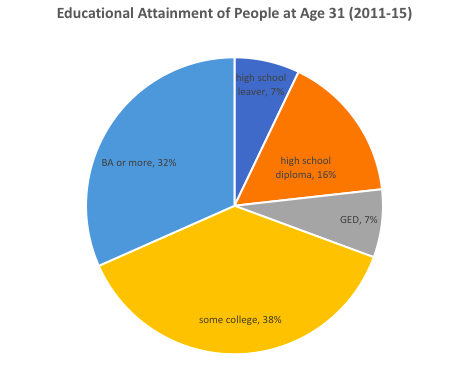
Forty percent of Millennials do not take any college courses at all (whether in community colleges or four-year institutions). They don’t have college debt, and their immediate economic problems may be quite different: the minimum wage, daycare, job training, GED options.

Another 38 percent enroll in college but don’t attain a BA. They have mixed experiences. Some of them incur debt but don’t hold degrees. However, according to Sandy Baum and Martha Johnson, 60% of graduates of public community colleges hold no student debt. They have Associates Degrees and are debt-free. Most of the people who borrow to obtain a 2-year degree attend for-profit institutions, and that’s a problem unto itself.

[Graph corrected on April 21]

The proportions of all adults who report holding student debt is pretty steady across all income levels. (Source: Caroline Ratcliffe and Signe-Mary McKernan for the Urban Institute.)

But the loans get bigger as you go up the income ladder. Ratcliffe and McKernan report that people in the top quartile are least worried about their ability to repay their debt, yet they hold almost half of the dollars owed.

Similarly, Pew reports, “About two-thirds of young college graduates with student loans (65%) live in families earning at least $50,000, compared with 40% of those without a bachelor’s degree.”

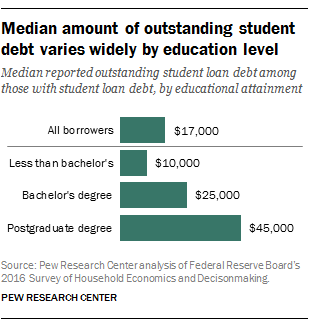
It should not be surprising that the more education you attain, the higher your debt. This also means that the people with the most debt are young adults in white-collar professions. They may be struggling, and I am fully sympathetic to them, but they represent the upper socio-economic stratum.
Median amount of outstanding student debt varies widely by education level

It would therefore be difficult to spend public money reducing debt without channeling most of the resources to upper-income young adults.

More youth regard debt as a problem than personally hold debt. Fifty-seven percent tell Pew that “student debt is a major problem for young people in the United States.” One reason may be that the prospect of debt deters people from pursuing college at all (or keeps them from pursuing more costly four-year and postgraduate degrees). In that case, college affordability and debt would be challenges for more than the 35%-40% of Millennials who actually hold debt.

But it’s a big assumption that the main reason people don’t pursue college degrees is the cost of tuition. About 41% of 31-year olds have no more than a high school diploma. The next step up the SES ladder for them would be an Associates Degree, and 60% of people who graduate from public community colleges have no debt. There may be many reasons 41% of young adults can’t get Associates Degrees–and they may not even want one–but tuition is not likely the main obstacle.

I’d be the last person to criticize reforms that make college more affordable. I just don’t think that this is the Rosetta Stone to the Millennial vote.