On April 23rd at 11am US ET, I will present online on “A Culture of Justice: Should a University Have a Creed?” for the Hale Ethics Series at the Rochester Institute of Technology, in Rochester, NY. We have a Zoom link for those who would like to join remotely:
Category Archives: education
Online Talk for the Hale Ethics Series at the Rochester Institute of Technology
On April 23rd at 11am US ET, I will present online on “A Culture of Justice: Should a University Have a Creed?” for the Hale Ethics Series at the Rochester Institute of Technology, in Rochester, NY. We have a Zoom link for those who would like to join remotely:
Invited Talk on A Culture of Justice, Catholic University of America
On April 9th of 2026, I will meet with Dr. William Barbieri, his colleagues, and students, to talk about “A Culture of Justice: Should a University Have a Creed?” a talk about my latest book, A Culture of Justice. If you’d like to join the meeting via Zoom, you can us this link.
Invited Talk on A Culture of Justice, Catholic University of America
On April 9th of 2026, I will meet with Dr. William Barbieri, his colleagues, and students, to talk about “A Culture of Justice: Should a University Have a Creed?” a talk about my latest book, A Culture of Justice. If you’d like to join the meeting via Zoom, you can us this link.
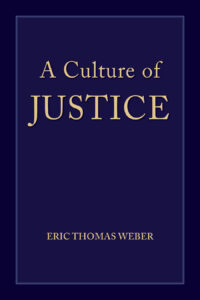
A Culture of Justice
Argues that there is a shared public obligation to establish and maintain a culture of justice, with implications for education, poverty, free speech, and “PC” culture.
**You can use the discount code: SNPF26 on the publisher’s site to get a 30% discount on the book while the discount lasts. The paperback comes out in July of 2026.**
Description
In A Culture of Justice, Eric Thomas Weber shows how culture can enable or inhibit the pursuit of justice. Weber argues that there is a shared, public obligation to establish and maintain a culture of justice. Culture can be employed to threaten people’s self-respect, to diminish their sense of positive power to pursue meaningful life plans. Weber also addresses problems of poverty and stigmatization as well as of racism and threats conveyed by means of public speech and the cultivation of hatred. Advancing John Dewey’s idea that democracy is a way of life, not merely a set of political mechanisms, he draws implications for policies and practices related to poverty, education, free speech, and the inadequately named set of norms that we call “political correctness.” Written in an accessible style, A Culture of Justice offers numerous everyday examples and conflicts for the reader to consider.
Eric Thomas Weber is Professor and Director of Graduate Studies in Educational Policy Studies and Evaluation at the University of Kentucky and serves as Executive Director of the Society of Philosophers in America (SOPHIA). He is the author and editor of several books, including Uniting Mississippi: Democracy and Leadership in the South.
Endorsements
“A pleasure to read, A Culture of Justice will appeal to a wide audience of social and political philosophers, scholars and practitioners of education, and people thinking about racial justice. Weber makes clear the relevance of the great American pragmatists to addressing current social and political problems such as poverty, hate speech, and racism.”
— Nicholas Tampio, Fordham University
A Culture of Justice
Argues that there is a shared public obligation to establish and maintain a culture of justice, with implications for education, poverty, free speech, and “PC” culture.
**You can use the discount code: SNPF26 on the publisher’s site to get a 30% discount on the book while the discount lasts. The paperback comes out in July of 2026.**
Description
In A Culture of Justice, Eric Thomas Weber shows how culture can enable or inhibit the pursuit of justice. Weber argues that there is a shared, public obligation to establish and maintain a culture of justice. Culture can be employed to threaten people’s self-respect, to diminish their sense of positive power to pursue meaningful life plans. Weber also addresses problems of poverty and stigmatization as well as of racism and threats conveyed by means of public speech and the cultivation of hatred. Advancing John Dewey’s idea that democracy is a way of life, not merely a set of political mechanisms, he draws implications for policies and practices related to poverty, education, free speech, and the inadequately named set of norms that we call “political correctness.” Written in an accessible style, A Culture of Justice offers numerous everyday examples and conflicts for the reader to consider.
Eric Thomas Weber is Professor and Director of Graduate Studies in Educational Policy Studies and Evaluation at the University of Kentucky and serves as Executive Director of the Society of Philosophers in America (SOPHIA). He is the author and editor of several books, including Uniting Mississippi: Democracy and Leadership in the South.
Endorsements
“A pleasure to read, A Culture of Justice will appeal to a wide audience of social and political philosophers, scholars and practitioners of education, and people thinking about racial justice. Weber makes clear the relevance of the great American pragmatists to addressing current social and political problems such as poverty, hate speech, and racism.”
— Nicholas Tampio, Fordham University
VIDEO: U of KY Alumni Association Great Teacher Award, 2024

VIDEO: U of KY Alumni Association Great Teacher Award, 2024

Updates and Resources for Civic Learning Week
Good afternoon friends. Next week is Civic Learning Week, and we wanted to take a few minutes and share with you some resources to support student civic learning and engagement.
Teachers Advacing Civic Learning
First of all, here at the Lou Frey Institute and our Florida Joint Center for Citizenship, we believe in the power of elevating the voices of educators in advocating for civic learning policy at the local, state, and federal levels. A new initiative, Teachers Advancing Civic Learning, has launched and it is a great opportunity to grow as a civics advocate and educator! You can learn more about the TACL initiative (Teachers Advancing Civic Learning) at its newly launched website.
Webinar With Congressman Dennis Ross
We would also like to remind you of our upcoming webinar featuring former Florida Congressman Dennis Ross! We will discuss student civic enagement, civil discourse, and other issues important to civic learning and life! You can sign up here, as registration is required. Please feel free to share the link and the flyer!
Civic Learning Week National Forum
This is a great opportunity, and we encourage you to attend in person if you can and virtually if you cannot!
U.S. Supreme Court Justices Sonia Sotomayor and Amy Coney Barrett will join the Civic Learning Week National Forum on March 12, 2024, livestreamed from Washington, D.C. Showcasing the Justices’ shared commitment to high-quality civic education, the featured conversation will be moderated by Eric Liu, Co-Founder and CEO of Citizen University, and address student questions about the judicial system and civic engagement, as well as the Justices’ legal career paths. The discussion will highlight the civic knowledge, skills, and dispositions gained through civic education, and why civics is essential to sustaining and strengthening constitutional democracy in the United States.
There will also be some other fantastic events during the forum, including talks on information literacy and bridging the divide brought about by political polarization, among others. Hope to ‘see’ you there! You can register for the livestream here! If you can get to DC, you can register to attend in person here!
Civic Learning Week Resources
While we are proud of our own materials, you can find many useful and different resources available from multiple organizations on the Civic Learning Week website. We encourage you to check them out to determine if they meet your needs!

KY’s Potential for Leadership in Educational Ethics: Calling for an End to Corporal Punishment in American Schools
[youtube id=”84bQWD9FwHE” width=”100%”]
In the spring of 2023, the Ethics and Social Justice Center at Bellarmine University issued a call for proposals for their yearly Commonwealth Ethics Lecture. They invited scholars from around the state to propose a talk to be delivered for their 2023 lecture, considering approaches from all disciplines and with special interest in interdisciplinary dialogue and topics, encouraging “critical reflection, dialogue, and constructive action on contemporary ethical issues in society.” They also welcomed proposals “related to politics, societal well-being, and individual happiness,” as well as that “intersect these themes with regional issues.”
I pitched my proposal in relation to the fact that Kentucky is a state that continues to permit and make use of corporal punishment in public schools. I have long thought about corporal punishment especially as an example of a practice long outmoded and for which evidence has become increasingly clear that better alternatives are available and that long-term effects of the practice are psychologically and medically discouraged. Given this opportunity, it was a great chance for me to focus on corporal punishment directly, so I jumped at the chance finally to focus extensively on this topic.
Kentucky has decreased the use of the form of discipline in public schools to nearly negligible levels, with 17 recorded instances of corporal punishment in the 2020-2021 school year, which suggests that the practice would not be difficult to end at the state level. Given that, Kentucky could serve as a leader among states that presently permit and engage in the practice, to show how others can follow the lead of the Commonwealth state of Kentucky, to end the practice around the country. The video here above is 1hr and 1 min long, concluding at the end of my talk, not including the question and answer session, though that was fun and rewarding for me also.
I am especially grateful to Dr. Kate Johnson for being a welcoming and great host at Bellarmine University for the talk. The attendance and recording of the talk were great and much appreciated.
The PowerPoint slides for my talk are available online here.