Fun Interview on WDAM TV

Photo of Miranda Beard in a school library.I had a delightful time in Hattiesburg, MS this January. My first stop while in town was at WDAM TV’s studio for the Midday News on Channel 7. I had the great pleasure of talking with Miranda Beard, who invited me to tell people about Uniting Mississippi and who announced my talk at the University of Southern Mississippi later that day, as well as the book signing afterwards. Miranda is a very impressive news professional and was very kind and welcoming.

Photo of WDAM TV's studio in Hattiesburg, MS.

The people at WDAM were very kind. The studio was easy to find, and I couldn’t have asked for a more beautiful day to drive. I will say that Mississippi’s actually quite a big state. I had to get up at 5 and be on the road at 7 to get to Hattiesburg by shortly after 11 for this interview. It was well worth it. One of the members of the audience at my 2pm talk said that she saw me on WDAM and that she had read my interview in the Clarion Ledger earlier in January.

Here’s the interview:

If you can’t see this video in your RSS reader or email, then click here.

Thank you to Miranda and to Margaret Ann Morgan, who set this up!

If you’re looking for a speaker for your next event, or know someone who is, visit my Speaking & Contact pages. Also, follow me on Twitter @EricTWeber and “like” my Facebook author page.

TV Interview and Talk at USM

I’m looking forward to meeting the folks at WDAM in Hattiesburg, MS, on Friday, January 29th for an interview about Uniting Mississippi: Democracy and Leadership in the South. I’ll be on live at around noon. I’ll post a clip of the interview as soon after it as I can. That same day (Friday), I’ll next head to the University of Southern Mississippi, where Sam Bruton in the Philosophy department hosts “Philosophical Fridays.” Check out the sweet announcement poster they made:

Poster of the announcement for my talk at 2pm in Gonzales Auditorium, LAB 108, on 'Uniting Mississippi.'

MHC-logo-FB“Philosophical Fridays” is a great initiative that engages audiences in and around Hattiesburg. The program has the support of the Mississippi Humanities Council, which is great.

If you’re in the area, come on by. I’m finalizing details about the book signing that’ll follow the talk.

Reader Email from Iran, and My Reply

Weber answering emails at his desk in 2011.

I received a reader email from Iran in the last few weeks. I’ve been swamped and hadn’t had a chance to respond until now. I’m still swamped, catching up, but I thought it might be fun to post the question and my reply here. These responses were quickly drafted, with some thought but little editing. <Disclaimer…> lol.

Dear Eric Thomas Weber

I’m [name omitted] from Iran.We are Iranian people who we love peace  and other culture we love other people in every point of earth.You know my country is a victim of mistaken policies in 8 years ago but we(people of Iran) are not bad.Politician of united state of America like Mr President Barak Obama say that the human right situation in Iran is not good.I want to know that what is meaning the human rights?

Best Regards, [name omitted]

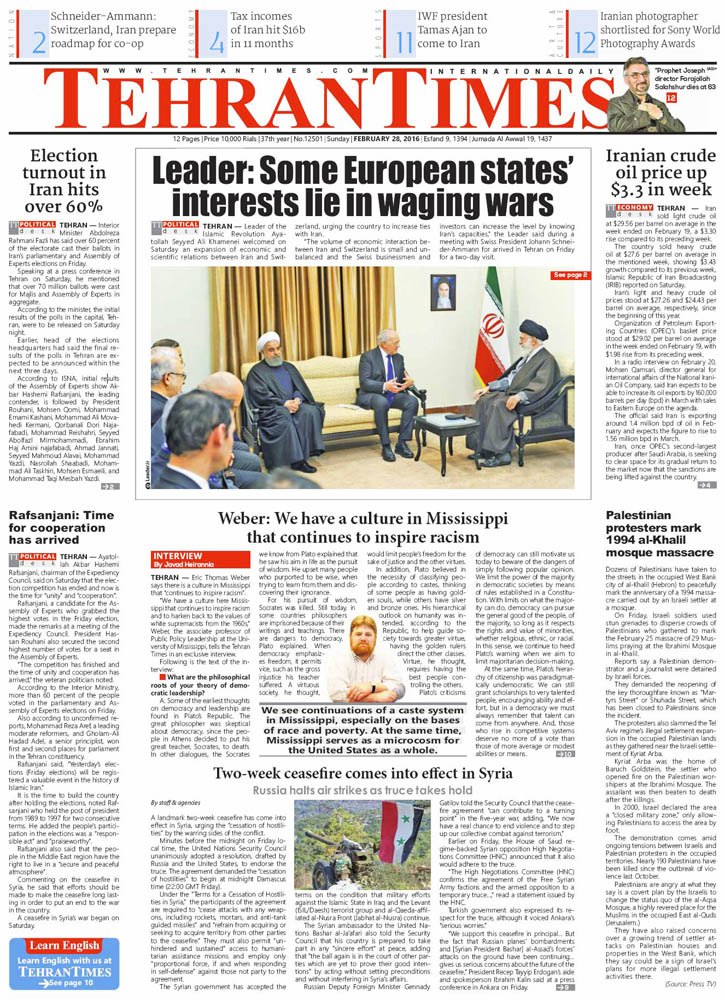
Front page of the Tehran Times, November 1, 2015.While I feel bad about having little time to answer [name omitted], I felt worse about how long it had taken for me to get to his email (BTW, that’s my mug on the front page of The Tehran Times from this past July – Pretty cool). So, here’s my rough and quick reply:

Hi [name omitted],

I apologize for the long delay before my reply… [explanation omitted]. To answer your question, human rights are generally considered responsibilities on the part of a government towards its people. The legitimacy of a government depends upon its respect for its people and their rights. Among the kinds of rights that Americans find sadly infringed upon in Iran are the freedom of expression and of the press. Governments cannot be wise and just without knowing about how their people are affected. When free expression is stifled, when leaders do not allow criticism of their decisions, the government intentionally fails to draw its judgments on the greatest pool of information available. Therefore, one of the cornerstones of just governments on this view is the right to criticize any public official. Here is an example of what I mean:

http://www.al-monitor.com/pulse/originals/2014/06/iran-professor-imprisoned-criticizing-nuclear-program.html#

I think it is fair to say that the United States, and most every nation, falls short of perfect justice. There are some things that we take to be fundamental, however. Freedom to raise one’s concerns as a citizen is vital as perhaps (or one of) the most basic human right(s).

That’s how I think about the question you’ve asked me. Again, I apologize for the delay in my reply. Happy new year to you and your family,

Eric Weber

Cover of Ignatieff's book, Human Rights as Politics and Idolatry.Now that I’ve sent that message, I’m reminded of Michael Ignatieff‘s suggestion that freedom of movement might possibly be considered more fundamental than speech. I see his point with respect to cases of ethnic cleansing.

Thoughts? Tweet them to me @EricTWeber or post them on my Facebook page.

Interview on BAM South’s Midlife Criss podcast

January 6, 2016, With host Jack Criss, and guests Kinsella, Weber, and Rings

Photo of a microphone in front of a soundboard.

I had a great time talking with Jack Criss on BAM South’s Midlife Criss podcast. The interview will soon be up on BAM South’s site, but for now Jack’s posted the interview on Sound Cloud. The player is here below. Jack is a great M.C. and he had questions for me about Uniting Mississippi. My interview is about 16 minutes in from the start of this audio recording. I’m the second of three guests: Stephan Kinsella, me, and John L. Rings.

The Logo for BAM South, with the tag line, "Business Always Matters."Jack has kindly invited me to join him again for a more extended discussion when I’m next in Jackson, MS. I’ve got plans in the works for a trip to Jackson at some point in the spring of 2016, so I think that it would be great to join Jack again.

The name BAM South is short for Business Always Matters. Check out the online publication, which features a nice podcast series. Jack has a great voice, I should add. Fun host too. I hope you enjoy.

Here’s the interview (again, my interview is around 16 minutes in):

More information about Uniting MississippiInfo on Speaking.

“Justice as an Evolving Regulative Ideal”

Journal article published in Pragmatism Today, Volume 6, Issue 2 (2015): 105-116.

Photo of the top of my paper, which links to the PDF file on the journal's Web site.

Logo for Pragmatism Today.I’m happy to announced that my latest paper, as of December 2015, has been published in Pragmatism Today, the peer-reviewed journal of the Central-European Pragmatist Forum. This paper is a step in the larger project of my book in progress, A Culture of Justice.


Title: “Justice as an Evolving Regulative Ideal.”

Abstract:

In this paper, I argue that justice is best understood as an evolving regulative ideal. This framework avoids cynicism and apathy on the one hand as well as brash extremism on the other. I begin by highlighting the elusive quality of justice as an ideal always on the horizon, yet which is nevertheless meaningful. Next, I explain the ways in which it makes more sense to see justice as evolving, rather than as fixed. Finally, I demonstrate the value of Charles Sanders Peirce’s concept of a regulative ideal for framing a pragmatist outlook on justice. Peirce helps us at the same time to appreciate ideals yet to let go of outmoded understandings of their metaphysical status. Ideals are thus tools for regulating behavior. Each of these qualifications demonstrates that justice is best conceived of as an evolving regulative ideal.

Video of My Interview on WLOX TV News at 4

The video clip of my interview on WLOX TV News at 4 in Biloxi, MS, is included at the bottom of this post. I had a great time visiting the coast, seeing the beautiful water, and talking with some really nice people.

This is a still video frame from my interview on WLOX TV News at 4 in Biloxi, MS, about my book, Uniting Mississippi.

I also had a great time meeting Jeremy from Bay Books for the book signing afterwards at the West Biloxi Public Library. While I was at the TV studio, I was able to snap these photos.

I knew I had found the right place. The official studio, looking sharp. The requisite multi-TV display, demonstrating that this is a TV studio. The West Biloxi Public Library, where we held the signing. Made me laugh. One perk of a visit to Biloxi.

Here’s the interview video:

If you can’t see this video in your RSS reader or email, then click here.

MHC-logo-FBFor more information, you can visit my page about the book here. If you are looking for a speaker for your group or think your community might enjoy a book talk and signing, visit my Contact page and drop me a note. Groups in Mississippi can apply for a mini grant from the MS Humanities Council, as they have a speakers’ series that features my talks on Uniting Mississippi.

Also, if you haven’t already, follow me on Twitter @EricTWeber and on Facebook.com/EricThomasWeberAuthor.

Signed Copies of ‘Uniting Mississippi’ for Southern Bound Book Shop

image

Beautiful day in Biloxi! Just met the owner of Southern Bound Book Shop. If you live nearby and can’t make it to the signing tonight, you can head there for a signed copy later. They also have a store in Ocean Springs. If you live closer to Bay Saint Louis, Bay Books will have copies there after tonight’s signing.

Uniting the States? Brainstorming a Trajectory

When I was in graduate school, looking at the job market, I remember feeling perplexed at certain questions about the future of my career. Some colleges and universities ask you about your “research trajectory.” Finishing a dissertation prepares you with a stack of paper, but now it’s supposed to be nimble and fly like an arrow. I can just picture throwing an unbound dissertation from the top of some stairs, watching the pages fall in all directions. That’s one kind of a trajectory.

A photo of me reading at my desk in 2010, before I came to need glasses.

It wasn’t too hard to imagine things that I wanted to study next, but it’s a huge step in one’s academic career just to finish a major, final project. To be asked at that moment what your next one will be takes one aback. I’ve come to like that question, but somehow I hadn’t been expecting it at the time. It was exciting to think about what I might pursue over the course of my career, though. I had ideas about wanting to work on this or that topic, and some of them did come together.

I thought that I, like so many scholars you meet, would want to depart from the focus of my dissertation. While some steps have been diagonal or roundabout to this point, I have found myself actually returning to some of the issues and sources from that first project. I won’t get into that now, but the fascinating thing for me in writing has had to do with how each work builds on elements of the one before, even if in surprising ways.

Photo of the paperback and hardback editions of 'Democracy and Leadership.'My dissertation on John Rawls and John Dewey’s work focused on basic questions, after which my next project was much more centered on application. Then, Democracy and Leadership was a return to theory, especially to Plato, but with adaptations drawn from Dewey and some from Rawls. The last chapter of that prompted further focus on application, which resulted in Uniting Mississippi. While working on each of these earlier projects, I have had cause to return to Rawls and Dewey’s work, and noticed a concern that I believe is crucial, yet insufficiently explored in studying justice: especially the role of culture in enabling or impeding it.

So, I’ve been working in slow steps on A Culture of Justice for a few years now, longer than I expected. It is coming together, still needing work. That said, it is definitely a more theoretical project, even if I see and will note many possible applications. With my more applied writings, I’ve been striving to make them more and more accessible and publicly engaged. In addition, I’ve focused quite a bit on Mississippi, given that issues for democracy, education, and leadership are so striking here. At the same time, many of the issues I’ve studied are relevant beyond the South. Dean Skip Rutherford of the Clinton School highlighted that point for me. I thought it to be true, but he encouraged me to speak to a broader audience, beyond both Mississippi and the South.

Bust of Socrates.Given that, I’ve started rethinking some of the next projects that I want to pursue. In particular, I’m seeing a number of ideas come together for a next step after A Culture of Justice. The big picture challenge for democracy at the national level can be drawn from what I argued about Mississippi. That lesson was itself learned from Plato. Plato’s Socrates asked what could be a greater evil than that which makes the city many, instead of one? And, he continued, is there any greater good than that which binds it together and makes it one? Nothing and no. Unity is indeed vital for a good city.

For Plato, unity was important enough to trample on liberty. He thought leaders were justified even to lie to their own people for the sake of fostering unity. He was not democratic. In a democratic society, liberty is central. So how could a democracy be united, he wondered? Plato doubted that democratic societies could be wise enough to unite, to care about virtue, and to limit the will of the majority, when it wants vice and injustice.

John Rawls once noted that in many ways American democracy has been remarkably stable. I would suggest that he could only say that in a part of the country that did not fight for secession. We still have the scars of division from the Civil War showing in Mississippi. That said, I believe that Rawls was right when he explained that there are so many more things that unite Americans than that divide us.

A stack of newspapers.We focus so much on the latter, as that’s disagreement. It’s drama. It sells newspapers, or at least ads on their Web sites. The countless things I could mention that people accept as uncontroversial and obvious are so numerous that they would take entirely too long to list. Given that, we can say that in many ways, our hyper-polarized, divided society does live up to one key aspect of our nation’s billing. Indeed, it’s so easy to forget: the key virtue noted in Plato’s Republic is the one virtue mentioned in the name of our country: unity. Ours are the United States of America. Unity is primary. It is vital. But it is also not guaranteed.

So, I’m thinking about expanding from my project on Mississippi. I’ve adapted Faulkner’s line, and want to follow that next step. Faulkner said that to understand the world, you’ve got to understand a place like Mississippi. Ok, so I’ve given Mississippi a try. Next, I want to study the needs, forces, and factors Uniting the States of America. That may not be my title, but I’m working on it. Hell, I may go in a very different direction, but at present, this feels right.

The cover of 'Uniting Mississippi,' featuring University of Mississippi students participating in a 2012 candlelight vigil in Oxford, MS.While I’m an unabashed optimist — nothing ventured, nothing gained — I recognize that the “stability” that Rawls saw in the United States comes at a price of the massive incarceration of poor and otherwise disadvantaged people, the use of labor under the table, paid to people who do not have the protection of the police, and many other troubles that people face in the U.S. That said, a vision of progress takes recognition of our challenges, of what divides us. When we see the need for unity, for fighting problems like hyper-incarceration, we can fight for change. In that particular example, there is cause for hope, as Hillary Clinton, Bernie Sanders, and the Koch brothers, powerful voices on the Left and Right, all believe that we desperately need to combat hyper-incarceration.

These are just some sketched thoughts about the big picture next steps for my writing trajectory. If you have thoughts or questions for me, send me a tweet @EricTWeber or post on my Facebook Author page.

Video of my Interview on WLOV of Tupelo

Screenshot of the interview I gave for WLOV's This Morning show with Katrina Berry.

As promised,  I’m posting here below my interview on WLOV of Tupelo’s This Morning show with Katrina Berry. Also, below that is a photo of the nice layout that Reed’s Gumtree Bookstore setup for the book signing later that day.

If you can’t see this video in your RSS reader or email, then click here.

Katrina was a lovely person who was kind and encouraging. As I said, she drove home the fact that on WLOV they like to support local authors.  It was a great experience, and also featured the fastest turnaround I’ve experienced for getting a video of the broadcast. All around, great trip.

Oh, and here’s Reed’s Gumtree Bookstore’s nice setup before the book signing. Very nice people there too. They’ve got signed books from John Grisham, George Will, and many more. Great people.

Nice table and display layout for my book signing at Reed's Gumtree Bookstore in Tupelo, MS.

If you know of TV or radio stations that would be interested in an interview about Uniting Mississippi, or groups looking for a speaker, contact me on Twitter, Facebook, or via my info on my Contact page.

Had a Great Visit with Katrina Berry on WLOV Tupelo

Photo of terrible rain in between Oxford and Tupelo, MS.Despite the torrential rain this morning, I made it on time to meet with Katrina Berry of WLOV Tupelo’s This Morning show.

Berry is an impressive, award-winning journalist and TV anchor. Her award was from the Associated Press for her weekly series, Heavenly Helpers. When I first got a chance to talk with her, she explained that they aim to support local authors on the show, which was great.

It can seem strange to most scholars to put a lot of effort into securing and participating in a 3 minute interview, which is what it came out to be. Consider how much advertisers spend on 30 seconds or 1 minute of television, however, and all of a sudden, you can appreciate better what 3 minutes of air-time means, in financial terms. One source estimates that even on a local show, ads can cost from as little as $200 to as much as $1,500 for 30 seconds. So a 3 minute interview could be valued from anywhere between $1,200 and $9,000. That’s worth the drive to Tupelo, MS. Those aren’t funds that come to me, of course, but they are value that the show offers for getting the word out about Uniting Mississippi.

After a few nice questions about the book, Berry asked me about the book signing that I’ll be holding from 12-1:30 pm today at Reed’s Gumtree Bookstore, here in Tupelo. Here are a few photos I snagged of my visit to WLOV. When I get a clip of the video of the interview, I’ll post it to my site also. It was a great experience.

Selfie photo of Eric Thomas Weber with Katrina Berry of WLOV Tupelo. Photo of the weatherman in front of a green screen in Tupelo, MS's WLOV TV studio. Photos from the WLOV TV studio in Tupelo, MS.

Know a TV station that might be interested in hearing about Uniting Mississippi? Let me know on Twitter or on Facebook