
Sign up for September’s Tech Tuesday with QiqoChat

Registration is now open for September’s Tech Tuesday event featuring QiqoChat. Join us for this FREE event Tuesday, September 29th from 12:00-1:00pm Eastern/9:00-10:00am Pacific.

QiqoChat is a tool for phone-based dialogue and video chat.  It supports Tech_Tuesday_Badgedialogue methods such as online open space, Conversation Cafe, and liberating structures.

We will be joined by Lucas Cioffi and Michael Herman, who will provide a demonstration of the QiqoChat platform and discuss the lessons learned from hosting two open space conferences for the worldwide community of open space facilitators.

NCDD Member Lucas Cioffi served on the board of NCDD for three years.  He is an Iraq War veteran and is the software developer that built QiqoChat. Michael Herman been a facilitator and trainer of many methods and approaches since 1991 and an active Open Space community member since 1996. Michael and Lucas co-convened the first ever “virtual open space on open space” gathering in July 2015.

Don’t miss this opportunity to learn more about this platform and how it has been utilized – register today!

Tech Tuesdays are a series of learning events from NCDD focused on technology for engagement. These 1-hour events are designed to help dialogue and deliberation practitioners get a better sense of the online engagement landscape and how they can take advantage of the myriad opportunities available to them. You do not have to be a member of NCDD to participate in our Tech Tuesday learning events.
when a university is committed to democracy

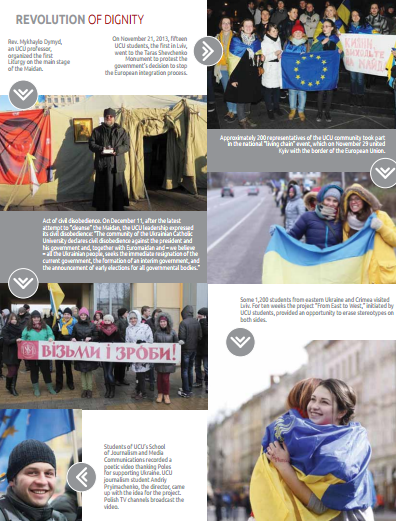
This is a page from the 2013-14 Rector’s Report of the Ukrainian Catholic University in Lviv, an institution that I visited this summer. (Click the image to open the PDF.) The page is headed “A Revolution of Dignity,” and it describes various political–even revolutionary–activities by the university or its members. The next page shows profiles of activists from the university, including a lecturer who was shot to death. It is an interesting combination of American-style glossy PR and strongly worded political commitment.

UkrainianCatholic

I would not hope for a comparable stance from an American university. For one thing, this brochure comes from a country with a war on its own territory and ongoing political crises. We shouldn’t wish for that level of strife here, even if it elicited more political commitment from higher education.

Besides, one can critically assess the position that the university has taken. I’m on the same side, but this position is debatable. Universities contribute to the public discussion by being fair and open to a range of perspectives and by demanding standards of evidence and reason from all participants. When a university commits itself strongly to a cause, it can undermine its ability to be an open forum for debate. It also acquires strange bedfellows–people on the same general side of the political issue who may be quite unsavory.

On the other hand, neutrality is impossible and is the wrong objective. Universities exist to promote free thought and substantive dialog and inquiry, which are incompatible with censorship, oppression, violence, and rampant corruption. Scholars also need intellectual freedom and public support in order to do their work. So universities are closely tied to social justice. They must leave space for a debate about what defines social justice, but they should not pretend that it is other people’s business.

US universities tend to respond to political threats and crises by staying clear of them, at least as official institutions. The Ukrainian Catholic University demonstrates what it looks like when an institution leaps into the fray. The Rector writes in his introductory message “we declared civil disobedience against the government and the president,” which is not what you’d expect in an annual report from a US college or university. He adds:

It’s difficult to summarize the last year, for most of the processes have only begun and are now continuing. We are still experiencing the ‘Revolution of Dignity.’ We are still fighting an external aggressor and internal problems. … From the first days of the revolution we clearly understood what we were fighting for. We were not distracted from running the university for a second. But we also supported our students. …  On December 11 we declared civil disobedience against the government and the president, who used violence against his own people. ….

We should work for victory and for reconciliation. Our weapons are truth and peace. We should already be thinking about what will happen after the war, how to heal physical and spiritual wounds, how to strengthen the country. In addition to the external enemy, Ukrainians need to conquer internal enemies: corruption, anger, hatred. I expect that the spiritual and educational life of the university will help our students handle these challenges.

Get 20% Off NCDD Membership & Renewal During Membership Drive!

Hi, everybody!  To round out our summer membership drive, we wanted to offer a special incentive for any of you XS Purple NCDD logowho have not yet renewed or upgraded your membership.

For the rest of the week, you can save 20% on all membership types and upgrades by entering “SUMMER-DRIVE” in the discount field in any of these three forms:

You can even renew for two years with the discount!

As always, you can look yourself up in the member directory at www.ncdd.org/directory to see what your member type is (“Member” means you’re non-dues, so please upgrade to Supporting Membership today!), and what your renewal due date is (if it is in the past, you’re lapsed, so it’s time to renew for sure!).  Or just send an email to office manager extraordinaire Joy Garman, at joy@ncdd.org, and she’ll let you know your status.

IMG_2123We know you appreciate the work NCDD does, and many of you are already supporting, sustaining, and organizational members.  But for those who aren’t, please consider upgrading or renewing this week.  Your support means the world to us, and helps us continue serving this amazing community.

Feel free to encourage other friends and colleagues to join NCDD this week using the SUMMER-DRIVE code – anyone can use it.

And as always, thank you for investing in the future of NCDD!

The Midnight Drink of Paul Revere

I recently went on a walking tour of Boston’s North End. The dense, historically Italian community is on some of the oldest land in Boston.

Like many coastal cities in the U.S., the Boston we now know is mostly landfill. It used to be practically an island, connected to the mainland only by a narrow peninsula.

Silversmith and agitator Paul Revere was one of many notable residents of the North End, and it was from here he took is famous “midnight ride” – first taking a boat to Charlestown, then riding up the Mystic through Somerville, Medford, and on to Lexington.

But on this walking tour I was told a detail of that ride I hadn’t heard before. Revere and his companion, William Dawes Jr., were arrested before they made it to Concord because they stopped to have a beer.

Now, of course I had to look into a salacious comment like that.

I’m afraid I haven’t found as much clarity on the subject as I would like, but this is what I know:

On the night of April 18, 1775, British troops set out to arrest patriots Samuel Adams and John Hancock, who were staying in Lexington at the home of Reverend Jonas Clarke. Revere and Dawes set out to warn them and raise an alarm, Revere taking the now-famous northern route and Dawes taking a southern route through the “Boston Neck” (now Roxbury).

After arriving in Lexington, Revere and Dawes were joined by a third rider, Dr. Samuel Prescott, and the three decided to carry on to Concord where arms and munitions were stored.

This is where things get particularly fuzzy.

On the road to Concord, the three were confronted by British soldiers. Prescott either evaded capture or very quickly escaped. Dawes also seems to have escaped after Prescott, leaving only Revere captured. He seems to have been released sometime the next day.

But what was that about a beer?

According to some accounts, before heading on to Concord Revere and friends stopped at a tavern to  “refreshid” himself. This “refreshid” can indeed be found in a letter from Revere recounting the experience.

While I was originally told, though, that he was arrested while having a beer – it does seem that the arrest came slightly thereafter.

And it was almost certainly an ale that Revere “refreshid” himself with. After all, drinking was quite common in colonial times, with many believing ale could make you healthy while (contaminated) water had the effect of making you sick.

So all this leaves only one question: if Revere, Dawes, and Prescott were all participants in this midnight ride, why does Revere get all the glory?

Published in 1860, Henry Wadsworth Longfellow’s “Paul Revere’s Ride,” is what made that rider famous than the others. The poem, you may know, is “less a poem about the Revolutionary War than about the impending Civil War — and about the conflict over slavery that caused it.”

With the goal of of support the Abolitionist cause, Longfellow choose Revere as the rider to highlight for one simple reason: his name rhymed better.

facebooktwittergoogle_plusredditlinkedintumblrmail

The Creation of Politics Video

The short video, The Creation of Politics (2014), was created by Kettering Foundation, in collaboration with Momentum Inc., Danijel Zezelj, and Main Sail Productions. The video tells the story of villagers who came together to address the dangers they faced as a community and how this led to the creation of politics. Below is the blog post from Kettering describing the video in more detail and find the link to the video here.

From Kettering

KF_Creation of PoliticsThose of you who have participated in Kettering’s annual summer Deliberative Democracy Exchange have probably heard Kettering Foundation president David Mathews tell a story about a small village that faces a recurring flood. It is a fable of sorts. In spite of the villagers’ many efforts to stop the flood, the waters return again and again.

So the people in the story had to make a decision: should they move across the river, where another band of people already live? Should they stay in their homeland? Or, should they move to higher ground? And in coming together and making a collective decision, the people create politics.

The story is designed to be universal – one that belongs to all times, all people, all cultures. People in communities everywhere face difficult problems and must weigh the costs and benefits of potential actions and then decide how to act together. The story counters the idea that public deliberation is some kind of new technique to be used on communities and encourages a notion of democracy that is citizen-centered.

A team at the Kettering Foundation collaborated with Momentum, Inc., artist and illustrator Danijel Zezelj, and MainSail Productions to produce a new animated video, The Creation of Politics, which brings to life this archetypal flood story that imagines how politics was first created – and why.

About Kettering Foundation
The Kettering Foundation is a nonprofit operating foundation rooted in the American tradition of cooperative research. Kettering’s primary research question is, what does it take to make democracy work as it should? Kettering’s research is distinctive because it is conducted from the perspective of citizens and focuses on what people can do collectively to address problems affecting their lives, their communities, and their nation.

Follow on Twitter: @KetteringFdn.

Resource Link: http://kettering.org/blogs/new-video-creation-politics

upcoming talks

These are public talks I am giving in the next two months. All welcome!

Sept. 23: Philanthropy for Active Civic Engagement (PACE) Webinar, “America’s Civic Renewal Movement,” with me and Eric Liu (Citizen University), Kelly Born (Hewlett Foundation) and Joan Blades (Living Room Conversations project). (Register here.)

Sept. 24, Hamline University (St. Paul, MN), Commitment to Community Keynote Address

October 5, University of Texas San Antonio’s Center for Civic Engagement. At its first Civic Engagement Summit, I will talk about “The Promise of Civic Renewal in America.”

Oct. 14, University of Connecticut: the Myles Martel Lecture in Leadership and Public Opinion

Nov. 4, Educational Testing Service office in Washington, DC, “R&D Forum” on civic learning

Public Engagement: The Vital Leadership Skill

We are pleased to share the announcement below about a great workshop led by several NCDD members this October 22. NCDD Supporting Member Mary Gelinas shared this announcement via our great Submit-to-Blog Form. Do you have news you want to share with the NCDD network? Just click here to submit your news post for the NCDD Blog!


Engaging the public in planning and policy making is a vital skill for leaders in all sectors, not just in government.

Join us for a half-day workshop on Public Engagement: The Vital Leadership Skill led by Pete Peterson and Carol Rische on Thursday, Oct. 22nd from 9am to 12pm at the Humboldt Bay Aquatic Center in Eureka, CA.

Pete Peterson is the director of the Davenport Institute for Public Engagement and Civic Leadership at Pepperdine University (and also an NCDD member). He speaks nationally on issues related to public participation and the use of technology to make government more responsive and transparent.

Carol Rische is the former General Manager of the Humboldt Bay Municipal Water District where she successfully led an award-winning, community based water resource planning process to address issues facing the District and our community.

If you are interested in becoming more effective in engaging the public in addressing tough issues, this workshop is for you. During this practical and interactive seminar you will learn:

  • A variety of ways to engage the public in meaningful and effective ways
  • The key questions to ask yourself before beginning a public engagement process
  • Criteria to follow while planning a public engagement process
  • How leaders and residents can engage one another more effectively, and
  • Why the Humboldt Bay Municipal Water District’s public process so successful.

To register call 707-826-3731 or visit www.humboldt.edu/extended/register.

This session is being hosted by two members of NCDD: Mary Gelinas and Roger James.

New Videos: Electing the President

One of the important relationships that the Lou Frey Institute and the Florida Joint Center for Citizenship have developed is with the Florida State Association of Supervisor of Elections. Recently, our own Dr. Terri Fine sat down with Bill Cowles, the Supervisor of Elections of Orange County, and Dr. Aubrey Jewett, Associate Professor of Political Science at UCF to discuss the process of electing the president. The video is broken down into four segments, and you can click the embedded link in the descriptive text to download each video. Alternatively, you can simply visit the page to preview the videos.

Please keep in mind that here in Florida, our 7th grade civics course does not generally address federal elections and the Electoral College, so these would be more applicable for high school students in this state. These could certainly serve as a means to develop/refresh your own content knowledge however! 

The first addresses the role of the census and reapportionment in determining the power and influence of a state within the Electoral College and in the selection of candidates.
censusThe second video explores presidential preference primaries and state caucuses, and the role they play in selecting a party’s candidate.

PPPThe third video describes the national conventions. It really is an interesting discussion about how the conventions have become more of a fundraising opportunity and media event rather than the traditional selection of the candidate, the running mate, and the platform. As argued in the clip, it is in many ways a ‘staged event’ now, because many of the decisions that used to occur at the convention now occur well in advance. It’s often just ratifying these decisions! Download the video and check out the discussion!
conv1 The next video in the series discusses Election Day and how time zones and different state-level voting procedures could impact both the voter and the election of the president, as well as a reminder that we are actually not really voting for the president! And no discussion of elections would be complete with a consideration of the money involved.
electon dayThe final video in the series looks at the Electoral College itself, always a controversial and misunderstood component of the American electoral system.
electorla college
We hope that you find this resource useful. Visit the Orange County Supervisor of Elections page to view and download the videos.

Reminder: Here in Florida, our 7th grade civics course does not generally address federal elections and the Electoral College, so these would be more applicable for high school students in this state. 


New Videos: Electing the President

One of the important relationships that the Lou Frey Institute and the Florida Joint Center for Citizenship have developed is with the Florida State Association of Supervisor of Elections. Recently, our own Dr. Terri Fine sat down with Bill Cowles, the Supervisor of Elections of Orange County, and Dr. Aubrey Jewett, Associate Professor of Political Science at UCF to discuss the process of electing the president. The video is broken down into four segments, and you can click the embedded link in the descriptive text to download each video. Alternatively, you can simply visit the page to preview the videos.

Please keep in mind that here in Florida, our 7th grade civics course does not generally address federal elections and the Electoral College, so these would be more applicable for high school students in this state. These could certainly serve as a means to develop/refresh your own content knowledge however! 

The first addresses the role of the census and reapportionment in determining the power and influence of a state within the Electoral College and in the selection of candidates.
censusThe second video explores presidential preference primaries and state caucuses, and the role they play in selecting a party’s candidate.

PPPThe third video describes the national conventions. It really is an interesting discussion about how the conventions have become more of a fundraising opportunity and media event rather than the traditional selection of the candidate, the running mate, and the platform. As argued in the clip, it is in many ways a ‘staged event’ now, because many of the decisions that used to occur at the convention now occur well in advance. It’s often just ratifying these decisions! Download the video and check out the discussion!
conv1 The next video in the series discusses Election Day and how time zones and different state-level voting procedures could impact both the voter and the election of the president, as well as a reminder that we are actually not really voting for the president! And no discussion of elections would be complete with a consideration of the money involved.
electon dayThe final video in the series looks at the Electoral College itself, always a controversial and misunderstood component of the American electoral system.
electorla college
We hope that you find this resource useful. Visit the Orange County Supervisor of Elections page to view and download the videos.

Reminder: Here in Florida, our 7th grade civics course does not generally address federal elections and the Electoral College, so these would be more applicable for high school students in this state. 


Reflections on Public Life and a Long Vacation

It’s been 25 days since my last blog post.

The break was intentional as I transitioned from my full time job of nearly eight years to becoming a full time student. In that three and half weeks I have lived un-publicly: I have said many goodbyes, relaxed on the Cape, read several books, done some significant cleaning, and explored the history of Boston’s North End.

It was remarkable to have so much time with so little responsibility. I got to truly relax and reset before beginning this next chapter of my life.

But I noticed something interesting as the end of my limbo neared: I was anxious about the prospect of regularly writing publicly again.

I kept finding myself wondering what topics I should write about, especially as I only half-followed the news. I kept finding myself wondering why I should even write publicly at all – an arguably presumptuous, egotistical move.

I started thinking that I wouldn’t blog on my promised restart date after all. Maybe I’d give myself another week to get settled into school. Then I could take the time to think of a worthwhile topic, I could find some commentary worthy of the public sphere.

But, of course, that’s the myth of public life: that it should be a place only for perfection, a space only for experts. That the rest of us, with our half-thoughts and individual perspectives should stick to the shadows, leaving our representatives to the public work.

When I started my vacation, my mind was exploding with possible blog post topics. Everything I read, every interaction I had – I looked for the public value in those private moments.

I left myself cryptic notes, “Voice – to broad public v. within institutions? Role of social media?” That idea seemed really important two weeks ago.

But as I got further and further away from public writing, I stopped thinking about public life all together. My private reflections remained private, and I thought less and less about their value to the public sphere.

I’ve no interest in leading a celebrity life – my private moments splashed all over the public domain. But at the same time I am a citizen, with an obligation to public participation , public deliberation, and, indeed, some measure of public life.

So I am back to blogging today, September 8, the day I said I would get back to it. I don’t know what to say, I don’t know what to write, and I’m far from certain that my perspective holds much value.

But I will continue to write publicly, I’ll continue to think publicly, and, of course, I’ll continue to work publicly, side by side with all of you.

Because if there’s one thing I know, it is this: there is much work to be done.

facebooktwittergoogle_plusredditlinkedintumblrmail