
How to Move from an Extractive to a Generative Economy?

One of the big, unanswered questions in our political economy today is “what constitutes value?”  Conventional economics sees value as arising from market exchange and expressed as prices. A very simple, crude definition of value.

But how, then, to account for the many kinds of value that are intangible, social or ecological in nature, and without prices – activities such as child-rearing and eldercare, ecological stewardship, online peer production, and commoning?  There is an urgent need to begin to make these forms of value explicitly visible in our political economy and culture.

Two new reports plunge into this complicated but essential topic.  The first one – discussed below -- is called “Value in the Commons Economy:  Developments in Open and Contributory Value Accounting,” The 49-page report by Michel Bauwens and Vasilis Niaros focuses on socially created value on digital networks. It was co-published yesterday by the Heinrich Boell Foundation and P2P Foundation. 

Another important report on how to reconceptualize value – an account of a three-day Commons Strategies Group workshop on this topic – will be released in a few days and presented here.

The P2P Foundation report declares that “society is shifting from a system based on value created in a market system (through labor and capital) to one which recognizes broader value streams,” such as the social and creative value generated by online communities.  The rise of these new types of value – i.e., use-value generated by commoners working outside of typical market structures – is forcing us to go beyond the simple equation of price = value.

Michel Bauwens and sociologist Adam Arvidsson call this the “value crisis” of our time.  Commons-based peer production on open platforms is enabling people to create new forms of value, such as open source software, wikis, sharing via social networks, and creative collaborations.  Yet paradoxically, only a small minority of players is able to capture and monetize this value.  Businesses like Facebook, Google and Twitter use their proprietary platforms to strictly control the terms of sharing; collect and sell massive amounts of personal data; and pay nothing to commoners who produced the value in the first place.

This is highly extractive, and not (re)generative.  So what can be done?  How could open platforms be transformed to bolster the commons and serve as a regenerative social force? 

The P2P Foundation report is a welcome splash of clarity on a topic that is often obscured by deceptive terms like the “sharing economy” and mystifications about the structural realities of digital cooperation. 

The Bauwens/Niaros report starts with a section analyzing the theoretical nature of the “value crisis” we are experiencing, before moving on to three powerful case studies of alternative value-systems pioneered by the Enspiral network, Sensorica and Backfeed.  The report concludes with a series of policy recommendations for changing the economic and political infrastructure. 

The Value Crisis

The real roots of the “value crisis” stem from the fact that “contemporary capitalist value-practices are no longer able to determine what value is,” write Bauwens and Niaros.  Stock market valuations are notoriously unable to attribute a reliable (financial) value to a company because so much value resides in social intangibles – the goodwill of consumers, brand reputations, and social sharing.  Stock analysts can try to add up the resale value of factory buildings, equipment and office furniture, but there is no reliable, consensus method for assigning a value to all the social beliefs and activities that make a company valuable.

Such a delicious irony!  Contemporary capitalism loves that it can freely appropriate software code, personal data, user-generated information, videos, etc. – a shareable cultural abundance that the world has never seen before.  Yet investors have great difficulty in monetizing and commodifying this value.  It is hard to make abundant social value artificially scarce and therefore saleable.

So we have the spectacle of commoners having trouble protecting the use-value that they create, which businesses are aggressively trying to channel into extractive market production and consumption.  (“Extractive” because companies want this value for free, and don’t want to reward the social communities.)  And yet even with their great extractive powers (lots of capital, copyright laws, terms of service contracts, etc.), large companies are finding that it is difficult to develop reliable flows of profit.

Toward Value Sovereignty

The focus of the P2P Foundation report is how to move from an extractive digital economy to a regenerative one.  Hence the focus on how three digital communities are trying to protect their “value practices” and create a “value sovereignty” beyond the pressures of capitalist markets.  These communities are trying to achieve a “reverse co-optation” by generating value flows from the old economy to the new, and by developing new value-accounting systems to properly honor social contributions.

One such project is Enspiral, a highly participatory, mission-driven coalition of entrepreneurs and other entities, many of them based in New Zealand.  “Enspiral calls itself an ‘open cooperative’ because of its commitment to both the production of commons and an orientation to the common good,” write Bauwens and Niaros. One of its innovations is the use of “capped returns,” which puts a limit on how much an investor in the Enspiral infrastructure can receive in return.  As the report notes:

….the shares issued by a company would be coupled by a matching call option which would require the repurchase of the shares at an agreed upon price.  Once all shares have been repurchased by the company, it will be free to reinvest all future profits to its social mission. Through this mechanism, external and potentially extractive capital is ‘subsumed’ and disciplined to become ‘cooperative capital.’”

Sensorica is an open collaborative network that is experimenting with new ways to combine commons and market forms.  It has an elaborate “value accounting system” for keeping track of its members' contributions to market-based projects. This system is then used to allocate revenues in proportion to each member’s role. Is Sensorica a new kind of (market-driven) co-op or a new type of (mission-based) commons?  Maybe a hybrid.

A third case study looks at Backfeed, a production community that relies on the blockchain ledger as an infrastructure for decentralized production.  Backfeed is more of an aggregation of individuals working together to sell to markets, than a commons.  Still, the cooperative organizational structure has the potential for making it capable of acting as a “value sovereign” community. Many others are exploring how the blockchain might enable cooperative control over a community's resources, whether for sale in the market or for internal use-value.

Policy Recommendations

The P2P Foundation report concludes with a series of policy recommendations that would help protect the kinds of value regimes described in the case studies.  It proposes open cooperatives to create new types of livelihoods and the use of “reciprocity-based licensing” to protect against value capture by capitalist enterprises and foster solidarity among generative coalitions.  The report also calls for open supply chains and common network resource planning to help promote an open source “circular economy”(e.g., “design global, manufacture local”).  

Bauwens and Niaros envision new sorts of political collaboration to provide a counter-power to the old economy and advocacy for peer production communities.  Local “chambers of commons” and “commons-oriented entrepreneurial associations” are needed, not to mention new forms of transnational collaboration, they urge.

At a time when the political left has trouble moving beyond Keynesian economic models and the management of neoliberalism’s many crises, Bauwens and Niaros point to some new models of commons-based peer production that could help transform the terms of engagement.

How to Move from an Extractive to a Generative Economy?

One of the big, unanswered questions in our political economy today is “what constitutes value?”  Conventional economics sees value as arising from market exchange and expressed as prices. A very simple, crude definition of value.

But how, then, to account for the many kinds of value that are intangible, social or ecological in nature, and without prices – activities such as child-rearing and eldercare, ecological stewardship, online peer production, and commoning?  There is an urgent need to begin to make these forms of value explicitly visible in our political economy and culture.

Two new reports plunge into this complicated but essential topic.  The first one – discussed below -- is called “Value in the Commons Economy:  Developments in Open and Contributory Value Accounting,” The 49-page report by Michel Bauwens and Vasilis Niaros focuses on socially created value on digital networks. It was co-published yesterday by the Heinrich Boell Foundation and P2P Foundation. 

Another important report on how to reconceptualize value – an account of a three-day Commons Strategies Group workshop on this topic – will be released in a few days and presented here.

The P2P Foundation report declares that “society is shifting from a system based on value created in a market system (through labor and capital) to one which recognizes broader value streams,” such as the social and creative value generated by online communities.  The rise of these new types of value – i.e., use-value generated by commoners working outside of typical market structures – is forcing us to go beyond the simple equation of price = value.

Michel Bauwens and sociologist Adam Arvidsson call this the “value crisis” of our time.  Commons-based peer production on open platforms is enabling people to create new forms of value, such as open source software, wikis, sharing via social networks, and creative collaborations.  Yet paradoxically, only a small minority of players is able to capture and monetize this value.  Businesses like Facebook, Google and Twitter use their proprietary platforms to strictly control the terms of sharing; collect and sell massive amounts of personal data; and pay nothing to commoners who produced the value in the first place.

This is highly extractive, and not (re)generative.  So what can be done?  How could open platforms be transformed to bolster the commons and serve as a regenerative social force? 

read more

the changing norms for Supreme Court nominations

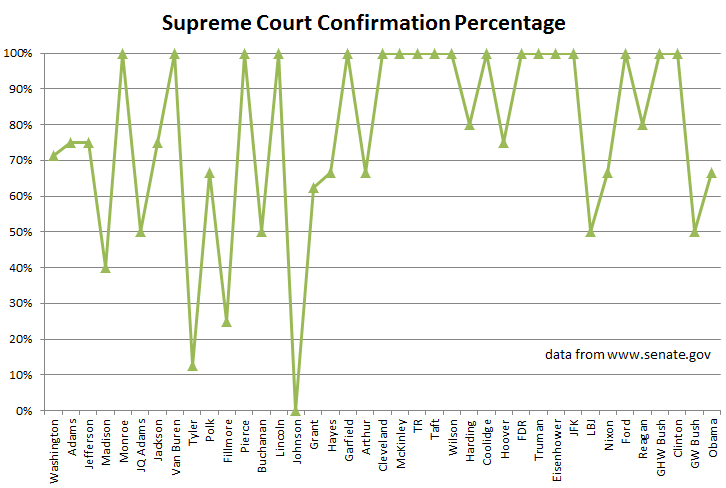
This graph shows the proportion of each president’s Supreme Court nominations who were confirmed as opposed to rejected, withdrawn, or postponed. I draw attention to the rocky record of the antebellum presidents, the very high confirmation percentage between 1900 and 1967, and the mixed story since then.

It’s often said that Robert Bork was the first nominee of modern times rejected on ideological grounds, not because of a scandal. Conservatives (rightly or wrongly) view that episode as the moment when a norm was broken, since 20th century presidents had been allowed to name candidates who met basic qualifications. Liberals now feel equally strongly about Merrick Garland, the first modern nominee not to receive a vote at all, even though he was clearly a moderate. If Democrats filibuster Neil Gorsuch and Republicans end the filibuster, that will be seen as a new stage. The new implicit rule will be: presidents can name Supreme Court nominees when a majority of the Senate chooses to concur, but otherwise the seat stays vacant. In general, we will expect vacancies to be filled when the Senate and White House belong to the same party, but otherwise to remain empty unless the two sides happen to be able to work out a win/win deal.

This trend could be taken as an example of the decline of norms and comity in Washington. I believe in the general truth of that story. However, I would interpret the changing norms for confirmation in a different way. From 1900 until around 1970, both national parties had conservative and liberal wings. Conservative Southern Democrats stood to the right of Republicans on social issues. Some Northern Republican Senators were genuine liberals. This meant that most presidents could assemble majority coalitions on important votes–not only nominations, but also landmark bills and budgets–regardless of which party controlled the majority. A Democrat would use party loyalty and intraparty horsetrading to line up most of his own caucus, adding liberal Republicans to reach a majority. A Republican would do just the reverse to win. As a result, the norm was not only that presidents got their way with Supreme Court nominations (absent scandals) but also that they drove national policy.

Once the parties polarized into left and right, that situation no longer applied. Since then, presidents have really only been able to govern domestically when their party has controlled Congress, although they have increasingly resorted to unilateral executive actions at other times. The only moments of effective governance, as envisioned by the Constitution, have occurred in 1980-82, 1992-4, 2003-6, and 2009-11. The rest of the time has seen stalemate or executive unilateralism.

For Supreme Court nominations, only the Senate matters. Since 1980, 11 justices have been confirmed while the Senate and presidency have been aligned, three (Kennedy, Souter, and Thomas) slipped through despite a hostile Senate, one (Miers) was withdrawn despite unified party control, and two (Bork and Garland) were blocked.

Going forward, I think it’s pretty much inevitable that presidents will get their Supreme Court nominees through when they have majorities in the Senate, and otherwise, they will be blocked. Merrick Garland deserved a vote but would have been defeated under this new norm. Trump gets Gorsuch and can fill other vacancies until he loses the Senate or his own reelection. Democrats should use the filibuster now, so that Republicans have to end it and the underlying rules are clarified. If Democrats win the Senate and White House in 2020, they should use majority votes to appoint strong liberals to the court.

I am not saying the new normal is acceptable, but I fail to see an alternative, and we might as well understand the stakes.

Data from the Senate. See also: is our constitutional order doomed?are we seeing the fatal flaw of a presidential constitution?, and two perspectives on our political paralysis.

We Will Not Stop

There have been a lot of theories floating around that some of the most egregious actions of the Trump administration – such as the confusion over whether the executive order banned green card holders – was intended to promote protest fatigue. So by the time all the really horrible stuff started happening, we’d all be too worn out to resist.

It’s reasonable to think that such a Machiavellian tactic would work – after all, the balance of fighting back and continuing life as normal is a precarious one. We still have bills to pay and work to do.

But if that’s the aim of the administration, I think they underestimate the outrage their policies cause; I think they underestimate the American commitment to democracy and pluralism. There may be a white supremacist serving as a senior advisor to the President, but we will not allow his vision for America to become what America is.

We are better than that and we will not stop fighting.

Perhaps I am naive to have such optimism – and goodness knows I am generally not one for optimism – but…today marks the 5 year anniversary of my father’s death. He was a radical, and he taught me to be a radical. I can think of no better way to mark this date than by attending a rally to make Massachusetts a ‘sanctuary state.’

At that rally, they warned of the danger of protest fatigue while the crowd chanted, “we will not stop. We will not stop.”

And, indeed, we won’t. We will not stop; there is so much work to do.

facebooktwittergoogle_plusredditlinkedintumblrmail

STIR Magazine Explores the Solidarity Economy

A very meaty issue of the British magazine STIR looks at a wide variety of projects based on Solidarity Economics.  Produced in collaboration with the Institute for Solidarity Economics at Oxford, England, the Winter 2017 issue explores everything from municipal energy in London to cooperatively owned digital platforms, and from childcare coops to the robust solidarity economies being built in Catalan and Rojava.  What’s striking about many of the articles is the fresh experimentation in new cooperative forms now underway.

Consider the Dutch organization BroodFondsMakers, based in Utrecht, an insurance-like system for self-employed individuals.  When a public insurance program was abolished by the government in 2004, a small group of self-employed individuals got together to create their own insurance pool.  More than a commercial scheme, members of the groups meet a few times a year, and even have outings and parties, in order to develop a certain intimacy and social cohesion.

When someone in a group gets sick for more than a month, they receive donations from the group, which usually have between 20 and 50 members. The mutual support is more than a cash payment, it is a form of emotional and social support as well. BroodFonds now has more than 200 groups and about 10,000 members participating in its system.

Another STIR article describes a new prototype for childcare in England that aims to overcome the well-known problems of high cost, low quality and poor availability of childcare.  The new cooperative model, Kidoop, is meant to be co-produced by parents and playworkers, and not just a market transaction. The model, still being implemented, aims to provide greater flexibility, better quality care and working conditions, lower costs, and a system that parents actually want.

read more

2016 NCDD Year In Review

Looking back, 2016 was an important year for NCDD and the dialogue & deliberation community. NCDD and the field saw a lot of important things happen and transitions take place, and as we look forward to the work ahead, we also wanted to look back at what we’ve accomplished and what’s changed.

NCDD 2016

Of course, the biggest effort on NCDD’s part was organizing the 2016 National Conference on Dialogue & Deliberation on “Bridging Our Divides,” a timely focus on the important work of bringing people together across differences of politics, race, socioeconomic status, and more. We had 350 public engagement practitioners, journalists, academics, public officials, funders, and students converge for this three-day gathering focused on sharing stories, exploring collaborations, and talking about what’s next for the dialogue and deliberation community following the divisive election season. You can view the schedule and speakers, watch panels, and more in the Events section of our site.

Following the conference and the presidential election, NCDD continued this conversation with our #BridgingOurDivides campaign, which sought to continue to collect and share stories, resources, and tools for bridging divides in our communities. We also hosted a special open Confab Call about what our community can do and is doing post-election. We invite you to check out the amazing compilation of the tools and resources we gathered and to watch the recorded Confab on the blog here. Many thanks to our community for sharing your great tools, resources, and stories!

New Projects, Programs, and Partnerships

In 2016, NCDD truly embraced our stewardship of Conversation Café with the launch of the new Conversation Café website and a Confab Call sharing the story of how Conversation Café was created and how it has been utilized in communities across the country. Conversation Café is an elegantly simple process for dialogue, and with its materials all open source and available for free (including a recording of our recent host training session), it’s a important resource for our field and communities in a time where dialogue is so critically needed.

NCDD was also proud to finally unveil our new Emerging Leaders Initiative, a program we’ve been working towards since our 2014 Conference. The Emerging Leaders Initiative, or ELI, will provide resources and support to rising leaders in our field and create more “on ramps” into the dialogue, deliberation, and public engagement field, especially for young people 35 and under. The ELI also seeks to provide support to newcomers to the field, no matter their age, in addition to helping facilitate collaborations and connections among D&D efforts that involve or focus on young people. Learn more about this exciting initiative at www.ncdd.org/youth, or contact our Youth Engagement Coordinator Roshan Bliss at roshan@ncdd.org.

Another outcome from NCDD 2016 was the launch of our new NCDD Podcast. The podcast brings together members of the D&D community to discuss ideas, opportunities, and challenges in our work, as well as share tools and resources. Our first three episodes, all recorded at NCDD 2016, are up on iTunes, SoundCloud and Google Play!

Last year, NCDD also solidified an agreement to embark upon an exciting new partnership with the American Library Association. NCDD is proud to partner with the ALA on the Libraries Transforming Communities: Models for Change initiative that will train librarians across the country in dialogue and deliberation methods for community engagement and connect them with NCDD members. We look forward to launching these online and in-person trainings very soon! For more information, see our blog post here.

And as always, our work with the Kettering Foundation continued – including a huge inventory survey we conducted in collaboration with KF and work engaging the dialogue and deliberation community in Kettering’s annual DC event, A Public Voice.

Changes in Leadership

So who was responsible for this fabulous work? Our amazing staff, of course! In 2016, we saw our amazing team of five continue to work hard to deliver fabulous programming, projects, and a successful conference. We also saw a transition in our leadership, with myself, Courtney Breese, moving into a larger role as Managing Director working in partnership with Sandy Heierbacher, who transitioned from Executive Director to Founding Director. Sandy and I enjoy working together so much, and we think this transition is a great move for both of us and NCDD. I know I have a very tough job ahead in managing NCDD’s day-to-day operations as skillfully as Sandy has! And Sandy is excited to continue her essential work nurturing and building our network with us, as well as having the flexibility to explore new opportunities to use her skills at building and engaging networks.

The year 2016 also saw the end of an era for our Board of Directors. Board members John Backman, Marla Crockett, Diane Miller, and Barbara Simonetti completed six years of service to NCDD – two complete terms, which is our max for Board members. We could not be more thankful to these Board members for their guidance, support and (serious) heavy lifting they provided to NCDD as we succeeded in gaining 501(c)3 status, building our staffing from three to five, organizing three successful conferences and numerous programs and initiatives. They will be missed!

We were also grateful to continue to work with Board members Susan Stuart Clark and Martin Carcasson, who are continuing into 2017 and will be joined by new Board members Simone Talma Flowers, Jacob Hess, Betty Knighton, and Wendy Willis, all of whom we’re excited to work with.

Looking Forward

As 2017 gets underway, NCDD is committed to continuing to support the dialogue and deliberation community through sharing resources, convening conversations, supporting collaborations, reaching out to new networks, and lifting up the stories of the work of this network.

NCDD’s staff is a small outfit that does a great amount of work to keep this community connected and supported. Our work is significantly funded by members’ dues and small donations. If you want to support all of the great work we do, please consider making a tax-deductible donation by visiting www.ncdd.org/donate or renewing or upgrading your membership at www.ncdd.org/renew.

We look forward to continuing to work with this community at this important time for dialogue in our country, and we certainly continue to be inspired by the innovative and essential work you do!

Seven Countries

On Friday, President Trump signed an Executive Order targeting immigrants and refugees from 7 majority Muslim countries: Iraq, Syria, Iran, Sudan, Libya, Somalia and Yemen. The order has been met with strong protests, questions about it’s legality, and numerous horror stories about children detained in isolation and Iraqi interpreters – who risked their lives and the lives of their families in service to our country – being barred entry.

I’ve been trying to figure out where that list of seven countries comes from. As it turns out, this is not a particularly easy task.

The Executive Order does not refer to the countries directly. Rather, it reads:

I hereby proclaim that the immigrant and nonimmigrant entry into the United States of aliens from countries referred to in section 217(a)(12) of the INA, 8 U.S.C. 1187(a)(12), would be detrimental to the interests of the United States,

INA refers to the Immigration and Nationality Act which was originally created in 1952, though it has been amended several times since then. As the INA website explains:

Although it stands alone as a body of law, the Act is also contained in the United States Code (U.S.C.). The code is a collection of all the laws of the United States…When browsing the INA or other statutes you will often see reference to the U.S. Code citation…Although it is correct to refer to a specific section by either its INA citation or its U.S. code, the INA citation is more commonly used.

So, when the Executive Order refers to “217(a)(12) of the INA” and “8 U.S.C. 1187(a)(12),” those are two citations for the same thing, both included for completeness.

Now, Section 217 of the INA deals with “Visa Waiver Program for Certain Visitors” and 217(a) reads:

(a) ESTABLISHMENT OF PROGRAM.-The Attorney General and the Secretary of State are authorized to establish a program (hereinafter in this section referred to as the “program”) under which the requirement of paragraph (7)(B)(i)(II) of section 212(a) may be waived by the Attorney General, in consultation with the Secretary of State, and in accordance with this section, in the case of an alien who meets the following requirements:

Bullet points (1) – (11) then list the requirements for “aliens” receiving a waiver.

Now, I’m no legal scholar, but there is no bullet point 12.

The text for the INA is hosted by the Department for Homeland Security, and the text for the related United States Code, 8 U.S.C. 1187, is hosted by the U.S. Government Publishing Office. Neither website includes a point 12. So I could tell you about 217(a)(11) of the INA and 8 U.S.C. 1187(a)(11), but I can’t tell you about the law referenced in President Trump’s Executive Order: section 217(a)(12) of the INA or 8 U.S.C. 1187(a)(12).

So where does that list of 7 countries come from?

I assumed I must be going about this all wrong, and that someone else had figured it all out already.

I looked at the New York Times helpful annotation of the Executive Order. Following the paragraph referencing section 217(a)(12) of the INA, 8 U.S.C. 1187(a)(12), the New York Times annotates:

The countries are Iraq, Syria, Iran, Sudan, Libya, Somalia and Yemen.

But where does that list of 7 countries come from?

President Trump has argued that his order is not substantially different from measures taken by President Obama (Fact Check: False). The list of countries may have come from President Obama, however, as CNN indicates:

In December 2015, President Obama signed into law a measure placing limited restrictions on certain travelers who had visited Iran, Iraq, Sudan, or Syria on or after March 1, 2011. Two months later, the Obama administration added Libya, Somalia, and Yemen to the list, in what it called an effort to address “the growing threat from foreign terrorist fighters.”

This implies that the list of affected countries can be found in two press releases from the Department of Homeland Security, the first from January 21, 2016 reads:

The United States today began implementing changes under the Visa Waiver Program Improvement and Terrorist Travel Prevention Act of 2015 (the Act). U.S. Customs and Border Protection (CBP) welcomes more than a million passengers arriving to the United States every day and is committed to facilitating legitimate travel while maintaining the highest standards of security and border protection. Under the Act, travelers in the following categories are no longer eligible to travel or be admitted to the United States under the Visa Waiver Program (VWP):

  • Nationals of VWP countries who have traveled to or been present in Iran, Iraq, Sudan, or Syria on or after March 1, 2011 (with limited exceptions for travel for diplomatic or military purposes in the service of a VWP country).
  • Nationals of VWP countries who are also nationals of Iran, Iraq, Sudan, or Syria.

The second release from February 18, 2016 then adds Libya, Somalia, and Yemen as “countries of concern.”

Now, Politifact has a great comparison between President Obama’s and President Trump’s policies…but I’m still unclear on how the 2016 list of countries ended up in President Trump’s Executive Order. And what is the Visa Waiver Program Improvement and Terrorist Travel Prevention Act of 2015 anyway?

I’m glad you asked.

The official Congressional website indicates the Visa Waiver Program Improvement and Terrorist Travel Prevention Act of 2015 as coming from H.R.158: An act to amend the Immigration and Nationality Act to provide enhanced security measures for the visa waiver program, and for other purposes.

This act was approved by the house and voted into law as part of an appropriations act (HR 2029).

Now, this bill includes:

(SEC. 3) Section 217(a) of the Immigration and Nationality Act (8 U.S.C. 1187(a)), as amended by this Act, is further amended by adding at the end the following: (12) NOT PRESENT IN IRAQ, SYRIA, OR ANY OTHER COUNTRY OR AREA OF CONCERN.

…in a country that is designated by the Secretary of State under section 6(j) of the Export Administration Act of 1979 (50 U.S.C. 2405) (as continued in effect under the International Emergency Economic Powers Act (50 U.S.C. 1701 et seq.)), section 40 of the Arms Export Control Act (22 U.S.C. 2780), section 620A of the Foreign Assistance Act of 1961 (22 U.S.C. 2371), or any other provision of law, as a country, the government of which has repeatedly provided support of acts of international terrorism;

None of that is particularly helpful, though again the related Homeland Security press release identifies the affected countries as Iran, Iraq, Sudan, or Syria, with Libya, Somalia, and Yemen added a month later.

Now, while I still don’t understand why there isn’t a section 217(a)(12) of the INA, it’s important to note that this list of countries was affected by a visa waiver program. As the DHS release clarifies:

These individuals will still be able to apply for a visa using the regular immigration process at our embassies or consulates. For those who need a U.S. visa for urgent business, medical, or humanitarian travel to the United States, U.S. embassies and consulates stand ready to process applications on an expedited basis.

And it goes on – as HR 158 does – to clarify that the change will not effect foreign nationals who were in the named countries “in order to perform military service in the armed forces of a program country.”

So those Iraqi interpreters?

Yeah, we should let them in.

facebooktwittergoogle_plusredditlinkedintumblrmail

Introducing The Transpartisan Review

In case you missed it in all the commotion of the past month, I want to encourage you to check out an important project launched on Inauguration Day 2017 by a handful of members and friends of NCDD – The Transpartisan Review.  I had the pleasure to join the team behind this new publication a few months ago, lending my skills as designer and editor, and I’d like to share a bit more about it.

Originally introduced to the NCDD community last fall at our NCDD 2016 conferenceThe Transpartisan Review is a new digital journal dedicated to sharing thoughts and insights from the growing transpartisan community.

In its inaugural issue, The Transpartisan Review explores the “transpartisan moment” we find ourselves in after the latest presidential election. Executive editors Lawrence Chickering and James Turner posit that we have reached a turning point in the history of our democracy – a transitional phase – which is offering us an opportunity to replace the “partisanship” splitting our country with a new form of political engagement incorporating the best features of left and right.

Alongside this assessment of the current political climate, this first issue of The Transpartisan Review shares several articles on a variety of topics, including contributions from distinguished NCDD members Joan Blades, Mark Gerzon, and Michael Briand (who also served as managing editor). It examines perspectives from the political side of NCDD’s #BridgingOurDivides campaign with articles contemplating how to be a better neighbor, an alternative approach to foreign policy, and even a different way to look at terrorism – all from a perspective that seeks to go beyond the traditional left-right divide.

Not only are they effective conversation starters, but these features represent the beginning of a dialogue the editors of the journal hope to encourage with and between its readership as we all gather to discuss the impact the new administration will have on the United States and the rest of the world.

You can read the entire issue online or download it for free at the journal’s website, www.transpartisanreview.com, and while you’re there, you can also check out Chickering and Turner’s Transpartisan Notes, a series of short-form articles on current issues viewed through a transpartisan lens.

You can look forward to more critical contributions to the work of bridging our nation’s divides in future issues of The Transpartisan Review and from this great team of NCDDers and transpartisan leaders.

taking satisfaction from politics in the face of injustice

Sorrow everywhere. Slaughter everywhere. If babies
are not starving someplace, they are starving
somewhere else. With flies in their nostrils.
But we enjoy our lives because that’s what God wants.
Otherwise the mornings before summer dawn would not
be made so fine. The Bengal tiger would not
be fashioned so miraculously well. The poor women
at the fountain are laughing together between
the suffering they have known and the awfulness
in their future, smiling and laughing while somebody
in the village is very sick.

From Jack Gilbert, “A Brief for the Defense.”

On Saturday, I ate my 50th birthday dinner with my beloved wife and younger daughter in a restaurant in Cambridge, MA. While we waited for the check, we heard about the protest at Logan Airport and decided to go. I then watched two of my favorite people stand against injustice in the company of a large and passionate band of our fellow citizens.

To say that I enjoyed my birthday evening seems wrong. It sounds a bit like saying, “The US Coast Guard turned the refugee-laden ship St Louis away from Miami in May 1939, and 254 of the passengers were soon murdered in the Holocaust, but I enjoyed standing on the dock with a ‘Let them in!’ sign.”

But there is another way of looking at these situations. Politics is often about cruelty and injustice. Sometimes the people who respond with optional political actions–like carrying signs in Logan’s Terminal E–are not directly at risk. We may nevertheless take satisfaction from our political action if we contribute, in some ultimate way, to a better world.

For one thing, we should draw satisfaction because that motivates more activity. If politics is mere sacrifice, everyone except the most direct victims (the ones with their backs to the wall) will drop out sooner or later. I think it’s wise for activists to advertise the emotional benefits of action.

More than that, we should take satisfaction from politics, even if others are suffering while we are safe, because consequential public action is part of a dignified life–an aspect of dignity too often denied to us by bureaucracies and markets. Hannah Arendt thought that the American Framers originally revolted in defense of their own private liberties, but they discovered, as they made the new republic together, that “no one could be called happy without his share in public happiness, that no one could be called free without his experience in public freedom, and that no one could be called either happy or free without participating, and having a share, in public business” (On Revolution,  p. 247). Lin-Manuel Miranda captures that feeling at the very end of Hamilton, when his hero sings, “I wrote some notes at the beginning of a song someone will sing for me. America, you great unfinished symphony, you sent for me. You let me make a difference.”

We shouldn’t wish for injustices so that we can make a difference. (Young-man Hamilton does–singing “God, I wish there was a war! / Then we could prove that we’re worth more /
Than anyone bargained for…”–but he outgrows that sentiment.) When, however, we are confronted with injustices that we did not choose, we may take some joy from rising up together with those we love:

For mighty were the auxiliars which then stood
Upon our side, we who were strong in love!
Bliss was it in that dawn to be alive.
[…]
Now was it that both found, the meek and lofty
Did both find, helpers to their heart’s desire,
And stuff at hand, plastic as they could wish;
Were called upon to exercise their skill,
Not in Utopia, subterranean fields,
Or some secreted island, Heaven knows where!
But in the very world, which is the world
Of all of us,–the place where in the end
We find our happiness, or not at all!

– Wordsworth, “The French Revolution

See also: unhappiness and injustice are different problems ; you have a right and a responsibility to attend to your own happinessnotes on Hannah Arendt’s On Revolution; and Mill’s question: If you achieved justice, would you be happy?