engaged political science

Today we begin the American Political Science Association’s Institute of Civically Engaged Research (ICER) at Tisch College. The participants are about 20 political scientists–PhD candidates and current professors–who are interested in engaged scholarship. I am leading the ICER along with Amy Cabrera Rasmussen (Cal State-Long Beach) and Valeria Sinclair-Chapman (Purdue) and a roster of visitors.

In one of our sessions today, we will discuss four readings that offer varied perspectives on what engagement might mean for political scientists:

  •  Flyvbjerg, Bent. “Social science that matters.” Foresight Europe 2 (2005): 38-42.

Flyvbjerg, a Danish planning professor, stimulated considerable debate in American political science with pronouncements like this: “No predictive theories have been arrived at in social science, despite centuries of trying. This is a wasteful dead end.” Flyvbjerg advocates “phronetic” social science, in which the scholar prompts and joins public discussion of four questions: “(1) Where are we going? (2) Who gains and who loses, and by which mechanisms of power? (3) Is this development desirable? (4) What, if anything, should we do about it?” The words “desirable” and “should” indicate a concern with normative questions; Flyvbjerg calls his questions “value-rational.” But the key issue is “praxis”: what should “we” (a group to which the social scientists belongs) do?

Hacker is a distinguished Yale professor and policy entrepreneur. He developed and advocated the “public option” as a complement to the Affordable Care Act. In that case, he engaged the national public in a discussion of what to do and formed a kind of partnership with laypeople who included the President of the United States. Hacker stands at one end of a power/status continuum, the other end of which might be a Youth Participatory Action (YPAR) project in which a social scientist and a few adolescents study their own neighborhood. Hacker concludes that by “speaking the truth to the power [that he] studied,” he learned about the political process (e.g., the nuances of interest groups’ agendas) and so became a “better political scientist.”

Marta Struminska-Kutra describes her struggles to conduct an ethical research project in an unnamed but specific city, with its own power dynamics and hierarchies. In this theoretically demanding paper, she explores the compensating advantages and limits of three approaches. A “critical perspective” uncovers and challenges power but can be paternalistic and impotent if the community doesn’t share the “liberal, egalitarian, environmental, and collective” values of the researcher. The “constructivist perspective” fully honors local values and goals but risks paralysis and satisfaction with the status quo. And the “pragmatist perspective”–aimed at addressing concrete problems–risks benefitting only the people who have defined the problems in the first place. She suggests a practice of deliberately shifting among the three.

  • Tickner, J. Ann. “On the Frontlines or Sidelines of Knowledge and Power? Feminist Practices of Responsible Scholarship.” International Studies Review, vol. 8, no. 3, 2006, pp. 383–395. JSTOR, www.jstor.org/stable/3880253.

This is a presidential address for the International Studies Association in which Tickner questions the role of IR scholars–men like Henry Kissinger–who stand beside policymakers (also usually men) in the capitals of empires. She juxtaposes an ideal of the “intellectual as an exile in his or her own society, … who raises embarrassing questions, is unsettled, unsettles others, and stands on the side of the weak and unrepresented.” She finds support for that stance in feminism. But she concludes with a call for pluralism, wanting to make space for scholars who stand on the frontlines (even “implementing legislation”) as well as those who stand on the sidelines, closer to “those who have not been the subject of history.”

See also Bent Flyvbjerg and social science as phronesis; what gives some research methods legitimacy?; principles for researcher-practitioner collaboration; and Participatory Action Research as Civic Studies.

Nominations Now Being Accepted for 2019 Civvys!

Today opens the nomination period for the 2019 Civvys, a.k.a. the American Civic Collaboration Awards! This annual award is presented by NCDD member org The Bridge Alliance, and Big Tent Nation, to celebrate those individuals and organizations doing civic collaboration work that rises above political ideology. Submit your nominations by Friday, July 12th and the winner will be announced at the National Conference on Citizenship this October. You can read the details on The Civvys below and read the original version here.


The 2019 Civvys are Here – Nominate Today!

Celebrating Partnerships that Strengthen America
In its third year, the American Civic Collaboration Awards will continue to highlight outstanding efforts of civic collaboration making impacts in local, national and youth communities.

Nominations will be open from June 17 – July 12, 2019. You can nominate people, organizations or projects here.

We seek to represent the full diversity of the United States among our nominees. This includes political diversity, religious diversity, and also underrepresented groups.

We will celebrate all winners and finalists in an awards ceremony at the National Conference on Citizenship in October.

Sign up for our email list so you don’t miss any updates! Read on for more about our criteria and review committee.

Award Categories and Criteria

The Civvys celebrate best practices in civic collaboration that put community and nation before party, ideology and narrow interests. In its inaugural year, the Civvys highlighted outstanding efforts of civic collaboration making impacts in National, Local and Youth communities.

Award Categories
National: These projects are nationwide in scope and audience.
Local: These projects are designed to serve a local, state or regional community.
Youth: These projects have a focus on children, teenagers or young adults.
Political: These are campaigns, cases of collaborative leadership or election races.

Criteria
We are looking for a range of projects, programs and people that use civic collaboration best practices to achieve real results in facilitating dialogue, enabling cross-partisan action, or putting civility and community above ideology. Here are some of the criteria the awards committee will consider:

Collaborative practices. To what extent does this work use civic collaboration best practices to achieve results?

Impact. Who has this work had an impact on, and in what ways?

Scalability. Is this work something that can easily be expanded to have a greater impact? Is it something that can appeal across geographic regions, or be used to effect change in other civics topics or challenges?

In addition, the Civvys celebrates programs and people that:

  • Engages a representative and diverse set of stakeholders
  • Cultivates civility and mutual respect
  • Creates meaningful shared goals for those involved, using the process of co-creation
  • Provides effective facilitation and support throughout the process
  • Develops or utilizes metrics to measure outcomes

You can find the original version this announcement on the Bridge Alliance site at www.civvys.org/.

Who Owns the Million Dollar Baseball?

Modern capitalism has the conceit that only individual property owners create wealth and they therefore deserve all the rewards.It cannot comprehend the idea that commoners and commons create value. Fortunately, a brilliant young cartoonist from Canberra, Australia, Stuart McMillen, clearly explains the collective origins of wealth through a wonderful extended comic strip. It is a parable involving collective moral claims on a World Series baseball that, by extension, exposes the self-delusions of people who believe they are "self-made." 

I just learned that the comic is based on a blog post that I produced with my friend, the late Jonathan Rowe, in 2010 -- “The Missing Sector: Enlarging Our Sense of ‘the Economy’” – in which we reflected on a controversy that arose after the 2004 World Series. After making the final 'out' in the last game of the series, a player for the Boston Red Sox quietly kept the baseball, knowing that he could sell it for millions of dollars and profit personally. The team’s victory was historic and sweet because it was the Red Sox’s first World Series victory in 85 years. But that sense of elation curdled when it was learned that first baseman Doug Mientkiewicz had pocketed the game-winning ball and refused to surrender it.

This story prompted Jon and I to reflect on the basic question, Who creates wealth? Who exactly created the monetary value of that ordinary ball, and why should the person who just happened to be holding it at the end of the game be entitled to all its value?

Stuart McMillen explores these questions in his magnificent 56-page cartoon, “Who Owns the Million Dollar Baseball?” It wasn’t the player Mientkiewicz who somehow made an ordinary baseball worth a million dollars or more. He was just the lucky guy who made the last ‘out’ of a seven-game World Series following a baseball season of 176 games, producing the first World Series victory after 85 luckless seasons.  

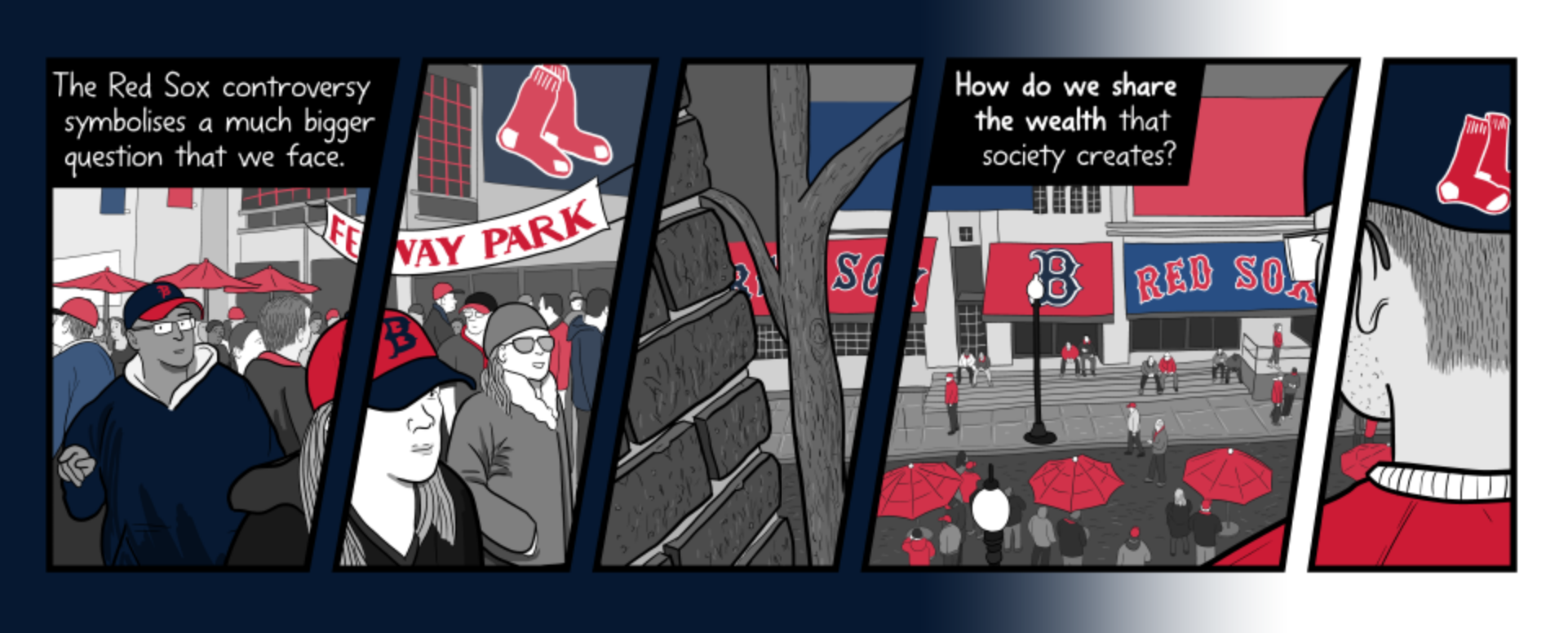
McMillen’s strip notes how the entire team won the three other games in the seven-game series, and how the fans had loyally supported the team for generations. The cartoon notes that the City of Boston and State of Massachusetts, played an indirect role by providing streets, electricity, sewer and other infrastructure for the Fenway Park stadium in which the Red Sox play. 

In our blog, Jon Rowe and I wrote:

The value of a business, resource, historic baseball or whatever does not reside solely in the thing. Nor does it arise from the efforts of an entrepreneur alone. Value is, rather, a co-production between an individual, society and nature; and the latter two often play the larger part. Land values, for example, are almost entirely a social product. That’s why two acres near an urban freeway exchange or subway stop can fetch more than does an equal amount of land in the middle of a desert.

The question is less what the owner did, than what others did around him, individually and through government. So, too, with music, inventions – just about everything. These accomplishments draw on what was done before, and depend on the sustaining presence of society as a whole. Even stocks would have little value without stock markets through which to sell them, and without governments to police – to some degree – those markets. These are social creations all.

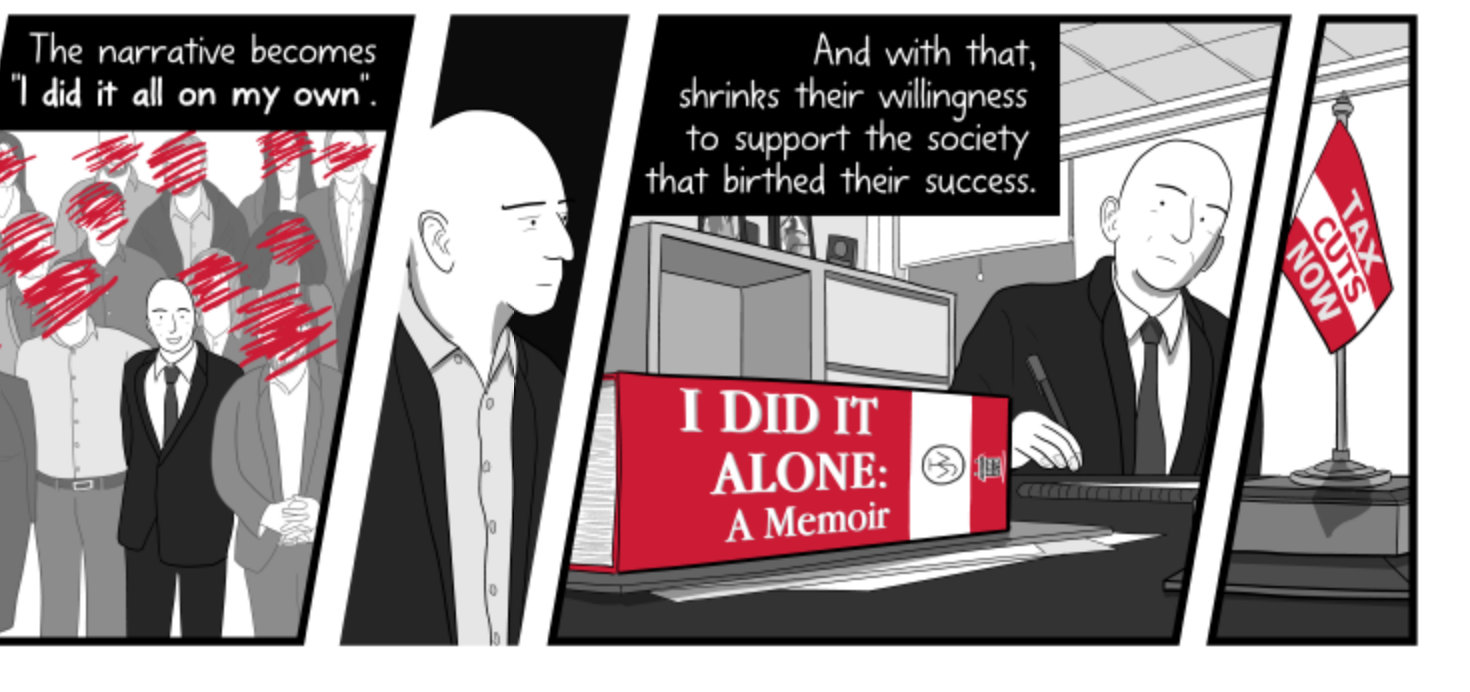
Once we acknowledge the social component of economic value, then discussion of financial return and social policy take a new turn. Taxation, for example, no longer is a matter of “redistributing” someone else’s income, or wealth, but rather of restoring a portion of it to the rightful owners. The acknowledgment of social co-production also dissolves the myth of the heroic individual businessman or woman as “self-made.” Individuals may do great things, but as Warren Buffett – who knows something about making money – has pointed out, none do it alone.

Stuart McMillen’s strip makes these points wonderfully vivid. In an accompanying blog post, he elaborates on the public factors that contribute to individual success. His "self-made" executive bears a striking and deliberate resemblance to Jeff Bezos of Amazon, the world's richest man.  

McMillen's principal interests are environmentalism, post-growth economics, and human psychology, but he also deals with such diverse topics as Buckminster Fuller, religion, energy, and drugs. He supports himself through a crowdfunding page at which 169 individuals have so far pledged a cumulative US$1,223 per month. He aspires to be the first crowdfunded Australian cartoonist to earn a median income for his country. You can contribute to his work at the crowdfunding site Patreon.

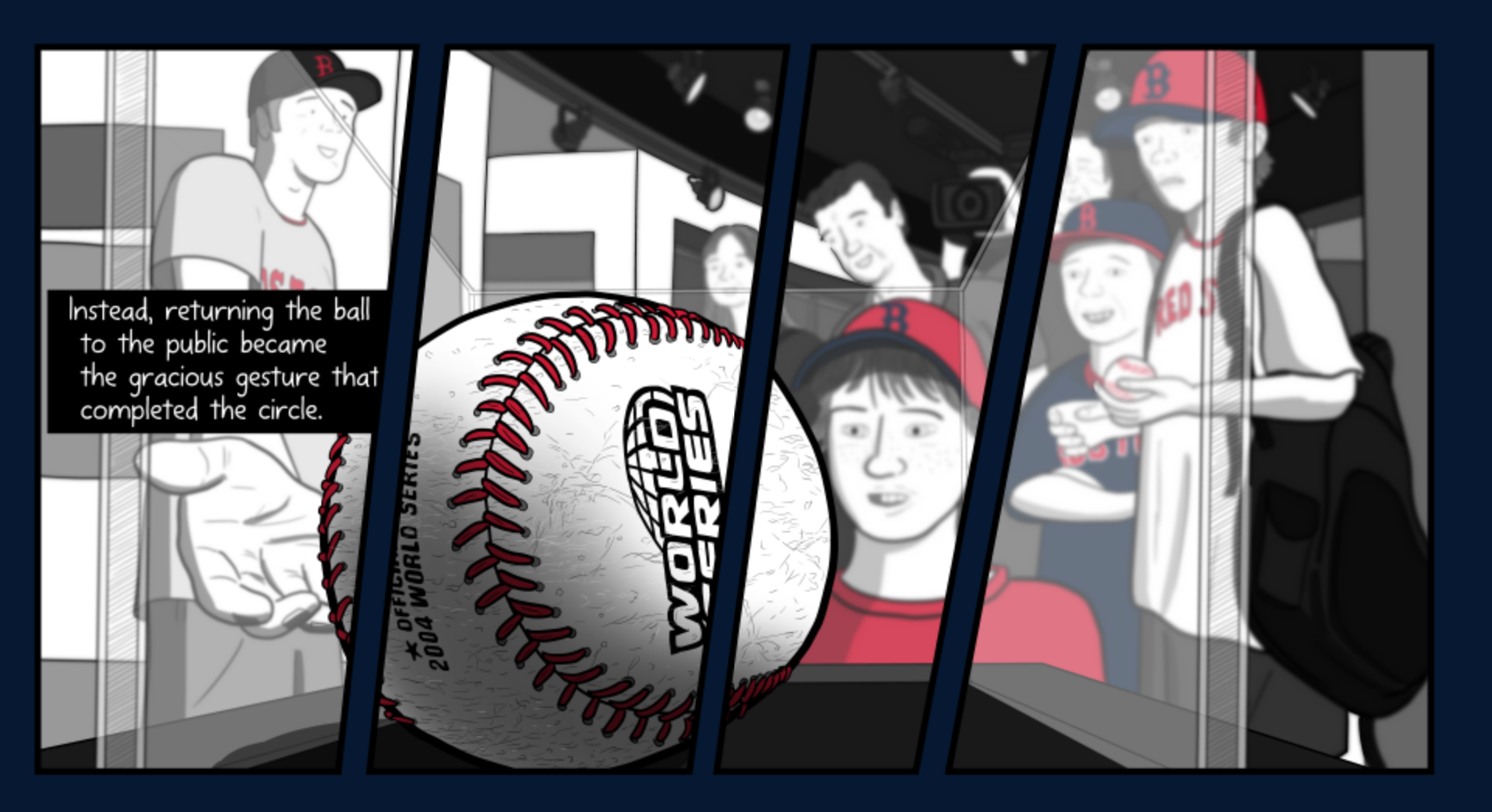
By the way, a shamed first baseman Mientkiewicz eventually agreed to return the ball so it could be put on display. It was an implicit acknowledgment that the Red Sox's success in the World Series stemmed from many sources generously working together.


Youth Collaboratory Accepting Applications Until July 1st

For younger folks excited to build their civic power, Citizen University is accepting applications for their 2020 Youth Collaboratory cohort! The Youth Collaboratory is an exciting opportunity for 24 high school sophomores and juniors, who are passionate about civic engagement, to join this year-long program to strengthen civic literacy and network with civic leaders. Applications are due Monday, July 1st – so make sure to share with your networks and submit applications ASAP. You can read more about the Youth Collaboratory and how to apply in the post below, and find the original version of this information on Citizen University’s site here.


Empowering the Rising Generation: Youth Collaboratory

The Youth Collaboratory is a year-long program to empower and connect a rising generation of civic leaders and doers.

24 highly-motivated students from around the country will join Citizen University and travel to cities around the nation, meeting leading civic innovators, sharpening their literacy in citizen power and producing their own independent projects in their communities.

This is a unique and exciting opportunity to be connected to a network of incredible change-makers and gain skills and connections for a lifetime of civic power.

In this era of economic and political inequality, the work of power literacy is especially urgent, nowhere more so than in the rising generation of young people who will be facing the consequences of today’s polarization and inequality for years to come.

Members of the Youth Collaboratory participate in interactive workshops led by Eric Liu and Citizen University educators, collaborate with Citizen U staff to develop programs to engage youth nation-wide, and individually complete projects in their communities. Each cohort meets three times, in three different locations.

Armed with the knowledge, skills, connections, and experience of the Youth Collaboratory, our diverse cohort of passionate young people will be prepared to be true leaders of civic change in America for the next generation.

The 2020 Youth Collaboratory Cohort will begin in October 2019.

Sign up on our interest form to receive information about Citizen University’s youth programs.

You can find the original version of this information on the Citizen University site at www.citizenuniversity.us/programs/youth-collaboratory/.

Frontiers of Democracy and summer institutes: coming up

The more-or-less final agenda for Frontiers of Democracy 2019 is up. We are oversold. If you want to attend and don’t have a ticket, you can email me to get on the waiting list. The talks on June 20 will be video-recorded and archived later (but not live-streamed.)

Before Frontiers and feeding into it are three other meetings:

And following the Frontiers conference will be the 11th annual Summer Institute of Civic Studies, for about 20 selected professors, graduate students, and activists from Argentina, China, Iran, Mexico, Spain, and the USA.

Participants in these groups, plus about 16 alumni of past Summer Institutes, plus another 50 people who simply signed up to attend will all convene at Frontiers.

Since I am in charge of ICER, Frontiers, and the Summer Institute, blogging has been light for the past week or so, and the forecast is for continued sporadic posting here–although I traditionally blog about some of the themes that arise.

Join Democracy Beyond Elections Campaign Kick Off in NYC

We are thrilled to share this exciting announcement from our friends at the Participatory Budgeting Project – an NCDD member organization, in collaboration with Civic Hall, for the national kick off of the Democracy Beyond Elections campaign. This campaign seeks to strengthen democratic engagement and participation between and beyond elections and we strongly encourage folks in the network to be present if they can when this new effort launches on Monday, June 24th at Civic Hall in New York City. Learn more about this new effort to amplify participatory democracy in the post below and find the original information on the Eventbrite page here.


Democracy Beyond Elections: A New Deal for Our Broken Democracy?

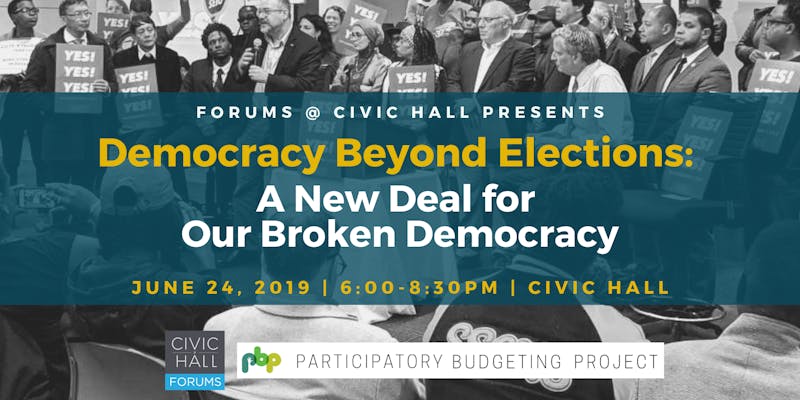
Join the Participatory Budgeting Project and Forums @ Civic Hall for the national kick off of the Democracy Beyond Elections campaign. We are convening to build support for a democracy that deepens participation and civic engagement beyond and between elections, and creates a pipeline for diverse and equitable community leadership.
Learn about top new models of participatory democracy, including Ireland’s National Citizen Assembly, Scotland’s Community Empowerment Act, Spain’s Decide Madrid, and New York City’s Civic Engagement Commission and Participatory Budgeting. Be inspired by how community and government leaders from these programs have used participatory democracy to equitably reshape government policy and spending on issues such as abortion, climate change, and transportation.

We’re asking questions like:

  • Why is trust in government so low?
  • Can we unrig our systemically undemocratic government structure so it reflects the majority rather than the privileged elite?
  • How could participatory democracy support social movements for equity and give more power to historically marginalized people?
  • How can we leverage moments of political and economic crisis to win structural changes in government?
  • How is participatory democracy different from and related to electoral politics?
  • How can we bring government by the people to scale in the U.S.?

The evening will start with a brief overview of the Democracy Beyond Elections campaign from Shari Davis, Co-Executive Director at the Participatory Budgeting Project. Guest speakers will then share their experience with expanding or engaging with participatory democracy practices, before moderated conversation and audience discussion. Speakers include:

Miguel Arana Catania | Director of Citizen Participation, City of Madrid

Louise Caldwell | Entrepreneur, Member of Ireland Citizens Assembly

Fiona Garven | Director, Scottish Community Development Centre and Community Health Exchange

Sarah Sayeed, Ph.D | Chair, Civic Engagement Commission | Senior Advisor, Community Affairs Unit, New York City Mayor’s Office

Doors open at 5:50 pm, we start promptly at 6:15 pm.

This event is coordinated by Forums @ Civic Hall and the Participatory Budgeting Project, in partnership with the Center for Popular Democracy, Generation Citizen, Everyday Democracy, and People’s Action.

Support for this program was provided by the Ford Foundation and the Robert Wood Johnson Foundation. The views expressed here do not necessarily reflect the views of the foundations.

For more information visit https://www.participatorybudgeting.org/dbe/.

You can find the original version of this information on the Eventbrite page at https://www.eventbrite.com/e/democracy-beyond-elections-a-new-deal-for-our-broken-democracy-tickets-62891807088

Online D&D Events Feat Courageous Leadership Project

This week’s roundup features events from NCDD sponsor org The Courageous Leadership Project, NCDD member organizations MetroQuest and  Living Room Conversations, as well as, from the America Indivisible, International Association of Facilitators (IAF), International Associate for Public Participation (IAP2), and more.

NCDD’s online D&D event roundup is a weekly compilation of the upcoming events happening in the digital world related to dialogue, deliberation, civic tech, engagement work, and more! Do you have a webinar or other digital event coming up that you’d like to share with the NCDD network? Please let us know in the comments section below or by emailing me at keiva[at]ncdd[dot]org, because we’d love to add it to the list!


Upcoming Online D&D Events: Courageous Leadership Project, MetroQuest, Living Room Conversations, NIFI, America Indivisible, IAF

The Courageous Leadership Project webinar – Brave, Honest Conversations™

Wednesday, June 12th
9 am Pacific, 12 pm Eastern

Some conversations are hard to have. Fear and discomfort build in your body and you avoid and procrastinate or pretend everything is fine. Sometimes you rush in with urgency, wanting to smooth things over, fix them, and make them better. Sometimes you go to battle stations, positioning the conversation so you have a higher chance of being on the “winning” side. NONE OF THIS WORKS. Instead, it usually makes a hard conversation harder; more divided, polarized, and disconnected from others. The more people involved, the harder the conversation can be. I believe that brave, honest conversations are how we solve the problems we face in our world – together.

In this webinar, we will cover: What is a Brave, Honest Conversation™? Why have one? What can change because of a brave, honest conversation? How do you have one? What do you need to think about and do? How do you prepare yourself for a brave, honest conversation?

REGISTER: www.bravelylead.com/events/bhcfreewebinar

MetroQuest webinar – Millennials to Boomers | How MDOT Involved 6,300 for Its LRTP

Wednesday, June 12th
11 am Pacific | 12 pm Mountain | 1 pm Central | 2 pm Eastern (1 hour)
Educational Credit Available (APA AICP CM)
Complimentary (FREE)

Is traditional public involvement getting old? While transportation matters to residents of all ages, few attend public meetings. That’s why Michigan DOT went online to engage the broader public when it began working on a completely new state long range transportation plan (SLRTP).

Times are changing. On June 12th, find out how Michigan DOT and WSP joined forces to engage 6,300 people to uncover their evolving transportation priorities for the Michigan Mobility 2045 SLRTP. Join Shane Peck, Anita Richardson, Brad Sharlow, and Kyle Haller as they share what they learned about public preferences for modal tradeoffs, infrastructure investments, intelligent technologies, and transit

REGISTER: http://go.metroquest.com/Millennials-to-Boomers-How-MDOTs-LRTP-Involved-6300.html

America Indivisible webinar: Facing Our Civic Health Crisis; Local Strategies to Fight Anti-Muslim Bigotry

Wednesday, June 12th
1 pm Pacific, 4 pm Eastern

Americans of Muslim faith are the least engaged in direct outreach to their elected representatives in national and local government at a time when racialized anti-Muslim bigotry is on the rise. Hear from Paterson, New Jersey’s first Arab American Mayor André Sayegh and local civic leaders from across the U.S. about strategies to build our civic health and fight anti-Muslim bigotry.

REGISTER HERE

Training (free): The Nuts & Bolts of Living Room Conversations

Thursday, June 13th
2 pm Pacific, 5 pm Eastern

Join us for 60 minutes online to learn about Living Room Conversations. We’ll cover what a Living Room Conversation is, why we have them, and everything you need to know to get started hosting and/or participating in Living Room Conversations. This training is not required for participating in our conversations – we simply offer it for people who want to learn more about the Living Room Conversations practice. Space is limited to 12 people so that we can offer a more interactive experience. Please only RSVP if you are 100% certain that you can attend.

REGISTER: www.livingroomconversations.org/event/training-free-the-nuts-bolts-of-living-room-conversations-11/

Online Living Room Conversation: The Power of Empathy: 90-Minute Conversation w/ Optional 30-Minute Bonus Round!

Thursday, June 13th
4 pm Pacific, 7 pm Eastern

Empathy goes beyond concern or sympathy. Empathy is stepping into the shoes of another with the intention to better understand and feel what they are experiencing. The power of empathy can bridge our “us vs. them” perceptions and lead to new solutions, improved relationships, better strategies for social change, reduction in loneliness, and realization of our shared human needs and oneness. This conversation is about sharing experiences giving, receiving, and observing empathy. Here is the conversation guide.

REGISTER: www.livingroomconversations.org/event/the-power-of-empathy-90-minute-conversation-w-optional-30-minute-bonus-round/

International Association of Facilitators webinar – Sharing IAF Brand Best Practices

Friday, June 14th
9 am Pacific, 12 pm Eastern

Sharing IAF Brand Best Practices is a webinar to get inspired by the many ways members, chapters and events are branding their Facilitation Activities.

REGISTERwww.iaf-world.org/site/events/sharing-iaf-brand-best-practices-0

International Association of Facilitators webinar – Becoming a CPF with the IAF

Wednesday, June 19th
8 am Pacific, 11 am Eastern

Making the decision to seek the IAF Certified™ Professional Facilitator (CPF) accreditation can be hard. Common questions people ask are What’s involved? How much time will it take? Will I meet the requirements? and What if I don’t pass? In response to strong interest from members, we will be exploring these questions at a webinar with hosts that have years of experience as professional facilitators and as IAF Assessors.

REGISTERwww.iaf-world.org/site/events/webinar-becoming-cpf-iaf-9

Online Living Room Conversation: Communicating With Care – 90-Minute Conversation w/ Optional 30-Minute Bonus Round!

Thursday, June 20th
4 pm Pacific, 7 pm Eastern

We may want to communicate with others in such a way that we gain knowledge and bridge divides, but those conversations don’t always come naturally. Most of us struggle to self-evaluate our communication skills and we might be unaware of words and actions that shut down healthy dialogue when discussing divisive issues. In this conversation, we will actively share and explore what works and what doesn’t, and we will reflect on ways that we can improve our interactions with others. Here is the conversation guide.

REGISTER: www.livingroomconversations.org/event/communicating-with-care-90-minute-conversation-w-optional-30-minute-bonus-round/

June CGA Forum Series: Climate Choices: How Should We Meet the Challenges of a Warming Planet?

Friday, June 21st
1 pm Pacific, 4 pm Eastern

Please join us for a Common Ground for Action (CGA) online deliberative forum on Friday June 21st @ 4pm ET/1p PT on the topic of ”Climate Choices: How Should We Meet the Challenges of a Warming Planet?” If you haven’t had a chance to review the issue guide, you can find a downloadable PDF copy at the NIF website: https://www.nifi.org/en/issue-guide/climate-choices

REGISTER: www.nifi.org/en/events/june-cga-forum-series-climate-choices-how-should-we-meet-challenges-warming-planet

A Bold Agenda for Treating Land as a Commons

The privileges of land ownership are so huge and far-reaching that they are generally taken as immutable facts of life – something that politics cannot possibly address. A hearty salute is therefore in order for a fantastic new report edited by George Monbiot, the brilliant columnist for The Guardian, and a team of six experts.  The report, “Land for the Many:  Changing the Way our Fundamental Asset is Used, Owned and Governed,” lays out a rigorous, comprehensive plan for democratizing access and use of land. 

“Dig deep enough into many of the problems this country faces, and you will soon hit land,” writes Monbiot. “Soaring inequality and exclusion; the massive cost of renting or buying a decent home; repeated financial crises, sparked by housing asset bubbles; the collapse of wildlife and ecosystems; the lack of public amenities – the way land is owned and controlled underlies them all. Yet it scarcely features in political discussions.” (The six report coauthors are Robin Grey, Tom Kenny, Laurie Macfarlane, Anna Powell-Smith, Guy Shrubsole and Beth Stratford.).

The report contains recommendations to the British Labour Party as it develops a policy agenda in preparation for the next general election. Given that much of the world suffers from treating land as a speculative asset, the report could be considered a template for pursuing similar reforms around the world. (Monbiot’s column summarizing the report can be found here.)  

For me, the report is quite remarkable:  a rigorous, comprehensive set of proposals for how land could be developed, used, and protected as a commons.

There are succinct, powerful sections on making land ownership data more open and available; ways to foster community-led development and ownership of land (such as a “community right to buy”); and codifying a citizen’s “right to roam” on land for civic and cultural purposes. One effective way to curb speculative development and revive farming and forestry is by creating community land trusts and curbing tax privileges and subsidies.

The bald financial realities about land are quite troubling. The report notes that in the UK, “land values have risen 544% since 1995, far outpacing any growth in real incomes.” Housing is simply unaffordable for many people. “Two decades ago, the average working family needed to save for three years to afford a deposit [downpayment] on a home,” the report notes. “Today, it must save for 19 years.”

Much of the blame can go to tax laws and other policies that encourage people to treat homes as financial assets. This fuels fierce speculation in housing that raises prices, greatly benefiting the rich (landowners) and impoverishing renters. Similarly, thanks to speculation and tax subsidies, wealthy landowners consolidate more land while small farmers are forced to give up farming.  Fully one-fifth of English farms have folded over the past ten years. 

Politicians are generally far too wary to propose solutions to these problems. It would only enrage a key chief constituency, the wealthy, and alienate some in the middle class who aspire to flip homes as a path to wealth. But there are in fact many ways to neutralize the speculative frenzy associated with land and mutualize the acquisition and control of land to make something that can benefit everyone.  

Land for the Many recommends a shift in “macroprudential tools” – financial assessments of systemic risk – to prod banks to make fewer loans for real estate and more loans that help productive sectors of the economy. The report also urges restrictions on lending to buyers intending to rent their properties.Other healthy ways to make land more accessible and affordable for all:  a progressive property tax on land; a reduction of tax exemptions for landowners; and a cap on permissible rent increases at no more than the rate of wage inflation or the consumer price index, whichever is lower.

Since profit-driven development can have catastrophic long-term effects on ecosystems, wildlife, and future generations, the report calls for the creation of Public Development Corporations. These entities would have the power to purchase and develop land in the public interest.

I especially like the idea of creating a Common Ground Trust, a nonprofit institution to help prospective homebuyers buy homes. As the request of a buyer, the Trust would buy the land underneath a house and hold it in trust for the commons. Since land on average represents 70% of the cost of a house, the Trust’s acquisition of land under housing would greatly reduce the upfront downpayments that buyers must make. “In return,” write Monbiot et al., “the buyers [would] pay a land rent to the Trust.”  Home buyers could reap any appreciation in value of their house, but land would effectively be taken off the market and its value would be held in the commons.

“By bringing land into common ownership, land rents can be socialized rather than flowing to private landlords and banks,” the report notes. “Debt-fueled and speculative demand can be reined in without the risk of an uncontrolled or destabilizing fall in values.”

Land for the Many is major achievement. It consolidates the progressive case for land reform and explains in straight-forward language how law and policy must change. Of course, the politics of securing this agenda would be a formidable challenge. But given the grotesque inequalities, ecological harms, declines in farming, and unaffordable housing associated with the current regime of land ownership, this conversation is long-overdue.

Listen to Confab Recording on Using Slack for Democratic Movement Building

We had a wonderfully engaging call last Thursday to learn more about the capabilities of using the collaborative platform, Slack, to further connect the D&D field and growing Democracy Movement. The call was co-hosted with our friends at the Bridge Alliance who discussed a new effort launched recently on the platform called the Democracy Movement Slack Forum and gave us a preview of the new space. If you weren’t able to join the call, we encourage you to listen to it now!

We were joined by Walt Roberts who gave the 45 participants on the call a quick tour of Slack and how the platform streamlines communication by bringing text, email, and direct messaging altogether. The way the platform is designed lends itself well to the growing Democracy Movement Slack Forum (DMFS), in how it offers space for participants to self-organize and create action together. Walt shared with us how this space was developed; growing from the Unrig the Summit 2018 conference and catalyzed by the desire to fix our broken and rigged political system. He discussed the evolution of the working title, the Democracy Movement, and how it is really a movement of many movements, across the spectrum of ideologies.

Phase two is currently in progress, in which the organizers of the Slack space are looking to bring in those groups and leaders who are doing Democracy building work. It’s meant to be a collaborative space for people to work together in nonpartisan ways and co-develop this growing Democracy Movement. If you are interested in participating in the DMFS, please reach out to keiva[at]ncdd[dot]org for the information on how to join! We’ve set up a channel on the DMFS called #group_ncdd_forum that we encourage you to join if you’re already onboard the Slack space!

Here are some of our favorite takeaways from the Confab call:

  • Slack brings an “open space” like way of self-organizing conversations and helps bring order to the chaos of multiple streams, threads, and branches of conversation.
  • The Democracy Movement is a broad term that encompasses all efforts to get our country back on track and spans the ideological spectrum.
  • The Democracy Movement Slack Forum is a collaborative work, conversation, & community space for those who seek to work together in nonpartisan ways to co-develop a big democracy movement, reduce silos & build a shared infrastructure.

We had an engaging conversation in the chat discussion and you can view saved the transcript of  it here. We recorded the whole presentation in case you weren’t able to join us, which you can access by clicking here. While access to the Confab recordings is usually a benefit of being an NCDD member, we have made an exception with this one in order for more folks to join the DMSF and co-create this movement. If you like what you experience, we’d love for you to join as an NCDD member (if you haven’t already!) and learn more about the sweet benefits of being part of the NCDD Coalition here!

Confab bubble image

We want to thank Walt, Jeremy and the Bridge Alliance team, for making this call happen! And an equally large thank you to all the Confab participants for contributing to this conversation! To learn more about NCDD’s Confab Calls and hear recordings of others, visit www.ncdd.org/events/confabs.

Finally, we love holding these events and we want to continue to elevate the work of our field with Confab Calls and Tech Tuesdays. It is through your generous contributions to NCDD that we can keep doing this work! That’s why we want to encourage you to support NCDD by making a donation or becoming an NCDD member today (you can also renew your membership by clicking here). Thank you!

See you on Slack!

New Research on Participatory Governance and Tax Compliance

At the World Bank, we have published two new studies on the effect of citizen engagement on tax morale and tax compliance.

In the first, published last month, we examine the Brazilian case, using data from all 5,570 municipalities in the country. We focus on two types of institutions that municipalities can voluntarily adopt to give citizens the opportunity to voice their preferences on policies and spending: public policy councils and participatory budgeting. Municipalities who adopt these practices collect significantly more local taxes. For instance, the adoption of participatory budgeting leads to the collection of up to 39% more tax revenues. Overall, the increase in municipal budgets is equivalent to roughly 40% of their capital investment spending.

But how context-dependent are these findings?

In the second study, published last week, we present results from the largest cross-country experiment ever conducted on tax morale. A unique online experiment, the study involved 65,000 individuals across 50 countries from all continents. Our results show that regardless of government systems, levels of development and culture, citizens are more committed to tax compliance when they: i) are able to voice their preferences about government spending, and ii) learn about government oversight of public resources.

I hope you will enjoy the reading.

Of Governance and Revenue: Participatory Institutions and Tax Compliance in Brazil

Michael Touchton, Brian Wampler and Tiago C. Peixoto

Abstract: Traditionally, governments seek to mobilize tax revenues by expanding their enforcement of existing tax regimes and facilitating tax payments. However, enforcement and facilitation can be costly and produce diminishing marginal returns if citizens are unwilling to pay their taxes. This paper addresses gaps in knowledge about tax compliance, by asking a basic question: what explains why citizens and businesses comply with tax rules? To answer this question, the paper shows how the voluntary adoption of two different types of participatory governance institutions influences municipal tax collection in Brazil. Municipalities that voluntarily adopt participatory institutions collect significantly higher levels of taxes than similar municipalities without these institutions. The paper provides evidence that moves scholarship on tax compliance beyond enforcement and facilitation paradigms, while offering a better assessment of the role of local democratic institutions for government performance and tax compliance.

Voice and Punishment : A Global Survey Experiment on Tax Morale

Fredrik M. Sjoberg, Jonathan Mellon, Tiago C. Peixoto, Johannes Hemker and Lily L. Tsai

Abstract: An online survey experiment spanning 50 countries finds sizable improvements in tax morale when (a) the salience of anti-corruption efforts is increased and (b) citizens are allowed to voice their expenditure preferences to the government. These results hold very broadly across a uniquely large and diverse sample of respondents from all continents. The findings are consistent with theories emphasizing the role of democratic accountability, as well as of perceptions of legitimacy and “retributive justice,” in generating voluntary tax compliance. Implications and avenues for further research are discussed.