Join Call on Bridging Divides Using Civil Discourse

As part of our #BridgingOurDivides and desire to lift up this important work, we wanted to share this upcoming call with the Orton Family Foundation, which will feature practical tips on bridging divides using civil discourse. This free event on Sept 28th will feature long-time NCDD member Carolyn Lukensmeyer of the National Institute for Civil Discourse and Thom Harnett the mayor of Gardiner, Maine. We encourage you to read the post from Orton Family Foundation and register for the call below or read the original here.


Heart & Soul Talks: Bridge Divides with Discourse that’s Civil

Orton LogoTaking on controversial issues is a challenge that every community faces. How those issues are approached can make the difference between a community that thrives and one where divides erode a community’s vitality.

Join us for insight and practical ideas and tools for advancing civil discourse from nationally-recognized expert in the field, Carolyn J. Lukensmeyer, executive director of the National Institute for Civil Discourse, and Thom Harnett, mayor of Gardiner, Maine, who has led the way in welcoming new residents, embracing the value they bring to the town, sometimes in the face of protest.

Speakers:

Dr. Carolyn J. Lukensmeyer, executive director, National Institute for Civil Discourse

As a leader in the field of deliberative democracy, Dr. Lukensmeyer works to restore our democracy to reflect the intended vision of our founding fathers. She previously served as Founder and President of AmericaSpeaks, an award-winning nonprofit organization that promoted nonpartisan initiatives to engage citizens and leaders through the development of innovative public policy tools and strategies.

Thom Harnett, mayor, Gardiner, Maine.

Thom, now serving his third term as mayor of Gardiner, Maine, recently retired from the state Office of the Attorney General where he had served as an assistant attorney general, and established Civil Rights Teams in more than 220 schools statewide. Thom was active in Gardiner’s Community Heart & Soul® project.

Fran Stoddard, moderator

A national award-winning producer of video programs, Fran produced and hosted Vermont Public Television’s weekly “Profile” interview program for more than a decade. She frequently serves as moderator for community events and has served on numerous non-profit boards.

This FREE event is 2-3 p.m. Eastern, Thursday, September 28. Can’t join us live? Register and we’ll send the call recording.

Heart & Soul Talks features stories and insight from Community Heart & Soul®, a community development model that builds stronger, healthier, and more economically vibrant small cities and towns. Learn more at orton.org.

You can find the original version of this announcement at www.eventbrite.ca/e/heart-soul-talks-bridge-divides-with-discourse-thats-civil-registration-37129446173?aff=es2.

Second Phase of D&D training with Am. Library Association

In the beginning of the year we launched our two-year partnership with the American Library Association (ALA) on the Libraries Transforming Communities: Models for Change initiative. For this collaborative project, we are working to train librarians on D&D methods and processes which they can in turn share with their communities to further make libraries hubs of community engagement and agents for change. We were thrilled at the response during the first phase of the project, which focused on large and urban libraries featuring NCDD member orgs Everyday Democracy and World Café.

Starting in September will be the second phase of the project, to provide D&D training tailored to academic libraries and further deepen the impact these spaces have on collaborative change on campuses. This round is comprised of three webinars featuring NCDD member orgs Essential Partners and National Issues Forums; and those that attend all three webinars will be invited to the in-person pre-conference workshop at the 2018 ALA Midwinter Meeting early next year. This partnership is an incredible opportunity to share the work of our field and increase the possibilities for our members to network with librarians over the long-term. We encourage you to read the announcement from ALA below and you can find the original here.


Announcing Free Dialogue & Deliberation Learning Series for Academic Libraries

ALA’s Public Programs Office, the Association of College & Research Libraries (ACRL) and the National Coalition for Dialogue & Deliberation (NCDD) invite academic library professionals to attend a free learning series that teaches several dialogue facilitation approaches and helps librarians position themselves to foster conversation and lead change on their campuses and beyond.

Through Libraries Transforming Communities: Models for Change, a two-year ALA initiative in collaboration with NCDD, academic library professionals can participate in three online learning sessions and one in-person workshop, all free of charge, between September 2017 and February 2018.

Attendees of this professional development training will learn to convene critical conversations with people with differing viewpoints; connect more meaningfully with library users and better meet their needs; and translate conversation into action.

Registration is currently open for three online sessions:

Each session will be recorded and archived for free on-demand viewing on the Programming Librarian Learning page.

Individuals who view all three webinars, live or recorded, will be invited to attend the free, one-day pre-conference workshop at the 2018 ALA Midwinter Meeting in Denver (Feb. 9 to 13, 2018). Details about the pre-conference will be available in fall 2017 and will be shared during the webinars.

LTC: Models for Change is made possible in part by the Institute of Museum and Library Services (IMLS) grant number RE-40-16-0137-16.

You can find the original version of this announcement on the ALA’s Programming Librarian site at www.programminglibrarian.org/articles/announcing-free-dialogue-deliberation-learning-series-academic-libraries.

Opportunity to Facilitate Ben Franklin Circles

We are excited to announce that NCDD is working with New York’s 92nd Street Y to support, The Ben Franklin Circles (BFC), a project in collaboration with Citizen University and the Hoover Institution. BFC – an NCDD member org, could use some facilitation support and that’s where NCDD comes in –  we have an exciting opportunity for you!

The Circles are inspired by Benjamin Franklin’s junto or “mutual improvement club,” – a sort of civic engagement support group the founding father started and ran for over 40 years.  In this 21st Century reboot, small groups of people get together once a month to reflect on big themes that Franklin identified as key to living a good life and creating a good society – topics like Industry/Work; Justice; Moderation; Thrift/Frugality and more.  There are 13 total.  Participants are encouraged to think about how these principles impact their own lives and how they shape our society, using the conversations as a way to create empathy and strengthen community bonds. Read more about the Circles in our Resource Center.

Here is the opportunity: 92Y has created a platform and toolkit and is offering limited stipends for facilitators to help lead these conversations in their communities. Circles meet once a month for 13 months for about 90 minutes each session. Meetings can be scheduled based on the facilitator’s schedule. 

This is a great opportunity for you to utilize this model, connect with groups in your community, and get paid for your time as well! NCDD would love to see a whole bunch of you get involved with Circles across the country. It’s another great way we can work to strengthen community connections and help people bridge divides, at this particularly divisive time in our nation. And many of you have the networks with interest in these kinds of conversations!

If you are interested in this opportunity and would like to connect with organizers to learn more, please fill out this quick form here and they will contact you to discuss this opportunity further! 

For more information, please visit: benfranklincircles.org. You can follow BFC on Facebook, Instagram, and on Twitter at @BFCircles as well as the hashtag #BenFranklinCircles.

Transpartisan Review Issue #2 Now Available

I’m excited to announce the latest issue of a project produced by a handful of members and friends of NCDD – The Transpartisan Review #2. Originally introduced to the NCDD community last fall at our NCDD 2016 conferenceThe Transpartisan Review is a new digital journal dedicated to sharing thoughts and insights from the growing transpartisan community.

In our second issue, The Transpartisan Review takes an introspective look at the state of politics in the US and examines the potential transpartisan engagement has in finding solutions for this troubled time. Executive editors Lawrence Chickering and James Turner explore the effect the transpartisan impulse has on political engagement, taking a comprehensive look at the current political climate in the United States through the lens of their “Transpartisan Matrix”.

This issue of The Transpartisan Review also includes several articles on a variety of topics, including contributions from distinguished NCDD members Pete Peterson & Michael Briand (who also served as managing editor), and shares an account of a Living Room Conversation focused on transpartisan issues. Not only are they effective conversation starters, but these features represent the continuation of a dialogue the editors of the journal are encouraging with and between its readership.

You can read the entire issue online or download it for free at the journal’s website, www.transpartisanreview.com, and while you’re there, we invite you to read Chickering and Turner’s Transpartisan Notes, a series of short-form articles on current issues written with a transpartisan perspective.

You can look forward to more critical contributions to the work of bridging our nation’s divides in future issues of The Transpartisan Review and from this great team of NCDDers and transpartisan leaders in the coming months.

NCDD Sponsor Shares Nevins Fellow Experience

NCDD has been part of the ongoing effort by Penn State’s McCourtney Institute for Democracy, to connect students from their Nevins Democracy Leaders Program to internships with individuals and organizations in the D&D, public engagement field. Which is why we are excited to share this blog piece from NCDD sponsor org The Jefferson Center about their recent intern’s experience working on the Minnesota Community Assembly Project. The Nevins Democracy Leaders Program is an incredible opportunity to host a D&D-trained student at no cost for two months during the summer.  You can learn more about the Nevins Democracy Leaders Program by checking out our earlier write-ups on the blog here and by listening to the Confab Call recording here.

We encourage you to read the Jefferson Center blog post below and you can find the original version on their site here.


The Minnesota Community Assemblies: Red Wing

This June and July the Jefferson Center hosted a Penn State student, Emma Rohan, made possible by Penn State’s Nevins Fellows program. Emma’s academic work focuses on education policy, and she came to us with experience in the field of deliberative democracy. While she was here, we were grateful for Emma’s support in the first of three Minnesota Community Assemblies — Red Wing. Below is Emma’s reflection on the experience.

It’s been an exciting and engaging start to the Minnesota Community Assembly Project (MNCAP)! This project, part of our Democratic Innovation Program, began in Red Wing over the course of three weekends. On Friday, June 9, participants gathered in the Red Wing Ignite event room, brimming with expectation and more than a little caffeine.

Eight full days of deliberation is a lot of work and commitment, but the thirty-six Red Wing citizens were in it for the long haul. Before they got down to business, participants had the chance to introduce themselves to their neighbors by sharing what they are sacrificing in order to be present at the Citizens Assembly. Taking care of children, enjoying free weekends with family, and going to work are just a few of the activities that participants agreed to forgo for this eight-day project, acknowledging that engaging in citizen-led democracy sometimes involves personal sacrifice.

These participants, randomly selected to reflect the demographics of their community, set out to learn about local government, discuss strengths and areas for improvement, identify the values underpinning good local government, and explore and recommend opportunities to ensure their local government reflects these values.

Participants learned about local government structures from experts around the globe – from Minnesota to Australia. Each equipped with a tablet, participants could vote on their preferred alternatives while visual representations of the results revealed themselves on the big screen. Bonds were forged as citizens helped each other navigate the digital voting system on their tablets.

During the second weekend, June 23-25, two guests joined the assembly in Red Wing to observe, though neither were new to the process. In the case of Ned Crosby, the founder of the Jefferson Center, this was an opportunity to see old processes in a new setting. As the creator of the Citizens Jury process in the United States, Dr. Crosby took the backseat this time, taking note of participation dynamics and exchanging ideas with our other guest observer, Neall Ireland.

A participant in a Canadian province-wide Citizens Assembly in British Columbia in 2004, Neil was captivated by the experience and makes it a habit to seek out opportunities to watch other assemblies in action around the globe: “I really enjoyed observing the Citizen’s Jury; found it particularly interesting to see how there is a common theme for in this type of process for the participants. It is my thought when educated to the issues and empowered, citizen participation truly is the most effective method of engagement and means to making impactful decisions for a constituency. I admire each of the individuals who have come forward to donate their time and contribute to their communities in a meaningful way. I am certain that each of the three communities engaged in the this process will move forward from it in a positive way and be a great example for other communities in the future.”

As the process moved along, time revealed that even cohesive and unified communities carry underlying tension. Discussions on participation responsibilities and representation in local government sparked contention, and the facilitated conversation unearthed divergent expectations and assumptions between community members. With careful attention paid to group dynamics and how a deliberation space may advantage some and silence others, it was refreshing to notice participants sort out their disagreements themselves over a snack break.

Citizens Juries aimed at the prospect of equipping people to evaluate the structure of their local governments and the platform to recommend changes is an undertaking which requires special consideration toward the role of the facilitator. As outsiders in a tight-knit community, the Jefferson Center team realizes the value of presentation of unbiased materials, giving participants space to share and respond to each other, and knowing when to step in to move the conversation along. Even so, navigating uncharted territory comes with miscalculations and oversights. End-of-the-day surveys gave participants the opportunity to share their feedback on the content and process of the event from a facilitation standpoint, and changes were incorporated in order to steer the group in the right direction.

The final weekend in Red Wing presented some of the largest challenges yet, while simultaneously inspiring some of the greatest displays of individual hard work and collective responsibility. With the deadline for the final recommendation by the Community Assembly fast approaching, participants worked together to craft their final recommendations and supporting statements, the report representing the culmination of their work together. Decisions about the presentation of the report were far from unanimous, and even after eight-hour days of deliberation, citizens in Red Wing stayed overtime to continue the discussion.

The Red Wing Community Assembly’s vision statement highlights some of the qualities of local government participants agreed were indispensable: “Our community needs a clear strategic vision, with leadership committed to working toward that vision. We’d like to see broad community participation, engagement, and communication – all aspects of transparency – to ensure community members are informed and engaged in developing and implementing our strategic vision and holding leadership accountable.” To accomplish this vision, the assembly advocated for a few alternatives to the status quo, such as ranked-choice voting, stronger financial disclosure requirements , better public meetings, and digital public engagement. It is important to note that support for these recommendations was not unanimous, and citizens had the opportunity to express their personal dissent or further recommendations by submitting a personal statement attached to the final report. See the final report in its entirety here.

By the end of our time in Red Wing, we couldn’t help but notice a renewed sense of ownership and personal stake in many of the citizens toward the governance of their communities. Several people shared new commitments they have undertaken since the Community Assembly got underway: people described their conversations with family and friends about the work they’ve done, several participants mentioned applying for local boards and commissions for the first time, and one participant even wrote a Letter to the Editor in the local newspaper. Regardless of the outcome, the value of forging these types of relationships between communities and their local governments cannot be overstated.

We are enthusiastic about the ways Red Wing will carry on this work beyond the formal process of the Community Assembly and into the community as a whole. One down, with Willmar and Brooklyn Park on deck!

You can find the original version of the Jefferson Center blog post at www.jefferson-center.org/red-wing-summary/.

Summer Resources from the NCDD Community

There have been several new resources recently released in the D&D field that have crossed the path of NCDD staff and we wanted to share a few of the key resources with you here on the blog. These resources will also be catalogued in the NCDD Resource Center and you can learn more about them over there. We know there are many more resources in the NCDD network out there, so let us know what else you are hearing about in the comments below!

NCDDers John Gastil and Katherine Knobloch, along with Justin Reedy, Mark Henkels, and Katherine Cramer wrote the recently published research article, Assessing the Electoral Impact of the 2010 Oregon Citizens’ Initiative ReviewThe report of how the Oregon’s CIR has impacted the electoral politics and voter behavior since it became part of the process in 2010. You can read the article here.

We are excited to let you know the Center for Public Deliberation at Colorado State University recently published the report, Inclusion Around the Cyclewritten by Samantha Maldonado a grad student of NCDD Board Member Martín Carcasson. The report offers strategies for inclusivity of non-dominant voices before, during, and after deliberative processes. You can read Samantha’s report here.

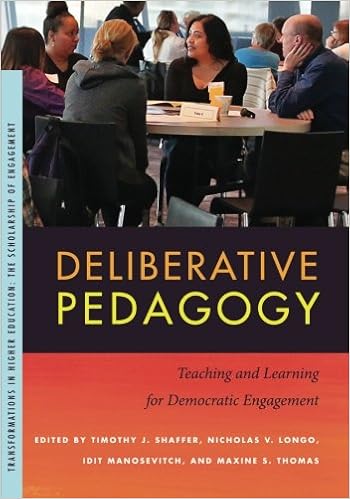
The book, Deliberative Pedagogy: Teaching and Learning for Democratic Engagement was edited by Timothy Shaffer, Nicholas Longo, Idit Manosevitch, and Maxine Thomas. This volume is written for faculty members and academic professionals involved in curricular, co-curricular, and community settings, as well as administrators who seek to support faculty, staff, and students in such efforts. The authors build upon contemporary research on participatory approaches to teaching and learning while simultaneously offering a robust introduction to the theory and practice of deliberative pedagogy as a new educational model for civic life. The book is available on AmazonSmile here and remember when you shop AmazonSmile, they will donate to NCDD on your behalf when you select for donations to go to “The National Coalition for Dialogue & Deliberation, Inc”!

National Civic League released their All-America Conversations Toolkit. All-America Conversations are designed to help cities and other groups understand residents’ aspirations for the community, the divisions facing the community and, most importantly, the small, specific actions that give people a sense of confidence that we can work across dividing lines. The toolkit can be found at: www.nationalcivicleague.org/all-america-conversations/.

We hope you will check out these great resources as part of your summer reading! We’re always impressed with the rich content coming from the D&D community.

Did we miss something? Let us know in the comments what other resources, reports, books, articles, etc. you are reading this summer, or anything you have published recently!


Recap from Frontiers of Democracy 2017

Outgoing NCDD Youth Engagement Coordinator Roshan Bliss attended this year’s Frontiers of Democracy Conference hosted by the Jonathan M. Tisch College of Civic Life at Tufts University in the Boston area. The conference was held from June 22-24 and focused on the theme, Deliberative Democracy in an Era of Rising Authoritarianism.

Around 150 of D&D scholars, practitioners, and leaders participated in workshops, discussions, and plenaries focused on the question of what the rising leaders who appear opposed to democracy around the world means for the field of dialogue, deliberation, and public engagement, and most importantly, how we should respond. The full schedule for Frontiers 2017 is still available to check out here with detailed information on plenaries, speakers, and break out sessions.

NCDDers were prominently featured in the gathering’s schedule, including NCDD Board member Wendy Willis of Deliberative Democracy Consortium, who gave opening remarks on the effect of loneliness on civic life. Roshan presented a workshop on Saturday afternoon with several individuals, including Shari Davis of the Participatory Budgeting Project – a NCDD member org, on the promise and potential of seeing student governments as key venues in which to grow and spread deliberative democracy. Organizational NCDD member Ashley Trim of the Davenport Institute challenged our field to be more genuinely open to conservatives and you can read her poignant talk on Healthy Democracy’s site here. The gathering ended with a challenge from Dr. Archon Fung for our field to rethink the role of power in the work of dialogue & deliberative democracy and to deeply consider that we may not change much without engaging in real ways with efforts to build and wield it.

We wanted to lift up the post-conference reflection piece from Peter Levine, where he explores the direct and indirect paths to deliberative democracy and the future of dialogue and deliberation work. He wrote:

“My main point is that we must consider the choice between direct and indirect paths to deliberative democracy, taking due account of the institutions, incentives, power structures, and social divisions that actually exist in our society.

For what it’s worth, my own view would be that it’s important to build and sustain a movement devoted to explicit work on dialogue and deliberation. Deliberative experiments yield knowledge of group processes, generate models that can be inspiring, and produce a cadre of professionals whose well-deserved reputations for skillful neutrality make them useful at opportune moments.”

For more information on the Frontiers conference, check out the info from Tisch below or on their website here. You can also look through the #demfront hashtag on twitter or this great Storify page that Joshua Miller created of the #demfront hashtag which you can see here.


Frontiers 2017 via Tisch

Thanks to everyone who joined us at an exciting, thought-provoking, and timely Frontiers of Democracy 2017. You can watch video of this year’s introduction, “short take” speakers, and one of our afternoon plenaries, below. (Click on each video’s description for timestamps that allow you to skip to a specific speaker’s presentation.)

Frontiers 2017 was focused on multiple frameworks for civic and democratic work developed respectively by Caesar McDowell of the Interaction Institute for Social Change and MIT, Archon Fung of the Harvard Kennedy School of Government, and Tisch College’s Peter Levine. Our short take speakers included Rev. Dr. F. Willis Johnson, the senior minister of Wellspring Church in Ferguson, Missouri; Wendy Willis of the Deliberative Democracy Consortium and the National Policy Consensus Center; and Hardy Merriman, President of the International Center on Nonviolent Conflict.

In addition, the Journal of Public Deliberation, the Deliberative Democracy Consortium, and The Democracy Imperative held a pre-conference symposium on “Deliberative Democracy in an Era of Rising Authoritarianism.”

More about Frontiers of Democracy
Frontiers of Democracy is an annual conference hosted by the Jonathan M. Tisch College of Civic Life at Tufts University. The event is organized in collaboration with several partners, which in 2017 included Carnegie Mellon’s Entertainment Technology Center and the Deliberative Democracy Consortium.

Now more than ever, the frontiers of democracy are threatened around the world. Leaders and movements that have popular support—yet are charged with being undemocratic, xenophobic, and illiberal—are influential or dominant in many countries. Meanwhile, many peoples continue to face deep and sustained repression. Social movements and networks are confronting this global turn to authoritarianism. This conference brings together scholars and practitioners from  do to defend and expand the frontiers of democracy.

Frontiers of Democracy immediately follows the Summer Institute of Civic Studies, a 2-week seminar for scholars, practitioners, and advanced graduate students.

NCDD Members: Thank You!

On behalf of NCDD’s staff, I wanted to thank all of our members who have joined or renewed their membership over the past several months. You all really stepped up after NCDD announced our membership changes and asked you to take action. NCDD relies on our members support, and we’ve been blown away by your response and commitment to this work!

If you haven’t already, don’t forget to check out how to maximize your membership – there are great benefits, discounts, and opportunities to share news and information with this community! This week we sent out an email to all members letting you know about some upcoming exclusive calls for NCDD members to chat with staff about their work and what they’d like to see the NCDD network talk about in the coming months – be sure to check your email! Our staff look forward to connecting with you soon.

Our member map and directory have been updated to reflect the changes in our membership structure – you can check them out at ncdd.org/map or browse the map below!

We also want to share a big thank you to our very first sponsoring member, the Jefferson Center for New Democratic Processes!

We appreciate the added support a sponsoring membership provides.  We also want to make sure you all know about this great organization! We’ll be sharing more about the Jefferson Center on our website soon (as we will be doing for all sponsoring members), but in the meantime be sure to check out their website at  www.jefferson-center.org.

If you did not get a chance to join or renew your membership before our changes took place – it’s not too late! Be sure to join or renew today, and reinstate your membership!

The NCDD staff thank you all again for recommitting to NCDD and the work of bringing people together across divides to discuss, decide, and take action together. We are constantly inspired by you all and the work you do, and we look forward to connecting with you all soon!

NACRJ 2017: Moving RJ from Margins to Center

Last month, the NCDD team had the pleasure of attending and presenting at the 6th Annual National Conference on Community and Restorative Justice in downtown Oakland, CA. The conference was hosted by the National Association of Community and Restorative Justice (NACRJ) and Restorative Justice for Oakland Youth (RJOY). A whopping 1,300 attendees gathered for the event – which was almost double the attendance from their 2015 conference!

The theme, “Moving Restorative Justice from Margins to Center: We Are the Ones We’ve Been Waiting For” set a powerful energy that carried through the three days we attended. There were three pre-conference training sessions held the day before on June 15th to deepen experience around implementing RJ in schools, utilizing an equity lens for RJ practice, and holistic health for RJ practitioners. The conference included beautiful cultural performances, powerful keynote speakers and plenary sessions, almost 300 presentations, an awards ceremony, and even a concert with Dead Prez.

NCDD staff Courtney, Roshan, and I presented a session on Healing Racial Divides and Addressing Community-Police Relations through Dialogue & Deliberation. In the session, we shared about the NCDD network and the important work being done around bridging racial and community-police divides. Since we were at a conference with RJ practitioners and enthusiasts, we also wanted to tap the knowledge that was in the room. We asked session participants what advice they had to offer people wanting to do police-community and cross-race dialogues. We heard valuable feedback regarding participation, ways to engage, and best practices to consider. Below are some of the large group report-outs:

  • Meet people where they are at, and be authentic. When people are in conflict or upset with you (as law enforcement), listen to what they have to say without your particular lens, and respect them for that without your personal opinion or bias, or institutional opinion or bias.
  • How do we get police to work with us? Form better relationships – engage with schools, young people, community orgs, etc.
  • There is a difference between human-to-human interaction, and police-to-community dialogue where officers can hold humility in the room.
  • There needs to be coordinated community responses – how to engage police, build policies, police being approachable and part of the community, make connections, etc.

There’s more detailed information that participants shared us and we’ve uploaded these notes gathered during the NCDD session, which can be found at https://tinyurl.com/ncddnacrj.

For more information on the overall conference, keep your eye on the NACRJ’s site here for recordings, interviews, and photos. You can also check out the hashtag #NACRJ2017 on Twitter for more photos, quotes, and participant experiences!

Planning for the 7th Annual NACRJ Conference is already underway! Save the date for the next conference in Denver, CO – June 2019!

DDPE Graduate Certificate Offers NCDD Member Discount

We are pleased to share that the Dialogue, Deliberation, and Public Engagement (DDPE) Graduate Certificate program at Kansas State University will offer NCDD members a 10% discount! [Fun fact: the price of your annual NCDD membership pays for itself with JUST this discount and there are so many more benefits!] The DDPE program is an opportunity to strengthen skills and understanding around theory and practice of leading groups in collaborative decision-making. The deadline for registration is August 21st, so make sure you register ASAP before it’s too late. Please feel free to contact Timothy J. Shaffer, PhD at tjshaffer[at]ksu[dot]edu with any questions.

You can learn more about the K-State DDPE program below or find the original on KSU’s site here.


Dialogue, Deliberation, and Public Engagement Graduate Certificate

Designed to be a transformative experience for graduate students and professionals, this program covers the practice and theory of leading groups through collaborative decision-making. Through a series of four courses, students will learn:

  • approaches to participatory planning and collaborative decision-making that are supported by sound scholarship
  • communication and leadership skills for designing and leading productive meetings
  • dialogic practices for developing and maintaining constructive working relationships and managing conflict
  • proven frameworks selecting or designing engagement processes for organizations, stakeholders, or whole communities
  • a wide range of tools and techniques for engaging small and large groups to address conflicts, explore alternatives and inform policy
  • principles and practices that move groups toward sustainable action that changes lives

Courses are presented in a hybrid format, with some offered completely online and others having face to face interaction. Students will interact regularly with each other and leaders in the field, who serve as collaborating guest faculty. A capstone engagement project concludes the certificate. Recognized as one of the most valued parts of the program, it provides opportunities for coached practice with faculty and seasoned practitioners.

Students in the program may pursue a 12-hour graduate certificate by enrolling in the courses for credit. The DDPE program is also designed for individuals who desire noncredit professional development instead of academic credit.

Noncredit Registration Information
The information below is intended for those who do not wish to receive academic credit for DDPE courses. Program fees do not cover potential travel costs associated with the face-to-face components of the Process Models and Capstone Experience courses. A 10 percent discount is available for National Coalition for Dialogue and Deliberation members. Registrants who do not have a Kansas State University eID will be required to obtain one after registering for the program. Instructions for requesting an eID will be provided in the registration confirmation email.

Full program fee: $3,800.00

Individual course fees (courses must be taken in sequence):

  • Theoretical Foundations (online): $1,000
  • Process Models (online and face to face): $1,000
  • Core Skills and Strategies (online): $1,000
  • Capstone Experience (online and face to face): $1,000

REGISTER NOW

For questions about registering for noncredit, please contact the Conferences and Noncredit Programs registration office at 785-532-5569 or 800-432-8222. Business hours are 8 a.m. to 5 p.m. CDT Monday through Friday.

Careers in Dialogue, Deliberation, and Public Engagement
The DDPE prepares graduate students and professionals to better serve communities through effective facilitation, communication, and leadership. Those in the following careers will be well-served by the program:

– city managers
– mediators
– Extension professionals
– community and organizational development specialists
– conflict resolution professionals
– county and city planners
– public servants
– elected officials

Accreditation
Kansas State University is accredited by the Higher Learning Commission of the North Central Association of Colleges and Schools.

The graduate certificate in Dialogue, Deliberation, and Public Engagement is offered through the Department of Communication Studies in the K-State College of Arts and Sciences.

Informed by the growing field of academic research dedicated to improving public deliberation, this practice-oriented certificate answers a demand from practitioners for an in-depth, graduate-level treatment of public engagement. The longstanding noncredit version of the program was created collaboratively with the International Institute for Sustained Dialogue, the Kettering Foundation, the Centre for Citizenship and Public Policy, University of Western Sydney, and the Public Dialogue Consortium. Designed and championed by the late Barnett Pearce, the program has an international alumni base representing the United States, Canada, Australia, New Zealand, Italy, Denmark, Mexico, Colombia, Argentina, Bolivia and Haiti.

The original version of the DDPE program information at http://global.k-state.edu/artsci/ddpe/.