Confab Call with Pete Peterson is THIS Thursday, 4/23

We are excited to be gearing up for NCDD’s next Confab Call this Thursday, April 23rd! Are you ready to join us? The call will take place from 1-2pm Eastern/10-11am Pacific.

Confab bubble imageAs we recently announced, this week’s Confab will feature a conversation with NCDD Member Pete Peterson. Pete is the Executive Director of the Davenport Institute for Public Engagement and Civic Leadership, and in 2014, he ran for California Secretary of State on a platform of increasing informed civic participation and using technology to make government more responsive and transparent.

On this Confab, Pete will share lessons learned from running for office on a platform he described as becoming California’s first “Chief Engagement Officer,” and what promise and challenges the civic participation field faces when translated into a political context.

NCDD’s Confab Calls are great opportunities to talk with and hear from innovators in our field about the work they’re doing, and to connect with fellow members around shared interests. Membership in NCDD is encouraged but not required for participation in these calls.


There’s still time left to get signed up, but don’t delay! Register today and save your spot! We look forwarding to having you join us for this wonderful conversation.

Tisch College Names Kei Kawashima-Ginsberg New Director of CIRCLE

I am thrilled to share that my colleague Kei Kawashima-Ginsberg was recently named director of CIRCLE – Tisch College’s Center for Information and Research on Civic Learning and Engagement.

Kei is honestly one of the smartest people I know. With a Ph.D. in Clinical Psychology with Specialization in Children and Families, she brings a critical development perspective to the work.

I’ve had the pleasure of working with her for nearly seven years and in that time I have learned so much from her insights. She is a true leader and I’m so excited to see the next phase of CIRCLE’s life.

You can read the formal announcement of her appointment here.


facebooktwittergoogle_plusredditlinkedintumblrmail

Better, Not More — aka Buen Vivir

Here is an inspiring five-minute video about the quest for a new post-growth economic system.  "Better, Not More," was produced by Kontent Films for the Edge Funders Alliance, and was released last week at a conference in Baltimore. The video is a beautiful set of statements from activists around the world describing what they aspire to achieve, especially by way of commons.

The vocabularies and focus for the idea of "better, not more," obviously differ among people in one country to another. Buen vivir is the term that is more familiar to the peoples of Latin America, for example. But as the growth economy continues its assault on the planetary ecosystem, cultivating an ethic of sufficiency -- and developing the policies and politics to make that real -- is an urgent challenge.

read more

the Millennials’ political values in context

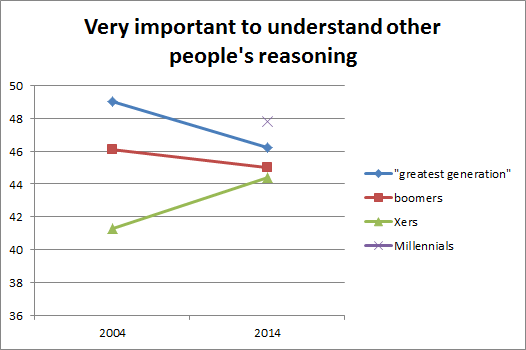
The General Social Survey asked a set of questions about political values or principles twice, in 2004 and 2014. The questions were phrased, “How important is it ….?” and the items included: always to obey the law, always to vote, never to try to evade taxes, and always to understand other people’s reasoning. Respondents were also asked how important it is for people to be able to participate in making decisions. It’s a nice mix of conventional civic obligations and deliberative and participatory values.

As is my wont, I have looked at the changes generationally. Graphs are helpful for visualizing these changes. For instance, the first graph below displays an interesting pattern in attitudes towards understanding other people’s reasons. Generation Xers have become substantially more committed to this value as they (or I could say “we”) have aged, although we still lag a bit behind our elders. Older Americans have lost their commitment somewhat, especially the group that was born between 1926 and 1945. Millennials enter the picture with the highest levels of support currently, although they rate listening as less important than their grandparents did a decade ago.

GSSothersreasons

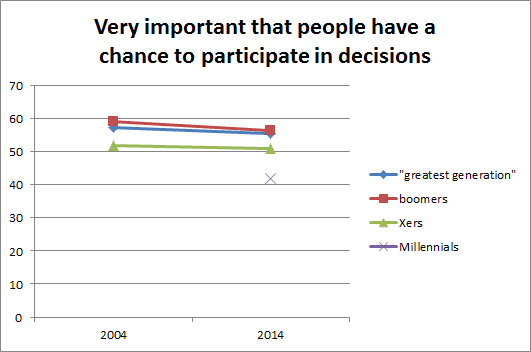
I’ll display a second graph that shows quite a different pattern. The younger you are today, the less likely you are to believe that it’s very important for people to be able to participate in decisions. At least since 2004, the older cohorts have not changed their minds on that topic. Millennials continue the pattern of declining support by entering adulthood with the lowest levels of commitment to the value or principle of participation. This graph suggests that unless we do something to change the trends, generational replacement will gradually lessen our commitment to participation.

GSSparticipation

The pattern for always obeying the law looks like the second graph above, although the gaps are smaller. Millennials seem less committed than their predecessors, which could reflect an openness to civil disobedience.

All the older cohorts have grown to oppose tax evasion more as they have aged. Millennials enter the picture least committed to that ideal, but they are just where the Xers were a decade ago, and it’s possible that people’s focus on this topic naturally grows as they age.

Voting, finally, shows a pattern like participation in decisions (the second graph above). Commitment is lower for each generation, and much lower for Millennials. The older generations did not change their minds between 2004 and 2014, but the shrinking of the pre-War cohort and the growth of Xers and Millennials pushes down the average for the population as a whole. Voting is becoming less of a perceived obligation due to generational replacement. However, it’s important to note that this is a question about the obligation to vote. Actual voting rates have been flat over time. In other words, Millennials vote at similar rates to their predecessors; they are just less likely to conceive of that action as a duty.

The post the Millennials’ political values in context appeared first on Peter Levine.

Reforestation of Parks in Seattle

This four-page case study (2014) from The Intersector Project outlines how the City of Seattle used cross-sector collaboration to establish the Green Seattle Partnership to  help reforest the city parks in Seattle, Washington.

From the Intersector Project

In 1994 the City of Seattle and the Parks Department began to notice something wrong with trees in city parks. Research found that Seattle’s 2,500 acres of forested city parks were at risk from invasive plants such as English Ivy, Himalayan blackberry and bindweed. In 2004, experts projected that within 20 years about 70 percent of Seattle’s forested parkland trees would be dead. Previously, park-goers removed invasive species on their own, while non-profit and government organizations likewise worked independently. Rather than helping the problem, however, these piecemeal efforts placed an undue strain on the city’s existing resources. In order to save the parks, a shared effort between community members, experts in forestry, and the departments that held park resources was necessary. In 2004, the Green Seattle Partnership was formed, with the aim of arming citizens to help the city’s trees in partnership with the Department of Parks, Public Utilities and the Office of Sustainability and Environment. Under the leadership of Mark Mead, Senior Urban Forester, the Partnership created a 20-year strategic plan to sustain Seattle’s forested parks. Green Seattle Partnership is now the largest urban forest restoration project in the country. Mark’s use of agents across all sectors connected to the issue, and mobilizing community members to volunteer 500,000 hours by 2013 to the reforestation program, have put the Green Seattle Partnership in place to achieve their goal of planting 500,000 new trees by 2025.

IP_Seattle

“What really energized me and brought me into the fold of doing this work was in the very early days…working with the community members, seeing their enthusiasm, their drive, and their commitment to making their community a better place.”– Mark Mead, Senior Urban Forester

This case study, authored by The Intersector Project, tells the story of this initiative.

More about The Intersector ProjectThe Intersector Project
The Intersector Project is a New York-based 501(c)(3) non-profit organization that seeks to empower practitioners in the government, business, and non-profit sectors to collaborate to solve problems that cannot be solved by one sector alone. We provide free, publicly available resources for practitioners from every sector to implement collaborative solutions to complex problems. We take forward several years of research in collaborative governance done at the Center for Business and Government at Harvard’s Kennedy School and expand on that research to create practical, accessible resources for practitioners.

Follow on Twitter @theintersector.

Resource Link: http://intersector.com/case/greenseattle_washington/ (Download the case study here.)

This resource was submitted by Neil Britto, the Executive Director at The Intersector Project via the Add-a-Resource form.

America’s Civic Renewal Movement: The View from Organizational Leaders

With support from the William and Flora Hewlett Foundation, Eric Liu—the founder and CEO of Citizen University and executive director of the Aspen Institute Citizenship and American Identity Program—and I interviewed 20 key organizational leaders about strategies to expand civic engagement in the United States. Our new paper is: Peter Levine and Eric Liu, “America’s Civic Renewal Movement: The View from Organizational Leaders” (Medford, MA: Jonathan M. Tisch College of Citizenship & Public Service, 2015).

Interviewees agreed that the nation faces polarization, corruption, and weakened civic capacity. David McKinney from the Alliance for Children and families observed: “Everyone is sick-and-tired of hyper-partisanship,” and we need “stories of leaders and their lives, folks that are doing the work in ways that are trying to cut through.” Anna Galland from MoveOn said, “Right now, our government is captive to lobbyists with money to spend.” Paul Schmidt of Ducks Unlimited observed that “the need and desire for affiliation has eroded.”

Most interviewees thought that citizens would have to play a major role in reversing these declines. John Bridgeland of Civic Enterprises said that we need civic engagement “now, more than ever” because of the paralysis and dysfunction of government and changes in society such as emerging conflicts, gaps in education and social mobility, racial conflict, and divides over immigration.

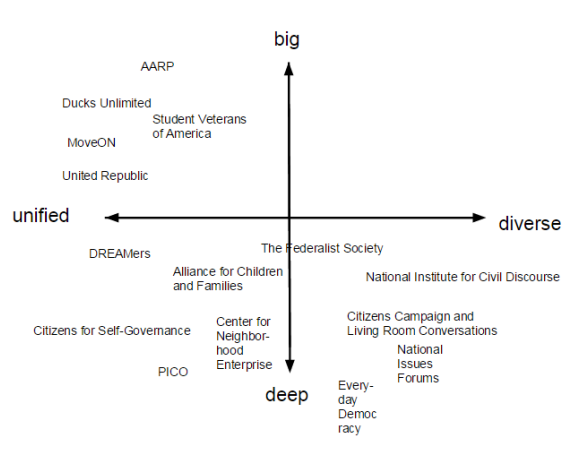
Some organizations included in this study are large, some are ideologically diverse, some have a coherent and focused agenda, and some are deep (engaging their members in learning, growth, leadership, and voice). But no organization has managed to be large, deep, diverse, and focused.

temp

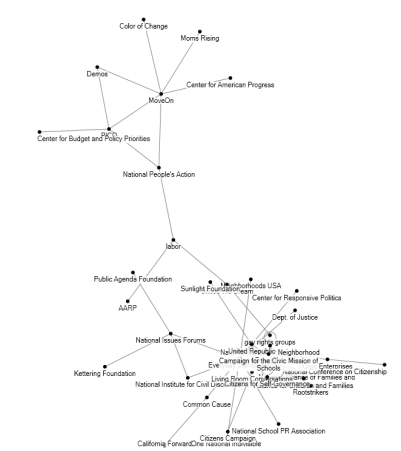
Furthermore, despite some working connections among these organizations, they do not yet form a coherent network. A simple network analysis of the connections that were either mentioned explicitly in the interviews or implied by the interviewees’ bios (for instance, when an individual holds leadership positions in two or more organizations) yielded the diagram below.

temp2

In exemplary episodes from American history, such as the Civil Rights Movement, networks of organizations have managed to be large, deep, diverse, and focused.

The paper concludes with some recommendations for research and convening to strengthen today’s network for civic renewal. You can download the full report here.

The post America’s Civic Renewal Movement: The View from Organizational Leaders appeared first on Peter Levine.

Celebrating Lisa Brukilacchio tonight at YUM

Tonight, the fabulous Lisa Brukilacchio will be honored at The Welcome Project’s YUM: A Taste of Immigrant City celebration. Lisa is one of those people who “knows everybody,” as her range of work and passion for the community brings her into many people’s orbits. Tonight she will be recognized with the Suzanne Sankar Founder’s Award, which is given to an outstanding individual or group who has served as a leader in building the collective power of Somerville area immigrants.

From The Welcome Project‘s website:

For over 30 years, Somerville resident Lisa Brukilacchio has worked to support immigrant communities in Somerville. Currently the Director of the Somerville Health Agenda of the Cambridge Health Alliance (CHA), Lisa says her passion for working with immigrants grew out of another love: gardening.

“I had a community garden plot on Tufts property the first summer I lived in Somerville, the summer of 1979, where I first met a lot of “real” people who lived in Somerville,” Lisa said, “Early on, it was mostly Greek and Italian neighbors who would engage with me around growing. Later, when I became more involved in doing outreach for community gardens, I met a couple from El Salvador, who got involved in the team building the garden along the bike path. ”

Through gardening and youth development work, Lisa met Rose Boardman, then director of The Welcome Project.

“I started working with kids from the Mystic Learning Center, including immigrant families who had plots at Mystic and Rose Boardman had me come and do some planting projects.” This work eventually grew into working with Somerville Housing Authority on a landscape training/jobs program for residents.  Meanwhile, over near Union Square, the Community Growing Center started up in 1993, where Lisa helped connect  others across the city interested in supporting youth development and cultural activities to highlight the many populations making Somerville their home.

“As a volunteer working in the city, I got to meet lots of people. I landed here for school, but when I got engaged with the community, I had an opportunity to interact directly with various communities,” Lisa explained. “There were a lot of young people who thought their only way out was the military. As part of coordinating out of school programs, we would spend time with youth, opening their minds to potential options. Working to provide experiential learning opportunities for youth, I met  other community leaders like Franklin Dalembert of the Somerville Haitian Coalition and other members of the Somerville Community Partnerships.  We sought to enrich the role of those kids through literally building a stronger, healthier community together through the process of building the Growing Center!”

This work also connected her with many different Somerville populations, including Haitian, Salvadoran, Tibetan, and Indian.

“It was really the commonality of gardens, growing food, and cultural connections to the earth which brought us together,” Lisa added. “A big part of this work, the mission of the Growing Center, is to bring people together in a safe space to share our different cultural traditions. Community gardens have a unique capacity to do that through providing chances for meaningful activity, community engagement and cultural exchange around growing food.”

Lisa brings this focus on immigrant communities to her work in healthcare as well.

“When I first started working In the healthcare field, a large number of the families I worked with were immigrants. Many had come over from Italy, like my own grandmother, some were political refugees and some had grandparents who were slaves in the rural south. I learned a lot from them all,” Lisa said. Later after working for the City of Somerville and for Tufts University, Lisa returned to healthcare at Cambridge Health Alliance.

“CHA comes to health care from a population health and community perspective. I’ve found so many colleagues who are committed to addressing health disparities and an institution that has served vulnerable populations for a long time.”

Lisa added that understanding people’s cultural background is a critical piece of health work.

“We all have different perspectives on what we want our lives to be – how you enjoy life, where you find pride, purpose and meaning. It’s so basic, so integral to a person’s well-being,” Lisa said. “Health care is really about trying to bridge our cultural understandings of wellness.”

The Welcome Project is thrilled to recognize Lisa Brukilacchio with the Suzanne Sankar Founders Award at the 2015 YUM: A Taste of Immigrant City celebration.

facebooktwittergoogle_plusredditlinkedintumblrmail

Excellent Profile of Enric Duran and Catalan Integral Cooperative

The Catalan Integral Cooperative (CIC, pronounced “seek”) is surely one of the more audacious commons-based innovations to have emerged in the past five years.  It is notable for providing a legal and financial superstructure that is helping to support a wide variety of smaller self-organized commons.  Some of us are calling this proto-form an “omni-commons,” inspired by the example of the Omni Commons in Oakland.

CIC is smart, resourceful, socially committed and politically sophisticated.  It has bravely criticized the Spanish government’s behavior in the aftermath of the 2008 financial crisis, which has included massive bank bailouts, foreclosures on millions of homes, draconian cutbacks in social services, a lack of transparency in policymaking.  CIC regards all of this as evidence that the state is no longer willing to honor its social contract with citizens.  Accordingly, it has called for civil disobedience to unjust laws and is doing everything it can to establish its own social order with a more humane logic and ethic.

Journalist Nathan Schneider provides a fascinating, well-reported profile of CIC in the April issue of Vice magazine. The piece focuses heavily on the role of the visionary activist Enric Duran, who in 2008 borrowed $500,000 from banks, and then he gave the money away to various activist projects. Despite being on the run from Spanish prosecutors, Duran went on to launch CIC in early 2010 with others. 

His avowed goal is to build a new economy from the ground up.  CIC is a fascinating model because it provides a legal and financial framework for supporting a diverse network of independent workers who trade with and support each other.  This is allowing participants to develop some massive social and economic synergies among CIC's many enterprises, which include a restaurant, hostel, wellness center, Bitcoin ATM, library, among hundreds of others.

As Schneider writes:

At last count, the CIC consisted of 674 different projects spread across Catalonia, with 954 people working on them. The CIC provides these projects a legal umbrella, as far as taxes and incorporation are concerned, and their members trade with one another using their own social currency, called ecos. They share health workers, legal experts, software developers, scientists, and babysitters. They finance one another with the CIC's $438,000 annual budget, a crowdfunding platform, and an interest-free investment bank called Casx. (In Catalan, x makes an sh sound.) To be part of the CIC, projects need to be managed by consensus and to follow certain basic principles like transparency and sustainability. Once the assembly admits a new project, its income runs through the CIC accounting office, where a portion goes toward funding the shared infrastructure. Any participant can benefit from the services and help decide how the common pool is used.

read more

Sign up for May’s Tech Tuesday featuring Consider.it

NCDD’s next Tech Tuesday event on May 5th will feature Consider.it, a social technology that lets people deliberate on an issue together online. Registration is now open, so sign up today to reserve your spot!

Consider.it was created as an interdisciplinary project througTech_Tuesday_Badgeh a grant from the National Science Foundation. The software focuses dialogues on a specific idea, encourages users to think about both sides of the idea, listen to and include the thoughts of others and express a nuanced opinion. Consider.it shows what thousands of people think about an idea on a histogram and why they think this way with a ranked list of all points from most persuasive to least persuasive.  These results show the common ground, sticking points and misconceptions that a facilitator can address to build consensus. For the past five years, Consider.it has powered the award winning Living Voter’s Guide, an interactive voters guide used by tens of thousands of Washington voters.

Join us as co-founder Kevin Miniter discusses how to use Consider.it to help create more thoughtful dialogues online for groups of all sizes.  Kevin will tell us more about the software and how it works, share some case examples, and talk with us about ways in which we might use Consider.it in our work.

This FREE event will take place on Tuesday, May 5 from 2-3pm Eastern/ 11am-12pm Pacific. Don’t miss out on the opportunity to experience this great tool – register today!

Tech Tuesdays are a series of learning events from NCDD focused on technology for engagement. These 1-hour events are designed to help dialogue and deliberation practitioners get a better sense of the online engagement landscape and how they can take advantage of the myriad opportunities available to them. You do not have to be a member of NCDD to participate in our Tech Tuesday learning events.

Watch this video to learn more about the Living Voters Guide…