Register for NCDD’s October 15th Confab on Brain Science

Join us on Thursday, October 15th for NCDD’s next “Confab Call.” We’ll be talking with NCDD Members Mary Gelinas and Susan Stuart Clark about how brain science supports constructive dialogue and deliberation. The confab will take place from 2-3pm Eastern (11am-12pm Pacific). Register today to secure your spot!

What’s happening “beneath the surface” when peopConfab bubble imagele are participating in public meetings? Many conveners are nervous about emotions: those of the public and sometimes even their own. Understanding what evokes the potentially difficult emotions of fear and anger as well as the potentially constructive sense of compassion and hope, along with the conditions that help people notice and effectively manage such emotions, is critical to designing and conducting productive processes.

Mary V. Gelinas of Gelinas James, Inc. and Susan Stuart Clark of Common Knowledge both use the burgeoning findings from brain science to work with clients and plan interactive group processes that use emotions skillfully to help groups find common ground. They also use it to prepare themselves to facilitate such processes. They will share highlights about:

  • Triune brain theory;
  • What emotions are, along with why and how they get evoked in meetings;
  • Some key lessons from brain science for designing and conducting effective group processes;
  • How brain science can increase our ability to be instruments of change.

During this interactive session Mary and Susan will highlight the key elements of brain science they use in their work to provide a stepping off point for participants to ask questions and share their own insights and experiences.

Mary V. Gelinas, Ed.D. is the managing director of Gelinas James, Inc. and co-director of the Cascadia Center for Leadership. She is a committed student of how brain science and contemplative practices can strengthen the design and conduct of inclusive and collaborative processes. Her blog “How We Talk Matters” provides inspiration, tips, and tools to create constructive conversations about consequential questions.

Susan Stuart Clark is the founder and director of Common Knowledge, a mission driven organization dedicated to a more inclusive and innovative democracy. She works at the intersection of sectors and cultures, using insights about neuroscience to help people interact with “other.” A research deputy for the Kettering Foundation, Susan serves on the board of the National Coalition for Dialogue and Deliberation and as an advisor to civic tech groups.

About NCDD’s Confab Calls…

NCDD’s Confab Calls are opportunities for members (and potential members) of NCDD to talk with and hear from innovators in our field about the work they’re doing, and to connect with fellow members around shared interests. Membership in NCDD is encouraged but not required for participation. Register today if you’d like to join us.

missing the civic empowerment messages of a Pope and a President

Michelle Boorstein compares the enthusiastic responses to Pope Francis in 2015 and Barack Obama in 2008 and collects several explanations for both:

  1. People have “an undeniable, sweeping affinity, a gut reaction to a new leader to whom we attach huge expectations …,  even though most Americans don’t know much about Francis.”
  2. “Does the pope’s all-embracing commentary, which seems to exclude no one, have particular resonance in an increasingly diverse country?”
  3. Does “Francis offer people hope of rescue with his confident proclamations about what needs to be done to fix the world? Cartoonists and graffiti artists have often drawn him as a caped superhero.”
  4. “Francis is an accessible father figure at the helm of one of the world’s largest organizations.”
  5. “People love the blank slate.”

Let me suggest an alternative. Both the president and the Pope talk explicitly about how we, active citizens, can and must address problems. These two men may have been caricatured as caped superheroes, but they are as clear as one can be that they are not the solutions to our problems; we are.

This was the main theme of Obama’s Springfield speech announcing his candidacy in 2007, an important note in his Grant Park speech on Election Night 2008, and a recurrent topic throughout the campaign. When he accepted the Democratic nomination in 2012, he put it concisely: “As citizens,” Obama said, “we understand that America is not about what can be done for us. It’s about what can be done by us, together through the hard and frustrating but necessary work of self-government.” I have collected many more similar quotes here.

As for the Holy Father, he said recently, “the future of humanity does not lie solely in the hands of great leaders, the great powers and the elites. It is fundamentally in the hands of peoples and in their ability to organize.”

I believe that people hear and are moved by these invocations of their power, agency, and responsibility. They do not treat Obama and the Pope as blank slates or as accessible personalities; they feel moved to take action.

Meanwhile, the press completely ignores these leaders’ talk of civic engagement. That theme was never covered in the 2008 presidential campaign, and no one mentions it when they cover the Pope. Obama’s critics especially misunderstand his civic appeal, thinking that it is narcissistic. (“We are the ones we have been waiting for” is literally misheard as “I am the one you have been waiting for”). And we see basically patronizing explanations of why these leaders strike a chord.

See also how to respond to a leader’s call for civic renewal; the encyclical Laudato Si and the power of peoples to organize; and Taking the President Seriously About Citizenship.

Data-ism

I had the opportunity today to hear a talk by Steve Lohr, New York Times technology reporter and author of the recent book, Data-ism: The Revolution Transforming Decision Making, Consumer Behavior, and Almost Everything Else.

Lohr said that “big data” is more than just a large collection of digital information, it’s a philosophical framework – a way of approaching the world. Big data, he said, allows people to see patterns in the world and to make better sense of the world around them.

Ultimately, he argued, big data is a revolution in decision-making.

This revolution can have many positive implications, making our lives simpler, faster, and better.

For example, according to Lohr, in 1880 the U.S. census took eight years to conduct. While the population swelled in 1890, this census took only a few weeks to complete. The difference was due to a technological innovation: the creation of a machine-readable punch card by a company that later became IBM.

Of course there are also possible pitfalls – one can imagine using big data to determine who gets a loan going terribly wrong. And, yes, this is something that “data science lenders” do, claiming that their methodology is more accurate than more traditional approaches.

Lohr was somewhat weary of these big data, automated, decision making processes, arguing that when data is used to make decisions affecting people’s lives, that process needs to be transparent.

But, he was more casual about the change than I might have thought. Perhaps it’s because he has covered technology’s evolution for nearly a decade, but – he was somewhat skeptical of concerns about privacy and the de-humanization of our lives.

Technology evolves and our mores will evolve with it, he seemed to say.

Lohr commented that when the handheld Kodak camera was originally introduced, it was seen as a invasion of privacy. Banned from beaches and the Washington monument, it was seen as a danger, a possible corrupting force.

Until privacy expectations evolved to meet the new technology.

Perhaps it is just nostalgia that makes us fear this brave new world.

It’s an interesting argument, and I think it’s good to be skeptical of our instinctual reactions to things. But pointing to the mistakes of our past fears seems insufficient – perhaps we should be more concerned with privacy, but have simply become slowly accustomed to not having it.

That could be a natural evolution, or it could be a slow degradation – with serious and lasting consequences.

facebooktwittergoogle_plusredditlinkedintumblrmail

“Violence Taught When Corporal Punishment Used”

Originally published in The Clarion Ledger, May 14, 2013, 9A.

The harsh treatment of prisoners in the U.S. causes much controversy, yet in our public schools, institutionalized
violence is commonplace.

This image is shows part of the scan of my 2013 Clarion Ledger article, 'Violence Taught When Corporal Punishment Used.' If you click on this image, you'll be taken to the full scan on my Academia.edu page.

In April, the Hattiesburg American reported that corporal punishment declined in Mississippi schools between 2007 and 2012 from more than 58,000 reported instances to around 39,000.

Photo of the map Southern Echo created of Mississippi counties and their use of corporal punishment in the 2009-2010 and 2010-2011 school years.The use of corporal punishment varies greatly by school district. For the Lafayette County School District’s roughly 2,700 students, there were seven recorded cases of corporal punishment in the 2009-2010 school year and none the following year. By contrast, the Quitman County School District enrolls just under 1,300 students, yet recorded 1,594 instances of corporal punishment in the 2010-2011 academic year, which is only about 180 school days.

In the U.S., all 50 states permit corporal punishment in domestic settings. For public and private schools, however, only 19 states still practice it, while in Iowa and New Jersey it is illegal to perform in schools.

Iowa is a helpful state to use in comparison with Mississippi, since it is largely rural and has a comparable population size. Of course, Iowa has its problems, with seven schools districts named “dropout factories” in a 2007 Associated Press report. The same report called 44 of Mississippi’s schools “dropout factories.”

At best, corporal punishment in schools is not helping Mississippi. At worst, it is part of the problem.

A public domain photo of a courtroom.According to studies, most parents find spankings in the home to be acceptable. It is important to distinguish parenting from schooling, however, and to watch out for institutional excesses. The 1980 federal case Hall v. Tawney said that excess corporal punishment in schools could violate a student’s “right to ultimate bodily security, the most fundamental aspect of personal privacy, (which) is unmistakably established in our constitutional decisions as an attribute of the ordered liberty that is the concern of substantive due process.”

Not all spankings in schools might be called excessive, of course, yet cases reported on in the Hattiesburg American raise serious concern. In 2011, 14-year-old Trey Clayton of Independence High School was paddled so severely that he fainted, “fell face-first onto the concrete floor … (and) had five shattered teeth and a lacerated chin,” according to reporter Marquita Brown.

Beyond legal concerns and the tragically severe cases, there are strong reasons to end institutionalized corporal punishment.

Bust of Socrates.

Bust of Socrates, Plato’s teacher.

First, students are compelled to be in school, and with good reason. Democratic societies must educate citizens to be self-governing. Yet Plato and other philosophers believed correctly, I think, that learning cannot take hold by compulsion. Socrates argued that “nothing taught by force stays in the soul.”

Compulsory schooling can address Plato’s worry, however, by showing students the value of education. It is vital to create an environment in which education is welcoming and inviting. Corporal punishment has the reverse effect.

Second, corporal punishment teaches students that when confronted with a challenge, adults use violence rather than reason to achieve our ends. It solidifies “school-to-prison pipelines” that the Justice Department is combating.

In Mississippi, we know that culture matters and that many of our schools are struggling. Corporal punishment is only one element of a culture which discourages students. Ending the practice, however, would contribute meaningfully to the reconstruction of an encouraging and positive culture of achievement in education.

Eric Thomas Weber is assistant professor of public policy leadership at the University of Mississippi and author of three books, including Democracy and Leadership (2013). He is representing only his own views. Follow @EricTWeber on Twitter. Visit EricThomasWeber.org.

PCP Launches 3 New Workshops this Fall

The good folks with Public Conversations Project (PCP) recently announced that they will offer three new workshops (and one of their classics) over the course of the next season, and we encourage our members to consider attending them! PCP shared the announcement below with us detailing the offerings, and you can find more info on their workshops by clicking here.


PCP new logoPublic Conversations Project: Fall 2015 Workshops

At the core of many of today’s most complex social problems is a breakdown in relationships that leads to mistrust, gridlock, and fractured communities. Our method, Reflective Structured Dialogue, addresses the heart of this breakdown: we work to shift relationships, building the communication skills and trust needed to make action possible and collaboration sustainable. Reflective Structured Dialogue helps participants engage in constructive, often groundbreaking conversations that can restore trust and lay the foundation for collaborative action.

Public Conversations provides workshops in facilitation, dialogue and communication to equip people in this field to communicate more effectively. In addition to our flagship workshop (Power of Dialogue), Public Conversations is offering three new workshops this fall that delve deeper into specific components of our work. To learn more about Public Conversations, find more information on our workshops and continuing education opportunities, and register for our workshops, please visit our website. All of the workshops listed will take place in the Greater Boston area.

Inside Out: Leading from a Connected Place (Oct. 2, 8:30AM – 5:00PM)

Learn how to harness a deep understanding of your sub-personality “parts” and essential “self” to communicate with calmness, curiosity and compassion. This is a specialty workshop combining the best of Public Conversations’ and Internal Family Systems’ approaches to constructive communication across difference.

Power of Dialogue: Constructive Conversations on Divisive Issues (Oct. 22-24, 8:30AM -5:00PM)

Public Conversations’ flagship workshop, the Power of Dialogue is a highly interactive, widely applicable workshop for anyone interested in transforming conflicted conversations – among a working team, in a town hall, on a college campus, and beyond. Participants will build and expand their facilitation skills to create conversations that foster mutual understanding between groups and individuals divided by differences.

The Power of Stories: Moving Beyond “Them and Us” (Dec. 3, 8:30AM – 5:00PM)

Stories are how we make sense of the world. Stories can connect people or – when it’s about “us” vs. “them,” – drive people apart. Learn how to integrate the practice of storytelling and deep listening into facilitated dialogues, classrooms, meetings, and personal relationships. Through stories, we hear and are heard.

Becoming the Communicator You Want to Be (Dec. 10-12, 8:30AM – 5:00PM)

Have relationships that feel stuck? Want to make a dreaded conversation feel hopeful? In this workshop, participants will learn how to reflect, listen, speak, and inquire in ways that help them understand themselves and one another more deeply and communicate more effectively.

About Public Conversations: The Public Conversations Project fosters constructive conversation where there is conflict driven by differences in identity, beliefs, and values. We work locally, nationally, and globally to provide organizations, institutions, and communities dialogue facilitation, training, consultation, and coaching to discover new possibilities for coexistence and collaboration.

thoughts on the College Scorecard

collegecost

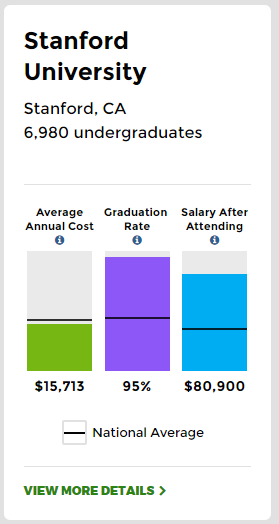
The College Scorecard began as a promise/threat to rate US colleges and universities, but for now, it offers some digestible nuggets of information on more than 3,500 institutions. The results for Stanford are shown to the right, as an example.

I like some things about this. Mainly, it tells a prospective applicant’s family not to be put off by the sticker price. Tuition plus room & board at Stanford costs $64,477, but the average student pays much less than that, graduates quickly, and earns a lot of money. That makes it a good deal (in strictly economic terms) for most people who can get in. In contrast, Cambridge College costs an average of $23,792 and yields an average salary of $36,500 for those who graduate–who represent two percent of those who enroll.

I have three main concerns. First, the average cost overstates the relevant price for a lot of students. Stanford completely waives the parental tuition contribution for families with incomes up to $125,000 a year and waives the whole cost for most families earning below $65,000 (which is about 60% of US households). The average cost is $15k because a lot of Stanford undergrads come from families in the very top tier of the income distribution. If you have a median family income, Stanford will probably be free.

Second, this kind of presentation can mislead about the business model. It can suggest that the real price of a Stanford education is $64k, but thanks to alumni gifts, the university subsidizes attendance for needy students (who, in this case, may be upper-middle-class). I think the following is closer to the truth: there are a lot of highly academically proficient students whose families can easily pay $64k and want to go to Stanford. Their kitchen counters cost more than a year’s tuition. So Stanford charges that much and uses the income to help subsidize all the operations of a research institution. It uses a sliding scale, however, so that all of its students aren’t rich. I don’t necessarily think this is wrong: it depends on how much public good comes from the research. But the numbers give a somewhat misleading impression of the financial model.

Third, the measure of “salary after attending” is very problematic if we see education as a public good. The lowest-paid majors for recent college graduates are “early childhood education ($39,000); human services and community organization ($41,000); studio arts, social work, teacher education, and visual and performing arts ($42,000); theology and religious vocations, and elementary education ($43,000); drama and theater arts and family and community service ($45,000).” A college that produces a lot of preschool teachers, clergypeople, and community organizers is going to score a lot lower on the measure of “salary after attending” than Stanford does. The average salary for recent Hampshire College graduates is $30,800, much less than half as much as Stanford’s figure, but it would be misleading to infer that Stanford offers more value than Hampshire.

Community and Family

My mother, an avid genealogist, was recently telling me just how homogeneous people used to be in many US cities.

I’d had a general sense that European-settled communities used to be more the same, with occasional waves of immigrants slowly being integrated into the society, but my mother pointed out a detail I’d previously overlooked.

Many small towns were also small families.

Especially as the United States was being settled, many communities were large enough to have a diverse gene pool, but small enough that marrying a cousin was common. In some communities, people weren’t even always aware of how closely they and their spouse were actually related.

Before you think about this too much – just reflect on the consequences: a dispute in the community became a dispute in the family; a fracture in the family became a fracture in the community.

These identities of family and community were far more intimately linked then I’d previously thought of — and probably more intimately linked than I’d like to think!

facebooktwittergoogle_plusredditlinkedintumblrmail

Constitution Day!

Not that you necessarily need reminding, but don’t forget that Thursday the 17th of September is Constitution Day! I will admit that I preferred when it was known as ‘Citizenship Day’, because we really do not, I think, do enough to recognize the importance of good citizenship and what it means. I suppose that is a topic for another post however. In any case, how are you planning do approach Constitution Day?

Yesterday evening, I had a chance to participate for a time in a Twitter chat at #sschat sponsored by our friends at iCivics. I think that this may be of great interest to you if you are looking to see how other educators across the country are approaching instruction concerning both citizenship and the Constitution. The questions that were asked were deep and provocative, and the participant responses were illuminating, with a number of worthwhile tools and resources shared. I encourage you to check out the storify of the chat! And if you are not on Twitter, why not? It is worth it just to follow the #socialstudies and #sschat hashtags!

Finally, while we have shared resources for Constitution Day and teaching about that precious document before (please see here and here and here and here, among others), the Constitutional Rights Foundation (and is there a better name for a civic education group; I don’t think so) offers a great number of lessons and resources that you can use on Thursday or any other day!

The Constitutional Rights Foundation has resources for every grade level!

The Constitutional Rights Foundation has resources for every grade level!

Of course we have our own lesson plans and resources on the Florida Joint Center for Citizenship site. Register for free and access anything you need.

And we would love to have you do a guest post for us on how you approached Constitution Day or the document itself! Just shoot me an email! 


Constitution Day!

Not that you necessarily need reminding, but don’t forget that Thursday the 17th of September is Constitution Day! I will admit that I preferred when it was known as ‘Citizenship Day’, because we really do not, I think, do enough to recognize the importance of good citizenship and what it means. I suppose that is a topic for another post however. In any case, how are you planning do approach Constitution Day?

Yesterday evening, I had a chance to participate for a time in a Twitter chat at #sschat sponsored by our friends at iCivics. I think that this may be of great interest to you if you are looking to see how other educators across the country are approaching instruction concerning both citizenship and the Constitution. The questions that were asked were deep and provocative, and the participant responses were illuminating, with a number of worthwhile tools and resources shared. I encourage you to check out the storify of the chat! And if you are not on Twitter, why not? It is worth it just to follow the #socialstudies and #sschat hashtags!

Finally, while we have shared resources for Constitution Day and teaching about that precious document before (please see here and here and here and here, among others), the Constitutional Rights Foundation (and is there a better name for a civic education group; I don’t think so) offers a great number of lessons and resources that you can use on Thursday or any other day!

The Constitutional Rights Foundation has resources for every grade level!

The Constitutional Rights Foundation has resources for every grade level!

Of course we have our own lesson plans and resources on the Florida Joint Center for Citizenship site. Register for free and access anything you need.

And we would love to have you do a guest post for us on how you approached Constitution Day or the document itself! Just shoot me an email!