Mobile Log Data

I had the opportunity today to attend a talk by Jeffrey Boase of the University of Toronto. Boase has done extensive work around mobile log data – having research participants install apps that gather their (anonymized) call data and engaging participants in short, mobile-based surveys.

The motivation for this work can be seen in part from his earlier research –  while 40% of mobile phone use studies base their findings on self-reported data, this data correlate only moderately with the server log data. In other words, self-reported data has notable validity issues while log data provides a much more accurate picture.

Of course, phone records of call time and duration lacks the context needed to make useful inferences. So Boase works to supplement log data with more traditional data collection techniques.

A research participant, for example, may complete a daily survey asking them to self-report data on how they know a certain person in their address book. Researchers can also probe further, not only getting at familial and social relationships but also asking whether a participant enjoys discussing politics with someone.

By using this survey data in concert with log data, Boase can build real-time social networks and track how they change.

His current work, the E-Rhythms Project, seeks to provide a rich understanding of mobile phone based peer bonding during adolescence and its consequences for social capital using an innovative data collection technique that triangulates smartphone log data, on-screen survey questions, and in-depth interviews.

facebooktwittergoogle_plusredditlinkedintumblrmail

Ten Commandments of Peer Production and Commons Economics

For the Uncommons conference in Berlin on October 23, Michel Bauwens recently distilled his years of thinking about digital collaboration into a short text, “Ten Commandments of Peer Production and Commons Economics.”  The document describes the key pillars of “a mode of production and value creation that is free, fair and sustainable.”  I am reproducing his entire text here because I think it is so succinct and seminal.

As we have tried to show elsewhere, the emergence of Commons-Oriented Peer Production has generated the emergence of a new logic of collaboration between open productive communities who created shared resources (commons) through contributions, and those market-oriented entities that created added value on top or along these shared commons.

This article addresses the emerging practices that should inspire these entities of the 'ethical' economy. The main aim is to create new forms that go beyond the traditional corporate form and its extractive profit-maximizing practices of value extraction. Instead of extractive forms of capital, we need generative forms, that co-create value with and for the commoners.

I am using the form of commandments to explain the new practices. All of them have already emerged in various forms, but need to be generalized and integrated.

What the world and humanity, and all those beings that are affected by our activities require is a mode of production, and relations of production, that are “free, fair and sustainable” at the same time.

OPEN AND FREE

1. Thou shall practice Open Business Models based on shared knowledge

Closed business models are based on artificial scarcity. Though knowledge is a non- or anti-rival good that gains in use value the more it is shared, and though it can be shared easily and at very low marginal cost when it is in digital form, many extractive firms still use artificial scarcity to extract rents from the creation or use of digitized knowledge. Through legal repression or technological sabotage, naturally shareable goods are made artificially scarce, so that extra profits can be generated. This is particularly galling in the context of life-saving or planet-regenerating technological knowledge. The first commandment is therefore the ethical commandment of sharing what can be shared, and only creating market value from resources that are scarce and create added value on top or along these commons. Open business models are market strategies that are based on the recognition of natural abundance and the refusal to generate income and profits by making them artificially scarce.

Thou shall find more information on this here at http://p2pfoundation.net/Category:Business_Models

FAIR

2. Thou shall practice Open Cooperativism

Many new more ethical and generative forms are being created, that have a higher level of harmony with the contributory commons. The key here is to choose post-corporate forms that are able to generate livelihoods for the contributing commoners.

Open cooperatives in particular would be cooperatives that share the following characteristics:

1) they are mission-oriented and have a social goal that is related to the creation of shared resources

2) they are multi-stakeholder governed, and include all those that are affected by or contributing to the particular activity

read more

$2.5M Grant Will Support Participedia & Democratic Innovation Research

NCDD is proud to be part of an international partnership of researchers and organizations that was recently awarded a $2.5 million grant that will be used to support Participedia – a democracy research project which is headed by two NCDD members – and the international coordination of research on global democratic governance innovations. Our own director Sandy Heierbacher has been advising the project, and this is great news for our field! We encourage you to learn more in the Participedia announcement below or to find the original here.


Global Research Partnership Awarded Significant Grant to Support Participedia

participedia-logoWe are in the midst of a transformation of democracy – one possibly as revolutionary as the development of the representative, party-based form of democracy that evolved out of the universal franchise. This transformation involves hundreds of thousands of new channels of citizen involvement in government, often outside the more visible politics of electoral representation, and occurring in most countries of the world.

In light of these fast-moving changes, a new global partnership has been awarded a significant grant to support the work of the Participedia Project. The Participedia Project’s primary goals are to map the developing sphere of participatory democratic innovations; explain why they are developing as they are; assess their contributions to democracy and good governance; and transfer this knowledge back into practice.

The 5-year, $2.5M Partnership Grant from the Social Sciences and Humanities Research Council of Canada (SSHRC) was awarded to the Centre for the Study of Democratic Institutions and the Department of Political Science at the University of British Columbia. The SSHRC Partnership Grant will support the collaborative work of an extensive community of academic researchers, students, practitioners of democratic innovations, design and technology professionals, and others.

The project partners include eight Canadian universities and seventeen additional universities and non-governmental organizations representing every continent on the globe. (Please see below for a list of the project partners. Full lists of the project’s collaborators and co-investigators can be found here.) More than $1M of the Partnership Grant funds will be split among project partners to support student research and travel that will further the students’ learning, while also advancing Participedia’s mission. For their part, the project partners have collectively pledged an additional $2M in cash and in-kind contributions to the initiative.

Professor Mark E. Warren, the Harold and Dorrie Merilees Chair for the Study of Democracy in UBC’s Department of Political Science, co-founded Participedia in 2009 together with Professor Archon Fung, Academic Dean and Ford Foundation Professor of Democracy and Citizenship at Harvard University’s Ash Center for Democratic Governance and Innovation. Warren serves as Participedia’s project director and as principal investigator for the SSHRC Partnership Grant.

Shared online research platforms will make it easy for both experts and non-experts to gather information. The current beta platform at www.participedia.net has already facilitated the collection of close to 1,000 entries cataloging case examples of participatory politics; the organizations that design, implement, or support the cases; and the variety of methods used to guide democratic innovations.

Warren emphasizes the project’s ambitious goals, noting that “By organizing hundreds of researchers, the Participedia Project will not only anchor and strengthen the emerging field of democratic innovations, but also develop a new model for global collaboration in the social sciences.” Expectations for the Participedia Project’s outcomes include:

  • Innovative research platforms to enable extensive, decentralized, co-production of knowledge;
  • A deep and voluminous common pool of knowledge about participatory democratic innovations that will support a new generation of research and practice; and
  • Global and diverse communities of research and practice focused on participatory democratic innovations.

Partner organizations include the University of British Columbia, University of Alberta, Emily Carr University of Art + Design, InterPARES Trust, McGill University, McMaster University, Université de Montreal,  Simon Fraser University, University of Toronto, University of Toronto-Scarborough, the Deliberative Democracy Consortium, Harvard University, the International Observatory on Participatory Democracy, Nanyang Technological University, the National Coalition for Dialogue and Deliberation, Peking University, Pennsylvania State University, Research College / University of Duisburg-Essen, Syracuse University, Tsinghua University, Universidade de Coimbra, Universidade Federal de Minas Gerais,  University of Bologna, University of Canberra, University of the Western Cape, University of Westminster, and the World Bank Institute.

You can find the original version of this Participedia announcement at www.participedia.net/en/news/2015/10/01/global-research-partnership-awarded-significant-grant-support-participedia.

Advocacy in Action Student Video Contest!

advocacy

Our colleague in Escambia, Cherie Arnette, sent this my way, and it fits so perfectly with the civic mission of schools and the work we do as a community in helping students grow into an engaged citizenship. The Center for Effective Government is sponsoring an ‘Advocacy in Action’ video contest for high school students.

From the CEG website: 

The Advocacy in Action video contest and lesson plan help students make real-world Social Studies connections. Students will:
  • Use our interactive map to locate their school and identify nearby facilities that may be putting them at risk
  • Learn how our government regulates these facilities and how they can be made safer
  • Explore essential communications strategies
  • Become active, engaged citizens

Together, we can advocate for companies to use safer chemicals, and make our communities healthier. Our student video contest is one way to do this. And you could win $1,000!

Here’s how it works: Create a short video that explores the safety of your community from harmful chemicals. Your video could raise awareness on this issue, pressure facilities to do better, and encourage the government to require the use of safer chemicals.

You can choose to submit your video in one of two categories: a 60 second “Public Service Announcement” video category or a 5-7 minute mini-documentary category that explores the risks your community or state faces from chemical facilities.

The contest is open to high school students in the United States. Videos, along with all required forms, must be completed by 11:59pm on March 18, 2016. We will announce winners in May. Please carefully read our guidelines and contest rules before submitting a video.

I encourage you to consider engaging your students in this project! What is also exciting, to me at least, as that we can connect this to dimensions of the C3 framework. It lends itself well to developing key questions, using a particular disciplinary lens, researching a problem and solution, and communicating findings and taking action! We would LOVE to share it if anyone take a C3 approach to this advocacy contest!

You can find all information about the contest here, including the guidelines, rubric, and FAQ. Good luck!


Florida Women’s History Month Essay Contest!

finalflyer

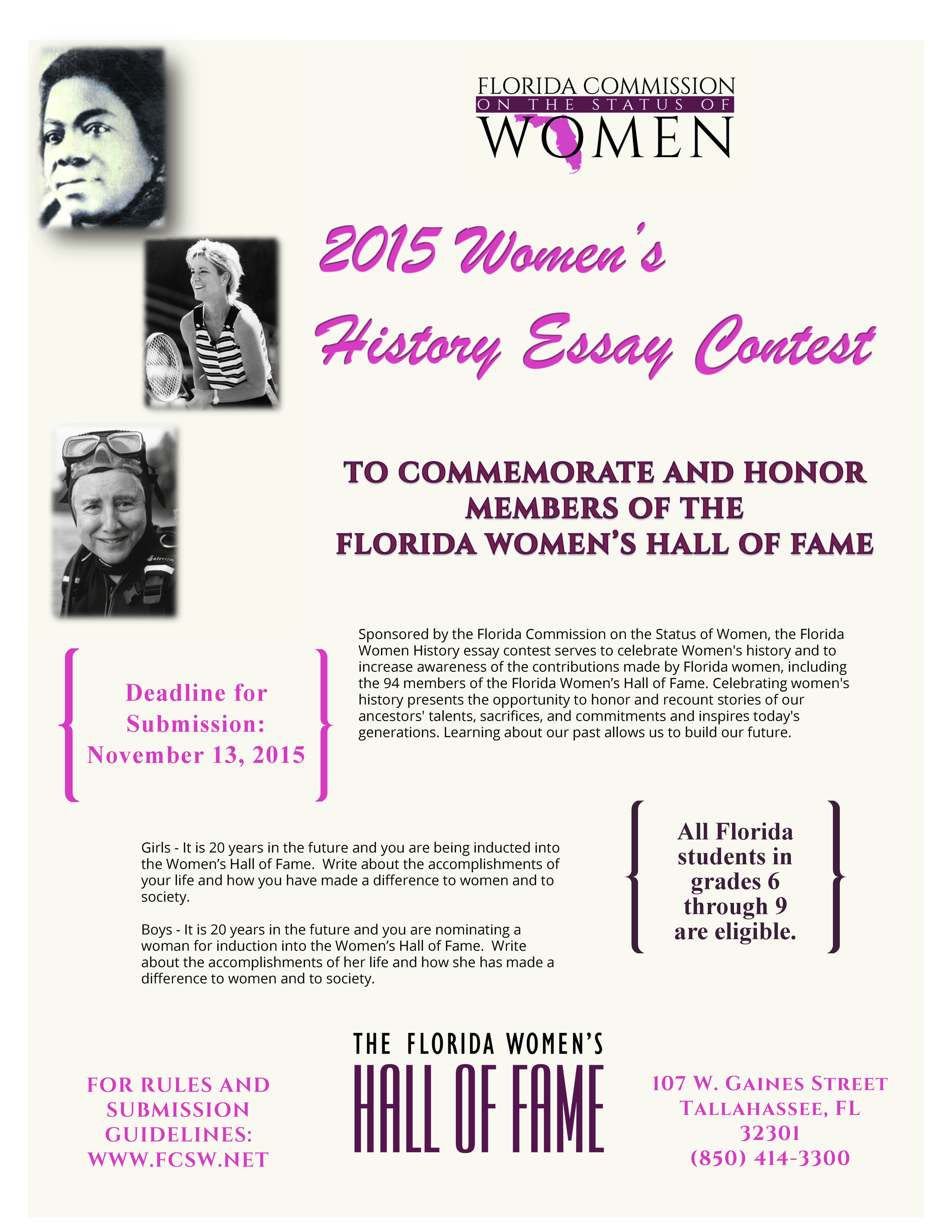
So, as you can see from the flyer above, the Florida Commission on the Status of Women is sponsoring an essay contest for all Florida students in grades 6-9. It’s a great opportunity for students to reflect on the role of women in the 21st century and what would make a women ‘Hall of Fame worthy’. A couple of interesting questions as well for students to consider:

Girls – It is 20 years in the future and you are being inducted into the Women’s Hall of Fame. Write about the accomplishments of your life and how you have made a difference to women and to society.
Boys – It is 20 years in the future and you are nominating a woman for induction into the Women’s Hall of Fame. Write about the accomplishments of her life and how she has made a difference to women and to society.

The top first grade essays (by grade level) will be read by the students when they are recognized in Tallahassee on the 3rd Annual Florida Woman’s Day in January.
Deadline for entry in November 13. You can find the essay packet here. Good luck! :)


Advocacy in Action Student Video Contest!

advocacy

Our colleague in Escambia, Cherie Arnette, sent this my way, and it fits so perfectly with the civic mission of schools and the work we do as a community in helping students grow into an engaged citizenship. The Center for Effective Government is sponsoring an ‘Advocacy in Action’ video contest for high school students.

From the CEG website: 

The Advocacy in Action video contest and lesson plan help students make real-world Social Studies connections. Students will:
  • Use our interactive map to locate their school and identify nearby facilities that may be putting them at risk
  • Learn how our government regulates these facilities and how they can be made safer
  • Explore essential communications strategies
  • Become active, engaged citizens

Together, we can advocate for companies to use safer chemicals, and make our communities healthier. Our student video contest is one way to do this. And you could win $1,000!

Here’s how it works: Create a short video that explores the safety of your community from harmful chemicals. Your video could raise awareness on this issue, pressure facilities to do better, and encourage the government to require the use of safer chemicals.

You can choose to submit your video in one of two categories: a 60 second “Public Service Announcement” video category or a 5-7 minute mini-documentary category that explores the risks your community or state faces from chemical facilities.

The contest is open to high school students in the United States. Videos, along with all required forms, must be completed by 11:59pm on March 18, 2016. We will announce winners in May. Please carefully read our guidelines and contest rules before submitting a video.

I encourage you to consider engaging your students in this project! What is also exciting, to me at least, as that we can connect this to dimensions of the C3 framework. It lends itself well to developing key questions, using a particular disciplinary lens, researching a problem and solution, and communicating findings and taking action! We would LOVE to share it if anyone take a C3 approach to this advocacy contest!

You can find all information about the contest here, including the guidelines, rubric, and FAQ. Good luck!


Florida Women’s History Month Essay Contest!

finalflyer

So, as you can see from the flyer above, the Florida Commission on the Status of Women is sponsoring an essay contest for all Florida students in grades 6-9. It’s a great opportunity for students to reflect on the role of women in the 21st century and what would make a women ‘Hall of Fame worthy’. A couple of interesting questions as well for students to consider:

Girls – It is 20 years in the future and you are being inducted into the Women’s Hall of Fame. Write about the accomplishments of your life and how you have made a difference to women and to society.
Boys – It is 20 years in the future and you are nominating a woman for induction into the Women’s Hall of Fame. Write about the accomplishments of her life and how she has made a difference to women and to society.

The top first grade essays (by grade level) will be read by the students when they are recognized in Tallahassee on the 3rd Annual Florida Woman’s Day in January.
Deadline for entry in November 13. You can find the essay packet here. Good luck! :)


A Ride Through History

I’m rather enjoying being back to daily commutes downtown. It’s been particularly interesting being primarily on the Green Line – having previously commuted primarily by Red.

The Redline is perhaps the most polished of the MBTA lines. It is certainly the youngest. The section of track from Park Street to Harvard was opened in 1912. Followed by the later extension to Porter, Davis, and Alewife as recently as the early ’80s.

The Green Line, on the other hand, is the MBTA’s oldest line – making it the single oldest public transit line in the United States. While the Lechmere terminus – where I now board the train – wasn’t opened until 1922 – much of the tunnel work was initially done in the late 1890s.

So every time the train squeals while going through one of those sharp turns I think of it as a little bit of history.

Perhaps even more interesting about the Green Line tunnels, though, is that there are places where you can actually see good portions of the track. With the current re-construction of Government Center station, there’s a whole section that’s well lit and open for viewing. It’s fascinating.

The MBTA boldly claims to have ” a history longer than that of American independence,” dating the city’s history of public transportation back to the family-operated ferries of 1631.

Public transit as we know it, though, really started to emerge in the mid-1800s. While initially stage coaches carried passengers between Boston and surrounding cities, in the 1820s “omnibus” (OMNI – a bus for all, everywhere) service emerged. “Longer than a conventional stagecoach, it had lengthwise seats along either side rather than cross seats, and a door at either end. Stagecoaches went directly from one city or town; omnibuses made several stops along an assigned route.” The OMNIs were, of course, still horse-drawn.

Around the sometime, street railways – horse drawn cars on tracks – began to appear in concert with the nation’s railroad boom. As one historian notes, these street railways “were not envisioned purely to provide transportation within the city, a need as yet not pressing or obvious in the small, compact cities of that day.”

By the 1850s, there were horse-drawn street cars throughout Boston and nearby cities, with service that competed with, and sometimes duplicated, that of the OMNIs. In 1887 the state consolidated all lines into the West End Street Railway, which then oversaw the expansion of the system and the introduction of electrified street cars.

Eventually, the streets became so crowded with street cars that the “Tremont Street Subway” – now the Green Line – was conceived to alleviate traffic in the city’s busiest disctricts.

facebooktwittergoogle_plusredditlinkedintumblrmail

the changing nature of risk and its relevance to political economy

(Washington, DC) Inspired by the work of the late Ulrich Beck, let’s say that capital and risk are two different issues. Whether you face low or high risk, you may have anywhere from zero to vast amounts of capital.

The more capital you have, the more power you can wield over other people. But the more risk you face, the more vulnerable you are to other people and to nature and fate. Governments and citizen groups can try to make the distributions of capital and of risk more consistent with justice, although the nature of justice is perennially controversial.

I think that companies and big investors have gotten better at handling risk, most individuals are more exposed to risk, and governments are worse at mitigating it.

In (say) 1932, capital was unequally distributed: Daddy Warbucks had a lot more cash than Little Orphan Annie. Risks were also unequally distributed: you were a lot more likely to get black lung disease if you were a miner than a stockbroker. But governments had a toolkit for analyzing, predicting, and remedying both sorts of inequalities. They could use tax and health statistics to see how capital and risk were distributed and could intervene by taxing and spending, by regulating big accumulations of capital (mainly banks and large corporations), and by implementing health and safety regulations. Labor unions also helped to socialize or mitigate risk. Meanwhile, corporations had limited tools to predict the risks that they faced individually, from strikes to earthquakes. And they had lots of sunk capital, such as the vast factories of Detroit. So they shared in the risks faced by their workers and were probably better off when governments mitigated risks for all.

Fast forward to 2012. Risks remain very unequal. With smaller unions and other strong membership associations and with generally less effective regulations, risks tend to be individualized. We also have a strong cultural presumption that risk belongs to the individual. A teenager who gets in trouble is supposed to pay the full price for his mistake.

Entities that have a lot of capital can navigate this environment. A company like Google in 2015 has much less sunk capital than a company like GM in 1932. Google can move investments anywhere in the world. It can fire an employer employee who is not performing or whose skills have become obsolete. The private sector also has sophisticated tools to forecast at least short-term risks and exotic financial instruments to hedge against risk. Overall, a company or an investor with lots of capital and sophistication is better off in a high-risk/high-opportunity economy than in a more predictable environment. To an increasing extent, money can simply purchase protection against risk.

But risk has shifted from capital to labor. Whereas the private sector can use a whole panoply of tools to predict adverse events and to externalize or limit their risks, individual workers have little recourse, and governments do not seem to be able to plan for even the most obvious risks, such as climate change. They choose systematically foolish responses to risks, such as dramatically overreacting to terrorism while ignoring the threat of financial meltdowns. Their unwillingness and incompetence are not inevitable laws of nature. They have been made weaker on purpose. Nevertheless, even a well-intentioned government would now have a long way to go before it possessed an adequate toolkit for understanding and mitigating risk.

Upcoming IAP2 Trainings from the Participation Company

Make sure to note that the at The Participation Company – one of our NCDD member organizations – is offering more IAP2 trainings that NCDD members can get a discount $30-$100 on! The trainings use the International Association of Public Participation (IAP2) framework and are a great opportunity to earn an official IAP2 certification. Learn more about the trainings in the announcement below or here.


IAP2 Training Events in 2015-2016

If you work in communications, public relations, public affairs, planning, public outreach and understanding, community development, advocacy, or lobbying, this training will help you to increase your skills and to be of even greater value to your employer.

This is your chance to join the many thousands of practitioners worldwide who have completed the International Association for Public Participation (IAP2) certificate training.

Foundations in Public Participation (5-Day) certificate program: PLANNING for Effective Public Participation (3-Days) and/or *TECHNIQUES for Effective Public Participation (2-Days)

  • November 3 – 5, 2015 in Fort Collins, CO — 3-day Planning
  • December 9 – 11, 2015 in Great Falls, MT — 3-day Planning
  • December 14 – 18, 2015 in Chicago, IL — 3-day Planning & 2-day Techniques
  • February 1 – 5, 2016  in Arlington, VA — 3-day Planning & 2-day Techniques
  • February 2 – 3, 2016 in Fort Collins, CO — 2-day Techniques
  • February 25 – 26, 2016 in Fairmont, MT — 2-day Techniques
  • February 29 – March 4, 2016 in Phoenix, AZ — 3-day Planning & 2-day Techniques

Austin, TX and Santa Fe, NM coming soon. Please check our website for updates to the calendar.

*The 3-Day Planning is a prerequisite to TECHNIQUES

The Participation Company (TPC) offers discounted rates to NCDD members. Visit www.theparticipationcompany.com/foundations for more information and online registration.