“Trump’s slogans not enough to win”

Interview with Javad Heiran-Nia in Tehran Times, November 1, 2015, 1 & 11.

Front page of the Tehran Times, November 1, 2015. I have again had the great opportunity to give an interview for reporter Javad Hieran-Nia of The Tehran Times, Iran’s major English-language newspaper. I feel honored to have my interview again land the first page of the paper. The image on right is of the front page, but is also a link to a printable Adobe PDF version of the piece, which I edited onto one page. You can alternatively click here or on the title of the piece below for the same linked file.

The piece is titled “Trump’s popular slogans will not be
enough to win him the primary election: Weber,” The Tehran Times, November 1, 2015, pages 1 & 11.

The interview is available on paper’s site here.

A Copernican Revolution Needed for Democratic School Reform

In the last installment of our Education Week blog conversation on democracy and schools, Deborah Meier gave a remarkable account of school change efforts in the last two decades, "Democratic Experiments." She is worth quoting at length:

"In the early 1990s...some 100 plus K-12 schools in NYC proposed a large-scale experiment, serving about 50,000 students and representative of the city as a whole. Our aim: to demonstrate the value of greater school/community-based autonomy including show-casing alternative systems of accountability. Annenberg offered us 50 million dollars to try it out. The mayor, NYC chancellor, NYC board of education, the state superintendent of schools, and the American Federation of Teachers local chapter signed on. Two local universities agreed to study our work over five years both statistically and ethnographically. If we hadn't been stopped by a new chancellor and a new state superintendent we'd have learned a lot."

Meier also describes smaller but still significant efforts like "Boston's Pilot" schools and the "Consortium" of schools in New York City, both of which have used alternative assessments, have generally proven successful, and have been largely ignored by policy makers.

The question is how to respond.

It seems to me that the fact the chancellor and state superintendent could end of the "large scale experiment" in the early 1990s despite the broad coalition involved in planning it, shows why we need to rethink politics on a large scale.

Politics has become narrowly professionalized, detached from "civic roots" in the life of local communities. It now almost entirely revolves around politicians (and other public figures), their antics, promises, and positions. Like many other experts, they are detached, especially at state and national levels and in federal agencies. Citizens are reduced to consumer choices. This makes for dysfunctional politics and powerless and irresponsible citizens.

I had a different experience as a young man in the civil rights movement. Black beauty parlors and barber shops were places where people learned "everyday politics." As Sara Evans and I describe in our book, Free Spaces: The Sources of Democratic Change in America, I saw how this learning could be deepened. Highlander Folk School worked with beauticians across the south to teach organizing skills.

One story with parallels from our years at the Humphrey Institute is about the late Vice President Hubert Humphrey. Humphrey described in his autobiography, The Education of a Public Man, how his father went about making his drug store in Doland, a small town in South Dakota, a civic center of the town. His father was one of six Democrats in a town of six hundred Republicans. "In his store there was eager talk about politics, town affairs, and religion," Humphrey wrote. "I've listened to some of the great parliamentary debates of our time, but have seldom heard better discussions of basic issues than I did as a boy standing on a wooden platform behind the soda fountain."

Here and there in recent years we've seen large scale educational experiments out of community organizing like Deborah Meier and her colleagues developed in New York. For instance, the Alliance Schools in Texas, described in Dennis Shirley's Valley Interfaith and School Reform, organized by an Industrial Areas Foundation affiliate with churches, unions and others, developed large scale efforts to redesign schools. It had similarities to Meier's story - more local autonomy, parent and student voice, democratic purpose. It sought to hold politicians accountable.

But like most other community organizing initiatives, it didn't undertake organizing to make democratic change within schools or the teaching profession - or electoral politics.

If we see organizing as "citizen politics," the practices of diverse people negotiating differences, working together for some common good, and developing political skills in the process, it can be taken into professions, schools, colleges -- and also electoral politics and government.

All his life Humphrey was a "different kind of politician" as a result of his father's drug store. He was able to find common ground with Republicans. He was expansive in his vision - he gave the famous civil rights speech at the 1948 Democratic convention, birthed the Peace Corps, led the Senate fight for desegregation. He also challenged everyday citizens to get involved.

Parties, ideologies, and professional politicians all have a role but they shouldn't be at the center of the political universe. Citizens - and civic settings where people of different interests interact and learn citizen politics - need to be at the center.

It will take a Copernican Revolution in our political thinking to bring this about.

“Judge Reeves speaks at UM”

Originally published in the Oxford Eagle on October 28, 2015. Republished with permission.

Image of Lyndy Berryhill of the Oxford Eagle.

Lyndy Berryhill, Oxford Eagle.

I’m grateful to Lyndy Berryhill of The Oxford Eagle, who came to our forum with Judge Reeves. She also kindly gave me permission to republish her piece on my page here. Thanks again to the Mississippi Humanities Council and to the College of Liberal Arts for their support for the event! Thanks to Berryhill for coming and letting people know about the event. There’s so much to be proud of in Mississippi. It’s crucial that we talk about that more often. Here’s her piece:

Judge Carlton Reeves, photo by Lyndy Berryhill of the Oxford Eagle, 2015.

Judge Carlton Reeves, photo by Lyndy Berryhill of the Oxford Eagle, 2015.

By Lyndy Berryhill

In the wake of racial discussions on campus, the University of Mississippi provided students with a speaker to talk about Mississippi history and racial violence in the state.

U.S. District Judge Carlton Reeves of Mississippi.

District Judge Carlton Reeves has presided over key race and equality cases in Mississippi

U.S. District Judge Carlton Reeves spoke on “Race and Moral Leadership in the U.S. Judicial System.” Tuesday afternoon in Bryant Hall.

“Mississippi has struggled with its past, but it has also struggled to move forward,” Reeves said.

Reeves famously presided over the racially charged murder of James Craig Anderson and later sentenced his murderers to prison. NPR called his speech at the trial “breathtaking” and it garnered Reeves national media attention. During the forum, Reeves talked about the case and how it was important for people to realize what a hate crime is.

Weber in 2010 in Ventress Hall at the University of Mississippi.

Ventress, (c) U of MS 2010.

He said he believes there is a new Mississippi starting to form with a new generation. A couple decades ago, most of the racial progress that is present today would be unthinkable. He said to continue that progress, students have to continue to have open discussions and remain open-minded.

“The response to him was better than I could have hoped for. The students could relate to Judge Reeves, because he’s from Mississippi,” said Eric Thomas Weber, associate professor of public policy leadership.

“Students often feel that politics is uncooperative, primarily a battle between competing interests. Sometimes, however, we can find shining examples of virtuous people and leaders making the right decisions,” he said.

Logo of the Mississippi Humanities Council.Weber routinely brings in visiting speakers relevant to the current news cycle. With the help of the Mississippi Humanities Council, Weber brought Reeves to visit his class and speak to a packed open forum.

Reeves first arrived in time for a lunch with public policy leadership majors and then he joined a philosophy of leadership class.

“Over the last few years, as I wrote ‘Uniting Mississippi,’ the racially charged murder of James Craig Anderson offered the most troubling recent example of injustice here that is rooted in underlying cultural divides and hatred,” Weber said.

After he wrote the book, Weber came across Judge Reeves’ speech from the sentencing in the case.

The Lyceum building at the University of Mississippi.“It truly took my breath away,” Weber said. “I was so moved that I immediately decided to write Judge Reeves to tell him. I mentioned in my note that if he were ever willing to come to my philosophy of leadership course, we would love to have him come to the university.”

Within a matter of hours, Reeves replied that he would be honored.

Weber said Reeves is an example of hope for progress in Mississippi.

“He is also an inspiration for our students to look beyond partisanship to the character of our leaders,” Weber said. “I couldn’t ask for more from the visit of an invited guest.”

The Oxford Eagle logo. Reposted here with permission from The Oxford Eagle.

Farewell Burns Weston, Questing Legal Mind and Dear Friend

Until the very end, my dear friend and colleague Burns Weston was passionate, hard-driving and committed to changing the world.  That’s why I was stunned to learn that Burns passed away yesterday, a few weeks shy of his 82nd birthday.  When he failed to make a scheduled telephone call, friends checked his condo and found him dead.  Burns was a well-known international law and international human rights scholar at the University of Iowa College of Law.  He was also founder of its noted Center for Human Rights.

I met Burns about seven years ago when he was a professor for one semester a year at Vermont Law School.  He was writing a major legal treatise about climate change, and one element of the essay dealt with the commons.  A mutual friend, the polymath Roger G. Kennedy, introduced us, and the gravitational pull of Burns’ essay quickly drew me in. It was an irresistible disruption in my life that got me thinking a lot about environmental law and the commons.

Soon we were working together on a variety of projects:  a major scholarly book, chapters in anthologies, law review articles, grant proposals. In the course of it all, Burns exposed me to a great deal of human rights and international law, and he helped clarify their potential and limits for re-imagining international governance, environmental law and the actualization of human rights. For my part, I introduced Burns to the loose but growing network of international commoners and commons literature. He quickly realized that the commons is not just complementary to human rights; the two are long-lost partners with affirmative synergies. 

Our conversations became more serious and, with a bit of serendipitous funding, we embarked upon a grueling book project, Green Governance:  Ecological Survival, Human Rights and the Law of the Commons, published in 2013 by Cambridge University Press.  It was a bold attempt to reimagine environmental law and policy through the lens of human rights and the commons.  We wanted to envision new ways to actualize human rights principles and commons practices at global and regional levels.  We wanted to think beyond the framework of the nation-state and international treaty organizations.  We wanted to think beyond the standard forms and institutions of law itself.

Burns attacked these questions with the enthusiasm of a first-year law student and the sagacity of a gray eminence.  He really wanted to come up with creative legal solutions, and he wasn’t afraid if they might require social and political struggle. Now that’s not a quality you find in your average law professor, let alone one in his seventies. Burns had a bold and questing temperament, and did not let himself be confined by the disciplinary blinders of law. That’s why, following the publication of Green Governance, Burns wanted to continue our explorations.  So we founded the Commons Law Project to see if we could propose an architecture of law and public policy to address climate change and other urgent ecological problems.

read more

Phase Transitions in Random Graphs

Yesterday, I attended a great talk on Phase Transitions in Random Graphs, the second lecture by visiting scholar Cris Moore of the Santa Fe Institute.

Now, you may be wondering, “Phase Transitions in Random Graphs”? What does that even mean?

Well, I’m glad you asked.

First, “graph” is the technical math term for a network. So we’re talking about networks here, not about random bar charts or something. The most common random graph is the Erdős–Rényi model developed by Paul Erdős and Alfred Rényi. (Interestingly, a similar model was developed separately and simultaneously by Edgar Gilbert who gets none of the credit, but that is a different post.)

The Erdős–Rényi model is simple: you have a set number of vertices and you connect two vertices with an edge with probability p.

Imagine you are a really terrible executive for a new airline company: there are a set number of airports in the world, and you randomly assign direct flights between cities. If you don’t have much start up capital, you might have a low probability of connecting two cities – resulting in a random smattering of flights. So maybe a customer could fly between Boston and New York or between San Francisco and Chicago, but not between Boston and Chicago. If your airline has plenty of capital, though, you might have a high probability of flying between two cities, resulting a connected route allowing a customer to fly from anywhere to anywhere.

The random network is a helpful baseline for understanding what network characteristics are likely to occur “by chance,” but as you may gather from the example above – real networks aren’t random. A new airline would presumably have a strategy for deciding where to fly – focusing on a region and connecting to at least a few major airports.

A phase transition in a network is similar conceptually to a phase transition in a physical system: ice undergoes a phase transition to become a liquid and can undergo another phase transition to become a gas.

A random network undergoes a phase transition when it goes from having lots of disconnected little bits to having a large component.

But when/why does this happen?

Let’s imagine a random network with nodes connected with probability p. In this network, p = k/n where k is a constant and n is the number of nodes in the network. We would then expect each node to have an average degree of k.

So if I’m a random node in this network, I can calculate the average size of the component I’m in. I am one node, connected to k nodes. Since each of those nodes are also connected to k nodes, that makes k^2 nodes connected back to me. This continues outwards as a geometric series. For small k, the geometric series formula tells us that this function will converge at 1 / (1 – k).

So we would expect something wild and crazy to happen when k = 1.

And it does.

This is called the “critical point” of a random network. It is at this point when a network goes from a random collection of disconnected nodes and small components to having a large component. This is the random network’s phase transition.

facebooktwittergoogle_plusredditlinkedintumblrmail

Tufts wins the New York Life Civic Engagement Award

The Washington Center for Internships selects the annual New York Life Higher Education Civic Engagement Award, and the 2015 award went to us at Tufts University along with Dominican University, John Carroll University (Ohio), Rutgers University-Camden (N.J.), and Weber State University (Utah).

These institutions are all wonderfully different, and the award emphasizes the many ways that colleges and universities can educate their own students for citizenship and strengthen public life in America.

At Tufts, we have two distinctive advantages.

First, we have elevated civic engagement to a high institutional priority. Unlike a typical school of public policy or public affairs, the Tisch College of Citizenship & Public Service at Tufts is charged with reaching all the students and faculty of the whole university, regardless of their majors, degree programs, and disciplines. And unlike a center for public engagement or service, the college has a dean who serves as a peer with the deans of Arts & Sciences, Medicine, and the other Tufts colleges and thereby influences the direction of the whole university. Tisch College is the epicenter of civic engagement at Tufts, collaborating closely with all the other schools.

Second, since we are a research university, we contribute to civic life by studying it and by conducting high-end research in collaboration with civil society. The award application asked for one example of a civic engagement program at each applicant’s campus, and we cited the Community Assessment of Freeway Exposure and Health (CAFEH) project. I’ve written about CAFEH before, but the essential points are that the idea came from community groups; they worked with Tufts on sophisticated, federally-funded science; and the results include not only more than 20 peer-reviewed articles but also local policies meant to address a really serious health problem (fine particulate pollution from highways). This is just an example, but it well illustrates how a research-intensive university can support civic life.

The blurbs on the other four winners are also inspiring and informative.

Confab Call Launches Nevins Democracy Leaders Program Partnership – Apply Today!

Wow. Our NCDD team was blown away by the amazing response from the field to the announcement we recently made about the launch of our partnership with the McCourtney Institute for Democracy‘s new Nevins Democracy Leaders Program and the Confab Call we hosted on Wednesday to educate organizational leaders on how they can apply to host a Nevins Fellow. We had nearly 70 registrants for the call, including some of D&D’s leading organizations, and the excitement on the call for what this program can do for the field was palpable.

Mccourtney Institute LogoIn case you didn’t hear about it, this week’s Confab Call featured a presentation from NCDD member John Gastil on the brand new Penn State program that will serve to place D&D-trained students into funded fellowship positions with organizations focused on D&D, transpartisan dialogue, and civic renewal. We had a lively conversation, and John shared tons of helpful info and background about this amazing opportunity to support our field while developing the next generation of its leaders.

If you couldn’t join us for the Confab Call conversation, we strongly encourage you to listen to the recording of the call to learn more about the program and how to apply.

After the call, NCDD Sustaining Member David Nevins – whose gift to the McCourtney Institute has endowed the program – shared some of his reflections on last summer’s pilot fellowships and his excitement about the full launch of the Nevins Democracy Leaders Program:

My vision of the program was very much based on the symbiotic relationship between the Fellow and the organizations that the Fellows engage with…  The letters I received from [last summer’s first two Nevins Fellows] in which they said things like “this summer changed my life” or “thank you for allowing me the opportunity to gain real world experience in deliberative democracy and trans-partisan politics” shows that experiences were rewarding and perhaps even life changing for the interns.

Thus my goal of a relationship equally as valuable to all parties involved seems to have been achieved. I could not ask for more in these early stages of the program, and I am confident that with each additional experience the program will blossom beyond my initial expectations.

We at NCDD share David’s confidence for the future of this great effort and are proud to be part of this transformative work.

If you are in leadership with an organization that would benefit from working with a Nevins Fellow, we encourage you to submit an application today! Please note that for priority consideration in the next round of fellowship matches, you must apply before the end of the day on Monday, November 2nd. Applications received after Nov. 2nd will still be considered, but may be put on the wait list for the next round of fellowship matches. We’ve already received over 20 applications, and competition for fellowship placements is going to be stiff, Confab bubble imageso make sure to apply ASAP!

To learn more about NCDD Confab Calls and find recordings from past presentations, visit www.ncdd.org/events/confabs.

Let’s Stop Parent-Shaming

Nearly every mother I know has described herself as a terrible mother.

I find that disconcerting.

Not that these mothers actually are terrible mothers – oh dear, you finally caved to your crazy toddler’s demands and let them watch tv so you could get a moment of rest? – rather, I find it concerning that so many mothers have the self-perception of failing.

To be clear, I imagine there’s a similar phenomenon for fathers, though I don’t have the personal experience to validate that. I also get the sense that this is a gendered issue which disproportionally effects women.

Interestingly, when I tried to find data on this, I mostly found self-help articles geared towards helping women be better mothers. So, that’s telling. Also, there’s an interesting study from the UK that found “70% of mothers are left feeling like the ‘bad cop’ while fathers become the centre of attention and known as the ‘fun one’ in family.”

But while some of the sense of “terribleness” may arise from such inner family dynamics. I don’t think that’s the only source of this phenomenon.

I cringe a little when I read one of those stories about a family handing out goodie bags before a flight with their infant.

Let’s be clear: you are rearing a small person; you don’t have to apologize to me.

I imagine much of this “bad parent” anxiety comes from idealized images of the 50s. After all, we all know that everything was just hunky-dory then.

But I’m not convinced that challenge gets the rest of us off the hook.

That is to say – imagine a parent: she thinks she’s a terrible mother because she thought it would be possible to “have it all” if she was good enough. She thought she would never get mad at her child whom she loves so much. She thought with a little patience and care, she could easily raise a child who was always polite and reasonable.

Even a woman has this misguided and idealized vision of what parenthood should be – why are the rest of us playing into that?

Shouldn’t we all be working to dispel those myths?

I’m impressed by any person who takes on the challenge of raising a child. It is hard, exhausting, and trying work. There will be food in your hair and too many sleepless nights. I am amazed by anyone who can handle all that and still get out of bed in the morning. …Even if you only got up because your child, who insisted on sleeping with you, somehow kicked you in the face.

So parents, don’t feel guilty when your kids cries on the train or throws groceries around in the store. You are doing something harder than anything I will ever do, and you are amazing at it.

I just wish there was some universal hand sign that could convey all that to the next frazzled mother I see nearing the point of break down because her toddler refuses to listen to reason.

Don’t worry: you’re doing great.

facebooktwittergoogle_plusredditlinkedintumblrmail

why calling Israel democratic increases criticism of Israel

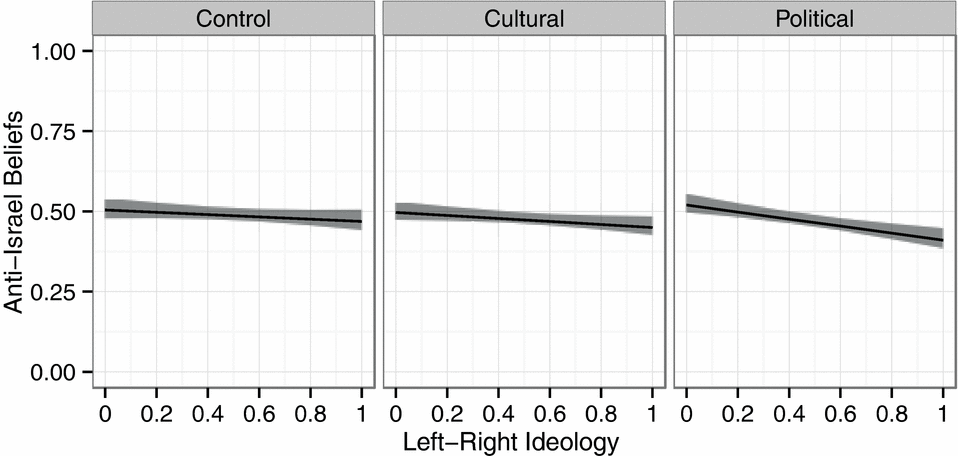
If you tell Dutch people that Israel is a democracy like the Netherlands, Israel’s favorability rises among the conservative respondents but falls among those on the left. That’s according to an experiment by Lelkes, Malka, and Sheets (2015). They asked everyone the same questions about Israel but randomized which news stories the respondents read before they answered. The control group read about Israel’s agricultural and industrial sectors and how they resemble those of the Netherlands. The “cultural” group read about some cultural similarities between the two countries. And the “political” group read about how both nations are democracies. The x-axis shows respondents’ political ideology, from left to right. Note the steeper slope in the “Political” graph.

israel

I visited Israel (and briefly the Occupied Territories) on a trip that was designed to increase our appreciation of Israel by exposing us to the freewheeling democracy of Israel. That meant that visits were arranged for us with Arab legislators and a jurist, the Palestinian Authority, and very liberal journalists, as well as right-wing settlers and others across the spectrum.

I am permanently grateful for this learning opportunity. My views became somewhat more complex, but I think that my overall appraisal of Israel’s policies declined during the trip–compared to a fairly low baseline. So I am like the Dutch left-of-center respondents: less favorable to Israel than my conservative compatriots to start with and prone to become even more critical when someone tried to show me that Israel is a democracy. Why?

First, because using the word “democracy” highlights the gap between rhetoric and reality. The 4.17 million people under Israeli occupation don’t have Israeli political rights. One could reply that all democracies fail to deliver on their principles–the United States, badly so. Indeed, I am angry about a lot of US policies, but that doesn’t make me feel better about Israel. Also, I doubt that we are currently doing anything as undemocratic as Israel is.

Second, democracies should be expected to achieve more justice than other systems do. A dictator will prevent the people from obtaining relevant information and diverse perspectives on issues, let alone acting to improve the world. He (or possibly she) will have very strong incentives and temptations to act unjustly, both towards subjects and outsiders. If benign despots are possible, they are rare. (H.G. Wells: “Amidst the tens of thousands of names of monarchs that crowd the columns of history, their majesties and graciousnesses and serenities and royal highnesses and the like, the name of Ashoka shines, and shines almost alone, a star.”) In democracies, on the other hand, information and deliberative opportunities are available, and the people have mechanisms to make wise and just decisions of they so choose. Israel denies those mechanisms to the people under occupation, but Israelis who are fully enfranchised should be able to act reasonably well. That is both a moral expectation and an actual prediction: it is more likely that a country that is as democratic as Israel is will act justly. So then being told that it is a democracy lowers one’s appreciation of its actual performance.