Selim Berker on moral coherence

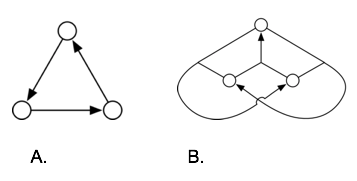
In “Coherentism via Graphs,”[i] Selim Berker begins to work out a theory of the coherence of a person’s beliefs in terms of its network properties. Consider these two diagrams (A and B) borrowed from his article, both of which depict the beliefs that an individual holds at a given time. If one beliefs supports another, they are linked with an arrow.

Screen Shot 2016-02-07 at 12.47.04 PM

Both diagrams show an individual holding three connected and mutually consistent beliefs. Thus traditional methods of measuring coherence can’t differentiate between these two structures. However, Graph A is pretty obviously problematic. It involves an infinite regress—or what has been called, since ancient times, “circular reasoning.” Graph B is far more persuasive. If someone holds beliefs that are connected as in B, the result looks like a meaningfully coherent view. If you find coherence relevant to justification, then you will have a reason to think that the beliefs in B are justified—a reason that is absent in A.

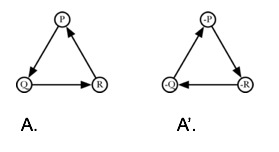
Berker also proposes a subtler but more decisive reason that B is better than A. Below I show A again, now with the component beliefs labeled as P, Q, and R. If the law of contraposition holds, than A implies another graph, A’, that is its exact opposite. A’  includes beliefs -P, -Q, and -R, and the arrows point in the reverse direction.

Screen Shot 2016-02-07 at 12.48.37 PM

But that means that if belief P is justified because it is part of a coherent system of beliefs, then the same must be true of -P, which is absurd.[ii]

The overall point is that coherence is a property of the network structure of beliefs. That should be interesting to coherentists, who argue that what justifies any given belief just is its place in a coherent system. But it should also be interesting to foundationalists, who believe that some beliefs are justified independently of their relations to other ideas. Foundationalists still recognize that many, if not most, of our beliefs are justified by how they are connected to other beliefs. Thus, even though they believe in foundations, they still need an account of what makes a worldview coherent.

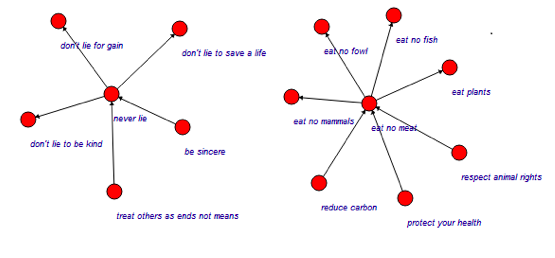
I have been developing a similar view, with a narrower application to moral thought (and without Berker’s deep grasp of current epistemology). I am motivated, first, by the sense that what makes a moral worldview impressively coherent cannot be seen without diagramming its whole structure. Imagine, for instance, a person who holds two major moral beliefs: “Never lie” and “Do not eat meat.” Assume that this person has not found or seen any particular connection between these two main ideas.

Screen Shot 2016-02-07 at 12.50.10 PM

His or her set of maxims is perfectly consistent: there is no contradiction between any two nodes. And every idea has a connection to another. But if we wanted to judge the coherence of this worldview, we would not be satisfied with knowing the proportion of the components that were consistent and directly connected. It would matter that the person holds two separate clusters of ideas—two hubs with spokes. This person’s network is fairly coherent insofar as it is organized into clusters rather than being completely scattered; but it would be more coherent if the two clusters interconnected via large integrating ideas. You can’t see the problem without diagramming the structure.

I also have another motivation for wanting to explore moral worldviews and political ideologies as networks of beliefs. In moral philosophy and political theory, constructed systems are very prominent. Although diverse in many respects, such systems share the feature that they could be diagrammed neatly and parsimoniously. In utilitarianism, the principle of utility is the hub, and every valid moral judgment is a spoke. That theory is so simple that to diagram it would be trivial. Kantianism centers on several connected principles, and Aristotelian, Thomist, and Marxist views are perhaps more complicated still. But in every case, a network diagram of the theory would be organized and regular enough that the whole could be conveyed concisely in words.

In contrast, my own moral worldview has accumulated over nearly half century as I have taken aboard various moral ideas that I’ve found intuitive (or even compelling) and have noticed connections among them. My network is now very large and not terribly well organized. A narrative description of it would have to be lengthy and rambling. Many of my moral beliefs are nowhere near each other in a network that sprawls widely and clusters around many centers.

I suspect this condition is fairly typical. No doubt, individuals differ in how large, how complex, and how organized their moral worldviews have become, but a truly organized structure is rare. (I have asked a total of about 60 students and colleagues to diagram their own views, and only one of the 60 gave me a network that could be concisely summarized.) That means that such constructed systems as Kantianism and utilitarianism are remote from most people’s moral psychology.

Further, I think that having a loosely organized but large and connected network is a sign of moral maturity. It is a Good Thing. That is obviously a substantive moral judgment, not a self-evident proposition. It arises from a certain view of liberalism that would take me more than a blog post to elucidate. But the essential principle is that we ought to be responsive to other people’s moral experiences.

Berker includes experiences as well as beliefs in his network-diagrams of people’s worldviews.[iii] In science, it should not matter who has the experience. An experience of a natural phenomenon is supposed to be replicable; you, too, can climb the Leaning Tower and repeat Galileo’s experiment. But in the moral domain, experience is not replicable or subject-neutral in the same way. Since I am a man, I cannot experience having been a woman my whole life so far. Thus vicarious experiences are essential to moral development.

If we are responsive, we will accumulate sprawling and random-looking networks of moral beliefs as we interact with diverse other people. These networks can be usefully analyzed with the techniques developed for analyzing large biological and social networks. It will be illuminating to look for clusters and gaps and for nodes that are more central than average in the structure as a whole. The coherence of such a network is not a matter of the proportion of the beliefs that are consistent with each other. Its coherence can better be evaluated with the kinds of metrics we use to assess the size, connectedness, density, centralization, and clustering of the complex networks that accumulate in nature.

On the other hand, if someone adopts a moral view that could be diagrammed as a simple, organized structure, he has not been responsive to others so far and he will be hard pressed to incorporate their experiences in the future. At the extreme, his simple graph is a sign of fanaticism.

See also: envisioning morality as a network; it’s not just what you think, but how your thoughts are organized; Stanley Cavell: morality as one way of living well; and ethical reasoning as a scale-free network (my first thoughts along these lines, from 2009).

Notes

[i] Berker, S. (2015), Coherentism via Graphs. Philosophical Issues, 25: 322–352. doi: 10.1111/phis.12052

[ii] “Coherence, we have been assuming, is a matter of the structure of support among a subject’s beliefs, experiences, and other justificatorily-relevant mental states at a given time.” But we can use directed hypergraphs (in mathematics, networks in which any of the nodes can be connected to any number of the other nodes by means of arrows) to represent all of those support relations. That is, we use directed hypergraphs to represent all of the relations that have a bearing on coherence. It follows that coherence is itself expressible as a graph-theoretic property of our directed hypergraphs (p. 339).

[iii] “Many theorists hold that a subject’s perceptual experiences are justificatorily relevant (in these sense that they either partially or entirely make it the case that the subject is justified in believing something).”

Listening for, and Finding, a Public Voice (Connections 2015)

The four-page article, Listening for, and Finding, a Public Voice by Bob Daley was published Fall 2015 in Kettering Foundation‘s annual newsletter, “Connections 2015 – Our History: Journeys in KF Research”.

The article describes how the design of deliberative democracy by David Mathews, president of Kettering Foundation, and Daniel Yankelovich, president of Public Agenda; sought to address what it meant to have “a public voice”. From this inquiry came a series of deliberative forums around some of the more important current issues, and the results were then shared with policymakers. Kettering Foundation created, A Public Voice, a nation-wide broadcast that would act as the annual report of these deliberative forums, which first aired April 1991 and continues to today. Below is an excerpt from the article. Connections 2015 is available for free PDF download on Kettering’s site here.

From the article…

KF_Connections 2015The question was: If the public doesn’t offer infallible wisdom for policymakers, what does it offer? The exchange between Henry and Cheney marked the beginning of the foundation’s inquiry into a public voice—not, mind you, the public voice, but a public voice—that continues today.

In his 2012 book, Voice and Judgment: The Practice of Public Politics, Kettering Foundation senior associate Bob Kingston said researchers wanted “to learn more clearly how the public might find and exert its will in shaping its communities and directing its nation (which sometimes seems, paradoxically, more oligarchy than democracy).”

The research plan included a series of deliberative forums held throughout the country on urgent national issues followed by reporting outcomes to policymakers…

In 1990, it was suggested, Kettering could build NIF’s influence in Washington, and its underlying vision of politics, through a widely distributed, annual report of the forums not much different from the National Town Meetings.

To envision the celebration’s annual national town meeting as a program televised from coast to coast was an incremental step forward. Kettering’s goal was to reach political and media leadership with a message about deliberative democracy and the public voice. To attract congressional attention, the reasoning went, NIF had to be of interest to a significant public audience in congressional districts.

The best way to ensure congressional attention to a public voice, it was felt, was to have congressional participation in the video. The second best way, it was further felt, was to ensure that the discussion was widely seen by elected officials’ constituents.

After reviewing several options, public television—considered to command a reasonable, national audience—was targeted. The foundation’s senior associate Bob Kingston was executive producer; Milton Hoffman, experienced in public affairs, public television programs, was the producer; and senior associate Diane Eisenberg handled distribution.

A Public Voice ’91, a one-hour public affairs television program was taped on April 15, 1991, at the National Press Club. It was the first time A Public Voice was used formally to describe forum outcomes. Bob Kingston was the moderator. Four members of Congress, four members of the press, and four members of the public joined him.

By September 5, 1991, 123 public television stations and 49 cable systems had broadcast the program and it was being distributed by community colleges to their local public access channels. The program continued to be produced in much the same format as the first one from 1991 through 2007. At its peak, A Public Voice was broadcast by nearly 300 public television stations across the country every year.

The program was seen as the central thrust in the foundation’s campaign to bring a new sense of politics to the consideration of the nation’s political and media leadership. The video had a single purpose: to show that there is something we can call “a public voice” on complex and troubling policy matters. And this public voice is significantly different from the debate on these issues as it is recorded in the media and significantly different from the debate “as we hear it through the mouths of political leaders.”

About Kettering Foundation and Connections
KF_LogoThe Kettering Foundation is a nonprofit operating foundation rooted in the American tradition of cooperative research. Kettering’s primary research question is, what does it take to make democracy work as it should? Kettering’s research is distinctive because it is conducted from the perspective of citizens and focuses on what people can do collectively to address problems affecting their lives, their communities, and their nation.

Each issue of this annual newsletter focuses on a particular area of Kettering’s research. The 2015 issue, edited by Kettering program officer Melinda Gilmore and director of communications David Holwerk, focuses on our yearlong review of Kettering’s research over time.

Follow on Twitter: @KetteringFdn

Resource Link: www.kettering.org/sites/default/files/periodical-article/Daley_2015.pdf

How Do We Show Dialogue’s Risks are Worth its Rewards?

Last month, NCDD Board member John Backman sparked lots of thoughtful conversation on our NCDD Discussion Listserv with the article below, and we wanted to share it on the blog too. His piece examines the fear we feel sometimes have around engaging in dialogue that could shift our stance on strongly-felt issues. He points out that for many average people, the idea of dialogue with “the other side” presents a risk – maybe real, maybe imagined – that allowing our opinions to shift might hurt some of our important relationships.
John’s article prompts us dialogue workers to take seriously what it sometimes means for us to ask people to take a risk like that, and it asks us how we can demonstrate that the risk is worth the reward. We encourage you to read John’s article below (original here) and let us know what you think about his questions in the comments section.


Guns, Changes of Mind, and the Cost of Dialogue

My opinion on government gun policy is starting to shift. That shift fills me with dread – and the reason, I think, may say a lot about why dialogue is such a hard sell.

Let’s start with my own biases. Temperamentally, I am as close to pacifist as you can get without actually being pacifist. Guns hold no appeal for me whatever (beyond the curiosity I have about pretty much everything). I grew up on Bambi. For most of my life, then, my thoughts on gun control were pretty much a default on the pro side.

But recent events have nudged me into more reflection. My experiments with gun dialogue (last month and in 2012) put me in contact with gun owners and their stories about why they value their guns, the enjoyment of pursuits associated with guns, the security they feel in owning a gun and knowing how to use it. Moreover, after pondering the Second Amendment, I can see how the standard gun owner’s interpretation may have some merit.

Bottom line: I can still support commonsense measures like background checks and waiting periods. But now, whenever cries to reduce gun ownership permeate the public square, I can’t quite join in – as much as my Bambi instinct still wants me to.

But this post is not about guns. It’s about why the shift scares me.

There are several reasons, but one towers above them all: some of the most important people in my social network – dear friends, immediate relatives, colleagues who might influence the course of my career – are vociferously anti-gun. I can think of a family member whose wisdom and love I would not do without… a colleague whose family has suffered several murders due to gun violence… a Catholic writer who shares many of my sensibilities but whose wrath grows with each mass shooting.

Will they abandon me now that I’m expressing a different opinion, even if just slightly different?

You might argue that it’s unlikely, and you’d probably be right. But in our current culture, friends and colleagues do part ways over disagreements like this. Consider the “harmonious” traditional family that fractures when a daughter comes out as gay, or good neighbors who find themselves on opposing sides when a casino comes to town. The notion that “if they abandon you over this, they weren’t real friends (or colleagues, or loved ones) anyway” is far too simplistic.

Now consider that I feel this dread strongly enough to hold my tongue around certain people – and I’m a dialogue person. How can I expect folks who are unfamiliar with dialogue to enter in when the risk is so high: when they might lose not only their basic convictions, but even their friends? How can those of us who care deeply about dialogue demonstrate that, in fact, the reward is worth the risk?

You can find the original version of this piece by John Backman on his blog at www.dialogueventure.com/2016/01/12/guns-changes-of-mind-and-the-cost-of-dialogue.

Motiemarkt “Motion-Market”

Problems and Purpose Every fall, the Enschede municipality in the Netherland establishes a budget for the coming years. A preliminary version is proposed by the executive board, which is then modified by motions and amendments from the municipal council. Generally these modifications are thought up by political parties. The purpose...

Video: US Judge Carlton Reeves on “Race and Moral Leadership”

Now that I’m finally catching up with my grant reporting obligations, I’m returning to work from October of 2015. We snagged some nice pictures of Judge Reeves while he was here and we recorded the video of the open forum discussion we held. U.S. District Judge Carlton Reeves of Mississippi’s southern district caught my attention in particular with the speech he delivered at the sentencing case of a racially motivated murder in Jackson, MS. NPR called his speech “breathtaking,” and it certainly is.

U.S. District Judge Carlton Reeves.

When I read it I was so moved that after a period of absorbing his deeply thoughtful remarks, I felt compelled to write to him and tell him how much what he said meant to me and to Mississippi. On a whim, I ventured to invite him, were he willing and ever able, to come talk with one of my classes, particularly on the Philosophy of Leadership. He got back to me the same day to say that he would be delighted to come. That’s the kind of guy this now famous judge is. [Video is at the bottom of this post]

Here’s the bio on Judge Reeves that NPR put together after his speech had garnered over a million downloads. It was a profound honor to have Judge Reeves meet with my students and me for lunch, my class soon after, and then the campus and Oxford community members who came to hear and speak with him. Judge Reeves is also famous and to some controversial for his judgments on prayer in school and on same-sex marriage. Progressive Mississippians came to meet the judge to thank him for his leadership and several called him a hero to them. Judge Reeves explained at our lunch and to my class that when he was growing up, his moral heroes in Mississippi were federal judges.

U.S. District Judge Carlton Reeves, in October 2015, talking with students at lunch.

Photo by Thomas Graning/Ole Miss Communications

The interesting thing about Judge Reeves’s position is that people think that judges must not be activists. Does that mean that they should not really speak up much on public issues? Judge Reeves thinks that they should. A judge should not be prejudiced in making his or her judgment on a particular case, but may, and Reeves argues should, voice their concerns about larger social issues and movements. I asked Judge Reeves whether he had been criticized for delivering the speech that he did at the sentencing for the murder of James Craig Anderson. Judge Reeves said just the opposite happened. If anything, people had issued threats because he upheld the Constitutional prohibition on governmental establishment of religion in public schools. For speaking up as he had, he explained, he had only received very positive feedback.

U.S. District Judge Carlton Reeves in October 2015 speaking at an open forum discussion on "Race and Moral Leadership in the U.S. Judicial System."

Photo by Thomas Graning/Ole Miss Communications

A judge holds a complex and interesting kind of leadership position, which is why I was eager to hear Judge Reeves talk about “Race and Moral Leadership in the U.S. Judicial System.” I certainly gained a great deal from his visit, and I welcome you to watch this video of the forum we held with Judge Reeves. Here it is:

If you can’t see this video in your RSS reader or email, then click here.

Follow me on Twitter @EricTWeber and “like” my Facebook author page to connect with me there.

you have a right and a responsibility to attend to your own happiness

Two theses for today: 1) You have a right (and even an obligation) to be concerned about your own inner wellbeing–call it happiness, peace, lack of suffering, equanimity, satisfaction, or mental health. And 2) Inner wellbeing is a complex issue, not just a matter of maximizing a simple mental state, such as pleasure.

Why it is right to be concerned about your inner wellbeing

The first premise is far from obvious. More than three million children die every year from undernutrition alone. Their deaths are stark evidence of grave deprivation that affects many more who do not happen to die. Almost half a million human beings are murdered annually around the world, again just a fraction of those who suffer from intentional violence. And even within the United States, more than two million of our fellow citizens are incarcerated, reflecting both severe hardship for the prisoners as well as a trail of harms that many of them have done to others. Under circumstances like these, why may a person like me (who is healthy, safe, and affluent) pay any attention to improving my own inner wellbeing?

No doubt, I ought to be concerned about others. Yet anyone’s inner welfare is also a valid and important concern for that person. This is because it seems to be necessary for human beings to be involved in making themselves happy or satisfied; no one can simply do that for us. So even if the goal were to maximize everyone’s happiness, that couldn’t be accomplished by a world of individuals who were concerned only with other people. They would also have to be responsible for themselves. Pure altruism or other-regardingness is not the ideal, because there would then be no one in a position to make each individual happier.

To be sure, we can ruin other people’s wellbeing, for instance by putting them in fear or anguish. And we can fail to remedy objective circumstances, such as poverty or political oppression, that prevent others from achieving wellbeing. In other words, outer circumstances and inner wellbeing are related. But the links are fairly loose. Some people who know no physical pain and have plenty of money are nevertheless miserable to the point of suicide. Poor villagers who live under a repressive government can be happier than wealthy suburbanites who are well treated by the state. We could make the distribution of rights and goods perfectly just in a whole society and yet everyone could be miserable because they failed to understand how to achieve inner welfare.

Maybe if we organized societies better, everyone would be happier. That is certainly worth trying, but we must also remember the value of freedom. Aldous Huxley’s 1931 novel Brave New World presents as a dystopia a future in which pharmaceuticals, sexual promiscuity, and efficient production have maximized happiness but thereby robbed people of the value and satisfaction that comes from having to struggle as independent and free actors. Free people choose diverse paths and set diverse priorities, some of which lead them to unhappiness. If we honor freedom, then we will be hesitant to make people happy at the cost of their freedom. This is why, in liberal democracies, happiness is not usually seen as a political objective. A government probably cannot make people happy and may threaten their liberty if it tries. The same is true of a parent within a family unit and a boss in a workplace. Each of these have real but limited responsibility for others’ happiness.

Some authors have argued that the only thing to worry about is our own inner wellbeing. A strong example is Epictetus. This major Stoic was born around 55 CE as a slave: his name means “purchased.” He was disabled, perhaps because of a master’s violence. Later in life, he was sent into exile. Yet he became a byword for virtue among both pagan philosophers and early Christians. His core insight was that accidents like disease, enslavement, and exile need not affect your happiness. You can divide all matters into those over which you have control (your own desires, emotions, and private thoughts) and those that are beyond your control (not only disease, suffering, and death but also worldly riches and success). You can learn to care only about the things that you control and can put them in perfectly good order. For instance, you can come to care only about having virtuous intentions, and you can learn to accept whatever happens outside your mind. “Don’t seek for things to turn out as you wish, but wish for them to turn out as they do, and then you will get on well.” [Enchiridion 8] Similar ideas have been worked out in Buddhist and Hindu traditions.

I think his view has two severe drawbacks. First, it reflects an unrealistic psychology. We are evolved, natural creatures. We evolved to be psychologically vulnerable to other people’s treatment. We cannot control our desires and responses to the degree that Epictetus suggests. For instance, it is beyond most people’s capacity to be happy when subjected to abuse or when abandoned and neglected. In fact, we could say that human beings are so constituted that we need other people to take care of us and that we must take care of ourselves. That is why living a good life requires having (and acting upon) the best possible ideas about your inner life and your relations to others.

Second, even when other people are able to make themselves fully happy, we must still be concerned about justice. For instance, if I were to encounter an advanced Buddhist sage who genuinely did not suffer even slightly when I stole his rice bowl, I would still be wrong to take it from him. Epictetus would agree so far; he is against mistreating our fellow human beings. But justice is more than refraining from harming people. I am also obliged to worry about whether other people are stealing food–and whether they have enough to eat in the first place. In other words, a good life includes concern for social justice: for the design, improvement, and maintenance of whole systems. That requires forming desires about the way society is organized and acting to realize those desires–in a word, it requires “politics.” But politics belongs to the category of things that we cannot control, things that are governed by other people’s wills and by fate. Just like making plans to be rich or popular, forming plans to improve a society exposes us to failure and disappointment.

Epictetus advises against political engagement.

You can become invincible if you enter no competition that is not in your power to win. When you see someone honored above others or able to do many things or otherwise admired, do not be carried away by the appearances and consider him blessed/happy. For if the essence of the good lies in what we can achieve, then there is no space for ill-will or jealousy. Rather, for yourself, don’t strive to be a general or an office-holder or a leader/consul, but to be free. The only road to that is contempt for things not in your power [XIX].

But the world needs the modern equivalents of generals, senators, and consuls, plus managers and committee chairs and active members of all kinds of groups. To be an active citizen is part of a good life–if not for all human beings, then at least for many. And that requires being concerned about justice to others as well as your own inner wellbeing.

The sorrows of Pandora’s Box fall into three categories. Some forms of suffering happen to human beings because of the kinds of creatures we are. We can postpone death, aging, disease, pain, and fear, but they are inevitable. Our very existence requires the death of other people, or else the earth would be too crowded for the living. Modern science asserts that we can mitigate these sources of suffering. For instance, we may not be able to cure mortality but we can medicate to reduce pain, anxiety, and other adverse mental states. Stoics and some Buddhists would counsel that we can take the sting out of the same adversities by disciplining our emotional reactions. I am not sure that either strategy can fully succeed.

A different set of injustices are miseries for which we rightly blame our fellow human beings. For instance, we oppress each other politically, exploit each other economically, and exclude each other socially. And even if we are not guilty at a given moment of any of those sins of commission, we may be guilty of grievous sins of omission. I am failing right now to help people even though I own superfluous resources.

The third category is a failure to flourish, thrive, enjoy, and achieve equanimity or satisfaction. Addressing this third category requires focusing inward, on our own moral commitments and beliefs, and seeing if we can improve them to make ourselves happier. Insofar as we can help other people with that task, one of the best ways may be to set a good example.

In short, your happiness should not be your only concern, but it should be one of your concerns.

Happiness is complicated

Much valuable research is being conducted today on the causes and conditions of happiness. Traditionally focused almost entirely on distress and pathology, the discipline of psychology is now turning to positive states and trying to learn what causes them. Meanwhile, economics is moving away from the simplistic premise that the purpose of an economy is to generate wealth and is beginning to conceive of a successful economy as one that makes people happy. The findings of happiness psychology and related research in economics tend to confirm what ancient Stoics, Skeptics, Epicureans and Buddhists advised.

For instance, people seem to gain happiness by being deeply immersed in a purposeful current activity, instead of thinking about the past or the future and instead of doing things that might seem pleasurable but that lack purpose. Acknowledging precedents in Eastern philosophy, the psychologist Mihály Csíkszentmihályi recommends “flow,” or single-minded immersion in an activity over which we have control. Note that flow comes from activity, not from passive experience.

Another source of happiness is caring relationships with fellow human beings. Most people are happier when they feel they contribute to worthwhile communities. That doesn’t mean that highly social people necessarily avoid being depressed. The psychologist Corey Keyes disputes the assumption that people fall on one continuum from depression to happiness (where the latter is defined as a lack of depression). Keyes’ survey research finds that the depression/happiness spectrum exists, but there is a second spectrum as well. This second continuum ranges from “languishing” to “flourishing,” where flourishing encompasses positive emotions, positive psychological functioning (such as believing that your life has purpose, or having warm and trusting relations), and positive social functioning (which includes positive beliefs about other people, confidence that one’s own daily activities are useful for others, and belonging to a community). “Languishing” is basically the absence of flourishing.

Since the flourishing/languishing scale is distinct from happiness/depression, it is possible to be depressed and flourishing. In fact, Keyes movingly discloses in public talks that he fits in that quadrant, being clinically depressed and also flourishing. His findings are important because flourishing brings powerful benefits. For example, it reduces the risk of cardiovascular disease to roughly the same degree as not smoking does. Although languishing is different from mental illness, languishing is bad for your mental health in the long run. In fact, your odds of suffering a diagnosed mental illness later on are just as bad if you are languishing now as if you have a mental illness now. If you would like to be free of mental illness in a few years, it’s just as important to start doing purposeful good work for others as it is to treat your depression or anxiety.

Another finding is that anger and resentment are very bad for happiness, and the best remedy is genuinely to forgive and feel empathy for the person who is the source of anger.

These and other findings from empirical psychology are worth knowing. However, I would not literally commit myself to them as maxims, for four large reasons.

First, they are based on statistical research into large numbers of human beings. Individuals differ. Although there is a general tendency for people to have better inner lives when they care for others, that may not be true for all. There may be genuine introverts who are happiest alone, and also psychopaths who are happiest when they harm others. Even if you are neither an introvert nor a psychopath, you are still unique, not a statistical mean, and so it requires introspection and experience to determine what makes you happy.

Second, these findings are very vague and general. “Immerse yourself in a meaningful current activity” is a succinct statement of a valid general principle. But at least for me, it would have little force because I know that I can only immerse myself in some kinds of activity, at some times, for some purposes. Moreover, each of these activities has limitations, costs, tradeoffs, and risks. The kinds of principles that seem worthy of endorsement are much more specific and qualified than the general maxim to “pursue flow.”

Third, other people are intrinsically involved. You can’t, for instance, feel confident that your own daily activities are useful for others (one of Keyes’ components of flourishing) unless you are actually responsive to other people’s needs and interests. What they need and want varies and should influence you. There can also be genuine sources of happiness that should be tempered or even avoided because they are not fair to other people. For instance, when I am thoroughly absorbed in a creative activity, I experience “flow,” but I am not being a very good parent, spouse, colleague, or citizen. Although life provides sufficient time for a bit of both, I don’t want to commit to “flow” without acknowledging the tradeoffs for other people.

Finally, these psychological findings are about inputs (experiences, activities, or commitments) and the positive mental states that result. For instance, if you forgive other people, you will be less angry and less subject to stress. If you immerse yourself in the present, you will be happier. Those are causal hypotheses. They beg the question of what outcomes we should want. It is not self-evident that we should want to be happy. At best, that vague term needs to be spelled out in more detail. Are we after calmness and acceptance? Excitement and intense positive experience? Satisfaction? Passion? These are complex and controversial topics, and the science of psychology cannot answer them. It can advise about how to get the various outcomes but not which ones to pursue. In short, inner wellbeing requires analysis as well as explanation. We cannot just decide to attend to our own happiness. We must reason about what our inner life should be like.

Imagine that the only thing that mattered was how we scored on one simple scale from intense pleasure to intense pain. Then attending to our inner welfare would be a matter of moving ourselves up the scale as far as we could go at any point. But, as Robert Nozick noted in Anarchy State and Utopia, we would not choose to be hooked to an “experience machine” that kept us permanently at the top end of the pleasure scale. Why not? Presumably because happiness–so defined–is not what we want, or to put it another way, the maximization of pleasure is not true happiness. The word that is usually translated as “happiness” from ancient Greek–eudaimonia–has complex meanings and associations, but it is closer to actively and intentionally flourishing than to feeling pleasure.

If we do not want to have as much pleasure as possible all the time, then what do we want for our inner lives? The answer may include some combination of pleasure, satisfaction, enjoyment, peace, equanimity, acceptance, hope, purpose, and passion, to name just some desirable mental states. Some of them go neatly and comfortably together. For instance, it could be that equanimity requires acceptance; then those two nodes are linked with an arrow. But some of these concepts are at least potentially at odds. To have purpose and passion may be incompatible with acceptance. Hope is a virtue in Christianity but not in classical Greek or Buddhist thought, which view hope as naive and inconsistent with equanimity.

Modern academic philosophy in the countries strongly influenced by the West is not especially focused on getting these ideas in good order. It attends more to ethics (in the sense of treating other creatures right) and social justice (organizing a social system fairly) than to inner wellbeing. In 1958, Elizabeth Anscombe noted and lamented that omission. “It can be seen” she wrote, “that there a huge gap, at present unfillable as far as we are concerned, which needs to be filled by an account of human nature, human action, the type of characteristic a virtue is, and above all of human ‘flourishing.’” To the extent that matters have improved since 1958, that is because academic philosophers in countries like the US and Britain have revisited authors from earlier traditions, notably the pre-Christian Greeks, the classical Asian thinkers, and subsequent works under their influence. Owen Flanagan argues that Buddhism and “Western” philosophy have compensating weaknesses and advantages. Buddhism gives rich and detailed accounts of the inner life but fails (as yet) to provide satisfactory accounts of social justice, especially in complex modern societies composed of states and markets. Western philosophy offers much weaker and more cursory accounts of the good inner life. We must put the pieces back together.

See also: Mill’s question: If you achieved justice, would you be happy?on philosophy as a way of lifeEmerson’s mistake.

the library of Edward R. Murrow

MurrowLast week I reported from the AFT building in Washington, where I’d attended a meeting in a room lined with the personal library of Albert Shanker, the late and very controversial leader of the teachers’ union. Earlier this week, I got to hear my excellent Tufts colleague Kelly Greenhill present on “The Security-Related Effects of Rumors” in a Tufts room that is furnished with the books of the late broadcast journalist Edward R. Murrow (1908–1965).

The arrangement of the two rooms is similar: the books fully surround a long wooden table, leaving just enough space for chairs.

Murrow was best known for his courageous WWII broadcasting and then his postwar opposition to Sen. McCarthy. He was perhaps a more consistently admirable person than Shanker, although opinions on that would vary. His books, however, were much more middle-brow. Shanker owned ponderous tomes of 20th century Continental philosophy. Murrow had more volumes like The Lady and the Vote (1956) by Marion K. Sanders. Then again, Sanders turns out to have been a crusading feminist journalist, a psychological warfare operative in WWII, an interviewer of Saul Alinksy, and a one-time congressional candidate. I’d guess that Murrow knew her professionally, which is reason enough to display her book and many like it.