Pluribus Project Seeks Narrative Projects & Ideas to Fund

We strongly encourage our NCDD members to take note that the Aspen Institute’s Pluribus Project is calling for projects and ideas aimed at changing the national narrative about citizen participation that it wants to fund with grants of up to $50,000, and we know many of our members could be eligible. All are encouraged to apply for this great opportunity, but the deadline is March 15th, so don’t delay! Read more in the Pluribus Project’s announcement below or find the original here.


Pluribus Project Narrative Collaboratory: Open Call For Fundable Projects

Our nation’s founders envisioned a republic in which the people would be the ultimate source of power. Today, however, a pervasive cultural narrative – across the right and the left – tells Americans it is pointless to participate in civic life because the game is rigged and their voices just don’t matter. At the Pluribus Project, we believe that it’s time to counter this dominant negative narrative and to displace it with a storyline of citizen empowerment so that Americans can begin to see that change is possible and how to become a part of it.

The reality is that many Americans in communities across the country are finding ways to come together and create real change. They may be a minority but they are not uncommon and they are still noticeably absent from the mainstream conversation. That’s why we created the Narrative Collaboratory, a platform for generating and propagating new narratives of citizen voice and efficacy, coupled with the tools of power and action that others can use. Think of it as a venture platform to seed experiments in media, storytelling, organizing, and experience design.

We are now announcing an Open Call for experiment and project ideas. We intend to select and support multiple proposals that creatively and effectively spread narratives of citizen power. Selected projects will be eligible for financial support, ranging from $5,000 to $50,000, from the Pluribus Project, and will be featured to additional donors and potential supporters through various media and events including the Aspen Ideas Festival.

Ultimately, we believe that with a sense of collective purpose, some trial and error, and the ingenuity of the many (that’s you), there is real opportunity right now to reinvent our civic reality, and to help create a more representative and responsive democracy.

SELECTION CRITERIA

Promise: All projects should show great promise to counter the pervasive, disheartening narrative that discourages citizens from engaging in their democracy. We are looking for platforms for experimentation that can generate or propagate new, durable, and contagious narratives of citizen power and efficacy.

A Diversified Portfolio: We are looking for projects that are diverse in type. Some may be media ventures, involving traditional journalism, digital media, or social media. Some might be organizing initiatives. Others might political ideation ventures. Some may even be hybrids. All projects must be non-partisan, and we prefer projects that are trans-partisan.

Scalable with a proof of concept: We are structure-agnostic – meaning that we will consider both for-profits and nonprofits. We generally prefer ventures with demonstrated proof of concept and a clear plan for reach and sustained impact. All funded ventures will be required to enter into a formal written agreement with the Pluribus Project, committing to use grant funds for specific purposes—including the charitable and educational ends—outlined in their proposal.

SELECTION PROCESS

Applications are due March 15, 2016. We will choose a set of projects to fund by April 15 and these projects will be implemented through the calendar year.

Applications will be reviewed and evaluated by a team of experts in civic engagement, innovation, and investment. The final portfolio will be financed at the discretion of the Pluribus Project Narrative Collaboratory team, who will receive advice and input of the experts engaged throughout the process.

TO APPLY

Please answer the following questions. Email your answers to narrative@pluribusproject.org. You may also include relevant attachments. The deadline for applications is March 15, 2016.

(1) Describe the narrative project or experiment. What exactly are you are doing, or do you plan to do, in order to generate or propagate new, durable, and contagious narratives of citizen power and efficacy? (500 words max.)

(2) How will you use the money and why will your project benefit from this investment? (250 words max.)

(3) What results have you achieved to date (if applicable), and what results do you anticipate for the next year? (250 words max.)

(4) Please provide brief bios for each core team member.

You can find the original version of this Pluribus Project announcement at www.pluribusproject.org/news/narrative-collaboratory-open-call.

A Quick Look at Three Ways to Approach Picture Analysis

As educators, we are always looking for new ways to approach our content and engage our students. A few weeks ago, the FJCC had the pleasure of providing professional development to teachers in Highlands County, a small rural county here in Florida very similar to where your humble blog host spent much of his early career. While there, I had the chance to speak with Holly Ard. Holly basically functions as the social studies specialist in the district while still teaching her own classes, and does excellent work.

One of the most difficult tasks for students to do, particularly at the lower grades, is to interpret primary sources, especially visual sources. While we stress the importance of primary sources, we often fail to actually provide teachers or students with the tools necessary to use them! This, in a time when disciplinary literacy has re-emerged as an important element of social studies teacher education thanks in part to the C3 Framework. Holly has attempted to address this issue by integrating a Picture Analysis Strategy. The strategy she uses is aimed at students of differing ability levels, and in talking with her, it seems to work well in engaging students with somewhat difficult content!

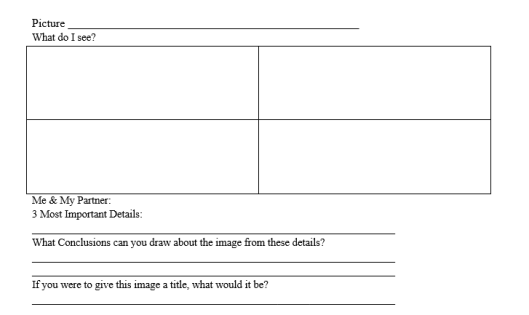
Working with partners, students individually break down the image, using the guide below. Note that the four ‘boxes’ represent the four quadrants of the image, a popular approach for image analysis. Having students create a title for the image does a nice job getting to the Common Core/Florida Standards expectation that students should be able to summarize text of all kinds. What else is a good a title than a really short and really strong summary of text?

I see

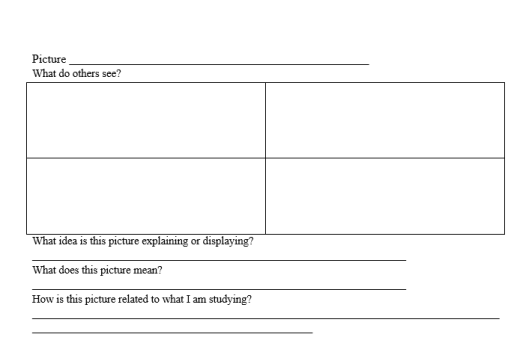
Another way to approach image analysis is seen below. This version of the analysis template can be done with a partner or individually. I appreciate how it seeks to have students connect it directly to what they are learning. Relations between content and context is important.

what do others see

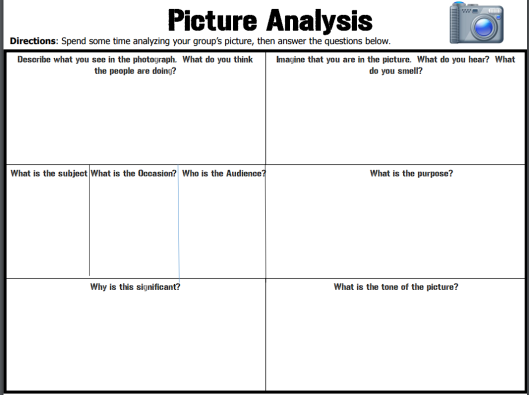
I especially love this version of the picture analysis activity, which may be most useful for paintings or photographs of a perhaps persuasive bent.

picture analysis1

Thanks, Holly, for sharing these approaches. We look forward to more goodness from you!:)

By the way, if you are looking for resources in Civics or History that can help kids with primary sources, I encourage you to check out the Stanford History Education Group!


Mimicking Deliberation

In 1950, pioneering computer scientist Alan Turing described an “imitation game” which has since come to be known as the Turing Test. The test is a game played between three agents: two humans and a computer. Human 1 asks a series of questions; human 2 and the computer respond.

The game: human 1 seeks to correctly identify the human respondent while human 2 and the computer both try to be identified as human.

Turing describes this test in order to answer the questioncan machines think?

The game, he argues, can empirically replace the posed philosophical question. A computer which could successfully be regularly be identified as human based on its command of language would indeed “think” in all practical meanings of the word.

Turing goes on to address the many philosophical, theological, and mathematical objections to his argument – but that is beyond the scope of what I want to write about today.

Regardless of the test’s indication for sentience, it quickly became a sort of gold standard in natural language processing – could we, in fact, build a computer clever enough to win this game?

Winning the game, of course, requires a detailed and nuanced grasp of language. What orders are properly appropriate for words? What elements of a question ought a respondent repeat? How do you introduce new topics or casually refer to past topics? How do you interact naturally, gracefully engaging with your interlocutor?

Let’s not pretend that I’ve fully mastered such social skills.

In this way, designing a Turing-successful machine can be seen as a mirror of ideal speaking. The winner of the Turing game, human or machine, will ultimately be the player who responds most properly – accepting some a nuanced definition of “proper” which incorporates human imperfection.

This makes me wonder – what would a Turing Test look like specifically in the context of political deliberation? That is, how would you program ideal dialogue?

Of course, the definition of ideal dialogue itself is much contested – should each speaker have an exactly measured amount of time? Should turn-taking be intentionally delineated or occur naturally? Must a group come to consensus and make a collective decision? Must there be an absence of conflict or is disagreement a positive signal that differing views are being justly considered?

These questions are richly considered in the deliberation literature, but it takes on a different aspect somehow in the context of the Turing Test.

Part of what makes deliberative norms so tricky is that people are, indeed, so different. A positive, safe, productive environment for one person may make another feel silenced. There are intersecting layers of power and privilege which are impossible to disambiguate.

But programming a computer to deliberate is different. A machine enters a dialogue naively – it has no history, no sense of power nor experience of oppression. It is the perfect blank slate upon which an idealized dialogue model could be placed.

This question is important because when trying to conceive of ideal dialogue run the risk of making a dangerous misstep. In the days when educated white men were the only ones allowed to participate in political dialogue, ideal dialogue was easier. People may have held different views, but they came to the conversation with generally equal levels of power and with similar experiences.

In trying to broaden the definition of ideal dialogue to incorporate the experiences of others who do not fit that mold, we run the risk of considering this “other” as a problematizing force. If we could just make women more like men; if we could make people of color “act white,” then the challenges of diverse deliberation would disappear.

No one would intentionally articulate this view, of course, but there’s a certain subversive stickiness to it which has a way of creeping in to certain models of dialogue. A quiet, underlying assumption that “white” is the norm and all else must change to accommodate that.

Setting out to program a computer changes all that. It’s a dramatic shift of context which belies all norms.

Frankly, I hardly know what an ideal dialogue machine might look like, but – it seems a question worth considering.

facebooktwittergoogle_plusredditlinkedintumblrmail

Dialogues Across Differences: An Introduction to Reflective Structured Dialogue

This partial-day workshop, Dialogues Across Differences: An Introduction to Reflective Structured Dialogue, from Public Conversation Project and has been developed over the last two decades. The dialogue process established in this training creates an opportunity to transform communication between participants who have conflict. Below is the description from Public Conversations Project and check out if there are upcoming workshop dates here on their site.

About the workshop…

Summary:
25 years ago, Public Conversations Project created a unique approach to dialogue that promoted connection and curiosity between those who saw one another as the enemy. Our approach has transformed conflicts across the country and the world – but its principles are widely applicable for everyday conversation. An intentional communication process can help individuals, organizations and communities build trust, enhance resilience for addressing future challenging issues, and have constructive conversations with those they otherwise “wouldn’t be caught dead with.”

Learning Objectives:

  • Learn basic theory and practice of Public Conversations’ relationship-centered approach to better communication and dialogue.
  • Achieve shared, clear, and mutually understood purpose in a conversation.
  • Design a framework for a constructive conversation that will encourage people to participate fully, listen actively, and enhance empathy.
  • Stimulate self-discovery and curiosity about the “other” through questions that promote connection, curiosity and caring.

Results:
As a result of this workshop, you will be equipped to:

  • Communicate with self-confidence about difficult or divisive topics.
  • Break destructive communication habits like avoidance, silence, or reactive responses, enabling those in a conversation to feel truly listened to.
  • Design conversations, dialogues, or meetings with clear purpose, full participation, and a structure for moving forward.
  • Employ effective and satisfying communication exercises in a broad range of personal and professional settings.

Who might participate:

  • Executives in the nonprofit, public, or private sectors interested in shifting the culture of communication in their workplace.
  • Managers seeking to lead more constructive conversations with a divided, frustrated, or distracted team.
  • Clergy looking to broach a challenging concept with their congregation or internal leadership.
  • Consultants in strategic communications, strategic planning, or organizational development exploring new ways to improve client relations.
  • Administrators seeking to encourage collaboration between departments.

Accreditation:
This workshop is approved for 6 clock hours for national certified counselors, Massachusetts licensed mental health counselors, MA licensed marriage and family therapists, and New Hampshire pastoral psychotherapists. Credits are accepted by the NH Board of Mental Health Practice for all licensed NH mental health professionals. For more information, please see our workshop policies. Public Conversations Project is an NBCC-Approved Continuing Education Provider (ACEP™) and may offer NBCC-approved clock hours for events that meet NBCC requirements. The ACEP solely is responsible for all aspects of the program.

For more information, please contact us at training[at]publicconversations[dot]org or 617-923-1216 ext. 10.

About Public Conversations ProjectPCP_logo
Public Conversations Project fosters constructive conversation where there is conflict driven by differences in identity, beliefs, and values. We work locally, nationally, and globally to provide dialogue facilitation, training, consultation, and coaching. We help groups reduce stereotyping and polarization while deepening trust and collaboration and strengthening communities.

Follow on Twitter: @pconversations

Resource Link: www.publicconversations.org/workshop/dialogue-across-differences-introduction-reflective-structured-dialogue

Democratic Education

Definition Democratic education infuses the learning process with these fundamental values of our society. Democratic education sees young people not as passive recipients of knowledge, but rather as active co-creators of their own learning. They are not the products of an education system, but rather valued participants in a vibrant...

Remembering Scalia

When I first heard that Supreme Court Justice Antonin Scalia had died I thought I must have misread. A Supreme Court justice passing away unexpectedly on the eve of a particularly volatile Presidential election cycle?

That’s the stuff Aaron Sorkin dramas are made of. Not real life.

This election cycle would make a great Aaron Sorkin drama.

After news of his death, it didn’t take long for the political pageantry to start. Senate majority leader Mitch McConnell quickly announced that the next president should appoint Justice Scalia’s replacement.

Supreme Court sessions typically run October – June, so delaying an appointment until after the start of 2017 would almost certainly mean not having a ninth Justice confirmed until the end of the next session.

Of course, President Obama was also quick to act, parrying McConnell’s announcement with his own declaration: I plan to fulfill my constitutional responsibilities to nominate a successor in due time.

If this is an Aaron Sorkin drama, perhaps we can get Edward James Olmos on the bench.

But, political posturing aside, the loss of this conservative giant has raised intriguing questions about the rule of law in a polarized nation and collegiality across political lines.

Justice Scalia had a notoriously positive friendship with liberal Justice Ruth Bader Ginsburg – so much so that there’s apparently a comic opera about it.

They disagreed ardently, fervently, irrevocably, yet still they found space to genuinely get along.

Ginsburg once explained this friendship, saying, “As annoyed as you might be about his zinging dissent, he’s so utterly charming, so amusing, so sometimes outrageous, you can’t help but say, ‘I’m glad that he’s my friend or he’s my colleague.’ ”

I once has the pleasure of hearing Justice Scalia speak. I utterly disagree with nearly all his opinions, yet I was struck by – what I can only describe as intellectual charisma. He was so bombastic in his beliefs yet well-reasoned in his arguments, it was hard not to pay him some measure of respect.

At the end of his talk, he took questions from the floor. I saw student after student get up with well-prepared questions and commentary ready. Scalia handily took each and every one of them down.

Not through the artful dodging that we’ve grown familiar seeing from politicians, but with clever, sharpened responses and wit. He out-argued them all.

I imagine that arguing with him would be like arguing with Socrates: I myself might be likely to conclude simply stammering, “well, you’re wrong and your stupid,” yet the opportunity to debate might be worthy in itself.

Ginsburg certainly seemed to think so. Possessed, I imagine, with equal skills of argument and rhetoric, Ginsburg once remarked of Scalia:

“My opinion is ever so much better because of his stinging dissent.”

facebooktwittergoogle_plusredditlinkedintumblrmail

Gloucester Shows How to Build a Culture of Dialogue

Our friends at with Public Conversations Project recently posted the story of a wonderful community dialogue project from Gloucester, MA, and we wanted to repost it here. The piece by Kathy Eckles shares some great history and reflections about the founding members of Gloucester Conversations’ efforts to build a culture of dialogue in their town, and there’s lots to learn from it. We encourage you to read Kathy’s piece below or find the original version here.


We are Creating a Culture of Dialogue And So Can You

PCP new logoWhat does “all in the same boat” really mean? Focus. Balance. Lean in. Pull together. For a harbor city on the east coast the phrase seems appropriate. In fact, as Gloucester citizens we are trying to figure out how to keep our shared boat afloat. With our history, the sea, land, skies and all people on board, we must discover how to sail onwards together, and remain stable, listening, and helping one another. Are our relational skills up to the urgency of integrating the depth and breadth of our history, cultures, environment, economies, education, needs and interests? We’re working on it.

It’s no easy task to move from an establishment model of engagement to ‘we the people’, but that’s where we’re headed. The tensions of what we could lose – our rugged beauty, passionate individualism, hardworking harbor and our interdependence – hold all of us accountable to each other and our community when it may seem easier to simply sell, fight or fold.

In light of this need, Gloucester Conversations (GC) was formed. Through the generosity of our mentor organization, Public Conversations Project, Gloucester Conversations is helping our city develop a culture of dialogue. Thoughtful conversations are gradually replacing ‘my side/your side’ battles. A confluence of people are caring about ‘how’ we do ‘what’ we do. From city government and journalism, fishing and small businesses, arts and cultural groups to education, human and environmental services, we’re striving to use frameworks that make a place for people to be heard, respected and part of the decision-making.

How did Gloucester Conversations start? 

Inspired by the successes of other communities, Gloucester resident John Sarrouf of Public Conversations talked with locals and eventually gathered a group of five interested in Gloucester becoming a more collaborative community. We met for what seemed ad infinitum to explore our values, vision, skills and personal styles and to develop a strategy and related materials to help foster a culture of dialogue.

The first step was figuring out how other people and organizations had done this work, and done it well. We reached out to Everyday Democracy and invited in leaders from Hands Across North Quabbin, Portsmouth Listens and Lawrence Community Works to share with our whole community their dialogue, decision-making and community engagement processes. We launched two cornerstone initiatives. First were two types of dialogue circles. We hosted small group dialogues for people to tell their stories and express their hopes for the city. In addition to discussing specific issues, participants reflected on the process of dialogue itself, what worked, and how dialogue makes a place for everyone. The other type of dialogue circles were called Kitchen Table Conversations, a framework for anyone to gather neighbors and friends for a deeper kind of conversation in their home.

Our second initiative was training a cadre of facilitators who could lead small group conversations within larger community dialogues. We shared our vision with leaders in government, journalism, education, arts and culture, asking for their support and seeking to understand how we could help them. In addition to in-person dialogue planning and facilitation support, our website offers dialogue and facilitation resources for anyone interested in pursuing a new conversation in Gloucester or another community.

What’s working?

Behind-the-scenes dialogue design, group facilitation and support for specific city projects. Here are two examples:

When tensions escalated over the placement of a donated piece of public art, city leaders asked Gloucester Conversations to help guide the conversation around developing a public art policy. We designed and facilitated a dialogue session for arts and cultural leaders, and later, a successful open community meeting. GC also supported a dialogue to resolve tensions between representatives of a day-center for homeless individuals and its neighbors. Participants discovered significant common ground, opened the possibility of collaborative problem-solving, and developed a plan for ongoing communication.

What have we learned?

The quality of conversations we have publicly is key to developing communication skills for every aspect of our lives, and visa versa.

While we might not always agree, our commitment to remaining in conversation with one another creates fertile ground for community, collaboration, and leadership. It helps us build strong families, raise kind children, and be good neighbors – people who listen, understand and act upon shared values for our shared future.

Gloucester is an amazing community. In the midst of major changes we are strengthening our capacity to steadily focus, balance, lean in, and pull together. May we become people and a community our children are proud of, and may the legacy we leave them be one they enjoy and tend lovingly for their children, and their children, too.

You can find the original version of this Public Conversations Project blog piece by visiting www.publicconversations.org/blog/we-are-creating-culture-dialogue-and-so-can-you#sthash.IbXMcZe4.dpuf.