DOJ Community Relations Service is Hiring Conciliators

Last week, Grande Lum – the former director of the Dept. of Justice’s Community Relations Service (CRS) and a keynote speaker at NCDD 2014 – shared on an announcement on our NCDD Discussion Listserv about a couple job openings at the CRS that we wanted to mention here, too.

The CRS is hiring for Conciliation Specialists, and we encourage our NCDD members to apply or share about the opportunity with people in your networks. The CRS seeks to serve as a neutral convener and mediator for communities dealing with conflict, and we know that some of our members would make great additions to their national staff.

Here’s how the CRS describes the positions:

Are you interested in a rewarding and challenging career? Join the U.S. Department of Justice!
The Department of Justice (DOJ), Community Relations Service (CRS) is seeking to hire highly qualified Conciliation Specialists for various Regional Offices. CRS has responsibility for assisting state and local units of government, private and public organizations, and community groups with preventing and resolving racial and ethnic tensions, incidents, and civil disorders, and in restoring racial stability and harmony.

You can find the job announcements at www.usajobs.gov/GetJob/ViewDetails/431163900 and
www.usajobs.gov/GetJob/ViewDetails/431163900. But the deadline to apply is Monday, April 4th, so if you think you’re a good fit for this position, be sure to apply soon!

Good luck to all the applicants!

Společenská burza

There was the first attempt of the method Agora Ekklesia in the Czech Republic. Method seems to be promising, but the timing and execution were poor. Organizer was a young newcomer to a village, unskilled in practical facilitation and his invitations were undermined by slander. Local mayor authoritatively dominates labor,...

Populism and Democracy

Yesterday, I discussed some of the concerns Walter Lippmann raised about entrusting too much power to “the people” at large.

Such concerns are near blasphemy in a democratically-spiritual society, yet I consistently find myself turning towards Lippmann as a theorist who eloquently raises critical issues which, in my view, have yet to be sufficiently addressed.

At their worst, Lippmann’s arguments are interpreted as rash calls for technocracy: if “the people” cannot be trusted, only those who are educated, thoughtful, and qualified should be permitted to voice public opinions. In short, political power should rightly remain with the elites.

I find that to be a misreading of Lippmann and a disservice to the importance of the issues he raises.

In fact, Lippmann’s primary concern was technocracy – the governing of an elite caring solely  for their own interests and whose power ensured their continued dominion. Calling such a system “democracy” merely creates an illusion of the public’s autonomy, thereby only serving to cement elites’ power.

I do not dispute that Lippmann finds “the public” wanting. He clearly believes that the population at large is not up to the serious tasks of democracy.

But his charges are not spurious. The popularity of certain Republican candidates and similarly fear-mongering politicians around the world should be enough to give us pause. The ideals of democracy are rarely achieved; what is popular is not intrinsically synonymous with what is Good.

This idea is distressing, no doubt, but it is worth spending time considering the possible causes of the public failures.

One account puts this blame on the people themselves: people, generally speaking, are too lazy, stupid, or short sighted to properly execute the duties of a citizen. This would be a call for some form of technocratic or meritocratic governance – perhaps those who don’t put in the effort to be good citizens should be plainly denied a voice in governance.

Robert Heinlein, for example, suggests in his fiction that only those who serve in the military should be granted the full voting rights of citizenship. “Citizenship is an attitude, a state of mind, an emotional conviction that the whole is greater than the part…and that the part should be humbly proud to sacrifice itself that the whole may live.”

Similarly, people regularly float the idea of a basic civics test to qualify for voting. You aren’t permitted to drive a car without proving you know the rules of the road; you shouldn’t be allowed to vote unless you can name the branches of government.

Such a plan may seem reasonable on the surface, but it quickly introduces serious challenges. For generations in this country, literacy tests have been used to disenfranchise poor voters, immigrants, and people of color. And even if such disenfranchisement weren’t the result of intentional discrimination – as it often was – the existence of any such test would be biased in favor of those with better access to knowledge.

That is – those with power and privilege would have no problems passing such a test while our most vulnerable citizens would face a significant barrier. To make matters worse, these patterns of power and privilege run deeply through time – a civics test for voting quickly goes from a tool to encourage people to work for their citizenship to a barrier that does little but reinforce the divide between an elite class and non-elites.

And this gives a glimpse towards another explanation for the public’s failure: perhaps the problem lies not with “the people” but with the systems. Perhaps people are unengaged or ill-informed not because of their own faults, but because the structures of civic engagement don’t permit their full participation.

Lippmann, for example, documented how even the best news agencies fail in their duty to inform the public. But the structural challenges for engagement run deeper.

In Power and Powerlessness, John Gaventa documents how poor, white coal miners regularly voted in local elections – and consistently voted for those candidates supported by coal mine owners. These were often candidates who actively sought to crush unions and worked against workers rights. Any fool could see they did not have the interest of the people at heart…but the people voted for them anyway, often in near-unamous elections.

To the outsider, these people seem stupid or lazy – the type whose vote should be taken away for their own good. But, Gaventa argues, to interpret that is to miss what’s really going on:

Continual defeat gives rise not only to the conscious deferral of action but also to a sense of defeat, or a sense of powerlessness, that may affect the consciousness of potential challengers about grievances, strategies or possibilities for change….From this perspective, the total impact of a power relationship is more than the sum of its parts. Power serves to create power. Powerlessness serves to re-enforce powerlessness.

In the community Gaventa studied, past attempts to exercise political voice dissenting from the elite had lead to people loosing their jobs and livelihoods. If I remember correctly, some had their homes burned and some had been shot.

It had been some time since such retribution had been taken, but Gaventa’s point is that it didn’t need to be. Elites had established their control so thoroughly, so completely, that poor residents did what was expected of them without hardly a thought. They didn’t need to be threatened so rudely; their submission was complete.

Arguably, theorists like Lippmann see a similar phenomenon happening more broadly.

If you are deeply skeptical of the system, you might believe it to be set up intentionally to minimize the will of the people. In the States at least, our founding fathers were notoriously scared of giving “the people” too much power. They liked the idea of democracy, but also saw the flaws and dangers of pure democracy.

In Federalist 10, James Madison argued:

From this view of the subject it may be concluded that a pure democracy, by which I mean a society consisting of a small number of citizens, who assemble and administer the government in person, can admit of no cure for the mischiefs of faction. A common passion or interest will, in almost every case, be felt by a majority of the whole; a communication and concert result from the form of government itself; and there is nothing to check the inducements to sacrifice the weaker party or an obnoxious individual. Hence it is that such democracies have ever been spectacles of turbulence and contention; have ever been found incompatible with personal security or the rights of property; and have in general been as short in their lives as they have been violent in their deaths. Theoretic politicians, who have patronized this species of government, have erroneously supposed that by reducing mankind to a perfect equality in their political rights, they would, at the same time, be perfectly equalized and assimilated in their possessions, their opinions, and their passions.

To give equal power to all the people is to set yourself up for failure; to leave nothing to check “an obnoxious individual.”

Again, there is something very reasonable in this argument. I’ve read enough stories about people being killed in Black Friday stampedes to know that crowds don’t always act with wisdom. And yet, from Gaventa’s argument I wonder – do the systems intended to check the madness of the crowd rather work to re-inforce power and inequity; making the nameless crowd just that more wild when an elite chooses to whip them into a frenzy?

Perhaps this system – democracy but not democracy – populism but not populism – is self-reinforcing; a poison that encourages the public – essentially powerless – to use what power they have to support those crudest of elites who prey on fear hatred to advance their own power.

As Lippmann writes in The Phantom Public, “the private citizen today has come to feel rather like a deaf spectator in the back row …In the cold light of experience he knows that his sovereignty is a fiction. He reigns in theory, but in fact he does not govern…”

facebooktwittergoogle_plusredditlinkedintumblrmail

What You Missed from the NCDD Confab Call with PBP

Our NCDD Confab Call this week featuring the Participatory Budgeting Project was one of our best so far! Over 75 people participated in the call and learned tons about the work that PBP is doing to grow participatory budgeting across the country – you missed out if you weren’t on the call!

PBP-Logo-Stacked-Rectangle-web1NCDD member and PBP’s Communications Director David Beasley told us about exciting developments coming down the line for PBP, including working closely with the City of New York to use PB inside their housing authority agency, the PB Squared initiative (PB^2) that employs PB to decide how PBP uses its money, and the upcoming Participatory Budgeting Conference.

We also heard from Allison Rizzolo of Public Agenda about some of the great evaluation work being coordinated by the North American PB Research Board, the ongoing research into PB processes, and the PB research and evaluation toolkit that Public Agenda made available here.

If you missed out on the call, don’t worry, we recorded the presentation and discussion, which you can see and hear by clicking hereWe also had a lively discussion in the text-based chat that informed the call, so we’ve also made the transcript of that conversation available as a PDF here.

Confab bubble imageThanks again to David, Allison, and the PBP and Public Agenda teams for collaborating with us to make this Confab Call a great success!
To learn more about NCDD’s Confab Calls and hear recordings of others, visit www.ncdd.org/events/confabs.

On Public Opinion

Walter Lippmann was notoriously skeptical of “the people.”

The Pulitzer Prize winning journalist was all too familiar with the art of propaganda, with the ease with which elites could shape so-called “public opinion.”

In 1920, Lippmann – who had worked for the “intelligence section” of the U.S. government during the first World War – published a 42-page study on “A Test of the News” with collaborator Charles Merz.

“A sound public opinion cannot exist without access to the news,” they argued, and yet there is “a widespread and a growing doubt whether there exists such an access to the news about contentious affairs.”

That doubt doesn’t seem to have diminished any in the last hundred years.

Civic theory generally imagines an ideal citizen to be one who actively seeks out the news and possesses the sophistication to stay non-biasedly informed of current events. But debate over the practically of that ideal is moot if even such an ideal citizen cannot gain access to accurate and unbiased news.

Lippmann and Merz sought to empirically measure the quality of the news by examining over three thousand articles published the esteemed New York Times during the Russian Revolution (1917-1920).

What they found was disheartening:

From the point of view of professional journalism the reporting of the Russian Revolution is nothing short of a disaster. On the essential questions the net effect was almost always misleading, and misleading news is worse than none at all. Yet on the face of the evidence there is no reason to charge a conspiracy by Americans. They can fairly be charged with boundless credulity, and an untiring readiness to be gulled, and on many occasions with a downright lack of common sense.

Whether they were “giving the public what it wants” or creating a public that took what it got, is beside the point. They were performing the supreme duty in a democracy of supplying the information on which public opinion feeds, and they were derelict in that duty. Their motives may have been excellent. They wanted to win the war; they wanted to save the world. They were nervously excited by exciting events. They were baffled by the complexity of affairs, and the obstacles created by war. But whatever the excuses, the apologies, and the extenuation, the fact remains that a great people in a supreme crisis could not secure the minimum of necessary information on a supremely important event.

And lest we think such failures are relegated to history, consider the U.S. media’s coverage leading up to the Iraq War. Here, too, it seems fair to say that whatever the motives of media, they were indeed derelict in their duty.

Such findings gave Lippmann a deep sense of unease for “popular opinion.”

“The public,” he writes in The Phantom Public (1925), “will arrive in the middle of the third act and will leave before the last curtain, having stayed just long enough perhaps to decide who is the hero and who the villain of the piece.”

The public makes its judgements on gut instinct and imperfect knowledge. Most do not understand a situation in full detail – they know neither the history nor the possible implications of their views. They are consumed with the details of their own daily lives, raising their eyes to politics just long enough to briefly consider what might be best for them in that moment.

Such a system is sure to end in disaster – with public opinion little more than a tool manipulated by elites.

As Sheldon Wolin describes in Political Theory as Vocation, such a system would be ‘democracy’ in name but not in deed:

The mass of the population is periodically doused with the rhetoric of democracy and assured that it lives in a democratic society and that democracy is the condition to which all progressive-minded societies should aspire. Yet that democracy is not meant to realize the demos but to constrain and neutralize it by the arts of electoral engineering and opinion management. It is, necessarily, regressive. Democracy is embalmed in public rhetoric precisely in order to memorialize its loss of substance. Substantive democracy—equalizing, participatory, commonalizing—is antithetical to everything that a high-reward, meritocratic society stands for.

This is the nightmare Lippmann sought to avoid – but it also the undeniable reality he saw around him.

In elevating “the voice of the people” to “the voice of god,” our founders not only made a claim Lippmann considers absurd, but paved the way for a government of elites, by elites, and for elites – all in the hollow, but zealously endorsed, name of “the people.”

facebooktwittergoogle_plusredditlinkedintumblrmail

why don’t social movements have great leaders any more?

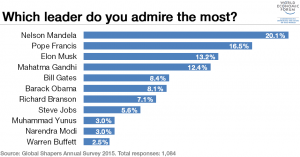
In a discussion with undergraduates a week ago, the familiar question arose: Why don’t social movements have great leaders any more? One could dispute the premise, arguing that we do have social movement leaders today and that we romanticize the past when we forget how divisive–even within their own movements–most leaders have always been. Still, I think the students were onto something when they posed this question. Here are the leaders whom young people around the world admired the most in 2015:

leaders

The two people who could clearly be classified as leaders of social movements are dead. Of the rest, five are business leaders and two are elected officials in very large and influential democracies. Only Pope Francis and Muhammad Yunus could be described as leaders in civil society, and neither is a classic example of a social movement participant. Meanwhile, some highly prominent current movements–the Arab Spring, #Occupy, Black Lives Matter–are known for their reluctance to anoint leaders.

I’d propose three theses:

1. “Apex” leaders are assets to social movements, even today. 

Leaders who become famous for their participation in social movements are useful. They symbolize the movement’s objectives and its spirit in human form. They can use their prestige to mediate disagreements within the movement. And they are available to negotiate with outside powers. It’s hard to imagine the victory of Solidarity in Poland or the Freedom Movement in South Africa if Lech Walesa and Nelson Mandela hadn’t ultimately been able to sit down across a table from the regime and work out a deal.

2. Social movements make leaders, more than leaders make social movements.

There is a widespread view that very charismatic and visionary leaders call social movements into being. Perhaps that has happened a few times, but the reverse seems much more typical. Social movements identify individuals who have potential to lead. They offer them opportunities to develop leadership skills and expand their reputations. Often, movement members must cajole the prospective leader into playing that role. They then deliberately construct a reputation for their leader, for the consumption of outsiders.

A classic example is Martin Luther King’s ascent to leadership in Montgomery ca. 1954. As Taylor Branch tells the story in Parting the Waters, King moved to Montgomery with ambitions to participate in civil right activism. Although still a young man, he had been groomed for leadership in his father’s Atlanta congregation and at Morehouse College, where President Benjamin E. Mays was a prophetic leader who had gone to India to meet Gandhi. These institutions, already pillars of the nascent Civil Rights Movement, had developed King’s skills and imparted an overwhelming sense of obligation. In his new city of Montgomery, he took deliberate steps to enter the black leadership, giving a “stirring speech” at the NAACP and joining its executive committee (which, needless to say, already existed). The Montgomery Bus Boycott was started by other people, mainly women, who used finely honed techniques to implement a carefully designed plan. King was recruited to join the effort after it had begun and was then nominated to be the president of the leadership team.

Idealists would say afterward that King’s gifts would made him the obvious choice. Realists would scoff at this, saying that King was not very well known, and that his chief asset was a lack of debts or enemies. Cynics would say that the establishment preachers stepped back for King only because they saw more blame and danger ahead than glory (Branch, p. 137). 

And–I would add–everyone assumed that a male reverend doctor would make a more palatable leader than Rosa Parks, a woman without a college degree who had been “focused for almost two decades on white men’s sexual aggression and violence against black women” and who had challenged the Montgomery bus system because of systematic sexual harassment against black female riders. Hers was not an agenda that would appeal to socially conservative African Americans or white liberals.

So King was chosen. This is not to detract from his personal gifts, but even those came in part from his training within the movement. The other church leaders in Montgomery identified King’s extraordinary talents, gave him an opportunity to use them, and helped develop his national persona. It’s in that sense that the Civil Rights Movement made Dr. King, more than the reverse.

3. Good social movements hold their leaders accountable and limit their powers.

We live in a time of “strong” leaders. China’s Xi Jinping, India’s Narendra Modi, Russia’s Vladimir Putin, and Turkey’s Recep Tayyip Erdogan’s alone preside over a contiguous bloc of countries whose populations approach three billion. Each of these men has consolidated power and projects a macho image. None is particularly accountable. Meanwhile, as I mentioned earlier, we see social movements develop without leaders at all.

The best cases surely lie in between. They are movements with “apex” leaders whose powers are circumscribed and who are held constantly accountable. Again, King is a great example. His main formal role was president of the Southern Christian Leadership Conference, which “differed from organizations such as the Student Nonviolent Coordinating Committee (SNCC) and the National Association for the Advancement of Colored People (NAACP), in that it operated as an umbrella organization of affiliates.” So King was not only accountable to a board, but the organization he led depended on churches’ voluntary and revocable decisions to join. He had no formal power over SNCC or NAACP, let alone the Nation of Islam. Indeed, these groups fairly often competed. To the extent that he was the leader of the whole Civil Rights Movement, he had to earn that standing by constantly serving the grassroots base. It’s that specific kind of leadership that seems especially lacking today.

See also the real Rosa Parksis the Sanders campaign a movement?; and how to respond to a leader’s call for civic renewal.

The Neurology of Consumer Compulsion

It is self-evident that mass consumption is a main driver of relentless economic growth, the utopian goal of capitalism, and this has obvious ecological implications as we over-consume the Earth.  But why do we feel compelled to consume far beyond what we truly need? 

In a provocative new essay on the Great Transition Initiative website, neuroscientist Peter Sterling explores “Why We Consume:  Neural Design and Sustainability.”  It is an evolutionary scientist’s argument for how human beings are neurologically wired and what we might do about it. What is the biological substrate for our behaviors as homo economicus and as social cooperators?  Why do we (over)consume? 

Sterling points to such obvious social factors such as our desire for social status and a good self-image, all of it fueled by advertising.  But while these feelings of satisfaction invariably wane, they invariably surge forward again and again: “Something at our neural core continually stimulates acquisitive behavior,” he writes, adding that “we urgently need to identify and manage it.”

Sterling notes that we all have neurological circuits that are periodically bathed in dopamine as a reward for satisfying behaviors. More than a “pleasure center,” these neural responses serve as a reward for human learning and adaptation in a highly varied environment. It is the decline of our highly varied environment that may be responsible for our consumerist obsessions.

read more

Integral Facilitator & Meridian Univ. Collaboration Advances Facilitative Leadership

We are happy to share the announcement below about a new facilitation training opportunity in California from NCDD Sustaining Member Rebecca Colwell of Ten Directions. Rebecca shared this announcement via our great Submit-to-Blog Form. Do you have news you want to share with the NCDD network? Just click here to submit your news post for the NCDD Blog!


Ten Directions & Meridian University Collaboration

We are pleased to announce an innovative professional training and development collaboration between Ten Directions and Meridian University, based in the San Francisco Bay Area.

The Ten Directions and Meridian University collaboration enables students who are pursuing graduate degrees at Meridian University to concurrently complete the Integral Facilitator certificate program for academic credit towards their degree program.

The Meridian University degree programs which are eligible to receive academic credit for participation in the Integral Facilitator Certificate Program are:

  • Integral MBA in Creative Enterprise
  • M.A. in Psychology
  • Ph.D. in Psychology (meets the educational requirements for psychologist licensure in California)
  • M.Ed. in Educational Leadership
  • Ed.D. in Organizational Leadership

How it Works 

Students enrolled both at Meridian University and Ten Directions can substitute 120 Integral Facilitator program hours for 12 quarter credits of Meridian coursework during the academic year in which they are participating in the Integral Facilitator training. Enrolled Meridian University students meet the academic requirements of Meridian’s programs, consisting of online learning, residential sessions, and reading and writing assignments related to the content of the Integral Facilitator Certificate Program.

Meridian Scholarship program for Ten Directions

Students admitted to both Meridian University and the Ten Directions Integral Facilitator Certificate Program are eligible to apply for a $5,000 scholarship, established especially for this program.

To Apply

To apply, please submit a separate application for each program, unless you have already been accepted into one of the programs.

Apply for Ten Directions training at www.tendirections.com/integral-facilitator
Apply for Meridian’s programs at www.meridianuniversity.edu

About Ten Directions
As many NCDD members know, Ten Directions provides premier developmental trainings for leaders, facilitators, coaches, consultants and change agents who wish to employ an Integral approach to facilitation and develop the competencies of facilitative leadership.

Ten Directions’ programs emphasize personal transformative practice to support the development of embodied presence, skillful perspective taking, masterful communication, compassionate engagement and fluid responsiveness to complexity. Our facilitation and leadership training programs are available in North America and Europe, including online programs, 3-day live Intensives and a 9-month Integral Facilitator Certificate program.

About Meridian University
Guided by an Integral Vision, Meridian University seeks to educate leaders with the capacities, skills, and knowledge essential for transforming the professions of Psychology, Business, and Education. The leadership capacities of courage, compassion, clarity, conscience, and embodied self-awareness together constitute the wisdom and integrity required for transforming the professions and the wider culture. Transformative learning at Meridian catalyzes the emergence of these capacities which, along with developing creative inquiry skills and acquiring professional knowledge, actualizes Meridian’s commitment to sustaining an education that transforms.

Maoist chic as Orientalism

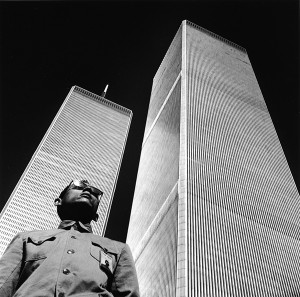
tseng kwong chiWhile visiting the excellent Tufts University Art Gallery exhibition, “Tseng Kwong-Chi: Performing for the Camera,” my colleagues and I heard the following story. Tseng was the child of Chinese anticommunist refugees. He moved to the East Village in the 1970s, where he worked and played with people like Keith Haring and Andy Warhol. When his parents visited from their home in Vancouver, they wanted to take him to Windows on the World, the fancy restaurant that used to be at the top of the World Trade Center. It required a jacket, and the only jacket Tseng owned was a Chinese Communist uniform that he had bought in a second-hand store in Montreal. The restaurant not only let him in but fawned over him, assuming that he was a Chinese dignitary. This reception gave Tseng the idea of posing in front of iconic monuments all over the North America and Western Europe, dressed in his Mao jacket, Ray-Bans, and an ID badge that reminds me of the X-Files. He always donned the serious, distant look of the Chairman inspecting the Red Army’s triumphs.

Tseng had studied art in Paris, so Richard Wolin’s book, The Wind from the East: French Intellectuals, the Cultural Revolution, and the Legacy of the 1960s provides some helpful background. Wolin writes that Communist China was all the rage in Paris in 1967. That year,

Mao-collared suits–“les cols de Mao“–had become immensely fashionable. Try as they might, the clothing boutiques in Paris’ tony sixteenth arrondissement could not keep them in stock. … Lui, the French equivalent of Playboy, decided to jump on the pro-Chinese bandwagon by featuring an eight-page spread of scantily clad models in straw hats, red stars, and Red Guard attire. The accompanying captions were culled from The Little Red Book. One striking image portrayed a young woman, unclad and equipped with an automatic rifle, emerging from an enormous white cake. “The revolution is not a dinner party,” read the legend.

Tseng might not have seen this Lui issue, but he lived in Paris soon after Chinese communism had inspired everything from softcore porn to an insurrection. Meanwhile, in the actual China, during the year 1967 alone, some 237,000 citizens were killed and 730,ooo permanently disabled as a result of the Cultural Revolution.

Tseng was a Canadian citizen, a gay man, an East Village artist, and an Asian immigrant to North America. In these pictures, he is role-playing the most powerful Asian man of the time, one whose victims–almost all Asians–may number 65 million. By passing as a Communist official instead of an East Village immigrant artist, he was able to experience social recognition in his adopted land. He also parodied the appropriation of serious matters for profitable pop culture and made serious art out of the parody.

See also:  French post-War intellectuals: some generalizations and when is cultural appropriation good or bad?

How Human Brains Give Rise to Language

Yesterday, I attended a lecture by Northeastern psychology professor Iris Berent on “How Human Brains Give Rise to Language.” Berent, who works closely with collaborators in a range of fields, has spent her career examining “the uniquely human capacity for language.”

That’s not to say that other animals don’t have meaningful vocalizations, but, she argues, there is something unique about the human capacity for language. Furthermore, this capacity cannot simply be attributed to mechanical differences – that is, human language is not simply a product of the computational power of our brains or the ability of our oral and aural processing.

Rather, Berent argues, humans have an intrinsic capacity for language. That is, as Steven Pinker describes in The Language Instinct,  “language is a human instinct, wired into our brains by evolution like web-spinning in spiders or sonar in bats.”

While this idea may seem surprising, in some ways it is all together reasonable: humans have specialized organs for seeing, breathing, processing toxins, and more – is it really that much more of a jump to say that the human brain is specialized, that the brain has a specialized biological system for language?

Berent sees this not as an abstract, philosophical question, but rather as one that can be tested empirically.

Specialized biological systems exhibit an invariant, universal structure, Berent explained. There is some variety among human eyes, but fundamentally they are all the same. This logic can be applied to the question of innate language capacity: if language is specialized, we would expect to find for principles: we would expect what Noam Chomksy called a “universal grammar.”

In searching for a universal grammar, Berent doesn’t expect to find such a thing on a macro scale: there’s no universal rule that a verb can only come after a noun. But rather, a universal grammar would manifest in the syllables that occur – or don’t occur – across the breadth of human language.

To this end, Berent constructs a series of syllables which she expects will be increasingly difficult for human brains to process: bl > bn > bd > lb.

That is, it’s universally easier to say “blog” than to say “lbog,” which “bnog” and “bdog” having intermediate difficulty.

One argument for this is simply the frequency of such constructions – in languages around the world “bl” occurs more frequently than “lb.”

Of course, this by no means proves the existence of an innate, universal grammar, as we cannot account for the socio-historical forces that shaped modern language, nor can we be sure such variance isn’t due to the mechanical limitations of human speech.

Brent’s research, therefore, aims to prove the fundamental universality of such syllables – showing that there is a universal hierarchy of what human brain prefers to process.

In one experiment, she has Russian speakers – who do use the difficult “lb” construction – read such a syllable out loud. She then asks speakers of languages without that construction (in this case English, Spanish, and Korean), how many syllables the sound contained.

The idea here is that if your brain can’t process “lbif” as a syllable, it will silently “repair” it to the 2-syllable “lebif.”

In numerous studies, she found that as listeners went from hearing syllables predicted to be easy to syllables predicted to be hard, they were in fact more likely to “repair” the word. Doing the experiment with fMRI and Transcranial Magnetic Stimulation (TMS) further revealed that people’s brains were indeed working harder to process the predicted-harder syllables.

All this, Berent argues, is evidence that a universal grammar does exist. That today’s modern languages are more than the result of history, social causes, or mechanical realities. The brain does indeed seem to have some specialized language system.

For myself, I remain skeptical.

As Vyvyan Evans, Professor of Linguistics at Bangor University, writes, “How much sense does it make to call whatever inborn basis for language we might have an ‘instinct’? On reflection, not much. An instinct is an inborn disposition towards certain kinds of adaptive behaviour. Crucially, that behaviour has to emerge without training…Language is different…without exposure to a normal human milieu, a child just won’t pick up a language at all.”

Evans rather points to a simpler explanation for the emergence of language: cooperation:

Language is, after all, the paradigmatic example of co‑operative behaviour: it requires conventions – norms that are agreed within a community – and it can be deployed to co‑ordinate all the additional complex behaviours that the new niche demanded…We see this instinct at work in human infants as they attempt to acquire their mother tongue…They are able to deploy sophisticated intention-recognition abilities from a young age, perhaps as early as nine months old, in order to begin to figure out the communicative purposes of the adults around them. And this is, ultimately, an outcome of our co‑operative minds. Which is not to belittle language: once it came into being, it allowed us to shape the world to our will – for better or for worse. It unleashed humanity’s tremendous powers of invention and transformation.

facebooktwittergoogle_plusredditlinkedintumblrmail