help shape the strategy for civic renewal in America

The 2016 Annual Conference on Citizenship is co-hosted and co-planned by my colleagues and me at the Jonathan M. Tisch College of Civic Life at Tufts University and will specifically focus on issues of diversity, equity, and inclusion in civic life. Unless we make progress on these issues, we cannot move our country forward.

This year’s conference will be interactive; the whole group will think together about what civic life in America would look like if it strove for equity, diversity, and inclusion.

Participants will help shape the agenda for civic renewal in America and will leave with contacts and practical ideas to strengthen their own work.

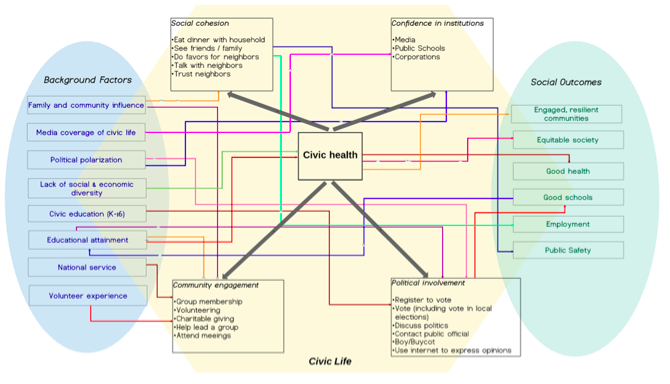
During the day, we will work together to revise and improve our collective understanding of civic life. The map below will be a starting place.

screen-shot-2016-09-27-at-11-37-57-am

On the left are factors that may affect civic life, for better or worse. In the middle is “Civic Health” as it has been measured by the National Conference on Citizenship (NCoC) and its partners over the past decade. Civic Health has four major components that radiate out from the center. On the right are valuable outcomes of having a healthy civic life, such as resilient communities and good schools.

The arrows show connections uncovered by NCoC, Tisch College, and others. For example, we know that k-12 civic education can boost political involvement, that communities with more political engagement have better schools, and that good schools boost educational attainment, so all of those boxes are connected with arrows.

This is just a start, and during the day, we will ask participants to add, edit, or move boxes and arrows to help build a better diagram. We will also ask you to place yourself on the map.

There will be opportunities to hear from inspiring and well informed speakers. Click here to view the agenda at-a-glance.

Please join us for this important convening and invite other colleagues whose voices need to be heard. Register today!

End Corporal Punishment in Public Schools

First published in The Herald Leader (Lexington, KY), Sunday, 9/25/16, 4-5C.

Logo of the Lexington Herald-Leader.On September 4th, The Herald Leader of Lexington, KY, published an in-depth news article on the subject of corporal punishment in public schools. It was still early in the school year, which makes such topics timely. I had written a draft to send them on the subject, but the news article offered many specifics to address in considering the kinds of justifications people raise for continuing corporal punishment in public schools.

Here is the news article to which I was responding, titled “The Paddle Is Still Wielded in Kentucky Schools, but in Declining Numbers.” The piece covers quite an array of reasons people give for the continued practice of corporal punishment. I believe philosophers have a lot to offer when it comes to analyzing arguments, clarifying concerns, and cataloguing reasons for or against a matter. So, I updated my initial draft for the Herald Leader and it came out yesterday in the Sunday issue.

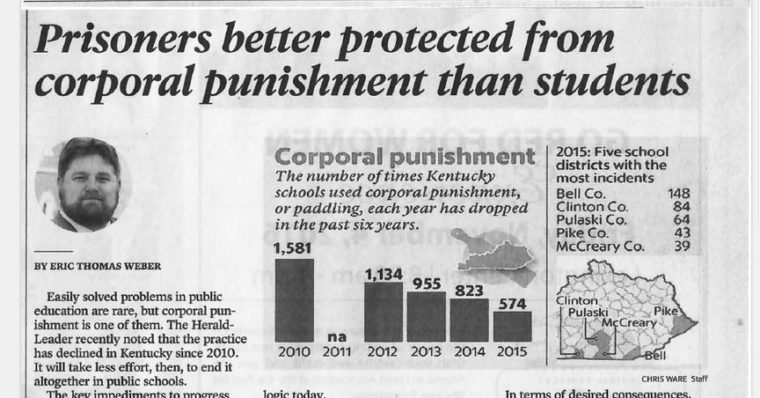
Photo of the header of my op-ed on corporal punishment. Clicking on the link in the image takes you to the full scan of the printed article, available on Academia.edu.

My original title was “End Corporal Punishment in Schools,” but the editors found one of the lines from the piece stronger. So in print and online, the op-ed is titled “Prisoners Better Protected from Corporal Punishment than Students.” That link takes you to the HTML version of the piece online. I’ve also scanned in the printed version which you can view on Academia.edu here or by clicking the image here above.

Big Tent Social Justice

I’ve been trained to think like a marketer, and I tend, at times, to think of social justice efforts through this lens too.

That is, if you’re trying to bring about behavior change among a large portion of the population, what communication strategies and tactics do you use to bring about this change? This way of thinking is somewhat distasteful given the manipulative reputation of marketing as a profession, but I find it useful nonetheless.

From this perspective, the strategy of a social justice movement would be to appeal to the largest possible number of people – to welcome everyone under a “big tent” vision of the cause. If this is your goal, then the strategy becomes relatively straightforward: create messages with broad appeal, take actions which generate sympathy, in all things go for the broadest reach and broadest appeal possible.

This is all very reasonable from a marketing perspective.

However, there’s a problem with this approach: the bigger your tent, the more diluted your vision. The more you try to please a broad group of people, the more you will have to relax your core stance.

This balance applies to any issue, not just social justice. Robert Heinlein used to argue that it was impossible to make a decision if more than 3 people are involved. Any time you have a large number of people in one place, the number of things they can really, deeply agree to will be minimal.

If you’re a marketer trying to maximize your profits, find the right balance takes skill but is relatively straightforward: appeal to the largest number of people possible while also creating a coherent brand identity. There’s a trade-off between the two, but no real sacrifice either way.

The calculation is more complex when it comes to social justice: just how much are you willing to let go?

This is an important question with a non-trivial answer: appeal to many people and you increase your chances of accomplishing something – but you also make it more likely that what you accomplish will be a toothless, meaningless shadow of your original goal.

There are varied opinions on which side of this spectrum it’s better to be on, and there’s no easy answer. When doing nothing is disastrous, is it better to accomplish something ineffective or to accomplish nothing at all?

Perhaps doing something is better than doing nothing; or perhaps an empty victory only serves to alleviate the sense that something needs to be done – making it virtually impossible for any real change to occur.

I don’t have an answer to this question – certainly not a generalizable one which could be applied to any issue at any time. But I do think that both arguments are reasonable – that we must appreciate the efforts of all who strive towards social justice and to value their input and perspective – even when we disagree.

facebooktwittergoogle_plusredditlinkedintumblrmail

what people mean when they say that Trump or Clinton is honest

It flabbergasts many people to learn that more Americans view Trump rather than Clinton as “honest and trustworthy” (35% versus 33%), even though we can read in The New York Times, “A Week of Whoppers from Donald Trump”; in The Washington Post, “Trump’s Week Reveals Bleak View, Dubious Statements in ‘Alternative Universe‘”; and in The Los Angeles Times, “Scope of Trump’s Falsehoods Unprecedented for a Modern Presidential Candidate.”

In philosophy school, you learn to make distinctions, and I think two distinctions may be useful for interpreting the public’s response. First, “truthfulness” can mean:

  1. Saying what is true. Because they envision truths as claims consistent with evidence, many fact-checkers compare candidates’ assertions to government data and public records or to academic research. For instance, Donald Trump has said that Lester Holt, the debate moderator, is a Democrat, but official records show that Holt is a registered Republican. The Times calls that a “whopper.” I am confident that Hillary Clinton’s claims are far more often verifiable than Donald Trump’s, and in that sense, she is more truthful and trustworthy.
  2. Investing skill and effort in finding the truth. If truth is correspondence to some independently verifiable reality, then a person could say something true–or false–by accident. We can also err when we fact-check. But some people truly strive for truth. They are careful not to opine on matters for which they lack evidence, they listen to alternative views, they complicate their positions when they encounter contrary evidence, they may even seek contrary evidence, and they select appropriate methods for answering empirical questions. They can still be wrong, but they have a respectful attitude to truth. I am confident that Hillary Clinton is a much more dedicated and skillful truth-seeker than Donald Trump is, although one could raise serious criticisms of her truth-seeking in episodes like her vote to authorize the Iraq War (when she had privileged access to intelligence) or her endorsement of the “super-predator” theory of crime.
  3. Speaking what is in your mind. For many people, honesty and truthfulness mean candor, sincerity, or forthrightness. Provoked by tricky Odysseus, guileless Achilles exclaims, “I hate like the Gates of Hell a man who says one thing and thinks another in his mind!” A candid straight-shooter can say lots of things that are false, either by accident or because he’s not a good truth-seeker. If he really, truly thinks that taxes are higher in the US than any other country, he looks you in the eyes and says so. Judged by that third standard, I am not sure whether Trump is “honest.” Although he may be guileful, it’s at least plausible that he blurts out what he really thinks, reflecting an ideological/normative worldview that he genuinely holds. Sometimes he even says things that cost him tactically because they make him look dumb or alienate a specific voting bloc that might have preferred him. And just for that reason, lots of people think he’s “honest.” As for Hillary Clinton, I perceive that she thinks many things in her mind and puts them through a very careful screen before she speaks aloud. Voters are sensitive to that kind of processing. They take slip-ups, like her “deplorables” comment, to be glimpses of a hidden stratum of sincere beliefs. This is what some have in mind when they call Trump more honest than Clinton.

“He tells it like it is”

My own view would be something like this: Truth-seeking is an important virtue for political leaders. It raises the odds that leaders will know the actual truth, although I’d forgive any human being for making errors if she demonstrates both commitment and skill in her truth-seeking.

Politicians should also demonstrate some candor. To struggle to know the truth and then to say something less than, or different from, the truth in public is not very democratic. On the other hand, politics isn’t a seminar room, a lab, or a witness stand in a court of law. Other political virtues may conflict with candor, such as tact, diplomacy, privacy, national or global security, and sheer effectiveness. A political leader must strive to enact and change policies, and it can undermine her effectiveness if she says everything she believes. I am pretty sure that’s why Clinton talks as she does, but because many people equate truthfulness with candor, she pays a price.

It’s also worth distinguishing between …

  1. the immediate empirical truth of statements (e.g., “Lester Holt is a Democrat,” which is false), and
  2. the truth or validity of broad ideological positions (e.g., “The media is biased against regular folks”).

I believe that Hillary Clinton’s center/left ideology is much more defensible than Trump’s authoritarian ethno-nationalism, but that requires arguments rather than empirical data; and other positions are more defensible still than Clinton’s.

I am also inclined to think that Trump is pretty candid about his own ideological position, although he fails to acknowledge its implications (which is a fault of his truth-seeking). I am not sure how candid Clinton is about her ideology; that is hard to assess from afar. I’d argue that center-left American politicians exhibit a general lack of ideological candor because they presume that many beneficial policies are unpopular. For instance, it would be wise to borrow and spend on infrastructure, but you can’t say that because the American people don’t trust government. It would be desirable to standardize curricula and tests because in lots of communities, parents are creationists or otherwise misguided, but you’d better not say that because those people vote. I’d posit that Clinton struggles to attract trust in part because she belongs to a whole ideological bloc that has struggled since the 1970s to present itself candidly to the electorate.

See also: Bernard Williams on truth as a virtue of the humanitieswhy Hillary Clinton appears untrustworthy; and Hillary Clinton on spending for infrastructure.

Support Still Needed for NCDD2016 Youth Scholarship Fund!

As we announced recently, NCDD is in the midst of an effort to raise $10,000 for our Youth Scholarship Fund to bring as many young people as possible to the NCDD 2016 conference, and we need your help! We have raised just over $1,000 so far in generous donations from our incredible NCDD network, but we still have a lot to raise before our October 7th deadline. Will you consider making a tax-deductible donation today to support the involvement of young people in the D&D field? 

Involving young people and students in our conferences is a huge benefit to our field, the gathering itself, and of course, the young people! Youth and student attendees help bring new ideas and perspectives to our conversations, energize other participants, and having them with us also contributes to bridging the generational divide that so often impacts our country. But most of all, we need to involve the next generation of D&D leaders today to help us foster resilience and longevity for our field as many of leading pioneers of the field begin to exit the work. Won’t you help us develop the D&D leaders and practitioners of tomorrow?

Your donation will be tax-deductible, and it goes directly to helping us provide travel support, cover hotel rooms, and pay registration fees for young people who otherwise wouldn’t be able to attend. Plus, anyone who donates $50 or more will have their contribution acknowledged in the printed conference guidebook!

We want to say a special “Thank You!” to some of champions of young people who have already donated! Thank you very much to:

  • The Network for Peace through Dialogue
  • Hawaii State Senator Les Ihara, Jr.
  • Chris Bui of The American Focus
  • Cynthia Kurtz
  • Bluebonnet Hills Christian Church, Austin, TX
  • Larry Schooler
  • and Bill Potapchuk of the Community Building Institute
  • Carolyn Penny, Director, UC Davis Campus Dialogue & Deliberation

These leaders have contributed to making it possible for more of our field’s young people to have the life-changing experience of attending an NCDD conference, and we encourage you to join them in investing in our emerging leaders to insure the bright future of our work! Learn more about other ways you can support young people coming to the conference in our earlier post here.

We need everyone to chip in to help us reach our goal of raising $10,000 for the NCDD 2016 Scholarship Fund before October 7th, so we urge you to make a contribution now!

The FJCC Is Looking For Script Writers!

So, as you may or may not know, our popular Escambia Civics Review site is going to be undergoing a significant transformation over the next few months as we develop new and more effective resources for both review and instruction. One of these resources will be a set of brand new student friendly videos, one for each of the assessed benchmarks, that are between 5 and 7 minutes long. They will draw on our Student Friendly Readings as a foundation, and include reflection questions throughout the video.

So, here is the thing. We do not have the ability to knock out 35 scripts in two weeks. So we need your help. If you are a current or past quality civics teacher here in Florida, we would love to hire you to write some scripts for us. We are looking for a small group of high quality teachers for this, perhaps ten or so. You would earn 100 dollars per script, and the turn around time for each would be no longer than 3 or 4 days, at most. You will be assigned benchmarks to write for following a brief and required webinar around the process, and we would of course recognize your contribution at the end of the video. We are really looking for some good, student friendly, engaging scripts that can cover the content well while also making viewing enjoyable.

If this is something that interests you, please shoot me an email and let me know of your interest! Please include your name (obviously), your district and school, and how long you have been or taught civics in Florida. We hope to hear from you soon!

UPDATE: If you have experience with Powtoon, we are also looking for video developers!


Florida Council for the Social Studies Awards Overview!

Every year at the annual conference, the Florida Council for the Social Studies gives out a number of awards that recognize excellence in social studies education and service to the social studies community. I just want to take a few minutes and provide you with an overview of those awards. I hope that you will consider registering for the conference and attending the awards banquet in order to help recognize your colleagues!

We are excited also to welcome Dr. Gwendolyn Zoharah Simmons as the keynote speaker at dinner! Dr. Simmons has been proclaimed as an original Black Power feminist and a grassroots leader of the Mississippi Freedom Summer. Dr. Simmons will present her experience and role in Freedom Summer ’64 working to build schools, libraries and registering voters in black communities in the Mississippi Delta as part of the Civil Rights Movement. She will reflect on how these experiences were the start of a life of…“Putting communal goals before individual goals.”

The Doctor Theron Trimble Florida Teacher of the Year Award is to recognize exceptional social studies teachers for grades K-6, 5-8, and 7-12, and to encourage participation in the NCSS Teacher of the Year program at the national level. Nominees must be a former or current district-nominated FCSS Teacher of the Year, and a current member of FCSS. Nominees may apply in only one category (teaching social studies regularly and systematically in elementary settings, and at least half time in middle/junior high and
high school settings).

The Harry Tyson Moore Award is named after a teacher who championed the advancement of civil rights in Florida. Founder of the first branch of the National Association for the Advancement of Colored People (NAACP) in Brevard County, Moore and his wife, Harriet Vyda Simms Moore, paid the ultimate price for their activism when their house was bombed on Christmas night, 1951. In sponsoring this award, Nystrom Education hopes to inspire future generations of Florida’s students to civic action with the story of Harry T. Moore, who declared, “Freedom never descends upon a people. It is always bought with a price.”

The Gilder-Lehrman Institute of American History awards the Florida American History Teacher of the Year in conjunction with the Florida Department of Education annually in its effort to promote the study and love of American history.

The Doyle Casteel Outstanding Leadership Award is given to an individual for his/her continuous leadership in a supervisory or administrative capacity. Their leadership in FCSS has promoted cross cultural understanding, mentoring of classroom teachers, and advocating the importance of social studies education. This award is sponsored by McGraw Hill Education.

The Warren Tracy Beginning Teacher of the Year Award, sponsored by Houghton Mifflin Harcourt, is to recognize and celebrate the accomplishments of social studies teachers new to the field of education, who engage students in meaningful lessons to increase student awareness, who are involved with school/ community activities, and who are leaders on behalf of education.

The Outstanding Citizen Award recognizes an individual in the state of Florida who has done the most to promote the growth of social studies throughout the State.

The Excellence in Teaching History Award, sponsored by Pearson Education, is to recognize and celebrate a Florida teacher of history who encourages an appreciation and respect for history, involves students in the historical process, and evidences mastery of the subject matter.

The Agnes Crabtree International Relations Award recognizes the FCSS member who has, through teaching, research or community activities furthered the cause of international, intercultural relations. It is given in honor of Agnes Crabtree, a Miami-Dade teacher. Agnes was active in NCSS and FCSS, and the United Nations Association, serving as NEA international relations consultant.

The B. J. Allen Social Science Professional Award is given to an outstanding FCSS educator who has served the professional organization in a comprehensive way. The award honors service to FCSS and to social studies during the year or years immediately past. Dr. B.J. Allen, Florida State University Professor, and President of the organization.

The J.R. Skretting Leadership Award honors an outstanding FCSS educator who has served with distinction during the year or years immediately past. J. R. Skretting was head of the Social Studies Education Department at Florida State University, the first Executive Secretary of FCSS and provided outstanding leadership for the organization.

The Wilma Simmons Golden Service Award recognizes a member who has been active for many years and has made significant and lasting contributions to the council. Wilma Simmons, former Social Studies Supervisor in Duval County, was one of the original founders of FCSS.
awards-sponsorsWe hope that you will join us to recognize the winners of these and the district Outstanding Teachers of the Year that will also be brought on stage! Register now for FCSS! 


Representing the Structure of Data

To be perfectly honest, I had never thought much about graph layout algorithms. You hit a button in Gephi or call a networkx function, some magic happens, and you get a layout. If you don’t like the layout generated, you hit the button again or call a different function.

In one of my classes last year, we generated our own layouts using eigenvectors of the Laplacian. This gave me a better sense of what happens when you use a layout algorithm, but I still tended to think of it as a step which takes place at the end of an assignment; a presentation element which can make your research accessible and look splashy.

In my visualization class yesterday, we had a guest lecture by Daniel Weidele, PhD student at University of Konstanz and researcher at IBM Watson. He covered fundamentals of select network layout algorithms but also spoke more broadly about the importance of layout. A network layout is more than a visualization of a collection of data, it is the final stage of a pipeline which attempts to represent some phenomena. The whole modeling process abstracts a phenomena into a concept, and the represents that concept as a network layout.

When you’re developing a network model for a phenomenon, you ask questions like “who is your audience? What are the questions we hope to answer?” Daniel pointed out that you should ask similar questions when evaluating a graph layout; the question isn’t just “does this look good?” You should ask: “Is this helpful? What does it tell me?”

If there are specific questions you are asking your model, you can use a graph layout to get at the answers. You may, for example, ask: “Can I predict partitioning?”

This is what makes modern algorithms such as stress optimization so powerful – it’s not just that they produce pretty pictures, or even that they layouts appropriately disambiguate nodes, but they actually represent the structure of the data in a meaningful way.

In his work with IBM Watson, Weidele indicated that a fundamental piece of their algorithm design process is building algorithms based on human perception. For a test layout, try to understand what a human likes about it, try to understand what a human can infer from it – and then try to understand the properties and metrics which made that human’s interpretation possible.

facebooktwittergoogle_plusredditlinkedintumblrmail