the floating “that”: a linguistic innovation?

(Orlando) “You’ve got to eat those vegetables and do that exercise every day.” “We’re concentrating on those metrics, that whole assessment piece.”

Maybe it’s just me, but I’m noticing this speech pattern lately. People use “that” to intensify a noun. I think they’re mimicking a situation in which you have already talked about an important topic–and perhaps achieved agreement on it–and now you use “that” to refer back to the previous discussion. But in this new linguistic phenomenon, there’s no previous discussion to refer back to. “That” simply stresses the following noun.

No value-judgment implied. People are endlessly inventive; language constantly changes. I just find this new speech pattern interesting. (I wouldn’t use it in written text, however.)

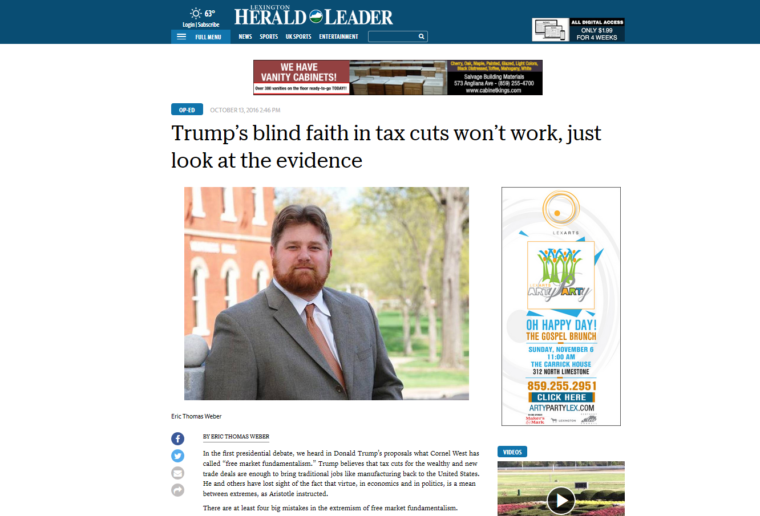
Trump’s Blind Faith in Tax Cuts Won’t Work, Just Look at the Evidence

Piece originally published in The Herald Leader, October 13, 2016.

Thumbnail photo of my piece in the Herald Leader, titled, 'Trump's Blind Faith in Tax Cuts Won't Work, Just Look at the Evidence.' The link leads to the article on the Herald Leader's site.

After watching the first Presidential debate, I was struck by how little Donald Trump had to offer in terms of actual policy proposals. He suggested renegotiating trade deals, but that’s not something he can unilaterally do. I’m skeptical. The things government can do on its own, among his recommendations, included lowering taxes for the wealthy and for corporations. It’s his panacea. It’s also something that in many cases has already been shown not to work.

Of course, there can be too much. But for a man proud of paying no taxes, it’s all the more absurd to suggest that taxes are too high on him. Here’s my piece, covering what I take to be the four big mistakes in Donald Trump’s free market fundamentalism.

Election Modeling

I’ve been spending a lot of my time working on a class assignment in which we are asked to model the U.S. presidential election. The model is by necessity fairly rudimentary – I’m afraid I won’t be giving Nate Silver a run for his money any time soon – but it’s nonetheless been very interesting to think through the various steps and factors which influence how election results play out.

The basic approach is borrowed from the compartmental models of epidemiology. Essentially, you treat all people as statically equivalent and allow for transitions between discrete compartments of behavior.

Consider a simple model with the flu: you start with a large pool of susceptible people and a few infectious people. With some probability, a susceptible person will come in contact with an infectious person and become infected. At some average rate, and infectious person will recover. Thus, you can separate people into compartments, Susceptible, Infectious, Recovered, and with average transition rates can estimate the number of people in each compartment at each time step.

Of course, sophisticated epidemic models can be much more complicated then this, and trying to interpret the complexity of an electoral system through such a simple model has proven to be challenging.

First there’s the question of how to transfer this metaphor to electoral politics – what does it mean to be ‘susceptible’, ‘infectious’, or ‘recovered’ in this context?

But perhaps the piece I have found most interesting is trying to understand the system’s “initial conditions.” I am not an epidemiologist, but a simplified model of disease spreading where some people start susceptible and a few people start infected makes intuitive sense to me. We even worked out mathematically how moving people from “susceptible” to “recovered” via vaccination helps prevent a serious outbreak of a disease. (PSA: get your flu shot.)

But I’ve had a much harder time wrapping my head around what initial compartment a voter might belong in.

There’s an idealized version of politics in which all eligible voters start with a completely open mind – a clean slate ready to be filled with thoughtful judgements and reflections on the merits of each candidate’s policies.

But that’s not really how electoral politics works.

I, for example, have always been a staunch partisan, and while it perhaps would be better if I entered an election season as a clean slate – I always enter with a whole host of biases and preconceptions. The debates and TV ads were never going to change my mind.

So what has been most striking in the process is how little movement actually takes place – especially considering just how long this election has gone on.

When you take the partisan leaning of Independents into account, Pew estimates the current population of registered voters as 44% Republican/lean Republican, 48% Democrat/lean Democrat, and 8% no leaning/other party.

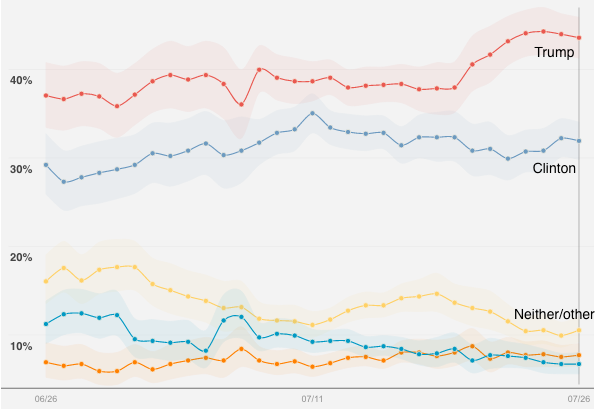
FiveThiryEight‘s weighted average of national polls shows some fluctuations over the last six months, but currently puts Clinton at 45.8%, Trump at 39.4%, and Johnson at 5.8%. That’s not a direct correlation to the raw partisan leaning, but it’s close enough to show that – in the epistemological framework – relatively few transitions are happening.

In fact, the earliest FiveThiryEight numbers, from June 8 of this year put Clinton at 42%, Trump at 38%, and Johnson just shy of 8%. So I guess this makes me wonder:

…Couldn’t we have held this election back in June and saved ourselves the trouble?

facebooktwittergoogle_plusredditlinkedintumblrmail

social class does predict Trump support

Some say that Trump has captured the support of working-class Whites who are economically stressed or anxious. Others reply that Trump voters are relatively upscale but motivated by racial resentment alone. The former premise suggests that Democrats must do more to empower the working class, including Whites. The latter suggests that White nationalism is our fundamental problem today. Although I see truth in both positions, I’ve argued for addressing the economic and political vulnerability of the White working class. I present that as a strategy for countering Trumpism, but it’s a misguided strategy for that purpose if Trump voters are relatively affluent.

The raw story is that White people with lower incomes are Trump’s strongest backers.

Presidential Candidate Preference for Whites with Family Income <75K (Reuters)

Presidential Candidate Preference for Whites with Family Income <$75K (Reuters)

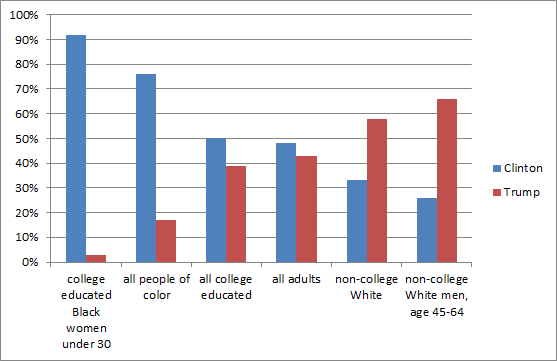
But it’s not just about income and race. Education levels, age, and gender are also strongly related to voters’ preferences in this election, as I illustrate with data from YouGov:

yougov

The question is what to make of those middle-aged White men without college degrees, who are preferring Trump over Clinton by more than two-to-one in the YouGov polls (and by 59%-25% in Reuters). Is it economic anxiety, racial identity, or what?

One of the most widely cited pieces of evidence against the economic-anxiety explanation is Jonathan Rothwell’s paper, “Explaining nationalist political views: The case of Donald Trump.” Rothwell, who works for Gallup, conducted a regression analysis of almost 100,000 Gallup survey responses collected over the year that ended in July (i.e., mostly during the primary season). I have no quarrel with the paper, but I would note that it does not debunk a class analysis of the Trump vote.

Rothwell finds that holding a favorable view of Trump correlates with higher, not lower, income. Nate Silver is also widely cited for his finding that Trump voters during the primary season had higher median incomes than Clinton and Sanders voters (but the same as Cruz voters and lower than Kasich voters).

However, Rothwell also looks at whether household income remains a significant predictor of Trump support once you consider the fact that Trump voters are disproportionately White, male, and older. Using one measure of income, it remains a significant predictor; with a different measure, it ceases to predict Trump support.

At the same time, Rothwell’s model shows that you are more likely, to a statistically significant degree, to favor Trump if you: (1) hold a blue-collar job; (2) did not attend college; and (3) live in a community with high White mortality rates. Those relationships appear in the whole sample but are especially strong when the model is restricted to non-Hispanic Whites. Further, “more subtle measures at the commuting zone level provide evidence that social well-being, measured by longevity and intergenerational mobility, is significantly lower among in the communities of Trump supporters.”

If social class means income, then class is not a strong predictor of Trump support in Rothwell’s model. At least during the primary season, Trump voters were actually wealthier than the mean American voter. But if class means social status, and status involves occupation and education, then Trump voters tend to be downscale Whites in downscale White areas.

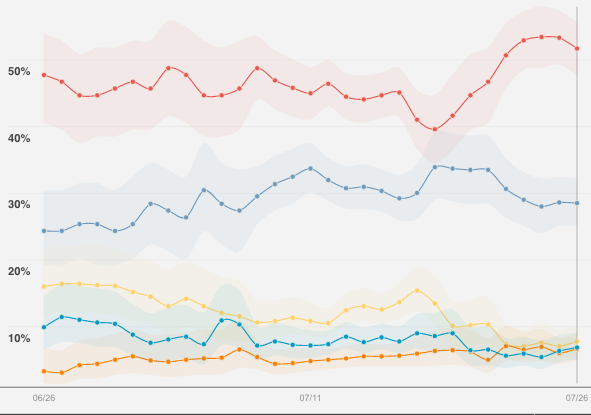
Rothwell’s paper uses a binary outcome of Trump support versus non-Trump support. The non-supporters include Republicans who were still favoring Cruz, Rubio, and others, plus Democrats for Sanders. That makes the analysis a bit dated now that we’re down to Clinton v. Trump. Reuters data suggests that Trump widened his lead among working class White men once he won the nomination.

Presidential Candidate Preference, White Men Without College Degrees (Reuters)

Presidential Candidate Preference, White Men Without College Degrees (Reuters)

Meanwhile, Clinton is now doing very well among the top 1 percent of the income distribution.

In sum, the relationship between working class status (measured by education) and Trump support seems strikingly strong for the White population. This doesn’t mean that class is the only issue. Race/ethnicity and gender are obviously very significant. But it means that there is some truth to the class analysis.

See also why the white working class must organize and it’s hard to talk about tough issues if no organization represents you.

Even MORE Upcoming FCSS Sessions!

So this weekend is the start of the Florida Council for the Social Studies Annual Conference. Have you registered yet? Are you coming? We hope you are coming, because we have some awesome sessions lined up. You can learn more about the keynote speaker here, and you can go here and here to get get an overview of some of the sessions we have planned. So with that out of the way, let’s take another look at some of the quality sessions we have lined up for you this weekend.

Saturday Morning, Concurrent Session 1

Factors Relating to U.S. History End of Course Exam for African American Students Irenea Walker, University of Central Florida

If social studies teachers properly alter their pedagogical approaches, African American students can learn to appreciate learning about historical facts. This paper focuses upon creative lessons that focus on interactive activities to peak interest.

eoc-graphic

Engaging the 21st Century Learner Amanda Mudlock and Rich Sayers, Pearson

Build academic skills for 21st century students through inquiry-based learning by facilitating easy projects, civic discussions, and document-based questions. Teach students to take ownership of their ideas, work together, and communicate clearly. 

21st-cent-kid

Curating Your Collection: Promoting Content Area Literacy by Giving Student Tools
to Explore Social Studies Texts  Heather Cerra, Northwest Elementary School, Hillsborough County Public Schools

How can teachers spark student interest in informational and historical fiction texts related to social studies content? Using a unique framework, teachers can build student engagement and realize student growth in the areas of vocabulary and comprehension. (Elementary Session!)

hillsborough

Saturday Afternoon, Concurrent Session 2

The Great Travel Fair: A Cross-Curricular Unit of Study Amy Trujillo, Orange / Orlando Science Elementary School

Now in it’s fourth year, The Great Travel Fair combines ELA, Science, Social Studies, and Math in order for students to understand the regions of the United States through a balance of 21st century skills. 

interdisciplinary
Public History, Memory, and Survival: Producing History Through Student
Centered Technology  Joshua Stern, St. Johns Country Day School

Attendees will learn how to use iMovie to allow students to bring stories of Holocaust survival to life. Students become active public historians and create meaningful results by preserving and transmitting these vital personal histories.

imovie

Saturday Afternoon, Concurrent Session 3

St. Augustine Civil Rights Movement: Seamless Integration into your Classroom Blake Pridgen & Benjamin Rome, Flagler College

Utilizing the primary sources in Flagler College’s Civil Rights Library of St. Augustine (CRLSA: http://civilrights.flagler.edu), teachers will learn to effectively teach Florida’s involvement in the civil rights movement, grades 4-12.

crlsa

Sunday Morning, Concurrent Session 7

The State of the Assessment: Civics End-of-Course Assessment Stacy Skinner, Ed. D., Social Studies Coordinator, Test Development Center; Elise Beachy, Annette Boyd Pitts, Robert Brazofsky, Maureen Carter, Erin Conklin, Christy Disinger, George Masek, Stephen Masyada, Ph.D., Peggy Renihan, Chris Spinale, Jackie Viana

This annual conference message about the middle school Civics EOCA will provide an overview of implementation, a review of student performance data, and a discussion about test development with Florida educators involved in the process. (Note: A similiar session around the US History EOCA will be offered earlier in the morning.)
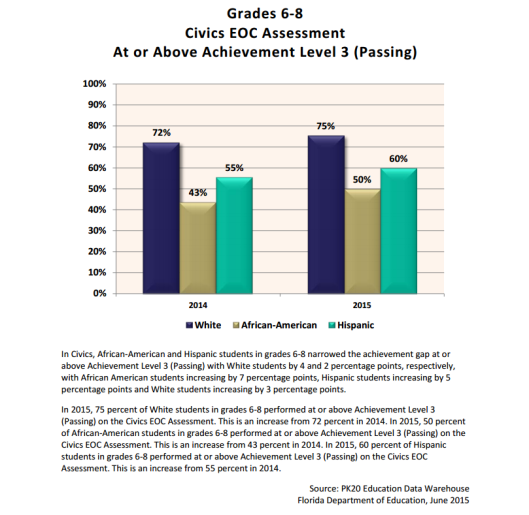
Demographic Breakdown

Achievement Level by Demographic Background

Context and Comparison: At the heart of AP World History Robert Strayer and Patrick Whelan, Bedford, Freeman & Worth Publishers

This session provides resources—both content and pedagogical—for effectively teaching contextualization and its companion skill of comparison. It addresses the much increased role of contextual thinking in the new exam format. 

apworldspongebob


This has been just taste of the possibilities. Please be sure to check out additional session descriptions at 2016-fcss-session-descriptions, and earlier posts on what is shaping up to be a great conference session here, here, here, and here on why you should attend! Hey, it will be worth it for the trick or treating alone!

You can register for FCSS online. It’s a great and affordable conference, and a chance to meet folks you can work with and learn from. Hope to see you here in Orlando. The hashtag for the conference, by the way, will be #FLCSS16. Join us!



Free Webinar on Making Participation Accessible, Oct. 27

As you may have seen recently on our NCDD discussion listserv, NCDD members are invited to attend a free webinar this Thursday, Oct. 27 on how to make our processes more accessible. The webinar is being offered by MH Mediate, and will be a good opportunity for practitioners to continue to learn new tools for going beyond “the usual suspects” for participation in our events. You can learn more in MH Mediate’s announcement below or register here.


Become Accessible to a Wider Audience

Thursday, October 27th, 1-2pm Eastern / 10-11am Pacific

Accessible processes are equally appealing to people with diverse abilities and needs, including people with disabilities. After we explore a universal design framework for creating accessible dialogue processes, we’ll apply key accessibility principles to some examples. Finally we’ll discuss how to communicate your accessible practices to constituents and organizational partners.

Register free by clicking here or visiting https://goo.gl/sfv5Xy

E-mail dan@mhmediate.com if you have any questions or examples you’d like to cover during the presentation. You can also submit them when you register for the webinar.

About the Presenter
Dan Berstein is a mediator living with bipolar disorder and the founder of MH Mediate. He has hosted a variety of dialogue events, including the first New York City National Dialogue on Mental Health event which became a model for inclusive discussions around the country. Dan is an expert in accessibility, having trained practitioners across a dozen states. Dan’s workshops stress designing processes that work better for everyone while ensuring they work with people living with disabilities and other needs.

We’re Moving! Please update your records with our new address

After more than 40 years in Midtown Manhattan, our offices are moving to a WeWork space in Brooklyn Heights at the end of this week.

Please update your records with our new mailing address, effective Oct 28, 2016:

195 Montague Street, 14th Floor
Brooklyn, NY 11201

Our phone numbers and email addresses will remain unchanged.

We look forward to settling into the new space and seeing you there soon!

Best,
Public Agenda

America: The Owner’s Manual

atom-cover-highresI’m delighted to see that the new edition of America: The Owner’s Manual is out. Senator Bob Graham, a truly dedicated leader for civic engagement, has written it with Chris Hand. They take the research, structure, and impact of the book with the utmost seriousness and have worked hard to revise it for a new edition. As I say in my blurb, “America, the Owner’s Manual is the only book that comprehensively explains how to be effective in American politics and civic life, and it does so brilliantly. It’s consistently practical, realistic, accessible, and inspiring. It’s perfect for anyone who wants to improve the world.” It works very well as a textbook, but you can also use it on your own or with a voluntary group.

Buy it here. Follow it on Twitter, @USAownersmanual; on Facebook, USAownersmanual; or use hashtag #ATOMbook.

Attend the Everyday Democracy Nat’l Convening, Dec. 8-10!

We want to encourage everyone our NCDD network to consider registering to attend the Everyday Democracy national conveningThe Moment is Now: Democracy that Works for All. The gathering will take place Dec. 8-10 in Baltimore, and it will be a great opportunity to learn from and connect with EvDem’s national network of community leaders and practitioners who are working to create change for racial equity, economic opportunity, and deep democratic engagement through dialogue in their locales. Learn more in EvDem’s announcement below, visit the conference page, or register today!


EvDem LogoEveryday Democracy’s National Convening

There is no time like now to come together, share experiences, learn, and expand our impact.

At Everyday Democracy’s National Convening, The Moment is Now: Democracy that Works for All,  this December 8-10 in Baltimore, MD, you will join hundreds of active, engaged and influential individuals from across the country who are making positive change in their communities.

The Convening will be a space for changemakers of all backgrounds and sectors to share lessons and ideas on how to build equity, inclusivity, and increased voice and participation in our communities and our country. You will meet people doing great work – people like the residents of Wagner, South Dakota who, for the past nine years, have used Everyday Democracy’s coaching and materials to organize dialogue circles to work through issues of intergenerational poverty and racism. The program has decreased tensions and helped build trust between native and white residents. Results include a significantly higher native graduation rate and the establishment of a small business incubator with a racially diverse board. Read more about their work here.

This is just one of many examples of people coming together across divides for honest, productive dialogue on tough issues and then solving problems together. Let’s connect these local efforts for greater national impact.

Highlights of the Convening

This will be a collaborative, arts-oriented, multi-cultural event. Some of the noteworthy features include:

  • The release of the new edition of Everyday Democracy’s guide on community-police relations with a special focus on racial equity,
  • Panel of young community leaders,
  • Arts to connect and inspire us,
  • A photography/storytelling exhibit that will be created during the convening,
  • An opportunity to hear from John W. Franklin, curator for the newly opened African-American Museum, and
  • An opportunity to hear from national leaders in participatory democracy, criminal justice, education, and health.

The election is almost here, and afterwards, no matter what the outcome, we will need to build on positive examples of dialogue and deliberation and real work towards equity. Please join us in Baltimore, MD, December 8-10, and get ready to be inspired.

Click here for more information about the Convening and click here to register. More stories of change, and resources for all communities, are here at our web site, also.

We hope to see you there!

Silke Helfrich Explains the Origins of “Patterns of Commoning”

The following is an interview that Silke Helfrich gave to Michel Bauwens about the assembling and editing of the anthology Patterns of Commoning, which has recently been posted online at Patternsofcommoning.org. In coming weeks, I will be posting selected chapters from the book here.

Bauwens: Silke, could you first give some background about yourself and your collaboration with David Bollier in editing your books about the commons?

Helfrich: I feel cosmopolitan, but my roots are in the hilly countryside of East Germany, near the German border — the “system border” between capitalism and socialism until 1989. I currently live in Jena, Germany, and will soon move to the South where I will try to remodel a house that is exactly 500 years older than I am. This is an experience that makes me feel humbled because it brings me face-to-face with the realities of making something “sustainable.”

Since 2007 I have work closely with David Bollier, an American activist. We often describe what we do (along with you, Michel Bauwens, the third member of the Commons Strategies Group) as “seeding new conversations.” Just like farmers, we cannot really know how big and copious the harvest will be, or when exactly it will come. But we keep seeding to help making the commons visible at different levels:

1. As collective resources, both material and immaterial, which need protection and require a lot of knowledge and know-how;
2. As social processes that foster and deepen thriving relationships; and
3. As a new mode of production that I call the Commons-Creating Peer Economy, or Commons-Oriented Economy.

I’d even say that there is a fourth level: the Commons as a worldview, as the expression of an ongoing paradigm shift now underway.

B: Is Patterns of Commoning an effort to sow seeds that will make the commons visible?

H: Absolutely! It is the second of three books that explore different aspects of the commons. The first began in 2010, when together with David and almost 80 contributors from all over the world, and thanks to the tremendous support of the Heinrich Böll Foundation, we started to work on an anthology called The Wealth of the Commons. That book was originally planed to sketch out the philosophical and policy foundations for a commons-friendly politics. But we quickly realized that we first had to introduce the commons and explain why we believe that commons having very different practices and resources – so-called traditional commons of land and water, for example, and digital commons on the other hand – are in fact related. They may look very different based on the resources managed, but in essence they have a lot in common – a social commitment to manage the resources responsibly, fairly and in inclusive ways.

silke-thumb

The Wealth of the Commons became longer and longer, and so we ended up doing what commoners often do when there is an unsolvable conflict: we forked the project. David and I started thinking about a volume 2, which in 2015 became Patterns of Commoning, an anthology of profiles of successful commons and an exploration of the inner dimensions of commoning. Mid-way through this book, after maybe a dozen of concept versions of it, we realized that all good things come in threes, so we committed to a third volume, this one on the macro-political, economic and cultural dimensions of a commons-based society.

read more