Participate in NCDD’s #BridgingOurDivides Campaign
As the election winds down, ballots are counted, and the debates about the many decisions on the ballot finally have clear outcomes, we have arrived at a time when we as a field need to take stock of what we should do next. A major theme of our NCDD 2016 conference in Boston was how D&D practitioners can help repair our country’s social and political fabric, both after this bruising and bitter election year, but also in light of many of the longer-standing divisions in our country.
NCDD has made an ongoing commitment to answering that question, and as part of that commitment, we are calling on our members and others to enlist in our new #BridgingOurDivides campaign!
In this new effort, NCDD is asking our members to help us collect information about the projects, initiatives, or efforts that you and others are undertaking to help our nation heal our divisions and move forward together, with a special focus on
collecting the best shareable resources that folks are using to support or spark bridge building conversations in the aftermath of the election and beyond.
To do that, we ask that you share about those efforts and resources in the comments section of this post – post your links, write ups, reports, and descriptions that will help NCDD and others learn about divide bridging efforts you’re connected to, whether they are election-related or not.
In addition, we want to foster a broad conversation about what our field is doing and offering to bring people together to discuss difference and find common ground, so we are encouraging everyone to join the conversation on social media by sharing those comments, resources, links, and thoughts about this work using the hashtag #BridgingOurDivides. This will be a great way to increase the visibility of our field’s work, and we hope it also increases support for NCDD, so we encourage you to include a link to NCDD’s “Get Involved” page at www.ncdd.org/getinvolved, too! (You can also use the shorter bit.ly/ncddinvolve for tweets.)
There are already some great efforts to bring people together across divides in the NCDD network now:
- The Utah Citizen Summit is being convened by the Salt Lake Civil Network and the Bridge Alliance as part of the ongoing effort to help bridge partisan divides
Essential Partners is working to start forward-looking, post-election conversations on social media with their #AfterNov8 hashtag, which we encourage everyone to participate in alongside the #BridgingOurDivides conversation- The Americans Listen project is calling on everyday people to have empathetic, one to one listening conversations with Trump supporters about both what they find appealing about his message and what keeps non-supporters from really hearing their concerns
These are just a few examples of projects that are #BridgingOurDivides, and we know that the NCDD network is full of thoughtful, creative people engaged in many more. So tell us – what are you doing or planning to do that is bridging our divides? Not just the divides exposed or widened during the election, but the ones that were there before as well? Share all about it in the comments section below and on social media!
Our nation’s divides, whether related to the election or not, didn’t emerge over night, and they certainly won’t be bridged overnight either. But we at NCDD believe they can be healed – one conversation at a time. Join us in helping the world see how, and support us in this effort.
Joseph Schumpeter and the 2016 election
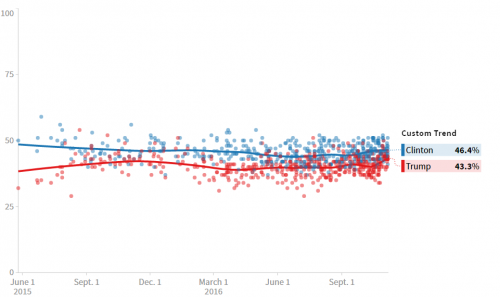
The graph below depicts the 2016 campaign as I see it. When all the polls are displayed on a graph with a y-axis from 0-100% and a fairly strong “smoothing” algorithm is applied, it becomes evident that hardly anything has changed for 18 months. Hillary Clinton has been ahead of Donald Trump by about 4-5 points nationally all along, and she leads by a mean of exactly four points in the major final polls released by this point on the last Monday. The ups and downs revealed by zooming in are best understood as temporary responses to news that may influence who participates in surveys–or who feels enthusiastic on a given day–but very few people have actually changed their minds; and most of those switches have been random and have canceled each other out.

I think this means that Clinton is likely to win the national popular vote by about 4 points, although GOTV operations could change result that (in either direction).
It’s hard to know whether different nominees would have performed differently. A reasonable guess is that if both parties had nominated politicians with typical levels of popularity who used typical methods of campaigning, the Republican would have an edge. That implies that Trump v. Clinton costs the GOP maybe 4-6 points, net–but that is not much more than a guess.
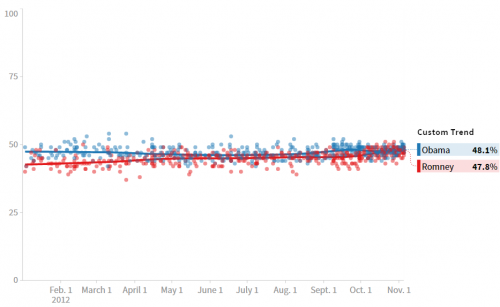
By the way, 2012 looks about the same, except Romney ran closer to Obama all the way along.

But 2008 was different: McCain was ahead at first but slipped behind Obama to lose pretty badly.
For me, the interesting question is what this means about our civic culture and the purpose of campaigns and elections. The presidential candidates have raised about $1.3 billion so far and spent most of that on such activities as advertising, canvassing, and events. The press has spent untold billions on campaign coverage and commentary. All kinds of remarkable events have occurred. As all that has played out, citizens have been exhorted to pay attention and to change their opinions in response to arguments and information. But it looks as if almost everyone already had enough data 18 months ago to make up their minds. That includes me: nothing has transpired since June 2015 that has altered the probability of my voting for Clinton versus Trump by even one thousandth of a percentage point.
I used to subscribe to the view that the actions of candidates and campaigns matter, but they usually cancel each other out because all presidential nominees of major parties are effective campaigners. This year, we have one truly incompetent candidate, yet the trend remains flat. Unless you think that Clinton’s weaknesses cancel out Trump’s incompetence, it looks as if campaigns hardly matter at all. Once citizens know the candidates’ party labels, demographics, and basic facts about their biographies, they are ready to vote.
Perhaps Joseph Schumpeter was right, at least about presidential politics. It’s all about rendering a verdict on the status quo and choosing either the incumbent elites or an outsider. Schumpeter adds:
The reduced sense of responsibility and the absence of effective volition in turn explain the ordinary citizen’s ignorance and lack of judgment in matters of domestic and foreign policy which are if anything more shocking in the case of educated people and of people who are successfully active in non-political walks of life than it is with uneducated people in humble stations. Information is plentiful and readily available. But this does not seem to make any difference. Nor should we wonder at it. … Without the initiative that comes from immediate responsibility, ignorance will persist in the face of masses of information however complete and correct. It persists even in the face of the meritorious efforts that are being made to go beyond presenting information and to teach the use of it by means of lectures, classes, discussion groups. Results are not zero. But they are small. People cannot be carried up the ladder. …
Thus the typical citizen drops down to a lower level of mental performance as soon as he enters the political field. He argues and analyzes in a way which he would readily recognize as infantile within the sphere of his real interests. He becomes a primitive again. His thinking becomes associative and affective.
Since Schumpeter’s view of democracy is unattractive, we must either reform presidential politics or (if that seems impossible) write it off and focus on other aspects of our political system, where more people can show more “immediate responsibility” for collective decisions.
Pragmatic Local Intervention
Method: Pragmatic Local Intervention
Humanistic Data Visualization
Yesterday, I participated in “Visualizing Text as Data,” the inaugural discussion series from Northeastern’s NULab for Text, Maps, and Networks. We discussed Data Visualization in Sociology, by Kieran Healy and James Moody and Humaniti
Drucker writes:
…Graphical tools are a kind of intellectual Trojan horse, a vehicle through which assumptions about what constitutes information swarm with potent force. These assumptions are cloaked in a rhetoric taken wholesale from the techniques of the empirical sciences that conceals their epistemological biases under a guise of familiarity. So naturalized are the Google maps and bar charts of generated from spread sheets that they pass as unquestioned representations of “what it.”
Data visualizations – just like statical techniques – are an interpretation of the data, not a realization of the data. In the statistical world, there are known problematic techniques such as p-hacking where you find something significant only because you tried so many thing something (randomly) had to be significant. This is part of the art of data analysis – data fundamentally needs to be interpreted, but we should always be clear on what we’re interpreting, what assumptions we’re making in that interpretation, and what biases go into that interpretation.
Using a humanist lens, Drucker seems to apply a similar argument to visualizations. We are too accustomed to taking a visual representation of data as a ground Truth of what that data can tell us and to unaccustomed to thinking of visualization as a interpretation.
That’s not to say that visualization has no purpose, or that the fact that visualizations are interpretation is irreparably problematic.
There’s a great classic example of from Francis Anscombe – Anscombe’s quartet, as it’s appropriately called. Four data sets which appear comparable from their basic statistical properties, but which are obviously different when visualized.
But I don’t think that Drucker wants to throw visualization out all together. I read her article as a provocation – a reminder that visualizations, too, are interpretations of data.
Arguably, this reminder is even more important when were talking about visualizations rather than narrative or statistical descriptions. Those later modes almost inherently force a user to engage – to think about what they’re reading and what it means. Though there’s still plenty of misleading interpretation in the statistical world.
The real concern – and the one Drucker highlights so poignantly – is that we accept visualizations without question – we don’t spend enough time thinking about what boundaries a visualization should push.
In many ways this makes sense – we expect a visualization to be quickly and easily interpretable. But we are at risk of letting our biases run wild if we don’t question this. It may be easy for someone to interpret gender in a visualization if colors indicate pink for women and blue for men.
But please, please, don’t use this color scheme to encode gender. It may be interpretable, but it carries with it too much baggage of social norms. Far better to shake things up a bit.
Drucker pushes this argument to the extreme. Changing the gender color scheme is a relatively minor act of subversion, what happens if you take this questioning further? Make the user really work to understand the data?
This argument reminds me of the work of Elizabeth Peabody – who created intricate mural charts which could only be understood with a significant amount of time and energy. These visualizations were not “user friendly,” but at a time when women had few rights, they pushed the boundary of who gets to create knowledge.
This also reminds me of the arguments of Bent Flyvjerg, who argues that social science should stop trying so hard to be computational and should instead focus on phronesis – emphasizing a humanities, rather than computational, approach.
I’m not sure the two approaches are as mutually exclusive as Flyvbjerg fears, but his argument, like Drucker’s, raises a crucial point: it is not enough to ask “what is,” it is not enough to take computation as ground truth and – in terms of visualization – to take what is easy as what is good.
Regardless of field, we should be hesitant to put humanistic concerns aside, to think that facts can stand isolated from values. Values matter. Our assumptions and interpretations matter, and it may not always be most appropriate to try to bury our biases and try to pretend that they don’t exist.
Rather, we should bring them to the fore and examine them critically. Instead of asking “do I have any biases?” perhaps we’d do better ask ourselves, “do I have Good biases?”
Project Green Bloc
Case: Project Green Bloc
Terre de Liens: Experiencing and Managing Farmland as Commons
This essay was published in Patterns of Commoning, which is now online for free at www.Patternsofcommoning.org.
By Véronique Rioufol and Sjoerd Wartena
A feeling of joy and achievement runs through the group of ten people gathered in Robert’s kitchen. After three years of planning, they have come to celebrate: Ingrid and Fabien will soon be able to settle down and develop their farming business. The farm is theirs!
In this small, pastoral village of the French Pre-Alps, establishing young farmers is an act of will. Everywhere, small mountain farms are closing down; work is hard and the business not deemed profitable enough. When aging farmers retire, they do not find a successor. The best land is sometimes sold off to one of the few more or less industrialized farms that remain. Overall, villages are progressively abandoned or become havens of secondary residences.
In Saint Dizier, a small village of thirty-five inhabitants, local people have decided differently. Municipality members, local residents and farmers have decided to preserve agriculture as a component of local economic activity and lifestyle. They also view farmers as young, permanent residents for the village. So they keep an eye on land put for sale, and have contacted farmers and landowners to learn their plans for the future. The municipal council has sought public subsidies to acquire farmland and rent it to young farmers, but with no success.
In 2006, villagers started to work with Terre de Liens, a recently established civil society organization focused on securing land access for agroecological farmers. Everywhere in France, high land prices and intense competition for farmland and buildings have become a major obstacle for young farmers. Obstacles are even higher for those doing organic agriculture, direct sales or other “alternative” forms of agriculture, which usually are not deemed profitable enough by banks or worthy of public policy support.
Announcing: A January Workshop on Social Ecosystems for Local Stewardship
For the past several months I've been having conversations with a friend, Dave Jacke, who is a long-time designer of landscape ecosystems via his firm, Dynamics Ecological Design, of Montague, Massachusetts. In his long career in permaculture circles -- he's the author of a classic book Edible Forest Gardens -- Dave came to realize that a "landscape-only" approach to ecosystem design is inadequate. It doesn't deal with human social dynamics and their effects on ecosystems. For my part, I have come to realize that I need to know more about the deep, long-term functioning of ecosystems. I am especially interested in learning concepts and vocabularies that some in permaculture circles use.
So Dave and I decided to share our mutual interests and ignorance, and host a public workshop to investigate this critical nexus between nature and humanity (which of course are not so separate and independent, after all). Our workshop is called "Reinventing the Commons: Social Ecosystems for Local Stewardship & Planetary Survival." 
The event will consist of a Friday evening talk by each of us on January 20, 2017, and an all-day participatory workshop the next day, January 21, at the Montague (Massachusetts) Common Hall ("Grange"). Pre-registration is required; the public lectures will be $10; the workshop & public lectures $85 to $125. More details here or by writing Dave Jacke at davej@edibleforestgardens.com. Or register through Brown Paper Tickets (fees apply) at ReinventingCommons.brownpapertickets.com.
Here is our overview of the workshop and the ground we wish to cover.
For all its benefits, the dominance of capitalist economics has also generated a world of predatory, extractive markets based on short-term self-interest that is literally destroying the planet. What feasible alternatives exist? This workshop will explore the potential of the commons as a practical and fair system of local provisioning, governance, and culture for transforming society.
From early in human cultural evolution until only a few centuries ago, the vast majority of resources was held and managed in common. Certain groups of people formed agreements about how to use and manage specific shared resources, from woodlands and farm fields to pastures and water, and they managed those resources sustainably for generations. It took the privateers hundreds of years to consolidate their power, control the structures of the state, and exploit cheap energy to destroy the commons systems of Europe and the global South. The unbridled privatization and commoditization of commons that inaugurated the Industrial Revolution continues today, with catastrophic results for planetary ecosystems and social well-being.
new professorship in health and civic life
The Tufts University Medical School’s Department of Public Health & Community Medicine and the Tisch College of Civic Life seek an Associate Professor or Professor.
We invite applications for a full-time, 12-month joint faculty appointment at the level of Associate Professor or Full Professor. We seek a candidate with distinguished scholarship on (or highly relevant to) “civic life,” a broad category that encompasses civic engagement, public participation, social capital, civil society, citizenship, the public sphere, and related topics. The successful candidate is expected to enhance current teaching and mentoring activities at both the masters and doctoral level, as well as develop an independent research program and participate in community and professional service appropriate to a university faculty member.
A successful candidate must also demonstrate a strong record of scholarship within a discipline (medicine, environment, nutrition, etc.) that has a clear public health framing and must emphasize the translation of research into policy and practice. Candidates with research interests and approaches that include community engaged or community based participatory research (CEnR/CBPR); public/community/stakeholder engagement in public health policy; the impacts of civic engagement on health; or the influence of social movements on public health policy; civic life in racial and ethnic minority communities or populations and/or low-income populations are particularly encouraged to apply. Because Tisch College seeks to strengthen Tufts’ interdisciplinary intellectual community focused on civic life, we will prefer applicants who demonstrate an interest in fundamental questions about civic life that cross disciplinary boundaries, such as the nature of good citizenship or the appropriate role of the public in policymaking.
More information and the application portal is here.