ENGAGING IDEAS – 03/02/2018
Reply

Very exciting news from NCDD member org – the Participatory Budgeting Project, Mayor Bill de Blasio recently announced that participatory budgeting will soon be happening in all NYC public high schools. With over 400 high schools, this is bringing PB to schools in a way that sets a powerful precedent for youth engagement and participation in democracy. Friendly reminder about the Innovations in Participatory Democracy conference happening next week and we encourage folks in the NCDD network to attend!
For those that will be at IPD, NCDD will be co-presenting a session on the first day which you can learn about in our blog post here and we also plan on having an NCDD meet up on Friday night – which we would love for you to join! You can read the PBP announcement below or find the original here.
 Did you hear? Just this week Mayor Bill de Blasio announced the launch of Participatory Budgeting (PB) in all public high schools in New York City!
That’s over 400 schools in total!
In his State of the City address, Mayor de Blasio emphasized:
“We’ve got to prove to our young people that they’ve got the power to change the world around them. When people feel empowered they participate. When they can see the impact they’re making they come back for more. So starting next school year public school students will learn how to stay civically engaged and to fight for the future they believe in with our Civics for All initiative.”
At the Participatory Budgeting Project (PBP), we’re fighting for this future alongside young leaders like Jacinta Ojevwe and Vanessa Gonzalez – two of our youth scholarship recipients for the Innovations in Participatory Democracy Conference.
To continue growing this work, we’re hosting many conference sessionson how to engage, support, and empower youth leadership in reimagining democracy. I’m especially excited to open our conference at Phoenix’s Central High School during their PB vote – where we’ll hear from students and teachers and see nearly 3,000 students cast their ballots on how to spend part of the school district budget.
We’re eager to continue scaling and deepening the impacts of PB because, as Mayor de Blasio said:
“We know that when students feel that opportunity to make a difference it will be the beginning of a long lifetime of participation.”
Will you join us in empowering even more young leaders, and celebrating with them at our Innovations in Participatory Democracy Conference?

For a preview of the PB vote in Phoenix, see (and share!) our PB in Schools Video.
Hope to see you there!
You can find the original version of this PBP blog post at www.participatorybudgeting.org/big-news-pb-schools-big-invitation/.
 (Washington, DC) I just signed a contract with The Florida Review so that they can re-publish my interactive novel, The Anachronist. It should appear there in July 2018, and it will reside on their digital platform, Aquifer. It also remains, at least for now, on my site. Four reviews are collected here.
What’s Next, Alabama? is an issue guide created by the David Mathews Center for Civic Life in 2017 for Alabama Issues Forums 2017 – 2020. The issue guide provides a brief overview of economic issues facing Alabama and outlines three approaches in addressing economic infrastructure over the course of three forums. The David Mathews Center—a non-profit, non-partisan, non-advocacy organization—does not advocate a particular approach or solution to economic issues, but rather seeks to provide a framework for citizens to carefully examine multiple approaches, weigh costs and consequences, and work through tensions and tradeoffs among different courses of action. The issue guide, authored by Justin Lutz, Program Director at the David Mathews Center, outlines what “the economy” means to a community:
When we talk about “the economy,” we don’t just mean jobs and unemployment or the stock market. We define the economy as any issue that is important to your community on its quest to achieve a better life. Perhaps it’s ensuring quality schools in your community, or expanding broadband internet access, or having an educated and sober workforce, or a thriving downtown area—the economy is the community you live in, and your capacity to thrive and prosper as a part of that community.
The issue guide outlines three types of economic infrastructure: physical, human, and civic. These are used to examine the current state of a community, assess what the community would like to change, and map out a way to make those changes, over the course of three forums:
Forum One: Where are we now?
The first forum addresses the current state of economic issues in a community. Participants are introduced to both local and statewide economic data and are asked to reflect on both the assets and challenges within their community. The objective of the first forum is to allow the participants to become familiar with all aspects and concerns of their community and their fellow citizens before deciding on a direction in which to take their community.
Forum Two: Where do we want to go?
The next step is for the group to decide, together, what they want the future of the community to look like. Participants are asked to identify and examine issues impacting the economic infrastructure of their community, and to then consider the strengths, opportunities, resources, and trade offs associated with each option. The goal of the second forum is for the community to identify and prioritize an issue or set of issues in which they would like to affect change.
Forum Three: How do we get there?
In final forum community members must take the components of the previous forums and decide what issues to address first and what actions to implement. Participants must consider who to involve, what challenges may arise, what work is already being done and can it be built upon, what actions are the most doable, and what are the next steps. At the end of the forum the community should walk away with a clear idea of what changes they can make together and where to start.
Watch the introductory video below about What’s Next, Alabama?
About DMC Issue Guides…
David Mathews Center issue guides are named and framed by Alabama citizens for Alabama Issues Forums (AIF). Alabama Issues Forums is a David Mathews Center signature program designed to bring Alabama citizens together to deliberate and take community action on an issue of public concern. Digital copies of all AIF issue guides, and accompanying post-forum questionnaires, are available for free download at http://mathewscenter.org/resources/
For further information about the Mathews Center, Alabama Issues Forums, or this publication, please visit http://mathewscenter.org/.
Resource Link: http://mathewscenter.org/whatsnext
This resource was submitted by Cristin Brawner, Executive Director of the David Mathews Center for Civic Life via the Add-a-Resource form.
In the wake of the current gun violence, NCDD sponsoring organization Essential Partners recently shared this piece written by their executive director Parisa Parsa, on the urgency for people to come together and address how do we keep our schools and communities safer. She talks about the need to come in conversation with each other from a place of creativity and with the purpose of recognizing our shared values, and rise above the current polarization. These conversational practices are vital in order to deepen relationships and ultimately work towards preventing another mass shooting from happening again. You can read the Essential Partner’s article below or find the original version here.
 The question was: what is at the heart of the matter for you when you think about the question of whether guns should be allowed in schools?
Seven people ranging in age from their 20’s to their 60’s, 4 women and 3 men, leaned in to listen closely to one another’s responses. They had many different views on the question of guns in schools, and guns in American life in general.
When it came time for him to speak, one man’s eyes welled with tears. After a long pause he said:
“Here is what is at the heart of the matter for me: I don’t want to be talking about this at all. I don’t want to live in a world where kids are not safe going to school. So when someone asks me what I think, all I can think is how can we make this stop?”
The simple recognition of our shared grief and anger brought more of the group to tears, and began a shift in the conversation. Person after person had already shared the values they learned growing up about guns, and now enriched by one anothers’ stories the sense of companionship led to a new entry point to thinking together. What would it take for our town prevent mass shootings?
The conversation later turned to social isolation and the need for folks to really look out for each other, to know each other’s’ children. And to offer services for those in need who might escape other attempts at outreach. And support for concerned parents.
The community still needed to talk about the issue at hand: the question of arming school personnel. But this small group was now also armed with the beginnings of a conversation that could help them work together on many of the other known contributing factors to preserve safety in schools. Perhaps, I thought, working on some of those other things together would help them deepen their relationship so that the continuing conversation about guns could have more creativity than the zero-sum perception both sides have been diving into. And which we dive into again and again.
Most recently, we’ve watched it in the wake of the tragic shooting at Marjory Stoneman Douglas High School. Social media has been awash, as ever, with people’s grief and anguish, fear and outrage. This time, the young people who survived the shooting almost immediately made a very pointed ask of our nation’s leaders. They asked the grown-ups in charge to sort out whatever needs sorting out to keep this from happening again.
The initial message they shared in the days immediately after the shooting was simple: as a nation we have to sort this out together. Their initial leadership was their refusal to accept that the current polarization in our conversation on guns is inevitable and permanent. And they are absolutely right to refuse the current story that this is an issue we cannot touch as a nation.
The students weren’t all, or even mostly, activists before the incident. Some were gun rights advocates, some gun control advocates, many more neutral and uninvolved. As the media conversation has continued, a predictable pattern has emerged: the loudest and most extreme voices have been amplified, put into debate mode with politicians at a Town Hall, lashed out on Twitter. And then came the responses: the kids are paid actors, being manipulated by left-wing interests, their Tweets analyzed and criticized for their violence and perceived extremism.
When the shouts begin, the door of possibility closes and we can’t figure anything out together. There is no listening, no further understanding, just suspicion and accusation. One “side’s” gains in activism get a counter-attack or build greater cynicism, driving the other “side” to feel justified in nasty rhetoric. So the win of one side becomes the rallying cry for the other, locking us in a battle few of us would have chosen. And the din leaves no space for the many folks who find themselves somewhere in the middle between the two defined “sides.”
The thing is, we can have sensible conversations with our neighbors who don’t agree. In our conversations about guns in Montana, Massachusetts, Colorado, New Hampshire, and Wyoming we have found some trends that are worth considering and also cause for hope.
Friends, there is no one but us, no time but now, and no way forward without turning to one another. Let’s start engaging in deep, honest, conversations about this violence in our nation. Our communities, and our lives, depend on it.
Here are three things you can do today to change the conversation:
You can find the original version of this Essential Partner’s blog piece at www.whatisessential.org/blog/if-our-lives-depend-it.

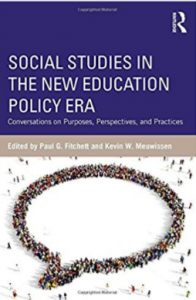 Paul G. Fitchett and Kevin W. Meuwissen have published Social Studies in the New Education Policy Era: Conversations on Purposes, Perspectives, and Practices. This edited volume is devoted to exchanges between pairs of scholars. My assigned debating partner is Prof. Beth Rubin from Rutgers, whose work I admire and who has influenced me a lot. There isn’t a whole lot of room between Beth and me, but we manage to disagree mildly in ways that might be illuminating.
I begin by arguing that the policies adopted so far by states and districts for civic education matter, but not as much as how such policies are implemented. Support for things like professional development makes policies either work or fail. I also note that the policy debate reflects disagreements about what should be taught. Given such disagreements, no one can expect to get the curriculum that she or he prefers enacted into law in all 50 states. I propose a division of labor: public schools should teach relatively uncontroversial, relatively basic civics, and community-based groups should add more politically charged content that reflects their diverse perspectives.
Beth understandably worries that the mainstream curriculum mandated by governments will, in fact, be biased. She argues that governments should make schools good places for learning, leaving civics curricula mostly unconstrained by policy. That would imply skepticism about policies like standards and tests, because they centralize decisions about the curriculum. I counter by offering a state policy agenda that includes standards, professional development, reforms of school discipline, and tests–if they are well done. This package is fairly minimalist, intended to create a baseline for all kids while leaving space for diversity. Beth ends the exchange with some concerns about whether the “baseline of knowledge” that I want to see in state standards can really be good for all of our kids.
The rest of the book is entirely devoted to similar debates, and it looks good throughout.
For those working with civic engagement and higher ed, we wanted to share these recent updates from AASCU’s the American Democracy Project about several exciting opportunities! Coming up this Wednesday, February 28th from 1-2pm Eastern, is a free webinar on assessing civic competency and engagement, and how these efforts translate to student learning. Second, there are three different national ADP awards nominations that are now open and are due by March 30. Finally, check out the upcoming 2018 Civic Learning and Democratic Engagement Meeting (#CLDE18) on June 6-9, hosted by the American Democracy Project (ADP), The Democracy Commitment (TDC), and the NASPA Lead Initiative. You can read the announcement below or find the original on ADP’s site here.

With our recent effort to significantly increase our ADP programming, you might be interested in some of the upcoming ADP activities, including opportunities to get national recognition for deserving folks on your campuses. Please pass along to those who might be interested as well. Thank you in advance for your support
Free Webinar Featuring Assessment of Civic Competency and Engagement
Wednesday, February 28 | 1 p.m. – 2 p.m. EST
Register now
Walking our Talk: Converting Civic-Focused Mission Statements to Student Learning
Many higher education institutions include complex civic concepts as part of their missions, but how do we know if we are translating these lofty goals into student learning? Assessment is often viewed as a secondary or even bureaucratic institutional practice but done well it supports learning improvement processes that prioritize student development, organize institutional efforts, and direct change. This session will discuss recent ETS research initiatives focused on national trends in the assessment of civic competency and engagement as well as an institutional perspective on assessing and addressing these skills in students.
Presenters: Ross Markle, Senior Assessment Strategist for Higher Education, ETS; and Kara Owens, Special Assistant to the President for Institutional Effectiveness and Assessment, Salisbury University (Md.)
Nominations for Three ADP National Civic Engagement Awards Due March 30, 2018
Participate in ADP’s National Conference: The 2018 Civic Learning & Democratic Engagement (CLDE) Meeting
Wednesday, June 6, 2018 to Saturday, June 9, 2018
Hyatt Regency Orange County • Anaheim, California
The American Democracy Project (ADP), The Democracy Commitment (TDC), and NASPA are committed to advancing the civic engagement movement in higher education. Join us in Anaheim, California for our annual conference which brings together faculty, student affairs professionals, senior campus administrators, students and community partners. Together we will ensure that students graduate from our colleges and universities–both public and private–prepared to be the informed, engaged citizens that our communities and our democracy need.
Learn more about ADP and how to be engaged during our ADP Organizing Meeting on Thursday, June 7 from 9 a.m. – Noon. Annual awards will be presented during this meeting.
For more information: http://www.aascu.org/meetings/clde18/
Register now for the best rates.
You can find the original version of this ADP blog post at: https://adpaascu.wordpress.com/2018/02/15/adp-winter-2018-updates-announcements/.
We here at the Florida Joint Center for Citizenship are strong advocates of the C3 Framework. The emphasis on inquiry, and actually doing something with that inquiry, is civic learning at it finest, and we believe that the C3 Framework would be an excellent model to build standards and curriculum around. It seems that Florida is now making some moves towards providing teachers with an opportunity to embrace the C3.
Over the past few years, the social studies community has established a repository of Inquiry oriented lessons from various states at C3 Teachers.
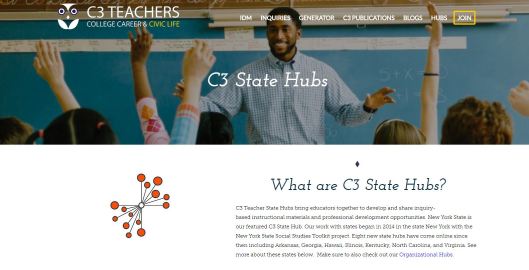
This website is an excellent resource with a variety of K-12 inquiry lessons that can be modified to fit Florida standards and benchmarks. But, you may ask, where is Florida? Well, for a variety of reasons, Florida has fallen behind others states in using elements of the C3 Framework (though some districts like Pasco and Brevard have begun using the language of C3 in curriculum development and pacing).
Happily, this may be about to change. Dr. Jane Lo of Florida State University and Mr. Michael DiPierro, the social studies consultant of the State Department of Education, have announced a new project and opportunity that will create a C3 Hub for Florida! From their recent call:
WHO: We are seeking K-12 Florida social studies
teachers to be involved in an exciting lesson
creation project funded through Title IV-Part A and
managed by the Florida Department of Education
and Florida State University. Florida K-12 teachers
of all social studies content areas may apply
WHAT: This project is seeking teachers with experience
writing and implementing inquiry based lessons in the social
studies classroom. Selected lesson writers will participate in
a series of virtual professional development activities and
one face-to-face professional development session on the
C3 Inquiry Design Model with experts in the field. The
professional development is intended to help writers create
two lesson plans using the Inquiry Design Model. Lesson
plans will be shared with fellow teachers on the National
Council for the Social Studies C3 hub site. Lesson writers will
be compensated for their travel, professional learning, and
approved lessons. In-service points will be available to
submit for district consideration. More information will be
provided to selected writers.
WHEN: A virtual logistics meeting will occur in May 2018. A
face-to-face PD session will be conducted in summer 2018.
The lesson writing process will take place during Fall 2018,
with continued virtual professional development and
support (approximately one check-in per month). The
expected completion date of the lessons is January 2019.
The lessons will then undergo a review process, during
which time, writers may be asked to provide revisions. The
goal is to have lessons to share with the broader social
studies teaching community by Fall 2019.
WHY: This is a great professional development opportunity
that allows teachers to work with experts to hone their
inquiry lesson writing skills as well as inquiry pedagogy. This
process will also allow us to create a Florida C3 Hub so that
Florida social studies teachers can have a reliable resource
for rigorous inquiry plans.
HOW: To apply for a writer position, please fill out this form
online by March 23rd, 2018. Contact Dr. Jane Lo, Assistant
Professor, Social Studies Education, jlo@fsu.edu and copy
Michael.DiPierro@fldoe.org, FLDOE Social Studies Education
Specialist, with any questions or concerns.
This is a great opportunity to help develop an incredible resource for Florida teachers, and we here at FJCC would love to see what you come up with for civics!
The Kenya Youth Manifesto is great. It’s the product of an elaborate deliberative process involving Kenyans between the ages of 18 and 35 (a cohort that represents 57 percent of the electorate). The Manifesto offers 52 pages of detailed recommendations. I’m sure it has specifically Kenyan underpinnings that I have missed, but from my perspective, it looks pragmatic rather than revolutionary, concerned with participation and voice as well as economic outcomes, attuned to issues like gender and disability, and consistent with Amartya Sen’s “capabilities approach.”
In his foreword, Willice Okoth Onyango depicts “youth as a distinct but heterogeneous population group.” He sounds like Sen when he calls for “build[ing] the capabilities and expand[ing] the choices of young people by enhancing their access to and participation in all dimensions of society.” And he calls for “young people and their representative associations” to be included “at all stages of the policy development and implementation process.”
Any group that writes a manifesto must avoid recommending policies that are simply unaffordable, settling for minor tweaks, demanding blatantly obvious reforms, neglecting the most obvious reforms in the interest of being original, setting vague targets, setting overly narrow or short-term targets, advocating elaborate processes (such as new commissions or research studies), ignoring process altogether, placing all the demands on target authorities, promising to solve all problems themselves, simplifying complex issues, or offering too much wonky detail. This sea is full of shoals. I think the Kenyan youth navigate just about as well as can be done.
Their product is more like a party manifesto (what Americans call a “platform”) than, say, the Communist Manifesto, which offered a compelling new social vision. The Kenya Youth Manifesto couldn’t simply be implemented, because it would need various kinds of scarce resources–not only money but also political capital. I know far too little about Kenyan social issues to be able to assess the recommendations. But it’s an impressive product that’s worth imitating elsewhere.