Recognizing FJCC/Lou Frey Institute Fellows and Staff!

page 12018conf
Good morning friends. This past weekend was the 61st annual Florida Council for the Social Studies state conference, and it featured a keynote (sponsored by the Lou Frey Institute) from National Council for the Social Studies President-Elect Dr. Tina Heafner of UNC-Charlotte. The keynote was well-received, and we are grateful for Dr. Heafner’s participation and engagement with FCSS members!
During the awards dinner, fellows and staff from the Florida Joint Center for Citizenship at the Lou Frey Institute at UCF demonstrated why both LFI and UCF continues to grow in reputation and influence. The following winners of professional organizational awards were announced:

The Agnes Crabtree International Relations Award
The Agnes Crabtree International Relations Award recognizes the FCSS member who has through teaching, research, or community activities, furthered the cause of international relatiions. It is given in honor of Agnes Crabtree, a teacher in Miami-Dade County. Agnes was active in the NCSS and the FCSS, and the United Nations Association, serving three times as international relations consultant for the NEA.

Dr. Scott Waring of UCF’s College of Community Innovation and Education and a Fellow of the Florida Joint Center for Citizenship at the Lou Frey Institute

Dr. J. Doyle Casteel Outstanding Leadership Award
The Doyle Casteel Outstanding Leadership Award is given to an individual with a minimum of five years’ experience for his/her continuous leadership in a supervisory or administrative capacity, and leadership in FCSS. Applicants are judged on the impact their efforts have made to promote cross-cultural understanding, the role they have played in mentoring classroom teachers, and the degree to which they have advocated the importance of social studies education.


Mr. Christopher Spinale, 
FJCC’s Action Civics Coordinator

Dr. B.J. Allen Social Science Professional Award
The BJ Allen Outstanding Leadership Professional Award honors an outstanding FCSS educator who has served the professional organization in a comprehensive way. It emphasizes service to FCSS and to social studies during the year or years immediately past. B.J. Allen was Florida State University Professor and President of the Organization.


Ms. Peggy Renihan, 
FJCC’s Professional Development Coordinator

J.R. Skretting Leadership Award
The J.R. Skretting Social Studies Science Proffesional Award recognizes the FCSS leader who has excelled in the past year in increasing membership and involving members as well as representing ably the goals and purposes of FCSS to the public, the membership, members of the total professional community, and the legislature. J.R. Skretting was a Florida State University Professor and First Executive Director of FCSS.


Dr. Stephen Masyada, 
FJCC Director

Congratulations to these excellent folks for representing not only UCF but the Institute and the Center well, and for contributing so powerfully to our field, to civic education, to our state, and to our nation.


Oh the Places You’ll Go & People You’ll Meet at NCDD2018!

A Quick Guide to Networking at the NCDD Conference that will set you on a course for successful partnerships.

What happens when you bring together a few hundred innovators in dialogue and deliberation and give them dedicated spaces to spark conversations and partnerships? MAGIC.

Every two years, NCDD does just that. This November, our three-day conference will convene at the Sheraton Denver Downtown and include 400+ attendees from around the globe. Fellow humans passionate about public engagement ready to connect and create friendships and partnerships that will last years into the future.

NCDD’s planning team has been hard at work to ensure an environment that facilitates idea generation and times and places to find your D&D tribe.

Here’s what you need to know:

Start early! Be sure to download and use the interactive conference guide brought to us by Konveio. This will allow you to browse the events, learn more about the networking opportunities, and many of the great attendees presenting and speaking at the conference.  To learn more about how to use the guide attend the Tech Tuesday on October 23rd!

Want to get a jump start on meeting fellow NCDD attendees and don’t want to wait until Friday morning? Then make sure you check out the six pre-conference sessions being offered on Thursday, November 1st! We have limited space for available for each of the sessions, so register ASAP to reserve your seat.

Dinner Time!  Saturday night is “on your own” but what we really mean is “with new NCDD friends”. First, meet up at the hotel bar (Mix16 Lounge) and then pick a place to wander to and get into the full conference spirit by connecting over food and drink at any one of Denver’s delicious eateries.

Use the On-Site Networking Board! Those returning will fondly remember our extra-large NCDD bulletin board made to suit all of your conference networking needs. We’ll have those great networking cards that will help you post your interests and propose opportunities to connect with others.

Do not miss the plenaries! Our opening plenary will feature “lightning talks” by civic innovators to spark inspiration and will include a networking activity to assist every attendee with identifying goals for the conference and beyond. On Saturday and Sunday, we will be focusing the plenaries almost exclusively on connecting, by using Open Space and Pro Action Cafe, respectively, for folks to propose the topics and ideas they most want to connect with others about!

Places for YOU! For when you want to meet outside of our scheduled sessions, there are four rooms and a foyer available on a first-come basis. Just look for Plaza Court rooms #2, #3, #4 and #5 for more privacy and swing around to the Plaza Exhibit Foyer for more casual seating space for discussions.

We also thought it might be helpful to create a space to connect before the conference. Please use the comment section below to start finding who you want to connect with in Denver this November! Propose a meet-up over lunch, dinner, or in between, and start finding folks to join you! We’ll keep sharing and pointing people to this post up until the conference kick-off.

We hope you are as revved up as we are about NCDD 2018!

Democracy Fund Revamps electiononline Website

If you are looking for unbiased news and information on US elections, then check out the newly revamped electionline website! The Democracy Fund – a sponsor of NCDD2018, recently redeveloped the platform, which is a resource for our nation’s elections and offers tools and best practices for improving the voter experience. The site has daily news, an elections calendar, training resources, jobs marketplace – and is a great space for civic organizations, elected officials, or anyone interested in learning more about US elections. You can read the announcement below and find the original version here.


Democracy Fund Relaunches electionline

Today we are pleased to unveil a new and improved electionline — America’s only politics-free source for election administration news and information.

In January 2018, we announced that electionline had become a project of Democracy Fund’s Elections program. We felt then, as we do now, that it is a vital platform for finding trusted news and information about the people and processes that guide our nation’s elections, and for sharing tools, best practices, and innovative ideas for improving the voting experience. Our simple goals for redeveloping the site were to enhance its capabilities and expand content — but our long-term plans are to create a place where readers are exposed to new ideas, opportunities for continuing education, and relationship building.

To do this, we started by thinking long and hard about the site’s current audience and their needs. Starting today, election administrators, academics, voting advocates and other regular readers of electionline will find new items of interest on the site, including:

  • A calendar of national, state and other field-relevant events;
  • A directory of organizations and their areas of expertise;
  • Reports, trainings, tools, guides, and other materials;
  • A marketplace featuring job openings in the elections field and information on used election equipment for sale; and
  • Better search functionality throughout

Electionline remains the only place on the internet to find state-by-state curation of daily election administration news. In addition to publishing the classic electionline Weekly newsletter, we will also begin sharing original reports and exclusive content from leaders and experts in the field — making the site a must-read for local election officials, civic organizations, and journalists who cover elections.

While redeveloping the site, we learned two really insightful lessons that might be helpful for others who are developing virtual spaces for information sharing and engagement.

First, collaborate with your audiences and include some “outsider” perspective. As our team weighed important decisions about the look and feel of the website, we were grateful to receive insight and direction from many readers who already trust and rely on electionline.

Second, reflect your values. Redeveloping or creating a new platform is an opportunity to reinforce essential characteristics that inform readers who your organization is, and what they care about. For us it meant focusing on authenticity (even if it means publishing unflattering stories about ourselves or our partners); transparency about who we support with resources in the field; and cultivating greater interest for under-covered areas of importance like voting trends for overlooked communities.

Through this process, we hope we were able to successfully incorporate the feedback we heard from current readers. We also hope that the new electionline website more deeply resonates with all those who are interested in elections in America. We’re excited to hear your thoughts and reactions as you explore the new website. Please visit www.electionline.org and let us know what you think!

You can find the original version of this announcement on the Democracy Fund site at www.democracyfund.org/blog/entry/democracy-fund-relaunches-electionline.

closing remarks at the Bridge Alliance summit

(Posted by request: my remarks at the close of the 2018 Bridge Alliance Members Summit, a convening of “more than 90 respected established organizations committed to revitalizing democratic practice in America,” Washington, DC, Oct 17.)

I’ve been asked to offer some reflections on the day’s discussion.

My first reflection is gratitude to the Bridge Alliance, its whole staff, and to all the Alliance members for all the work you do every day.

My second reflection is anxiety. I admit that in meetings like this, I am filled with anxious questions:

  • Are we big enough? Are enough people and resources here? Do we have enough people with us?
  • Are we diverse enough? The answer to that is clearly no. That is a problem that belongs to the whole network, not to the Bridge Alliance alone.
  • Are we experienced, knowledgeable, talented, and smart enough?
  • Are we unified enough? Today, I was privileged to participate in one small-group discussion in which the axis of disagreement was institutionalist versus insurrectionist: should we try to defend beleaguered institutions such as journalism, science, and the US Constitution, or seek to replace them because they were never good enough? I also participated in a good discussion about ideology: should we aim to be maximally inclusive or neutral, or rather develop a distinctively pro-democratic stance that some may support more than others do? These kinds of disagreements seem to threaten our unity.

What we know about social movements may be helpful. I have in mind two kinds of movements. One is the coalition or network that works for “healthy self-government”–in other words, the organizations that are in this room. As a group of groups, we could gain more of the “fizz” of a movement. Meanwhile, we see actual movements around us: #MeToo, #BlackLivesMatter, #NeverTrump, and the Tea Party. They could operate in ways that have more collateral benefits–and do less collateral harm–to democracy.

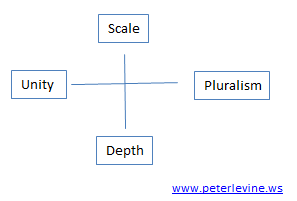
My reading of the social movement literature suggests that social movements succeed when they have four qualities:

Size: Movements need many members, organizations, and resources. Erica Chenoweth says that no nonviolent resistance campaigns in her large database have failed if they have “achieved the active and sustained participation of just 3.5% of the population—and lots of them [have] succeeded with far less than that. … In the U.S. today, this means almost 11 million people.” If 11 million people came together for a reform, it would probably happen.

Depth: Participation must develop the members’ commitments, skills, knowledge, and tactics. No group begins smart enough to win; they must learn. In Stride Toward Freedom, Martin Luther King writes, “Human beings with all their faults and strengths constitute the mechanism of a social movement. They must make mistakes and learn from them, make more mistakes and learn anew. They must taste defeat as well as success, and discover how to live with each. Time and action are the teachers.”

Unity: Social movements always present themselves as unified, because that is a source of strength. Hence the hashtags, armbands of a single color, protest songs, and mass demonstrations.

Plurality: Social movements need diverse perspectives, skills, and assets. They need both insiders and outsiders, both romantics and pragmatists. They should be demographically diverse, too, although that doesn’t always mean reflecting the demographics of the whole country. The Big Six leaders of the American Civil Rights Movement were all Black men. It wasn’t great that they were all men, but it was good they were all Black. The movement needed African American leadership and was rooted in the Black community. Still, their diversity of backgrounds, stances, and skills was essential. Randolph was a union leader, King a pastor and theologian, Lewis a youth leader, and so on.

Unfortunately, size conflicts with depth, and unity conflicts with plurality. It is very hard to have a large movement that also affects most of its members deeply, or a diverse movement that also achieves unity.

These four qualities spell SPUD, and we need more of it (even if it sounds like a lot of carbohydrates).

In interviews that Eric Liu and I conducted for “America’s Civic Renewal Movement: The View from Organizational Leaders,” Scott Reed of the faith-based PICO network said that his organization “invests lots and lots of time to connect with people and develop relations.” But “scale is what we are trying to figure out … because we are nowhere near where we want.” In short, PICO has U and D and some P, but no S. Meanwhile, Anna Galland of MoveOn acknowledged that her online organization has “tremendous scale and little depth.” MoveOn’s goal, she says, is to “move from a list of 8 million to horizontal connectivity.” MoveOn has S and U but no P or D.

SPUD is in short supply in the US as a whole. But I would suggest two reasons for hope.

First, the Bridge Alliance is not just the people in this room: organizational leaders. It encompasses all the grassroots participants in your many organizations. It is appropriate to gather organizational leaders periodically. But that strategy also has limitations–for instance, it is much harder to achieve true diversity of age and socioeconomic status when you convene the leaders of 501(c)3 organization. If we can convene our many members, we can come much closer to achieving SPUD.

Second, SPUD increases the chance of victory. It pays off. Movements that draw a diverse 3.5% of the population and build their talent and unity almost always win. Therefore, it is in the interest of the powerful movements that we see around us to cultivate SPUD. The more SPUD-ly they are, the more they are likely to win–and the more they will create diverse, empowered, deliberative groups of Americans. That should have deep collateral benefits for our republic. Because many of us are experts on group dynamics, civic education, discussion, etc., we have a lot to offer to our fellow Americans who are invested in social movements with specific agendas.

I hope this makes you less anxious than I am. We have good reasons to be optimistic.

See also: we need SPUD (scale, pluralism, unity, depth)Why Civil Resistance Worksthe power of the NRA in an age of civic desertsso, you want to strengthen democracy?; and a sketch of a theory of social movements.

An Ostrom Reader

Lexington Press has recently finished publishing a four volume collection of the work of Elinor Ostrom and her husband Vincent–before that I do not believe the work has been gathered anyplace easily accessible. Since the price is astronomical–though well worth it for the serious scholar or scholarly library, I’m sure–I’d love to have a single-volume reader that collects the most important pieces, while perhaps leaving some of the more detail-oriented empirical and modeling work behind.

Perhaps one reason no such “Portable Ostrom” collection exists is that her work has been widely pirated online–claimed by the commons if you will–a fact that made the links below easier to find. Here are some things I might include in such a reader:

Ostrom frequently plagiarized herself and many of the links above have repeated passages and arguments. She thought that the public needed access to certain information about governance and skills at self-organization that we don’t teach in school, and that mainstream economics has actively undermined. She felt an obligation–which is now ours–to find some method for expressing these insights in less technical and more accessible ways.

Join Us for October TechTues Call Feat Konveio on 10/23

In anticipation for the upcoming National Conference on Dialogue & Deliberation, we have an exciting October Tech Tuesday that you won’t want to miss featuring Konveio! We have teamed up with Konveio to bring the NCDD conference guide to life by making it digital, interactive, and engaging (in addition to our classic hardcopy version). Learn all about it at the FREE Tech Tuesday on October 23rd from 2:00-3:00pm Eastern/11:00am-noon Pacific. Save your spot on the call ASAP and register today!

Konveio helps change agents, community-builders and forward-thinkers turn their collaborations into action, not just a PDF! The software is a digital outreach platform that turns bland PDFs into actionable websites to better convey ideas, collect feedback and spark action. Konveio is one of the easiest-to-use engagement tools on the market. Users simply upload their PDFs to an online viewer so others can read and navigate them in their browser. They then add maps, videos, charts, and other rich content to make it more insightful and easier to explore. Finally, they can ask for feedback using embedded surveys or comments directly on the document.

Konveio is a proud sponsor of the NCDD conference. The software will be used to bring this year’s conference guide to life, with videos, maps, recaps, and presentations, as well as ways to provide feedback on sessions. On this webinar, we will be joined by Chris Haller, founder and CEO of Urban Interactive Studio, who created Konveio (which was initially called CiviComment). During this Tech Tuesday session, we’ll give a quick overview of the software, look at some real world Konveio examples, will showcase the #NCDD2018 conference guide and ask for feedback on how to improve it and make it more useful.

It’s great for leaders in the government space, non-profits or other fields who need to convey a draft plan, policy or finding, to make an impact or inspire action. Which is exactly what we’ve heard from early customers:

“We have been getting great feedback from our community on the use of Konveio. It was really easy to load our documents and it’s been easy to review and reply to comments within the document as well.”

“I have been consistently pleased with how easy the platform is to use. Konveio has been a great experience for my government client; it has injected a feeling of transparency and customer-friendly service that they are thoroughly enjoying.”

About our presenter:

Chris Haller is a nationally-recognized User Experience designer and Online Engagement strategist, with a broad background in local government, urban and regional planning and communication technologies. These skills, combined with many years of experience in consulting for urban planning projects, are what brings Urban Interactive Studio’s mission – to provide interactive solutions that allow citizens to participate in making our cities better places to live, work and play – to life.

This will be a great chance to learn more about Konveio and see how it comes to life for the #NCDD2018 conference. Don’t miss out – register today!

Tech Tuesdays are a series of learning events from NCDD focused on technology for engagement. These 1-hour events are designed to help dialogue and deliberation practitioners get a better sense of the online engagement landscape and how they can take advantage of the myriad opportunities available to them. You do not have to be a member of NCDD to participate in our Tech Tuesday learning events.

Taylor Willingham Grant Accepting Applications Until Nov 20

In case you missed it, the National Issues Forums Institute, an NCDD member org is now accepting applications for the 2019 Taylor L. Willingham Legacy Fund grant. The grants are intended to honor the legacy of Taylor Willingham and her contributions to the field of deliberative democracy by supporting projects in the field, and we highly encourage NCDD members to apply for a grant or donate to the fund. Applications are due November 20, 2018, so make sure you submit yours before it’s too late! Click here to learn more about Taylor’s life work and past awardees’ work – 2018 winner Matt Miller, 2017 winner Lauren Gabbard, and 2016 winner Edward W. “Chipps” Taylor III. You can read the announcement below and find the original on NIFI’s site here.


Apply Now for a Taylor L. Willingham Legacy Grant to Help Your Community Talk about Public Issues

Applications are now being accepted (deadline is November 20, 2018) from individuals who are interested in being considered to receive a Taylor L. Willingham Legacy Fund grant. Grants are provided to individuals to enable them to develop an understanding of deliberative democracy and launch one or more deliberative dialogues in their communities and organizations in order to advance NIFI’s overall mission, which is to promote public deliberation about national issues.

Grants are expected to be in the range of $500-1,000.

The Taylor L. Willingham Fund was established to honor the work of Taylor Willingham in the deliberative democracy movement and is administered by the National Issues Forums Institute (NIFI).

Click here to download an application.

You can find the original version of this announcement on NIFI’s blog at www.nifi.org/en/apply-now-taylor-l-willingham-legacy-grant-help-your-community-talk-about-public-issues.

youth on the brink of a watershed election

My CIRCLE colleagues are on a roll. Since October 9, they have released three reports based on their original national survey of Americans between the ages of 18 and 24:

In addition, based on an entirely separate survey conducted with Opportunity Youth United (OYU) of 1,200 youth from socioeconomically disadvantaged backgrounds, they have released:

Some highlights, for me:

It doesn’t make sense to vote as a complete individual. If 100 million others will also vote–your voice is too small. But it does make sense to vote if you see yourself as part of a group that has a voice. CIRCLE asked whether “you are part of a group or movement that will vote to express its views.”  Just 37.2% of White men said yes, versus 59.5% of young Latinas, 54% of Black men, and 46% of White women. White men were also the one group of youth who plan to vote Republican.

Women and youth of color held views that could be described as more cynical about politics and politicians. But cynicism predicted higher turnout.

We find that young people who reported feeling more cynical are actually more likely to say they are voting than those who are not: 40% vs. 26%. Importantly, being cynical about politics is not preventing young people from recognizing its importance. More than half of youth in our poll (54.8%) agree that the outcome of the 2018 elections will have a direct impact on their everyday lives, only slightly lower than 60.0% in 2016, which is remarkable given that presidential elections are generally seen as much more consequential.

These findings would suggest that young women and people of color are more energized and motivated to vote than young white men are–and that may be true overall. But the barriers to voting fall most heavily on poor youth and youth of color:

Young people, especially those from low-income backgrounds, face logistical barriers to voting, each of which may seem small, but together can make voting difficult. These barriers include having to find out where their polling place is located, not having transportation to the polling place, and having to work around their job schedule—an obstacle compounded by the fact that many have more  than one job.

… For instance, a quarter of our participants had moved within the last 12 months, but of those, only 40% had changed their voter registration address. At the same time, laws and tools designed to facilitate voter participation, such as online registration and text reminders for voting, are not widely used by low-income youth.

… Many of our participants assumed (mostly incorrectly) that a variety of minor criminal offenses and past convictions would bar them from voting. For instance, when asked if someone who has a suspended driver’s license would be able to vote, 24% wrongly believed they could not, and another 42% did not know.

Some young people are apprehensive about going to the polling place because they rarely see people there that they can identify with 74% said they don’t see poll workers that “look like them,” and 87% said they do not see young people working at the polls. Relatively few actually experienced harassment at the polls, but 59% do not believe that election officials make an effort to ensure that people like them can vote.

Overall, it looks as if youth turnout will be a contest between motivated, angry, energized young people and our sometimes inaccessible and alienating electoral systems. I predict some improvement in youth turnout compared to recent midterm elections–with lots of room to improve in future years.

Journalists Empower Citizens’ View of Role in Democracy

NCDD member org the Kettering Foundation recently shared some takeaways from journalists at the last Deliberative Democracy Exchange (DDEx). The journalists despite being from five different countries shared similar concerns about the growing global polarization and were united in their desire to both inform readers and empower people to engage in working toward solutions. You can read the article below and find the original on Kettering’s site here.


Journalists at DDEx Grapple with Helping Citizens See Themselves in Public Issues

The journalists from five different countries who gathered at the Deliberative Democracy Exchange (DDEx) had many things in common, but most of all, they were worried.

Over the past year, headlines around the world have called out the deepening of divisions, “populist” revolts, and growing polarization. What concerned these journalists was how these divisions were impeding people’s ability to make progress on issues, not just in a single country, but around the globe. And what was more, they suspected that standard journalistic practices were contributing to the deepening divisions and wanted to do something about it, but they weren’t sure how.

The journalists came from Colombia, Israel, Italy, Kenya, and South Africa. They shared experiences and frustrations in trying to encourage citizens to see issues as shared public problems instead of dilemmas to be solved by experts alone.

Each saw polarization, but acknowledged that in each country the fractures emerge in different ways. In the United States, for example, polarization is often defined in political terms, such as Democrats versus Republicans or liberal versus conservative.

Yet in South Africa, class and race emerge as dividing lines.

In Colombia, class, land ownership, and the experiences of decades-long civil war—and the challenges of negotiating a recent, fragile peace—have left citizens polarized.

In Israel, religious differences both between faiths and within them, and the societal power associated with different group identifications, divide people.

In Italy, Kettering Fanning resident Federica Marangio said that politics has become so contentious that people just walk away. They see no clear role for themselves and so become apathetic.

In Kenya, where there are numerous tribes but only a few that typically gain political power, government corruption and tribal identification are both issues that split people and groups.

The journalists at DDEx want to cover the issues, but do so in a way that people see a role for themselves in democracy and in making progress on shared public problems. The journalists all had the same question: How could they help both inform people and encourage them to see their own power?

The answers are a little different for each journalist—and each country.

In South Africa, where three-quarters of fourth graders cannot read for meaning, the answer is not simply to write another story emphasizing the need for parents to use libraries or demand more from schools. Instead, Rod Amner, a former Fanning resident and journalism professor at Rhodes University, is helping to build a network of parents, learners, teachers, NGOs, and government officials to help families become more literate and help others to do the same. Then those who have undergone literacy training will be involved in writing the stories.

In Kenya, three journalists are holding meetings with other journalists in their country about the need to go beyond daily stories of corruption that increase the feelings of apathy among readers and radio listeners. Instead, they want to discuss ways journalists can write stories that help people see what they can do. They hope to hold meetings to discuss the practices of naming and framing issues for journalists for whom those concepts are new.

In Colombia, journalists decided to take a different approach when covering the recent presidential election. They noted that the country has been divided for 50 years, between political parties and between right-wing and left-wing armed militants. Political divisions in peacetime are still prevalent, and they wanted to avoid contributing to those divisions. They tried to cover stories in a way that showed people what they have in common, even if they have different views. They gathered citizens ahead of the race to ask them what questions they wanted candidates to answer and involved officeholders who seemed most interested in a community-oriented approach.

In Israel, journalists wrote about an issue that a Jewish woman spoke about in a way that made both Jewish and Muslim women see what they all shared in common. It involved a husband withholding from his wife a blessing over a meal, done in such a way that made it impossible for her to eat without suffering public shame. Both groups saw that the use of religion to harass or abuse a spouse was not relegated to one religion alone; they coined the term, “spiritual violence” for such acts and have made it a public issue. In such stories, the journalists said, they could show people a problem that very different religions share.

And in Italy, Marangio discovered for herself that how journalists frame stories will make it more or less likely that people will respond and get involved. She first tried to hold a public forum to hear people’s general concerns, but nobody came. Then she wrote a story on increased levels of illness in areas located near factories, and then held a forum, inviting both citizens and politicians. This time, 100 people came because she had written about an issue in a way in which her readers could “see” themselves—and see the issue—as a shared public problem. The way she framed the story mattered.

The steps each journalist took were often small, but important, and contribute to their shared recognition that ordinary citizens have a role in democracy in grappling every day with issues of concern. Journalists who are open to change and who question their professional routines and the way they go about reporting stories may find that they are embarking on interesting and even exciting experiments that change the way they report the news. It might even change how those who read and hear their stories think about, and perhaps even trust, the media.

You can find the original version of this on Kettering’s site at www.kettering.org/blogs/journalists-ddex.

two approaches to social capital: Bourdieu vs. the American literature

The phrase “social capital” is used in (at least) two very different senses and discussions.

One is an Anglophone discussion among social scientists who seem generally comfortable with a liberal market order. Important participants include James Coleman, Robert Putnam, Elinor Ostrom and (using the related phrase “collective efficacy”) Robert Sampson and Felton Earls. These social scientists understand social capital as the value that derives from collaborating and solving collective-action problems together. It’s measured by rates of joining, socializing, participating in the institutions of civil society, and trusting one’s peers. It can exist in any group, regardless of wealth and prestige. For instance, Sampson, Earls and their colleagues found that levels of collective efficacy varied greatly among Chicago neighborhoods, independent of race and class.

The central hypothesis in this literature is that higher social capital predicts better outcomes (safety, education, health, employment). This hypothesis is often proven in empirical studies. The deepest explanation is that these desirable outcomes are public goods, subject to problems of collective action, and social capital is the capacity—inherent in a group—to address problems of collective action successfully. For instance, safe streets represent a public good, and when people voluntarily maintain order, the streets are safer.

The other discourse is loosely Marxian and of Continental European origin; the most influential theorist is Pierre Bourdieu. For Bourdieu, social capital can only be understood in relation to economic capital and cultural capital. All three forms are the result of past labor, which accumulates or materializes in forms that can then be owned and by–and used to the advantage of–specific individuals or closed groups, such as firms.

Economic capital means ownership, or the ability to own, the means of production (factories, offices, farms, mines). Cultural capital means personal characteristics that you can learn in order to set yourself apart as a member of an advantaged group. For example, if you know how to dress for and behave at a corporate job interview, you have acquired cultural capital. And social capital means membership in any group that has value for those who belong.

Thus a paradigm case of social capital for Bourdieu is being connected to specific aristocrats in a way that puts you within the group known as “the nobility.” You might be a poor and boorish noble: then you would have social capital without much economic or cultural capital. Still, each of the three pays off in ways that are fundamentally economic.

For Coleman et al., the effort required to build social capital is at least partly altruistic. When you try to help others around you, it turns out that you benefit as well from the public resource of social capital. Social capital is non-rivalrous or win/win. If poor people in Chicago build more social capital, that does no harm to Lake Shore millionaires. It might even reduce their tax burdens by boosting graduation rates and cutting crime in the city as a whole.

The Bourdieuian form of social capital is competitive and maybe even zero-sum. If you form a connection to an aristocrat that gives you a leg up in society, I am less advantaged. According to Bourdieu, people build social capital to advance their own interests, strategically targeting others who have various forms of capital to add to their networks:

The existence of a network of connections is not a natural given …  It is the product of an endless effort at institution. … In other words, the network of relationships is the product of investment strategies, individual or collective, consciously or unconsciously aimed at establishing or reproducing social relationships that are directly usable in the short or long term. …

The reproduction of social capital presupposes an unceasing effort of sociability, a continuous series of exchanges in which recognition is endlessly affirmed and reaffirmed. … This is one of the factors which explain why the profitability of this labor of accumulating and maintaining social capital rises in proportion to the size of the capital. Because the social capital accruing from a relationship is that much greater to the extent that the person who is the object of it is richly endowed with capital (mainly social, but also cultural and even economic capital), the possessors of an inherited social capital, symbolized by a great name, are able to transform all circumstantial relationships into lasting connections. They are sought after for their social capital and, because they are well known, are worthy of being known (‘I know him well’); they do not need to ‘make the acquaintance’ of all their ‘acquaintances’; they are known to more people than they know, and their work of sociability, when it is exerted, is highly productive.

Although these theories are different, they could both apply in a society as a whole. After a discussion with students last week, I am inclined to the following hypotheses:

  1. Access to the highest rungs of socioeconomic advantage requires (or at least benefits from) Bourdieu-style social capital. If you want to get a seat on the Supreme Court, it seems almost necessary to attend Harvard’s or Yale’s law school, partly because of who you know as a result. Social capital may also get you into those law schools in the first place. For instance, I can think of someone who attended Law School on his way to federal judicial appointments; his mother had also been a judge, and his grandfather had attended Yale.
  2. Well-being in the middle and lower rungs depends on social capital in the Coleman/Putnam sense. If you are trying to get through high school and obtain some post-secondary education, get a job, stay out of jail, and live to the median age, it’s very helpful to be embedded in networks of cooperation and mutual support. Those networks have value even if the other members are not rich and powerful.

See also: David Brooks/Pierre BourdieuBourdieu in the college admissions officeChua and Rubenfeld, The Triple Packagesocial capital and economic mobility“social capital”: political and apolitical and when social advantage persists for millennia.