a discussion of Civic Studies at Tufts

Here is a recent discussion of Civic Studies. The audience was Tufts alumni. The speakers (from left to right) are Tisch College’s Associate Dean Diane Ryan; Prof. Hilary Binda, who runs the Tufts University Prison Initiative at Tisch College; Prof. Alnoor Ebrahim of the Fletcher School and Tisch College, whose next book is  Measuring Social Change: Performance & Accountability in a Complex World; and me. We discuss what “Civic Studies” means at Tufts. Much more is written about it here.


Exciting New Book on 30 Years of Participatory Budgeting

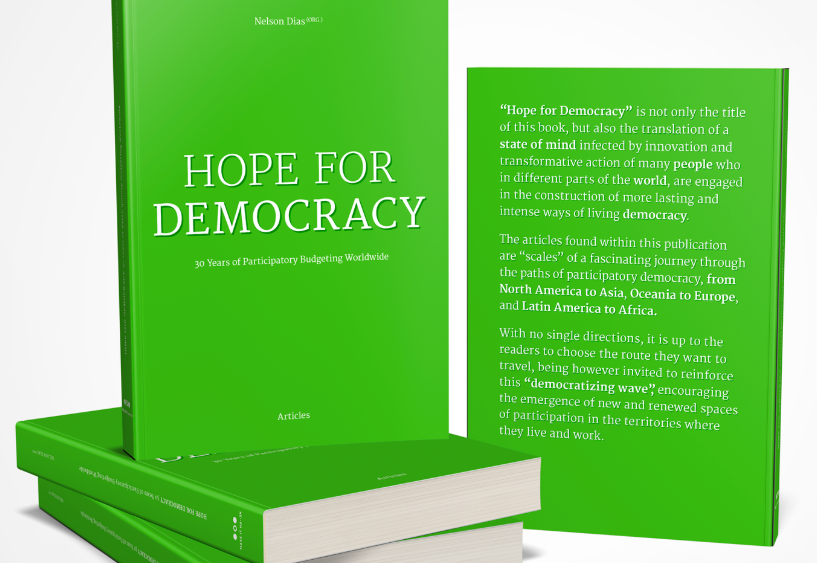
For our participatory budgeting enthusiasts out there (and we know there are a lot of you!), NCDD member org – the Participatory Budgeting Project, recently shared the exciting new book, Hope for Democracy: 30 years of participatory budgeting worldwide. The 600-page volume, edited by Nelson Dias, features over 60 authors on their experiences with PB across the world over the last 30 years and offers great insights for how to further grow the PB movement. We are thrilled to note that folks are able to download this book for free! You can read more about it in the post below and find the original announcement on the PBP site here.


Hope for Democracy: A New Book Reflects on 30 Years of Participatory Budgeting

An expansive new volume edited by Nelson Dias features dispatches by more than 60 authors from the frontlines of participatory budgeting’s (PB) growth around the world. This book, Hope for Democracy, could not have come out at a better time for PB supporters in North America. Next year will mark 10 years of PB in the US and new opportunities to take PB to the next level: a big citywide process approved in NYC, hundreds of new school PB processes, and growing political interest in strengthening democracy.

To make the most of these great opportunities to revitalize democracy, we need to first learn from PB’s growth internationally. Dias and his collaborators deliver countless insights in their 600-page panorama. (Download the book for free here.)

We lift up the biggest lessons below…

Why have Hope for Democracy?
Dias begins with an overview of key trends in PB as it spread from Porto Alegre, Brazil in 1989 to over 7,000 localities around the world. PB experts Brian Wampler, Stephanie McNulty, and Michael Touchton note how in Brazil during the 1990s, leftist politicians and activists championed PB as a radical project to “broaden the confines of representative democracy, mobilize followers, and achieve greater social justice” (p. 55); over time, it attracted support from a wide range of actors, including international organizations like the World Bank, because of its potential to improve governance and promote civic engagement. Giovanni Allegretti and Kalinca Copello discuss how, as PB spread internationally, new processes often committed fewer funds, whether measured as lower PB spending per person or as a smaller share of PB in the overall budgets (p. 45).

Benjamin Goldfrank and Katherine Landes examine how this trend has played out in the U.S. and Canada. They report that PB has expanded more slowly than other regions in terms of the number of cities implementing it, the amount of participants, and the volume of funds (p. 161). Yet, Goldfrank and Landes demonstrate this is not due to a lack of public interest: “we find that where PB allocates larger pots of money, the rate of participation tends to be higher” (p. 172). In other words, the more dollars that a PB process allocates, the more people care about it. Moreover, two bright spots on the horizon indicate that PB may grow faster in coming years: its mounting presence in schools and its rising appeal among progressive activists and politicians.

In the light of the recent victories in NYC—PB in all public high schools and citywide PB approved into the city charter—this watershed may be closer than the Goldfrank and Landes anticipated. Chapters on Paris, Russia, and Portugal offer additional insights on how to scale up PB in North America.

Paris offers a model of PB going big
Paris currently runs the largest PB process in the world. Similar to NYC’s coming city-wide process, PB in Paris was championed by a progressive mayor, Anne Hidalgo, who successfully campaigned on bringing PB to Paris in her 2014 election. Mayor Hidalgo wasted no time in implementing her plan of dedicating 5% of the city’s capital budget to PB over the first five years (That’s roughly 500 million euros!). Tiago Peixoto and colleagues use the Paris case to study large-scale issues, like whether online voting improves the process or biases it towards more privileged residents. Their research finds that voting patterns between online voters and those who vote in person are remarkably similar.

PB in Russia innovates, expands rapidly
In 2015, Russia experienced a turning point after which the number of PB processes grew surprisingly fast. This occurred when the Ministry of Finance noted the positive outcomes in regional PB processes and created a framework known as Initiative Financing. The next year, 8,732 PB projects were implemented. By 2018, half of all regional governments in the country (the equivalent of U.S. states) decided to set up PB programs.

Why did so many regions begin PB so quickly, when the federal government did not provide financial incentives to do so? Ivan Shulga and Vladimir Vagin emphasize how the central framework and technical assistance provided by the Ministry of Finance and the World Bank made regional implementation much easier. These processes also made use of some innovative institutional designs. In some programs, municipalities, businesses, organizations, and citizens pledged to co-finance projects, increasing their chance of receiving regional funding. Another program used a form of sortition or citizen jury, in which a cohort of volunteer budget delegates was randomly selected, to work with experts to turn project ideas into full-fledged and feasible proposals.

Portugal leads the way with national PB
Portugal was the first country to run nation-wide PB. While the process is not particularly large in terms of public participation or budget, it does provide one model of a large-scale institutional design that bridges disparate regions.

Roberto Falanga outlines how the process collected nearly 1,000 ideas from each part of the country in 50 assemblies and winnowed them down into viable proposals for a vote. The process did not use budget delegates to revise the proposals. While this may streamline the process, it runs the risk of giving experts and officials more power than public participants. However, an effort was made to minimize this danger by requiring detailed reasons for rejecting proposals and re-including ones that could be revised and made feasible. Still, proposals that were backed by informal social networks may have received undue prominence. For example a bullfighting project won funding even though a majority of the Portuguese public believes that the practice should be banned.

Reflecting on what’s been done, ready for more
It’s an exciting moment to get involved with PB. And it’s an important time to reflect on how far different regions have taken PB. While there are currently around 100 active processes in the U.S. and Canada, Latin America and the Caribbean hosts around 2,500 processes and Europe 3,500. We have some catching up to do.

Donate here to help PB grow.

You can find the original version of this announcement on the Participatory Budgeting Project’s site at www.participatorybudgeting.org/hope-for-democracy-a-new-book-reflects-on-30-years-of-participatory-budgeting/.

social media and the youth vote

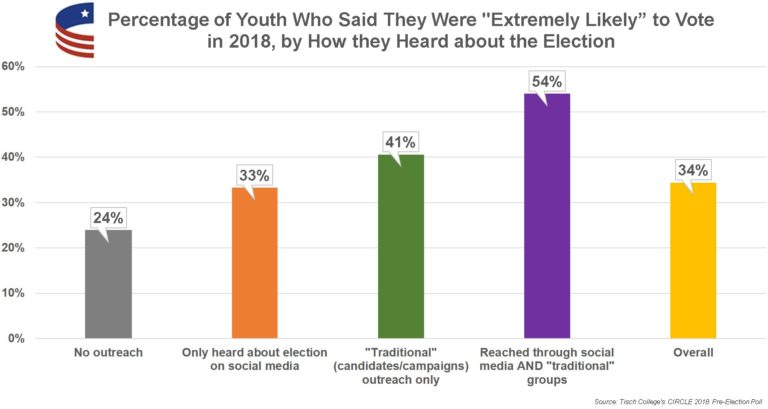
CIRCLE has released a highly substantive analysis of social media and the 2018 youth vote that is worth reading in full.

It probably won’t surprise you that many young adults heard about the election on social media. In fact, it might be worth pausing over the fact that only 47 percent saw something about it on Facebook, Instagram, Snapchat, and/or Twitter. It is possible to go through an election cycle without seeing much about politics on social media if your friend-networks are apolitical. We talk a lot about polarization into left and right, but an equally significant phenomenon is the division between political and apolitical Americans. That was less of a problem when people got their information from sources like broadcast TV and newspapers, which forced everyone to see political headlines.

More than one quarter of young adults heard about the election only on social media, not from traditional outreach by campaigns, candidates, and parties. That probably means that social media is expanding the number of youth who are engaged in the election.

The more you hear about an election, the more likely you are to vote. Compared to young adults who had heard about the election both on social media and from campaigns or candidates, young adults who recalled no outreach were less than half as likely to say (in October) that they were extremely likely to vote.

Some selection is at play here. If you are already a likely voter or part of a community that is seen as active, campaigns are more likely to contact you. If you have friends who vote, you are more likely to see information about the election online, but you might have voted anyway. Maybe you even pick friends who are into politics. Still, evidence from randomized experiments shows that outreach boosts turnout, and at least some of these differences must be attributable to the effects of outreach.

Support NCDD this #GivingTuesday!

Want to join us in supporting a good cause? This #GivingTuesday the National Coalition for Dialogue & Deliberation (NCDD) is asking for your support in our mission to bring together and support people, organizations, and resources in ways that expand the power of discussion to benefit society.

NCDD envisions a future in which all people–regardless of income, position, background or education–are able to engage regularly in lively, thoughtful, and challenging discussions about what really matters to them, in ways that have a positive impact on their lives and their world. We envision a society in which systems and structures support and advance inclusive, constructive, dialogue and deliberation.

NCDD is a small outfit, with just four part-time staff, and we rely on the support of our network and friends to help us continue to educate people on dialogue and deliberation, and to build this national coalition. Your contribution will make an impact, whether you donate $5 or $500.

For today only, Facebook and PayPal will match a total of $7 million in donations. Starting at 8am Eastern/5am Pacific, donations made through our Facebook page, will be matched – so please give what you can and help NCDD continue to support this network of innovators!  If you don’t use Facebook, you can always make a donation of any amount on our donation page.

Everyone who contributes to NCDD’s Giving Tuesday fundraiser will be thanked on our website and in our November newsletter. Additionally, the first 15 people to donate $50 or more will get a special NCDD notebook as a thank you for your support.

For sixteen years, NCDD has worked hard to gather visionaries and practitioners dedicated to raising the quality of discourse across many key issues and questions. Many of you have been a part of that – and we’re grateful for you!

As you reflect back on your years of association, we’re curious: how much has this network meant to you? Has it made a difference for good in some way? In what ways can we continue to drive NCDD together to support each other doing this work?

Please consider a #GivingTuesday donation to help us continue this work into the new year. More than ever before, we could use the help and support – and would be so grateful for your assistance!

We recognize there are a lot of fantastic organizations out there to donate to on Giving Tuesday, but we hope you consider donating to NCDD, which plays such a critical role in building capacity for improved democracy, conversation, and connection (which, we argue, is actually the most important issue we face right now as a country). It is really tough for organizations like NCDD to fundraise and be sustainable because it is a network of organizations, practitioners, and volunteers. Most of the members understandably have to focus on their own organizations and efforts. But networks like NCDD are critical to build a community of practice and grow the field. 

If you don’t know very much about us, we encourage you to check out some of the great benefits of NCDD and become a member. If you are already connected, please consider donating, even just a little bit, especially since it can be matched this morning.

Thank you for your support this Giving Tuesday!

Democracy Fund Creates New Team to Support Strategic Investment in our Democracy

Hot off the digital press! Democracy Fund, an NCDD 2018 sponsor, announced this morning they are building a new team dedicated to being a better resource for donors and the field; in order to support strategic efforts to invest in our country’s democracy. Currently, there is very little funding given to those working to improve our democracy, and it is vital to invest resources to those doing this work if our democracy is to survive. Democracy Fund is seeking a Director of Partnerships to lead this newly created team and stay tuned for the program rollout which will offer investment strategy resources, educational events, and joint funding opportunities.

On a related note, if you are looking to support an organization working to further democracy then consider donating to NCDD! We are one of the leading organizations that work to foster the D&D field and support those working to actualize a truer democracy. This Giving Tuesday, Facebook will match your donations – so double your impact and donate tomorrow through our NCDD FB page here! We encourage you to read the announcement below and find the original on Democracy Fund’s site here.


Building a Team to Invest in Democracy

Following the 2016 election, Democracy Fund heard from many philanthropists seeking advice on what they can do to respond to the threats facing our political system. For some, the last two years have brought a newly pervasive sense that our democracy is under threat and that our political system is far more fragile than most of us assumed. We feel the same way, and we are humbled that interested donors and their advisors are turning to us and to our peers for guidance.

Through our efforts to support these new partners, we discovered that Democracy Fund can play a helpful role in providing advice and connections to philanthropists who are learning about the field. To that end, I am delighted to share that we are building a new team at Democracy Fund to help us be a better resource to philanthropists, advisors, and our peers. The team will be led by a newly created position, the Director of Partnerships. (Read and share the job description here.)

This swell in philanthropic interest comes at a pivotal time. Despite a clear and pressing need, the level of philanthropic support for this field remains critically low. Whether you look at voting, journalism, or civic education, many of the most capable and innovative organizations in the space have struggled through multiple cycles of feast and famine and need more resources to meet the challenges at hand.

To make progress on issues that are important to the American people and to ensure the health of our democracy for future generations, the United States needs deep investment by philanthropists and advocates. Policy reforms ranging from the future of affordable housing to climate change depend on a political system that is responsive to the public. A more equitable society requires eliminating barriers to voting and reducing the influence of money on politics. And improving the ability of individuals and communities to thrive rests on a functioning government, fair enforcement of the rule of law, and stability in our politics. Despite the reality that progress hinges on a healthy democracy, the field receives less than two percent of overall philanthropic giving.

Building a healthier democracy together

Working with our peer funders, we hope the Democracy Fund Partnerships team can be a resource to donors and to the field. Our goal is to make the expert capacity of our staff and our collaborative approach available to interested philanthropists. We believe that enlisting greater philanthropic energy, ideas, and resources to the fields in which we work is one of the most effective ways for us to meet the scale of the challenge.

Our new team will educate and engage philanthropists who are new to democracy with the goal of helping them to enter the field. Led by the Director of Partnerships, the team will help donors and their advisors make strategic decisions to invest in our country’s democracy. It will take some time and experimentation to build this program, but there are a few things you should expect to see:

  • Resources: Democracy Fund will work with our peers to develop resources that help new donors to better understand the space, including investment guides highlighting the most innovative and high-impact strategies and organizations in the field. The Foundation Center’s data tool for the democracy field is an excellent example of the kind of resource we have helped create in the past that can help philanthropists understand the existing landscape.
  • Educational Events: Over the past 18 months, Democracy Fund has partnered with the Giving Pledge to educate members of that network about opportunities to strengthen democracy in the United States. We expect to organize more briefings and workshops like those we organized with Giving Pledge to inform new donors.
  • Joint Funds: Democracy Fund participates in and has created several collaborative funds that enable donors to easily contribute to vetted, highly effective grantees working to protect the health of our government, elections, and free press. Our Public Square program, for example, works with other journalism funders through NewsMatch, the North Carolina Local News Lab Fund, and the Community Listening and Engagement Fund. We aim to work with our peers to develop other similar funds that make it easier for new donors to enter the space.

Our Commitment to the Field

Our new efforts to build philanthropic partnerships will not slow our existing efforts to deploy our resources to support the field. Since Democracy Fund began, we have committed more than $100 million in grants and built a team of more than 45 people with deep expertise on issues ranging from journalism and elections to Congress and government accountability. Thanks to the generosity and leadership of Pierre Omidyar we intend to continue to invest at a similar level in the coming years.

At the same time, our commitment to our existing grantees will not limit our advice to new donors – we hope to help philanthropists find their own path into the field, whether or not it mirrors the path that we have chosen.

We are grateful for the mentorship and ongoing partnership of many foundations who have supported this field for decades, including the Knight Foundation, Carnegie Corporation, Ford Foundation, Open Society Foundations, and Rockefeller Brothers Fund. At such a deeply important moment for our country, we are excited to begin this important work and will continue to share our progress as the team grows and the program develops.

You can find the original version of this announcement on Democracy Fund’s site at www.democracyfund.org/blog/entry/building-a-team-to-invest-in-democracy.

Giving Thanks and Resources for Tough Conversations

With Thanksgiving this week, NCDD’s staff are giving thanks to YOU, the members and broader NCDD network, for continuing to support NCDD and our collective work of bringing people together to connect and make decisions.  NCDD is a coalition, and it takes every one of us working together to make it work, and to make our field stronger and more connected. You are why NCDD exists, and you keep us going with your fabulous contributions of time, skills and other gifts, and of course your support of NCDD.

This time of the year is a time for giving thanks, but it is also a time where many people fear the tough conversations that can emerge when family gathers together. Millions of Americans find themselves dreading family gatherings they used to enjoy, especially with the current political climate.

NCDD and our network know there is a better way! There’s a way to come together with those who see the world night-and-day different, and do something more than just bite our tongues and talk about the weather.

As a reminder, NCDD has gathered helpful resources anyone can use to help navigate these potentially tough topics:

Do what it takes to make YOUR family gatherings what they should be: enjoyable.

We hope you have a happy and full Thanksgiving holiday. And, we hope you will share your thanks for NCDD next week with a donation of any amount on Giving Tuesday. On Tuesday, November 27, be sure to join us over on Facebook for our Giving Tuesday fundraiser, where your donations will be matched dollar for dollar by Facebook and PayPal!

NCDD is a small outfit, with just four part-time staff. We rely on our network’s support through membership and donations, to help keep our organization running. It is the time and support of this fabulous network of innovators which keeps NCDD running! Please consider supporting us this Giving Tuesday with a donation over on Facebook. If you don’t use Facebook, you can always make a donation of any amount on our donation page.

Thanks again for making NCDD so vibrant and for all the work that you do!

the state versus petit-bourgeois white America

Citizens experience the state in the form of people–teachers, social workers, police officers, nurses and doctors. These may be public employees or just subsidized by public funds, as when doctors get reimbursed by Medicare or professors get some of their salary from federal financial aid and grants. They help, serve, and protect; they also advise, cajole, assess and select, and discipline.

If we expand distributive justice (taxing richer people and spending the money on “government”), then relatively needy people will be confronted with human representatives of the state. These interactions will be friction points, sites of cultural conflict and resistance.

This is a well-known problem that has been discussed for a century. Traditionally, it has a strong class dimension: the state sends mostly college-educated people to both help and discipline working-class people. The state represents norms and ways of life embraced by the dominant social class. (I think this was even the case in the USSR.) In the US, the friction also has a racial dimension, even though white people have always been recipients of government support and surveillance in the US.

I think four strategies have often been proposed to reduce the friction:

  1. Make the state more demographically representative of the people it relates to. For instance, work to enhance the racial diversity of public school teachers, especially when their students are people of color.
  2. Design programs and laws–also train the “street-level bureaucrats” who deliver services–to minimize unnecessary moral superiority, reduce patronizing attitudes, and shift the balance to helping people versus disciplining them. For instance, educators are taught to be sensitive to their students’ backgrounds; social workers have norms against being judgmental.
  3. Organize or train the recipients of government services to stand up for their own rights and values.
  4. Expand cash transfers and other detached forms of redistribution that don’t involve monitoring and changing behavior (as education, policing, public health, and social work do).

None of these strategies has ever been fully successful. But we now see a new dynamic. A significant segment of the population identifies strongly as middle class and culturally mainstream. These are white, Christian people who may have attended college (often without completing BA degrees) and who may own small businesses or work in white-collar settings. They live in smaller towns, exurbs, and rural settings that represent a vision of respectability.

Traditionally, they identified with the state, particularly since they were very well represented in Congress, the state legislatures, and the military. Their typical question was whether or not to spend money on the government, which might waste their tax dollars but might also protect their national security, might genuinely help them without a lot of lecturing (think of agricultural extension workers or locally-controlled public schools), and would discipline other people.

Now this class—white, non-urban, Christian, and petit-bourgeois rather than working class–is in trouble. Obesity, opioid abuse, and suicide are rising to the point that their life-expediencies are falling. In some cases, their communities are losing population. Their traditional economic roles are in peril, and they’re told that their children must live and learn differently to retain their class position.

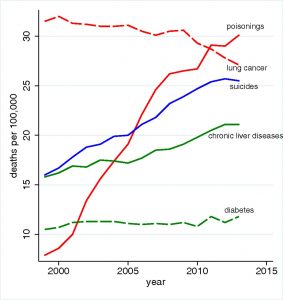
“Mortality by Cause for White Non-Hispanics Ages 45–54,” from Anne Case & Angus Deaton, PNAS December 8, 2015 112 (49)

The very bad trends depicted in this figure are concentrated among white people without college experience, but those with some college show increasing mortality. It’s only people with BAs or more who have escaped that pattern.

The state arrives to tell them to eat different foods, not to smoke, to raise their children differently. It may seem that the state disagrees with the messages that they hear in church, which they attend to live good lives. The state tells them to send their kids to the state university if they want to stay in the middle class. Their taxes and tuition dollars will pay for people who relate to them as the state has traditionally related to the poor and working class. Professors and student-affairs workers will steer their kids into a new culture that the coastal bourgeoisie has created. From the same universities come the k-12 teachers, nurses, and others who lecture them back in their own communities about food and exercise and carbon emissions. (Here I am indebted to Kathy Cramer, among others.)

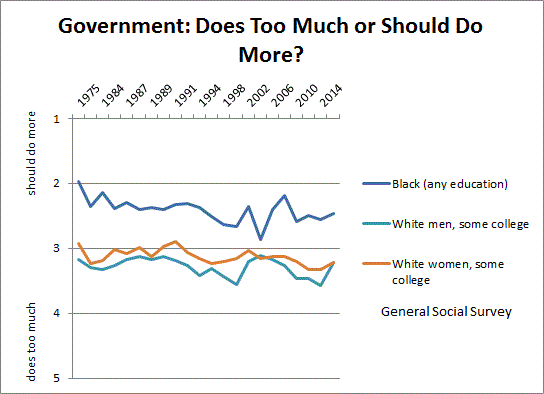
When asked whether the government should “do more” (1 on the scale below) or “is trying to do too many things that should be left to individuals and private business” (5 on the scale), white men have traditionally tilted against government. However, they caught up with white women in their support for government between 2014 and 2016, perhaps because they needed it more. We don’t have 2018 data yet, but we know they voted for Trump that year. This is consistent with needing government but not liking it.

The conflict between petit-bourgeois white people and the state is gendered, because many of the front-line representatives of the government are female, and many of the people with the most counter-normative behavior are men. The conflict is also racial in two respects. First, white, middle class people traditionally distinguished themselves from Americans who needed government aid and guidance, whom they viewed disproportionately as people of color; but that distinction is erased if the middle class also needs help. Second, representatives of the state–especially those who appear on TV–look at least somewhat more racially diverse than white communities do. At the very top of the state structure for eight years was a Black man.

I think these tensions are at the heart of current US politics. Focusing on them challenges both the “economic insecurity” and the “racial resentment” explanations of the 2016 election and its aftermath. A somewhat different premise is that lower-middle-class rural and exurban white Americans are now experiencing the state roughly as poor urban people are used to experiencing it. They need it but don’t like it, because it is always telling them they must change.

I’m not saying that most of them are responding appropriately or wisely, but we might want to dust off our tools for repairing the welfare state: make sure the government employs people who talk and look like those it affects, train them for sensitivity, organize those most affected by the state to push back, and try to shift to cash redistribution instead of invasive behavior-modification.

See also: why the white working class must organizeresponding to the deep story of Trump voterswhat do the Democrats offer the working class?

Moving Past Couch-Potato Democracy to Engagement

In the sixth installment of their series, democracy around the world, NCDD sponsoring member, the Jefferson Center, wrote this piece on how Americans can be more civically engaged and address our challenging issues. Many of the states in the U.S. are designed to give the people even more power to shape legislation through initiatives and referendums. The article challenges for people to push more into civic life and participate in government, especially when their elected officials are not. You can read the article below and find the original version of it on the Jefferson Center site https://jefferson-center.org/2018/09/initiate-democracy-across-the-united-states/here.


It’s Time to Initiate Democracy Across the United States

This is the sixth post in our blog series exploring democracy around the world, submitted by a diverse group of people interested in using deliberation, participation, and civic tech to solve challenges we face today. The following does not necessarily represent the views of the Jefferson Center or Jefferson Center staff.

John Hakes is a freelance writer and Certified Public Accountant who has worked with the U.S. Census Bureau and Questar Assessment Inc. He earned his Master’s Degree in Advocacy and Political Leadership from the University of Minnesota Duluth.

Congress shall make no law respecting an establishment of religion, or prohibiting the free exercise thereof; or abridging the freedom of speech, or of the press; or the right of the people peaceably to assemble, and to petition the government for a redress of grievances. – First Amendment to the U.S. Constitution

In the opening blog of this series, guest blogger Ross Busch suggested a national assembly model recently employed by the country of Ireland– on an agenda of climate change leadership, aging population and abortion– might be used to address the seemingly intractable issue of gun control in the United States.

If Ireland, a nation with a centuries-long entrenched position on the sensitive abortion issue can use informed reasoning to assess the will of the people through assembly— the Busch reasoning goes– there is hope people could do likewise on other emotionally-charged issues.

We will now ‘wait ‘n see’ whether Busch’s clarion call takes root around the world. But meanwhile, in November, the twin ‘people power’ petition mechanism afforded to American citizens by the First Amendment will be exercised on the issue of gun control. That’s when Washington citizens will decide whether they wish to add parameters to the use of firearms through a vote of the people via Initiative I-1639.

The Initiative Tool

Should you call states like Hawaii, New Mexico, Iowa, North Carolina, Maryland, or around 20 others home, you may not be not familiar with the initiative process.

Unlike a referendum, where a question must come from a given jurisdiction’s legislative body, a citizen initiative is typically created when a certain number of ‘registered voter’ signatures are gathered on a question proposed to become law.  Initiatives can either be direct (where potential new law is decided on by voters) or indirect (where the affirmed petition question is handed to a Legislature for it to decide on).

The state of Washington’s citizen initiative process was enacted in 1897. The I-1639 effort began when the gun measure petition received the requisite number of signatures from across the state.  Naturally, the road from ‘obtaining a verifiable set of signatures’ to ‘Secretary of State approval’ to ‘finalized question on the November ballot’ has been met by significant counter challenges. But on August 24, 2018, a ruling of the Washington Supreme Court officially permitted the existence of the ‘gun measures’ question to be included on the November 6th ballot .

Initiative and Referendum in the U.S.

Less than half of the U.S. states allow their citizens to raise & legally install the answer to a question through the initiative process. More western than eastern states have this process in place.

At least partly due to the continually shifting voting preferences over time in a given electorate, states currently deemed ‘red’ and ‘blue’ both offer legislation-by-initiative. Washington & California are examples of so-called blue states while North Dakota and Arizona are counted among ‘red’ states that utilize initiatives.

Unsurprisingly, voter turnout in these states has historically been 5 to 7 percent higher than in states without initiative and referendum (states with one typically offer the other). The reason for this is simple: voters feel that their vote for or against a grassroots-raised issue on the ballot does make a difference.

Despite being a state that frequently leads the nation in voter turnout,  Minnesota–also well-known for possessing a strong political and civic culture–features neither an Initiative or Referendum component in its democratic procedural toolkit.

Like every other state, Minnesota does allow questions pertaining to  legislatively-referred, state constitutional amendments to be decided on by voters.  There have been three periods in which the right to decide by Initiative has been seriously considered in Minnesota, with the last push led by MN House Representative Erik Paulsen during the Jesse Ventura administration of the early 2000s.

Looking ahead

Although it’s true that social media has the power to amplify voices and mobilize people to achieve ‘a’ form of grassroots push on a given issue, such sentiments too often blow away with the wind of the next incoming news cycle.  Rather than focusing only on the  couch-potato democracy by electronic device, Americans in half of the U.S. states should exercise the legal levers they already have to permanently alter the law when their elected representatives don’t seem up to the task.

To quote the Busch piece again: “Conversations between ordinary citizens on complex topics are perhaps the greatest defense against the degradation of modern politics.”

What better way to begin stepping across the street for face-to-face conversation than to create outcomes on even an incredibly divisive issue through an Initiative provision, like approximately half of our country’s people have the legal luxury of doing?

And though founders like James Madison would likely be one to equate the Initiative process with ill-advisedly caving to the passions of the people, perhaps even our celebrated ‘Father of the Constitution’ might see the diligence and organization required of Initiative efforts as preferable to the Rule by Retweet method that regularly influences the course of events today.

Thanks to efforts like those who’ve advanced the I-1639 in Washington, political pockets of our country are arguably “deliberating, even when it’s difficult,” on important issues, as writer Ross Busch recommends.

You can find the original version of this article on The Jefferson Center site at www.jefferson-center.org/2018/09/initiate-democracy-across-the-united-states/.

Elementary Social Studies and Why It Matters

Elem Social Studies CCSSO

We know that we have issues in this country with social studies instruction, and it is especially challenging at the elementary level. Whether we are talking about the impact of assessment on instruction, the weakness of the content-based resources, or simply the loss of time devoted to and disappearance of social studies from the elementary curriculum, it has an impact that is simply not debatable. When social studies is marginalized, it robs students of the opportunity to develop the knowledge, skills, and dispositions they need to be effective and engaged citizens. We simply cannot expect success and engagement when many kids don’t start learning about civic life and engagement, and everything that goes into it, until well into middle school or even high school. Social studies matters. We have an obligation to ensure that it is being taught with fidelity and with passion. As Dr. Tina Heafner argued in her keynote at the Florida Council for the Social Studies’ recent conference, effective and quality social studies instruction is the right of all students. 

The Social Studies Collaborative, a working group made up of members of the Council of Chief State School Officers, has recently released an infographic, featured at the top of this post, that illustrates both the disturbing data on the marginalization of social studies AND  the positive benefits of social studies instruction that can result when we return our beloved field to the prominence it deserves.

You can download the infographic here or here: Elementary SS Brief 45

We here at the Florida Joint Center for Citizenship and the Lou Frey Institute support and believe in this message completely. We need to bring social studies back to the elementary schools. We need it to ensure that our students become the best citizens they can be. And it needs to, and CAN, start in Kindergarten. FJCC even has some short civics-oriented lessons that can be done in about 15 or 20 minutes and introduce social studies and civics concepts to elementary school students at all grade levels!

Addressing Incidents of Bias in Schools: A Guide for Preventing and Reacting to Discrimination Affecting Students

There's a growing concern about discrimination and hate crimes taking place across the country. While incidents of bias can occur anywhere, it's especially troubling when it happens in our schools. Discussing race and discrimination can be difficult for the most seasoned of professionals, however, that discomfort should not prevent important conversations from taking place.

This guide is designed to bring together a school community in order to address and prevents incidents of bias, discrimination and hate crimes. It includes suggestions for facilitating the discussions so that they are safe, illuminating and productive, as well as for organizing the process so that it fits in the daily rhythm of the school community.