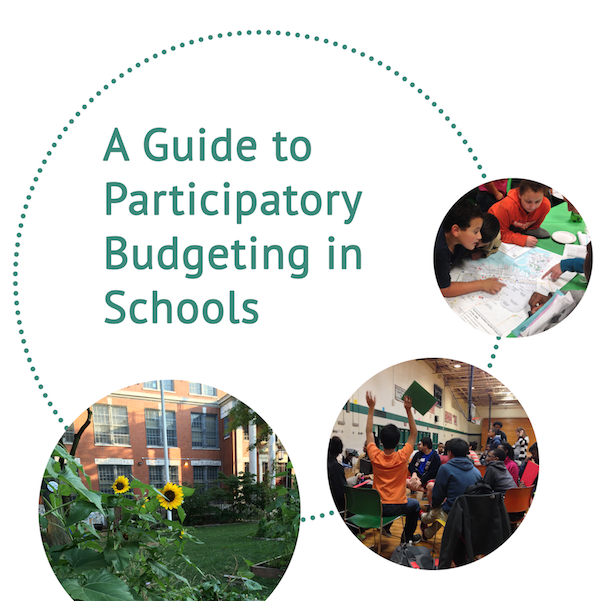
PBP Releases Guide for Participatory Budgeting in Schools

Ensuring that younger generations have opportunities to practice the skills they need to make decisions together about substantive issues is vital to maintaining a democratic society. So we are thrilled to share that the Participatory Budgeting Project – an NCDD member organization – has created a new tool to help schools everywhere give students that opportunity with its new PB in Schools Guide, which is designed to help educators collaboratively launch participatory budgeting processes in their classrooms and school buildings. Learn more in the PBP announcement below or find the original here.


PBP-Logo-Stacked-Rectangle-web1PB in Schools Guide

We all want young people to become civically engaged. This can start now, in school! PBP has developed a free Guide for you to give students a direct experience in civic engagement through Participatory Budgeting.

The Guide shows how to get your school working with Participatory Budgeting (PB). The PB process creates an experiential learning environment for community engagement at a local level. Students are challenged to think about community needs and issues, exploring their environment. They are then empowered to design and implement a solution, taking shared ownership of their school community. They will gain a new attachment to their community; a sense of pride that comes with civic contribution. And they will build a stronger, more collaborative relationship with school administration, one another, and the community at large.

The Guide includes 18 lesson plans and 6 worksheets that are designed to take 45 minutes, once a week, over the course of a semester. You will find sections that explore:

  • Idea Collection
  • Proposal Development
  • Planning
  • VotingPB_Schools_Cover
  • Implementation and Beyond

Participatory Budgeting is great to bring into your classroom because:

  • It’s democracy in action.
  • It gives your students a positive civic engagement experience.
  • It serves as a bridge for your students to be engaged in politics and their community.
  • It strengthens the school community by building positive relations between students and the administration.
  • It shows students the benefits of getting involved.

By implementing Participatory Budgeting into classrooms, students will learn to:

  • Increase their ability to work collaboratively
  • Develop research, interviewing, and surveying skills
  • Develop problem-solving and critical thinking skills
  • Develop public presentation skills
  • Increase their awareness of community needs and their role in addressing those needs
  • Understand budgetary processes and develop basic budgeting skills
  • Identify ways to participate in governance
  • Increase concern about the welfare of others and develop a sense of social responsibility

The Guide’s game plan is effective and efficient as well as adaptive – modify it to fit your context. The Guide explains how to navigate idea collection, proposal development, an expo, a community vote, and implementation of winning projects.

PBP welcomes you to take the first step in bringing your school community closer and educating your students in an engaging democratic process by downloading our free Guide!

You can find the original version of this Participatory Budgeting Project announcement at www.participatorybudgeting.nationbuilder.com/pbinschools.

CII Seeks Support to Develop New “Wise Democracy” Tool

Long time NCDD members John Spady recently sent us news of a project being undertaken by another NCDD member, Tom Atlee, and his Co-Intelligence Institute that we wanted to share here. Tom and the CII are developing a new tool for supporting “wiser democracy,” and are seeking support to obtain a matching grant for the work. We encourage you to read John’s letter about the project below or learn more about the project and how to support here.


Fundraiser request from the Co-intelligence Institute with Tom Atlee

The board of the Co-intelligence Institute (CII) has initiated a fund raiser to support the emergence of “wiser democracy” – Tom Atlee and Martin Rausch have developed a pattern language card desk design (similar in design to the Group Works deck created in 2011) to impart a sense of what is possible and promote wiser archetypes of design, and they are calling on the D&D community for support in funding the project.

The CII fundraiser is at this secure link: https://bit.ly/CII-fundraiser2016. Here’s a bit more explanation from the fundraiser page:

Tom Atlee and Martin Rausch have been working on a Wise Democracy Group Pattern Language deck, that builds on the insights of Tom’s previous books, The Tao of Democracy and Empowering Public Wisdom. In some ways, this new pattern language is analogous to the Group Pattern Language deck, only its focus is on democracy as a whole, instead of on groups. Your contribution will allow us to complete this project, which is already half-way there! We still need to edit the cards, complete the designs, and invest in our first print run.

It’s also a great time to contribute, since your money will be doubled through an anonymous challenge grant, if we reach our goal by August 31st! Any funds over the amount we are requesting here, will be used for other co-intelligence projects, such as the completion of a nearly-finished book on the need for a participatory approach to sustainability.

This challenge grant from a generous and anonymous donor has been made and the challenge can only be met if CII first raises $10,000. Please take a moment to visit the link and review the challenge.

In the words of Walt Whitman: “I cannot too often repeat that Democracy is a word the real gist of which still sleeps, quite unawakened, notwithstanding the resonance and the many angry tempests out of which its syllables have come, from pen or tongue. It is a great word, whose history, I suppose, remains unwritten because that history has yet to be enacted.”

While wise democracy has not yet been enacted on a large scale,  a number of successful experiments show what is possible. The cards that have been drafted distill patterns of “good design” – aspects we need to consider when creating  a wiser democracy. These are not a “set of rules” but instead support reflection, integration, and implementation.

Thank you for you interest in this project from the Co-intelligence Institute!

John Spady
CII Board Member
and Founder of the National Dialogue Network

Transforming Historical Harms

The 96-page manual, Transforming Historical Harms by David Anderson Hooker and Amy Potter Czajkowski, was uploaded October 2013 on Coming to the Table‘s site. The manual gives a holistic framework to address historical injustices, in a way that engages all participants, and identifies the aftermath and legacies of [generational] trauma. This manual was developed by Coming to the Table and has been a collective effort of Eastern Mennonite University’s (EMU) Center for Justice & Peacebuilding (CJP) and their Strategies for Trauma Awareness and Resilience (STAR) program. From the STAR program, came the group Coming to the Table, which itself was launched in 2006 when a group of EMU participants gathered to address the historical trauma between descendants of enslaved African-Americans and enslaver European-Americans.

The framework is given through the lens of trauma and provides a holistic approach to transform traumas from historical injustices for healing to occur. In order to be possible, all participants affected must be included and address all the following aspects: “Facing History; Making Connections; Healing Wounds; and Taking Action”.

The manual provides five sections and an appendix:
Section I: Overview, context and using the manual
Section II: The THH Framework
Section III: Practices of the THH Approach
Section IV: Analysis and Process Design
Section V: Tools and Resources for Practicing the THH Approach

Below is an excerpt from the manual, you can find the it in full on Coming to the Table’s site here.

From the manual…

The THH Framework
The Transforming Historical Harms (THH) manual articulates a Framework for addressing the historical harms mentioned above as well as the many others present in societies around the world. The framework looks at historical injustices and their present manifestations through the lens of trauma and identifies the mechanisms for the transmission of historical trauma: legacies and aftermaths. These are the beliefs and structures responsible for transmitting trauma responses and traumagenic circumstances between generations. The framework then offers a comprehensive approach to transforming historical harms through Facing History; Making Connections; Healing Wounds; and Taking Action. Transforming historical harms must occur through the practice of all these dimensions. The order in which they are engaged can be different, but none can be omitted. This approach will be the primary focus of the manual. Finally, the framework includes the levels at which healing needs to occur, which range from the individual to the international level. For the sake of simplicity, we will refer to analysis and interventions at the individual and group levels.

The framework we offer in this manual is unique in several ways. The four part THH Approach is holistic because each dimension is interconnected with the others and the approach only works when all the dimensions are present. The framework introduces specific understandings of the concepts of legacy and aftermath, and transformation is considered incomplete unless both beliefs and structures have been addressed that have been responsible for perpetuating historical trauma and harms. The THH framework includes all groups that have participated in and have been touched by the historical trauma and harms rather than focusing exclusively on the group or groups that have been named the “victims.” There is clear and ample evidence that in the context of massive and historical trauma, those who were victimized, those who perpetrated, those who were bystanders AND the descendants of each group are all effected. It is our assumption that participation and healing is required at some point for all groups in order for the approach to be effective. Not only is it requisite for all groups to participate, but for consideration to be made for the unique manifestations of trauma across generations for each group and for healing interventions to occur at the individual and group levels.

How to use this manual:
The intention of this manual is to provide value to those trying to address the personal, familial, communal and/or societal remnants of traumagenic historical experiences that continue to hurt or limit the lives of individuals, groups, societies and nations. The pain or limitation could result from overt violence such as enslavement, war, colonialism or genocide, or more subtle forms of violence like discrimination, poverty and personal or societal exclusion.

Objectives: Those using this manual will:
1. Learn how historical harms, which are current challenges in our lives and communities, are rooted in large-scale historical traumas.
2. Identify how Legacy and Aftermath describe the transmission of historical trauma and harms.
3. Apply the Transforming Historical Harms Approach that includes:
a. Exploring approaches to facing history that help identify ways to move forward;
b. Learning how making connections — building relationships across historical divisions — can create partnerships capable of working towards effective change;
c. Identifying the importance of creating spaces and methods that welcome and support healing wounds (mind, body and spirit) from truama both individually and collectively; and
d. Taking action to address beliefs, behaviors and structures responsible for ongoing harms.
4. Explore historical trauma and harms in specific contexts, and learn about strategies for using the THH approach in these situations.

Above is an excerpt of the manual. We recommend looking at the manual in full, which can be found here.

About Coming to the Table
Coming to the Table provides leadership, resources, and a supportive environment for all who wish to acknowledge and heal wounds from racism that is rooted in the United States’ history of slavery. Our vision for the United States is of a just and truthful society that acknowledges and seeks to heal from the racial wounds of the past—from slavery and the many forms of racism it spawned.

Follow on Twitter: @ComingToTable

About EMU’s Center for Justice and Peacebuilding
The Center for Justice & Peacebuilding educates a global community of peacebuilders through the integration of practice, theory and research. Our combined vision is to prepare, transform, and sustain leaders to create a just and peaceful world.

Follow on Twitter: @CJP_EMU

Resource Link: http://comingtothetable.org/wp-content/uploads/2013/10/01-Transforming_Historical_Harms.pdf

Recap of Our Tech Tuesday Event with Trusted Sharing

We had another fantastic Tech Tuesday event earlier this week with the team from Trusted Sharing. The webinar featured NCDD member Duncan Work, founder and CEO of Trusting Sharing, and Ruth Backstrom, Director of Marketing and Outreach who walked participants through an in-depth demonstration of the features and capabilities of their asynchronous conversation platform.

The walk through was hugely informative, and it was clear to all of us how helpful a tool like Trusted Sharing can be to folks working not just on planning, engagement, and decision making processes, but also in classrooms, organizations, and all manner of other collaborative endeavors. We got to ask Duncan and Ruth specific questions about Trusted Sharing’s functionalities and the case studies we explored, and heard a bit more about their next steps in rolling the tool out. It was a wonderful call!

If you missed out on the call and still want to see and hear the presentation, then we encourage you to check out the recording of this Tech Tuesday call by clicking here.

The Trusted Sharing team is still developing and refining the tool, and since NCDD’s member network is such a rich repository of knowledge and expertise, they created a special Trusted Sharing conversation page where NCDDers are invited to offer input and suggestions to the TS team about templates for conversations based on method and process you use. So we encourage NCDDers to visit www.trustedsharing.com/ncdd to continue the conversation from the call, ask more questions, and offer your professional feedback on the Trusted Sharing tool.

Tech_Tuesday_BadgeThanks again to Duncan, Ruth, and everyone who participated in the call for an engaging and educational event!

To learn more about NCDD’s Tech Tuesday series and hear recordings of past calls, please visit www.ncdd.org/tech-tuesdays.

First Comprehensive Analysis of PB in N. America Released

We want to draw our NCDD members’ attention to some of the work done by the team at Public Agenda – one of our NCDD member organizations. PA recently completed the first-ever comprehensive analysis of participatory budgeting processes in N. America, and the report they released is a fabulous tool for understanding and promoting PB. It’s full of insightful findings and poses important questions for going forward. We encourage you to read their summary below or find more from PA’s website here.


Public Spending, By the People

PublicAgenda-logoFrom 2014 to 2015, more than 70,000 residents across the United States and Canada directly decided how their cities and districts should spend nearly $50 million in public funds through a process known as participatory budgeting (PB). PB is among the fastest growing forms of public engagement in local governance, having expanded to 46 communities in the U.S. and Canada in just 6 years.

PB is a young practice in the U.S. and Canada. Until now, there’s been no way for people to get a general understanding of how communities across the U.S. implement PB, who participates, and what sorts of projects get funded. Our report, “Public Spending, By the People” offers the first-ever comprehensive analysis of PB in the U.S. and Canada.

Here’s a summary of what we found:

Overall, communities using PB have invested substantially in the process and have seen diverse participation. But cities and districts vary widely in how they implemented their processes, who participated and what projects voters decided to fund. Officials vary in how much money they allocate to PB and some communities lag far behind in their representation of lower-income and less educated residents.

The data in this report came from 46 different PB processes across the U.S. and Canada. The report is a collaboration with local PB evaluators and practitioners. The work was funded by the Democracy Fund and the Rita Allen Foundation, and completed through a research partnership with the Kettering Foundation.

You can read the findings in brief below, download a PDF of the executive summary,download the full report or scroll through charts and graphics from the report. This report is also part of an ongoing Public Agenda project on participatory budgeting – you can read about the project here.


Summary of Findings

Part 1: What Happened? Facts and Figures About How PB Was Implemented

How exactly did communities implement PB? How did communities differ from one another in their adaptation of PB to local needs and resources? And how successful were different council districts and cities in getting the word out and encouraging residents to take part?

Key findings:

  • More than half of the 2014–15 PB communities were undertaking PB for the first time.
  • Officials allocated on average $1 million to a PB process (nearly always capital funds only), ranging from $61,000 to over $3 million.
  • In all PB communities, residents under 18 years old were eligible to vote. The minimum voting age was most commonly 14 or 16.
  • More than 8,000 residents brainstormed community needs in more than 240 neighborhood idea collection assemblies. In communities that held more neighborhood idea collection assemblies, total participation across assemblies was higher.
  • Over 1,000 resident volunteers turned ideas into viable proposals as budget delegates. Some communities did not offer residents opportunities to become budget delegates, and one reported as many as 75 such volunteers.
  • Nearly all communities used online and digital tools to tell residents about PB. Far fewer did targeted person-to-person outreach. Person-to-person outreach was associated with greater participation of traditionally marginalized communities.
  • 140 partnerships between community-based organizations (CBOs) and government formed to increase participation in PB. CBO outreach was associated with higher representation of traditionally marginalized communities at the vote.
  • More than 70,000 residents cast ballots across nearly 400 voting sites and more than 300 voting days. Some communities brought out fewer than 200 voters, others more than 3,000.
  • A total of 360 projects won PB funding.

Part 2: Who Participated? The Demographic Profile of Voter Survey Respondents

What do we know about the demographics of PB voters? How representative were PB voters of their local communities? How successful were communities in engaging groups that are often marginalized from the political process?

Key findings:

  • AGE: Residents under 18 years old and seniors were overrepresented among survey respondents in many communities, while residents between 18 and 44 years of age were underrepresented. Overall, 11 percent of respondents were under 18 years of age. Click to view charts.
  • RACE/ETHNICITY: In nearly all communities, black residents were overrepresented or represented proportionally to the local census among voter survey respondents. Hispanics were underrepresented among survey respondents in most PB sites. Overall, blacks made up 21 percent of respondents and Hispanics made up 21 percent of respondents.Click to view charts.
  • INCOME: In most communities, residents from lower-income households were overrepresented or represented proportionally to the local census among voter survey respondents. Overall, 27 percent of respondents reported annual household incomes of less than $25,000 and 19 percent reported annual household incomes between $25,000 and $49,000. Click to view charts.
  • EDUCATION: Residents with less formal education were underrepresented among voter survey respondents in most communities. Just 39 percent of respondents overall reported not having a college degree. Click to view charts.
  • GENDER: Women were overrepresented among voter survey respondents in nearly all PB communities. Overall, 62 percent of respondents were women. Click to view charts.

Part 3: What Got Funded? Ballots and Winning Projects

What kinds of projects made it on the ballot? What types of projects received the largest amount of PB allocations? And what kinds of projects were most and least likely to win residents’ votes?

Key findings:

  • Parks and recreation projects were the most common ballot items overall, followed by school projects. But ballots varied substantially—some included no parks and recreation or no school projects.
  • Overall, schools received the largest share (33 percent) of PB-allocated funds.
  • Public safety projects were rare on ballots but had a high chance of winning.
  • Public housing projects were rare on ballots and had a low chance of winning.

Questions for National and Local Stakeholders

We hope this publication will stimulate national and local discussion about PB and its potential to positively impact individuals, communities and governments across the U.S. and Canada. The report therefore concludes with some important questions for national and local stakeholders who are debating PB’s current state and potential impacts, are working on refining its implementation or are conducting further research and evaluations. Following are these questions in brief.

Questions about PB’s potential to spread and scale:

  • With an average of $1 million allocated in each PB community, what can be achieved?
  • How do communities support and finance the implementation of PB, and how sustainable are these strategies?
  • What community conditions facilitate or hinder successful implementation of PB?

Questions about implementation:

  • What are the various goals local communities have for PB, and how are they communicated?
  • What is the quality of deliberation—when and how do residents consider the trade-offs of various community needs and projects?
  • How do online and digital tools for outreach and engagement affect who participates and what gets funded?
  • As communities vary in voting rules and ballot design, how does that impact voting patterns?

Questions about participation:

  • Why are some communities better than others at engaging traditionally marginalized populations?
  • What are the characteristics and motivations of residents who submit project ideas and volunteer as budget delegates?
  • How do PB participation rates and participant demographics compare with those in other types of local civic and political engagement?

Questions about ballot items and winning projects:

  • What do we know about the processes by which projects make it on the ballot?
  • How do money allocations in PB differ from those that are happening without PB?

Questions about long-term impacts:

  • What exactly may be PB’s key long-term impacts on the health of U.S. and Canadian communities?
  • Are there long-term impacts on the civic skills, attitudes and behaviors of participants?
  • Does PB lead to more equitable distribution of resources?
  • How does PB affect government decision making outside of the PB process?

Methodology in Brief

Findings in this report are based on data collected and shared with Public Agenda by local PB evaluation teams across the U.S. and Canada. Public Agenda has been collaborating with local evaluators since early 2015 to facilitate shared learning across communities and to collectively tell the story of PB across the U.S. and Canada.

Our data compilation was guided by a framework of 15 key metrics that Public Agenda developed based on the experiences of local evaluators and the advice of the North American PB Research Board—a group of local evaluators, public engagement practitioners and U.S.- and Canada-based academic researchers who have researched the effects of PB in other countries—along with input from the nonprofit organization the Participatory Budgeting Project.

These 15 key metrics specify data points about PB implementation, participation and winning projects that are important for a better understanding of the current state of PB, the tracking of its immediate outputs and the clarification of its potential long-term impacts. Click here to read more about the 15 key metrics for evaluating participatory budgeting.

You can find the original version of this Public Agenda summary and more about their report at www.publicagenda.org/pages/public-spending-by-the-people.

NCDD Resources for Responding to the Orlando Shooting

In the wake of the awful attacks in Orlando, it can be hard to know what to say or even how and when to begin a conversation. But as people who work in dialogue, many of us have been and will be called upon or feel compelled to help grieving, angry, and fearful communities talk with each other about what happened, about our differences, and about where we can go from here.

To try to help those wanting and needing to start these conversations, we wanted to share a few helpful links to items from our NCDD Resource Center that are relevant places to start. There is no resource we can link you to that tailored to a tragedy so visceral and complex, but we hope that reviewing this list will at least give you some direction.

Places to look

There are many layers to unpacking the Orlando shooting: sexual orientation, race, guns, religion, and more. So we suggest that you start by looking at the tags in our resource center that have to do with those topics. You can look at:

We also recommend you use the search feature in the resource center to query specific topics you want to find resources on. Especially since the Orlando shooter’s religion is a key point of friction for many, we recommend running a search for “Islam” and “Muslim” for those looking to discuss the role of religion and how to support the Muslim community in this trying time.

Specific Resources

We also want to highlight a few specific resources that may be helpful for talking about key dynamics present in the aftermath of the Orlando shooting. We recommend that you take a look at:

We know it’s not much, but we hope that these resources can help those NCDD members who are seeking to help their communities process and heal from this tragedy. Whatever you do, please take good care of yourselves and your loved ones in the coming weeks.

How to Develop Discussion Materials for Public Dialogue

The 28-page guide from Everyday Democracy, How to Develop Discussion Materials for Public Dialogue, was published November 2007. This guide describes in detail the process for developing materials for public dialogue, as have been used to develop the Everyday Democracy discussion guides. From how to get started, this guide provides tips for creating a team that represents though the guide is aimed toward and some best practices for when selecting team contributors. The guide continues with four templates for developing each step of the process when developing materials, some exercises for writing, and some addition optional elements to consider developing.

Below is an excerpt of the guide, which is available for download as PDF on Everyday Democracy’s site here.

ED_Develop_dialogue_materialsFrom Everyday Democracy…

Good discussion materials help people explore a complex, public issue from a wide range of views, and find solutions that they can agree to act on and support. Discussion materials don’t have to provide all the answers; instead, they provide a framework and a starting place for a deep, fair discussion where every voice can be heard.

Keep in mind that this is an art, not a science. As you write, think about your audience. Don’t overestimate what people know, but don’t underestimate their intelligence. Trust the public, and trust the process.

The step-by-step instructions provided here mirror the order that many discussion guides follow. They are designed to help the writing team move through a series of meetings and tasks to produce the discussion materials.

Guiding principles
Your discussion guide should…

– give people a sense that their voice matters.
– connect personal experience to public issues.
– help people understand the power of collective thinking and collaborative work.
– welcome all points of view.
– acknowledge and embrace cultural differences.
– help build trust.
– encourage people to analyze the values and assumptions that underlie their views.
– help people uncover common ground and find better solutions.
– help people move from dialogue to action.

Characteristics of effective discussion guides
An effective discussion guide…

– addresses a current issue with broad public appeal.
– provides a starting place for a safe and open discussion.
– presents many different points of view about the issue, without promoting any particular point of view or solution.
– represents widely held views of citizens and experts.
– is easy for people from all walks of life to use.
– is brief and uses plain, jargon-free language. Quotes or viewpoints should soundlike something people might actually say.
– states each viewpoint clearly, in the “voice” of a person who holds that view.
– helps people learn about the issue.
– helps people explore areas of disagreement.
– may include sample action ideas

About Everyday Democracy
Everyday Democracy
Everyday Democracy (formerly called the Study Circles Resource Center) is a project of The Paul J. Aicher Foundation, a private operating foundation dedicated to strengthening deliberative democracy and improving the quality of public life in the United States. Since our founding in 1989, we’ve worked with hundreds of communities across the United States on issues such as: racial equity, poverty reduction and economic development, education reform, early childhood development and building strong neighborhoods. We work with national, regional and state organizations in order to leverage our resources and to expand the reach and impact of civic engagement processes and tools.

Follow on Twitter: @EvDem

Resource Link: www.everyday-democracy.org/resources/how-develop-discussion-materials-public-dialogue

Following Up on Our Tech Tuesday Call with Urban Interactive Studios

Earlier this week, NCDD hosted another one of our Tech Tuesday calls with the good folks from Urban Interactive Studios (UIS), and we had a great conversation. The call featured the sophisticated suite of engagement technology that UIS has developed in their EngagingPlans and EngagingApps software, UISand together with nearly 40 participants on the call, we all learned quite a bit about the cutting edge of civic tech.

Our presenters – NCDD member and UIS Founder & CEO, Chris Haller, and UIS Partnership Manager Emily Crespin – impressed us with a demonstration of the attention to detail and versatility that UIS has built into their civic tech tools while keeping it accessible for everyday people who may only have a limited amount of time to use it. They helped spark a rich and engaging discussion on the call – so engaging, in fact, that there were more questions from participants than we had time to answer!

If you missed out on the live event, don’t worry – we recorded the presentation and discussion and you can watch the recording by clicking here.  And as a bonus, Chris and Emily were kind enough to take the time to actually write out answers to the questions that we didn’t get to on the call, which you can find by clicking here.

Tech_Tuesday_BadgeMany thanks, again, to Chris and Emily for leading us through the demonstration and for following up with even more info!

To learn more about NCDD’s Tech Tuesday series and hear recordings of past calls, please visit www.ncdd.org/events/tech-tuesdays

Speed Meeting Activity for Community Addressing Racism

The three-page, Speed Meeting Activity for Community Addressing Racism, by Everyday Democracy was published October 2014 on ED’s site here. This activity is designed to address racial equity issues, and is especially helpful for those using the Facing Racism in a Diverse Nation discussion guide [by Everyday Democracy].

Participants are given a printout of a clock with four meeting times: at the 3:00, 6:00, 9:00, and 12:00. Each person finds a partner in the room to meet with during each of these times (4 meet ups total). Each time slot has a different question to explore with the partner “scheduled” at that time, and after all four meet ups, there is an overall group debrief at the end. Below is an excerpt from the activity and you can find the entire activity on Everyday Democracy’s site here.

ED_address racismFrom Everyday Democracy…

This activity can be used whenever people don’t know each other and need to connect at any phase of the work, and especially in the organizing phase.

Purpose of Activity:
– To get participants comfortable talking in pairs and about race/ethnicity
– To allow participants an opportunity to reflect on their past and present experiences
– To help participants feel more comfortable thinking about their experiences through a racial/ethnic/cultural lens.

Background:
This activity was created so that participants could start talking about race and ethnicity in pairs. This activity help participants begin to build relationships. Through answering the 6:00 to 9:00 questions, participants will be able to reflect on their past and present experiences through a racial/ethnic/cultural lens.

Find the entire activity on ED’s site here

About Everyday Democracy
Everyday Democracy
Everyday Democracy (formerly called the Study Circles Resource Center) is a project of The Paul J. Aicher Foundation, a private operating foundation dedicated to strengthening deliberative democracy and improving the quality of public life in the United States. Since our founding in 1989, we’ve worked with hundreds of communities across the United States on issues such as: racial equity, poverty reduction and economic development, education reform, early childhood development and building strong neighborhoods. We work with national, regional and state organizations in order to leverage our resources and to expand the reach and impact of civic engagement processes and tools.

Follow on Twitter: @EvDem

Resource Link: http://everyday-democracy.org/resources/speed-meeting-activity-communities-addressing-racism