Lessons from NCDD Members Bridging Partisan Divides

One of the most salient divides in our nation today that we will be focusing on during NCDD 2016 is the divide between the left and right sides of the political spectrum. Bridging the partisan divide, especially in an election year, is crucial work that many of our NCDD members have taken on, and we wanted to share the article below in which NCDD member Mark Gerzon of the Mediators Foundation poignantly shares lessons to be learned from their efforts. The original version of Mark’s piece appeared in the Christian Science Monitor and can be found here.


Four Ways to Fix American Politics

It’s not just young revolutionary Bernie Sanders supporters or angry-as-hell Donald Trump fans who want to “change the system.” It’s also the president of the United States of America.

The future we want “will only happen if we fix our politics,” said President Obama in his 2016 State of the Union address. “If we want a better politics, it’s not enough just to change a congressman or change a senator or even change a president. We have to change the system to reflect our better selves.”

But exactly how do we do that? The president did not say. And when William Jefferson Clinton in 1992 and George W. Bush in 2000 expressed the same noble sentiment, they didn’t tell us how either.

Our last three presidents did not tell us because they don’t know. They are products of the system and clearly are not going to reform much less revolutionize it. They have risen to the top of the leadership pyramid by playing the partisan game. Them telling us how to work together would be like an alcoholic telling us how to get sober: He knows everything about the topic except doing it.

On both sides of the aisle, Democrats and Republicans are recognizing that they are in a long-term political marriage that needs help. But even if both donkeys and elephants want to repair their broken relationship, they still need to learn how. The primary causes of dysfunction that Obama identified – the gerrymandering of congressional districts and the tyranny of money in campaigns – are certainly real. But these and other causes will never be effectively addressed unless we stop restating the problem and start focusing on the solutions.

The good news is that we not only can bridge this political divide; in fact, we already are.

I have recently interviewed and profiled dozens of Americans who know how to solve problems across the divide. They are doing so in state legislatures and on Capitol Hill; in living rooms and town halls; between corporations and anti-corporate activists; with police departments and minority communities; and in almost every sector of our society. When diverse groups connect in constructive dialogue, they make progress on issues ranging from criminal justice reform to internet privacy to education reform.

Literally dozens of major initiatives have had concrete successes bringing Left and Right together to break down the partisan wall and find common ground. They have succeeded where Capitol Hill has failed. This movement to reunite America is gaining momentum because it starts with four fundamental shifts that are a vital part of fixing our politics.

From Confirming to Learning.
Anyone who thinks that political leadership means thinking that whatever we believe is automatically right – and anyone who disagrees with us is wrong – is not part of the solution. Simply confirming what one already knows is not leadership; it is an addiction to being right. The movement to reunite America is redefining leadership to be about learning rather than about being know-it-alls. (Check out Public Conversations Project, Everyday Democracy or Citizen University as examples of this shift.)

From Control to Relationship.
Particularly during elections, winning seems to be everything. “Controlling” the Congress and the White House appears to be the goal. But on the day after the election, whoever won or lost must forge a relationship with the opposition. Making relationships across the divide strong and healthy is today the key to accomplishing anything that endures. (Learn more from Living Room Conversations or the 2000-member National Coalition for Dialogue and Deliberation).

From Position-Taking to Problem-Solving.
America has a surplus of leaders with rigid positions and a deficit of leaders who solve problems. It’s time to reverse that imbalance. Across the country, a host of problem-solving organizations are gaining ground. (Examples include No Labels in Washington, D.C., to Future 500 in San Francisco, from the Village Square in Tallahassee to the American Public Square in Kansas City.)

From Endless Campaigning to Effective Governance.
The line between campaigning and governing used to be clear. Campaigns were brief preludes before Election Day, not never-ending tit-for-tat attacks that became a permanent part of civic life. But today campaigning is benefiting from unprecedented levels of investment, and governing is being paralyzed. Fortunately, from the offices of city mayors to state-level initiatives and even on the edges of Capitol Hill, red-blue coalitions are finding common ground on a wide range of policy issues ranging from criminal justice reform to education to defense spending. (The National Institute of Civil Discourse’s “Next Generation” project, for example, has convened across-the-aisle collaboration in scores of state legislatures.)

So we Americans do know how to work together. But we have to get past the soaring rhetoric from the right and the left about how they alone can “save America.” We have to get down to the real business of learning and applying boundary-crossing skills. If we actually want a “system that reflects our better selves,” let’s start with what works. Let’s take to scale the scores of projects where that is already happening.

You can find the original version of this Christian Science Monitor article at www.csmonitor.com/USA/Politics/Politics-Voices/2016/0425/Four-ways-to-fix-American-politics?cmpid=gigya-tw.

Bridging Divides in the Methodist Church on LGBTQ Issues

As we prepare to think together about how we can bridge our nation’s divides during our NCDD 2016 conference, there’s much to be learned from the piece we’ve shared below from the Public Conversations Project, an NCDD member organization. In it, PCP’s Jessica Weaver reflects on key lessons that can be learned how the Methodist Church has been dealing with its perennial conflict about LGBTQ people in the church. You can read her article below or find the original piece here.


Three Lessons About Embracing Difficult Conversations from The Methodist Church

PCP new logoAs you may have read in the last few weeks, a deep conflict within the Methodist Church has surfaced once again. More than 750 congregations within the Church have formed the Reconciling Ministries Network, which advocates for the inclusion of LGBT people in a denomination that has barred them from being ordained, and from marrying a person of the same sex.

“It’s the perennial issue that will not go away, and for better or for worse, it’s the main battle flag issue between the liberal side of the Church and the conservative side of the Church,” said Mark Tooley, president of the Washington, D.C.-based Institute on Religion & Democracy, as quoted in the Religion News Service.

Understandably, this conversation has a history of being emotionally and politically fraught, disrupting conversations, gatherings, and relationships. The narrative I’ve noticed emerging from major media outlets about this movement is that it’s a sign of struggle, of irrevocable conflict, of failure. But I look at this story and I see something beyond a deeply emotional, and seemingly intractable conflict. I see resilience, a willingness to come to the table in the midst of deep differences, and an intentional approach, not only to the outcome of this critical discussion, but to how those conversations take place and how relationships can be preserved. Here are three strengths I think we should celebrate amidst this very difficult – and very public – divide.

1. A perennial conflict isn’t a sign of failure, it’s a fundamental reality of being part of any human community: there are differences we have to live with, not overcome.

The mainstream media has drawn out notes of exasperation in its coverage of this resurfacing issue. From within the U.S., where same-sex marriage is legalized and supported by the majority of the American public, the Church’s struggle is being criticized as backwards and behind the times. Research reveals, however, that almost two-thirds of church members accept homosexuality in society, simply not within the Church (i.e. would not want the Church to ordain someone who identifies as LGBTQ). Broader social acceptance of gays and lesbians in American society is complicated by the Church’s recent expansion into regions of the world where homosexuality is flatly banned.

In other words, it’s far more complicated than “liberals vs. conservatives,” as a number of factors are pulling factions of the church in different directions. That it is once again up for debate is not a sign of the Church’s failure to engage in a difficult conversation, or a sign that previous conversations have failed. There will always be differences in identity: in sexual orientation, faith, and relationship to scripture. What matters most is the community’s continued willingness to engage in these difficult conversations; to keep listening through the hard conversations.

2. How the conversation happens is just as important as the outcome.

Before diving into the specifics of the issue, the Church’s top lawmaking assembly (the Commission on the General Conference) decided to define a structure for discussing this divisive and often emotional issue. “We need to expand the ways that we can make decisions and be in conversation with each other,” said Judi Kenaston, the commission’s chair. The resulting “Group Discernment Process” called for smaller committees to meet and draft petitions to be submitted to a larger body of elected members. On Wednesday, however, that process was voted down.

While deep disagreements persist around how to even have this conversation, at least the “how” is being broached with intentionality and transparency. That’s not the case for so many divisive community issues. So it seems the Methodist Church acknowledges something critically important: no constructive conversation can proceed without an effective process in place.

3. “Togetherness” isn’t a monolith, and it doesn’t mean consensus.

In such a divided environment, talk of schism or splintering has inevitably arisen. Prominent leaders in the Church have openly admitted that it’s a possible outcome, especially in the midst of such a polarized age, when the “nation’s third-largest denomination and many of the political and theological divisions that divide America into its red and blue camps.” Those same leaders, and many more, are also exploring the nuances of what “unity” means and are unwilling to prematurely name the future of the Church. Said the president of the Methodist Council of Bishops, “we remain open to new and innovative ways to be in unity. We will remain in dialogue with one another and others about how God may be leading us to explore new beginnings, new expressions, perhaps even new structures for our United Methodist mission and witness.”

So what we have here is messy. It’s the hard, raw stuff of deep differences and human pain. But it’s worth noticing when public conflicts are handled with resilience and curiosity instead of posturing and accusation. This is a community struggling to remain intact and understand exactly what that means, how to reconcile individual beliefs with a community’s story. Let’s not shame them; let’s name what they’re doing right.

You can find the original version of this Public Conversations Project piece at www.publicconversations.org/blog/three-lessons-about-embracing-difficult-conversations-methodist-church.

Join NICD’s “Revive Civility” Campaign this Election Season

As many of you may have heard yesterday, the National Institute for Civil Discourse – one of our NCDD member organizations – just launched a new campaign, and we want to encourage our NCDD members to participate. The effort is known as the Revive Civility, Our Democracy Depends On It Campaign.

Through the campaign, NICD is inviting people across the country to join them in trying to shift from the toxic tone of US politics and the rhetoric that this year’s election is generating. They have laid out a strategy that they feel will give people options of actions to take to move our politics toward more civility and respect, and they’re asking for everyone – average citizens, media, and candidates – to sign on to their Standards of Conduct for civil politics.

But don’t take it from us. Below is the call the NICD has sent out to join the campaign:

Please join the National Institute for Civil Discourse as we launch our Revive Civility, Our Democracy Depends On It Campaign this Wednesday, May 25th: www.nicd.arizona.edu/revivecivility.

This nationwide campaign provides tools every American can use to help revive civility during one of the most negative campaigns we have seen. The citizen toolkit provides ideas and actions everyone can take to help Revive Civility.

On Wednesday, please go to our website, read our Standards of Conduct, and if you agree, sign them. Your support along with others across the country will help us get out the message that Civility Matters, especially when we are talking about the future of our country. Upon signing the Standards, you will become a Citizen for Reviving Civility, and we will send you a weekly bulletin on the Revive Civility campaign and how you can take action to revive civility in our politics and everyday lives.

Please also pass this information along to all your friends, colleagues and neighbors who are as concerned as the rest of us about the impact of the incivility in the 2016 campaign.

We encourage all of our NCDD members to consider signing on to the Standards of Conduct, and to spread the word to your networks. You can join the conversation on Twitter using the hashtag #ReviveCivility. We hope to see many of our members become Citizens for Reviving Civility!

Mathews Center for Civic Life Seeks Summer Interns

We encourage our younger and student members to take note of the announcement below from the David Mathews Center for Civic Life – one of our NCDD member organizations. The internships they are offering this summer are great opportunities to gain experience in deliberation, and we encourage you to apply today! Learn more in their announcement below.


Looking for Interns

Our Jean O’Connor-Snyder Internship Program (JOIP) provides experiential civic learning opportunities for college students across multiple disciplines. Students research deliberative practices and asset-based approaches to working alongside Alabama communities in capacity-building projects. We at the DMC administer the JOIP program and collaborate with faculty mentors across the state.

Participating students build civic and professional skills while implementing asset-based, capacity-building projects in Alabama communities. JOIP interns apply their immersive civic learning experiences to their future studies and careers. Through JOIP, we hope to build upon the millennial spirit of civic engagement in Alabama.

For information about eligibility, project guidelines, proposal requirements, and other details, contact Rebecca Cleveland at rcleveland@mathewscenter.org.

We originally found this announcement on the NIF website at www.nifi.org/en/david-mathews-center-looking-interns.

PB Processes Grow Campus Democracy for NY Students

This week is the N. American PB conference in Boston, and given that one of its themes is “Youth Power through PB,” we thought we’d share the post below from the Participatory Budgeting Project. The piece shows what the concept behind that theme looks like in practice, as student-led pushes to have a say in how their schools spend their money through PB spread across NY state and beyond. Check out PBP’s piece on recent developments below or find the original here. And be sure to connect with us NCDD staff (myself included!) who will be at the PB conference this weekend!


College Students Learn Democracy through PB

PBP-Logo-Stacked-Rectangle-web1All the buzz was around Queens College campus during the Participatory Budgeting 101 workshop. Over 25 students from at least 6 campuses attended and networked over complimentary bagels and coffee. Students were eager in learning how to gain decision-making power over spending $5,000 of the student government budget. The workshop engaged with student interests on equity and the role of tech tools.

Providing contracted technical support, our staff gave QC students a crash course on managing their own PB process. Students gathered around discussing the need for “transparency and accountability from their student government and campus administration” said Alex Kolokotronis, PB Queens College Coordinator and Founder/Lead Organizer of the Student Organization for Democratic Alternatives (SODA).

The common goal that students had: to have a say in the quality and future of their education. Many students also want to build skills that they can use in their post-college life and career. QC and CUNY students voiced a desire to open opportunities for those who don’t have equal access to higher education, keeping tuition down, and wisely allocating the existing school budget to improve school infrastructure. “Some students and even faculty hope PB can be part of a push to more broadly democratize CUNY” said Alex.

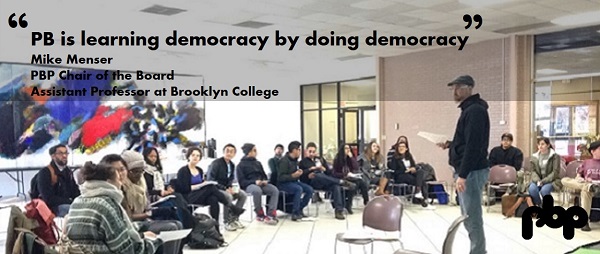
PB in a university setting was first launched at Brooklyn College in 2012 and is still going strong with students managing a budget of $25,000, which has grown over the past four years. “I believe finding out that Brooklyn College did PB gave Queens College students additional confidence that it could be done at a university level…” shared Mike Menser, PBP Chairman of the Board and Professor at Brooklyn College. Queens College has about 20,000  students, however, this process cannot be done successfully without support from the faculty and administration. PB offers a great platform for everyone on campus to engage in discourse that prioritizes the needs of students and faculty and streamlines this to the administration.

Follow Queens College Participatory Budgeting on Facebook!

You can find the original version of this post from the Participatory Budgeting Project blog at www.participatorybudgeting.org/blog/college-students-learn-democracy-through-pb-2.

Kettering Shares Lessons Learned on Economic Prosperity & Health Care

At their recent event, A Public Voice, NCDD member organization the Kettering Foundation released the interim report on what they have learned from the many deliberative forums they’ve hosted on the topics of health care and economic opportunity in the last year. We encourage you to learn more in the Kettering announcement below, or find the original version on their blog by clicking here.


kfOn May 5, the Kettering Foundation released an interim report on two series of deliberative forums that used materials prepared by Kettering researchers for the National Issues Forums. The report details the results of forums held in 2015-2016 using the Health Care: How Can We Reduce Costs and Still Get the Care We Need? issue guide and forums held in 2016 using the Making Ends Meet: How Should We Spread Prosperity and Improve Opportunity? issue guide. Forums on both issues will continue through 2016.

At A Public Voice 2016, representatives of NIF and other deliberative democracy groups discussed the concerns that have emerged from forums on heath-care and economic security issues. A panel of elected officials and policymakers responded to that discussion.

The interim report is drawn from the work of NIF members and forum participants. To compile the report, researchers from Kettering and Public Agenda attended forums, talked with forum moderators, reviewed questionnaires filled out by forum participants, and analyzed transcripts of forums.

The interim report can be downloaded here.

You can find the original version of this Kettering Foundation post by visiting www.kettering.org/blogs/apv-2016-interim-report.

Register for D&D CAN Call on Climate and Elections, 5/17

This post is a reminder to our members that the next D&D Climate Action Network (D&D CAN) conference call coming up on Tuesday, May 17th from 5-7pm Eastern / 2-4pm Pacific!

D&D CAN is a network led by NCDD supporting member Linda Ellinor of the Dialogue Group that is working to foster shared learning, networking and collaboration among those seeking to use dialogue, deliberation, and other process skills to address climate change. The monthly D&D CAN conference calls are a great way to connect with the network, and we encourage you to register to save your spot in their next conversation by clicking here.

The title of this month’s D&D CAN call is Peril & Promise: Climate Activism, Elections, & Dialogue, and it will center on discussing the nexus of climate dialogue and the election cycle. Some of the questions to be explored on the call will include:

  • What ways have you seen or been part of bringing climate issues into candidates’ campaigns, platforms, citizen initiatives and propositions?
  • How are electoral issues and climate concerns converging, or not?
  • What roles do skilled process work and intentional conversations play?
  • What’s working and how?


The D&D CAN calls are being hosted on the QiqoChat platform, which is run by NCDD member Lucas Cioffi and about which we hosted a recent Tech Tuesday call (you can hear the recording of the call here).

The combination of online D&D technology and powerful ideas makes this call an exciting and dynamic conversation, so be sure to register today at https://ddcan.qiqochat.comWe hope to hear many of our members on the call!

NCDD Discount on Engagement Strategy Workshop, 6/23

Our colleagues at Public Agenda, an NCDD member organization, are hosting a great workshop on engagement strategy this June 23 in Boston, just before the Frontiers of Democracy conference, and they are offering a $25 discount for NCDD members! That means the workshop is only $250 when you register before for the May 15 early bird deadline. It will be a chance to hone your skills and learn new methods and tools!  You can learn more and find the discount code in the announcement from Public Agenda below, or find the original version here.


Workshop: Public Engagement Strategy Lab

PublicAgenda-logo

Looking for assistance with organizing and sustaining productive public engagement? Struggling to decide how to combine online and face-to-face engagement? Frustrated with the standard “2 minutes at the microphone” public meeting? Want to know about the latest tools and techniques? Need expert advice on bringing together a diverse critical mass of people?

Join the Public Engagement Strategy Lab!

Who:
Leaders looking to revamp or strengthen their engagement strategies, structures, and tools

Date:
Thursday, June 23, 2016

Time:
9:30am – 4:30pm

Location:
Tufts University Medical School
145 Harrison Avenue
Boston, Massachusetts 02111

Cost:
Early Bird $275 (by May 15, 2016) or Regular $350 (after May 15, 2016)
Use the promo code NCDDMEMBER to get $25 off!

Registration Deadline:
Required by June 16, 2016, pending availability

Contact:
PE[at]publicagenda[dot]org or call Mattie at 212-686-6610 ext.137

Space is limited. Register today!

During the workshop, Public Agenda trainers Matt Leighninger and Nicole Hewitt will:

  • Provide an overview of the strengths and limitations of public engagement today
  • Help you assess the strengths and weaknesses of public engagement in your community
  • Explore potential benefits of more sustained forms of participation
  • Develop practical skills for planning for stronger engagement infrastructure, and
  • Demonstrate a mix of small group and large group discussions, interactive exercises, case studies, and practical exercises

This Strategy Lab is hosted by Tisch College, Tufts University as a preconference session for Frontiers of Democracy 2016. Participants in the Public Engagement Strategy Lab have the option of staying for the Frontiers of Democracy Conference. To register for the conference, click here.

The Public Engagement Strategy Lab will provide you with the tools and resources you need to authentically engage stakeholders in thoughtful, democratic processes. No more public forums and community meetings that lack impact. Move your public engagement planning forward with approaches based on the ideas and examples found in Public Participation for 21st Century Democracy (Wiley-Blackwell, 2015).

To register, follow this link. We hope to see you there!

You can find the original version of this Public Agenda announcement at www.publicagenda.org/pages/workshop-public-engagement-strategy-lab#sthash.wCLJLYPK.dpuf.

Classroom Debate Can Boost Youth Democratic Capacity

The team at the Jefferson Center, an NCDD member organizations, recently began a series of guest blog posts on political engagement and democracy, and we were impressed by the series’ piece below from MN high schooler Bruce Acosta. In it, Bruce reflects about how increasing civic education, debate, and deliberation about social issues in schools can fight young people’s disengagement from political involvement and boost their democratic capacity – a trend our field can both support and benefit from. We encourage you to read his piece below or find the original version here.


Better Engaging Young People in Politics

The problem of political participation and awareness among young Americans manifests itself both in and outside schools. Combined with low current involvement in linkage institutions, standardized testing has shown that students and younger voters are missing critical knowledge about our government and their duty in maintaining it.

This is not to say that they do not care about their nation. On the contrary, studies suggest that this new generation of Americans is simply seeking out other, less institutionalized ways to enact change, including volunteering, activism, and organized protest. However, it is important to note that this is largely because of negative media portrayal of politics and narrowly-targeted campaigns that alienate these budding citizens. Thus, in order to effectively combat civic disengagement from traditional politics and promote political awareness, we must find how to utilize this desire to impact one’s community in addition to making voting intent and efficacy integral values in school curricula.

Among successful programs and reforms currently adopted by schools across the country are the open classroom climate and service learning. As a proven method in engaging students in politics, the open classroom climate is the teaching of civics with a strong focus on debate and discussion of social issues. Regarding the lack of appeal of traditional, or “big P” political activity shared by many young people that was mentioned earlier, a series of surveys in California and Chicago high schools and other research has highlighted the impressive results of this strategy in improving student interest in voting, as well as civic knowledge and general confidence in one’s democratic capacity.

On the other hand, service learning, the use of community involvement activities to enforce and supplement course concepts, provides students with a deeper connection to one’s ability to actualize their own goals through volunteering and activism, or “little P” politics. Overall, a study that compared the effects of these two pedagogical strategies affirmed that students exposed to service learning became significantly more involved in these unconventional actions, while open classroom students tended to lean towards participation through voting and joining a political party or interest group.

Despite the success of these schools in employing effective measures against political disengagement, it is also important that we continue to improve the current state of civics courses. While many ideas exist about the direction education should head, two particularly promising solutions stand out. Firstly, history classes, which are heavily favored by state curricula over government classes, could be taught with additional political context. By introducing more civics standards into history courses, schools that would otherwise be unable to provide their students with a background in politics would be able to teach them crucial skills and values to promote future activity.

Secondly, civics classrooms should adopt an increased use of the internet in teaching and student application of course content. For example, online discussion forums serve as potential avenues for children to debate and research issues that are relevant to them, helping to promote efficacy. Evidently, the classroom holds an infinite number of possibilities in expanding the political minds of young Americans.

You can find the original version of this guest blog post from the Jefferson Center at www.jefferson-center.org/engaging-young-people.

New Civic Tech Developments for Public Engagement

If you are interested in civic technology, we highly recommend that you take a good look at the article below from NCDD member Tiago Peixoto‘s blog, DemocracySpot. Tiago lays out some high-tech new engagement and evaluation tools that are in the works or have just recently been release, and it’s exciting to see the progress being made. You can read his piece below or find the original version here.


Catching Up on DemocracySpot

democracy spot logoIt’s been a while, so here’s a miscellaneous post with things I would normally share on DemocracySpot.

Yesterday the beta version of the Open Government Research Exchange (OGRX) was launched. Intended as a hub for research on innovations in governance, the OGRX is a joint initiative by NYU’s GovLab, MySociety and the World Bank’s Digital Engagement Evaluation Team (DEET) (which, full disclosure, I lead). As the “beta” suggests, this is an evolving project, and we look forward to receiving feedback from those who either work with or benefit from research in open government and related fields. You can read more about it here.

Today we also launched the Open Government Research mapping. Same story, just “alpha” version. There is a report and a mapping tool that situates different types of research across the opengov landscape. Feedback on how we can improve the mapping tool – or tips on research that we should include – is extremely welcome. More background about this effort, which brings together Global Integrity, Results for Development, GovLAB, Results for Development and the World Bank, can be found here.

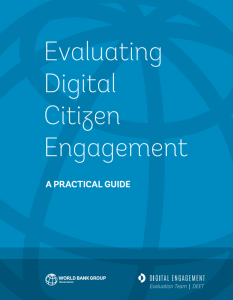
Also, for those who have not seen it yet, the DEET team also published the Evaluation Guide for Digital Citizen Engagement a couple of months ago. Commissioned and overseen by DEET, the guide was developed and written by CaptureDEETguideMatt Haikin (lead author), Savita Bailur, Evangelia Berdou, Jonathan Dudding, Cláudia Abreu Lopes, and Martin Belcher.

And here is a quick roundup of things I would have liked to have written about since my last post had I been a more disciplined blogger:

  • A field experiment in Rural Kenya finds that “elite control over planning institutions can adapt to increased mobilization and participation.” I tend to disagree a little with the author’s conclusion that emphasizes the role of “power dynamics that allow elites to capture such institutions” to explain his findings (some of the issues seem to be a matter of institutional design). In any case, it is a great study and I strongly recommend the reading.
  • A study examining a community-driven development program in Afghanistan finds a positive effect on access to drinking water and electricity, acceptance of democratic processes, perceptions of economic wellbeing, and attitudes toward women. However, effects on perceptions of government performance were limited or short-lived.
  • A great paper by Paolo de Renzio and Joachim Wehner reviews the literature on “The Impacts of Fiscal Openness”. It is a must-read for transparency researchers, practitioners and advocates. I just wish the authors had included some research on the effects of citizen participation on tax morale.
  • Also related to tax, “Consumers as Tax Auditors” is a fascinating paper on how citizens can take part in efforts to reduce tax evasion while participating in a lottery.
  • Here is a great book about e-Voting and other technology developments in Estonia. Everybody working in the field of technology and governance knows Estonia does an amazing job, but information about it is often scattered and, sometimes, of low quality. This book, co-authored by my former colleague Kristjan Vassil, addresses this gap and is a must-read for anybody working with technology in the public sector.
  • Finally, I got my hands on the pictures of the budget infograffitis (or data murals) in Cameroon, an idea that emerged a few years ago when I was involved in a project supporting participatory budgeting in Yaoundé (which also did the Open Spending Cameroon). I do hope that this idea of bringing data visualizations to the offline world catches up. After all, that is valuable data in a citizen-readable format.


I guess that’s it for now.

You can find the original version of this DemocracySpot blog post at www.democracyspot.net/2016/04/29/catching-up-on-democracyspot.