Delusions of Genocide & the Real Thing

On returning home from Germany, I was startled to hear a voicemail from a white supremacist campaigning for President. It repeated the old trope that there is a genocide being perpetrated on the white race. In the United States, we often throw around words like “Nazi” and “genocide.” Seinfeld’s funny “Soup Nazi” story is one thing, but ridiculous demonizing of political opposition is another. The Iowa Tea Party offered one blatant example, but so do national commentators warning of “liberal fascism” or labeling conservatives “Nazis.” We should sober up and remember what real genocide looks like.

This is a photo of some of the ovens made to dispose of bodies at the Dachau concentration camp.

Some of the ovens made to dispose of bodies at the Dachau concentration camp.

In Democracy and Leadership, one of the key virtues of democratic leadership I wrote about is moderation. Today people so often dismiss moderation, seeing it as a weakness of will, as a lack of principled character. I find that view tragic, as it inspires such polarization that even the Federal government was shut down in 2013, despite the fact that the world is watching and the credit rating for U.S. debt was downgraded in 2011. Unstable societies are risky investments, as are unjust societies.

Moderation proves to be one of the deepest challenges for democratic societies, I argued more recently in my forthcoming Uniting Mississippi. Moderation is the virtue that aims to achieve unity. If you can’t moderate differences, unified groups tear apart and become several, rather than one. At the same time, of course, there can be delusional, hateful, or simply ridiculous ideas about unity. One of them is the white supremacist’s outlook.

The white supremacist thinks that there’s a need for greater unity among white people as a race. It is one thing when a group has systematically been targeted and oppressed, such as in slavery, the Holocaust, or Apartheid. Such group solidarity in those conditions is understandable, for people need to express pride and unity in their identities as survivors of horrible atrocities and continuing prejudice. Even in such cases, however, no reasonable group calls for purity of its race. Only white supremacists believe that interracial marriage is a threat to a race.

A photo of the entrance to the gas chamber at the Dachau concentration camp, which was deceptively marked "Showers," in German.

A little over a week ago, I had the sobering opportunity to visit a real genocidal institution. The Dachau concentration camp was built for holding around 5-6 thousand imprisoned workers. By the end of World War II, it held 32,000. To deal with the mass of people and to quell their number, the Germans had created gas chambers, which could kill large groups at once. To avoid resistance to entering the gas chamber at Dachau, the Germans had labeled the door “Brausebad” – “Shower.”

Once people were killed, they were moved to the ovens, photographed in the featured image above. Part of what was so disturbing in all of this was the thoughtful reasoning that went into controlling people and disposing of them. To convince people that the “Brausebad” really was a shower, and not a gas chamber, the Nazis had installed false shower heads. For the visitors like myself, the covers were removed from many of the shower heads, revealing a closed cone above. There was no water pipe. This was simply the illusion meant to make it easier to slaughter people. Here is a photo of the covered and uncovered shower heads, side by side:

Side-by-side image of the false shower heads installed in the Dachau gas chamber, to fool people, making it easier to get them to enter the room.

Having visited the truly disturbing and sobering Dachau camp, all I could think was that the white supremacists campaigning for President are tragically misguided and absurd. Some people are so lacking in sense that they actually believe that white folks are under threat as a group. The level of such nonsense is deeply saddening.

The call I received was eerie, partly because the voice didn’t sound quite right. It was a woman’s voice, and it was somewhat realistic, but you could tell that the message was one of those recordings generated by a computer voice – just a pretty good one. It read a message that began with formulaic language I have received before from white supremacists. It said that there are countries for these kinds of people and those, so there should also be countries for white people.

Adding to the absurdity of the call is the fact that the United States is a highly religious country. In fact, the Ku Klux Klan now denies that it is a hate group. They have long called themselves Christians. It is long past time to remind people that such views call for seeing all people as kin, as children of the same God. Using the Christian religion in service of hate or disunity is a gross perversion, yet as I have argued, even in the most religious state in the U.S., Mississippians are recalcitrant even when religious leaders call for progress and unity.

We need to take the aim of unity seriously. We need to stop using demonizing language lightly and foolishly. We also need more people to see the effects of such crazy polarization and disunity, which have led even to campaigns for the Presidency from white supremacists. We don’t need delusions of genocide, when there are disturbing and tragic examples of the real thing.

To close, I thought about sharing with you a photo of a mountain of dead, skeleton-thin bodies. Instead, I’ll leave you with a photo I snapped at the Jewish memorial at Dachau, which was immensely beautiful and moving for me.

A photo I took from inside the Jewish memorial at the Dachau concentration camp.

“Converging on Culture”

Rorty, Rawls, and Dewey on Culture’s Role in Justice

Cover photo for the journal, Essays in the Philosophy of Humanism.This piece, published in 2014, represents an important early step in a book project in progress, titled A Culture of Justice.

Abstract

In this essay, I review the writings of three philosophers whose work con-verges on the insight that we must attend to and reconstruct culture for the sake of justice. John Rawls, John Dewey, and Richard Rorty help show some of the ways in  which culture can enable or undermine the pursuit of justice. They also offer resources for identifying tools for addressing the cultural impediments to justice. I reveal insights and challenges in Rawls’s philosophy as well as tools and solutions for building on and addressing them in Dewey’sand Rorty’s philosophy.

Read the paper on Academia.edu

Citation

Weber, Eric Thomas. “Converging on Culture: Rorty, Rawls, and Dewey on Culture’s Role in Justice.” Essays in the Philosophy of Humanism 22, Issue 2 (2014): 231-261.

Racism Defies the “Greatest Commandment”

Eric Thomas Weber, first published on The Second Breakdown, July 30, 2015.

In July 2015, University of Mississippi graduate, Adebanke Alabi invited me to comment on race and the Church for a series on her blog. The following is my piece, originally published on her page and reposted here with permission.


Preface: I am grateful to Adebanke (Buki) Alabi for calling me to comment on race and Christianity for the readers of her blog, The Second Breakdown: My Thoughts on Jesus and His Church.

Photo of a Church gathering of the KKK, meeting underneath a sign that reads, "Jesus Saves."


Photo of a church.Mississippi is still home to obstinate racism, even while in 2014 Gallup found it to be the most religious state in the United States. The vast majority of the 44 failing school districts’ enrollments in the state are majority- to almost totally made up of African American students. Some districts have been accused of  not having desegregated. We have seen  symbolic racism at the University of Mississippi, as well as troubling direct confrontations. Some young people planned and executed a  racially motivated murder a few years ago in Jackson, MS.

Photo of a Church gathering of the KKK, meeting underneath a sign that reads, "Jesus Saves."Despite all of these disturbing cases of racism in Mississippi, many citizens and public officials continue to resist change even to symbols of racism. I have argued that falsely romanticizing heritage does us harm  and that symbols, like the Confederate Battle Flag featured in the canton of MS’s state flag, contribute to the perpetuation of racism and injustice. What has gotten very little attention is the tragic inconsistency between the religious beliefs people say that they hold dear and the contradictory behaviors that we see here in Mississippi.

Bust of Socrates.In a passage from the Republic, Plato’s Socrates tells us that leaders must convince their people that we are all born of the earth, children of the same parent – a mother, according to the story. When threats to security arise, if people do not care sufficiently about their neighbors, they will fail to act in others’ defense. Kinship motivates us to take care of our children and our brothers and sisters. People thinking of each other as kin is one of the most important needs for a society’s safety and unity, he argues. He thought the story was a lie, but a necessary one. Christians today do not think it is a lie, and Darwin’s evolutionary theory confirms humanity’s common kinship.

Plato lived about 400 years before Christ. When we look to the Christian religion, we see a related social aim to the kinship that Socrates called for. A basic Christian belief is that human beings are all children of the same parent – in this case, a Father. One might think that the belief that we are all brothers and sisters would motivate Christians to treat others accordingly.

People are very good at finding ways around what they ought to do, however. Some people divide humanity into categories of those who are fallen and those who are elect or saved. If there are children of God in one community, what do we call people from another community or belief system? Galatians 3:26 explains that people are all children of God in their shared faith in Christ. If that is true, does that mean that nonbelievers or those who profess different faiths are not children of God? That is not logically necessary: “All things red have color” doesn’t imply that other things don’t also have color.

Iconic photo of black man drinking from a water fountain labeled "Colored."Many Christians treat others in ways that are not neighborly, even in deeply religious places. The tragedy of this fact is that people in Mississippi share many religious beliefs – that we are all children of the same Father. In their faith in Christ, Scripture says, they should all see each other as children of God.

For many, the core of the Christian religion can be distilled, as Jesus is said to have done in Matthew 22:35-40, Mark 12:28-31, and Luke 10:25-28, into the Greatest Commandment, which has two parts. In addition to loving God, the first element, which people proclaim in word so commonly, Jesus calls for loving our neighbors as we love ourselves. This second element is far less often extolled in word, and evidence in deeds illustrates blatant defiance of the commandment.

Mississippi flag, featuring the emblem of the Confederate Battle flag.It is time to call people out on this gross contradiction. How in a place like Mississippi people can resist symbolic change, let alone progress in deeds, even with respect to a symbol of the state’s defense of slavery, while claiming to be Christians, is deeply distressing. Some public figures recognize this and have courageously called for progress. It is time others who profess their faith own up to what it means to love one’s neighbor as oneself.

Weber at his desk in 2011.Dr. Eric Thomas Weber is associate professor of Public Policy Leadership at the University of Mississippi and author of four books, including Uniting Mississippi: Democracy and Leadership in the South (forthcoming in September 2015). He is representing only his own point of view. Follow him on Facebook and on Twitter @erictweber.

DemocracySpot’s Most Read Posts in 2014

Glasses for reading (1936) – Nationaal Archief

(I should have posted this on the 31st, but better late than never)

Below are some of the most read posts in 2014. While I’m at it, I’ll take the opportunity to explain the reduced number of posts in the last few months. Since mid-2014 I have been working with a small team of political and data scientists on a number of research questions at the intersection of technology and citizen engagement (I presented a few preliminary findings here). Following the period of field work, data collection and experiments, we have now started the drafting and peer-review stage of our research. This has been an extremely time-consuming process, which has taken up most of my weekends, when I generally write for this blog.

Still, one of my new year’s resolutions is precisely to better discipline myself to post more regularly. And I am hopeful that the publication of our upcoming research will make up for the recent reduction in posts. We will start to disseminate our results soon, so stay tuned.

In the meantime, here’s a selection of the five most read posts in 2014.

The Problem with Theory of Change

Technology and Citizen Engagement: Friend or Foe? 

A Brilliant Story of Participation, Technology and Development Outcomes

When Citizen Engagement Saves Lives (and what we can learn from it) 

Social Accountability: What Does the Evidence Really Say?


13 Citizen Engagement Stories from Around the World

Orçamento Participativo 2015/2016 é aberto na região Leste
The Journal of Field Actions, together with Civicus, has just published a special issue “Stories of Innovative Democracy at the Local Level: Enhancing Participation, Activism and Social Change Across the World.” When put together, the 13 articles provide a lively illustration of the wealth of democratic innovations taking place around the world.


From Spain’s 15-M Movement: The Charter for Democracy

Stacco Troncoso and his colleagues at Guerrilla Translation, in Madrid, have completed an English translation of an important statement from Spain, “The Charter for Democracy,” which should be of great interest to small-d democrats throughout the world. He explains that “the group behind the piece, “Movimiento por la Democracia” (Movement for Democracy) is undoubtedly one of the most important evolutions of Spain’s 15-M movement.  It clearly targets the political arena without desiring to become a political party itself. Their ‘Charter for Democracy’ is an inspiring, thorough text on what politics should be. It proposes a politics for the people: squarely grounded in environmental realities and social justice, based on the Commons, defended from corporate interests and neoliberal dictates.” 

The Movement for Democracy introduces itself this way:

"We emerged during the destruction of an economic and political model that, by its decadence, makes us poorer, excludes us, and exiles us from our own cities and towns...we are here to take democracy into our own hands, to defend against the constant threat of its systematic robbery...we are the Movement for Democracy and we came into being to say, “Yes we can!” a thousand times and more. And as we hold this to be true, that we actually can, we will challenge whoever tells us it’s impossible."

The Charter for Democracy is “a thoroughly detailed plan for the transformation of public policy and democratic representation, open for public challenge and participation,” said Troncoso, whose network of translators acted as “compilers and editors of a volunteer group-produced work” in making the English translation.  A hearty thanks to translators Jaron Rowan, Jaime Palomera, Lucía Lara, Lotta, Diego and Stacco Troncoso, with editing by Jane Loes Lipton. I love that the Charter is illustrated with some beautiful original illustrations by Clismón, one of which I include here.

Here are the opening paragraphs of this inspiring document:

This Charter was born of a deep malaise: lack of prospects, mass unemployment, cuts in social rights and benefits, evictions, political and financial corruption, dismantling of public services. It was drafted in reaction to the social majority’s growing lack of confidence in the promises of a political system devoid of legitimacy and the ability to listen.

The two-party system, widespread corruption, the financial dictatorship imposed by austerity policies and the destruction of public goods have dealt the final blow to a democracy long suffering from its own limits. These limits were already present in the 1978 Constitution. They can be summarized as a political framework that neither protects society from the concentration of power in the hands of the financial groups, nor from the consolidation of a non-representative political class. This political framework has established a system which is hardly open to citizen participation, and unable to construct a new system of collective rights for our protection and common development. This is evident in the fact that, despite some very significant public demonstrations, the demands of the vast majority of the population have repeatedly been ignored.

read more

New Book on 25 Years of Participatory Budgeting

Screenshot 2014-06-09 17.17.40

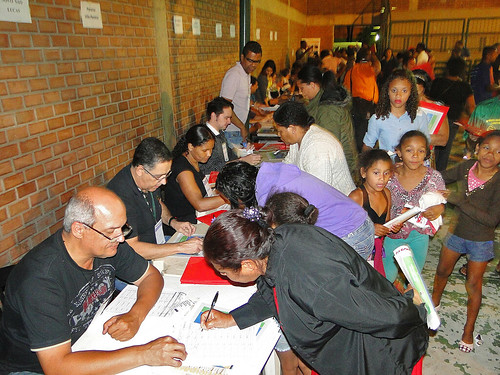
A little while ago I mentioned the launch of the Portuguese version of the book organized by Nelson Dias, “Hope for Democracy: 25 Years of Participatory Budgeting Worldwide”.

The good news is that the English version is finally out. Here’s an excerpt from the introduction:

This book represents the effort  of more than forty authors and many other direct and indirect contributions that spread across different continents seek to provide an overview on the Participatory Budgeting (PB) in the World. They do so from different backgrounds. Some are researchers, others are consultants, and others are activists connected to several groups and social movements. The texts reflect this diversity of approaches and perspectives well, and we do not try to influence that.

(….)

The pages that follow are an invitation to a fascinating journey on the path of democratic innovation in very diverse cultural, political, social and administrative settings. From North America to Asia, Oceania to Europe, from Latin America to Africa, the reader will find many reasons to closely follow the proposals of the different authors.

The book  can be downloaded here [PDF]. I had the pleasure of being one of the book’s contributors, co-authoring an article with Rafael Sampaio on the use of ICT in PB processes: “Electronic Participatory Budgeting: False Dilemmas and True Complexities” [PDF].

While my perception may be biased, I believe this book will be a major contribution for researchers and practitioners in the field of participatory budgeting and citizen engagement in general. Congratulations to Nelson Dias and all the others who contributed their time and energy.


Who Participates in Africa? Dispelling the Myth

picture by Britanny Danisch on flickr.

Whenever discussing participation in Africa (as well as in other developing contexts) the issue of “who participates” often emerges. A constant in these conversations is an assumption that participation in the continent is strongly driven by material and immaterial resources (e.g. money, time). In other words, there seems to be a widespread belief, particularly among development practitioners,  that the most privileged sectors of society are disproportionately more likely to participate than the least well-off.

In part, such an assumption is empirically grounded. Since the early 70s,  studies have shown inequality in political participation, with the most advantaged groups being disproportionately more likely to participate. Considering that policy preferences between groups differ, unequal participation leads to the troubling possibility that public policy is skewed towards favoring the better off, thus further deepening societal differences and access to public goods and services.

However, often ignored is the fact that most of these studies refer to  participation in traditional western democracies, notably the United States and European countries. But do these results hold true when it comes to participation in Africa? This is the question that Ann-Sofie Isaksson (University of Gothenburg) tackles in a paper published in Electoral Studies “Political participation in Africa: The role of individual resources”.

By looking at an Afrobarometer dataset of 27,000 respondents across 20 African countries, Isaksson’s findings challenge the standard thinking on the relationship between resources and participation:

(…) it seems the resource perspective does a poor job at explaining African political participation. If a resource is relevant for meeting the costs of participating, more of that resource should mean more participation. If anything, however, the estimations suggest that having little time (i.e. working full-time) and little money (i.e. being poorer) is associated with more participation.

Isaksson’s analysis is not confined to participation in elections, also examining non-electoral participation, i.e. attending community meetings. With regard to the latter only, there are modest effects associated with exposure to information  (e.g. radio, TV, newspapers) and education. Yet, as the author notes, “the result that community attendance is higher among the poor remains”.

To conclude, as underlined by Isaksson in her paper, she is not alone in terms of findings, with other studies looking at Asia and Latin America pointing in a similar direction, slowly dispelling the myth of the role of resources for participation in developing countries. Development practitioners should start to take note of these encouraging facts.

***

P.s.: An earlier ungated version of the paper can be found here [PDF].


Has Democratization Reduced Infant Mortality in Sub-Saharan Africa?

Evidence suggests it has. Excerpts from paper by Masayuki Kudamatsu:

Does democracy promote development? Despite a large number of empirical studies of this question, the evidence remains inconclusive since it is difficult to establish causality running from democracy to development: democracy is likely to be endogenous to socio-economic factors that also affect development (Lipset 1959). As democracy at the national level is clearly not randomly assigned across countries, the empirical challenge is to disentangle the effect of democracy from other confounding factors to the largest possible extent. This paper revisits this question in the context of human development in sub-Saharan Africa. Specifically, I investigate whether the democratization sweeping the region in the 1990s has reduced infant mortality.

(…)

My findings are as follows. After democratization in sub-Saharan Africa since 1990, infant mortality drops by 1.2 percentage points (12% of the sample mean). This result is robust to controlling for country-specific linear trends in the birth year of babies, country-specific birth-order dummies, country-specific quadratic trends in the mother’s age at birth, and country-level covariates such as per capita GDP, the incidence of wars, and the amount of foreign aid. Except for a couple of outlying cases, there is no such reduction in infant mortality in countries where the dictator holds multiparty elections and stays in power by winning them or where leadership change takes place in a nondemocratic way.

Kudamatsu, M. (2012). Has Democratization Reduced Infant Mortality in Sub-Saharan Africa? Evidence from Micro Data. Journal of the European Economic Association10(6), 1294-1317. [PDF] 

***

Also read:

Does Democracy Improve the Quality of Life for its Citizens? 

Open Government and Democracy