C2D2 Climate Change Deliberation Webinar on Thursday

NCDD’s sister organization, the Canadian Community for Dialogue and Deliberation (C2D2), is hosting a great webinar this Thursday, June 5th, starting at 12pm Eastern/9am Pacific that we wanted to make sure you heard about. The webinar will focus on learning from a climate deliberation initiative in Alberta and will be facilitated by three NCDD members. You can read more about or find out more by clicking here, and make sure to register today by clicking here.


C2D2 Webinar: Climate Change, Dialogue, and Deliberation

C2D2-logoThis webinar will provide an opportunity to learn about the work of Alberta Climate Dialogue (ABCD). This five year initiative (2010-2015) brings together a group of researchers and practitioners who are exploring how citizen deliberation can contribute to shifting engagement and policy on climate change locally and internationally.

This webinar will be an opportunity to discuss in detail what is being learned about deliberative dialogue practice from the following three deliberations:

In the spirit of the ABCD collaboration, the webinar will be facilitated by three of its members:

  • Dr. David Kahane, principal investigator and project lead, University of Alberta
  • Dr. Gwendolyn Blue, researcher, University of Calgary
  • Jacquie Dale, practitioner, One World Inc. and C2D2 Board member

ABCD’s work is funded by a Community-University Research Alliance grant from the Social Sciences and Humanities Research Council of Canada as well as contributions from universities, governments, and NGOs that are partners. Deliberative events are co-funded with government, civil society partners, and further grants.

You can find the original version of this post at http://c2d2.ca/c2d2-webinar-climate-change-dialogue-and.

Open Government Needs Public Trust

The piece below comes from the Gov. 2.0 Watch blog, a project of our organizational partners at the Davenport Institute. The reflections shared on building trust in government as a critical component of public engagement and open government initiatives are good food for thought, and we encourage you to read more below or find the original post here.

DavenportInst-logoIn the wake of recent scandals involving California lawmakers, this CA Fwd interview with Leon Panetta is a needed reminder of the importance of integrity in public service. Ed Coghlan comments:

Three months into 2014 and three California State Senators have had brushes with the law. Needless to say, public confidence in elected officials is shaken.

It’s understandable, but like any setback in life, it’s also an opportunity to reflect and change for the better.

Now is the time for our elected officials to enact immediate and meaningful reform in response to alleged state-level corruption that has gotten national media attention. Only then will public trust in government be on the road to recovery.

CA Fwd is attempting to “catalyze a conversation on rebuilding public confidence in government,” and released a roadmap called The Path Toward Trust in April. More information is available here.

The Huffington Post published a related article last month by Gavin Newsom and Zachary Bookman, highlighting successes in the “Open Government movement” in Palo Alto, Bell, San Francisco, and the California State Lands Commission, that they argue have helped to increase public trust and civic engagement:

As a sector, government typically embraces technology well-behind the consumer curve. This leads to disheartening stories, like veterans waiting months or years for disability claims due to outdated technology or the troubled rollout of the Healthcare.gov website. This is changing.

Cities and states are now the driving force in a national movement to harness technology to share a wealth of government information and data. Many forward thinking local governments now provide effective tools to the public to make sense of all this data.

New platforms can transform data from legacy systems into meaningful visualizations. Instant, web-based access to this information not only saves time and money, but also helps government make faster and better decisions. This allows them to serve their communities and builds trust with citizens.

You can find the original version of this post at http://publicpolicy.pepperdine.edu/davenport-institute/gov20watch/index.php/2014/04/public-trust-open-government.

Nominate Youth for GenUp Leadership Opportunity

We recently heard about an interesting leadership and development opportunity for young people that we think might suit some of our NCDD members or their connections well. The Thrive Fellows program, coordinated by Generation Waking Up, is accepting nominations for young people until June 10th and applications until June 15th, so we encourage you to learn more and nominate young leaders as soon as possible. You can read about the program below or find more information here


Thrive Fellows: A Year-Long Leadership Program in Social Innovation

July 2014 to June 2015
www.generationwakingup.org/thrivefellows
Apply or Nominate today!

We are living at a critical moment in history, facing complex challenges like no generation before and holding a profound opportunity to remake our world. It is a time that is calling for system-thinkers, bridge-builders, and creative innovators with bold new approaches to social change.

The Thrive Fellows program is a transformative “leadership-in-action” journey that supports a diverse cohort of young leaders in designing and implementing social innovation projects toward a thriving, just, and sustainable world. Social innovation is the process of generating novel and creative solutions to complex challenges. As Buckminster Fuller aptly stated, “You can never change things by fighting the existing reality. To change something, build a new model that makes the existing model obsolete.”

Each Thrive Fellow will embark upon a yearlong journey that includes personal development, team building, community engagement, collective learning, and collaborative action, by applying the most promising tools and capacities of our time to generate creative solutions to complex challenges.

AS A THRIVE FELLOW YOU WILL

  • Join a network of dynamic young leaders, changemakers, and innovators
  • Develop leadership skills for creating personal, interpersonal, and social change
  • Deepen your understanding of the interconnection of issue areas and how to create systemic change
  • Learn how to turn your ideas into action and create collective impact
  • Co-lead a social innovation project to address complex challenges
  • Receive mentoring from leading experts across multiple sectors of society
  • Connect your local efforts with wider movements of social change
  • Establish a Thrive chapter on your campus or in your community

WHO SHOULD APPLY

Young people ages 16 to 29 based in North America who are committed to growing as a leader and bringing social innovation to your campus and/or community. We strongly recommend finding one other person from your campus or community to apply too in order to strengthen the success and impact of your fellowship. If you are interested in applying as an international participant, please contact us at thrive@generationwakingup.org.

Additional criteria for becoming a Thrive Fellows include:

  • Passion for growing personally and creating social change
  • Representing a campus, community, or place-based context for implementing an ongoing social innovation project
  • An ability to commit an average of 6 – 10 hours a week
  • Demonstrated leadership skills and potential, ideally with a track record in community service, social activism, or social entrepreneurship
  • A willingness to cover and/or help raise the funds needed for your tuition cost
  • A commitment to diversity & team collaboration

APPLICATIONS

Application deadline is June 15th. Fill out an online training application here. Our team will contact you to confirm your participation.

NOMINATIONS

Nomination deadline is June 10th. If you know an ideal candidate, please fill out an online nomination form here. Our team will contact you to confirm your nomination.

If you have questions or want to know more, please visit www.generationwakingup.org/thrivefellows or contact Joshua Gorman at joshua@generationwakingup.org.

Facilitating & Introversion: Tips for Engaging Quiet People

We recently read a great piece on bringing out the gifts of introverted people over at NCDD supporting member Janice Thomson’s blog, Citizenize-Citizenise. Janice has been working with the Chicago chapter of the International Association of Facilitators on developing resources for effectively engaging quieter folks, and we think they could be quite useful to our members. You can read Janice’s piece below or find the original here.


“Stop the madness for constant group work. Just stop it!” pleads Susan Cain, author of Quiet: The Power of Introverts in a World That Can’t Stop Talking. Group work, she claims, stifles some of the most insightful and creative thinkers and inflates the influence of extroverts. To generate the best ideas, workplaces and schools need to provide more solitude for deep reflection and creative thinking.

As a facilitator, her critiques made me wonder. Do the group processes I use marginalize important voices and perspectives? Is it possible to design meetings and workshops to fully involve introverted participants? I started a conversation around these questions with fellow facilitator Margaret Sullivan and together we designed a workshop to test our ideas and learn from others.

This blog summarizes learning from our “Facilitating Introverts” workshop held May 16, 2014 with the International Association of Facilitators (IAF), Chicago chapter. We warmly invite additional suggestions for how to include introverts in meetings and workshops!

What’s an introvert?

The concept of introversion originated with psychologist Carl Jung who noticed that people tend to be energized either by going inward in quiet reflection (introverts) or outward in interactions with people (extroverts). Later personality theorists added concepts like how one processes information, sensitivity to novelty and stimulation, and attitudes toward privacy and public attention.

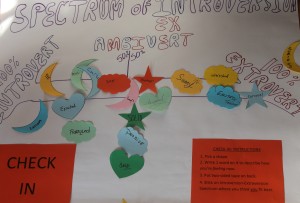
Spectrum of Introversion Photo: Al Rush

Introversion/extroversion is a spectrum (see top photo). The population is roughly equally divided between the two halves and most people fall somewhere toward the middle. Although most people can function in both introverted and extroverted ways, they prefer one or the other. So, traditional group work, which is designed for extroverts, can indeed disadvantage introverts. To rectify this imbalance, it is necessary to first understand the special needs and gifts of introverts.

Importantly, since nobody functions exclusively as an introvert or extrovert, it would in fact be more accurate to discuss facilitating introversion or incorporating introverted processes into group work. This however is linguistically and conceptually cumbersome. So, for clarity, we simply use the term “introverts”.

Needs and gifts of introverts

Reflecting on the ideas of personality theorists and considering group situations that challenge introverts, we created a list of needs and gifts of introverts relevant to group work.

Important themes include:

  • Managing energy. Introverts are drained by social interaction and need alone time to recharge.
  • Processing time. Introverts take in lots of multi-layered information. They may therefore need more time than extroverts to process information, reflect, and decide what to say. They also need to understand expectations so they may prepare in advance.
  • Privacy and caution. Introverts do not like to call attention to themselves and can be reticent to share their ideas — especially if they are not yet fully formed or may provoke conflict.
  • Meaning and focus. Introverts are drawn to meaningful conversations and can go deep into subjects. Conversely, they get overwhelmed when multiple themes are discussed simultaneously.
  • Deep listening. Introverts can be very attentive listeners. They may notice things and make connections that extroverts miss. They also ask great questions.
  • Writing and non-verbal expression. Many introverts prefer to communicate in ways other than talking and may be skilled at writing or drawing.
  • Creativity and imagination. Introverts have rich inner lives which can lead them to uncover valuable insights and generate creative solutions.

Tools and techniques to involve introverts

Using these needs and gifts, we brainstormed tools and techniques to help introverts feel comfortable, meet their needs, and share their gifts in group work. We then added ideas culled from online facilitator forums and workshop discussions. We offer this initial list of tools and techniques for facilitating introverts to facilitators as thought-starters in designing group processes.

An introvert-friendly workshop

To demonstrate what an “introvert-friendly” workshop might look like, the methods we used in our own “Facilitating Introverts” workshop and why we chose them are described below.

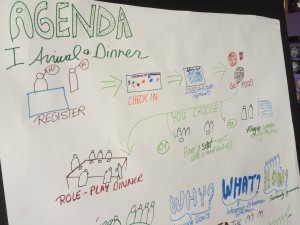
I. Arrival and Dinner

Arriving at a meeting or workshop can be uncomfortable for introverts, especially if they don’t know anyone. So it’s important to consciously design an experience to put them at ease. We provided:

Photo: Al Rush

Visible agenda. Introverts like to know what to expect, including when they may need to contribute. We displayed a large visual agenda at arrival and reviewed it at the start of the workshop.

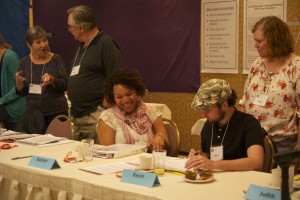
Greeter and host. While extroverts can just dive into unstructured social situations, introverts welcome some assistance. Participants were met by a greeter at a registration table and a “host” who mingled and made sure everyone was comfortable – e.g., introducing people and suggesting activities.

Nonverbal check-in. Fun, non-verbal activities done at one’s own pace can be an easy warm-up and help facilitate connections. We invited participants to write their mood on a colored shape and place it on an introversion-extroversion spectrum chart. This also introduced a core concept of our workshop, showed who was in the room, and provided a “temperature check”.

Reflection pond. This served as both “graffiti wall” and “parking lot”. Introverts don’t like to draw attention to themselves or provoke conflict so it’s good to offer ways to share anonymously. They can also get overwhelmed when multiple topics are discussed simultaneously. So it’s useful to use methods like “parking lots” to keep conversations focused.

Dinner choices. It’s important to never label a person or activity as “introvert” or “extrovert”, but rather to offer choices that allow participants to manage their own energy. For dinner, we offered three options: mingling informally, sitting in small groups, or participating in a facilitated “role play” game. We also kept novelty and stimulation low by providing familiar food (pizza) and calming music.

Role play dinner. Since introverts may be reticent to draw attention to themselves, role play games can help them speak more freely. We created a scenario where five famous introverts and five famous extroverts worked together on a project team. Participants described how their character (e.g., Eleanor Roosevelt, Marie Antoinette, etc.) would feel and behave in different group situations. This provided both structured group interaction and a playful introduction to workshop themes.

Flexible meeting space. We chose a meeting space, the Thinkubator, that provides many seating options, nooks and crannies, and an outdoor deck for different types of group interaction and solo breaks.

II. Opening

After introducing the topic, we created community agreements that included:

  • Moment of silence. Because introverts take in so much information, they sometimes need extra time to “catch up”. To create opportunities for this, we created “silence” signs anyone could use to request the group to be quiet for a few minutes – no explanation needed.
  • Breaks. Introverts sometimes need alone time to recharge. So we gave participants permission to take a break at any time, for any reason, no questions asked.
  • OK to pass. Introverts sometimes need additional time to formulate their thoughts. So, in structured go-arounds and sharing times, participants can “pass” and talk later.
  • Don’t hold back. “Quieter people” were reminded that they too have contributions valuable to the group and not to “hold back” sharing.

Homework and paired sharing. Introverts like to come prepared to meetings. Assigning homework is one way to achieve this. We asked participants to watch Susan Cain’s TED Talk to prepare. The first social interaction was low-key: sharing one thing learned from this video with one’s neighbor.

III. Needs and Gifts

An individual “scenario reflection” exercise was used to identify introverts’ needs and gifts. Three situations were described that can be challenging to introverts: 1) arriving at a meeting of strangers, 2) being asked to share one’s viewpoint early in a meeting, and 3) a meeting on a contentious issue.

To share ideas, we planned a structured go-around using a talking stick. This gives introverts the floor without them having to ask for it, but also lets them “pass” and speak later if they aren’t ready to talk.

IV. Tools and Techniques

We began with individual brainstorming, followed by a 20 minute discussion in groups of 3-4 people to modify and add to our initial list of tools and techniques. Especially with introverts, it’s important to begin brainstorming individually. A group size of 3-4 people allows sharing, but is comfortable to introverts.

Here’s a 1 minute video of the entire workshop (thanks to Gerald and Steve at the Thinkubator):

V. Post-event

Introverts often get their best ideas after a meeting or workshop – i.e., once they’ve had time to fully process its content and reflect alone on its meaning. So it’s important to provide a method, such as an online forum, to continue sharing and discussion after the event. That is one goal of this blog.

What do you think?

Margaret and I are sharing this blog with both the Chicago IAF workshop participants and the broader facilitation community. We invite suggestions of additional tools and techniques, needs and gifts, and thoughts on “facilitating introverts”. Please leave your comments below in “Leave A Reply”. You may also post a comment on the Chicago IAF Facebook page or Linked In group.

If there is sufficient interest, we might offer this workshop again, perhaps in modified or expanded form. Please use the contact form to let me know of your interest in organizing or assisting with a future workshop.

You can find the original version of this blog piece at www.janicethomson.net/facilitating-introverts-eliciting-the-gifts-of-the-quiet-ones.

99 Ideas for Making Your Town More Playful from CM

CM_logo-200pxAs summer approaches, you may be looking for ways to make your neighborhood, town, or city more fun and engaging. If you are, our friends at CommunityMatters have a ton of ideas for way you can do that!

CM recently shared two posts (here and here) with ideas for making your space more engaging and out of the ordinary. So to help give you food for thought for the summer months, we put the lists together below. They also hosted a conference call about it called Creating Fun Places that you can listen to here.

We hope these ideas will get your creative juices flowing and help you make your summer more interesting! Thanks to CM staffer Caitlyn Horose for putting all of these together!

75 Seriously Fun Ways to Make Your Town More Playful

  1. Join the CommunityMatters conference call on play and placemaking 
  2. Turn the subway into a swing set 
  3. Munch people with your eyes

    Photo credit: Audrey Penven

  4. Turn your street into a Play Street 
  5. Let sidewalks be trampolines
  6. Play pong with traffic lights
  7. Transform a set of stairs into a piano
  8. Give pedestrians the keys to your city
  9. Host a hummingbirdman rally
  10. Embed games in public seating
  11. Think more like a roller coaster designer
  12. Rethink the public library as a place for play
  13. Start a citywide festival of play
  14. Challenge people to try alternative transportation
  15. Create a local currency, then turn it into a game
  16. Get all ethereal and make a playground in the air
  17. Install a swing just about anywhere
  18. Make a plan for engaging your community in play
  19. Give everyone on the street a nametag for a day
  20. Turn your laundromat into an art studio
  21. Paste silly thoughtbubbles in your neighborhood
  22. Fix crumbling infrastructure with legos
  23. Make cupcakes for strangers
  24. Transform a bike lane into a video game
  25. Knit your bridge

    Photo credit: flickr user Mr. T in DC

  26. Create space for sharing compliments among friends
  27. Organize a public play day
  28. Play a massive game, like megasoccer
  29. Try out tiny game, like dum-dum
  30. Turn shopping into a game
  31. Create a playground for adults
  32. Make friends in a ball pit
  33. Create a virtual block party
  34. Turn a parking lane into a mini golf course
  35. Use stickers to brainstorm new ideas
  36. Pretend an urban space is way more wild
  37. Use your smartphone to create a scavenger hunt wherever you are
  38. Have more fun with bike paths. Can you say “Whoopdeedoo?
  39. Install playful public seating
  40. Make your sidewalk sound like the ocean (or a farm)
  41. Replace stairs with slides
  42. Experiment with shadows
  43. Stop littering with a fun trashcan
  44. Play games with found bottlecaps
  45. Transform bus stops into swingsets
  46. Imagine a more playful playground
  47. Use a public fountain as a pool
  48. Pledge to be more playful
  49. Start a DIY neighborhood summer camp
  50. Share toys at a neighborhood gathering place
  51. Play trash bin basketball
  52. Build your own cardboard arcade
  53. Reimagine bus stops
  54. Turn your neighborhood into an art project
  55. Organize a playground tour
  56. Increase access to play

    Photo credit: Paul Krueger

  57. Make your city a Playful City USA
  58. Create a neighborhood golf course with help from a smartphone
  59. Have fun with secret spaces
  60. Paint those ugly utility boxes
  61. Build a pop-up playground
  62. Cause scenes with a prank collective inspired by Improv Everywhere
  63. Add color to crosswalks
  64. Soften your sidewalk
  65. Rethink building facades
  66. Install creative bike parking
  67. Find a new use for that old phone booth
  68. What’s more fun than a colorful piazza?
  69. Paint a bridge like it is built with legos
  70. Upgrade a chain-link fence
  71. Write memories of childhood play all over your street
  72. Create a pop-up play shop
  73. Organize a street party
  74. Add some life to your parking meters
  75. Drats! We need one more idea to get to #75. Help us out by sharing your thoughts in the comments below!

That was the initial list. But then a few weeks later after lots of suggestions, CM came up with 25 more fun ideas:

25 (More) Ways to Make Your Town More Playful

  1. Add cheer to the streets with tiny notes.
  2. Host a temporary tattoo parlor.
  3. Get out on the street with a popcorn machine.  Idea from @wemakegood
  4. Three words: Cardboard Animal Picnic. Inspired by Patrick McDonnell
  5. Stop standing and start sitting with bench bombing.
  6. Install a Givebox Idea from @wanderingzito
  7. Start a bell box mural project.
  8. Conduct pointless surveys.  Idea from @uncustomaryart
  9. Put on a one man (or woman) flash mob.  Another idea from @uncustomaryart
  10. Build a treehouse for grownups.
  11. Transform a decaying building into a folding public theater.  Idea from @Kaid_at_NRDC
  12. Use scaffolding as a place to linger.
  13. Turn heartbeats into music.
  14. Create a mini golf course in an empty parking lot.
  15. Remind strangers that they are beautiful.
  16. Play around with baggage carousels.
  17. Establish Living Innovation Zones.
  18. Install temporary, lego-like bike lanes.
  19. Fill your city with friendly robotic trash cans.
  20. Bubble your city.
  21. Host a stilt walking tournament Idea from Bill “Stretch” Coleman
  22. Have a little fun with curb-side sewers.
  23. Turn your alley into a movie theater.  Idea from Debbie in Fort Collins, Colorado
  24. Plant a vacant lot with cabbage. Lots of it. Idea from Barry Thomas
  25. Host a chalk art festival.  Idea from Kelli at KickstartFarmington.org

Still hungry for inspiration? Listen to CommunityMatters’ conference call on Creating Fun Places, featuring Mike Lanza of Playborhood and Brian Corrigan of Oh Heck Yeah.

Ten Equity & Action Tools from Everyday Democracy

Our organizational partners at Everyday Democracy recently shared a compilation of their top 10 resources for dialogue and deliberation practitioners that we highly encourage you to check out. They provide guidance on issues from incorporating racial equity into our work to training youth facilitators and are valuable tools for deepening our work. You can read more about the resources below or find EvDem’s original post by clicking here.


EvDem LogoOver the past 25 years, our most important source of learning has been from the deep partnerships we have had with formal and informal leaders in communities from every region of the country. People come to us from places of all sizes and demographics, and with a wide variety of histories, assets and concerns. As we have coached them, we have learned with them, and as a result have created and adapted advice and tools that others can learn from and adapt to their particular situations.

Some of the lessons we have learned from our community partners include:

  • How community coalitions can work together to organize large-scale dialogue and action;
  • How to recruit a broad diversity of residents for dialogue, facilitation, and action;
  • How to engage those who are often left out or marginalized;
  • How to frame an issue so that people of all backgrounds and views can find their voice in the conversation;
  • Ways to use an intentional “equity lens” so that organizing, dialogue and action can take into account and address the underlying inequities and power dynamics of the community;
  • How to bridge dialogue and intentional action strategies;
  • How community voice and participation can change the way public instutions such as school systems and police departments work;
  • How to link community voice with policy-making;
  • How to embed dialogue and change processes in the regular culture and practices of the community.

Many of these lessons are captured the tools and advice you will find on our website. The tools that were most frequently clicked on in recent months reflect an interest in applying these lessons in other communities. Here is a sampling of our “readers’ favorites” of the recent past:

1. Facing Racism in a Diverse Nation

This six-session discussion guide helps all kinds of people take part in meaningful dialogue to examine gaps among racial and ethnic groups and create institutional and policy change.

2. Action Road Map Planning Tool

This Action Road Map will help communities walk through the steps we need to take to carry out a plan for action. Using this worksheet, you will think about the people, places, and things in your community that can help you reach your goals. Each action team should create their own Action Road Map.

3. Protecting Communities, Serving the Public

This five-session discussion guide is designed to help communities bring police and residents together to build trust and respect, develop better policies, and make changes for safer communities.

4. Guide to Training Public Dialogue Facilitators

A Guide for Training Public Dialogue Facilitators is a comprehensive training curriculum. This guide includes advice for creating a training program for both youth and adults, with expanded facilitator training, plus suggestions for ongoing support and evaluation of dialogue facilitators.

5. Organizing Community-Wide Dialogue for Action and Change

This comprehensive guide will help you develop a community-wide dialogue to change program from start to finish.

6. Personal Cultural Timeline Exercise

This activity will help the group get to know each other better and understand our histories. The facilitator should post large sheets of paper with the timeline written on it for participants to add their events. Follow the instructions in the handout below to facilitate the discussion.

7. Building Prosperity for All

Building Prosperity for All is for people in rural communities and small towns who are working to move from poverty to prosperity. This resource was designed to benefit communities that participated in dialogue-to-change programs using the guide, Thriving Communities: Working Together to Move From Poverty to Prosperity for All. However, no prior experience with Thriving Communities is necessary to get involved.

8. Strong Starts for Children

This five-session discussion guide helps people get involved in an important issue facing all of us: the well-being of our youngest children. The guide looks at how we are connected to the lives of children in our community and the “invisible” effects of racism and poverty. It also guides people in developing plans for action.

9Focusing on Racial Equity as We Work

Organizing groups should review this list of questions, occasionally, to make sure they are working well together.

10. Facilitators’ Racial Equity Checklist

Following each dialogue session, facilitators should take some time to debrief and make sure they are working well together.

Please let us know what tools and supports you are using in your community, and what you are learning as you apply democratic principles and practices. We look forward to working and learning with you, and to sharing your practical insights with others.

The original version of this post can be found at http://everyday-democracy.org/news/top-10-resources-creating-change#.U37rSPldUlr.

Gleitsman Activist Award Nominations Open

We recently learned about a great award being offered by the Center for Public Leadership at Harvard’s Kennedy School of Government that we think would be well-suited for some of our NCDD members and their networks. Nominations for this honor are open until July 5th, so make sure not to delay if you want to nominate someone. You can read more below or find more info here.


We are excited to announce the opening of the nomination period for the 2014 Gleitsman Citizen Activist Award. Between now and the nomination deadline of July 5, 2014, we welcome nominations of individual activists who are leaders in confronting and correcting social injustice in the United States.

The Gleitsman Citizen Activist Award celebrates the courageous, innovative work of individuals who advance social justice and improve lives in their communities and beyond. The award, given every other year at the Center for Public Leadership at Harvard’s Kennedy School of Government, recognizes these change agents for acting upon their unique and powerful insights about solving society’s toughest problems and for shaping strong, successful programs that truly make change happen.

Past honorees stand out in the field of social change for their vision, their determination, and their capacity to achieve lasting social impact with effective, pragmatic, programs. For example, Rebecca Onie, the 2012 honoree, has greatly improved health outcomes for lower-income patients through  her work as CEO of Health Leads, a nonprofit that works to create a healthcare system that addresses all patients’ basic resource needs as a standard part of quality care. Susan Burton, the 2010 honoree and criminal justice system activist Susan Burton, has changed lives and helped people build new and better futures by empowering formerly incarcerated women to reenter society, maintain their sobriety, and reunite with their children.

The honoree will receive $125,000 and a specially commissioned sculpture designed by Maya Lin, the creator of the Vietnam Veterans Memorial in Washington, D.C. The award ceremony will be held in November 2014 at the Center for Public Leadership, which oversees and sponsors the award.

You can complete the Citizen Activist Award nomination form by following this link, http://bit.ly/1kYQOpN, and forwarding supporting materials to us postmarked no later than July 5, 2014.  Alternatively, please complete the attached form and supporting materials and return them postmarked no later than July 5, 2014. Please feel free to share this nomination request with your networks.

If you have any questions regarding this nomination or the Center for Public Leadership, or need any additional information before sharing this nomination, please write to Mike_Leveriza@hks.harvard.edu or call 617-495-1386.

NCDD Grows to 2,000 – Welcome New Members!

Since our member drive last year, and with a bit of a Spring push, NCDD has officially surpassed the 2,000 member mark! We are so proud of our members and the amazing work they do, and we are honored to have the support of so many leaders in our field.

We want to send a warm welcome out to the newest members of the National Coalition for Dialogue & Deliberation. You can search for and connect with all our new and existing members in the member directory and the new member map at www.ncdd.org/map.  And to all our new members, remember to familiarize yourself with the member benefits page to ensure you get the most out of your membership!

The following organizations and individuals joined NCDD or renewed their membership in the last month…

Our newest Organizational Members…

Ash Center for Democratic Governance and Innovation, Archon Fung, Tim Glynn-Burke, and Christina Marchand

Ethelo Decisions Inc., John Richardson, Darryl Brousseau and Kent Mewhort

Environmental Dispute Resolution Program, University of Utah, Michele Straube, Kirstin Lindstrom, John Ruple, and James Holbrook

One Million Moderates, Rick Raddatz

The Institute for Civil Dialogue, John Genette, Clark Olson, and Jennifer Linde

Our newest Supporting Members…

Linda Honold Democracy Entrepreneur, Strategy for Vision in Action

Grande Lum Director, Community Relations Service, U.S. Department of Justice

Jesikah Maria Ross Community Engagement Specialist, Capital Public Radio

Jesse Lyn Stoner Executive Director, Berrett-Koehler Foundation

Russ Charvonia Deputy Grand Master, Freemasons of California

Abby Pfisterer Director of Civics Programs, Morven Park

Ed Poole Director of Teaching & Learning, Cambridge Lakes Charter School

Scott Bittle Rutherford, NJ

Patrice O’Neill Executive Producer/CEO, Not In Our Town

Sara Drury Assistant Professor, Wabash College

Nick Deychakiwsky Brighton, MI

Cornelia Flora Distinguished Professor Emeritus, Iowa State University

Priscilla Sanville Associate Professor, Lesley University

Caroline Rennie Managing Partner, Ren-New LLC

Libby Holtmann Haggard Library Manager, City of Plano

Hannah Litzenberger Associate, EnviroIssues

Laurie Richardson Cambridge, MA

Michael Morrissey Novato, CA

June Holley Founder, Network Weaving

Our most recently Renewed Members…

Sustaining Members

Dr. Mary Gelinas Managing Director, Gelinas James, Inc.

Organizational Members

Canadian Community for Dialogue and Deliberation, Arjun Singh

The Taos Institute, Dawn Dole

Curtin University Sustainability Policy (CUSP) Institute, Janette Hartz-Karp, Ph.D

Mediators Foundation, Mark Gerzon

Public Agenda, Will Friedman

PlaceSpeak Inc, Colleen Hardwick

Supporting Members

Jan Inglis Director, Integrated Learning Institute

Ellen Knutson Research Association, Kettering Foundation

Sarah Barton Senior VP & COO, Rise Alaska LLC  

Douglas Crocker Buena Park, CA

Debby Sugarman Brandywine, MD

Samuel Mahaffy  Dr. Samuel Mahaffy & Associates

Seamus Kraft Co-Founder, OpenGov Foundation

Patricia J. Eastwood Program Facilitator, Washington State Office of Secondary Education for Migrant Youth

Belinda Lowing Engagement and Facilitation Business Analyst, City of Boroondara

Pete Glassman New York State Agricultural Mediation Program

Sharon Durgin-Campbell Community Mediation Coordinator Rutland United Neighborhoods Community Justice Center

Jeannine LaPrad Ann Arbor, MI

Debian Marty Professor, California State University Monterey Bay

Interested in Joining their Ranks?

If you’re already an NCDD member, you can upgrade or renew your membership here.  And if you’re new to NCDD, you can join (and learn more about membership) at www.ncdd.org/join. You can join as a non-dues-paying Member, or you can support the Coalition by joining as an Organizational, Sustaining, Supporting, or Student Member.

Learn more about everyone who’s part of the National Coalition for Dialogue & Deliberation in our online Members Directory and Members Map.

Citizen’s Initiative Review Spreads to County Decisions

Our friends at the Jefferson Center, an NCDD organizational member, recently shared an exciting piece about the first use of the Citizen’s Initiative Review process at the county level. Conducted in collaboration with Healthy Democracy, another NCDD organizational member, the project seems to have been a success and bodes well for the expanded use of CIR processes across the country. You can read more in the article below or find the original piece here.


JeffersonCenterLogoWe recently partnered with Healthy Democracy - a civic engagement organization that uses its Citizens’ Initiative Review (CIR) process to facilitate citizen evaluation of ballot measures and provide Oregon voters with unbiased information – in the first ever county-level Citizens’ Initiative Review.

The Jackson County CIR convened twenty randomly-selected voters from across the county to form a demographically-balanced microcosm of the community and evaluate Measure 15-119, a local ballot initiative seeking to ban the cultivation of genetically modified crops within the county. Measure 15-119 has received significant attention across the state and country, drawing millions in outside contributions.

Over the course of three-and-a-half days, the twenty CIR panelists parsed arguments from both the PRO and CON campaigns, listened to presentations from technical experts, and deliberated among one another to produce a Citizens’ Statement outlining their conclusions about the ballot measure. CIR panelists reported ten key findings, or factual arguments that the panelists thought every voter should know in order to make an informed decision when voting on the measure. The Citizens’ Statement also included the five best arguments in favor of and in opposition to the proposed ballot initiative.

2014 Citizens Initiative Review GroupThe CIR is being evaluated by researchers from Colorado State University. Questionnaires given to the panelists by CSU researchers provided initial insight into citizen perceptions of the CIR process and community deliberation. Eighteen of the twenty panelists felt high or very high satisfaction with the CIR. Significant majorities also felt they had sufficient opportunity to express their views and were consistently willing to consider the views of other panelists and experts who held opinions different from their own.

In their closing statements, panelists expressed great enthusiasm for the opportunity to have participated in the CIR and, more importantly, to have helped their neighbors understand complex arguments related to the Measure.

The Citizens’ Initiative Review is an adaptation of our Citizens Jury process, and we’re proud to see it succeed in new contexts. We’re also humbled to see the support of voters who participated in the process. Check out some of their comments in the news stories below:

KDRV TV (ABC)

KOBI TV (NBC)

Kettering Interview with NCDD’s Sandy Heierbacher

Back in March, our partners at the Kettering Foundation published a wonderful interview with NCDD’s very own director, Sandy Heierbacher, that explored the origins of NCDD and more of Sandy’s own story. Sandy has been too humble thus far to post the interview here herself, but I’m not! It’s an insightful read with a peak into NCDD’s future, so I encourage you to read the interview below or find the original version here.


Connecting Communities: Sandy Heierbacher & the National Coalition for Dialogue & Deliberation

kfFor folks who are out in the trenches of communities, opening up dialogues, working on problems, one of the most useful spaces on the Internet is the National Coalition for Dialogue & Deliberation’s (NCDD) resource center, which has almost 3000 items compiled from practitioners throughout the field. Case studies, tools, descriptions, maps, assessment tools – it’s a treasure trove for the dialogue and deliberation field. But another contribution of NCDD’s might be even more important – and that’s the physical (and digital!) work of connecting the many diverse members of this field. It’s this connectivity that makes the community as productive and innovative as it is.

But this doesn’t happen on its own – it happens because NCDD director Sandy Heierbacher and NCDD have made it their mission. Former KF research assistant Jack Becker recently sat down with Sandy for a chat about the history and future of NCDD.

 Jack Becker: Can you first talk a little about your background? What brought you into dialogue and deliberation, and what lead to the creation of NCDD?

Sandy Heierbacher: I was drawn to the concept of dialogue because of my interest and involvement in race relations. I first learned about dialogue in graduate school in 1997, during a course on conflict transformation at the School for International Training, where I was studying intercultural and international management.

When I learned about dialogue, I realized I had been approaching anti-racism work all wrong. It dawned on me that people can’t change until they feel respected and safe and until they feel they’ve been listened to without feeling judged. I dove into dialogue after that and decided to focus my studies on race dialogue.

Part of my graduate program included conducting in-depth interviews with leaders of race dialogue efforts across the country, asking dialogue practitioners questions like “Which methodologies do you use?”, “Do you feel connected to other dialogue practitioners?” and “What are your greatest challenges?” (among many others!). The interviews were amazing, and I had soon fallen completely in love with dialogue and with the kind of people who are drawn to this work.

Those interviews provided me with an amazing learning opportunity on many levels, but two observations really stood out for me from my interviews: one, leaders of race dialogue efforts felt isolated and disconnected from other practitioners, and oftentimes felt they were solopreneurs inventing something completely new, and two, most of the practitioners I talked to admitted they were struggling to know when and how to move their race dialogue groups from talk to action and that they were losing African American participants because of a perceived lack of action.

The first learning came into play later on, and led to me and 60 others organizing the first National Conference on Dialogue and Deliberation several years later. The second learning convinced me that I should focus my graduate thesis on how race dialogue groups can move from talk to action more effectively.

Once my thesis was completed, my partner Andy (now my husband and creative director of NCDD) suggested we simplify the paper a bit, break it up into sections, and put it up on a website. I really wanted people to read my work and perhaps benefit from it, and we decided that to get people to the site, we should add a “community page” to the site, where I’d post news from the field, upcoming conferences and trainings, and calls for facilitators. There was no place like this online at the time.

That project, which we called “Dialogue to Action Initiative,” eventually grew into the National Coalition for Dialogue & Deliberation. I think the turning point came about at the 2000 Hope in the Cities’ conference: a group of attendees ended up hanging out in the hallway talking about how great it would be to have a conference designed to allow us to experience each other’s dialogue models and tackle our common challenges—like moving from talk to action or deciding when to use which method.

After the conference was over, I started a Yahoo! group so we could continue our conversation on the idea of a dialogue conference. As so often happens with groups, two people emerged as being the real worker bees who push things forward. For this group, it was me and Jim Snow, a retired US State Department official who was involved in running dialogues for George Mason’s Institute for Conflict Analysis and Resolution.

I ended up as the director of the National Coalition for Dialogue & Deliberation because of a combination of factors: luck and timing; the right kind of skills and tendencies; a great husband who was willing to contribute his design and tech skills and who became as committed to NCDD as I am; a genuine concern and affection for dialogue and deliberation practitioners; a good deal of self-interest that fortunately was aligned with what the field seemed to need at the time; and a certain amount of youthful energy and naïveté about what I was embarking on and whether I had all the skills and resources required to do it!

Fortunately, it has never been just Andy and me. We brought together a dynamic, diverse group of 60 volunteers (and 50 endorsing organizations) to make the idea of a National Conference on Dialogue & Deliberation into a reality—and that incredible spirit of commitment and collaboration has been a key part of NCDD’s culture ever since.

About every two years NCDD members have come together for regional or national conferences. We might call these conferences “exchanges,” since members share insights about their work and discuss their successes and struggles. How do you and the NCDD staff connect these gatherings together and make them meaningful?

Our stated goal for the first National Conference on Dialogue & Deliberation in 2002 was to “unite and strengthen the growing dialogue and deliberation community.” This has remained our primary goal for all NCDD conferences.

In many ways, each conference is its own animal, as many attendees and presenters are newcomers to NCDD each time and we try new things with each event. We learn a great deal from each one, both in terms of formats that work for our audience and ways we can help participants tackle their collective challenges.

At the very first NCDD conference, we used the study circles “action forum” concept on the last day of the conference, inspiring over a dozen action groups to form around ideas and goals that had been identified at the previous day’s plenary. The action groups focused on goals like increasing diversity in the field, internationalizing NCDD, building a resource toolbox for practitioners, and integrating dialogue and deliberation into educational environments. Though the conference was very highly rated and our attendees did want to see progress made on all the action areas, we learned that conference attendees are not necessarily interested in committing themselves to long-term group work.

Since then, we’ve experimented with a variety of different formats and tactics to encourage attendees to combine forces and share knowledge both during and after the events. At our 2008 conference in Austin, for example, we had 5 artists in our graphic facilitator team manage large murals that were placed on the walls in the plenary room throughout the 3-day event. Each mural focused on one of the five “challenge areas” attendees had prioritized during the final session of our 2006 conference in San Francisco, which could easily be considered our field’s most “wicked problems”:

  • Framing this work in a way that’s accessible to a broad audience;
  • Moving from talk to action effectively;
  • Institutionalizing or embedding dialogue and deliberation into government and other systems;
  • Increasing diversity and inclusion in our field and in our communities’ decision making processes; and
  • Evaluating and assessing dialogue and deliberation work.

For our most recent national conference in 2012, we tried something new called the NCDD “catalyst awards” to provide two $10,000 awards for collaborative, team-led projects that had the potential to move our field forward. Though we hadn’t thought of it this way at the time, you could consider the catalyst awards an experiment in participatory budgeting. We asked our community members to propose projects, work together on developing them, and then vote on the winners.

The framing question for the 2012 Seattle conference was, “How can we build a more robust civic infrastructure in our practice, our communities, and our country?” Why this question? Is there evidence that the civic infrastructure in America or abroad is cracked, crumbling, or otherwise not up to the task of addressing the tough problems governments and communities face?

We’ve learned from our members that dialogue and deliberation work is most effective over the long run when it is embedded in their communities and their institutions. Yet it’s extremely challenging for individual practitioners to focus on impacting established systems. With the concept of civic infrastructure, we’re encouraging NCDD members and conference attendees, in part, to think about small things they can do to make it easier for people to engage effectively next time around.

Thinking about building civic infrastructure through their work, a practitioner might spend a little more time training facilitators and making sure local organizations can tap into and utilize those facilitators for future projects. A practitioner might think about how their shorter-term project could actually launch a long-term online space where community members can meet and connect. And they might take extra time to cultivate and recognize local champions of public engagement—especially those in government.

What is a civic infrastructure? What local and national projects are underway in support of one?

I like to think of civic infrastructure as the “big picture” of why we do this work. Ultimately, dialogue and deliberation practitioners are passionate about what they do because they are showing people that there is another way to make decisions, solve problems, and resolve conflicts. Civic infrastructure is what’s needed in our communities, in our nation, and across the globe, in order for these practices to become simply the way things are done.

By civic infrastructure, we’re talking about the underlying systems and structures that enable people to come together to address their challenges effectively. This includes some things that would require major changes in most communities, like changing local laws and procedures so the public is consulted more effectively when a decision needs to be made on a contentious public policy issue.

But it also includes many things that practitioners can influence on a project by project basis, like whether a cadre of trained facilitators is being developed in a community they’re working with and being sure local nonprofits and government champions have access to those facilitators when they decide to engage people next.

There are many local projects underway that support civic infrastructure. One example is New Hampshire Listens, which is building a statewide infrastructure to take the successful dialogue to action techniques used by Portsmouth Listens to scale. New Hampshire Listens is working with local and statewide partners to bring people together for productive conversations that augment traditional forms of government, like town meeting or school board meetings. Their vision is to create a network of engaged communities in New Hampshire that can share their experiences and resources for getting “unstuck” and solving public problems.

NCDD is involved in a national dialogue process on mental health called Creating Community Solutions, which has been developed in a way that could potentially be replicated for different subject areas. The website’s online map in particular provides a model for connecting people and organizations locally to encourage them to self-organize dialogues with some centralized support and resource materials.

The winner of NCDD’s 2012 catalyst award on civic infrastructure is developing an infrastructure for a different kind of self-organized national dialogue. Their approach is to open up the whole process to the public – from selecting an issue to framing the discussion materials to implementing solutions.

Can you comment on what you’ve been up to since NCDD Seattle? What came out of the conference that you’re still following?

A few things of the things we’re still following and supporting from the Seattle conference are:

  •  The two NCDD catalyst award-winners and their projects—one of which is focused on developing a truly self-organized, public, national dialogue infrastructure, and the other has been experimenting with exciting ways to use mass media “infotainment” to promote participatory democracy.
  • Our emphasis on civic infrastructure has continued, partly through our involvement as one of seven Community Matters partners (a project of the Orton Family Foundation we’ve been involved in for two years which is focused on developing civic infrastructure in communities), and partly through our focus on and involvement in national dialogue efforts, which rely on communities with strong civic infrastructure in order to get to any level of scale.
  •  One or two workshops at NCDD Seattle focused on the growing challenge many public engagement practitioners are facing: organized disruptions to public meetings. I have been focusing on this behind the scenes, learning and gathering as much as I can on these unique protests, and plan to engage the broader membership in this soon.

We’ve been focused on many other projects and programs that are unrelated to the Seattle conference as well, including:

  •  Experimenting in combining “thick” and “thin” engagement by incorporating text messaging into small, simple face-to-face dialogues (part of the Creating Community Solutions project we’re involved in).
  •  Launching a series of “Tech Tuesday” webinars for our members who are interested in gaining a better understanding of how they can utilize online technology in their engagement work.
  •  Working with leading organizations in the field to promote a new set of model ordinances that local government can adopt in order to bypass some of the longstanding legal barriers to quality public engagement.

And of course much of our time is devoted to keeping the NCDD network strong, active, and valuable to our members. This is a time of extraordinary progress, momentum, and productivity in our field, and we are constantly supporting our members by highlighting their programs on our blog and social media, sharing their resources in our online resource center (which now has over 2,900 listings), and providing them with numerous spaces to connect with each other about their successes and challenges.

One thing we’re starting to do now is to gear up for the 2014 National Conference on Dialogue & Deliberation. We have a great venue secured in the DC area for October 17-19, and we’ll soon be engaging our whole network around what they’d like to see at the next conference.

You can read the original version of this piece on the Kettering Foundation blog at www.kettering.org/kfnews/connecting-communities.