Easter readings: new selection of articles and notes on democracy, open government, civic tech and others

Open government’s uncertain effects and the Biden opportunity: what now? 

A review of 10 years of open government research reveals: 1) “a transparency-driven focus”,  2) “methodological concerns”, and 3) [maybe not surprising] “the lack of empirical evidence regarding the effects of open government”. My take on this is that these findings are, somewhat, self-reinforcing. 

First, the early focus on transparency by open government advocates, while ignoring the conditions under which transparency could lead to public goods, should be, in part, to blame. This is even more so if open government interventions insist on tactical, instead of strategic approaches to accountability. Second, the fact that many of those engaging in open government efforts do not take into account the existing evidence doesn’t help in terms of designing appropriate reforms, nor in terms of calibrating expectations. Proof of this is the recurrent and mostly unsubstantiated spiel that “transparency leads to trust”, voiced by individuals and organizations who should have known better. Third, should there be any effects of open government reforms, these are hard to verify in a credible manner given that evaluations often suffer from methodological weaknesses, as indicated by the paper.

Finally, open government’s semantic extravaganza makes building critical mass all the more difficult. For example, I have my doubts over whether the paper would reach similar conclusions should it have expanded the review to open government practices that, in the literature, are not normally labeled as open government. This would be the case, for instance, of participatory budgeting (which has shown to improve service delivery and increase tax revenues), or strategic approaches to social accountability that present substantial results in terms of development outcomes.  

In any case, the research findings are still troubling. The election of President Biden gives some extra oxygen to the open government agenda, and that is great news. But in a context where autocratization turns viral, making a dent in how governments operate will take less  policy-based evidence searching and more evidence-based strategizing. That involves leveraging the existing evidence when it is available, and when it is not, the standard path applies: more research is needed.

Open Government Partnership and Justice

On another note, Joe Foti, from the Open Government Partnership (OGP), writes on the need to engage more lawyers, judges and advocates in order to increase the number of accountability-focused OGP commitments. I particularly like Joe’s ideas on bringing these actors together to identify where OGP commitments could be stronger, and how. This resonates with a number of cases I’ve come across in the past where the judiciary played a key role in ensuring that citizens’ voice also had teeth. 

I also share Joe’s enthusiasm for the potential of a new generation of commitments that put forward initiatives such as specialized anti-corruption courts and anti-SLAPP provisions. Having said this, the judiciary itself needs to be open, independent and capable. In most countries that I’ve worked in, a good part of open government reforms fail precisely because of a dysfunctional judiciary system. 

Diversity, collective intelligence and deliberative democracy 

Part of the justification for models of deliberative democracy is their epistemic quality, that is, large and diverse crowds are smarter than the (elected or selected) few. A good part of this argument finds its empirical basis in the fantastic work by Scott Page.

But that’s not all. We know, for instance, that gender diversity on corporate boards improves firms’ performance, ethnic diversity produces more impactful scientific research, diverse groups are better at solving crimes, popular juries are less biased than professional judges, and politically diverse editorial teams produce higher-quality Wikipedia articles. Diversity also helps to explain classical Athens’ striking superiority vis-à-vis other city-states of its time, due to the capacity of its democratic system to leverage the dispersed knowledge of its citizens through sortition.

Now, a Nature article, “Algorithmic and human prediction of success in human collaboration from visual features”, presents new evidence of the power of diversity in problem-solving tasks. In the paper, the authors examine the patterns of group success in Escape The Room, an adventure game in which a group attempts to escape a maze by collectively solving a series of puzzles. The authors find that groups that are larger, older and more gender diverse are significantly more likely to escape. But there’s an exception to that: more age diverse groups are less likely to escape. Intriguing isn’t it? 

Deliberative processes online: rough review of the evidence

As the pandemic pushes more deliberative exercises online, researchers and practitioners start to take more seriously the question of how effective online deliberation can be when compared to in-person processes. Surprisingly, there are very few empirical studies comparing the two methods.

But a quick run through the literature offers some interesting insights. For instance, an online 2004 deliberative poll on U.S. foreign policy, and a traditional face-to-face deliberative poll conducted in parallel, presented remarkably similar results. A 2007 experiment comparing online and face-to-face deliberation found that both approaches can increase participants’ issue knowledge, political efficacy, and willingness to participate in politics. A similar comparison from 2009 looking at deliberation over the construction of a power plant in Finland found considerable resemblance in the outcomes of online and face-to-face processes. A study published in 2012 on waste treatment in France found that, compared to the offline process, online deliberation was more likely to: i) increase women’s interventions, ii) promote the justification or arguments, and iii) be oriented towards the common good (although in this case the processes were not similar in design). 

The external validity of these findings, however encouraging they may be, remains an empirical question. Particularly given that since these studies were conducted the technology used to support deliberations has in many cases changed (e.g. from written to “zoomified” deliberations).  Anyhow, kudos should go to the researchers who started engaging with the subject well over a decade ago: if that work was a niche subject then, their importance now is blatantly obvious. 

(BTW, on a related issue, here’s a fascinating 2021 experiment examining whether online juries can make consistent, repeatable decisions: interestingly, deliberating groups are much more consistent than non-deliberating groups)

Fixing the Internet? 

Anne Applebaum and Peter Pomerantsev published a great article in The Atlantic on the challenges to democracy by an Internet model that fuels disinformation and polarization, presenting alternative paths to address this. I was thankful for the opportunity to make a modest contribution to such a nice piece.  

At the same time, an excellent Twitter thread by Levi Boxel is a good reminder that sometimes we may be overestimating some of the effects of the Internet on polarization. Levi highlights three stylized facts with regards to mass polarization: i) it’s been increasing since at least the 1980’s in the US, ii) it’s been increasing more quickly among old age groups in the US, and iii) in the past 30 years countries present different patterns of polarization despite similar Internet usage.

Of course, that doesn’t mean we shouldn’t be concerned about the effects of the Internet in politics. For instance, a new study in the American Political Science Review finds that radical right parties benefit more than any other parties from malicious bots on social media. 

Open democracy

2021 continues to be a good year for the proponents of deliberative democracy, with growing coverage of the subject in the mainstream media, in part fueled by the recent launch of Helène Landemore’s great book “Open Democracy.” Looking for something to listen to? Look no further and listen to this interview by Ezra Klein with Helène.

A dialogue among giants 

The recording of the roundtable Contours of Participatory Democracy in the 21st Century is now available. The conversation between Jane Mansbridge, Mark Warren and Cristina Lafont can be found here. 

Democracy and design thinking 

Speaking of giants, the new book by Michael Saward “Democratic Design”, is finally out. I’m a big fan of Michael’s work, so my recommendation may be biased. In this new book Michael brings design thinking together with democratic theory and practice. If the design of democratic institutions is one of your topics, you should definitely check it out!   

Civic Tech 

I was thrilled to have the opportunity to deliver a lecture at the Center for Collective Learning – Artificial and Natural Intelligence Institute. My presentation, Civic Technologies: Past, Present and Future, can be found here.

Scholar articles: 

And finally, for those who really want to geek-out, a list of 15 academic articles I enjoyed reading:

Protzer, E. S. (2021). Social Mobility Explains Populism, Not Inequality or Culture. CID Research Fellow and Graduate Student Working Paper Series.

Becher, M., & Stegmueller, D. (2021). Reducing Unequal Representation: The Impact of Labor Unions on Legislative Responsiveness in the US Congress. Perspectives on Politics, 19(1), 92-109.

Foster, D., & Warren, J. (2021). The politics of spatial policies. Available at SSRN 3768213.

Hanretty, C. (2021). The Pork Barrel Politics of the Towns Fund. The Political Quarterly.

RAD, S. R., & ROY, O. (2020). Deliberation, Single-Peakedness, and Coherent Aggregation. American Political Science Review, 1-20.

Migchelbrink, K., & Van de Walle, S. (2021). A systematic review of the literature on determinants of public managers’ attitudes toward public participation. Local Government Studies, 1-22.

Armand, A., Coutts, A., Vicente, P. C., & Vilela, I. (2020). Does information break the political resource curse? Experimental evidence from Mozambique. American Economic Review, 110(11), 3431-53.

Giraudet, L. G., Apouey, B., Arab, H., Baeckelandt, S., Begout, P., Berghmans, N., … & Tournus, S. (2021). Deliberating on Climate Action: Insights from the French Citizens’ Convention for Climate (No. hal-03119539).

Rivera-Burgos, V. (2020). Are Minorities Underrepresented in Government Policy? Racial Disparities in Responsiveness at the Congressional District Level.

Erlich, A., Berliner, D., Palmer-Rubin, B., & Bagozzi, B. E. (2021). Media Attention and Bureaucratic Responsiveness. Journal of Public Administration Research and Theory.

Eubank, N., & Fresh, A. Enfranchisement and Incarceration After the 1965 Voting Rights Act.

Mueller, S., Gerber, M., & Schaub, H. P. Democracy Beyond Secrecy: Assessing the Promises and Pitfalls of Collective Voting. Swiss Political Science Review.

Campbell, T. (2021). Black Lives Matter’s Effect on Police Lethal Use-of-Force. Available at SSRN.

Wright, N., Nagle, F., & Greenstein, S. M. (2020). Open source software and global entrepreneurship. Harvard Business School Technology & Operations Mgt. Unit Working Paper, (20-139), 20-139.

Boxell, L., & Steinert-Threlkeld, Z. (2021). Taxing dissent: The impact of a social media tax in Uganda. Available at SSRN 3766440.

Miscellaneous radar: 

  • Modern Grantmaking: That’s the title of a new book by Gemma Bull and Tom Steinberg. I had the privilege of reading snippets of this, and I can already recommend it not only to those working with grantmaking, but also pretty much anyone working in the international development space.
  • Lectures: The Center for Collective Learning has a fantastic line-up of lectures open to the public. Find out more here.
  • Learning from Togo: While unemployment benefits websites were crashing in the US, the Togolese government showed how to leverage mobile money and satellite data to effectively get cash into the hands of those who need it the most
  • Nudging the nudgers: British MPs are criticising academics for sending them fictitious emails for research. I wonder if part of their outrage is not just about the emails, but about what the study could reveal in terms of their actual responsiveness to different constituencies.
  • DataViz: Bringing data visualization to physical/offline spaces has been an obsession of mine for quite a while. I was happy to come across this project while doing some research for a presentation

Enjoy the holiday.
corporations should articulate core democratic principles

According to CNBC, “Coca-Cola CEO James Quincey said the company has always been against legislation in Georgia that restricts voter access, but is choosing to speak up publicly about it after the bill passed.” Coca-Cola has received public criticism for not opposing the law and may face a boycott. Quincey claims that his company worked privately against the law. “Now that it’s passed, we’re coming out more publicly,” he said.

I wouldn’t expect big companies to improve democratic institutions. It’s not clear that they benefit from more equitable democracy or more responsive government, nor is it appropriate for them to use their power to influence the rules of the game more than they do now.

However, the literature on what causes democracies to devolve into autocracies emphasizes the importance of “guardrails”: lines that political actors should know they must never cross. Steven Levitsky and Daniel Ziblatt emphasize “constitutional forbearance” and “mutual toleration.”* Forbearance means refraining from using all the powers that the written text of the constitution affords you. Regimes rarely survive once politicians routinely ignore the spirit of the rules. Toleration means explicitly acknowledging that the other side has a legitimate place in politics, a right to its views, and a right to govern if it wins elections. Crossing such lines without repercussions can cause the whole system to fail.

Big business could play a role in preserving these guardrails. Businesses benefit from the stability, openness, and accountability provided by a functioning republic. Without meddling excessively in public institutions or ignoring their own interests, businesses could stand up for core principles that preserve the basic constitutional order.

But exactly what are those principles, and when are they violated?

In my view, Georgia broke through a guardrail when it passed its new election law. It should have to pay a price so that similar bills do not pass elsewhere. However, my claim is not self-evident. Legislatures constantly change voting laws for better or worse, and most of their choices are matters for debate and disagreement within the democratic process. The consequences may be serious–but we should expect that, because the consequences of governance are serious. Laws often cause people to live or die.

To show that a given law crosses a line that imperils democracy requires clearly articulated principles. Your own principles can be very demanding–if you like–because you are a free individual who is entitled to your opinions and even obliged to express them if you care about them. You could even argue that failure to implement universal automatic voter registration violates democratic principles.

In contrast, a company’s principles regarding democracy probably will not be very demanding. I might actually prefer that corporations stick to core values and not pretend to be advocates for a better political system.

Articulating core principles in advance would warn political actors not to cross certain lines. It would also make companies’ behavior seem less arbitrary. Quincey, the Coca-Cola CEO, said his “company has a long track record in Georgia … of working with legislators and lobbying for itself or with alliances and achieving what it wants while working in private.” He wants us to believe that Coca-Cola tried to make Georgia’s law better. But a lack of publicly articulated principles makes that claim impossible to assess–and rather dubious.

It’s easy to envision activists pushing Coca-Cola to take positions on subtler voting-law issues, while other customers would counter-mobilize against perceived voter fraud or reforms championed by Democrats. If the company does not articulate its principles in advance, it has no defense.

Writing such principles would not be easy. They could be too vague to distinguish norm-busting laws, or too concrete and precise to cover unanticipated policies, such as Georgia’s provision that bans serving water on voting lines. (Who would have foreseen that?) But I think that companies could help democracy if they articulated core principles, and they should do so in their own enlightened self-interest. After all, they depend on the survival of the republic.

*e.g., How Democracies Die, Steven Levitsky and Daniel Ziblatt. Cf. Four Threats: The Recurring Crises of American Democracy by Suzanne Mettler and Robert C. Lieberman.

Katherine Gibson and the Community Economies Research Network

One of the more spirited lines of research and action for building a post-capitalist future these days is coming from two related networks of international scholars -- the Community Economies Institute and an associated group, the Community Economies Research Network (CERN).   

Unlike most academic fields, Community Economies is highly transdisciplinary and socially committed. In fact, it is formally dedicated to “ethical economic practices that acknowledge and act on the interdependence of all life forms, human and nonhuman.”

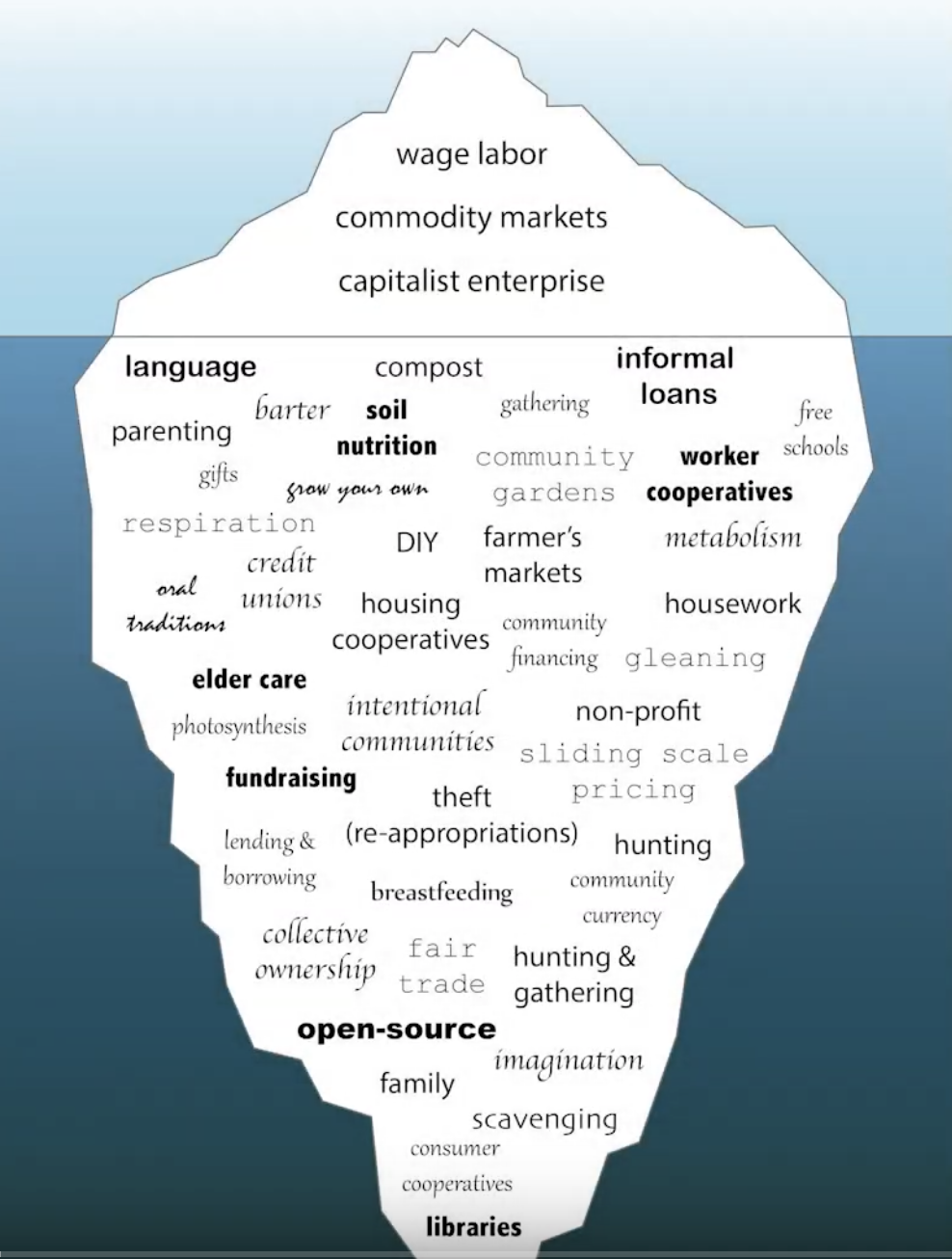
It also rejects some premises of standard economics, highlighting instead the vast amounts of informal, off-the-books work that is not necessarily monetized or intended for the market. This takes many forms, as the Community Economies “iceberg” image (below) helps illustrate.  Even though parenting, community life, care work, gift economies, barter, vernacular culture, and many other form of life are productive and valuable, economists generally dismiss these as trivial or uninteresting. After all, there is no market associated with them and no money changing hands.

To get a better understanding of Community Economies and the work of both CEI and CERN, I recently interviewed Professor Katherine Gibson of the Institute for Culture and Society at Western Sydney University, in Australia, for my Frontiers of Commoning podcast, Episode #13.

Gibson is famous for developing -- along with Julie Graham, the geography professor at UMass Amherst who died in 2010  – the very idea of “diverse economies.” It is meant as a counterpoint to capitalism without being derivative of the capitalist worldview and epistemology.

Under the joint byline J.K. Gibson-Graham, the two wrote such books as The End of Capitalism (As We Knew It): A Feminist Critique of the Political Economy (2006), A Postcapitalist Politics (2006), and Take Bake the Economy (with Jenny Cameron and Stephen Healy) (2013).  

Much of the work of the 300-plus CERN researchers around the world is devoted to bringing “invisible” parts of the economy into the daylight. This consists of treatises on such topics as the Solidarity Economy, degrowth, co-operatives, community finance, local trading systems, underground markets, open source software, and commoning, among other topics.

Just recently, I caught a lecture by CERN member Caroline Shenaz Hossein on the self-organized social finance systems known as ROSCAs, or Rotating Savings and Credit Associations, which are informal cooperatives of Black diaspora women in the Caribbean, North America, and elsewhere. ROSCAs, which go by many different names in different countries, help their participants amass capital for starting a business, buying a car, or paying college tuition for their children. The “Banker Ladies,” as Shenaz Hossein calls them, amount to a hidden social system for meeting financial needs that are mostly ignored by the formal, capitalist banking system.

A primary goal of the Community Economies literature is to “decenter” capitalism as the reference point for thinking about alternative economic projects. Why must everything be seen through the normative lens of capitalism? So, among CEI and CERN researchers, the overriding goal is to shine a light on the actual diversity of community-based projects unfolding everywhere  --  inconspicuously, locally – and to understand them on their own terms.

Venturing into these unconventional forms helps us transform how we might think in fresh ways about the whole cultural construct known as “the economy.” After all, “the economy” is about much more than the stock market, GDP, the Federal Reserve, and the mainstream (capitalist) policy.

Professor Katherine Gibson

“The attention given to a monolithic capitalism belies the diversity of economic activities,” explains Gibson. “There is something going on with the representation of economies that allows for certain activities to be highlighted and thus valued, and others to be made less visible.”

As one reviewer of A Postcapitalist Politics put it, Gibson-Graham “rejects the idea that capitalist economies are tightly organized systems” and instead presents the economy as consisting of “many different undertakings, only some of which cluster around market transactions.”

It also follows that the potential for change starts with us, as embodied selves, not with distant political or economic institutions. Consider Gibson-Graham’s line in The End of Capitalism:

But what sense is there in denying the ample evidence that people have the capacity to experience extraordinary joy and pleasure in working with each other simply because they are working together: the giddy sensation that one is smaller than what one thought (a part of a whole) and larger than what one is (stripped of individual fetters), that one has become folded, along with others, into a new creature altogether.

I’ve also loved the memorable line by Gibson-Graham: “If to change ourselves is to change our worlds, and the relation is reciprocal, then the project of history making is never a distant one but always right here, on the borders of our sensing, thinking, feeling, moving bodies.”

That’s the kind of sentiment that arises from feminist economics, with its attention to our living bodies and relationships. It’s the kind of idea that comes from scholars who want to study the real world, and avoid arid economic abstractions that are losing their explanatory power with each passing week as capitalist crises proliferate.

My Frontiers of Commoning podcast interview with Katherine Gibson can be accessed here.

Transatlantic Exchange of Civic Educators (TECE): School Based and Non-Formal Civics in Germany and the USA

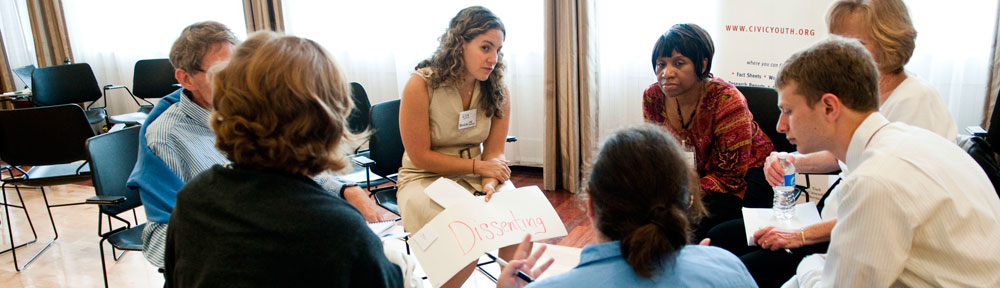
The Tisch College of Civic Life is excited to announce the launch of the Transatlantic Exchange of Civic Educators (TECE), a new project in partnership with the Association of German Educational Organizations (AdB). This fellowship will bring together ten participants from Germany and ten from the United States to engage in dialogue in the field of extracurricular/OST youth and young adult civic learning.

From July 2021 through March 2022, fellows will participate actively in in-person exchange activities in Germany and the U.S., as well as online programming to include peer-learning seminars, site-visits, and thematic small-group work.

Are you involved in the field of civic learning with young people (ages 12-29) in a community or youth work organization, after school association, museum, historical site, youth organizing nonprofit, research association or other related institution? Can you commit to enhancing your own practice and boosting the work of your organization through international professional exchange?

We are eager to accept your application by the deadline on May 18th. More information on the program and how to apply can be found here.

As part of our project launch, we will host an open event, “Civic Learning vs. Politische Bildung: A Discussion of Concepts, Infrastructures and Approaches in the US and Germany”, on April 20 at 11:00am EST/5:00pm CET with Dr. Peter Levine, Associate Dean and Lincoln Filene Professor of Citizenship & Public Affairs in Tufts University’s Jonathan M. Tisch College of Civic Life, and Prof. Bettina Heinrich, Professor of Social Work and Culture Work at the Protestant University of Applied Sciences Ludwigsburg. The main event will be followed by an informal Q&A session, where applicants can ask questions about the application process. The event will be held in English. To register, please visit: https://us02web.zoom.us/meeting/register/tZwkfuuorTIsGdWiSdKJJDFLCXl24qVgi29X

Please contact greeson@adb.de with any questions.

Background

The effort to reengage in transatlantic dialogue in the field of youth civic learning comes at a critical time, as both Germany and the United States experience similar societal challenges: structural racism, right-wing populism, polarization and mistrust of democratic institutions and the media, not to mention a strained transatlantic relationship, all exacerbated further by the COVID-19 pandemic.

In Germany, the field of non-formal civic education, which falls within the broader “youth work” sector, is legally established and involves a rich array of public and civil society institutions. This system has roots in the democratic “reeducation” effort post WWII in Germany, which was led by the United States. It has its own guiding principles and professional field, separate from school-based civics.

Even though they share a connected history, interactions between school-based and non-formal civic education and between German and US civic educators been sparse. Professional discourse has developed separately, resulting in distinct and diverse infrastructures, concepts, and approaches. In bringing together actors in the field of civic learning, civic engagement and civic youth work from two national approaches and infrastructures, we hope to unlock opportunities for mutual learning through an investigation of common challenges and respective approaches, as well as to identify promising new concepts and future partnerships.  

Revised Florida Civics Benchmarks and New Holocaust and Character Education Standards Next Week

Good morning, friends in Civics. This came across my desk from our friends in FDOE.

The department has opened Rule 6A-1.09401, Florida Administrative Code, for rule development to
adopt or revise several content areas of student academic standards. These include Civics and Government (revised), Holocaust Education (new), Character Education (new), B.E.S.T. English Language Arts (ELA) standards (technical and minor revisions that will not affect implementation), and Access Points – Alternate Academic Achievement Standards for the B.E.S.T. ELA and Mathematics standards for students with the most significant cognitive disabilities. Drafts of the proposed revisions will be posted the week of April 5, 2021, at http://www.fldoe.org/standardsreview/.


A rule development workshop will be held on Friday, April 9, 2021, at 11:00 am EDT. To register for the workshop, please visit https://register.gotowebinar.com/register/4060571620471297807.


There will also be an online public comment survey for Civics and Government, Holocaust Education, and Character Education standards. The department encourages all stakeholders to participate in the review process through the online surveys, which will be open when the draft standards are posted through April 23, 2021.
• Civics and Government survey: https://survey.alchemer.com/s3/6176659/CivicsStandards1.
• Holocaust Education survey: https://survey.alchemer.com/s3/6240586/HolocaustEdStandards1.
• Character Education survey: https://survey.alchemer.com/s3/6240369/CharacterEdStandards1.
We encourage you to share these public comment opportunities with local stakeholders to help maximize the number of Floridians contributing to this critical process. If you have additional questions, please contact Michael DiPierro in the Bureau of Standards and Instructional Support at 850-245-9773 or by email at Michael.DiPierro@fldoe.org.

We here at LFI/FJCC encourage you to take some time and plan on attending this workshop if you can; at a minimum, be sure to provide feedback on the new Holocaust and Character Education Standards and the revised K-12 Civics benchmarks! If you have questions about this meeting or these standards, please shoot your questions to Mike DiPierro at FDOE.

New Resources Added to Civics360!

Good afternoon, friends in Civics! I am happy to share with you today some new activities that have been added to Civics360. These were developed by two excellent civics educators in Orange County Public Schools, Lindsey Russell and Michelle Preiser, and edited by our own Val McVey. We are grateful for their willingness to develop more support resources for our Civics360 platform!

The new resources are for 2.8 (Political Parties):

2.9 (Constitutional Qualifications for Office):

and 2.11 (Bias, Symbolism, and Propaganda):

Work on additional improvements and resources for Civics360 are ongoing. Of course, if you have any questions about this platform, the resources (including word versions or answer keys) or anything else, please email us!

Find Ease and Flow in Groups with Next Stage Facilitation!

Ten Directions invites you to an exciting development opportunity with their anticipated Next Stage Facilitation Program. The 6- weeks online training goes live from April 20th- May 25th and is oriented for professionals who want to push their edge, take more risks and find more flow, ease and effectiveness in working with groups. This is perfect for anyone who is interested in taking the first step in the Certified Integral Facilitator ® path and is officially accredited by the ICF to provide 23.5 CCEU’s

Even better, in partnership with Ten Directions we are offering a DISCOUNT FOR NCDD members of 20% off the tuition until April 10 **** use coupon JOY2NCDD ****

To find out more and register, read below or navigate to the Ten Directions’ page here.


April 20-May 25 Next Stage Facilitation

This is the first step in the Certified Integral Facilitator ® path.

Integral Facilitator ® is focused on growing capacities for collaborative work – in communities, groups and organizations. Facilitative leaders, coaches, facilitators, and mediators, and change makers to transform how people and groups can accomplish more together, create thriving dynamic communities, and shape the kind of culture we want to live in.

Next Stage Facilitation™ is an advanced leadership program, designed to expand your perception of yourself as a facilitative leader, your impact in the room, and your potential for shaping group experience. It integrates deep insights from the fields of adult development, Zen Awareness and Integral theory, combined with core competencies of masterful facilitation.
This live 6 week online training is oriented to self-actualizing professionals who want to push their edges, take more risks, and find more flow, ease and effectiveness in working with groups.

In this training, you’ll refine your ability to:
– Rejuvenate a room by addressing what is exciting or even threatening (and often both)
– Go off-script to adapt in the moment, following energy to sustain engagement
– Make “facilitator moves” to increase trust and connection

You’ll experience hands-on practice and receive targeted personal feedback and coaching from the faculty team, alongside other high-caliber facilitative leaders, change makers and innovators engaging with courageous intentions and fresh outlooks.

Next Stage Facilitation – April 20 – May 25, 2020 – 6 weekly classes, online.
Learn More and Register Here

Being in the room with a team of confident, adaptive, and insightful facilitators provides a rich and immersive container for experiential learning. In every moment, there is something we can learn from. Please share this with your colleagues so that they can take advantage of this opportunity – And – even better – here is a special DISCOUNT FOR NCDD members of 20% off the tuition until April 10 **** use coupon JOY2NCDD ****

Please reach out with any questions – group discounts are available for teams of 3+
Programs@tendirections.com
https://tendirections.com/offerings/integral-facilitator/next-stage/

Find the original version of this opportunity on the Ten Directions’ site at: www.tendirections.com/offerings/integral-facilitator/next-stage/

LFI/FJCC Free Online Civics Professional Development Courses

CivicsClassroomLogo

Good afternoon, friends in Civics. Are you looking for some free self paced professional development in civics education? Consider enrolling in our The Civics Classroom Course Series! A certificate of completion, for 5 hours of professional development, will be issued for each course successfully completed. While the first course, The Prepared Classroom, is especially designed for Florida civics teachers, the courses are free and open to all civics and government educators throughout the country.

Are you already enrolled in any of these courses? That’s great! We have had over 200 people complete these courses succesfully! While we want to definitely encourage you to take your time in completing these courses (we understand your schedule!), please be aware that as of April 01, 2021 we will be removing participants who have not visited/taken part in their courses since last summer. You are of course free to re-enroll should you be removed. We believe that these can make a difference and support your professional learning and your students.

You can download the above flier here: Civics_Classroom.

What is the Civics Classroom?

This course series provides educators with online, self-paced, professional learning that develops the knowledge and skills necessary to help students achieve their roles as participants in civic life. Each course will take approximately five hours to complete. While it is recommended that participants complete the courses in order, it is NOT required.

The awarding of a certificate for each course in this series is based on successful completion of the pre and post tests, module quizzes, post course survey, and a passing final grade in the course. Certificates are emailed by staff of the Florida Joint Center for Citizenship at the Lou Frey Institute within two weeks of course completion.

A Prepared Classroom

A Prepared Classroom provides teachers with an understanding of:

  • Course descriptions and the Civics End-of-Course Test Item Specifications,
  • How to utilize curriculum and pacing guides,
  • The value of strategic planning and preparing for instruction, and
  • Making informed decisions about instruction based on formative and summative data.

Download the course syllabus

Enrollment Information: Self-enroll in this course at https://canvas.instructure.com/enroll/JXYKR7. Or, sign up at https://canvas.instructure.com/register and use the following join code: JXYKR7.

A Cognitively Complex Classroom

A Cognitively Complex Classroom provides teachers with an understanding of:

  • The role of cognitive complexity when facilitating instruction and assessment,
  • Utilizing strategies and structures, and
  • Developing learning activities that integrate English Language Arts and disciplinary literacy skills.

Download the course syllabus

Enrollment Information: Self-enroll in this course at https://canvas.instructure.com/enroll/R3L74M. Or, sign up at https://canvas.instructure.com/register and use the following join code: R3L74M.

A Cohesive Classroom

A Cohesive Classroom provides teachers with an understanding of:

  • identifying the needs of students for scaffolded and differentiated supports aligned with the Universal Design for Learning and,
  • how to develop a responsive civics classroom that builds academic and social-emotional competencies.

Download the course syllabus

Enrollment Information: Self-enroll in this course at any time by clicking here https://canvas.instructure.com/enroll/YFE7HR. Or, sign up at https://canvas.instructure.com/register and use the following join code: YFE7HR.

A Constitutional Classroom

(THIS COURSE WAS DEVELOPED IN COLLABORATION WITH THE NATIONAL ARCHIVES!) A Constitutional Classroom will provide teachers with an understanding of:

  • Major ideas in the U.S. Constitution,
  • How to apply disciplinary literacy skills, and
  • Preparing for instruction to make content accessible for all learners.

Download the course syllabus

Enrollment Information: Self-enroll in this course at any time by clicking here https://canvas.instructure.com/enroll/BKAM74. Or, sign up at https://canvas.instructure.com/register and use the following join code: BKAM74.

Questions about The Civics Classroom? Contact Us!

We also have a course specially designed for government classes around the state of Florida’s Civic Literacy Assessment for high school.

The Civics Classroom

The High School Government Classroom: Building Critical Knowledge course will provide teachers with pedagogy, content, and resources for:

  • lesson planning and preparation in social studies
  • the principles of American democracy
  • the US Constitution
  • Founding Documents
  • Landmark Cases

Download the course syllabus

Enrollment Information: Self-enroll in this course at https://canvas.instructure.com/enroll/EXNT4C. Or, sign up at https://canvas.instructure.com/register and use the following join code: EXNT4C.

And there is our High School US History PD, developed in collaboration with the National Archives.

The Civics Classroom

The High School US History: Civil War and Reconstruction course will provide teachers with pedagogy, content, and resources for:

  • the major ideas of the cause, course, and consequences of the Civil War and Reconstruction Era
  • primary sources and disciplinary literacy
  • strategies and structures for accessible learning

Download the course syllabus

Enrollment Information: Self-enroll in this course at https://canvas.instructure.com/enroll/AMPACA. Or, sign up at https://canvas.instructure.com/register and use the following join code: AMPACA.

Questions about these courses or any other professional development? Drop me a line and tell us how we can support you!