Submit a Proposal for Frontiers of Democracy 2016

We’re pleased to announce that once again, the Frontiers of Democracy conference is accepting proposals for their 2016 gathering. This year’s conference will be from June 23rd – 25th at the Tufts University downtown campus in Boston, as always, so mark your calendars!

The annual Frontiers of Democracy conference – now a pillar in the civic infrastructure of the D&D field – brings together leaders in deliberative democracy and civic education to explore ideas at the forefront of advancing democracy, and NCDD’s leadership and members are staples of the event every year. We know that our NCDD members could host some great workshops or learning exchanges based on the work you are doing, so we encourage you to consider submitting a proposal of your own!

You can find the form to submit proposals by clicking here.

More details about the 2016 gathering are forthcoming, so make sure to check back frequently to the Frontiers of Democracy conference website at http://activecitizen.tufts.edu/civic-studies/frontiers for news and updates. We look forward to seeing many of you there!

a blogaversary flashback

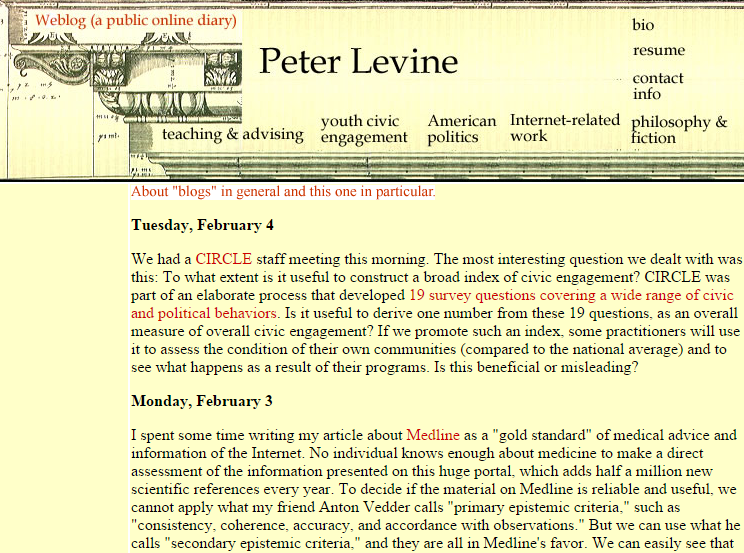
I’ve been blogging since January 2003–for 13 years. I usually note the anniversary with a post about the past year. This year I will illustrate the blogaversary with a screenshot (thanks to the Internet Archive) of the blog as it looked on February 4, 2003:

2003screenshot

The text in those days was simple HTML. In other words, this site was not a database of posts that automatically generated a “front end” view for the reader (as it is now). Back then, I just typed each new entry on top of the previous one. Because blogging was still fairly new, I felt the need to explain at the top of the page that a Weblog was a “public online diary” and I included a link to a statement about “‘blogs’ in general and this one in particular.” I put the word “blog” in quotation marks because it was unfamiliar. In keeping with my definition, I did in fact write a kind of diary. The intro to each of the posts you see above was about what I had done during that day, hooked to some kind of substantive point.

On Feb. 4, 2003, we seem to have talked about creating a “broad index of civic engagement.” The fruits of that discussion include the Civic Health Index, led by the National Conference on Citizenship, which was written into federal law as part of the Kennedy Serve America Act of 2009. We’ve been involved in countless other measurement efforts since then.

The Feb. 3 post is about a form of literacy (in this case, medical literacy) and whether to promote it with better free electronic resources or with public schooling–or both. Even now, in our world of social media, these issues remain important and difficult. I continue to resist piling all responsibilities for boosting every form of “literacy” onto our public schools. I also continue to think that sometimes we can lower the cognitive demands on citizens by simplifying systems, rather than trying to feed everyone ever more information. That strategy seems appealing for law and policy as for medicine and health.

Flashing forward to 2015 (3,119 posts later) … I think the past year was fairly typical, although I intentionally let slip my traditional obsession with posting every single workday. Nowadays, this is not a diary so much as a notebook of argumentative writing, a fair amount of which ends up in articles. For better or worse, the categories that interest me remain basically the same as they were more than a decade ago.

propose sessions for Frontiers of Democracy

The next Frontiers of Democracy conference will take place on June 23-25, 2016 at Tufts University’s downtown Boston campus. The conference schedule is taking shape, and we welcome proposals for concurrent sessions. We call the sessions “learning exchanges” because we do not accept papers or presentations. Instead, we are looking for moderated discussions, workshops, trainings, debates, or other interactive sessions that normally last 90 minutes each and involve up to 20 people. The special conference theme for this year is “Revolt Against the Mainstream?” (thinking not only about the US presidential election but many other examples of “revolts” from around the world.) Session ideas would be welcome that address that theme, but we are open to all kinds of topics related to civic engagement and democracy. Please use this form to submit ideas–for best consideration, by Feb. 29.

Reader Email from Iran, and My Reply

Weber answering emails at his desk in 2011.

I received a reader email from Iran in the last few weeks. I’ve been swamped and hadn’t had a chance to respond until now. I’m still swamped, catching up, but I thought it might be fun to post the question and my reply here. These responses were quickly drafted, with some thought but little editing. <Disclaimer…> lol.

Dear Eric Thomas Weber

I’m [name omitted] from Iran.We are Iranian people who we love peace  and other culture we love other people in every point of earth.You know my country is a victim of mistaken policies in 8 years ago but we(people of Iran) are not bad.Politician of united state of America like Mr President Barak Obama say that the human right situation in Iran is not good.I want to know that what is meaning the human rights?

Best Regards, [name omitted]

Front page of the Tehran Times, November 1, 2015.While I feel bad about having little time to answer [name omitted], I felt worse about how long it had taken for me to get to his email (BTW, that’s my mug on the front page of The Tehran Times from this past July – Pretty cool). So, here’s my rough and quick reply:

Hi [name omitted],

I apologize for the long delay before my reply… [explanation omitted]. To answer your question, human rights are generally considered responsibilities on the part of a government towards its people. The legitimacy of a government depends upon its respect for its people and their rights. Among the kinds of rights that Americans find sadly infringed upon in Iran are the freedom of expression and of the press. Governments cannot be wise and just without knowing about how their people are affected. When free expression is stifled, when leaders do not allow criticism of their decisions, the government intentionally fails to draw its judgments on the greatest pool of information available. Therefore, one of the cornerstones of just governments on this view is the right to criticize any public official. Here is an example of what I mean:

http://www.al-monitor.com/pulse/originals/2014/06/iran-professor-imprisoned-criticizing-nuclear-program.html#

I think it is fair to say that the United States, and most every nation, falls short of perfect justice. There are some things that we take to be fundamental, however. Freedom to raise one’s concerns as a citizen is vital as perhaps (or one of) the most basic human right(s).

That’s how I think about the question you’ve asked me. Again, I apologize for the delay in my reply. Happy new year to you and your family,

Eric Weber

Cover of Ignatieff's book, Human Rights as Politics and Idolatry.Now that I’ve sent that message, I’m reminded of Michael Ignatieff‘s suggestion that freedom of movement might possibly be considered more fundamental than speech. I see his point with respect to cases of ethnic cleansing.

Thoughts? Tweet them to me @EricTWeber or post them on my Facebook page.

What do we want in a social studies teacher?

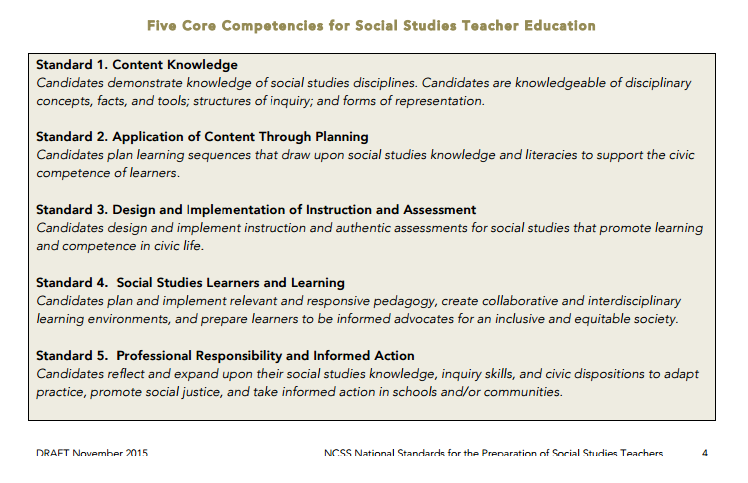
Recently, the National Council for the Social Studies released its National Standards for the Preparation of Social Studies Teachers guidance document for public review. If you are a parent, pre-service social studies teacher or teacher educator, current or former teacher, or, honestly, simply an engaged citizen with a concern for the future, I encourage you to check it out and provide them with feedback. The document, which runs about 23 pages, provides an overview of five core competencies that are important in social studies teacher education.

5 core competenciesEach section of the report dives deeper into each of the core competencies. No doubt, there will be some comments raised about the inclusion of ‘social justice’, knowing that that particular term was once removed from standards of the National Council for Accreditation of Teacher Education (now the Council for the Accreditation of Educator Preparation), for good or ill. I do appreciate the emphasis on inquiry, skills, and knowledge as having an equal role in teacher preparation, though the references to C3 could be an issue in states where that program is (unfortunately) not adopted.

As a civic educator, I cannot help but notice that there is a HUGE amount of attention paid to varying elements of civic education and competency. Obviously, if we consider that social studies is at the heart of instruction in good citizenship, this is important, but it’s ultimately necessary that these standards make clear that civics must necessarily connect to other content areas in our field, and I think they do that adequately.

You can review the standards here, and I encourage you to do so and reflect on them before you complete the survey here.


the Koch brothers network and the state of American parties

Kenneth Vogel reported recently in Politico that “[Charles] Koch and his brother David Koch have quietly assembled, piece by piece, a privatized political and policy advocacy operation like no other in American history that today includes hundreds of donors and employs 1,200 full-time, year-round staffers in 107 offices nationwide. That’s about 3½ times as many employees as the Republican National Committee and its congressional campaign arms had on their main payrolls last month.” Vogel adds that the Koch network will spend more than twice what the RNC spent in 2012, that it has more staff and funding in some key states than the state’s Republican party has, and that it is the leading provider of voter data and political training/coaching on the right today, supplanting the GOP.

Vogel and some of his quoted sources emphasize that this network is unprecedented in US history, which seems true. I would add that it appears unique in the world. The Varieties of Democracy (V-Dem) Project offers free data on the political systems of 173 countries. They ask so many questions about each country that the dataset includes 15 million data points. (I am one of many coders for the USA.) The V-Dem project asks about all kinds of ways in which political parties may be strong or weak; autonomous or co-opted; free, regulated or banned–but it doesn’t even pose questions about entities that perform the traditional functions of parties without being parties. That seems to be a novel contribution of the US since 2000.

The Koch network stands for an ideology and policies that I mostly disagree with, but that’s not the only reason to worry about this development–which could be replicated on the left. These are the main reasons:

  1. A standard political party is at least somewhat accountable, representative, and deliberative. Here are the extensive Rules of the Republican Party, which are mostly about intra-party elections, offices, procedures, and powers. They create a system in which each grassroots Republican has an independent voice and influence. To be sure, some parties have boasted of their authoritarian internal structures, but they have never been important in the US. More common are parties that fail to live up to their claims of responsiveness. In fact, Robert Michels’ “Iron Law of Oligarchy” (1911) was about the rigid tendency of even social-democratic parties to become internal oligarchies. That is a real worry, but there are limits to it. In competitive systems, parties that present themselves as democratic yet act oligarchically lose members and elections. Party elites are disciplined by voters–imperfectly but inevitably. There is no such mechanism within the Koch brothers’ network. It is officially and thoroughly oligarchical. The 1,200 paid staffers work for the people who pay them, not for voters or members.
  2. A party is also accountable to all the voters because it can obtain power and actually govern, and then the electorate can decide what they think of the results. But the Koch network doesn’t directly govern; it just influences some of the people who do. If the politicians they support turn out to be unpopular, the Koch network can pick new candidates for the next round. It cannot itself be voted out.
  3. A standard political party must be transparent if it seeks to attract and retain members. That’s why the GOP has published rules, leaders, and a platform. I am fully aware of the secrecy in US politics, but secrecy is checked by the need to compete for public support. As far as I can tell, the Koch network doesn’t even have an official name, let alone a set of binding rules that an outsider can assess, let alone a public budget.
  4. A standard political party includes both activists and interest groups and actual office-holders. The office-holders are responsible for performance in government and can’t just spout rhetoric. The activists, on the other hand, have some freedom to speak truth to power. The result is a healthy tension between aspirations and reality. But the Koch network is run by activists/interests groups who influence office-holders. It has no incentive to compromise or to support compromise.
  5. Power within the Koch network is proportional to money and is extraordinarily unequal. Michels taught that all parties are inequitable, even those most passionately committed to equality. Still, parties need citizens to vote and volunteer, and the capacity to do so is pretty evenly distributed across the population. The Koch network is purely and simply driven by money.

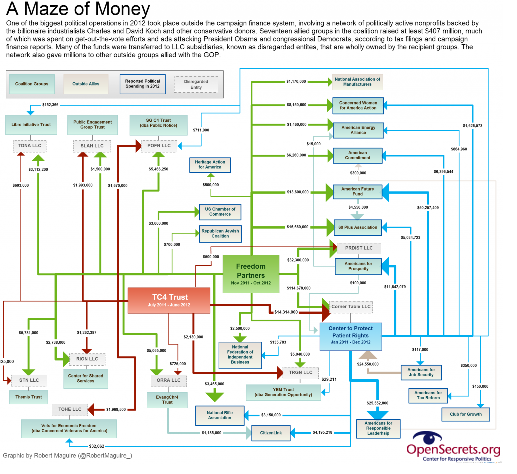
Below is the Koch network as depicted by my friends at the Center for Responsive Politics. It does not belong in a civics textbook, although a realistic textbook today should probably include it.

.Koch network


Separate and Unequal in 1963: How Can We Create A Fair Society? (DMC Issue Guide)

Separate and Unequal in 1963: How Can We Create a Fair Society?, is a 22-page historical issue guide developed in 2014 by the David Mathews Center for Civic Life, Alabama Public Television (APT), and additional partners for use in a classroom setting. Download the Issue Guide PDF here.

DMC_1963_guideIn Separate and Unequal in 1963, students are asked to place themselves in 1963 Birmingham, Alabama to deliberate together through the difficult choices faced by those working to address segregation and inequality. Additionally, students are encouraged to consider the ways in which their own civic engagement shapes the communities of today. The issue guide includes an opening essay from Dr. David Mathews, a Civil Rights timeline, a fictional editorial on inequality in Alabama, three framed approaches, two classroom activities, a glossary of terms, and a list of helpful primary and secondary sources.

This historic issue guide is an accompanying resource for Alabama Public Television’s electronic field trip series entitled Project C: Lessons from the American Civil Rights Movement. The issue guide was named and framed by a diverse group of Alabamians. More information about the naming and framing process of this unique guide is available here. APT’s entire Project C electronic field trip series and accompanying resources can be found at www.aptv.org/project-C/.

In introducing this issue guide, Dr. David Mathews asks students to carefully weigh the challenges faced by Birmingham residents during this historic period:

“[T]ry to imagine yourself and your classmates have traveled back to 1963 and are looking at the options people were considering then. How would you weigh the three options that are presented in this issue book? Can you give each of them a “fair trial,” even the options that you don’t like? You’ll need to say what you think and listen closely to what others say. (Deliberation requires both.) This exercise will strengthen your ability to deliberate; and, in addition, it will teach history in a way that will allow you to experience it.”

The issue guide outlines the following three approaches to addressing the historical issues of segregation and inequality in 1963 Birmingham:

Approach One: “Take a Legislative and Legal Stand”
We can achieve lasting equality only through laws that ensure fairness and justice. If the United States is the land of the free, then we must do more to make sure that everyone is treated fairly. To honor our founding principles of freedom and equality, we need to aggressively change laws to get rid of segregation. Lawmakers must enact and enforce federal laws prohibiting segregation and discriminatory practices. Federal courts must require states and cities to respect court rulings, then lawyers must work to ensure equality through lawsuits.

Approach Two: “Build and Strengthen Relationships”
Inequality is a serious problem, but we must be very cautious not to disrupt relations in our community as we work to deal with it. Rapid change would lead to a disordered society that threatens everyone regardless of race. We must work together in our communities to improve relationships between black and white citizens. We must study the issue, learn to work together, and push for change at the local level. We must search for common ground to unite us and work to eliminate fear. Cities, states, and local communities should work peacefully on policies that guarantee equality and fairness for all citizens.

Approach Three: “Take Direct and Immediate Action”
We cannot wait for gradual change. It has been 100 years since the Emancipation Proclamation, and segregation is still being practiced in communities across the country. People are being treated unfairly, and Washington D.C. and state capitols are not moving fast enough. We cannot expect legislation and lawsuits alone to create equal opportunities. If we want to make real change, all citizens must take direct action now. Rapid change in the community may lead to positive changes across the country and the world. It’s urgent that we protest, boycott, and educate immediately. We must be willing to risk jail, injury, and perhaps even death.

About DMC and the Issue Guides
The David Mathews Center—a non-profit, non-partisan organization—authors deliberative frameworks for people to carefully examine multiple approaches, weigh costs and consequences, and work through tensions and tradeoffs among different courses of action to current and historic issues of public concern.

David Mathews Center issue guides are named and framed by Alabamians for Alabama Issues Forums (AIF) during a biennial “Citizens’ Congress” and follow-up workshops. Alabama Issues Forums is a David Mathews Center signature program designed to bring Alabamians together to deliberate and take community action on an issue of public concern. Digital copies of all AIF issue guides, and accompanying post-forum questionnaires, are available for free download at http://mathewscenter.org/resources. For further information about the David Mathews Center or this publication, please visit http://mathewscenter.org/ or contact DMC Executive Director, Cristin Foster, at cfoster[at]mathewscenter[dot]org.

Follow DMC on Twitter: @DMCforCivicLife

Resource Link: http://mathewscenter.org/wp-content/uploads/2014/09/DMC-ProjectC-Singlepgs.pdf

This resource was submitted by Cristin Foster, the Executive Director at David Mathews Center for Civic Life, via the Add-a-Resource form.

Interview on BAM South’s Midlife Criss podcast

January 6, 2016, With host Jack Criss, and guests Kinsella, Weber, and Rings

Photo of a microphone in front of a soundboard.

I had a great time talking with Jack Criss on BAM South’s Midlife Criss podcast. The interview will soon be up on BAM South’s site, but for now Jack’s posted the interview on Sound Cloud. The player is here below. Jack is a great M.C. and he had questions for me about Uniting Mississippi. My interview is about 16 minutes in from the start of this audio recording. I’m the second of three guests: Stephan Kinsella, me, and John L. Rings.

The Logo for BAM South, with the tag line, "Business Always Matters."Jack has kindly invited me to join him again for a more extended discussion when I’m next in Jackson, MS. I’ve got plans in the works for a trip to Jackson at some point in the spring of 2016, so I think that it would be great to join Jack again.

The name BAM South is short for Business Always Matters. Check out the online publication, which features a nice podcast series. Jack has a great voice, I should add. Fun host too. I hope you enjoy.

Here’s the interview (again, my interview is around 16 minutes in):

More information about Uniting MississippiInfo on Speaking.