All welcome …


All welcome …
Debate and dialogue, while both tools for political exchange, are important to distinguish as philosophically different approaches.
To be sure, the two are similar in many ways. Perhaps most fundamentally, they both seek the Truth. Furthermore, they both rely on information exchange to try to discover the Truth. They both require rational arguments, and may or may not accept rhetorical, emotional, or experiential statements.
Yet the two are importantly different.
Consider, for example, a political debate. Candidates not only state their views and highlight points of disagreement – they make the unwavering case for why they are right.
In true dialogue, on the other hand, people share their views while trying to understand the views of their peers.
I am not sure how to best quantify this difference, but most fundamentally, it seems – in a debate, participants try to win; in dialogue they seek to agree.
That’s not to say that debate is bad and dialogue is good. Debate can help protect against bias, for example. A group that agrees without carefully considering all the options may well agree on on something inaccurate or suboptimal. The process of debate – in which each idea is vigorously and equally defended – can therefore help ensure that each idea is considered fully by its merit.
But I do wonder if debate is the best format for politics and discussion amongst candidates. Debate feeds into an “us” versus “them” mentality which here only serves to reinforce existing polarization.
The approaches also imply different theories as to where Truth lies. In dialogue, Truth most clearly resides in the wisdom of the whole. Participants are supposed to share rational arguments for one view or another, but the fundamental assumption is that – if everyone enters this process with an open mind – the Truth will be surfaced through this process.
I’m not sure the same can be said for debate. In this setting, Truth seems to take on a somewhat technocratic air – capable of discovery by the most skilled rhetoricians.
That may be a somewhat unfair generalization of debate, yet it is enough that it ought to give us pause regarding the ubiquity of debate – and the lack of deliberation – in political settings.
The question, then, is: what would a more dialogue-centric democracy look like?


I’m looking forward to meeting the folks at WDAM in Hattiesburg, MS, on Friday, January 29th for an interview about Uniting Mississippi: Democracy and Leadership in the South. I’ll be on live at around noon. I’ll post a clip of the interview as soon after it as I can. That same day (Friday), I’ll next head to the University of Southern Mississippi, where Sam Bruton in the Philosophy department hosts “Philosophical Fridays.” Check out the sweet announcement poster they made:

 “Philosophical Fridays” is a great initiative that engages audiences in and around Hattiesburg. The program has the support of the Mississippi Humanities Council, which is great.
If you’re in the area, come on by. I’m finalizing details about the book signing that’ll follow the talk.
Washington Monthly has a cover story by Phil Kiesling arguing that voting by mail would raise turnout substantially and also produce a more representative electorate, especially in primaries, thus reducing partisan polarization. Kiesling makes many good points, and his argument is definitely worth reading. Among other things, he is right to be frustrated by the research on voting-by-mail, although I wouldn’t characterize the problem as he does–as “the tyranny of dated, superficial, and/or irrelevant, academic research.” In fact, my colleagues and I are responsible for some of that research, and there are reasons that we analyze the data as we do. It is genuinely hard to measure the effects of a policy that has been adopted in only one or a few states. But that methodological challenge can limit our imaginations as reformers. Even though I don’t think he characterizes the research fairly, Kiesling helpfully challenges our imaginations.
Before getting into the methodological weeds, let me explain why I am not yet convinced that vote-by-mail would increase turnout. Below is Oregon’s turnout trend compared to the national trend. I show the presidential years and off-years as separate lines, because otherwise you get a confusing zigzag pattern. Oregon abolished polling places in 2000 and has run its elections entirely by mail since then. Turnout in the 2004 presidential election was strong, but not so great in 2008 and 2012. Turnout in the off-year elections since 2000 has been lower than it was in the 1980s and 1990s. I don’t see evidence of positive impact here.
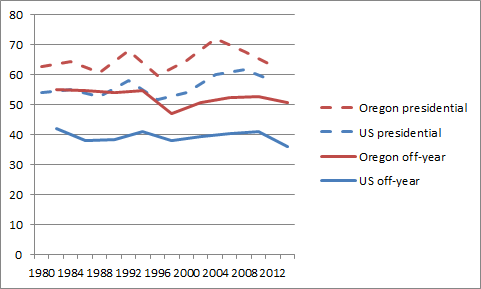
Kiesling calls it a “problematic assumption” to measure turnout as I do above: as the percentage of all eligible citizens who voted. (My data come from Michael McDonald.) Kiesling would rather define turnout as the percentage of registered citizens who vote. But if votes-per-registered rises, and yet votes-per-eligible-citizens does not, then there is only one mathematical possibility: the percentage of the population that registered must have fallen. That’s not a good thing. So the only way to assess the net impact of a reform on our democracy is by measuring turnout as votes per eligible population. We always do this, not in a “selective manner … to overlook (or even disparage)” vote-by-mail.
My graph simply allows you to see whether turnout has risen or fallen in Oregon before and after the vote-by-mail reform. That is not really a satisfactory method because many other factors are obviously at work. Nor can we conduct randomized experiments with new voting laws. Thus the way almost all academics study state policy reforms is by building large datasets that include statistics from all 50 states over many years. Then we try to isolate the apparent impact of a given change, controlling for everything else that we have measured, including the baseline turnout rates for states prior to the reform.* That method has yielded a rough consensus in favor of Election Day Registration–mentioned by Kiesling and exemplified in our own research.
This method cannot, however, assess the impact of a reform that has only been implemented in one or a handful of states. The math just doesn’t allow estimates of impact when there are very few cases in the category of interest. Thus, frustratingly, we omit Oregon’s vote-by-mail system from most of our models. Kiesling is right to complain about that gap, but I know of no satisfactory solution. One potential option would be to lump universal vote-by-mail together with other reforms, to increase the number of cases, but that would hide any special advantages of universal vote-by-mail.
Kiesling says that the research “lazily tries to extrapolate absentee ballot-based data, inappropriately uses VEP-based yardsticks, and/or focuses on presidential contests only—ignoring midterm and primary elections, where the approach is best suited to show dramatic results.” Those are not fair complaints about our models.
I’d still vote for and recommend universal vote-by-mail, as an experiment. The graph shown above makes me a little pessimistic about its impact (particularly in midterm elections). And I do lament the loss of a secret ballot when elections move to mail. The secret ballot was a hard-won reform designed to prevent voters from being coerced by employers and relatives or from selling their votes. (If you promise to pay me for voting for A, but my ballot is secret, I can take your money and vote for B, which ruins the market. In an election-by-mail, however, your boss, your spouse, or a bribe-giver can check your ballot.) Kiesling says the Oregon Secretary of State is aware of “just a dozen documented cases,” and I guess we could live with that–although each case of coercion is a human rights violation.
More broadly, I resonate with Kiesling’s frustration. If a state does something bold and different, the standard methods of social science really struggle to assess its impact. When a bunch of states implement the same rather modest change, we can measure impact, but often it’s disappointing. For instance, we have found that the variation in states’ education laws does not seem to matter for students’ media literacy or electoral participation. I don’t conclude that reforming education is a waste of time, but rather that the prevailing reform strategies are too weak. A few states have done more interesting things with civic education policy, but we can’t assess their impact using multivariate models.
As citizens, we must keep our imaginations vivid and hopeful. Statistics are always about the past, and the future can be different. I welcome the Washington Monthly’s cover article as a spur to creativity. A 21st-century election system should look very different from the clunky mechanisms we have in place today. Universal vote-by-mail could be the answer. I just don’t read the existing research evidence as Kiesling does.
—
*Kiesling writes: “But point out that in 2014, the nation’s three UVBM [universal vote-by-mail] states’ voter turnout—based on the identical VEP denominator—was 16 percent higher than non-UVBM states, and the response is often something along the lines of, ‘Yes, but that’s irrelevant because Oregon (and presumably now Washington and Colorado) have always been high-turnout states.’ As if Minnesota, Maine, and Wisconsin are any different?” This is overlooking the power of a multivariate model, which takes into account the historical turnout rate as well as many other variables. We favor Same Day Registration not because turnout is simply higher in states that have it, but because it is higher controlling for other factors.
We encourage NCDD members to consider attending the 2016 OpenGov & CivicTech Online Unconference this Thursday, January 28th from 11am-2pm Eastern. The event is hosted by former NCDD Board member Lucas Cioffi, and NCDD members get a 30% discount on registration, so make sure to sign up today! Read more below or find the full invitation by clicking here.
 2016 OpenGov & CivicTech Online Unconference
What is the purpose? Why should I attend?
Use promo code “ncdd” when you register here to bring the cost down to just $10.
Register here: www.eventbrite.com/e/2016-opengov-civictech-online-unconference-tickets-20428926469
What is an “unconference”?
Unlike standard conferences sessions where people give presentations, unconference sessions are far more conversational. Professionals will discuss and work through the challenges at the cutting edge of the opengov & civic tech fields.
What is the agenda?
Participants (including you!) create the agenda during the opening session. This ensures that everyone finds a session that interests them and sets a collaborative tone for the event right from the start. Add your session to the agenda after you register.
Who will be there?
Designers, developers, activists, practitioners, and entrepreneurs working at the intersection of civic engagement and technology. The power of this event is that it will bring together people with different skills.
You can find more information on the OpenGov & CivicTech Online Unconference by visiting www.eventbrite.com/e/2016-opengov-civictech-online-unconference-tickets-20428926469?.
The six-page article, From Public Policy Institutes to Centers for Public Life: Transforming People and Communities by Alice Diebel, was published Fall 2015 in Kettering Foundation‘s annual newsletter,“Connections 2015 – Our History: Journeys in KF Research”.
Diebel shares how Kettering’s research fueled the development of issues guides to be used in the National Issues Forums and ultimately, improve the ways that democracy works. She shares the beginning of the forums as Public Policy Institutes (PPIs) and how they transformed into a new approach, Centers for Public Life. Read more an excerpt from the article below or find it in full on Kettering’s site here.
 From the article…
In 2010, we called on four very experienced PPI directors to help us design a new approach to the PPI experience. We were going to work to understand deliberative politics, not just public policy. Martín Carcasson, Betty Knighton, Alberto Olivas, and David Procter joined me and my colleague, Kettering program officer Randy Nielsen, in creating a new design for a research-oriented exchange.
The idea of “research exchange” also reflected a shift for Kettering. Moving from the language of learning that occurs in workshops with a curriculum toward shared learning in exchange among mutually interested parties was a shift the foundation made that paralleled the change in our approach to PPIs. The research exchange creates the space to delve more deeply into the context of democratic, public deliberative politics and to learn along with new organizations beginning to use NIF to plan and design approaches to improve all of the politics and practices in the places in which they work. As a result, the design of the exchanges with new centers continues to change and develop along with the centers
How could we learn more about the challenges of building more democratic communities?
…
PPI commitments in the past focused primarily on holding forums. Commitments in the centers’ exchanges, however, focused on building relationships for democratic practice and change. Creating an identity as a center with a clear mission is part of the work. Structuring deliberative frameworks and forums involving key publics meant they had to look beyond civic education or individual change and instead work toward addressing difficult problems in real settings.
The first centers for public life cohort started in February 2011, so the experiment with the concept of centers is still quite new. Many of the organizations are young enough that their impacts aren’t as apparent as those with a 20-year history. However, we have a few insights from this short period of time. These insights speak more to the relationship with Kettering in a “learning exchange” than to the direct impacts they are having.
About Kettering Foundation and Connections
 The Kettering Foundation is a nonprofit operating foundation rooted in the American tradition of cooperative research. Kettering’s primary research question is, what does it take to make democracy work as it should? Kettering’s research is distinctive because it is conducted from the perspective of citizens and focuses on what people can do collectively to address problems affecting their lives, their communities, and their nation.
Each issue of this annual newsletter focuses on a particular area of Kettering’s research. The 2015 issue, edited by Kettering program officer Melinda Gilmore and director of communications David Holwerk, focuses on our yearlong review of Kettering’s research over time.
Follow on Twitter: @KetteringFdn.
Resource Link: www.kettering.org/sites/default/files/periodical-article/Diebel_2015.pdf
Someone asked me to write a post about becoming a morning person. Based, I suppose, on my expertise of frequently getting up in the morning.
I was skeptical – can one actually become a morning person? What does that even mean?
I suppose it’s no surprise that there are already countless articles on the subject – apparently, it only takes five minutes to become a morning person. Or, if you prefer, here are 19 Ways to Trick Yourself Into Becoming a Morning Person. (My favorite tip: “nap cautiously”). If you’re looking for a somewhat more legitimate news source, here’s a Times Magazine op-ed wistfully entitled, “How I became a morning person.”
I am still skeptical.
All these self-help articles are written in the blasé tone commonly found in fat-shaming weight loss articles. If you want to lose weight, eat less. If you want to be a morning person…just get up in the morning.
This advice does not seem that helpful.
For one thing, sleep habits are – at least in part – biologically determined. In one 2013 study, researchers used the standard Munich Chronotype Questionnaire to sort participants into “morning” and “night” type people. They then studied melatonin and saliva samples of the participants, finding the the difference in circadian rhythms could be “detected at the molecular clockwork level.”
I am certainly reaching far beyond my areas of expertise, but it seems as though there is sufficient evidence for the conclusion that it is unproductive to simply tell a night owl to try harder to get up in the morning.
To be compound the matter, there is some evidence to suggest that “misalignment of circadian and social time may be a risk factor for developing depression” – eg, that “night owls,” whose preferred timing is disconnected from what is generally socially acceptable – are at higher risk of depression.
To be clear, chronotype is not a binary state. On the whole, a population may skew towards early or late, but diurnal preferences are a distribution for which most people fall in the middle. So those individuals glibly writing guides for how they became morning people were most likely not particularly night people to begin with.
If you really want to be a morning person, it seems reasonable to give it a try…but if it really doesn’t work for you, it may be best try finding a lifestyle that better supports your given sleep preferences.
So, I guess I don’t have very good advice.

We encourage our members to give some thought to the piece below written by NCDD Supporting Member Matt Leighninger for Public Agenda. In it, Matt reflects on evidence that is beginning to show that democratic innovation can actually decrease social inequality and have many other positive effects, and he proposes a series of critical questions for future research into how we can amplify those benefits. Read Matt’s piece below or find the original here.
 When people have a say in the decisions that affect their lives, they will be better off economically as well as politically.
This idea has intrigued community development experts, foundation executives, public officials and academic researchers for many years. It has also animated some of the work people and governments are undertaking to address inequality, both in the United States and (especially) in the Global South.
But can a participatory democracy lead to greater economic opportunity? We are just beginning to amass evidence that this idea is true, understand how and why it works, and figure out how to make it happen better and faster.
Over the last two decades we have witnessed a quiet revolution in how governments and other institutions engage the public. Public officials, technologists, engagement practitioners, community organizers and other leaders have developed hundreds of projects, processes, tools and apps that boost engagement.
While they differ in many ways, these strategies and resources have one common thread: they treat citizens like adults rather than the clients (or children) of the state. They give people chances to connect, learn, deliberate, make recommendations, vote on budget or policy decisions, take action to solve public problems or all of the above. The principles behind these practices embody and enable greater political equality.
This wave of experimentation has produced inspiring outcomes in cities all over the world, but it has been particularly productive in Brazil and other parts of the Global South, where engagement has been built into the way that many cities operate. In these places, it is increasingly clear that when people have a legitimate voice in the institutions that govern their communities, and when they have support through various kinds of social and political networks, their economic fortunes improve.
The best-documented cases come from cities in Brazil, where Participatory Budgeting and other forms of engagement have been built into a much more robust “civic infrastructure” than we have in most American cities. In other words, people in these places have a wider variety of ways to participate on a broader range of issues and decisions. Their chances for engagement include online opportunities as well as face-to-face meetings. Many are social events as much as political ones: people participate because they get to see their neighbors and feel like they are part of a community, in addition to being able to weigh in on a public decision.
In these cities, the gap between rich and poor has narrowed, much more so than in similar cities without vibrant local democracies. In addition, governments are more likely to complete planned projects; public finances are better managed and less prone to corruption; people exhibit increased trust in public institutions and are more likely to pay their taxes; public expenditures are more likely to benefit low-income people; public health outcomes, such as the rate of infant mortality, have improved; and poverty has been reduced.
The connection between democratic innovation and greater economic equity raises many questions ripe for research:
Does short-term engagement yield long-term impacts?
Most of the engagement work in the United States and other countries of the Global North have come in the form of temporary efforts to address a public issue or policy decision. They have produced outcomes of their own, but due to their short-term nature, they seem unlikely to have shifted long-term challenges like inequality. But this is a hypothesis rather than a well-supported conclusion. We might shed light on this question by assessing the long-term impacts of such processes – for example, projects like Horizons, in which thousands of people in hundreds of small towns in the Pacific Northwest worked together to address rural poverty.
Do stronger networks from sustained engagement boost economic opportunity?
Sustained engagement seems to strengthen community networks, so that people may be more likely to find jobs or find supports that help them work, such as child care or transportation. How much does this “social capital” effect explain the effects of participation on inequality?
What is the role of data and transparency in reducing inequality?
Tiago Peixoto of the World Bank argues that annual participatory budgeting processes make a greater impact on inequality when the data on local inequality are made public, and when local officials and participatory budgeting organizers emphasize those numbers as a key goal of the process. In other words, when people focus regularly on equality data, they are better able to ensure that the process reduces inequality. While participatory budgeting has been proliferating across the United States, the role of inequality data is not as strong in the American processes.
Does engagement in the private sector boost local economies or public-sector engagement?
Workplaces have also used engagement tools and processes to help people learn, connect with colleagues, make decisions and improve how they work. In fact, it may be true that in some cases, private institutions are more responsive and participatory than public ones. In some cases, high levels of engagement in the workplace seem to have spilled over into the community, creating “more robust forms of community engagement.” Some business leaders clearly feel that workplace engagement enhances the productivity of their firms – does it also enhance the state of the local economy? Should we be considering engagement in the private sector as we explore ways to advance it in the public sector?
Is it important to explicitly acknowledge racial and cultural differences in engagement efforts?
Many engagement processes, especially in the United States, have focused on the role of race in public life, especially in areas like policing and immigration. The knowledge gained through engaging citizens around issues of cultural difference helped inform how practitioners organize engagement on other issues. To what extent have engagement efforts in other countries addressed race, and how important is it to explicitly address cultural difference in any attempt to promote participation and reduce inequality?
What can public institutions do to integrate engagement internally and support sustained engagement externally?
How can public institutions, including local governments and K-12 school systems and state and federal institutions such as Congress, incorporate more productive engagement practices and principles in the way they operate? How can these entities work with foundations, universities, businesses, nonprofit organizations and other groups to support more sustained, efficient and powerful opportunities of public participation?
These are ambitious questions. But if we are serious about reducing inequality, at home and abroad, practitioners and researchers should be taking a broader view of what we are learning about democracy and what we might do to improve it.
You can find the original version of this Public Agenda blog post at www.publicagenda.org/blogs/to-reduce-economic-inequality-do-we-need-better-democracy#sthash.RPWmYRS7.dpuf.
In today’s column, Paul Krugman defends president Obama as “an extremely consequential president, doing more to advance the progressive agenda than anyone since L.B.J.” Krugman challenges “the persistent delusion that a hidden majority of American voters either supports or can be persuaded to support radical policies, if only the right person were to make the case with sufficient fervor.” He rejects the premise that a “sufficiently high-minded leader can conjure up the better angels of America’s nature and persuade the broad public to support a radical overhaul of our institutions.” Obama’s achievements, Krugman says, “have depended at every stage on accepting half loaves as being better than none: health reform that leaves the system largely private, financial reform that seriously restricts Wall Street’s abuses without fully breaking its power, higher taxes on the rich but no full-scale assault on inequality.” And that, Krugman argues, is the only way change happens in our system.
Between 2008 and 2010, I wrote a dozen posts and a Huffington Post piece defending President Obama against Krugman’s persistent critiques from the left. Then Krugman argued that we were in serious trouble because we had been “governed by people with the wrong ideas.” Obama should have challenged Republicans’ ideas with much stronger and more effective rhetoric in order to change public opinion. Instead, the president compromised on his progressive stance, and therefore Americans did not understand their options. Communication was everything for Krugman in those days. One column alone included these phrases: “What Mr. Obama should have said… Mr. Obama could and should be hammering Republicans… There were no catchy slogans, no clear statements of principle.” The president “has the bully pulpit,” but it will be worthless unless he “can find it within himself … to actually take a stand.”
Now Krugman says that it has never worked to try to shift public opinion dramatically to achieve radical policy. “Even F.D.R., who rode the depths of the Great Depression to a huge majority, had to be politically pragmatic, working not just with special interest groups but also with Southern racists.”
I absolutely do not blame Krugman for changing his mind. I am not calling him on an inconsistency here. He is doing what any intelligent person should do: intently studying the unfolding of history and forming and revising his opinions. My views have also changed since 2008, and if they hadn’t, I would be ashamed of my pig-headedness. I call attention to Krugman’s evolved views because they provide a kind of evidence in favor of one view of American politics. A Nobel-laureate economist with a very sharp eye for politics has tried out a couple of hypotheses, and the accumulated evidence as of 2016 leads him to endorse the strategies of Barack Obama ca. 2008-10.