
Putting the Public Back in Public Education
Kettering’s Archives Hold a Quarter-Mile of History (Connections 2015)
The four page article, Kettering’s Archives Hold a Quarter-Mile of History, by Maura Casey was published Fall 2015 in Kettering Foundation‘s annual newsletter, “Connections 2015 – Our History: Journeys in KF Research”. Casey describes the treasure trove of information that can be found within the Kettering Foundation archives. The archives contain decades of documentation, dating as far back at the 1920s, which give detailed information on how citizens have interacted around a variety of issues. Read an excerpt of the article below and find Connections 2015 available for free PDF download on Kettering’s site here.
 From the article…
The windowless, basement room that houses the archives of the Kettering Foundation is out of the way for most of the foundation’s visitors. But, in many ways, the records it holds serve as the silent sentinels of the organization. They tell a tale of where the foundation has been and hold clues as to the path ahead.
The room contains a little more than a quarter-mile of material nestled in towering, rolling shelves. There’s an estimated 1,250 feet of paper files, 25 feet of photographs, and more than 100 feet of audio-visual material. The foundation thrives on conversation and discussion, and the archives make certain that all those words, and the research supporting them, leave records behind.
…
“The breadth of information that we have traces the research and follows various ideas relating to citizen roles involving community, government, and education and how to make citizen ideas visible,” Kingseed said. “We do a lot of work by talking, but those conversations leave traces. This is the place that backs up the stories we tell.
McDonough agreed. “You can’t know where you are going, unless you know where you have been,” she said. “For example, if you want to do work in public education, it’s always a good idea to see what we learned 20 years ago. As much as people like to think that in 20 years America has changed a whole lot [concerning education], well, it really hasn’t. All you have to do is examine our NIF issue guides from the 1980s: the things they talked about we are still dealing with today. And if you don’t save it, you won’t have it in the future.” Are the archives in danger of getting filled? Not for awhile, said McDonough.
The archives room is only about half-full. The foundation began to scan reports in 2010, but digitizing records won’t necessarily mean more room, as the originals are retained. Publications, such as the Kettering Review, Higher Education Exchange, and Connections, will be scanned and become .pdf copies, searchable through the foundation’s computer network. Changing technology, however, presents challenges of its own. McDonough keeps a floppy disk drive reader handy for accessing old files and will keep a DVD drive to read compact discs that are already being replaced by newer technology.
According to McDonough, materials related to Kettering’s Citizens and Public Choice program area take up the most files in the archives, followed by materials related to public education and higher education. Kettering’s archives are primarily organized by program area. Some materials are organized by a single foundation staff member, such as with the multinational/international program area. “Hal Saunders had it so well organized, I just kept all the files the way he had it,” McDonough said. When staff members prepare for retirement, McDonough starts working with them months in advance of their final day to get their files organized for inclusion in the archives.
About Kettering Foundation and Connections
 The Kettering Foundation is a nonprofit operating foundation rooted in the American tradition of cooperative research. Kettering’s primary research question is, what does it take to make democracy work as it should? Kettering’s research is distinctive because it is conducted from the perspective of citizens and focuses on what people can do collectively to address problems affecting their lives, their communities, and their nation.
Each issue of this annual newsletter focuses on a particular area of Kettering’s research. The 2015 issue, edited by Kettering program officer Melinda Gilmore and director of communications David Holwerk, focuses on our yearlong review of Kettering’s research over time.
Follow on Twitter: @KetteringFdn
Resource Link: www.kettering.org/sites/default/files/periodical-article/Casey_2015_0.pdf
New Initiative Seeks to Reconnect Higher Ed & Democracy
Last year, the Kettering Foundation – one of our NCDD organizational members – convened several university presidents that inaugurated an important effort to help higher education reclaim its roots and role in supporting democracy throughout our society. The effort is being chronicled in a new KF blog series, and we wanted to share the first of the series here. We encourage you to read more about this great initiative below or find the original post here.
Template for Campus Conversations on Democracy
 Kettering has recently begun working with college presidents to move beyond their administrative and fundraising roles and provide new leadership for civic engagement. Beginning with a meeting with a small group of college presidents in July 2015, we found that these presidents were indeed eager to take leadership on themes of democracy and civic engagement on their campuses and with their stakeholders. This blog series, College Presidents on Higher Education and Its Civic Purposes, offers a space to gather and present their thoughts.
For inquiries related to Kettering’s research on college presidents and the civic purposes of higher education, please contact barker[at]kettering[dot]org.
Based on initial conversations at Kettering, Paul Pribbenow, president of Augsburg College, and Adam Weinberg, president of Denison University, working with public intellectual, political theorist, and civic organizer Harry Boyte, also of Augsburg College, have drafted a brief overview of how higher education leaders can initiate these conversations. Campus Compact, as part of its activities in recognition of its 30th anniversary, and Imagining America’s Presidents Council, have already expressed interest in sharing the document with leaders in their networks.
In this inaugural post, Pribbenow describes the purpose of the document and offers an initial draft for comments and feedback.
Letter from Paul Pribbenow
Dear Colleagues,
In July 2015, the Kettering Foundation convened a meeting of presidents on how we, as leaders of our institutions, can more intentionally become public philosophers of education and democracy, in a time of deep unrest in our society as well as on campuses.
The group commissioned Adam Weinberg, president of Denison University, and myself, working with Harry Boyte from Augsburg’s Sabo Center for Democracy and Citizenship, to develop a Leadership Template on the topic. The template offers a few suggested focus areas and resources for presidents and higher education leaders to initiate campus discussions about democracy and citizenship.
We are eager for you to offer your thoughts about the diverse ways in which this template can be used. We aim to help spark a broad discussion on campuses and beyond about how we can strengthen democracy as a “way of life,” with higher education playing vital roles. I don’t have to explain why we need such a discussion.
This effort is undertaken in cooperation with Campus Compact’s 30th anniversary and Imagining America’s Presidential Council, which also has been discussing the democratic purposes of higher education.
Yours in service of our democracy,
Paul Pribbenow, President, Augsburg College
Leading Democracy Colleges and Universities: The Public Roles of Presidents
Drafted by Paul Pribbenow and Adam Weinberg, with Harry Boyte, January 2016
“The first and most essential charge upon higher education is that… it shall be the carrier of democratic values, ideals and processes.” – Truman Commission on Higher Education, 1947
“Our institutions need to be citizens of a place, not on the sidelines studying it.” – Nancy Cantor, Chancellor of Rutgers-Newark, 2015
The Truman Commission drew from a large and inspiring view of “democracy as a way of life” widespread early in the 20th century. As John Dewey put it, “Whether this educative process is carried on in a predominantly democratic or non-democratic way becomes a question of transcendent importance not only for education itself but for the democratic way of life.”
This view once infused higher education – land grant and public universities, liberal arts colleges, historically black colleges and universities, normal schools, state universities, and community colleges. “Most of the American institutions of higher education are filled with the democratic spirit,” said Harvard president Charles Eliot, conveying a large conception of democracy.
Today, though many colleges and universities invoke “democracy” or “democratic engagement,” it is rare to have public discussions that reflect on the actual meaning of democracy, just as it is easy to miss the deep challenge to cultures of detachment in Nancy Cantor’s call for colleges and universities to be “citizens of a place, not on the sidelines studying it.” In a time of threats to democracy at home and abroad, the meaning of “democracy” has shrunk along with the purposes of higher education. Democracy often means simply free and fair elections, as the US Agency for International Development defines it (see page 37 of the USAID Strategy on Democracy, Human Rights, and Governance). For many, colleges are a ticket to individual success.
Yet there are signs of renewed concern for the public purposes and work of colleges and universities, reviving higher education’s democratic roles. In this view, colleges and universities are centers of knowledge making and leadership formation, responsible not only for creating and dispensing information but also for addressing local issues and stimulating public exploration of great questions: What does it mean to have a “democratic way of life”? How can higher education, working with communities, help get us there?
This template on leading democracy colleges and universities responds to a request from a group of presidents brought together in July 2015 by the Kettering Foundation on “College Presidents and the Civic Purposes of Higher Education.” Like two efforts by National Issues Forums to organize deliberative dialogues on the purpose of higher education, Shaping Our Future and The Changing World of Work, and the Imagining America Democracy’s College discussion among a group of colleges and universities, it grows from the American Commonwealth Partnership invited by the White House to mark the anniversary of land grant colleges, a coalition to strengthen the public purposes and work of higher education. This effort also builds from efforts like the Carnegie Classification on Community Engagement and the President’s Honor Roll for Community Service that push back against narrow views of “excellence,” like the rankings of US News and World Report.
This statement aims to help spark a broad discussion, on campuses and beyond, about what it means for college and university presidents to lead a public conversation about democracy as a “way of life” with higher education playing vital roles. There is evidence that the nation may be ready for such a discussion. To launch this process, we suggest five focus areas for conversation and action:
Democracy Saga/Public Narrative: This focus area emphasizes an intentional campus and community-wide effort, working with students to recover, discuss, and engage the “saga” or “public narrative” of each unique educational community (for example, see Paul Pribbenow, “Lessons on Vocation and Location: The Saga of Augsburg College as Urban Settlement”).
Democratic Excellence through Diversity: This area of focus revitalizes the conviction, buttressed by research, that a mix of students with diverse backgrounds and talents, interacting in learning cultures of high expectation which develop their unique gifts, can achieve both individual and cooperative excellence, which no focus on winnowing out the stars can achieve (see “Lani Guinier Redefines Diversity, Re-evaluates Merit,” New York Times).
Preparation for Citizen Professional Leadership: This area of focus involves professional programs, disciplinary fields, and learning outside the classroom that recall the democratic values of scientific and other fields and instill democratic skills and habits of public work in students, as well as faculty and staff, to prepare students to be empowering civic leaders and change agents (see citizen professionals at Augsburg).
Free and Public Spaces: This area of focus develops intentional plans to create diverse free spaces and public spaces where students and others learn the skills of surfacing tensions and conflicts constructively, while working with others who are different (see Project for Public Spaces, “Campuses” and Adam Weinberg, “6 Tips for Getting the Most from a Liberal Arts College”). (See also the National Issues Forums issue guides and other resources for engaging campuses in deliberative dialogues on controversial issues.)
Citizens of Places: Colleges and universities as “stewards of place” and “anchor institutions” contributing to the civic and economic health of communities are spreading rapidly. These include a variety of practices, from college purchasing power used to support local businesses and partnerships in creating public spaces to collaboration on local school improvement and support for staff involvement in civic life (see the Anchor Institutions Task Force).
Presidents who act as “public philosophers of democracy and education” are key players in recovering a vision of democracy as a way of life. We encourage presidents to consider their roles in the context of the 2016 Campus Compact Civic Action planning process, which will commence in early 2016, in conjunction with the Compact’s 30th anniversary. Future meetings of college and university presidents, under the auspices of the Kettering Foundation, will offer opportunities to refine and grow this emerging understanding of the public roles of presidents in our democracy.
Other resources: “Democracy University” WNYC Radio show with Harry Boyte and Tim Eatman on the new book collection, Democracy’s Education: Public Work, Citizenship, and the Future of Colleges and Universities (Vanderbilt University Press, 2015). Research on concepts and practices of higher education civic engagement can also be found in several Kettering Foundation publications.
You can find the original version of this Kettering Foundation blog post at www.kettering.org/blogs/template-campus-conversations.
Putting the Public Back in Public Education
In my blog conversation with Deborah Meier on Education Week, Meier's question last week, "what defines a public school?" reminds me of the book.
Not only what is a public school but who gets to define it?
This turns out to be intensely political at the University of Illinois Urbana Champaign, where I gave a talk last week, "Public Universities and the Future of Democracy."
College and universities' connections to larger publics - and their power to shape that destinies, in a time of enormous change - has been greatly weakened. There are a lot of forces at work, such as the detachment of research cultures. But one that is not often discussed is the way colleges and universities define their purposes.
Today college is mainly perceived as a ticket to individual success. This purpose is linked to the way colleges and universities typically separate, even oppose, "liberal arts" and "education for careers."
If we reframe the goal as education for "citizen professionals" it changes the discussion. This means preparing students who understand and engage the real world of today's jobs and are also prepared to be constructive agents of change, helping to create the jobs we need as a society -- more democratic and humane jobs and institutions in schools, businesses, government, health care and elsewhere.
To return public purpose to careers requires integrating liberal learning and skills of democratic action with career preparation: the "heart" and "hand" with "head."
At Illinois questions of educating for jobs are front and center - the university is experiencing huge pressures to cut back on liberal arts and focus instead on job skills. But the focus from the politicians is on "today's jobs," not the jobs we will need as a society. Based on experiences, I'm convinced that if the larger citizenry comes into the conversation it can shift this narrow focus.
In the late 1990s, our Center for Democracy and Citizenship (then at the University of Minnesota) worked with the provost, Bob Bruininks, to create a task force on civic engagement. Its charge was to develop strategies for strengthening the university's public mission, called the "land grant mission." From 2000 to 2002, during the task force work, we had many conversations about how to strengthen the public dimensions of teaching, research and engagement with communities - how to make work "more public," as we put it. The history is described on the University of Minnesota web site.
I was impressed with the depth and seriousness of discussions in Minnesota among many groups, business leaders, small and large, to African American community leaders, school teachers, nonprofit organizations. All sorts of people felt they had a stake in defining the university's public purposes and its future. State legislators described how the university had lost public relationships as it became more like an "Ivory Tower." This loss weakened it politically.
So I took these experiences to the American Commonwealth Partnership, a coalition on the public purposes of higher education which Jon Carson, director of the White House Office of Public Engagement, invited me to organize for the 150th anniversary of the Morrill Act in 2012.
One product was two national discussions on the purposes of higher education, Shaping Our Future -- How Can Higher Education Help Us Create the Future We Want? and The Changing World of Work. We worked on both with the Kettering Foundation and the National Issue Forums, and launched them at press conferences at the National Press club with leaders like Martha Kanter, Obama's Undersecretary for Post Secondary Education, David Mathews, Nancy Cantor, Muriel Howard, Scott Peters and others. The first is described in a Youtube video.
There were forums in every region of the country. They surfaced much richer and more multidimensional public sentiments than the narrow ways policy about higher education is now debated, "education for jobs," cutting costs, and the like. Jean Johnson from the Public Agenda group did a great job summing up what we found on the first in a report, Divided We Fail - Are Citizens and Leaders Talking Past Each Other?
The trip to the University of Illinois brought home for me how much the people's voice is needed today in the public debate about policy.
How can we bring the people back in?
On Participatory Budgeting and Democracy, We Need Patience, Research and Clear Goals
Exit, Voice, and Presidential Elections
In spring 2003, I was living in Japan.
That’s where I was when the Unites States invaded Iraq for “Operation Iraqi Freedom” as it was colorfully named by my government.
Throughout the months I lived abroad, I tried to keep up on the news from home; daily scouring reports from the U.S., the U.K., and Japan. The flavor of news coming out of each country was markedly different – the U.S. blindly patriotic, the U.K. supportingly reserved, Japan politely disapproving.
The details and word variation between articles told remarkably different stories, and I hoped, I suppose, that by reading multiple accounts I could somehow triangulate the truth.
The news coming out of the U.S. was particularly disturbing.
It was as though the whole nation had gone mad.
Other countries reported stories of schools being bombed by U.S. troops; my country was on some tear about Freedom Fries.
This was in the infancy of the blogosphere, so apart from the few people I kept in touch with over AOL Instant Messenger, my only sense for public opinion back home came from the sycophantic mainstream media. A media which has, in fact, somewhat reformed in recent years in response to its catastrophic failure of that time.
And perhaps this is why I’m inclined to sigh whenever someone declares that they will move to Canada, or, perhaps, the moon, should someone they strongly dislike be elected President.
I heard that a lot when President George W. Bush won reelection, and I’m hearing it a lot now.
It’s hardly a solution.
I hardly mean to imply that the Iraq War would have played out differently had I not been abroad; but it seems fairly certain that such warmongering tendencies would only be worse should all progressives decide to leave.
At the very least – I have to say – let’s not leave the nuclear launch codes behind.
In Exit, Voice, and Loyalty, Albert O. Hirschman outlines the three ways in which a person might interact with an organization, community, or state. As you may have guessed, the options are: exit, voice, and loyalty.
A person might stay loyal to an organization and support it’s views and actions; a person might exit an organization, leaving its undesirable policies in search of greener pastures; or a person might exercise voice: speaking up and fighting to make the organization the way they’d like it to be.
There are, of course, many instances throughout human history where people have been forced to exit for fear of their lives and wellbeing. One report estimates that there are nearly 60 million refugees in the world today. Theirs was not an exit taken lightly.
But the situation in the United States – while disheartening – is hardly so harsh.
I know most people are joking when they speak of plans to move away, and yet – it is a troubling sign of resignation.
We may not be the unparalleled superpower we might fancy ourselves to be, but we are still a nation which wields the potential for great harm or good.
If elections don’t go the way we like, it shouldn’t be cause to flee, but rather a call to action: our voices would be needed more than ever.


NCDD Members Get 30% Off New Transpartisan Book
We are pleased to share the announcement below from the Bridge Alliance – one of our NCDD organizational members – about the release of its co-founder and NCDD member Mark Gerzon‘s new book, The Reunited States of America, on March 1st. Mark’s book is highly relevant for D&D practitioners, so he and Bridge Alliance are offering a 30% discount for NCDD members with the code “NCDD”. Read more about the book in the announcement below, or find Mark’s book here.
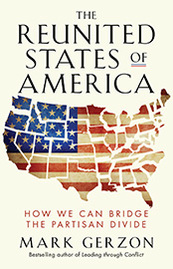
Reunited States of America
We have an exciting offer for you that you won’t want to miss!
Mark Gerzon is releasing his new book March 1st and we want you to be some of the first people with this timely and important tool in hand! That is why we are offering.30% off of the book when you pre-order as a member of NCDD.
Here are 5 reasons why you want to take advantage of this offer and order your copy of The Reunited States of America TODAY:
- This book puts the spotlight on dozens of individuals and organizations that comprise a new narrative for Democracy 2.0. It is a manifesto for a movement that includes the NCDD field – and highlights the importance of what those of us in this field are all trying to do.
- It describes problem solving on some of the most difficult and divisive issues, such as: abortion, gun control, sex education, defense spending, criminal justice reform and more!
- Gerzon invites us into a movement to reunite our nation and put country before party! This book doesn’t ask party members to forfeit their values, but celebrates the beauty of all diverse voices that grow out of love for your country.
- The Reunited States of America explains what you can do starting now to strengthen our nation’s sense of unity while honoring the vital role of conflicting points of view.
- While we all know that not one book, one person nor one organization has the power to change the course of American politics. But this new narrative, with your help, can rise up above the barrage of attack ads and spread a message about dialogue, deliberation and real democracy!
Although we come from opposite ends of the political spectrum, we believe our country needs to come together. “The Reunited States of America” will help us do that. It reconnects us to our country’s motto – “out of many, one” – and helps us meet the challenge of reuniting the country that we all love.
– Grover Norquist, president, Americans for Tax Reform & Joan Blades, co-founder MoveOn.org and LivingRoomConversations.org
For 30% off of your copy of this book click here and use the discount code: NCDD
You bought the book, now what? Here are some easy ways to get the word out and unite America starting today!
Internet Communications Technologies (ICT)
Tamsin Shaw’s critique of moral psychology
I think that Tamsin Shaw’s article “The Psychologists Take Power” (New York Review of Books, February 25, 2016) is very important. I enjoyed an informal seminar discussion of it on Friday, but that conversation made me realize that the article is rather compressed and allusive, and its argument may not convey to readers who are unfamiliar with the research under review or with important currents in moral philosophy.
This is how I would reconstruct Shaw’s argument:
First, the psychological study of morality presents itself as a science; it claims to be value-neutral and strictly empirical. The phenomena under study are called “moral,” but the researchers purport or at least strive to be value-free.
Given that self-understanding, psychologists are attracted to three research programs: evolutionary biology, neuroscience, and game theory. Each presents itself as value-neutral. The three programs can be made highly consistent if one focuses on rapid human reactions to very basic stimuli, such as sexual desire or perceived threat. These reactions presumably arose well before cultural differentiation, they have Darwinian explanations, they would serve individuals or groups in competitive situations (e.g., while struggling for food or mates), and they light up specific parts of the brain. Findings that seem consistent with all three streams of research have special prestige because they seem particularly hard-headed and empirical. (A perfect example is the Times’ article yesterday: “What’s the Point of Moral Outrage? It may seem noble and selfless, but it’s also about improving your reputation.”)
People who think this way about morality are basically amoral. They have no independent moral compass. Yet they learn techniques that are useful for manipulating subjects, particularly in extreme situations where instinctive human impulses are most pertinent. Therefore, it is no surprise (Shaw writes) that some of them became professional advisers on torture during the first years of the Iraq occupation. Any argument against torture will seem to them arbitrary and subjective.
The last point may be a bit of an ad hominem, although it is certainly worth taking seriously as a warning. But even if all psychologists use good professional ethics, the agenda of making moral psychology strictly empirical needs to be challenged.
For one thing, you can’t study phenomena categorized as “moral” without independently deciding what constitutes morality. We have many deep, instinctive impulses. For instance, we are capable of altruism and even self-sacrificing love, but also of violence and greed. It’s plausible that many of these impulses have evolutionary roots and can be explained in game-theoretic terms. But only some of them are moral. Imagine, for instance, that I said, “Greed is a moral virtue that we developed early in our evolution as a species to motivate individuals to maximize resources.” This would not be a scientifically false statement. It would be morally false. The mistake is to call greed a “virtue.”
Jonathan Haidt likes to provoke liberals by describing “authority” and “sanctity” as moral values. They may be, but that requires a moral argument against the position that only care, fairness, liberty, and loyalty count as moral. The fact that some people see authority and sanctity as virtues does not make that opinion right. Hitler thought that racial purity was moral, and he was wrong. So moral reasoning is indispensable.
Further, when we reason morally, we are usually thinking about very complex, socially constructed phenomena that we don’t directly perceive. We certainly don’t experience them as immediate sense-data. I wrestle with my feelings about democracy, the United States, academia, capitalism modernity, etc. These things don’t appear in my visual field like violent threats or piles of yummy food. I experience such institutions through speech and text, through vicarious reports, and by accumulating experience and arguments over decades. Possibly the impulses that homo sapiens developed early in our evolution influence my judgments. For instance, I may have a deep, unconscious tendency to separate people into in-groups and out-groups, and that may affect my tendency to see the USA as my group. But I could treat another unit as my main group, I could be uninterested in (or even unaware of) the USA as an entity, or the country might not even exist. A nation is a social construction, built by people for complex reasons, that we understand in a mediated way. It would be a contentious assumption, not a hard-nosed scientific premise, that our most primitive impulses have much to say about institutions or our attitudes toward them.
See also: Jonathan Haidt’s six foundations of morality; neuroscience and morality; morality in psychotherapy; on philosophy as a way of life; is all truth scientific truth?; and right and true are deeply connected.