the youth turnout story so far

From CIRCLE’s release this morning: “An estimated 1.8 million young people participated in Super Tuesday’s primaries and caucuses, almost a million youth in the Democratic contests and around 900,000 in the Republican contests. With a number of strong showings across many states, young people continued this year’s trend of high participation that rivals the numbers from 2008, when youth turnout in some cases tripled that of previous years. Young Republican participation, especially, has increased compared to 2008, sometimes by dramatic amounts. And in both parties young people are still not rallying around the frontrunners.”

CIRCLE also has a nifty new interactive tool that allows you to compare recent presidential campaigns’ youth support. One takeaway for me: Sanders is mobilizing almost as many young voters as Obama did in ’08. (Sanders’ percentage is larger, but the actual number is a bit smaller.) The young Obama voters in ’08 were on a bus that drove all the way to the White House. The Sanders voters will not have such a smooth ride. What difference will that make to their development as citizens and activists?

Moderating Deliberative Forums – An Introduction [NIFI]

This 26-slide powerpoint, Moderating Deliberative Forums – An Introduction, was released from National Issues ForumInstitute (NIFI) in February 2016. The powerpoint explains the basics of deliberation, the roles of a moderator, and other gems of advice for running a National Issues Forums. Below you can a little more from NIFI of what the power point contains and a link to the powerpoint, or find it directly on NIFI’s main site here.

From National Issues Forums Institute (NIFI)

A new informative PowerPoint presentation is available to view or download, and to modify for your own use. The presentation covers a range of topics related to convening and moderating National Issues Forums (NIF), including: What are the main goals of an NIF forum? What kinds of questions do moderators use to encourage deliberation? This PowerPoint presentation introduces the basics and can be adapted by local forum organizers to match their own needs and goals.

Download the powerpoint for free here.

About National Issues Forums Institute (NIFI)
NIF-Logo2014Based in Dayton, Ohio, the National Issues Forums Institute (NIFI), is a nonprofit, nonpartisan organization that serves to promote public deliberation and coordinate the activities of the National Issues Forums network. Its activities include publishing the issue guides and other materials used by local forum groups, encouraging collaboration among forum sponsors, and sharing information about current activities in the network.

Follow on Twitter: @NIForums.

Resource Link: www.nifi.org/en/groups/powerpoint-presentation-moderating-deliberative-forums-introduction

Technology & Democracy Video Project Seeks Submissions

Here’s a fun-but-relevant thing happening out there: the collaborative team at hitRECord is partnering with the ACLU to crowd source a series of short films on the theme of how technology has impacted democracy. They’re asking folks to submit videos of themselves speaking on the subject, and we know many of our NCDD members have great thoughts to share on the topic! Read more about the project below or find hitRECord’s original post along with their introductory video by clicking here.


Are you there, Democracy? It’s me, the Internet.

Today’s technology is changing pretty much every facet of our lives – even things as important as our Democracy. And especially with this being an election year here in the US, I think these changes are really worth having a conversation about, and making art about.

So, I wanna hear what you think. Record yourself (or interview someone else) on camera answering these three questions:

  1. Is today’s technology good or bad for Democracy?
  2. How might the technology of the future be BAD for Democracy?
  3. How might the technology of the future be GOOD for Democracy?

Once we have lots of footage of different people answering these questions, we’ll use that footage to produce a bunch of short films. We could make a stylized documentary, we could dramatize somebody’s personal point of view, we could do animation, a song, who knows.

And now, I’m very pleased to announce that for this project, hitRECord will be partnering with the ACLU. The ACLU is a 100-year-old, non-profit, legal organization who is right at the forefront of figuring out how today’s laws should or shouldn’t adapt to today’s technology.

And, although this project isn’t about the money, as with every hitRECord production, if one of your contributions is used in one of the final short films, you will get paid. I just finished shooting a movie where I play Edward Snowden, which really got me thinking about all of this. And so I’ve decided to donate my acting fee from that movie to facilitate this conversation about technology and democracy. Some of that money will go to this production, and the rest will go to the ACLU.

That’s about it. I really look forward to hearing how you answer the three questions and seeing what kinds of short films we can make out of it.

You can find the original version of this hitRECord post at www.hitrecord.org/projects/2650089.

Natural Language Processing

I’ve been taking a great class this semester in Natural Language Processing – a computer science field which deals, as you may have guessed, with the processing of “natural” language. NLP is the foundation of technologies like spellcheck, automatic translation (a work in progress!), and Siri.

Essentially, you feed a bunch of human-generated text into a computer and it gives you something in response, with the “something” varying greatly based on what you’re trying to do.

A few weeks ago I deleted all the vowels from the Declaration of Independence.

(And then nondeterministically put them back in).

But at more sophisticated levels, you can analyze the sentiment of a text, mimic human dialogue, or generate new text in the style of a given author. Eventually, I hope to use NLP techniques to process transcripts of political and civic dialogue, but for now I’m enjoying learning the basics of the field.

The fundamentals of NLP are fascinating – in our native language, we each easily construct our own sentences and relatively easily interpret the sentiment and meaning of other’s sentences. We’re generally familiar with the basic syntax and parts of speech in our native language, but generally we don’t give these much thought as we communicate with those around us.

And, as spoken languages are living languages, in casual conversation we effortlessly change the rules and adapt to new words and styles.

One might think that teaching a computer all the rules of grammar as well as the flexibly of our unspoken rules would be quite complicated. And that’s true to some extent, but more generally the challenge of computer-interfaced language is just different.

ELIZA, one of the early successful NLP programs, is relatively simple. Programmed to respond to human-typed input as a Rogerian psychotherapist, ELIZA is based off an algorithm of pattern-matching. You say, “I am sad,” and ELIZA responds, “I’m sorry you are sad.”

On the other hand, satire and sarcasm continue to elude NLP programs…such humor is just too subtle to capture in rules, I suppose.

The rules for a given NLP program can become quite elaborate and yet, the underlying theory is relatively simple: you start at the beginning of a sentence, and then explore a set of rules with each rule given with a certain probability. When you reach an end symbol (eg, a period), you are done.

facebooktwittergoogle_plusredditlinkedintumblrmail

register for Frontiers of Democracy 2016

The annual Frontiers of Democracy conference will take place on June 23-25, 2016 at Tufts University’s downtown Boston campusPlease use this form to register and hold a place.

We will hear brief, inspiring “short take” talks from speakers who will include:

  • Danielle Allen, Harvard University, author of Our Declaration: A Reading of the Declaration of Independence in Defense of Equality (2014)
  • Laura Grattan, Wellesley College, author of Populism’s Power: Radical Grassroots Democracy in America (2016)
  • Joseph Hoereth, Director of the Institute for Policy and Civic Engagement at the University of Illinois at Chicago
  • Hélène Landemore, Yale University, author of Democratic Reason: Politics, Collective Intelligence, and the Rule of the Many (2012)
  • Frances Moore Lappé, Small Planet Institute and author of 18 books including Democracy’s Edge: Choosing to Save Our Country by Bringing Democracy to Life,
  • Talmon J. Smith, Tufts ’16, a Huffington Post columnist on political reform
  • Victor Yang, an organizer for the SEIU
  • A panel on civic tech with Nigel Jacob (City of Boston), Jesse Littlewood (Common Cause), and Chris Wells (University of Wisconsin)

Most of the time will be spent on 90-minute, interactive sessions called “learning exchanges.” We still welcome proposals for learning exchanges. Please use this form to submit ideas.

Examples of currently approved learning exchanges include: “Unlocking the Potential of Student Voices,” with Frank LoMonte, director of the Student Press Law Center; “From Voice to Influence (Technology as Civic Practice)” with Chaebong Nam and Danielle Allen; “Growing Your Grassroots Efforts” with iCitizen.com’s Jacel Egan and Alex Shreiner; “Social Media Legitimacy: From Policy to Neighborhood Action” with James Toscano of Dots Matter and Joseph Porcelli of Nextdoor.com; and “On Building a Living Democracy Movement” with Frances Moore Lappé.

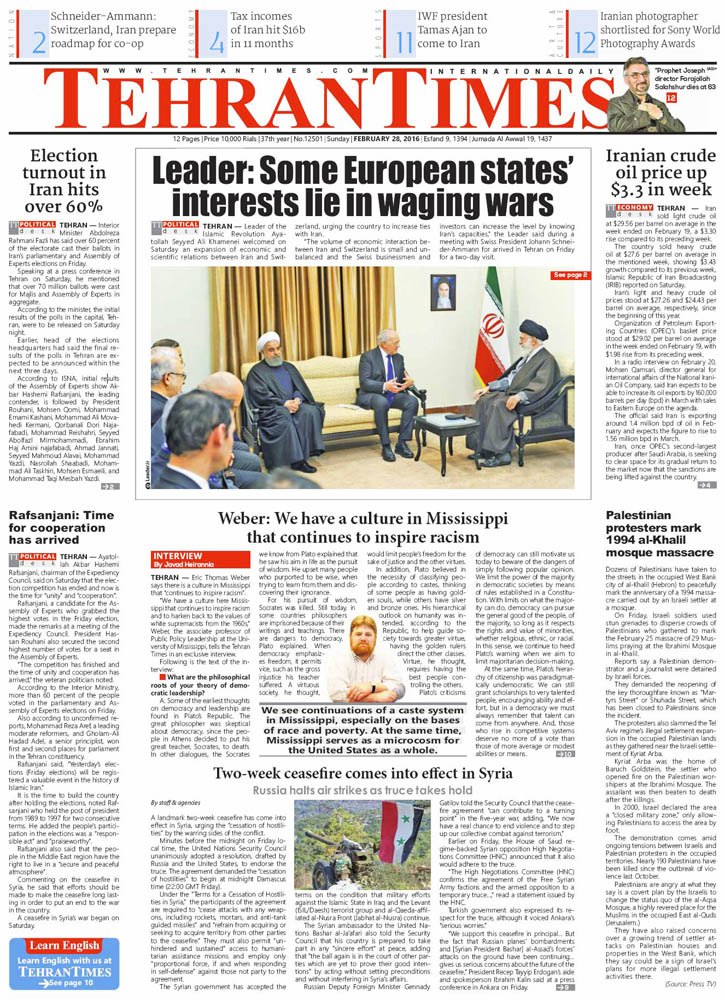
Tehran Times Front Page on ‘Uniting MS’

Check out the front page of February 28th’s Tehran Times. I gave an interview on Uniting Mississippi and was honored with some pretty cool real estate in the paper. Here’s an image of the cover and below that I’ve got links for a clipped PDF of the interview and to the regular text version on their site:

Cover pic of the front page of the Tehran Times, featuring an interview on 'Uniting Mississippi.'

Click on the image above to read a PDF of the piece, or click here. You can also read it online here.

You can learn more about the book here and find it for sale online here.

Follow me on Twitter @EricTWeber and “like” my Facebook author page @EricThomasWeberAuthor.

Teaching Civics by Living History

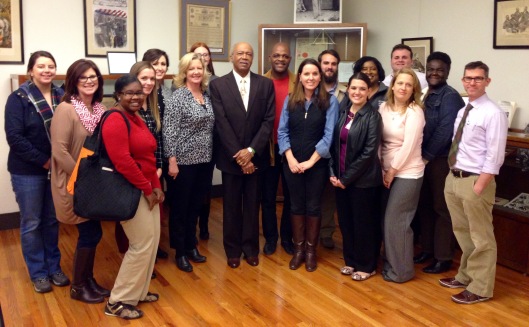
One of the most exciting things for a social studies teacher is when they get to meet the people that they are teaching about. Recently, our friends in Leon County had this very opportunity. 

Guest Post by Peggy Renihan, FJCC Regional Programs Coordinator:

The Leon County Schools Civics Teachers were hosted by the Florida Joint Center for Citizenship, African American History Task Force, and the Florida Humanities Council at the FAMU Meek-Eaton Black Archives for a special Civics Learning Community Meeting on the Civil Rights Movement in Tallahassee. The enthusiastic group of professional educators were joined by several special guests, including the Director of the Black Archives, the Dean of the College of Education, several professors from the College of Education at FAMU, area ministers and Dr. Errol Wilson on behalf of the African American History Task Force.

The highlight of the evening was the keynote speaker, Rev. Dr. Henry M. Steele. He is the second son of the late Rev. Dr. and Mrs. C.K. Steele Sr. Dr. Steele is the former pastor of several churches in Alabama, Florida and Georgia. Steele was the first high school teenager in the country to accept jail rather than bail during the lunch counter sit-ins in Tallahassee, following in the footsteps of his father, who was himself a leading Civil Rights activist in Florida. Arrested at 16 at a demonstration, he worked on a chain gang while serving time in the Leon County jail.

FullSizeRender (1)

In 1955, Rosa Parks set off this country’s first bus boycott of the civil rights movement. A few months later, the second major boycott got underway… in Tallahassee. There is now a Tallahassee-Leon County Civil Rights Heritage Walk. The memorial honors 50+ of Tallahassee’s “foot soldiers” — folks who took part in the 1956 bus boycott and, later, lunch counter sit-ins. Reverend Steele is one of those “foot soldiers”.

We encourage you to check out the documentary. It could be useful to explore this deep Florida connection to the Civil Rights Movement!

Every February the Leon County Schools Civics Teachers participate in an hour and a half experiential learning opportunity. We believe that field experiences in the community enhance and enrich their teaching. It was an honor and a pleasure to learn of Rev. Dr. Henry Steele’s experience in our capital city. His honest and candid memory was refreshing. The teachers were able to take their experience with a “foot soldier” back into the classroom to relate it to their students.


The Work of the Florida Joint Center for Citizenship

Data is, of course, what we in education are now obsessed with. Everything comes back to data. How are we doing? Let’s look at the data. How have our kids grown? Lets look at the data. How effective are our teachers? Let’s look at the data. Well, this is no less true for the work we do here at the Florida Joint Center for Citizenship. And, happily, we have some data for you to share in the wonderful infographic our own Mike Barnhardt has put together. Now, we are not normally ones to toot our own horn, but, well, one has to these days, doesn’t one?

infographic

We are quite proud of the work that we do here, and we hope to be able to continue this work if the legislature continues our funding. We do believe, based on the data that we have gathered, that our work and our resources have had an impact. This is the result of a team effort:
Valerie McVey: Curriculum Director
Peggy Renihan: Regional Program Coordinator
Dr. Elizabeth Washington: Pedagogy Specialist
Dr. Terri Fine: Content Specialist
Mike Barnhardt: Web Developer
Laura Stephenson: Assistant to the Executive Director of the Lou Frey Institute
Shena Parks: Office Manager
Dr. Doug Dobson: Executive Director of the Lou Frey Institute 

One of the most important elements of good citizenship is the ability to work together as a team and collaborate for the common good. Here at the FJCC, we believe that we have that ability and we love our work. We look forward to continuing this sort of self-evaluation over the course of the next year.