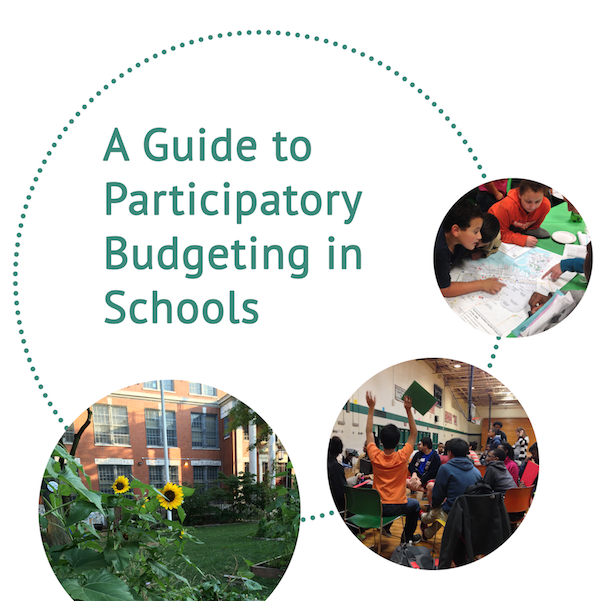
PBP Releases Guide for Participatory Budgeting in Schools

Ensuring that younger generations have opportunities to practice the skills they need to make decisions together about substantive issues is vital to maintaining a democratic society. So we are thrilled to share that the Participatory Budgeting Project – an NCDD member organization – has created a new tool to help schools everywhere give students that opportunity with its new PB in Schools Guide, which is designed to help educators collaboratively launch participatory budgeting processes in their classrooms and school buildings. Learn more in the PBP announcement below or find the original here.


PBP-Logo-Stacked-Rectangle-web1PB in Schools Guide

We all want young people to become civically engaged. This can start now, in school! PBP has developed a free Guide for you to give students a direct experience in civic engagement through Participatory Budgeting.

The Guide shows how to get your school working with Participatory Budgeting (PB). The PB process creates an experiential learning environment for community engagement at a local level. Students are challenged to think about community needs and issues, exploring their environment. They are then empowered to design and implement a solution, taking shared ownership of their school community. They will gain a new attachment to their community; a sense of pride that comes with civic contribution. And they will build a stronger, more collaborative relationship with school administration, one another, and the community at large.

The Guide includes 18 lesson plans and 6 worksheets that are designed to take 45 minutes, once a week, over the course of a semester. You will find sections that explore:

  • Idea Collection
  • Proposal Development
  • Planning
  • VotingPB_Schools_Cover
  • Implementation and Beyond

Participatory Budgeting is great to bring into your classroom because:

  • It’s democracy in action.
  • It gives your students a positive civic engagement experience.
  • It serves as a bridge for your students to be engaged in politics and their community.
  • It strengthens the school community by building positive relations between students and the administration.
  • It shows students the benefits of getting involved.

By implementing Participatory Budgeting into classrooms, students will learn to:

  • Increase their ability to work collaboratively
  • Develop research, interviewing, and surveying skills
  • Develop problem-solving and critical thinking skills
  • Develop public presentation skills
  • Increase their awareness of community needs and their role in addressing those needs
  • Understand budgetary processes and develop basic budgeting skills
  • Identify ways to participate in governance
  • Increase concern about the welfare of others and develop a sense of social responsibility

The Guide’s game plan is effective and efficient as well as adaptive – modify it to fit your context. The Guide explains how to navigate idea collection, proposal development, an expo, a community vote, and implementation of winning projects.

PBP welcomes you to take the first step in bringing your school community closer and educating your students in an engaging democratic process by downloading our free Guide!

You can find the original version of this Participatory Budgeting Project announcement at www.participatorybudgeting.nationbuilder.com/pbinschools.

Albany Administration Centre Site Citizens’ Jury

Author: 
Albany City Council in Western Australia requested to have their administration building relocated to an area outside of the city centre. The state government refused permission. The state department for planning and infrastructure was not convinced that the city council had sufficiently consulted with the Albany community, and it decided...

Mischa Berlinski, Fieldwork

This is an unsolicited advertisement for Mischa Berlinksi’s first novel, Fieldwork. It’s a compelling mystery, fluently and charmingly told. Without being at all pretentious, it’s also a challenging novel of ideas. Berlinski juxtaposes an imaginary Southeast Asian hill people who have remarkable religious rites of their own, a three-generation family of American evangelical missionaries who are thoroughly acclimatized and believe in the local gods (albeit as devils), a Dutch-American ethnologist who also happens to be a politically conservative woman, and a contemporary slacker dude. He describes everyone with respect and empathy. I can’t think of a way to discuss the issues Berlinski raises without spoiling the plot, so I will just say: read it.

Restorative Justice for Oakland Youth [RJOY]

In 2005, Restorative Justice for Oakland Youth [RJOY] was co-created by Fania Davis and members of the Oakland community and government. RJOY works to implement programs within schools, the community and juvenile justice system; beginning with a pilot program at West Oakland middle school in 2007. In the places where restorative justice has been implemented, there has been a noticeable decrease in youth violence, crimes and recidivism; and an increase in victim satisfaction and reconciliation of affected parties.

RJOYRestorative justice provides an alternative to our current retributive justice system, by shifting to bring in all affected parties, addressing the harms done and find ways to heal all affected parties. Our current justice system is designed to answer the questions: “Who did what and how can we punish them?” In contrast, restorative justice asks the questions:

“Who was harmed? What are the needs and responsibilities of all those affected? “How do all affected parties come together to heal?”

Restorative justice has had remarkable success in shifting the way that justice is carried out to better benefit the affected parties and community as a whole. Modern practices of restorative justice have been around for 30+ years, but are grounded in ancient, indigenous justice practices.

To learn more about restorative justice and Restorative Justice for Oakland Youth [RJOY], check out the site here.

From the site…

History
The dramatic successes of the Truth and Reconciliation Commission in healing the wounds of mass violence in South Africa and of restorative juvenile justice legislation in making youth incarceration virtually obsolete in New Zealand inspired civil rights attorney and community activist Fania E. Davis to explore the possibility of an Oakland initiative. In 2005, others joined the effort, including Oakland City Councilmember Nancy Nadel and community activist Aeeshah Clottey. Nancy hosted a series of meetings at her office, attended by community members, judges, educators, law students and representatives of the District Attorney’s, Public Defender’s, and Human Services offices. With a small grant from Measure Y, Oakland’s voter-approved violence prevention initiative, Restorative Justice for Oakland Youth (RJOY) was born.

Mission
Disparately impacting youth of color, punitive school discipline and juvenile justice policies activate tragic cycles of youth violence, incarceration, and wasted lives. Founded in 2005, RJOY works to interrupt these cycles by promoting institutional shifts toward restorative approaches that actively engage families, communities, and systems to repair harm and prevent re-offending. RJOY focuses on reducing racial disparities and public costs associated with high rates of incarceration, suspension, and expulsion. We provide education, training, and technical assistance and collaboratively launch demonstration programs with our school, community, juvenile justice, and research partners.

Beginning in 2007, RJOY’s city-funded West Oakland Middle School pilot project eliminated violence and expulsions, and reduced suspension rates by 87%, saving the school thousands in attendance and Title I funding. Inspired by the successes of our Middle School pilot, by May 2008, nearly 20 Oakland Unified School District (OUSD) principals requested training to launch programs at their sites. We have served over 1000 youth in Oakland’s schools. UC Berkeley Law’s Henderson Center for Social Justice evaluated the Middle School pilot and released a study in February 2011. A publication on implementing restorative initiatives in schools produced in collaboration with the Alameda County Health Care Agency is forthcoming. In 2010, the OUSD Board of Directors passed a resolution adopting restorative justice as a system-wide alternative to zero tolerance discipline and as an approach to creating healthier schools.

RJOY has enjoyed similar success in the juvenile justice arena. In 2007, we gave educational presentations to the Presiding Judge of the Juvenile Court and others. Impressed with the restorative justice model, the judge convened a Restorative Justice Task Force. RJOY provided education and training and helped initiate a planning process which engaged approximately 60 program directors- including probation, court, school, and law enforcement officials, as well as community-based stakeholders. In 2009, the group produced a Strategic Plan that charts reform of the county’s juvenile justice system through institutionalization of restorative justice. Two innovative restorative diversion and restorative re-entry projects focused on reducing disproportionate minority contact and associated public costs. The pilots have successfully served 19 youth of color. In collaboration with several partners, we now seek funding to expand the pilots.

RJOY has had programs at three school sites- West Oakland Middle School, Ralph Bunche Continuation School, and a three-year demonstration program at East Oakland’s Castlemont Community of Small Schools funded by a grant from The California Endowment’s Building Healthy Communities Initiative. Goals of the demonstration program were to reduce violence, arrests, and suspensions (particularly of youth of color) while decreasing associated costs and promoting parent and community engagement.

Having trained and made presentations to more than 1500 key justice, community, school, and philanthropic stakeholders as well as youth in the Oakland metropolitan area, and having significantly influenced policy changes in our schools and juvenile justice system, RJOY has already made headway toward its strategic goal of effectuating a fundamental shift from punitive, zero tolerance approaches to youthful wrongdoing that increase harm toward more restorative approaches that heal it.

Resource Link: http://rjoyoakland.org/

Reid Highway Extension Citizens’ Jury

Author: 
Reid Highway is a major roadway in Perth, Western Australia. A proposed extension of part of the highway had been a source of community contention throughout the 1990s, with particular concerns over safety at one intersection near a school. The incoming Labor government in 2000 suggested closing this intersection but...

Participate in NCDD’s Field-Wide Inventory!

What if we knew how many dialogue and deliberation events took place in a typical year? (Or at least had SOME way to guess!) What if we had a sense of which approaches people in the D&D community specialized in and had training in? What if we had a sense of when practitioners and organizations in our field were more likely to collaborate with their peers?

NCDD2012-wFranKorten-borderNCDD’s Inventory Survey was designed to get answers to these questions and more, and we invite you to participate! The results will be shared with our partner in this project, the Kettering Foundation, and will be summarized and distributed widely in the field.

It is our hope to also use some of this data to create a broad-based map of facilitators and organizations, searchable by location, approach used, and issues you specialize in. This map is part of our strategy to connect more people to the facilitation expertise they need, much more quickly than is possible today. We believe that now, more than ever, the skills of dialogue and deliberation are needed to address pressing issues in communities across the country, often in a very quick time frame.

If you or your organization does any kind of dialogue or deliberation work, we ask that you take the time to complete this survey as soon as possible. It should only take you 15 minutes or less to complete and is NOT limited to members of the NCDD community or those based only in the U.S.

Let’s see what we can learn about this vital field!

Scarborough Senior High School Redevelopment (Western Australia)

Author: 
Scarborough Senior was a high school in Perth, Western Australia that was shut down by the then-Liberal state government in 1999. The closure took place despite considerable opposition in the community and without any consultation. The land was designated for housing development. Following the election of a Labor government in...

CII Seeks Support to Develop New “Wise Democracy” Tool

Long time NCDD members John Spady recently sent us news of a project being undertaken by another NCDD member, Tom Atlee, and his Co-Intelligence Institute that we wanted to share here. Tom and the CII are developing a new tool for supporting “wiser democracy,” and are seeking support to obtain a matching grant for the work. We encourage you to read John’s letter about the project below or learn more about the project and how to support here.


Fundraiser request from the Co-intelligence Institute with Tom Atlee

The board of the Co-intelligence Institute (CII) has initiated a fund raiser to support the emergence of “wiser democracy” – Tom Atlee and Martin Rausch have developed a pattern language card desk design (similar in design to the Group Works deck created in 2011) to impart a sense of what is possible and promote wiser archetypes of design, and they are calling on the D&D community for support in funding the project.

The CII fundraiser is at this secure link: https://bit.ly/CII-fundraiser2016. Here’s a bit more explanation from the fundraiser page:

Tom Atlee and Martin Rausch have been working on a Wise Democracy Group Pattern Language deck, that builds on the insights of Tom’s previous books, The Tao of Democracy and Empowering Public Wisdom. In some ways, this new pattern language is analogous to the Group Pattern Language deck, only its focus is on democracy as a whole, instead of on groups. Your contribution will allow us to complete this project, which is already half-way there! We still need to edit the cards, complete the designs, and invest in our first print run.

It’s also a great time to contribute, since your money will be doubled through an anonymous challenge grant, if we reach our goal by August 31st! Any funds over the amount we are requesting here, will be used for other co-intelligence projects, such as the completion of a nearly-finished book on the need for a participatory approach to sustainability.

This challenge grant from a generous and anonymous donor has been made and the challenge can only be met if CII first raises $10,000. Please take a moment to visit the link and review the challenge.

In the words of Walt Whitman: “I cannot too often repeat that Democracy is a word the real gist of which still sleeps, quite unawakened, notwithstanding the resonance and the many angry tempests out of which its syllables have come, from pen or tongue. It is a great word, whose history, I suppose, remains unwritten because that history has yet to be enacted.”

While wise democracy has not yet been enacted on a large scale,  a number of successful experiments show what is possible. The cards that have been drafted distill patterns of “good design” – aspects we need to consider when creating  a wiser democracy. These are not a “set of rules” but instead support reflection, integration, and implementation.

Thank you for you interest in this project from the Co-intelligence Institute!

John Spady
CII Board Member
and Founder of the National Dialogue Network