on the Deep State, the administrative state, and the civil service

The last few days have seen several prominent articles about “the Deep State”: by David Remnick in the New Yorker, Marc Ambinder in The Washington Post, Julie Hirschfeld Davis in the New York Times, and Kevin Williamson in The National Review, among others. I’d been thinking of writing myself, and I think we need some definitions:

  • The Civil Service: a body of government employees who are protected against political patronage and dismissal without cause in return for embracing norms of nonpartisanship, public service, and professionalism.
  • The Administrative State: government agencies that make and enforce rules and regulations (in contrast to statutes enacted by legislatures) and/or directly manage public resources, such as land.
  • The National Security Apparatus: military and spy agencies as well as police agencies concerned with terrorism, foreign espionage, and subversion.
  • Bureaucracy: any large organization divided into specialized offices, each requiring appropriate training and having defined roles and responsibilities, the whole being organized hierarchically and aimed at achieving some predefined or externally defined end or purpose.
  • The Deep State: a group of people within any or all of the above who collude secretly to pursue their own shared agenda, which may reflect their self-interest or an ideological interest contrary to the goals of elected leaders.

Some observations based on those definitions:

Most of the above definitely exist. Whether the (or a) Deep State exists is a matter of conjecture. One reason that the answer is not obvious is that the National Security Apparatus is cloaked in considerable secrecy. But secrecy is necessary for the existence of such an apparatus at all, and is not indefensible. There are many things we would like our government to know yet not publicly disclose. State secrecy is a problem for a democracy but not necessarily an avoidable one.

If there is a Deep State, it would form within one or more bureaucracies yet would subvert them. That is because bureaucracies constrain their employees to carry out defined tasks, but people who collude for their own agendas are evading such constraints.

The Deep State could exist within the National Security Apparatus, the domestic civic service, or both. Americans in a large swath of the center-left and left tend to be critical of US foreign policy but supportive of regulation and the welfare state. Some of them have feared secret agendas in the National Security Apparatus while viewing officials in the domestic welfare and regulatory agencies as dedicated civil servants. Americans in a large swath of the right have been more supportive of foreign policy than of domestic policy, so they have been prone to see soldiers, police officers, and spies as public servants, and other federal employees as uncontrollable bureaucrats. However, the hard right has also been critical of foreign policy, so there have been Deep State narratives on the right at least since the McCarthy Era. Some on the hard left see the domestic policy apparatus as basically a Deep State devoted to disciplining the poor, but I hear less of that than I used to 20 years ago.

To the extent that we have a genuine civil service, it is designed to push back against elected officials and political appointees. That is not sign of a conspiracy but evidence that popular sovereignty conflicts with such values as scientific rigor and legal consistency. The civil service has a checks-and-balances relationship with elected politicians.

Finally, we do have a problem with the Administrative State, but it is not a conspiracy or anything wrong with the people who work in it. Theodore Lowi was a very fine political scientist whose death on Feb. 17 didn’t get enough attention. Lowi argued that liberals built the regulatory and administrative agencies to enact demanding values for which they had received popular support. But the agencies that liberals created do not have legitimacy to make value-judgments themselves. In lieu of making explicit value-judgments, they claim to make their decisions based on science, efficiency, precedent, or stakeholder negotiation. But they actually make value judgments every day. This creates a crisis of legitimacy that threatens the liberal project.

Another way to make Lowi’s argument is to note that the Administrative State is not envisioned in our Constitution (nor is a permanent National Security Apparatus). Agencies are widely understood as parts of the executive branch or as arms of Congress. (They even employ their own judges, which makes them resemble the judicial branch.) I think a better interpretation is that they represent a fourth branch altogether, which has developed since 1900. It should embody certain norms, such as impartiality, rigor, and predictability, and it should be designed to push and pull with the branches that reflect popular will (Congress and the presidency), deliberation (Congress), discretion and flexibility (the presidency), and law (the judiciary). We should expect tension between the president and the administrative agencies and improve our means of resolving those tensions.

As long as we do not regard the Administrative State as a branch with its own norms and standing, we should expect constant crises of legitimacy, because the existence of this branch has never been recognized by the American people. This is not to defend or rationalize Stephen K. Bannon’s attack on the administrative state. But there is a deeper and longer-term problem that will require attention sooner or later.

See also:  the Citizens United decision and the inadequate sociology of the US Constitutionthe public interest and why it matters;  problems with “stakeholders”; and on government versus governance, or the rule of law versus pragmatism.

‘I Count, I Participate, I Decide’ – Participatory Budgeting in Milan

Author: 
One of the most advanced Italian participatory budgeting projects started in 2015 in the city of Milan. Partially influenced by the Porto Alegre’s example, it also included elements of e-democracy and of territorial division inspired by French PBs.

The National O’Connor Scholars Program

Good morning, friends of civics. We have come across an interesting opportunity and thought it might be of interest for your students!

iCivics and the Aspen Institute are cosponsoring the National O’Connor Scholars Program. 11th or 12th grade students interested in the work of the Supreme Court, the life of Justice O’Connor, and/or constitutional law and history; and a record of civic participation and leadership in school, community, and/or faith- based organizations are encouraged to apply.

Applications will be accepted from March 13 to April 3, or until 150 applications have come in—whichever is sooner.  Scholars will be announced on or before April 21.

Apply herehttps://goo.gl/forms/alXN7vHHzfHfvY7w1

Learn more about the O’Connor Scholar Program.


Millennials’ political opinions: insights from the new CIRCLE poll

In November’s election, youth turnout seems to have been roughly on par with recent elections. Young voters preferred Clinton to Trump by 55% to 37%, but a majority of young whites chose Trump. See the full CIRCLE post-election report based on exit poll data.

Since then, there has been much political ferment among Americans in general, and specifically among Millennials. My colleagues at CIRCLE surveyed 1,608 young adults last October and recontacted 1,002 of them for a post-election survey released on March 7. The new CIRCLE report contains many insights about the election and the Trump era.  I’ll just mention two to give a flavor.

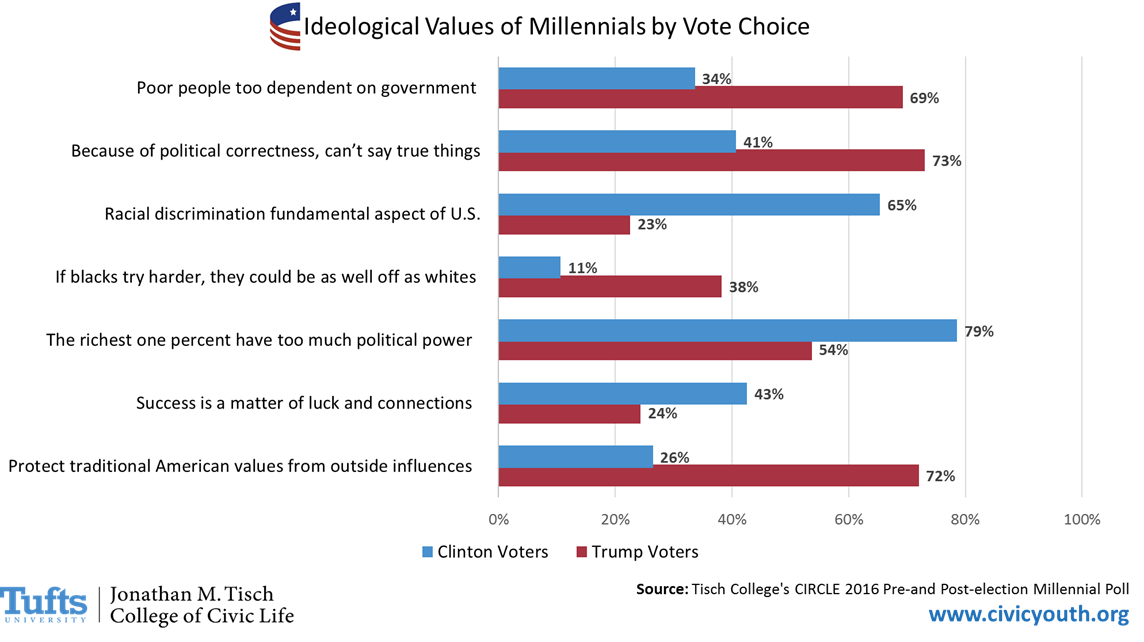
First, young people who voted for Clinton and Trump differed on many contested social issues, which is not surprising in itself. Young Trump voters were more likely to think poor people are too dependent on government, much less likely to be concerned about racial discrimination, and more critical of political correctness (although 43% of Clinton voters shared that view). Almost three quarters of Trump voters wanted to protect traditional American values from outside influences, a rare concern for Clinton voters. But a majority of Trump voters agreed with a larger majority of Clinton voters that the top 1% have too much political power.

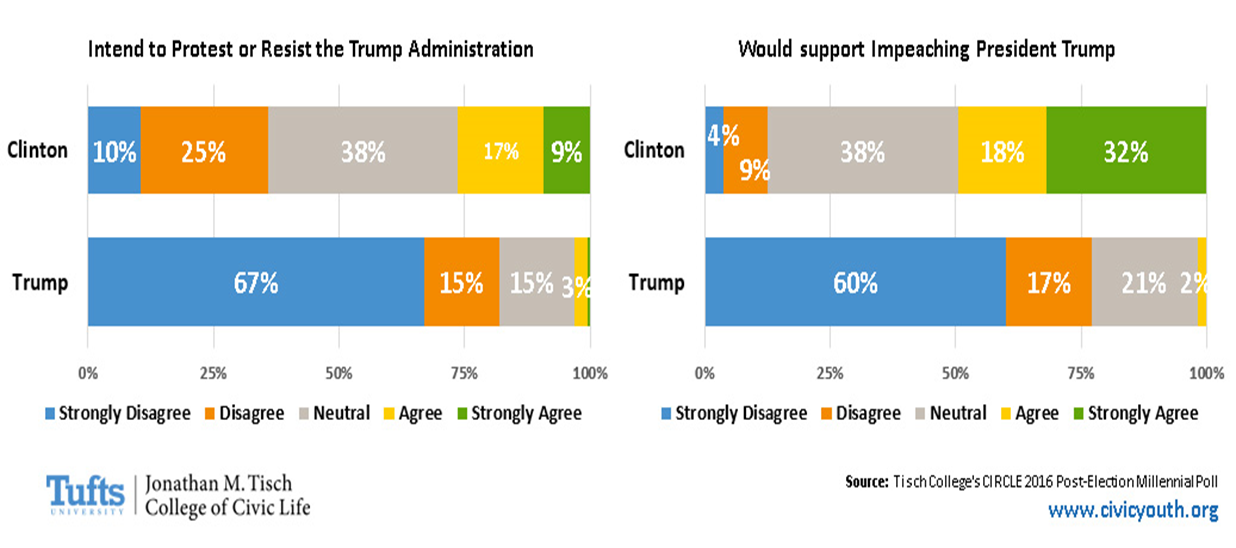
Second, even as early as January, CIRCLE found that most Millennials (whether voters or not) said they intended to protest or resist the Trump administration, and half were ready to support his impeachment. Of course, most Trump voters didn’t intend to protest or call for impeachment, but small minorities of his voters did seem to support the resistance, broadly defined.

Read the whole report here.


Red Blue Dictionary

The Red Blue Dictionary, in partnership with Allsides, is a collaborative effort with dozens of dialogue experts from the NCDD network, to create a site that gives definitions for a wide variety of words to help those all across the political spectrum better understand each other.

The idea for the website stemmed from the “Red Blue Dialogue brainstorming session” at the 2012 NCDD conference in Seattle, where Joan Blades, Amanda Roman and Jacob Hess decided to further develop the idea. Living Room Conversations, in early 2016, continued to support the effort by funding Jacob Hess to develop the site. Since then, all contributions to flesh out the Red Blue dictionary have been on a volunteer basis. You can peruse some of the highlight of the Red Blue dictionary below and find the full site here.

From the site…

This guide to America’s contested vocabulary has been written by a politically diverse team of 30 contributors from the National Coalition for Dialogue & Deliberation. Inspired by Abraham Lincoln’s Team of Rivals, our editorial and contributor teams draw together dialogue experts from maximally diverse backgrounds: religious & atheist, liberal & conservative, Marxist & capitalist, anarchist & libertarian, independent & partisan, hippie & traditionalist, Neil Diamond fans & the rest of us.

Are Americans losing the capacity to disagree in healthy ways? If so, how can we restore (and preserve) our civic ecosystem?

What would it mean to get curious about our differences? (and maybe even smile a little..)

Welcome to a Less-Painful, More Enjoyable Conversation

TOPIC-SPECIFIC TALKING-TIPS
Overwhelmed at the thought of venturing into contested word-territory. Have no fear! Issue-specific guides have been created to lay the groundwork to get you moving.

DIALOGUE EXAMPLES
And you thought super-heroes were cool? Buckle up…because these dialogue pioneers are going to rock your world.

REAL-TIME WORD WATCHERS
Every day some word seems to take on a new meaning…or lose an old…or become weaponized. We’re keeping an eye on that (78 eyes, to be exact) – to help you stay on top of it all!

ACCESSIBLE, EASY-READING
Worried about slipping into some college textbook? Don’t be. We’ve written textbooks before and don’t like them either…!

POLITICAL HUMOR
When was the last time you had a good belly laugh? Beware – because we’re coming after you with political bumper-stickers (and lots of other giggle-provocateurs).

TROLL-PROOF COMMENT SYSTEM
Tired of spending your life listening in to ONE more nasty-aggressive-mean-spirited comment? (Us too) We came across an innovator with the answer…and we think you’re gonna like it!

JUICY QUESTIONS
Tired of (more) small-talk at family parties? Pull one of these mind-popping inquiries out and let the (better) times roll!

WORD MAPS
Confused at why that word means X to THEM and Y to THOSE PEOPLE? Lucky for you! We got some of THEM and THOSE PEOPLE to collaborate on a guide to help us make sense of it all…hope it’s helpful!

CONVERSATION CATALYSTS
Stumped with a word (or person-using-a-word) that you really-cannot-fathom? Check out some of our suggested links to videos and other reading sure to liven (and loosen) things up a bit…

Categorical
The following categories are offered as another way to help orient readers to the terms, which are otherwise organized alphabetically. These categories are organized thematically in general idea clusters – with each term potentially showing up more than once across the different categories:

Race, Ethnicity & Class
Food, Environment & Health
Gender, Sexuality & Family
Life, Death & Conflict
Spirituality, Religion & Doubt
Money, Power & Freedom
Government Systems & Agencies
American History & Tradition
U.S.-World Relations
Education, Learning & Knowledge
Hostility, Dialogue & Peace
Judgment, Interpretation & Deliberation
Liberal & Progressive Thinking
Conservative & Traditional Thinking
U.S. Elections 2016
New & Unusual Terms

Find the Red Blue Dictionary explorations of these categories at the resource link below!

Resource Link: http://redbluedictionary.org/

Don’t Miss the Special Journalism-D&D Confab Call on Wed.

As we announced last month, NCDD is co-hosting a very special Confab Call along with member org Journalism That Matters (JTM) on deepening collaboration between the world of journalism and the field of dialogue, deliberation, and public engagement this Wednesday, March 15th from 1-2:30pm Eastern / 10-11:30am Pacific. It’s going to be one our most engaging Confabs yet, so we encourage you to register todayConfab bubble image

During the call, we’ll continue the conversation that we began during NCDD 2016 about how journalists and public engagement practitioners are needed now more than ever to help our communities in #BridgingOurDivides, enhance the impact D&D practitioners’ work, and find new ways to change the narrative about whether and how our country can overcome our bitter partisanship and political disfunction.

How can we bring our skill sets together to do this? How do community engagement practitioners and journalists work together to share stories? We’ll have in-depth conversations about these questions and more, hear from case studies of successful D&D-journalist partnerships, and even host special region-based small group discussions using Zoom technology to allow for more concrete opportunities to move from conversation to action.

We are excited to have NCDD’s Managing Director Courtney Breese co-hosting this call with JTM Executive Director and NCDD member Peggy Holman. We’ll also be featuring insights and stories from JTM President Dr. Michelle Ferrier, Kyle Bozentko of the Jefferson Center, Doug Oplinger of the Akron Beacon Journal, and Betty Knighton of the West Virginia Center for Civic Life. You can find more info about the details of the call and our speakers in our original announcement here.

Don’t miss this highly interactive discussion about an exciting new direction emerging in our field! Be sure to register today!

microgenetic, ontogenetic, and sociogenetic civic learning

At a Center for Ethics & Education conference last week in Kansas City, I learned from Larry Nucci about an important taxonomy. In my summary:

  • Microgenetic learning means obtaining particular knowledge, skills, concepts, values, etc. through particular experiences. A student doesn’t know about Abe Lincoln, reads a book about him, and knows and remembers the president’s story. That is an example of microgenetic learning. We often measure it with assessments before and after lessons or courses. However, it happens at more precise moments, so it’s possible to zero in on the learning events and understand the learning mechanisms.
  • Ontogenetic learning means becoming something different. A small child doesn’t know how to read but becomes literate, a reader. An undergrad doesn’t know much about medicine but ultimately turns into a skilled, practicing physician. Typically, the timescale of ontogenesis is longer than that of microgenesis, but that’s not the essential difference. In theory, ontogenetic change could happen suddenly, as perhaps for Paul on the road to Damascus. The definition is a change in who the person is, not just what he or she knows.
  • Sociogenetic learning is change at the level of a community or society. A community is oral and becomes literate, or pagan and becomes Christian, or analog and becomes digital. Such changes imply that different ontogenetic learning outcomes will become possible, valued, and typical. For instance, a Roman pagan ca. 100 BC couldn’t learn to be a Christian, but his descendants three centuries later could and even had to become Christians. That implied some new microgenetic experiences, like reading scripture and listening to sermons.

These levels of learning can relate in many complex ways. For instance, people can learn specific skills for civic engagement that help them to become activists, and as activists they can change what their society values. Then microgenesis -> ontogenesis -> sociogenesis. Probably more common is the reverse pattern: a society starts to value something, it establishes a new standard of success, and that leads schools to assign new lessons.

This diagram from Saxe 2012 illustrates the various possible pathways.

In fields like literacy and STEM education, which have received heavy investment, scholars have given attention to all three domains. However, I perceive a trend toward the microgenetic level in those fields. It’s increasingly common to apply Learning Sciences and Cognitive Sciences to understand how child A learns skill B at time C. If that trend comes to dominate, there will be need for a critique. We’ll be at risk of missing the forest for the trees and–especially–overlooking what people should learn ontogenically to produce a good society.

In civics, which is underfunded and understudied, most of the research is ontogenetic. It’s most common to use surveys to determine whether children or young adults have become good citizens of one kind or another, and then ask whether civics courses, democratic school climates, or other large influences are related to those outcomes. Practitioners and scholars are certainly interested in microgenetic questions, but that research is scattered and limited, mostly for lack of resources.

Meanwhile, there is a robust debate about sociogenetic changes in civic life. Scholars and pundits debate how the American polity and political culture have changed, what that means for citizens, and how our polity compares to others. Just as an example, Robert Putnam’s Bowling Alone offers a sociogenetic thesis: it’s about how Americans have come to engage more individualistically and less collaboratively since the 1960s. The underlying reasons include changes in technology and the economy (not shifts in civic education).

The sociogenetic debate about citizenship still tends to be somewhat disconnected from microgenetic and ontogenetic research. I didn’t know this vocabulary when Jim Youniss and I edited the volume Engaging Young People in Civic Life, but our explicit goal was to connect debates about civic education to debates about changes in civic life. We thought that developmental psychologists tended to assume that civic life was historically constant, and political scientists and sociologists tended to view civic education as historically constant. However, regimes and modes of education change, and these changes affect each other. It’s even possible for kids to gain skills through microgenetic civic learning that enable them to change what the society values.

Ultimately, we need civic education research that combines the microgenetic, ontogenetic, and sociogenetic levels and yields practical advice for practitioners, policymakers, and advocates.

Figure from Saxe, G. (2012). Cultural development of mathematical ideas: Papua New Guinea studies. Cambridge, UK: Cambridge University Press. My main source is Larry Nucci (2016) Recovering the role of reasoning in moral education to address inequity and social justice, Journal of Moral Education, 45:3, 291-307, DOI: 10.1080/03057240.2016.1167027

FJCC New Civics Teacher Webinar: What to Expect When You Are Expecting the Civics EOCA now available!

Good morning, friends of FJCC and civics. Our recent webinar, What to Expect When You are Expecting the Civics EOCA, is now available. In it, you will find an overview and discussion of Florida’s Civics EOCA, hosted by our own Peggy Renihan. Materials and resources relevant to the webinar are available here. 

You can access the annotated PowerPoint PDF below. The transcription is available on each slide as notes.
Annotated What to Expect When you are Expecting the EOCA

Should you have issues, please contact me.  Our next webinar will occur on March 29th, 2017 at 4:30 EST. It will cover review and remediation for the Civics EOCA. Registration will be open soon!


School-Community Engagement Conference in New England

If you’re based in the New England region, we encourage you to check out the annual School Redesign in Action conference this March 27-28 in Hartford. The interface between schools and the communities they serve is a space full of under-explored possibilities for our field to grow – not to mention a great way to expose more young people to D&D methods – so we’re excited that the conference planners have included a whole track this year focused on increasing community engagement for schools. Regular registration is $325, but the deadline to register is Mon., March 13, so act fast! You can learn more about the conference in their announcement below or by visiting the conference website here.


School Redesign in Action is the New England Secondary School Consortium’s eighth annual conference for educators and stakeholders from across the country to share success stories, exchange best practices, and continue to build momentum for innovations that will prepare all students for success in the colleges, careers, and communities of the 21st century.

WHEN:  Monday, March 27th, 1:00-5:00pm + Tuesday, March 28th,  8:00am-2:30pm

WHERE:  Connecticut Convention Center, 100 Columbus Blvd · Hartford, CT 06103

WHO:  Educators, students, community stakeholders, policy makers, and teams from secondary schools along with career and technical education centers and higher education from across the country engaged in school improvement

NEW THIS YEAR! A strand dedicated to school-community engagement

Across New England, educators are increasingly aware that meaningful family and community engagement is vital to student achievement and that educators must effectively engage stakeholders to develop more equitable schools. But what does authentic engagement entail? How can educators make the shift from event-based, often-siloed strategies to deeper, more powerful approaches to engagement? And how can communities and educators come together to challenge inequities and effect lasting change for youth?

To explore these questions and more, this year’s School Redesign in Action conference incorporates a strand of presentations and workshops that will increase participants’ capacity to foster authentic school-community engagement, establish meaningful relationships with marginalized groups in schools and/or communities, and strengthen partnerships and systems to improve outcomes for all students.

Below is a preview of the sessions in the student, family, and community engagement strand. To see the full program, visit this page.

  • What’s Equity Got to Do With It?: Creating a Pathway for All Students to Succeed
    Everyday Democracy | Hartford, Connecticut
  • Empowering Parents and Families: Building Leadership Skills and Capacity Inside and Outside the School System
    Annenberg Institute for School Reform | Providence, Rhode Island
  • Recalibrating School-Wide Discipline and Student Support: Building a Restorative and Accountable Approach
    Engaging Schools | Cambridge, Massachusetts
  • Reaching Across Language and Culture: Engaging Multilingual Families from Diverse Backgrounds
    Portland Public Schools Multilingual and Multicultural Center | Portland, Maine
  • Where Equity and Engagement Meet: From Funding to Implementation of Community-School Partnerships that Close Opportunity Gaps
    Puget Sound Educational Service District | Puget Sound, Washington
  • Being an Adult Ally: Practical Strategies for Emplowering Youth Voice, Agency, and Leadership
    Providence Student Union + Young Voices | Providence, Rhode Island
  • Building a Positive School Culture and Community Using Restorative Practices
    Prospect Hill Academy Charter School | Cambridge, Massachusetts
  • Students as Change Agents for Personalization: Infusing Purpose, Meaning, and Hope In School Redesign
    Up for Learning | East Hardwick, Vermont
  • Opening Doors: How Home Visits Can Strengthen School-Family Relationships in the Upper Grades
    1647 | Boston, Massachusetts
  • Teachers as Designers: A Human-Centered Approach to Solving Problems – and Creating New Opportunities – in Schools
    Business Innovation Factory | Providence, Rhode Island
  • Authentic School-Family Partnerships: What Works and Why It Matters
    Lawrence CommunityWorks | Lawrence, Massachusetts

Financial Assistance

As part of the New England Secondary School Consortium’s commitment to improving equity, access, and diversity, we are offering a limited number of reduced-price registrations to community-based nonprofit organizations and parent or community leaders who either support youth or work in partnership with their local schools*. Applicants will be asked to demonstrate financial need and articulate how they anticipate the conference will benefit their work, organization, schools, and/or community.

Applications for financial assistance are due no later than 5:00 p.m. on March 13, 2017.

You can learn more and register for the School Redesign in Action conference at www.newenglandssc.org/conference/conference-details.