We are heading overseas; back to the US and online on January 2.
holiday blogging break
Reply

We are heading overseas; back to the US and online on January 2.
Have you seen the recent Ted talk featuring two prominent folks from the NCDD network? NCDD member Joan Blades of Living Room Conversations and John Gable of AllSides, recently did the Ted talk at the TEDWomen 2017 conference in November. The two talk about the power of breaking outside of your filter bubbles by holding authentic conversations with people that are different than yourself and that by building relationships with people we tend to “listen differently to people we care about”. They share how their friendship has formed despite coming from very different ideological backgrounds and experiences, and how that has transformed the work they do. You can listen to their Ted talk below or find the original here.
Joan Blades and John Gable want you to make friends with people who vote differently than you do. A pair of political opposites, the two longtime pals know the value of engaging in honest conversations with people you don’t immediately agree with. Join them as they explain how to bridge the gaps in understanding between people on opposite sides of the political spectrum — and create opportunities for mutual listening and consideration (and, maybe, lasting friendships).
To free ourselves from the filter bubbles, we can’t just think about information filter bubbles, but also relationship and social filter bubbles. You see, we human beings — we’re not nearly as smart as we think we are. We don’t generally make decisions intellectually. We make them emotionally, intuitively, and then we use our big old brains to rationalize anything we want to rationalize.We’re not really like Vulcans like Mr. Spock, we’re more like bold cowboys like Captain Kirk, or passionate idealists like Dr. McCoy.
You can find this Ted talk at www.ted.com/talks/joan_blades_and_john_gable_free_yourself_from_your_filter_bubbles.
Here are three distinct goals that you might pursue if you see education as a means to improve a society. All three are plausible, but they can conflict, and I think we should sort out where we stand on them.
These three goals can come apart. For example, equity coincides with very poor human development when everyone is starving together. Sweden has high human development and high equity but not much mobility: Swedish families who had noble surnames in the 17th century still predominate among the top income percentiles. It’s just that it doesn’t matter as much that you’re at the bottom in Sweden, because the least off do OK there.
To be sure, the best-off countries in the world tend to be more equitable and prosperous, and there’s a long list of very poor countries that are also highly unequal and (I guess) have little mobility. That pattern could suggest that the path to higher development requires equity. But that’s a contingent, empirical hypothesis, unlikely to be true across the board, and the goals are not the same.
For proponents and analysts of education, the difference matters. Presume that you are concerned with improving human lives. One way to do that is to expand the availability of education. More people reach higher levels of education today than did in 1930–and more people lead safer, longer, lives. This strategy won’t produce equity, however. As educational attainment has risen in the United States, the most educated people have increased the wage gap.
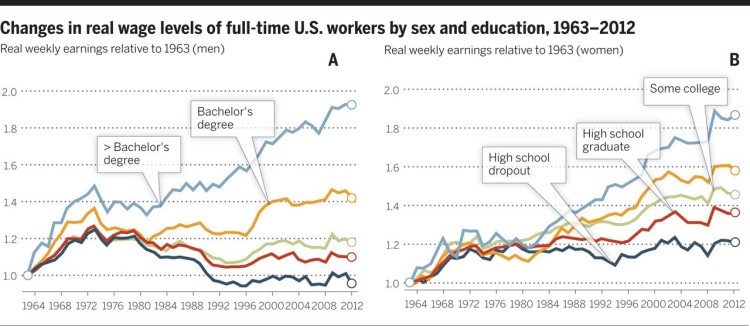
Another way to enhance human welfare is to yield outputs that benefit everyone: skillful doctors and engineers who have great new technologies, medicines, training, etc. To get the best results, it might be smart to concentrate resources at very high-status institutions. The universities that produce the most scientific advances tend to be highly competitive institutions in inequitable systems like the US.
Presume that you want to promote mobility. Then you must reduce the correlation between parents’ and children’s educational attainment. That means admitting and advancing more students whose parents were disadvantaged. It also means, by definition, admitting fewer students from advantaged homes. Increasing the number of total slots is an inefficient way to enhance mobility. Mobility requires competitiveness: when people can compete better, newcomers can more easily knock off incumbents. When individuals are protected against failure, mobility is hampered.
Mobility also operates at the level of communities. In a system of Schumpeterian “creative destruction,” Detroit can fall while Phoenix rises. European countries intervene much more effectively than we do to protect their deindustrializing cities. That is better for human flourishing, but it may also hamper mobility.
Finally, presume that you really want to improve equity. One way to do that would be to improve the education of the least advantaged while holding the top constant. Another way would be to lower the quality and value of the education received by the top tier. Very few people would support doing that, even if it improved equity. That’s because most people think that welfare and mobility are at least as important as equity. (I leave aside liberty, although that is also a valid and important principle.)
Hybrid goals are possible. Perhaps what we want is to maximize the welfare of the least advantaged while not allowing inequality to get out of hand or mobility to vanish. That’s arguably the outcome in Denmark and Sweden. The US may under-perform regardless of how you weigh the three goals. We have vast inequality, limited mobility, and not much safety or health for a large swath of our people. But even if we can make progress on all three fronts at once, they are still different directions.
See also: to what extent can colleges promote upward mobility?, when social advantage persists for millennia, and the Nordic model
We wanted to share this piece from the Essential Partners’ blog written by NCDD member Parisa Parsa, on making difficult people seemingly disappear. In the article, she talks about how each of us can be difficult people under certain circumstances, but how this can be minimized by well-designed process where folks speak their truth anchored by their beliefs. She also elaborates how often we miss the nuance of each other’s understanding and ultimately humanity, when we generalize that someone is “difficult”. You can read the Essential Partner’s article below or find the original version here.
 Earlier this year, a dialogue participant helped us with an amazing discovery:
We can make difficult people disappear.
Let me explain.
Our climate of public discourse is toxic, inundating us with the message that folks who believe differently must be pitied or feared. They are difficult. Intractable. Irrational. Naive. These stereotypes have different shapes when viewed from the left or the right, but the effect is just as stifling. And yet, many of us have real people in our lives — family members, neighbors, co-workers — who believe, vote, and live differently than we do.
Recently we included a dialogue about guns in schools in one of our trainings. Participants held widely divergent views on the subject, and the dialogue circles were composed of individuals who held a range of beliefs. Strong gun rights activists and fervent gun control advocates engaged in deep conversations about their relationship with firearms. As we debriefed, people were amazed that they found so many points of identification with “the others” in the room, so much understanding and shared experience.
Finally, someone said: “This was all fine, but where were all the difficult people?”
This landed for me on two levels:
First, of course, when we are feeling fearful, mistrustful, threatened, and under siege, any of us — all of us — are capable of being difficult people. The careful work of preparation we do with participants before dialogues and to shape agreements and structure for conversation is designed to help speak their deepest truths. Which turns out to be much more interesting than our well-rehearsed diatribes. When we speak and listen from where our beliefs and values are anchored, we let go of the defensive/offensive behavior of difficult people. We become, simply, people.
On yet another level, that question, “where were all the difficult people?” also spoke to another toxic factor in our public life. We have become accustomed to equating disagreeing with being difficult to such an extent that it is hard to believe we really had a conversation across difference if we didn’t cause or experience offensive behavior. We have stopped trusting our own experience of our neighbors as nuanced, full people, and instead are on alert for the jerks. Yet it turns out that the handful of really intractable people on any side of an issue are just that: a minority. They get a lot of airtime that distances the rest of us from each other out of fear and anxiety that everyone who believes differently is at the far extreme. This robs us of the experience of knowing each other all across the middle of the continuum. And it tells us that our experience of genuine compassion, of real stories and humanity in the people right in front of us somehow can’t be trusted.
The work of careful engagement in structured conversation helps us reclaim our own experience. It gives us an opportunity to see ourselves and others more clearly, in deeper, richer light. We give up nothing but our outdated assumptions and stereotypes. And we gain a window into a more abundant truth: that we can be both utterly committed to each other’s humanity and in disagreement about one – or many – issues.
After we can see each other as people, we also can claim and name how we are passionate people who want to stand up for what we believe is right. We become compassionate people who need one another to live out our values and navigate our personal and community struggles. We become committed people working toward solutions to our community’s and our nation’s problems.
When we make difficult people disappear, we set our sights on the new horizons of possibility in our connection, in our compassion and in our collaboration.
You can find the original version of this Essential Partner’s blog piece at www.whatisessential.org/blog/difficult-people.
(Hartford, CT) I’m in Hartford for a board meeting of the Paul J. Aicher Foundation, whose project is Everyday Democracy. This is a good moment to highlight the first Paul and Joyce Aicher Leadership in Democracy Award, which Everyday Democracy awarded to a New Mexico nonprofit, Generation Justice.
Great civic engagement. Building media literacy skills in youth, with a racial equity lens. Applying journalistic integrity to its advocacy and racial equity work. These are all reasons that Generation Justice, a New Mexico non-profit established in 2005, was selected as the winner.
Please check out the powerful media of Generation Justice, here.
Thanks to everyone who has stepped up by donating or renewing membership dues — we have raised a total of $4,761 to date! Today, we’re announcing that NCDD Board Chair Martin Carcasson and an anonymous donor are prepared to match up to $1,500 if other donations and member dues can match that amount by December 31st. So, now is the time to donate, even if you can only give $5 or $10!

A huge thank you to Martin Carcasson and our anonymous donor! If you don’t know Martin’s work already, you should check out the Center for Public Deliberation, which Martin directs.
These matches make your money go farther – a donation of $25 becomes $50, and every additional bit goes to help NCDD’s staff continue to bring you the latest news, events, and opportunities to engage with and learn from one another.
Here’s a couple ways you can support NCDD during the drive:
Check here on the fund drive page to see our progress! We’re also acknowledging our donors and their contributions on that page, and feature some quotes from leaders in our field about why they feel NCDD is worth supporting.
Our goal for this fund drive is $15,000, and I would love to see us reach $10,000 before the Christmas holiday.Your money will go twice as far for the organization, so take this opportunity and act today!
The National Issues Forum Institute released the six-page Issue Advisory, What Should We Do About The Opioid Epidemic?, published October 2017. The issue advisory presents three options to use during deliberation on how society can address the rising opioid epidemic that has swept the U.S. The issue advisory is available for free download on NIFI’s site here, as well as, a post-forum questionnaire.

From NIFI…
Drug abuse, a problem the United States has faced for decades, has taken a sharp and lethal turn with the rise of opioids—both legal pain- killers, such as oxycodone and fentanyl, and illegal ones like heroin.
More than 64,000 Americans were killed by drug overdoses in 2016, according to the Centers for Disease Control, and at least two-thirds of those deaths were caused by opioids. That is worse than the peak of the HIV epidemic in 1995 and more than the number of US combat deaths in the entire Vietnam War.
In the last year, doctors wrote more than 236 million prescriptions for opioids, or about one for every American adult. But many patients became addicted to the painkillers as their bodies began to tolerate higher and higher doses. Others, if they could no longer get prescriptions, switched to heroin; then came the even deadlier fentanyl.
Now drug abuse is so widespread it is even affecting productivity–employers say they can’t fill positions because too many applicants fail a drug test. The Federal Reserve reports that opioid addiction may be shrinking the number of job applicants because it is keeping otherwise able-bodied people out of the workforce.
The problem exists in almost every community throughout the United States, though it has hit hardest in the Northeast, the Midwest, and Appalachian regions, where joblessness and poverty have hollowed out many small towns and left families in desperate circumstances. In Cincinnati, Ohio, police estimated that police officers and paramedics spent at least 102 hours tending to overdose patients in just one week. Responding to the crisis is straining the budgets of many small towns and counties.
Doctors and nurses now see the epidemic’s effects on the next generation, a wave of babies born addicted to painkillers or heroin. Sara Murray and Rhonda Edmunds, nurses in Huntington, West Virginia, founded Lily’s Place, a facility for addicted babies and their mothers.
“The devil has come to Huntington,” Murray said on CNN. “We have generational addiction and that’s their normal. It was their mother’s normal. It was their grandmother’s normal. And now, it’s their normal.”
What should we do to relieve the opioid epidemic facing our communities? This issue advisory presents three options for deliberation, along with their drawbacks. Each option offers advantages as well as risks. If we increase enforcement, for example, this may result in many more people in prison. If we reduce the number of prescriptions written, we may increase suffering among people with painful illnesses.
Option 1: Focus on Treatment for All
This option says that, given the rising number of deaths from opioids, we are not devoting enough resources to treatment to make real headway in turning around the epidemic. Addiction is primarily a medical and behavioral problem, and those are the best tools for combating the crisis. Treatment should be available on demand for anyone who wants it. At the same time, the pharmaceutical companies that have profited from making and promoting opioid painkillers need to contribute more to the solution
Option 2: Focus on Enforcement
This option says that our highest priority must be keeping our communities safe and preventing people from becoming addicted in the first place. Strong enforcement measures are needed, including crackdowns and harsher sentences for dealers, distributors, and overprescribing doctors. And we should take tougher measures to cut off the supply of drugs at the source. Addiction to opioids and other hard drugs brings with it crime and other dangers, and closing our eyes to these dangers only makes the problem worse. Mandatory drug testing for more workers is needed. In the long run, a tough approach is the most compassionate.
Option 3: Focus on Individual Choice
This option recognizes that society cannot force treatment on people. We should not continue to waste money on a failed “war on drugs” in any form. Only those who wish to be free of addiction end up recovering. We should be clear that crime will not be tolerated, but if people who use drugs are not harming society or behaving dangerously, they should be tolerated and allowed to use safely, even if they are damaging their own lives. Those who do not or cannot make the decision to get well should not be forced, and communities shouldn’t spend their limited resources trying to force treatment on people.
 About NIFI Issue Guides
NIFI’s Issue Guides introduce participants to several choices or approaches to consider. Rather than conforming to any single public proposal, each choice reflects widely held concerns and principles. Panels of experts review manuscripts to make sure the choices are presented accurately and fairly. By intention, Issue Guides do not identify individuals or organizations with partisan labels, such as Democratic, Republican, conservative, or liberal. The goal is to present ideas in a fresh way that encourages readers to judge them on their merit.
Follow on Twitter: @NIForums
Resource Link: www.nifi.org/en/issue-guide/issue-advisory-what-should-we-do-about-opioid-epidemic
We wanted to remind everyone to register for the next NCDD Confab Call on community-police relations taking place tomorrow Tuesday December 19th from 1:00-2:30pm Eastern/10:00-11:30am Pacific. This FREE call will feature the Peninsula Conflict Resolution Center, an NCDD Organizational Member who will share with us their experience with community-police relations work in San Mateo County, California.
 We will be joined by PCRC Executive Director Michelle Vilchez and Engaging Communities Initiative Director Malissa Netane on the call, who will share the story of their work, and the lessons they have learned. Be sure to register for this call to learn more!
From PCRC:
Silicon Valley is one of the most unique, diverse, exciting, and enlivening regions on earth, with seemingly abundant opportunities for achieving a high quality of life. Despite these unique characteristics, there are stark social and economic divides among us that sometimes lead to interpersonal misunderstandings and feelings of disconnectedness and disenfranchisement.
Many recent events across our nation involving racial tensions between communities of color and law enforcement (Baton Rouge, Minneapolis, Dallas, and others) and the associated uncivil manner of discourse appear to be amplifying ideological and political differences, making this an uneasy time in our community and nation. In this region, we are extremely fortunate that we have not experienced such extreme incidents, yet we should never consider ourselves immune. Such tragedies, no matter how geographically distant, affect us all at some level, and our thoughts, reactions and emotions come with us when we go to school, or work, or out in the community.
For the past 20 plus years, PCRC has drawn from their foundation of mediation, training, facilitation and conflict coaching to bridge the divides between many different communities and law enforcement agencies. The success of this work depends on building and sustaining respectful and mutually beneficial working relationships among all of the participating partners, which is PCRC’s area of expertise. The vision of PCRC is a future where all members of society engage and collaborate to create a strong, vibrant community. Our mission is to partner with individuals, groups and institutions to empower people, build relationships, and reduce violence through collaborative and innovative processes.
PCRC has over 30 years of providing conflict resolution, mediation, violence prevention and community building services. By engaging in authentic dialogue, building capacity through leadership development, and focusing on action that lends itself to personal and collective transformation, the targeted five communities will have stronger relations inside the community and with other groups and institutions.
Time is running out! So make sure you register to join this exciting call!
About NCDD’s Confab Calls
 NCDD’s Confab Calls are opportunities for members (and potential members) of NCDD to talk with and hear from innovators in our field about the work they’re doing and to connect with fellow members around shared interests. Membership in NCDD is encouraged but not required for participation. Confabs are free and open to all. Register today if you’d like to join us!