
2018 European Summer Institute of Civic Studies

Call for Applications

We are happy to invite you to participate in the European Summer Institute of Civic Studies that will take place in Herrsching near Munich, Germany, from July 15th to July 28th 2018. The Summer Institute of Civic Studies is organized by a team from the University of Maryland (Prof. Karol Soltan) and the Catholic University Eichstätt-Ingolstadt/University of Augsburg (Prof. Tetyana Kloubert) with Tufts University’s Prof. Peter Levine, who will join for two days.

The total number of participants will be limited to 20. We will consider applications from Armenia, Azerbaijan, Belarus, Georgia, Germany, Kazakhstan, Kyrgyzstan, Moldova, Poland, Russian Federation, Turkmenistan, Ukraine and Uzbekistan. [Revised list, 1/15/18] We are especially interested in applicants who have a long-term interest in developing the civic potential of the region. If you are from elsewhere in the world, the Tisch College Summer Institute of Civic Studies at Tufts is a better fit.

Objectives and topics

The Summer Institute of Civic Studies is an intensive, two-week, interdisciplinary seminar bringing together advanced graduate students, faculty, and practitioners from diverse fields of study. It is part of an effort to build a new inter-disciplinary field of civic studies, aiming to develop ideas helpful to citizens. The notions of civic ideals, civic competence, civic society, and civic culture all capture in various ways the perspective of this emerging field.

Summer Institutes of Civic Studies have been annually organized by Peter Levine and Karol Soltan at Tufts University since 2009. The Tufts Summer Institutes has been organized around the theme of the interaction of theory and practice. They have aimed above all to establish civic studies as a theoretically serious field.

The European Summer Institute incorporates in addition distinctly European topics, such as the European Union. But within the European Summer Institute, with its roots in Eastern and Central Europe, we have also introduced a deeper second theme. We aim to develop the civic perspective in the shadow of past totalitarianism and its horrors. We look at modernity as a venue of civic work, with special attention to the fact that modernity also produced Lenin, Stalin and Hitler.

Civic Studies draws on examples from the practices of multiple civic society initiatives. Often the key question is strategic: What was practically possible and under what circumstances? For this purpose, examples from different international contexts are helpful, as they illuminate the possibilities and limitations of the establishment of civic perspectives. We seek to identify country-specific civic society projects, to search for a link between science and practice in the regional and international context and to promote intercultural encounters and intercultural learning.

The Summer Institute of Civic Studies deals with issues of development of civil society, the role of an individual/citizen in society, the role of education and the role of institutions in supporting, promoting and deepening democracy, and questions related to the ethical foundation of civic issues in a (democratic) society. These topics will be examined in international and comparative perspectives, considering European (especially German) and US-American civic traditions. International examples will be discussed in the context of consolidation of democracy in Eastern Europe, and in the context of the recent challenges of populism.

The Summer Institute of Civic Studies engages participants in challenging discussions such as:

  • What kinds of citizens (if any) do good regimes need?
  • What should such citizens know, believe, and do?
  • Should we reformulate the project of democracy in response to the challenge of populism, and if so, how?
  • What ought to be the relationships among empirical evidence, ethics, and strategy?

How to apply

All application materials must be submitted in English. The application must include the following:

  • A cover letter telling us why you want to participate in the summer institute and what you would contribute (maximum 2 pages)
  • A curriculum vitae

All application material can be sent as an email attachment in DOC or PDF format to tetyana.kloubert@ku.de.

Decisions will be announced in April 2018.

The working language of the Summer Institute will be English. Your mastery of the English language must be sufficient to read and understand complex texts from multiple disciplines, and to take part in a lively discussion.

Deadline

For best consideration apply by March 1, 2018.

Expenditures

The Summer Institute of Civic Studies is being funded by the DAAD (German Academic Exchange Service). All participants will be paid for their travel costs, accommodations, meals and full event access.

Contact

For more information about the Summer Institute of Civic Studies please contact tetyana.kloubert@ku.de

We encourage you to share this message with your networks of people who might be interested by the Summer Institute of Civic Studies.
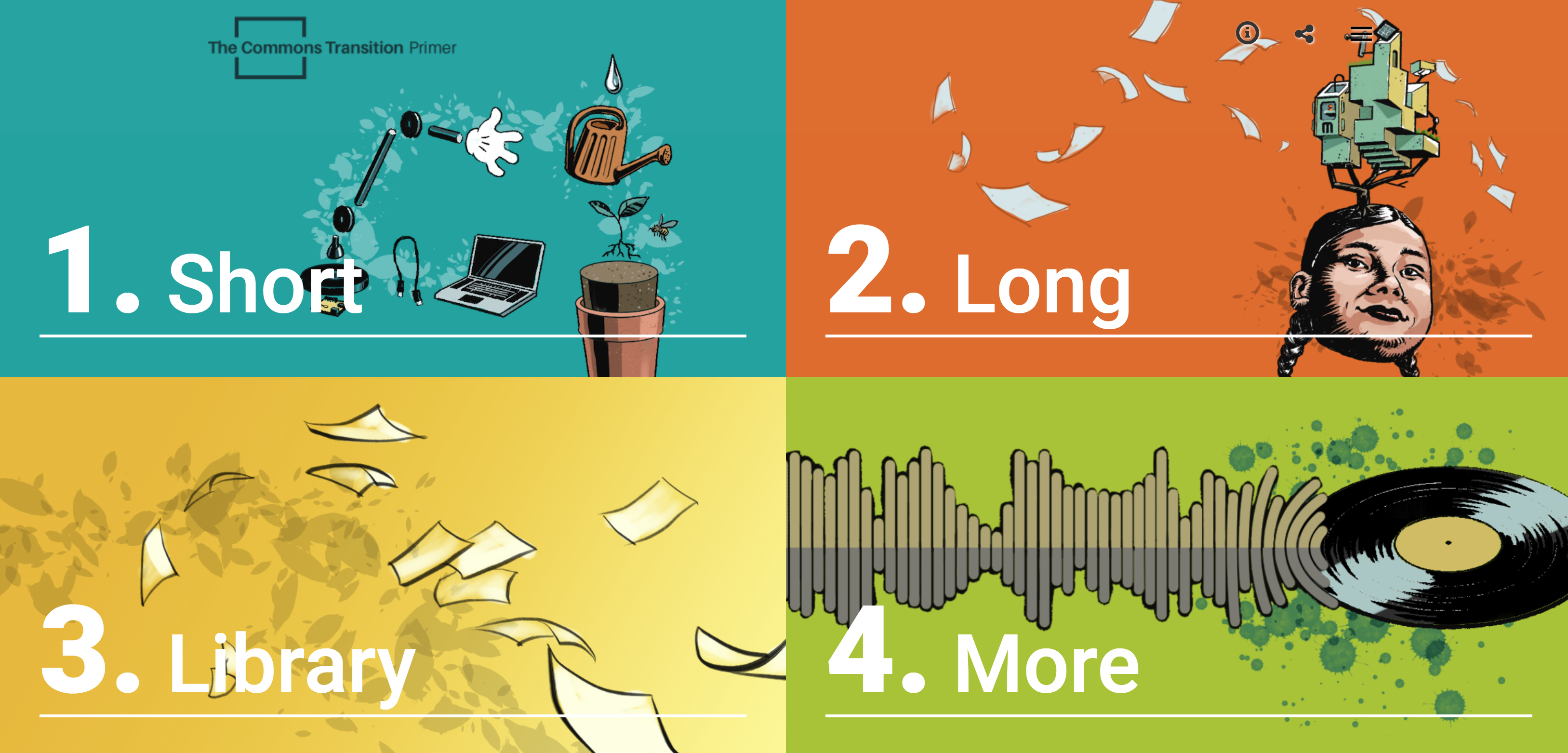
The Commons Transition Primer Demystifies and Delights

You are not likely to encounter a more welcoming set of texts and infographics to introduce the commons and peer production than the Commons Transition Primer website.

The new site features four types of materials suited different levels of interest: short Q&A-style articles with illustrations; longer, in-depth articles for the more serious reader; a library of downloaded PDF versions of research publications by the P2P Foundation; and a collection of videos, audio interviews and links to other content. 

The website does a great service in introducing topics that are sometimes elusive or abstract, giving them a solid explanation and lots of working examples. Go check it out!

Start with a series of Short Articles that addresses such questions as "What is a commons transition?" and "What is distributed manufacturing?" Then browse the Longer Articles section and read “10 ways to accelerate the Peer to Peer and Commons Economy,” a visionary piece on the movement to design global and manufacture locally. 


The Library contains a number of major reports on how to embark upon a commons transition. The organizational study of Catalan Integral Cooperative as a post-capitalist model is fascinating. Check out the new conceptualizations of value in a commons economy, and the two-part report on the impact of peer production on energy use, thermodynamics, and the natural world. 

There is also a wonderful overview of some leading commons, especially tech-oriented ones, in a collection of fifteen case studies. These explore such projects as Wikihouse, Farm Hack, L’Atelier Paysan, Mutual Aid Networks, Spain’s Municipalist Coalitions, and the Ghent’s urban commons (in Belgium).

Elena Martinez Vicente has produced a number of fantastic infographics that really help demystify some abstract ideas (the new ecosystem of value creation, patterns of open coops, cosmo-local production). Mercè Moreno Tarrés did the dazzling original art for the site, which helps make the material so engaging.  

The Commons Transition Primer was produced by the Peer to Peer Foundation and P2P Labs with support from the Heinrich Boell Foundation. Kudos to Stacco Troncoso and Ann Marie Utratel for conceptualizing the project and preparing much of the material, and to Michel Bauwens and Vasilis Kostakis for their contributions to the text.

THANK YOU for Your Support During our NCDD Fund Drive!

WOW! Huge thank you to everyone who showed their support for NCDD during our 2017 end of year fund drive – by directly contributing donations to the drive, and to those who joined NCDD as a member or renewed their membership. Over the course of the drive, our network met two fundraising matching challenges – the first of which was sponsored by NCDD board member Simone Talma Flowers and the second matching challenge which was sponsored by NCDD board chair, Martín Carcasson and an anonymous donor. We finished off the drive and 2017 by raising a total of $8,501 during the holiday season, which we understand can be a tight time of the year for extra expenditures – so a major thank you indeed!

We are humbled and appreciative of the support from our network for the work we do connecting the growing dialogue and deliberation field, and your generous contributions give NCDD an extra boost as we accelerate into 2018. For over 15 years, NCDD continues to serve as a hub, resource clearinghouse, and facilitative leaders for the dialogue, deliberation, and public engagement community. In addition to the work we already do supporting and connecting the D&D community through our conferences, blogs, listservs, forums, and resources; we are excited to expand our partnerships (like those with the American Library Association), our Emerging Leaders Initiative, and to put on another fantastic conference this year.

We are a small operation running on a shoestring budget and every little bit helps! We have lots in store for 2018, especially our 2018 National Conference on Dialogue and Deliberation, which will be happening next fall. Stay tuned to the NCDD blog, where we will be announcing the date and location of the conference and the application process for workshop proposals. We are thrilled for this upcoming conference, as the past conferences have been a fantastic opportunity to mingle and collaborate with folks in the field driving D&D work. If you’ve never been to an NCDD conference and you’re interested to learn what past conferences have been like, then click here!

Although the fund drive is officially over, you can always support NCDD at any time by giving a donation, joining as an NCDD member or renewing your membership by clicking here. Some benefits of being an NCDD member include: sharing content on the NCDD blog and having access to other members-only opportunities (read the full list here), being listed in the member map/directory, and discounts on NCDD events and with our partners (listed here). For a full list of member benefits and to join our thriving network of practitioners and innovators, click here!

Thank you again for your support, and here’s to a great New Year!

Choicebook

Method: Choicebook

Choicebook is an online survey tool used primarily by national governments to source public opinion on various policy issues. Each public consultation publicizes a dedicated Choicebook website. Participants are provided with background material on the policy issue and guided through a series of questions with fixed, multiple-choice response options. The...

New Online PD Cohort for Discussion and Deliberation Starting Soon!

Friends, we have talked about this effort before, but we are sharing this again because we believe it is an incredible opportunity for learning, collaboration, and cohort building. This is a way in which your students can develop their own civic skills and dispositions, and for teachers to consider new pedagogical and professional development approaches. It is open to Grade 6-12 teachers in Social Studies, ELA, Reading, or Science, and includes a stipend for Florida teachers. This is an entirely online cohort, so no travel is required or expected. Just try new things, collaborate, and learn with colleagues as your students grow as citizens.
The online PD is starting soon – Contact Val McVey, Valerie.McVey@ucf.edu, for more information and to enroll.
CRF Image

SCHEDULE OF EVENTS
A. Civil Conversation

1. View recorded webinar. You can find the webinar here.

2. Live Q&A with teachers on January 30, 2018. 4–4:30 PT, 5 pm MT, 6 pm CT, 7 pm ET.

3. Choose a lesson from the Library and try it out with a class. Any time before March 1.

4. Post thoughts on discussion board. Any time before March 10.

 B. Role Play/Simulation as Academic Discussion

1. Live webinar on March 15.  4-5 pm PT, 5 pm MT, 6 pm CT, 7 pm ET.

   (Or watch recorded webinar after March 16 and join live discussion on March 27.)

2. Try it out with a class. Any time before May 1.

3. Post thoughts on discussion board. Any time before May 10.

4. Reteach a Civil Conversation or Role Play. Any time before May 30.

 C. National Webinar, Flash Survey, and Stipend! (End of May.)


Community-Police Relations Confab Call Lessons with PCRC

In case you missed it, we had another fantastic Confab call with NCDD member org, the Peninsula Conflict Resolution Center (PCRC) in December. We were joined by roughly 60 participants to learn more about PCRC’s work over the last 20 years coordinating community-police relations and their best practices for how they have brought people together. Listen to the recording if you weren’t able to make it, because it was a great call!

On the call, we were joined by PCRC Executive Director Michelle Vilchez and Engaging Communities Initiative Director Malissa Netane who shared with participants some of the tenets of PCRC and strategies they’ve used to bridge divides between the community and police in San Mateo County, CA. A big part of the work that PCRC does is done collaboratively and before any engagement effort immense pre-work must be done, especially for more contentious issues. They are diligent to go to the community they are working with and personally get to know folks, ensure that people have a space to share their stories before gathering together in a larger group, and build relationships through dialogue. PCRC is mindful of the communities they are working with and are sensitive of the particular needs of each group, they emphasized the vital need to work with cultural humility when dealing with communities. – “When engaging any group that’s outside your own, you don’t have to be an expert in someone else’s culture. Have a commitment to learn and know there are culturally appropriate ways to communicate.”

“What a great call. I was struck particularly by how dialogue is one element in their larger strategy for community building: in many ways, they’re engaging in culture change as much as anything else. It makes me wonder how many dialogue efforts are tied into larger strategies in this way.” – John Backman, Confab participant

We want to thank Michelle, Malissa, and all the Confab participants for contributing to this important conversation! To learn more about NCDD’s Confab Calls and hear recordings of others, visit www.ncdd.org/events/confabs.

Confab bubble imageNo worries if you couldn’t participate in the Confab – we recorded the whole presentation, which you can find on the archives page by clicking here. Access to the archives is a benefit of being an NCDD member, so make sure your membership is up-to-date (or click here to join). We had several excellent contributions on the chat, which you can find the transcript of here.

Finally, we love holding these events and we want to continue to elevate the work of our field with Confab Calls and Tech Tuesdays. It is through your generous contributions to NCDD that we can keep doing this work! That’s why we want to encourage you to support NCDD by making a donation or becoming an NCDD member today (you can also renew your membership by clicking here).

Tisch College / Sociology Postdoc in Civic Studies

Tufts University Jonathan M. Tisch College of Civic Life & School of Arts & Sciences (Sociology) Postdoctoral Fellowship in Civic Studies

Tufts University’s Department of Sociology and the Jonathan M. Tisch College of Civic Life will award a Postdoctoral Fellowship in Civic Studies for the 2018-19 academic year to a scholar with a Ph.D. in Sociology who is not yet tenured. The Fellowship will begin July 1, 2018. We seek a sociologist whose research bears on civic engagement, broadly defined. Possible research topics include, but are not limited to, civil society, grassroots engagement, forms of citizenship, non-profits, social movements, democratic participation, and public sociology.

The Fellow will be expected to teach one academic course per semester in the Department of Sociology at the undergraduate level on topics related to civic life, in addition to conducting their research. In addition, the Fellow will be expected to deliver a public lecture at Tufts on the topic of their research, to contribute to the intellectual life of the university, and to participate in initiatives on campus concerning civic engagement as relevant. The Fellow will be housed in the Department of Sociology at Tufts University.

QUALIFICATIONS
Scholar with a Ph.D. in the field of Sociology who is not yet tenured.

APPLICATION INSTRUCTIONS
All applications must be submitted via Interfolio at: http://apply.interfolio.com/48127. Applications should include: (1) a cover letter which includes a description of your research goals during the fellowship year and the courses you would like to offer; (2) your CV; (3) one writing sample; (4) three letters of recommendation which should be uploaded by your recommenders to Interfolio directly; and (5) teaching course evaluations, if available.

Review of applications will begin February 1, 2018 and will continue until the position is filled.

Questions about the position should be addressed to Tisch College Associate Dean of Research Peter Levine at Peter.Levine@tufts.edu.

NCDD Board Member on Protecting our Civic Ecosystem

Our NCDD board member, Jacob Hess recently wrote a piece in which he correlates the increasing call to protect our threatened natural ecosystems with the need to also protect our democratic ecosystem. In the article, he shares his experience adapting Living Room Conversations in Utah by collaborating with individuals and organizations already doing civic engagement work, of which developed into a thriving network of civically-engaged folks. We encourage you to read Jacob’s piece below or find the original here.


Preserving and Protecting Our Precious Civic Ecosystem

Lots of attention is going today to physical habitat under siege (and for good reason): without more attention, many of these beautiful areas might go away, or be irreparably damaged. For that reason, many believe that energy invested in this protection and preservation is well spent.

Far less attention, however, goes to the way our civic ecosystem remains under increasing siege. What began as occasional concern for the hostility in the U.S. media and elected leaders, has become widespread trepidation regarding public animosities deepening in every direction, on nearly every issue.

Some believe that without more attention, this precious civic ecosystem could go away or likewise become irreparably damaged, thus prompting similar calls for additional investment to protect and preserve this fragile democratic habitat.

A case study in Utah. Starting in 2014, I had the opportunity to work for Living Room Conversations in a Utah experiment to help cultivate the civic ecosystem there. Rather than plowing up the roots already in place (or riding into town with the “newfangled solutions”), it felt important to build upon and leverage whatever rich habitat already existed.

Thus we began with a local reconnaissance reaching out to 20 different civics organizations to find out what had already been done (it turns out, a lot, as you can see here in a general summary and here in a more recent success in LGBT-religious conservative dialogue). After meeting with a number of leaders in the past work, including John Kesler (Salt Lake Civil Network), Michele Straube (Environmental Dispute Resolution, U of U) and David Derezotes (Peace & Conflict Studies, U of U), I was struck at how underrecognized and little known their efforts were, compared to much louder initiatives that captured the public eye.

Given the lack of recognition and continuing suspicion this kind of bridge-building elicited from many, we have experimented with different ways to connect more people to the possibility of vibrant and productive “disagreement practice”, as defined in the AllSides Dictionary.

Small is big. Perhaps the most obvious way to do so is meeting people where they are – in their own homes and communities. From my own early experiences, I quickly became mesmerized by the almost magical power of small group gatherings to bring people together across divides (see Eating Hummus With the ‘Enemy’: From Aversion to Affection).

We subsequently experimented with different ways to introduce people in Utah to this Living Room Conversation practice, from a local press release with offers of free consultation, to highlights of a filmed conversation, to even going door to door with invitations in my own neighborhood. Our conversations ranged from gun rights and evolution, to women’s rights and same-sex marriage/religious freedom. Everyone who participated came away feeling uplifted and encouraged. Out of all these efforts, two additional lessons became clear: (1) The pervasive busyness of American culture remained the largest barrier to involvement: why should I take away time from other things to do this? (2) As simple as these conversations seem, they elicit some visceral fears in some people of political confrontation or dangerous exposures. That explains another parallel dialogue “gateway” that we attempted.

Easing concerns with a PARTY! Alongside direct invitations to try it in your own home, we also organized larger community events where people could come have some food, laugh and watch a high-quality conversation take place on stage. This was possible due to the critical support of our key partner, Utah Humanities, in two different “seasons” of dialogue events. As you can see in the highlights from our inaugural Village Square event, we intentionally aimed to make the atmosphere light and social.

After repeating this approach in a dialogue on the secular/religious divide in Utah, we got feedback that people wanted more of a chance to explore the issue on their own, rather than just listen to a panel explore it. So in each event since – immigration, policing, climate change, racial bias – we have done a hybrid Village Square / Living Room Conversation model, where we begin with small table conversations over a meal before turning to a panel and then ending with small debriefing conversations.

The success of these efforts over time led to a larger, day-long gathering, that we called the Utah Citizen Summit. Sponsored by nearly 15 prominent Utah organizations, this event brought together local citizens and national speakers to first, learn how and practice dialogue, and then celebrate positive steps being taken. That event expanded our network to include the Salt Lake Public Library system, The Deseret News (the largest newspaper in the state), Salt Lake County Mayor Ben McAdams’ office, the Governor’s Office of Civic & Character Education, the NAACP, and the conservative Sutherland Institute.

Equipping citizen leaders. Even with all this, however, we noticed most people were hesitant and not confident in their own capacity to make any difference. Thanks to a grant from the Bridge Alliance, we’ve started an ongoing series of training for citizens who want to grow in their capacity to lead conversations, using the Essential Partners “Power of Dialogue” trainings as a vehicle.

Each participant comes away from these trainings with a new awareness of the many approaches they might use in their own community.

Building a practice network. One single event or training is not enough, though. As with most any craft, real time and work is needed to hone and develop the practice.For that reason, we have been deliberate about developing a network of dialogue practitioners throughout the state. This includes in-person and zoom meetings, as well as ongoing coordination in how to support each other’s work.

Like those who gather who practice meditation and gather with others for ongoing support and training, we aim to be a community of like-minded folks who support each other in “honing the craft.” Part of this “practice network” approach is helping each other make space and time for the practice, much like a meditation network encourages each other to “keep practicing.”

Why do we make time for this?

Because it’s worth prioritizing. Rather than waiting for national leaders to figure out how to talk across differences, our network of Utah citizens are committed to do whatever we can cultivate and preserve the civic ecosystem in our own communities. Once again, instead of advocating one technique, one organization or one practice as holding the singular capacity to “save” us from our current political atrophy, our overriding focus is on the complex and multiform civic ecosystem needed in order for communities to thrive. Just as, in nature, no single species in an ecosystem can thrive without a degree of interdependence on other forms of life, so too must efforts toward constructive dialogue draw strength from a web of other existing efforts. In this way, we envision Utah becoming a national model of what it takes to fight to protect a robust ecosystem for civic engagement, and in this way, strengthen our democracy.

You can find the original version of Jacob Hess’ article at: www.livingroomconversations.org/preserving-and-protecting-our-precious-civic-ecosystem/.

Civil Conversation Transforms Holiday Experiences

While the holiday season is now behind us, we wanted to pass along this reflection shared with us from NCDDer Ellen Geisler on their transformative holiday experience bringing facilitated dialogue to her family. In the article, she talks about how a civic engagement series at a public library opened up space for community dialogue (similar to the NCDD partnership with ALA). Geisler then brought civil dialogue home for the holidays and shares a key takeaway as we move into the New Year – that we can strongly disagree and still hear each other out. You can read the article below or find the original here.


Helping Families Learn How To Disagree About Tough Topics Over The Holidays

Every year, my large, extended family gathers for the entire week of Thanksgiving, which also coincides with deer hunting season in Wisconsin. While we agree to get along, we also rarely talk about controversial topics and the underlying values we hold that shape our perspectives on them. This Thanksgiving, though, inspired by my work as a community development educator for University of Wisconsin-Extension Marinette County, I brought one work project home to my family gathering.

Civility Speaks was a series of discussions held at the Stephenson Public Library in Marinette from June 2016 to June 2017. The series began when a patron asked if the library could organize events for visitors to learn and talk about controversial issues in a non-threatening environment in the lead up to the 2016 presidential elections. Working with UW-Extension, the library hosted community discussions that gave participants an opportunity to talk about controversial issues.

The goals of such discussions are that as participants learn about issues, they learn how to transform conflict, take individual and collective action, and improve institutional decision making. In turn, these changes can lead to increased civic capacity and improved community problem solving.

The series included discussions on a variety of topics throughout the year. For example, one was co-facilitated by Amy Reddinger, director of the LGBT Center at UW-Marinette, which serves Marinette and Oconto counties in Wisconsin and Menominee County in Michigan’s Upper Peninsula.  More than 30 people gathered at the library to learn and talk about transgender youth. One participant attended “to learn more about LGBT communities and how I could be more open-minded toward LGBT people,” and another asked, “what cultural issues can address these issues for our children and take away fear and [stigma] that may exist?”

It was surprising to hear transgender youth who attended the discussion describe their experiences with teachers and school administrators. The youth said they felt unsupported and in some cases threatened by classmates and adults. The LGBT Center, which opened in February 2017, continues to host events about transgender-related topics and other issues to build awareness and fulfill needs of the region’s LGBT community and their family and friends.

Prior to Thanksgiving this year, my uncle invited me to share with our family what I do for work — I suggested we organize a facilitated discussion about the use of technology. Politics, religion and agricultural production methods were all topics that hit close to home, so I proposed we start with an easier topic that wouldn’t necessarily feel so personal.  We all needed practice disagreeing with each other and talking about our values, as we rarely reach that area of conversation within our family.

After supper the Tuesday before Thanksgiving, my uncle introduced me as the guest facilitator for our family’s discussion, which would include 25 people ranging from age 8 to 65. We started by establishing ground rules as a group, and to my surprise everyone agreed to stay and participate instead of moving to another table to play cards. Everyone worked in groups of three or four responding to questions I offered. Every 10 minutes, they rearranged into new groups and I gave another prompt.

When the family came back to a large group to debrief, the most pleasing feedback was two adults, ages 65 and 35, saying they were impressed and excited by the thoughtful responses and participation from the youngest members of the family.

Our family comes from a dozen households, each with differing set of rules about what can or cannot be talked about in polite company. However, because this discussion started with established ground rules, everyone was on the same playing field.

During our family discussion, it was surprising to notice the kids seemed more at ease than the adults. When probed with questions like, “What about that is important to you?” the younger family members were eager to expound. The fact that so many relatives could listen to each other encouragingly suggests that we can disagree openly and continue to get along.

The day after our family discussion, it was revealed that four cousins in their 20s stayed up well into the night, prompted by one cousin who expressed an interest in discussing “something that matters, like abortion or euthanasia.” In another unanticipated outcome, a cousin and I slowly worked our way into discussing our perspectives about a topic about which we very strongly disagree.

My family is making progress in ways I could never have imagined. My optimistic five-year plan is to encourage family members who don’t want to ruffle feathers to talk about more contentious topics like reproductive rights, gender and sexuality, or immigration. It was exciting to take civil dialogue home for the holidays.

WisContext produced this article as a service of Wisconsin Public Radio, Wisconsin Public Television and Cooperative Extension.

You can find the original article on the WisContext site at www.wiscontext.org/helping-families-learn-how-disagree-about-tough-topics-over-holidays.