
how to tell if you’re doing good

If you have the capacity to affect other people, there seem to be three basic ways to decide what to do–and then to assess how much good you’ve done once you’ve acted.

  1. You can talk to the people affected. You can consult your fellow citizens or even convene them to deliberate and decide together. The advantages include sensitivity to a wide range of perspectives and considerations, from justice to practicality; nuance and complexity; and the chance for people to learn and enrich their individual views. Asking people to assess and influence the policy also honors their dignity and agency. On the other hand, actually asking very large numbers of people to deliberate and decide everything is prohibitively difficult and expensive. Consulting samples of people fails to enhance the agency of everyone else. Further, discussions are subject to serious and pervasive flaws, such as cognitive biases, inequalities of power and influence, tyranny of the majority, and vulnerability to manipulation and strategic action.
  2. You can predict and empirically assess the impact of what you do. You can use scientific methods to make predictions and test causal hypotheses. Science incorporates safeguards against biases, such as random sampling and blind review. It’s much more likely than deliberation to predict accurately what will happen if you do something. But it cannot determine whether your methods or your goals are good ones. And it confers power on experts (or employers of expertise) in ways that can be problematic.
  3. You can observe price signals. If milk is selling for more than the price of producing it, then people must want milk, and providing it meets a need. The feedback from prices is immediate; it reflects many people’s knowledge, choices, and agency; it’s hard to manipulate; and it allows comparisons. Since you are responsible for allocating finite resources among all possible purposes, prices give you a common metric. One evident drawback  is inequality. For example, market prices would suggest that there’s weak demand for clean water, even though 2.1 billion people lack access to it. They have too little money to affect prices. However, if you are concerned with justice, you can adjust price signals for equity. For instance, you can give poor people money and let them decide how to spend it, instead of dictating their choices. The other major problem with price signals is that they fail to make moral distinctions. Methamphetamine and antibiotics both have prices. It takes a combination of science (to assess affects) and deliberation (to discuss values) to determine that antibiotics are good while meth is bad.

All sectors of a modern society use all three methods. But I would argue that democratic governments are particularly obliged and well-suited to use deliberation. The fact that every citizen has a vote reflects: 1) the equal right of each person to affect outcomes, and 2) the obligation of every citizen to learn and discuss before making choices. For that reason, governments have formed parliamentary bodies and courts that are supposed to deliberate, they have safeguarded free speech, and they have built ways of consulting publics. Unlike a discretionary decision by a private entity, a government program must be subject to public deliberation because it is the people’s government.

Nonprofit associations and philanthropies use discussion and price-signals. But they are particularly well suited to use “science” (in its broadest form, including ad hoc experimentation and program evaluation). The fact that there are large numbers of modest-sized nonprofits and donors means that each one can try different things and observe the effects without accumulating dangerous amounts of power and influence. When their experiments work, others can pick them up. And unlike for-profit firms, they can ignore price signals in order to pursue goals that they believe in for moral reasons. This is why program evaluation is so common in the non-profit sector, whereas major governmental decisions–even massive tax cuts or wars–are hardly ever subject to formal evaluation.

Companies, obviously, use price-signals. If Toyota can’t sell enough Corollas at a profit, it will realize it must change its business. If it observes that Subaru is more profitable, it will consider copying Subaru. However, it’s worth noting that prices offer insufficient guidance even for profit-maximizing firms. Again, assume that Toyota suddenly cannot sell enough Corollas. It must find out why not, and that will probably require some combination of asking people what they value and studying causes and effects–the same techniques used by democratic governments and philanthropies.

Among people committed to democracy and/or philanthropy, prices provoke unease. When something previously offered free is charged for, critics will complain of “neoliberalism” and “marketization” or “commodification.” But if that good was scarce and provided to some group without a charge, then someone must have decided to allocate resources for that purpose and to that group (instead of to something and someone else). Those who make such decisions are morally responsible for exercising their power well. They should strive to determine whether their choices benefit the world. Consultation and science are two means for that purpose, but both have limitations. Prices are also very useful for determining demand and for making comparisons. Not only should responsible people notice prices, but they should worry about whether their actions (through governments and philanthropies) are distorting price signals in ways the deprive them of useful information about other people’s needs. For instance, if you offer free tuition, you can no longer tell whether schooling is what people want.

On the other hand, prices certainly do not offer all the necessary and relevant information, even for people and firms that want to make a profit–and still less for people who pursue justice.

Upcoming 2018 IAP2 Trainings with TPC

If you are looking for D&D trainings to kick off your year, we encourage you to check out the new calendar of trainings offered by NCDD member organization The Participation Company. TCP offers certification in the International Association for Public Participation‘s model, and dues-paying NCDD members get a discount on registration! We encourage you to to read more about the trainings in the TCP announcement below or learn more here.


The Participation Company’s 2018 Training Events

If you work in communications, public relations, public affairs, planning, public outreach and understanding, community development, advocacy, or lobbying, this training will help you to increase your skills and to be of even greater value to your employer.

This is your chance to join the many thousands of practitioners worldwide who have completed the International Association for Public Participation (IAP2) certificate training.

AICP members can earn Certification Maintenance (CM) credits for these courses.

Foundations in Public Participation (5-Day) Certificate Program:

Planning for Effective Public Participation (3-Days) and/or *Techniques for Effective Public Participation (2-Days)

  • Jan. 31-Feb 2 in Boulder, CO:  3-day Planning
  • Mar. 19-23 in Phoenix, AZ: 5-day Both courses
  • Jul. 30-Aug 3 in Minneapolis, MN: 5-day Both courses
  • Sep. 24-28: Chicago, IL: 5-day Both courses

*The 3-Day Planning training is a prerequisite to Techniques training

IAP2’s Strategies for Dealing with Opposition and Outrage in Public Participation (2-Days)
formally Emotion, Outrage – newly revised and renamed

  • Mar. 26-27 in Salt Lake City, UT
  • Apr. 19-2o in Orange County, CA
  • Apr. 26-27 in Los Angeles County, CA
  • Jun. 28-29 in Denver, CO
  • Jul. 26-27 in Minneapolis, MN
  • Oct. 18-19 in Chicago, IL

Register online for these trainings at www.theparticipationcompany.com/training

We also anticipate additional training coming to the following cities:

Foundations: Chicago, DC area, Orlando
Strategies/Outrage: Las Vegas, San Diego

The Participation Company (TPC) offers discounted rates to NCDD members. 

TPC can also assist you and your organization in other endeavors! Our team of highly experienced professionals help government and business clients manage public issues to accomplish client’s objectives. We can plan and manage your participation project from start to finish. We can provide strategic advice and direction. We can coach and mentor your staff and managers. We help you build agreements and craft durable and defensible decisions.

2018 European Summer Institute of Civic Studies

Call for Applications

We are happy to invite you to participate in the European Summer Institute of Civic Studies that will take place in Herrsching near Munich, Germany, from July 15th to July 28th 2018. The Summer Institute of Civic Studies is organized by a team from the University of Maryland (Prof. Karol Soltan) and the Catholic University Eichstätt-Ingolstadt/University of Augsburg (Prof. Tetyana Kloubert) with Tufts University’s Prof. Peter Levine, who will join for two days.

The total number of participants will be limited to 20. We will consider applications from Armenia, Azerbaijan, Belarus, Georgia, Germany, Kazakhstan, Kyrgyzstan, Moldova, Poland, Russian Federation, Turkmenistan, Ukraine and Uzbekistan. [Revised list, 1/15/18] We are especially interested in applicants who have a long-term interest in developing the civic potential of the region. If you are from elsewhere in the world, the Tisch College Summer Institute of Civic Studies at Tufts is a better fit.

Objectives and topics

The Summer Institute of Civic Studies is an intensive, two-week, interdisciplinary seminar bringing together advanced graduate students, faculty, and practitioners from diverse fields of study. It is part of an effort to build a new inter-disciplinary field of civic studies, aiming to develop ideas helpful to citizens. The notions of civic ideals, civic competence, civic society, and civic culture all capture in various ways the perspective of this emerging field.

Summer Institutes of Civic Studies have been annually organized by Peter Levine and Karol Soltan at Tufts University since 2009. The Tufts Summer Institutes has been organized around the theme of the interaction of theory and practice. They have aimed above all to establish civic studies as a theoretically serious field.

The European Summer Institute incorporates in addition distinctly European topics, such as the European Union. But within the European Summer Institute, with its roots in Eastern and Central Europe, we have also introduced a deeper second theme. We aim to develop the civic perspective in the shadow of past totalitarianism and its horrors. We look at modernity as a venue of civic work, with special attention to the fact that modernity also produced Lenin, Stalin and Hitler.

Civic Studies draws on examples from the practices of multiple civic society initiatives. Often the key question is strategic: What was practically possible and under what circumstances? For this purpose, examples from different international contexts are helpful, as they illuminate the possibilities and limitations of the establishment of civic perspectives. We seek to identify country-specific civic society projects, to search for a link between science and practice in the regional and international context and to promote intercultural encounters and intercultural learning.

The Summer Institute of Civic Studies deals with issues of development of civil society, the role of an individual/citizen in society, the role of education and the role of institutions in supporting, promoting and deepening democracy, and questions related to the ethical foundation of civic issues in a (democratic) society. These topics will be examined in international and comparative perspectives, considering European (especially German) and US-American civic traditions. International examples will be discussed in the context of consolidation of democracy in Eastern Europe, and in the context of the recent challenges of populism.

The Summer Institute of Civic Studies engages participants in challenging discussions such as:

  • What kinds of citizens (if any) do good regimes need?
  • What should such citizens know, believe, and do?
  • Should we reformulate the project of democracy in response to the challenge of populism, and if so, how?
  • What ought to be the relationships among empirical evidence, ethics, and strategy?

How to apply

All application materials must be submitted in English. The application must include the following:

  • A cover letter telling us why you want to participate in the summer institute and what you would contribute (maximum 2 pages)
  • A curriculum vitae

All application material can be sent as an email attachment in DOC or PDF format to tetyana.kloubert@ku.de.

Decisions will be announced in April 2018.

The working language of the Summer Institute will be English. Your mastery of the English language must be sufficient to read and understand complex texts from multiple disciplines, and to take part in a lively discussion.

Deadline

For best consideration apply by March 1, 2018.

Expenditures

The Summer Institute of Civic Studies is being funded by the DAAD (German Academic Exchange Service). All participants will be paid for their travel costs, accommodations, meals and full event access.

Contact

For more information about the Summer Institute of Civic Studies please contact tetyana.kloubert@ku.de

We encourage you to share this message with your networks of people who might be interested by the Summer Institute of Civic Studies.

The Commons Transition Primer Demystifies and Delights

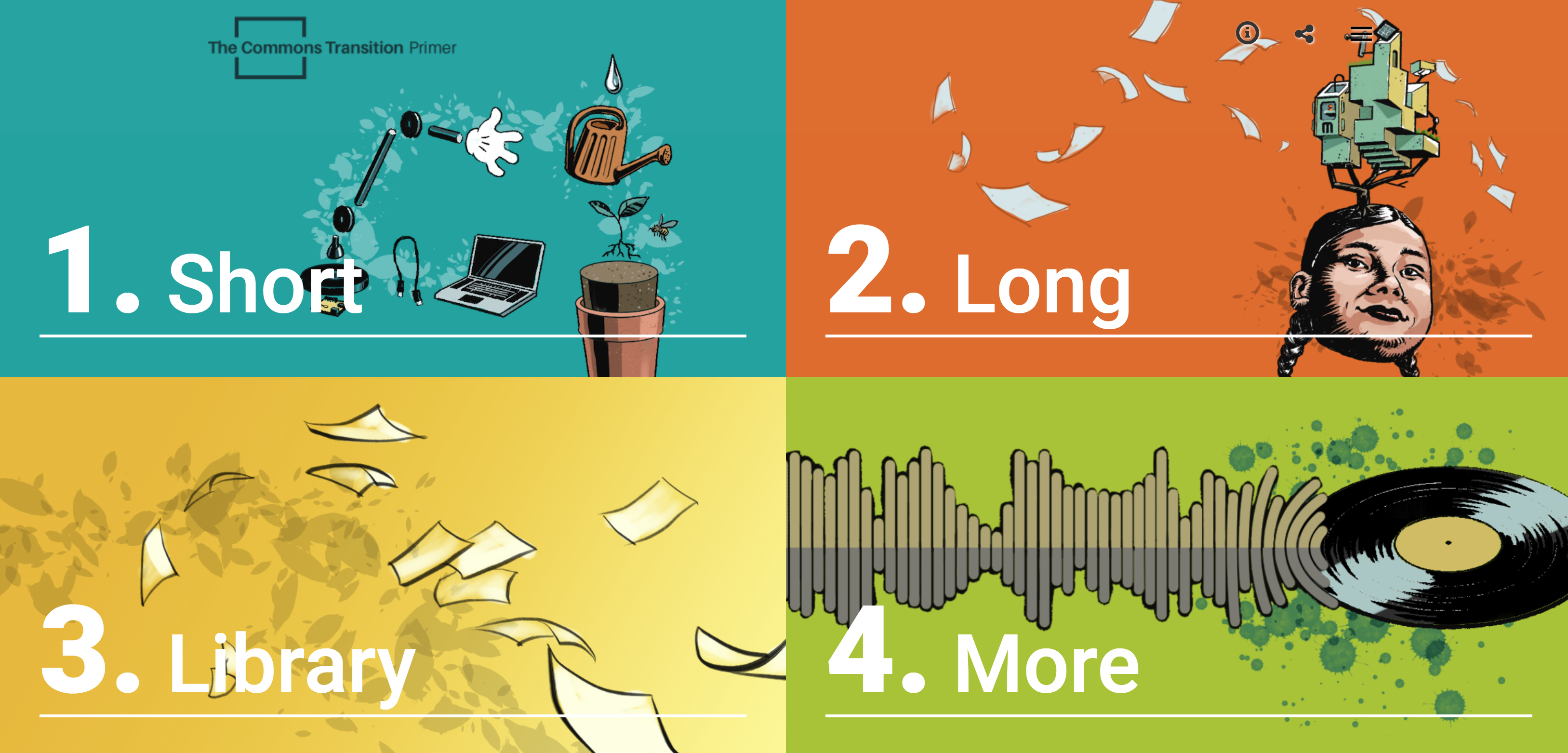
You are not likely to encounter a more welcoming set of texts and infographics to introduce the commons and peer production than the Commons Transition Primer website.

The new site features four types of materials suited different levels of interest: short Q&A-style articles with illustrations; longer, in-depth articles for the more serious reader; a library of downloaded PDF versions of research publications by the P2P Foundation; and a collection of videos, audio interviews and links to other content. 

The website does a great service in introducing topics that are sometimes elusive or abstract, giving them a solid explanation and lots of working examples. Go check it out!

Start with a series of Short Articles that addresses such questions as "What is a commons transition?" and "What is distributed manufacturing?" Then browse the Longer Articles section and read “10 ways to accelerate the Peer to Peer and Commons Economy,” a visionary piece on the movement to design global and manufacture locally. 


The Library contains a number of major reports on how to embark upon a commons transition. The organizational study of Catalan Integral Cooperative as a post-capitalist model is fascinating. Check out the new conceptualizations of value in a commons economy, and the two-part report on the impact of peer production on energy use, thermodynamics, and the natural world. 

There is also a wonderful overview of some leading commons, especially tech-oriented ones, in a collection of fifteen case studies. These explore such projects as Wikihouse, Farm Hack, L’Atelier Paysan, Mutual Aid Networks, Spain’s Municipalist Coalitions, and the Ghent’s urban commons (in Belgium).

Elena Martinez Vicente has produced a number of fantastic infographics that really help demystify some abstract ideas (the new ecosystem of value creation, patterns of open coops, cosmo-local production). Mercè Moreno Tarrés did the dazzling original art for the site, which helps make the material so engaging.  

The Commons Transition Primer was produced by the Peer to Peer Foundation and P2P Labs with support from the Heinrich Boell Foundation. Kudos to Stacco Troncoso and Ann Marie Utratel for conceptualizing the project and preparing much of the material, and to Michel Bauwens and Vasilis Kostakis for their contributions to the text.

THANK YOU for Your Support During our NCDD Fund Drive!

WOW! Huge thank you to everyone who showed their support for NCDD during our 2017 end of year fund drive – by directly contributing donations to the drive, and to those who joined NCDD as a member or renewed their membership. Over the course of the drive, our network met two fundraising matching challenges – the first of which was sponsored by NCDD board member Simone Talma Flowers and the second matching challenge which was sponsored by NCDD board chair, Martín Carcasson and an anonymous donor. We finished off the drive and 2017 by raising a total of $8,501 during the holiday season, which we understand can be a tight time of the year for extra expenditures – so a major thank you indeed!

We are humbled and appreciative of the support from our network for the work we do connecting the growing dialogue and deliberation field, and your generous contributions give NCDD an extra boost as we accelerate into 2018. For over 15 years, NCDD continues to serve as a hub, resource clearinghouse, and facilitative leaders for the dialogue, deliberation, and public engagement community. In addition to the work we already do supporting and connecting the D&D community through our conferences, blogs, listservs, forums, and resources; we are excited to expand our partnerships (like those with the American Library Association), our Emerging Leaders Initiative, and to put on another fantastic conference this year.

We are a small operation running on a shoestring budget and every little bit helps! We have lots in store for 2018, especially our 2018 National Conference on Dialogue and Deliberation, which will be happening next fall. Stay tuned to the NCDD blog, where we will be announcing the date and location of the conference and the application process for workshop proposals. We are thrilled for this upcoming conference, as the past conferences have been a fantastic opportunity to mingle and collaborate with folks in the field driving D&D work. If you’ve never been to an NCDD conference and you’re interested to learn what past conferences have been like, then click here!

Although the fund drive is officially over, you can always support NCDD at any time by giving a donation, joining as an NCDD member or renewing your membership by clicking here. Some benefits of being an NCDD member include: sharing content on the NCDD blog and having access to other members-only opportunities (read the full list here), being listed in the member map/directory, and discounts on NCDD events and with our partners (listed here). For a full list of member benefits and to join our thriving network of practitioners and innovators, click here!

Thank you again for your support, and here’s to a great New Year!

Choicebook

Method: Choicebook

Choicebook is an online survey tool used primarily by national governments to source public opinion on various policy issues. Each public consultation publicizes a dedicated Choicebook website. Participants are provided with background material on the policy issue and guided through a series of questions with fixed, multiple-choice response options. The...

New Online PD Cohort for Discussion and Deliberation Starting Soon!

Friends, we have talked about this effort before, but we are sharing this again because we believe it is an incredible opportunity for learning, collaboration, and cohort building. This is a way in which your students can develop their own civic skills and dispositions, and for teachers to consider new pedagogical and professional development approaches. It is open to Grade 6-12 teachers in Social Studies, ELA, Reading, or Science, and includes a stipend for Florida teachers. This is an entirely online cohort, so no travel is required or expected. Just try new things, collaborate, and learn with colleagues as your students grow as citizens.
The online PD is starting soon – Contact Val McVey, Valerie.McVey@ucf.edu, for more information and to enroll.
CRF Image

SCHEDULE OF EVENTS
A. Civil Conversation

1. View recorded webinar. You can find the webinar here.

2. Live Q&A with teachers on January 30, 2018. 4–4:30 PT, 5 pm MT, 6 pm CT, 7 pm ET.

3. Choose a lesson from the Library and try it out with a class. Any time before March 1.

4. Post thoughts on discussion board. Any time before March 10.

 B. Role Play/Simulation as Academic Discussion

1. Live webinar on March 15.  4-5 pm PT, 5 pm MT, 6 pm CT, 7 pm ET.

   (Or watch recorded webinar after March 16 and join live discussion on March 27.)

2. Try it out with a class. Any time before May 1.

3. Post thoughts on discussion board. Any time before May 10.

4. Reteach a Civil Conversation or Role Play. Any time before May 30.

 C. National Webinar, Flash Survey, and Stipend! (End of May.)


Community-Police Relations Confab Call Lessons with PCRC

In case you missed it, we had another fantastic Confab call with NCDD member org, the Peninsula Conflict Resolution Center (PCRC) in December. We were joined by roughly 60 participants to learn more about PCRC’s work over the last 20 years coordinating community-police relations and their best practices for how they have brought people together. Listen to the recording if you weren’t able to make it, because it was a great call!

On the call, we were joined by PCRC Executive Director Michelle Vilchez and Engaging Communities Initiative Director Malissa Netane who shared with participants some of the tenets of PCRC and strategies they’ve used to bridge divides between the community and police in San Mateo County, CA. A big part of the work that PCRC does is done collaboratively and before any engagement effort immense pre-work must be done, especially for more contentious issues. They are diligent to go to the community they are working with and personally get to know folks, ensure that people have a space to share their stories before gathering together in a larger group, and build relationships through dialogue. PCRC is mindful of the communities they are working with and are sensitive of the particular needs of each group, they emphasized the vital need to work with cultural humility when dealing with communities. – “When engaging any group that’s outside your own, you don’t have to be an expert in someone else’s culture. Have a commitment to learn and know there are culturally appropriate ways to communicate.”

“What a great call. I was struck particularly by how dialogue is one element in their larger strategy for community building: in many ways, they’re engaging in culture change as much as anything else. It makes me wonder how many dialogue efforts are tied into larger strategies in this way.” – John Backman, Confab participant

We want to thank Michelle, Malissa, and all the Confab participants for contributing to this important conversation! To learn more about NCDD’s Confab Calls and hear recordings of others, visit www.ncdd.org/events/confabs.

Confab bubble imageNo worries if you couldn’t participate in the Confab – we recorded the whole presentation, which you can find on the archives page by clicking here. Access to the archives is a benefit of being an NCDD member, so make sure your membership is up-to-date (or click here to join). We had several excellent contributions on the chat, which you can find the transcript of here.

Finally, we love holding these events and we want to continue to elevate the work of our field with Confab Calls and Tech Tuesdays. It is through your generous contributions to NCDD that we can keep doing this work! That’s why we want to encourage you to support NCDD by making a donation or becoming an NCDD member today (you can also renew your membership by clicking here).

Tisch College / Sociology Postdoc in Civic Studies

Tufts University Jonathan M. Tisch College of Civic Life & School of Arts & Sciences (Sociology) Postdoctoral Fellowship in Civic Studies

Tufts University’s Department of Sociology and the Jonathan M. Tisch College of Civic Life will award a Postdoctoral Fellowship in Civic Studies for the 2018-19 academic year to a scholar with a Ph.D. in Sociology who is not yet tenured. The Fellowship will begin July 1, 2018. We seek a sociologist whose research bears on civic engagement, broadly defined. Possible research topics include, but are not limited to, civil society, grassroots engagement, forms of citizenship, non-profits, social movements, democratic participation, and public sociology.

The Fellow will be expected to teach one academic course per semester in the Department of Sociology at the undergraduate level on topics related to civic life, in addition to conducting their research. In addition, the Fellow will be expected to deliver a public lecture at Tufts on the topic of their research, to contribute to the intellectual life of the university, and to participate in initiatives on campus concerning civic engagement as relevant. The Fellow will be housed in the Department of Sociology at Tufts University.

QUALIFICATIONS
Scholar with a Ph.D. in the field of Sociology who is not yet tenured.

APPLICATION INSTRUCTIONS
All applications must be submitted via Interfolio at: http://apply.interfolio.com/48127. Applications should include: (1) a cover letter which includes a description of your research goals during the fellowship year and the courses you would like to offer; (2) your CV; (3) one writing sample; (4) three letters of recommendation which should be uploaded by your recommenders to Interfolio directly; and (5) teaching course evaluations, if available.

Review of applications will begin February 1, 2018 and will continue until the position is filled.

Questions about the position should be addressed to Tisch College Associate Dean of Research Peter Levine at Peter.Levine@tufts.edu.