
Why Civil Resistance Works

Here are some working notes on Erica Chenoweth and Maria J. Stephan, Why Civil Resistance Works: The Strategic Logic of Nonviolent Conflict (Columbia University Press, 2011)

This is their central finding: nonviolent campaigns are nearly twice as likely to win–meaning that they achieve their objectives–as violent campaigns are, and the gap is growing (citing the Kindle edition, locations 315, 337).

This pattern appears to be causal; staying nonviolent increases the odds of success when other factors are held constant. Moreover, countries that have experienced successful nonviolent campaigns are much more likely to achieve “durable and internally peaceful democracies” than those that have experienced violence (351, 1260).

Why would this be? Doesn’t violence help to win many struggles? Didn’t George Washington raise an army to get George III out of the colonies? Chenoweth and Stephan argue:

  1. Nonviolent campaigns are less costly and dangerous to join than violent struggles, so they draw many more people. Although a few participants typically take prominent and perilous roles in a nonviolent campaign, there is also plenty of room for modest acts of support that can preserve the participants’ anonymity and safety (839). Large campaigns sometimes achieve critical mass, when the sheer size of the protests makes it safe to join–and possibly dangerous not to (812). It’s a clear pattern that bigger movements are more likely to win (892). To be sure, some people are drawn by the political potential of violence, the romance of armed struggle, or the sense that being willing to fight confers solidarity and dignity (769, citing Frantz Fanon). But the people drawn to violence tend to be young and male, and a broader base is necessary for victory.
  2. Nonviolent campaigns draw “robust, diverse, and broad-based membership” (351). Diversity is an asset beyond sheer numbers.
    1. When protests are diverse, the authorities can’t “isolate the participants and adopt a repressive strategy short of maximal and indiscriminate repression” (892). In turn, cracking down violently on a broad segment of a population often backfires. Although violent crackdowns do reduce the chance of successful resistance, they also increase the gap in the success rate between nonviolent and violent campaigns (1098, 1421). In other words, if the state is going to attack its citizens, that’s bad news, but the citizens’ smartest move is to remain nonviolent.
    2. Diverse campaigns typically generate a whole range of messages, tactics, and strategies, and that “tactical diversity” allows some options to succeed even if others don’t. In contrast, violent campaigns tend to make irreversible strategic decisions that prove fatal if they fail.
    3. A movement with diverse members is more likely to include people who have personal ties to the security forces, the government, or the business class, so it is more likely to fracture the opposition. Sixty percent of the larger nonviolent campaigns achieve “security force defections (1040). “Fraternization” is an ingredient of many campaigns’ success (1995)
  3. Nonviolent campaigns are much more likely to draw international support (1129).
  4. Authorities have sincere reasons to fear giving up power. Many former rulers have ended their lives before firing squads. Campaigns that are able to maintain the discipline of nonviolence can credibly promise to honor agreements made at the negotiating table, and that increases incumbents’ willingness to yield or share power.

As a matter of definition, we are talking about durable campaigns that have names and goals, not just events, activities, or organizations (426). Nonviolent resistance campaigns employ extra-legal activity (387), not just regular elections or lawsuits. (But sometimes a stolen election is a catalyst for extra-legal protests). They are predominantly and distinctively nonviolent, even though some violence may occur around the margins.

Chenoweth and Stephan contribute to the perennial and basic debate about structure versus agency. A structural theory explains outcomes as a result of big, impersonal forces. For instance, American presidential candidates win if the economic conditions are favorable to them, and not otherwise. It hardly matters what they do or say. An agency theory suggests that it does matter how we choose to act. A structural theory of nonviolent campaigns would attribute their success to factors like fractures in the ruling regime. Chenoweth and Stephan instead “make the case that voluntaristic features of campaigns, notably those related to mechanisms put into place by resistors, are better predictors of success that structural determinants” (1347). As I argue in my Civic Studies video, there are several robust intellectual traditions that not only find agency important in history but also work to enhance agency. Nonviolent resistance is one of those traditions.

As shown on the graph above, many nonviolent resistance campaigns fail. Although they have a surprisingly high success rate, they can still end in tragedy. One challenge is combining unity with diversity. Incorporating many kinds of people in a movement is smart; it clearly increases the odds of success. Yet movements also need unity. It can be hard to convey a coherent message or to negotiate effectively if participants in a movement disagree among themselves.

It’s also easy to overlook–when reading detached cases from distant countries–the sheer emotional difficulty of struggling together within a diverse movement. It sounds like an obviously good thing for the hard-core radicals to join together with police officials who are feeling uneasy about the regime and business interests who see new opportunities. But that’s easier said than done. Even in the relatively tame circumstances of the US in 2018, one can sense deep tensions between people who have been confronting police brutality for decades and people who joined their first protest last January and want to go home safely after the march. Making a movement out of all of them is a spiritual as well as a practical challenge.

I’d interject my SPUD model here. Successful movements must combine unity with plurality, and size with depth, even though those are in tension.
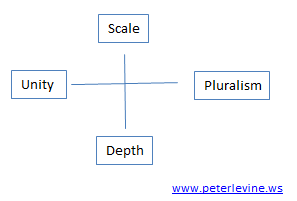
Another challenge is keeping authoritarians from dominating a plural movement. The Iranian Revolution of 1979 began as truly diverse, encompassing religious revolutionaries, secular Marxists, merchants hoping for economic liberalization, civil libertarians, and even a Hippie drug counterculture (2084-2111). To achieve Unity along with all that Pluralism, the movement settled on the Ayatollah Khomeini as a leader, not because they all agreed with his positions but because he seemed uniquely viable (2111). In fact, there wasn’t much discussion in the revolution itself about what Iran should look like after the Shah (2196).  This weakness became critical once the Shah was deposed, the Ayatollah gained power, and he and his allies ruthlessly destroyed all the internal opposition. The question is whether nonviolent social movements can be streams that carry authoritarians into power, and if so, what to do about it.

See also: a sketch of a theory of social movementswhat is a social movement?the kind of sacrifice required in nonviolence; and self-limiting popular politics.

Honoring the Legacy of Dr. Martin Luther King Jr.

In honor of Dr. Martin Luther King Jr.’s legacy, we wanted to share this article from NCDD member org, Everyday Democracy‘s Executive Director, Martha McCoy. The article speaks on the painful realities of racism and how it continues to afflict the world around us. McCoy calls on us to better understand and address racism together in order to create a more just and true democracy. You can read the article in the post below or find the original on EvDem’s site here.


The Urgency of Now

EvDem LogoThe writings of Martin Luther King continue to urge me to clearer sight and greater urgency on issues of racial justice.

As a white girl growing up throughout the South – with most of my young years in Richmond, Virginia – I saw and was part of a genteel culture of segregation and inequality that supported discrimination and a systematic denial of opportunity for people of color. That experience was seared into my brain and soul. I was blessed that black faith leaders and teachers took the time to teach me when I was in my teens and early 20s. They helped me understand the meaning of what I was seeing.

Through the work of Dr. King and others, I began to see how racism affects all of us, not just people of color, and how it suffuses the very fabric of our democracy, to the detriment of all of us. That is why envisioning and fighting for a “New South” that would embrace racial justice – and indeed, a “new United States” – became an integral part of my life’s work.

As we commemorate the fiftieth anniversary of Martin Luther King’s “I Have a Dream” speech and his assassination, may those of us who have internalized his messages bring them to life.  For me, Dr. King is so much more than an historical figure. He affects me directly. The people he taught went on to teach me, and as a result I am working to pass those teachings along. He still speaks to our country today about the “fierce urgency of Now” – a line from his “I have a dream” speech that is less often quoted.

We have an urgent need to help all people in our country understand the ways in which racism sickens our souls, our relationships, and our body politic. We need to understand that racism is a “shape shifter” that uses culture, policies, institutions, and social media to perpetrate itself. But there is the hope that Dr. King described. He called on us to see racism clearly, understand its impact, address it together, and use the highest democratic principles to create true opportunity for all. The more of us who understand that and move forward to create a “New United States” that embraces racial justice, the more authentic our democracy will be, and the more our country will experience true greatness.

You can find the original version of this article on Everyday Democracy’s site at www.everyday-democracy.org/blog/fierce-urgency-now.

Esculeita Zapatista

L’Escuelita zapatista è un percorso di apprendimento, scambio e incontro a cui le comunità resistenti del Chiapas hanno invitato la società civile locale, nazionale e internazionale nel 2013. Un cammino di educazione dal basso in cui migliaia di persone provenienti da tutto il mondo hanno potuto condividere, insieme alle indigene...

where to invest to RAYSE youth civic engagement

CIRCLE has developed RAYSE (Reaching All Youth Strengthens Engagement) to help nonprofits, philanthropists, agencies, political campaigns, activists, and others decide where to invest in youth engagement or understand the strengths and weaknesses of the places where they are committed to work. It organizes data on all the counties in the US.  This new video explains how to use it and also presents a broad strategy for renewing democracy by investing in youth. Get started by looking up your own county!

New D&D Job Openings

Looking to switch things up in your job life? There have been a lot of fantastic job and internship opportunities this month that we’d love to see filled with folks from our talented network! If you’re looking to hear about the jobs we find ASAP, make sure you sign up here for our Making-A-Living listserv where we post opportunities as we find them. To note, access to the Making-A-Living listserv is part of being an NCDD member, so make sure you join/renew your NCDD membership here to receive this great benefit! Finally, if your organization is hiring, send the details directly to the Making-A-Living listserv or to keiva[at]ncdd[dot]org.

The list of the openings and links we’ve seen lately:

Everyday Democracy, an NCDD member org, is seeking a Training and Resource Officer. The position will remain open until filled and applications will start being considered by February 15th. Learn more about the position and how to apply here.

The Participatory Budgeting Project, an NCDD member org, is hiring a Finance and Operations Manager, who would be based out of their Oakland or Brooklyn office. Learn more about the position and how to apply here.

Public Agenda, an NCDD member org, is hiring for a Graphic Designer and Data Visualization Specialist. Learn more about the position and how to apply here.

University of Michigan‘s Program on Intergroup Relations, an NCDD member org, just announced they are looking for an LSA Associate Director and Lecturer. There are two interrelated postings for the position and interested candidates must be qualified and apply for both. Learn more and apply for both postings here and here.

The 106 Group has an opening for a Community Engagement Specialist in the St. Paul, MN office. Learn more about the position and how to apply here.

Anti-Oppression Resource & Training Alliance (AORTA) is looking to hire three worker-owner candidates for full time positions. Deadline to apply is February 11th. Learn more about the position and how to apply here.

The Democracy Fund has several full time job offerings, including: Communications Director. IT Senior Administrator, Executive Assistant to VP & President, Associate Director – Elections Policy, Director of Grants Management, Associate Director – Public Square; as well as a contract position, Project Manager – Voter Study Group. They also have several paid internships available, including: Governance Program Internship, Elections Program Internship, Public Square Internship, as well as, Strategy, Impact and Learning Internship. Learn more about the positions and how to apply here.

Democracy Works is hiring an Administrative Associate in their Brooklyn headquarters and looking to have this person start March 1st. Learn more about the position and how to apply here.

Generation Citizen is looking for a Program Associate for their Teacher-Led model. Deadline to apply is January 22nd but applicants will be considered on a rolling basis until the appropriate candidate is secured. Make sure you move fast on this one if you’re interested. Learn more about the position and how to apply here.

Not in Our Town is hiring for a Community Organizer based in Oakland, CA. Learn more about the position and how to apply here.

Please share with this announcement with your networks and best of luck to all applicants!

new Tisch College summer program for high school students

Tufts Pre-College Intensive Program:
Leadership for Social Change
July 8th-July 20th 2018
Two weeks. Not for credit. Residential.

Join Tufts University’s Tisch College of Civic Life for an exciting, engaging, two-week summer program created for those who are passionate about making a difference in the world and having an impact on local and global issues. With a lens toward advancing equity, inclusion and participation in civic life, the program will equip students with the skills and knowledge to build connections, work collaboratively, and emerge as change agents who can inspire others. The students will also tour several college campuses in the area.

More information here.

Submit Your #CLDE18 Program Proposals by Jan. 29th

For those of you passionate about advancing civic engagement in higher education, make sure you check out the 2018 Civic Learning and Democratic Engagement Meeting (CLDE18) coming up June 6, 2018 in Orange County, California. Coordinated by the American Democracy Project (ADP), The Democracy Commitment (TDC), and the NASPA Lead Initiative; it’s sure to be a great networking and learning opportunity. Program proposals are currently being accepted until January 29, 2018 – submit yours ASAP! You can read the announcement below or find the original on ADP’s site here.


#CLDE18: Lend your voice to something bigger than yourself

An unprecedented chapter of America’s political history is upon us and it has never been more critical to nurture engagement with democracy in our students. It is as engaged citizens that we can put the values we proclaim on our campuses into action, and support those with less access, privilege, resources, and even basic rights, who are seeking a path to higher education.

The 2018 Civic Learning and Democratic Engagement Meeting (CLDE18), being held June 6-9, 2018 at the Hyatt Regency Orange County, in Anaheim, California, offers an opportunity for student affairs professionals, faculty, community partners, and students, to participate in discourse around the fundamentals of democracy and gain inspiration from our featured speakers to take back to your campus community. #CLDE18 will rejuvenate your passion for activating your students to be the change they want to see in the world.

The American Democracy Project (ADP), The Democracy Commitment (TDC), and the NASPA Lead Initiative are committed to advancing the civic engagement movement in higher education, and invite you to submit a program proposal to this unique and vital professional development event by Monday, January 29, 2018.

We urge you to be a part of something bigger than yourself by sharing your civic learning or democratic engagement theory, success, or best practice—or by joining us as a participant for this year’s convening of change.

Register by May 1, 2018 to get the best rates.

You can read the original version of this at ADP’s site at www.adpaascu.wordpress.com/2018/01/10/clde18-lend-your-voice-to-something-bigger-than-yourself/.

Free NIF Workshop at ALA Midwinter Meeting in Feb.

As part of our partnership with the American Library Association, we have been working with the ALA on their Libraries Transforming Communities: Models for Change series; an initiative which seeks to train librarians in various dialogue and deliberation approaches. There is an opportunity for academic librarians to attend a free National Issues Forums workshop tailored for academic libraries on Friday, February 9th from 9 a.m. – 4 p.m. MT at the 2018 ALA Midwinter Meeting in Denver. Qualifications for attending the workshop are in the post below or on the original post here. While participation is free, space is limited – please check it out and share with your academic librarian friends!


Free Workshop for Academic Libraries this February!

We’re reaching out to encourage you to contact your academic library partners about this exciting opportunity for them to receive a free training workshop in the National Issues Forums model at the 2018 ALA Midwinter Meeting in Denver.

Academic libraries are invited to attend “LTC: National Issues Forums Workshop for Academic Libraries,” which will be held on Friday, February 9, 2018, from 9:00 am to 4:00 pm.

The one-day pre-conference workshop at the 2018 ALA Midwinter Meeting will highlight the National Issues Forums approach to dialogue and deliberation. Participation in the workshop is free; however, space is limited and registration via this website is required.

NOTE: In order to qualify for the in-person workshop, librarians must view three 90-minute online learning sessions prior to the workshop and must claim a participation badge via Credly.com after each webinar. View the online sessions here and create a Credly account by following these instructions.

Please share this opportunity with your academic librarians and encourage them to both view the free webinars and apply to attend the workshop. Space is still available but it won’t last long!

About Libraries Transforming Communities: Models for Change

This workshop is offered as part of Libraries Transforming Communities (LTC): Models for Change, an initiative of the American Library Association (ALA) and the National Coalition for Dialogue & Deliberation (NCDD). The initiative seeks to introduce libraries to various dialogue and deliberation approaches, enabling libraries to foster conversation and lead change in their communities. LTC: Models for Change Series 2 highlights dialogue and deliberation models most useful for academic libraries.

LTC: Models for Change is made possible in part by the Institute of Museum and Library Services grant RE-40-16-0137-16.

You can find the original version of this announcement on ALA’s LTC site at: www.apply.ala.org/LTCMidwinter.