‘Ethics & Public Policy’ course in Fall ’18

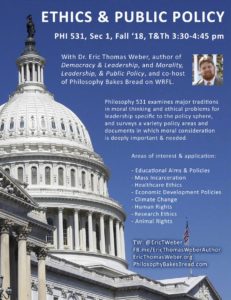
For the Fall semester of 2018, I’m planning an upper level course here at the University of Kentucky in ‘Ethics and Public Policy,’ PHI 531, Section 1, which will run on Tuesdays and Thursdays from 3:30 – 4:45 pm. The course will begin with an examination of major moral traditions as well as ethical problems that are special challenges for leadership in the policy sphere. We will then survey a variety of policy areas and documents in which moral consideration is deeply important and needed.

The Capitol Building in Washington, D.C.

A stack of newspapers.Areas of interest and application for the course will include:

  • Educational Aims & Policies
  • Mass lncarceration
  • Healthcare Ethics
  • Economic Development Policies
  • Climate Change
  • Human Rights
  • Research Ethics
  • Animal Rights
Image of a flyer for the course, featuring the information described on the present page.

Flyer for the course.

My former students who have studied ethics and public policy with me have gone on to work in the White House, under both the present and previous administrations, the House of Representatives and the Senate, the State Department, the F.B.I., the Heritage Foundation, the Center for American Progress, and numerous think-tanks, as well as a variety of offices in state government. There is need for study of the kind addressed in this course also for countless advocacy groups and organizations, as well as in current events journalism.

For those interested, here is the University of Kentucky’s page with information about how to register for courses for the Fall of 2018.

For those interested in more information now, you can check out my books on ethics and public policy, including:

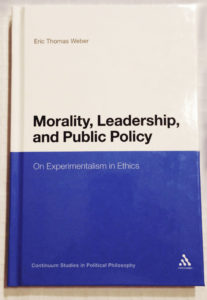
Cover for 'Morality, Leadership, and Public Policy.'


Morality, Leadership, & Public Policy (London: Bloomsbury, 2010)


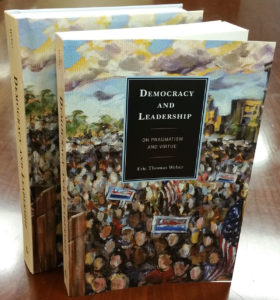
Photo of the paperback and hardback editions of 'Democracy and Leadership.'Democracy and Leadership: On Pragmatism and Virtue (Lanham, MD: Lexington Books, 2013)

and

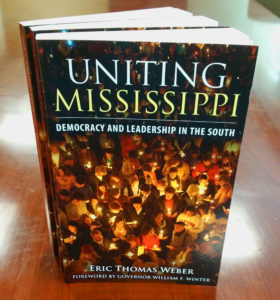
Paperback editions featuring the cover of 'Uniting Mississippi.'Uniting Mississippi: Democracy and Leadership in the South (Jackson, MS: The University Press of Mississippi, 2015)


The logo for Philosophy Bakes Bread, which involves to slices of bread with tails, making them look like dialogue bubbles.In addition, for those who are unfamiliar, I co-host the Philosophy Bakes Bread radio show & podcast that airs on WRFL Lexington, 88.1 FM and in the show we cover a number of public policy topics. Give it a listen!

The post 'Ethics & Public Policy' course in Fall '18 first appeared on Eric Thomas Weber.

Some Recent Interviews about the Commons

As you may have noticed, my blogging has suffered in recent weeks because of work on a new book with Silke Helfrich. Fortunately, we should be done soon. In the meantime, I have also given a few interviews that may be of interest. 

The British web magazine Beshara just published an interview of me, “The Revival of the Commons,” by Editor Jane Clark. It’s a beautifully presented webpage. Here’s one excerpt:

Jane:  …When there is this deep encounter with other beings, it triggers a natural desire to reciprocate, to share and communicate. So perhaps the commons brings out that aspect of our humanity which naturally desires to work toward the flourishing of our fellow creatures?

David: Yes, and I think this is why there is a kind of invisible tropism towards the commons. People sense precisely this potential of the commons and, without fully understanding or even if they have certain resistances or skepticism, they are nevertheless drawn to it. Through the many talks I have given and the conversations I have had over the years, I have come to see that the commons appeals to something very deep in people. It is about making human connections, about speaking to larger circumstances in life – and to deep time, both historical and present day. And it does so without all the encrustations of theological dogma.

These days there are very few discourses available to us where we can explore these matters outside of a theological one. Some kind of broad, cross-cultural exploration of our common humanity is long overdue. So I think that this aspect of the commons will grow as more and more people become involved with it.


Here’s another general introduction to the commons: an interview that I did with Adam Simpson of the Next System Project. The podcast -- Episode 17, “Social Transformation Through The Commons” -- is a 35-minute conversation that covers the basics about the commons. Adam was quite skilled in asking the right questions and eliciting things that might not have otherwise occurred to me!

Last Thursday, I had the pleasure of visiting Kingston Radio, WKNY, in Kingston, New York, where Jimmy Buff is showing what a community radio station ought to sound like! Amazing diversity of music, news, cultural perspectives, and community-building. Jimmy interviewed me about the commons, and Peter Buffett, Co-President of the NoVo Foundation, about the state of the world.

Finally, I’m pleased to have played a role in a newly released theatrical film called 24 Davids, a documentary by Canadian filmmaker Celine Baril.

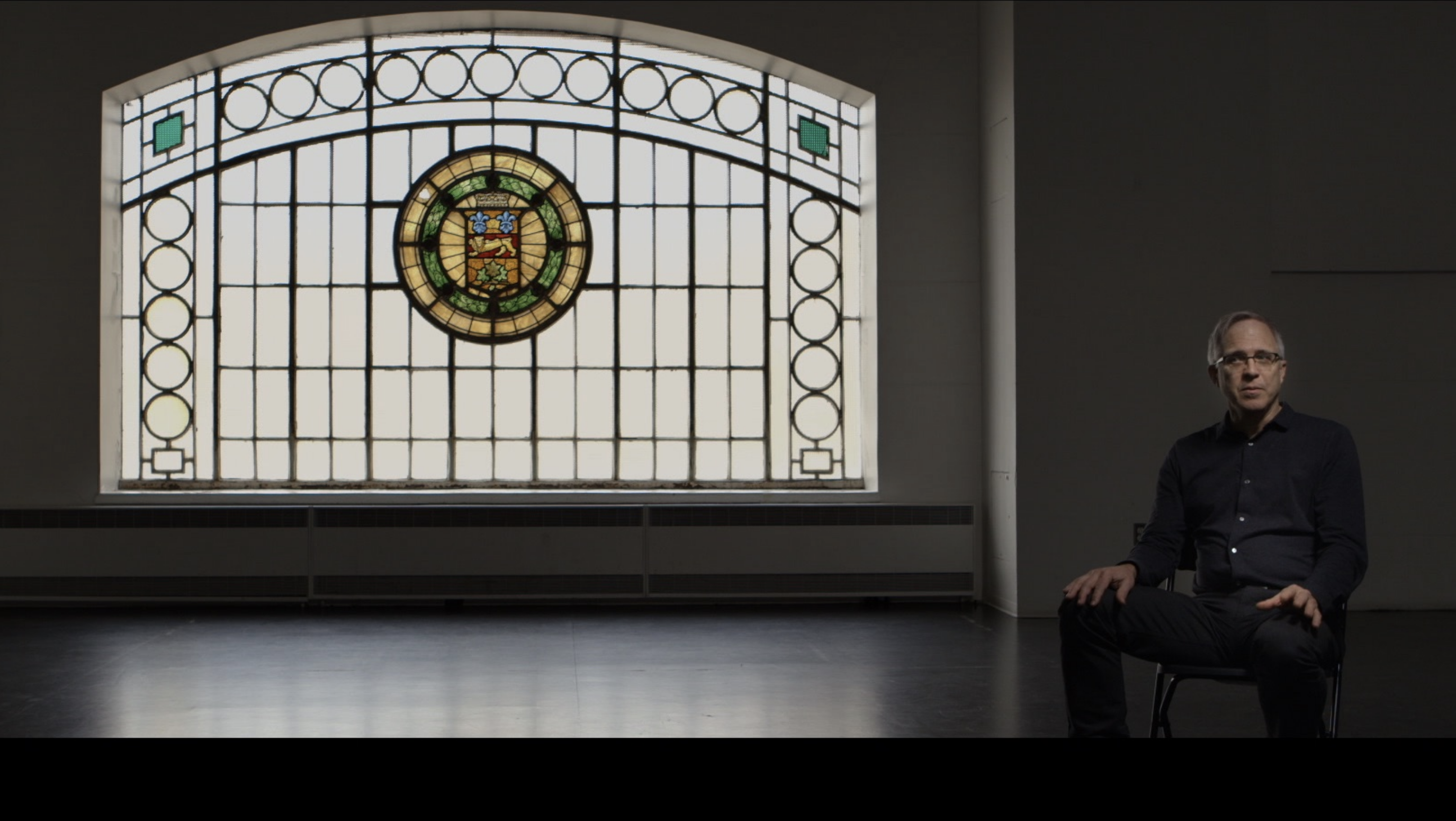
The film is an idiosyncratic, oddly compelling film about a lot of cosmic issues and societal challenges as seen through the eyes of 24 people named David on three continents. Including me, filmed circa 2014. I look a bit younger.

Baril used portions of my interview as the voiceover for the film’s trailer, which should give you a sense of the film’s ambitions and tone. Also, here's a short clip from my interview.

I loved encountering the other Davids. Each of us offered our own grand speculations about the future of global civilization. Baril slyly provides a subtle emotional undertone to the film, linking a lot of different people and gritty everyday realities together. Unfortunately, I can’t find a listing of where the film is showing, but it appears that that AMC, a US theater chain, has scheduled some showings. Perhaps the film will make it to Netflix sometime.

*             *              *

Let me end by re-posting a lovely poem that Beshara magazine included at the end of my interview. David Attwooll’s “The Binding of the Moor,” is about an attempt in the nineteenth century to enclose the ancient wetland Otmoor in Oxfordshire, which led to the Otmoor Riots of 1829-1830.

We took a fine oat-sheaf, tight bound at the waist And set it on fire; and while it was burning Our Lady of Otmoor rode all round the moor-edge Until the great sheaf was just ash on the ground.

Her shining cloak circled the land that was Common And granted forever to us local people For kypeing of fish, for eel scuttles of osier And fowling and keeping allotments of geese.

Many hundred’s year later, the gentry’s men came And bound her with fences, and drained her with ditches. They built mighty banks and stopped up the Ray. They enclosed all our birthright and forced us all out.

So men blackened their faces and wore women’s cloaks And ventured at night with hatchets and billhooks And tore down the bindings. On the sixth of September All in broad daylight, a thousand folk walked

Seven miles round the moorland, past all seven towns Pulling down fences in spite of the Riot Act. Sixty-six of us they arrested that day And carted us off to the City for trial.

When we reached Oxford it was St Giles Fair Where the holiday mob freed all of us prisoners. We won the day, but the moor stayed a patchwork: A hundred years passed ’til the bindings were loosed.

When the waters came home and the chessboard dissolved They planned the M40 to drive through her middle: Over three thousand people bought one-foot square parcels Of Alice’s Meadow to stop them at last.

The only road now is a path full of puddles, The Roman road’s agger is a scatter of stones. The moor’s safe – for now – and free to the people And the bright cloak of water is home to the birds.

system, organism, person, organization, institution: some definitions

If you want real expertise on this kind of question, you should attend “Social Ontology 2018, the 11th Biennial Collective Intentionality Conference” from August 22-25, 2018 at Tufts. But in case you want some light musing on the subject …

A system is an assemblage of interacting parts that persists over time. It can change, but a parsimonious description applies over its whole history. (“My Mac could run SPSS once I installed the new software, but it’s still the same system.”)

An organism is a system that no one designed. Instead, it results from the reproduction of similar organisms.

A biological organism is an organism that exhibits the properties of life. This definition implies that there may or could be non-biological organisms.

A sentient organism is one to which we can accurately attribute mental states, such as pain, pleasure, aversion, desire.

A person is a system whose mental states include memory, planning, and decision. Thus the person’s development over time is partly her responsibility, not solely the result of accident and force. Not all persons are organisms. Entities that meet the definition of persons include human beings but also God, angels, devils, space aliens, perhaps other advanced mammals, perhaps some future AI, and organizations–see below.

A human person is a person that is also an organism of the species homo sapiens. A human person is capable of certain specific mental states that are not necessary conditions of personhood in general, e.g., love and suffering.

An institution is a system composed of at least two persons, plus any number of other components (e.g., buildings, legal rights). A market, for example, is an institution that combines many buyers and sellers, their goods, their rights, rules, and so on. Note that a market is not a person because it doesn’t have mental states.

An organization is an institution to which we can attribute memory, planning, and decision. Such attributions are not metaphorical but use exactly the same logic that we apply to human persons. (“I can tell that Tufts intends to educate students from the fact that it expresses this intention on its website and then actually educates.” Tufts doesn’t love, but Tufts does intend and plan. As such, it is a person.)

By these definitions, a social organization is a person; it is simply not a human person. It lacks the rights of a human being. Human beings gain rights not from the mere fact that we are complex systems capable of remembering, planning, and deciding–so are organizations–but from something else. I would attribute our rights to the fact that in addition to being able to remember, plan, and decide, we can also love and suffer.

(I was led to these thoughts by the discussion of Elinor and Vincent Ostrom and their eclectic readings of Daniel Dennett, John Dewey, Douglas North, and others, as summarized in Vlad Tarko, Elinor Ostrom: An Intellectual Biography, pp. 137-43. See also: against methodological individualismwhy social scientists should pay attention to metaphysics; and the legacy of Elinor Ostrom and the Bloomington School.)

The Better Arguments Project Nominations due TODAY

Now, this is a tight turnaround for this next announcement, but we wanted to give folks in our network a heads up in case you missed it. The Better Arguments Project is an effort for Americans to engage each other around core US values and they are seeking nominations for communities to host their Better Arguments forums. Applications are due TODAY – April 10th, so check it out and get yours in ASAP!  In the post below, learn more about the funding support and other opportunities for those selected, as well as, find more detailed information on the Better Arguments Project’s site here.


The Better Arguments Project – Nominate your Community!

The Better Arguments Project allows Americans to reach across political, cultural and economic divides to have arguments that bring us closer together instead of driving us further apart. We launched this project out of the recognition that arguments are essential for our democracy. Indeed, America is an argument — between equality and liberty, central and local government, unity and diversity. The more we can equip communities to have arguments rooted both in this history and in best practices of constructive communication, the healthier our country will be.

Visit www.BetterArguments.org for more background on this initiative.

This project is designed to be practiced around a specific issue. How will we do this? We need YOU!

Over the next year, we will pilot the Better Arguments Project through local forums in select communities around the country. Would you and your community like to host one of our pilot Better Arguments forums? You’re in the right place!

With each partner, the Better Arguments Project will:

  • Provide the funding, materials, and training needed to convene community members.
  • Offer resources to help successfully lead community members through the forum.
  • Facilitate at least one agreed-upon follow-up step.
  • Document the experience in a video to be shared.

Our team is seeking partners representing various political parties, big and small towns, rural and urban areas, and most importantly, people from all walks of life. Some key qualities include:

  • Individuals or organizations rooted in community
  • Open-mindedness
  • Ability to convene community members representing a wide range of perspectives

Dates and Deadlines

  • Application due April 10th, 2018
  • Selections made April 24th, 2018

Ready to start a Better Argument? For more information:

The Better Arguments Project is a partnership among Facing History and Ourselves, The Aspen Institute Citizenship and American Identity Program, and The Allstate Corporation.

You can find the original version of this announcement on The Better Arguments Project’s site at www.facinghistory.org/together/better-arguments.

youth in recent protests

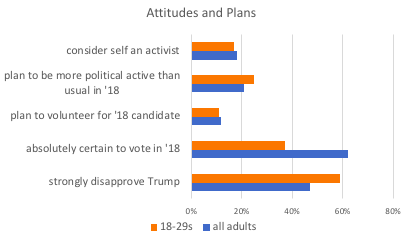
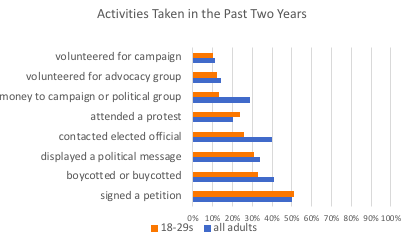
A new Washington Post-Kaiser Family Foundation poll provides detailed information about participation in current protests and social movements. The Post leads with: “Tens of millions of Americans have joined protests and rallies in the past two years, their activism often driven by admiration or outrage toward President Trump.” Here, I’ve broken out the data for ages 18-29 and separated the questions into categories.

To begin, 17% of 18-29s would call themselves “activists,” just a point below the whole adult population. They are less sure than older people that they will vote in 2018 (only 37% are “absolutely sure”), but more likely to disapprove strongly of Donald Trump. Just under 20 percent actually voted in 2014, the last midterm election. It will make a great deal of difference whether that number rises in 2018.

During the past two years, an outright majority of 18-29s have signed a petition, and many have taken other classic political acts. They are less likely than older Americans to give money, but they come close on most other measures of engagement.

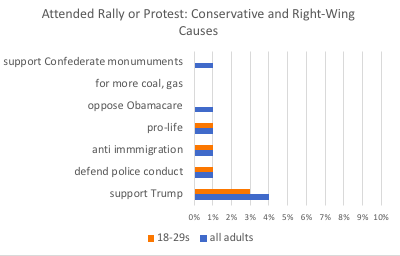
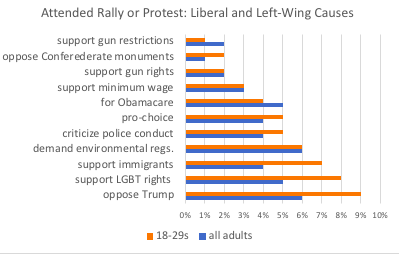
I’ve divided the long list of topics for rallies and protests into right- and left-wing causes. Respondents are asked whether they have personally attended a rally or protest of each type in the past two years.

Under-30s do not appear in detectable numbers in the rallies for Confederate monuments, for oil and gas, or against the Affordable Care Act. About one percent of 18-29s have rallied against abortion, against immigration, or in support of police conduct. Three percent have turned out at physical events for Trump. For right-wing causes, the rates of participation are low for all adults. Most of these are fringe movements.

Young adults have been more active on the other side of the political spectrum. Nine percent have marched or rallied against Trump, the most popular cause. (They have been over-represented in the anti-Trump events.) Marches for LGBT rights and immigration have also been popular for youth, and disproportionately so.

Only one percent have turned out (so far) in support of gun control. However, that could be misleading because students under the age of 19 have played notable leadership roles in the gun-violence movement. I commented on MSNBC about the youth protests against gun violence.

The International Residents Network: A Self-Sustaining Instrument for Learning and Sharing (Connections 2016)

The six-page article, “The International Residents Network: A Self-Sustaining Instrument for Learning and Sharing” by Ruby Quantson was published in Kettering Foundation‘s 2016 edition of their annual newsletter, Connections – Kettering’s Multinational Research. In the ninth article of the newsletter, Quantson talks about her efforts to re-connect with members of Kettering’s International Residents Network. She and Leonardo Correa, a previous member of the network reached out to fellow members to see in what ways the network had been self-sustained and what to do moving forward. Below is an excerpt from the article and Connections 2016 is available for free PDF download on Kettering’s site here.

From the article…

Responding to growing international interest in democracy research, in 1991, the Kettering Foundation established international residencies. These residencies, initially called “fellowships,” include the international residents, the Katherine W. Fanning Residents in Journalism and Democracy, and staff exchanges with the Chinese Academy of Social Sciences and Peking University. Residents usually spend several months at the foundation’s headquarters in Dayton, Ohio, exploring questions central to Kettering’s research program. Thus far, about 130 people have participated from around the world.

In the spring of 2014, I embarked, along with Leonardo Correa from Brazil, on a new research project to locate as many former international residents as we could. Both of us are former international residents, which put us in a unique position to interview others and analyze what we heard. This article focuses on the insights gathered from the research, expressed through the thoughts and voices of those we interviewed. It particularly highlights existing foundations and structures for building a formidable international network and how this platform could be sustained for learning across the world through self-responsibility as a principle of democratic practice.

A key interest in this research was whether former residents (at least a critical number) were self-motivated enough to be responsible for sustaining the network. This interest was particularly driven by two questions posed in the research interviews: how might you work with the international network, and how can the network be managed and sustained?

Mapping out Opportunities for Networking

Interactive Database
The core product generated in this research, critical to the sustenance of the network, was a database or directory on former residents. Intended to operate as an online interactive map, the directory describes careers, interests, and contact details of former residents and therefore offers the international alumni a platform to connect, exchange ideas, and promote collaborative work across a broad range of careers. Several former residents are applying the knowledge acquired during their residency in innovative ways. Their stories have the potential to ignite citizens’ actions elsewhere. For instance, a former resident who currently works as a wood sculptor observed inter alia:

I then took a few chairs and tables of wood; I went to a park near my place, . . . I made a circle, then I invited a few friends and the community. A lot of people came, people from my neighborhood, women that worked around the place, some of my students. . . . Now this place is a space where people can get together and talk about their issues.

What is needed is a means of sharing and learning from these experiences.

Global Voices and Actions for Democracy
The conversations with the former residents also revealed a broad knowledge base enriched by diverse cultures, practices, and experiences useful for knowledge exchange and transfer. The thoughts expressed were not abstract or whimsical; it was a rich and pressing struggle. They spoke to us about the challenges to democracy they see or seek to address within the contexts of a world facing a variety of challenges, including ISIS, Al-Shabaab, and Boko Haram; immigration and refugee crises; polarized politics; diminishing roles for NGOs; and coup d’états and unsustainable development goals in the developing world. When these voices and actions come together, they depict a challenging, yet engaging, global effort toward stronger democratic practices. If these conversations were to take place in a regular (even virtual) space among the residents, the learning and insights would be profound.

Building on Existing Initiatives
Former residents are interacting in many ways all around the world. We have learned of small gatherings in Argentina, Brazil, Colombia, Fiji, Ireland, New Zealand, Russia, and Tajikistan, to mention a few.

Residents from Ghana have assisted in offering training programs and participated in programs for organizations led by former residents from Zimbabwe and South Africa. The interactions range from simple dinners to exploring democratic practices in policymaking, as well as naming and framing issues. Several former residents are focused on boundary spanning, collaborating with each other to coproduce civic goods that strengthen democracy and promote learning in their respective institutions, as we heard in Kosovo and Tajikistan.

Mapping out these formal and informal connections with the aim of sharing with the larger network and upscaling can lead to greater learning and sustenance of the network.

This is just an excerpt, you can read the rest of the article by clicking here.

About Kettering Foundation and Connections
KF_LogoThe Kettering Foundation is a nonprofit operating foundation rooted in the American tradition of cooperative research. Kettering’s primary research question is, what does it take to make democracy work as it should? Kettering’s research is distinctive because it is conducted from the perspective of citizens and focuses on what people can do collectively to address problems affecting their lives, their communities, and their nation.

Each issue of this annual newsletter focuses on a particular area of Kettering’s research. The 2016 issue of Connections, edited by KF program officer and senior writer/editor Melinda Gilmore; KF senior associate Philip Stewart; and KF vice president, secretary, and general counsel Maxine Thomas, focuses on our year-long review of our multinational research.

Follow on Twitter: @KetteringFdn

Resource Link: www.kettering.org/sites/default/files/periodical-article/Quantson-Connections-2016.pdf


NCDD2018 Call for Session Proposals is Now Open!

NCDD’s 2018 National Conference on Dialogue & Deliberation is coming up this November 2-4 in downtown Denver.

NCDD conferences bring together hundreds of the most active, thoughtful, and influential people involved in public engagement and group process work across the U.S. and Canada.

Today we’re announcing our call for proposals for our concurrent sessions for NCDD 2018. We’re interested in finding creative ways to highlight the best of what’s happening in public engagement, group process, community problem-solving, civic tech, and arts-based dialogue — and we know you have lots of ideas!

Check out the Application for Session Leaders now to see what we ask for, and start cooking up those great proposals we’ve come to expect from our network! If you’re looking for ideas and inspiration, look over the comments on this blog post, where we asked the NCDD community to share what they’d like to see happen at NCDD 2018, and peruse the fabulous sessions offered at the 2016 and 2014 NCDD conferences.

Please note that the deadline for proposals is Wednesday, May 9th. We look forward to seeing what you’d like to offer!

If your work involves dialogue and deliberation, or you want to get involved with this work, you’ll love this conference. Imagine spending three days with some of the most amazing leaders in this field, forming new relationships and reconnecting with old colleagues and friends, hearing about innovative new approaches to the challenges you’re facing, and exploring together how we can shape the future of this important movement, all while using innovative group techniques there’s really nothing like it. (See our 2016 Conference Storify page for quotes and pictures.)

Here is some guidance for those thinking about presenting sessions at NCDD 2018…

Our theme for the 2018 conference is Connecting and Strengthening Civic Innovators, and we invite workshop proposals that in some way build upon or engage the ideas around this theme.

NCDD 2018 is taking place the weekend before the November midterm elections and these are vital times for using the skills and tools of the dialogue and deliberation community to continue to bring people together. We have heard from so many, both in our field and particularly those unfamiliar with D&D work – how do we come together and talk with each other despite the divisiveness that pervades our society? There are many in our country that are unaware of the D&D field’s work to better engage people and improve democratic processes.

Our goal of the conference is to explore how to bring dialogue, deliberation, and public engagement work’s many tools and processes into greater visibility and practice within our society. At the conference, we will dig into how to bring D&D to the more widespread awareness and use by:

  • Cultivating new partnerships and connections with other fields utilizing these approaches, including government, libraries, and journalism;
  • Developing our skills, and building our toolkits to address the emerging needs of the communities we work with and live in;
  • Making the case for public engagement, by elevating the stories of how people are coming together across divides, making decisions and taking action together, as well as demonstrating the value and impact of this work;
  • Growing the skills of D&D in our young people, and cultivating leaders who are drawn to D&D;
  • Building the skills and capacities of others in our communities to do this work;
  • Reaching out to and engaging with those less drawn to D&D, including conservatives, activists, and others;
  • Highlighting the ways D&D can be fun, and exploring innovative methods for public engagement – including the arts.

We invite session proposals that will highlight the work being done to tap D&D into the peoples’ daily lives, build democratic participation, and better expose D&D work through the above connections. Your proposal will be evaluated, in part, by its relevance to our theme and goals.

Some advice for potential session leaders:

  1. Identify great co-presenters.  Most workshops at NCDD conferences are collaborative efforts involving multiple presenters from different organizations and universities. Have you thought about who you can co-present with? Now’s the time to contact them to see if they’d like to offer a session with you! (Use the NCDD Main Discussion list and the comments below to put out feelers for potential co-presenters if you’d like.)
  2. Look over past workshop descriptions. Peruse the list of workshops from NCDD Boston to get a sense of the kinds of sessions the planning team selects. Sessions focused on innovative solutions to common challenges, ways to take this work to scale or to new audiences, and deep dives into great projects (and thoughtful explorations of failed projects!) are especially welcome.
  3. Be innovative with your session.  NCDD attendees are usually not too impressed with traditional panels or long speeches. Get them engaging with you and each other! Think about how you can get them out of their seats and moving around the room. And think about what you’d like to learn from them (not just what they can learn from you). Challenge yourself to run a session without relying on PowerPoint.
  4. Share your stories.  NCDDers prefer hearing your stories to getting a run-down of your organization or methodology.  People are interested in learning about what you did, what you learned, and how they may be able to learn from your experience.
  5. Share the latest.  What’s the latest research? What are the latest innovations in the field? What new challenges are you facing? What are your latest accomplishments?

Not quite ready to draw up a proposal yet? Use the comment field (and/or the NCDD Main Discussion listserv) to float your ideas by other NCDDers and members of the planning team. We may be able to match you up with potential co-presenters who can address the same challenge or issue you’re interested in focusing on.

Look over the comments on our engagement of members around what they would like to see at the conference, on the blog and the listserv. There is a wealth of ideas and insight in those results!

Deadline for submissions
To have your session proposal considered, we need you to submit the session application by the end of the day on Wednesday, May 9th. Members of the conference planning team will review the proposals and plan to respond by email to the first contact listed in your proposal early June.

Don’t forget that the super early bird tickets are NOW AVAILABLE! Get yours at this great low rate before it goes up!

The Kettering Foundation and China-US Relations (Connections 2016)

The six-page article, “The Kettering Foundation and China-US Relations” by Wang Jisi was published in Kettering Foundation‘s 2016 edition of their annual newsletter, Connections – Kettering’s Multinational Research. In the eight article of the newsletter, Jisi shares his experience with Kettering’s consistent engagement with China for over three decades, by bringing together people from both the US and China to learn from each other and maintain relations. Below is an excerpt from the article and Connections 2016 is available for free PDF download on Kettering’s site here.

From the article…

Since 1986, the Kettering Foundation has maintained a close and fruitful relationship with China, especially with China’s scholarly community. As a participant in this relationship from the beginning, I am both humbled at Kettering’s brave and strenuous efforts to strengthen US-China ties and proud of being a small part of them.

In 1986, when I was a junior lecturer in Peking University’s Department of International Politics, the Chinese Academy of Social Sciences (CASS) cosponsored with the Kettering Foundation a group visit to the United States. The Chinese delegation was headed by Li Shenzhi, vice president of CASS, and consisted of several senior Chinese individuals and four “young observers,” including Yuan Ming of Peking University and myself. We toured Racine, Wisconsin, where we joined the US delegation headed by Kettering president David Mathews and attended a conference together, which covered world politics in general and China-US relations in particular. We were also entertained by local officials and celebrities in Racine. In fact, what impressed me most was not anything related to China-US relations, but a special session conducted by David Mathews, in which he vividly introduced Kettering’s political philosophy and approach to conducting its projects.

It was the first time I had ever heard a representative of an American NGO explain to us how it worked. During the Racine conference, we had interesting conversations with our US counterparts, some of whom had no China connection at all. Racine was a perfect location that allowed Chinese and American public citizens to get to know each other personally.

I confess, although I had spent 18 months at the University of California at Berkeley in 1984-1985 and toured other American cities and towns during that period, my personal contacts in the United States had been confined almost exclusively to Americans who were interested in China, East Asia, or international politics. It was Kettering that widened my horizon by bringing me to Racine and, later, to Dayton, Ohio, where its headquarters is located. This helped me become familiar with grassroots America. In this sense, Kettering opened a window for me—and presumably for many other Chinese colleagues who have participated in the Kettering programs—to observe and understand American society and domestic politics by way of knowing some “real” Americans who live in “typical” US cities like Dayton.

As one of the so-called “US watchers” in China, I used to make the analogy that the relationship between China and the United States is like a state-society relationship. In the China-US relationship, China acts as a state, a hierarchical structure of organizations like CASS and Peking University with individuals in them as a subordinating part, whereas America acts as a society, in which horizontal networks like the Kettering Foundation coexist with governmental organizations but are not subordinated to them. With my experience at Kettering, I have developed a strong belief that we will not be able to catch the essence of US foreign policy and US-China relations unless we understand how civil society functions in America. It will take more time for me, or other Chinese, to fully grasp the meaning of such concepts as “framing public deliberation.” Still, Kettering’s numerous programs have greatly benefited dozens of Chinese citizens and enriched our knowledge about the United States beyond government-to-government connections.

Indeed, it is my own observation that the greatest contribution Kettering has made to the ChinaUS relationship is to bring together social elites from the two societies, making friends between us, letting us know that we share the same purposes of life—happiness, love, family, harmony, and unity. To be sure, political and cultural differences, as well as geographical spans, divide the two peoples, but these differences are secondary if compared to our shared purposes of life as human beings.

This is just an excerpt, you can read the rest of the article by clicking here.

About Kettering Foundation and Connections
KF_LogoThe Kettering Foundation is a nonprofit operating foundation rooted in the American tradition of cooperative research. Kettering’s primary research question is, what does it take to make democracy work as it should? Kettering’s research is distinctive because it is conducted from the perspective of citizens and focuses on what people can do collectively to address problems affecting their lives, their communities, and their nation.

Each issue of this annual newsletter focuses on a particular area of Kettering’s research. The 2016 issue of Connections, edited by KF program officer and senior writer/editor Melinda Gilmore; KF senior associate Philip Stewart; and KF vice president, secretary, and general counsel Maxine Thomas, focuses on our year-long review of our multinational research.

Follow on Twitter: @KetteringFdn

Resource Link: www.kettering.org/sites/default/files/periodical-article/Jisi-Connections-2016.pdf

Exploring How We Engage Values with Ben Franklin Circles

As we mentioned a couple of weeks back, we are going to be sharing stories from the Circles convened by NCDD member org, the Ben Franklin Circles. NCDD teamed up with BFC on this collaborative effort to bring alive the circle process our founding father, Ben Franklin, maintained for over 40 years. In the article, NCDD member Katherine Roxlo reflects on the Circle she convened in Scottsdale, Arizona with students from the Community College Initiative; and how the experience impacted the youth, as well as, affected how the values play out in her life. You can read the post below and find the original post on BFC’s site here.


Circle Spotlight: Katherine from Phoenix

Name: Katherine Roxlo
Hometown: Phoenix, Arizona (Circle is in nearby Scottsdale)
Sponsor Organization: Scottsdale Community College
Date Launched: August 30, 2017

What attracted you to Ben Franklin Circles?
I have always been interested in respectful conversations and community. The Ben Franklin Circles give me an opportunity to reflect on important values in a constructive fashion and to develop a special community in my life. Concentrating on one value at a time has allowed me to work the values into my life. I feel that morality, ethics and respectful conversations that incorporate the good of our local and national community are at a low point right now in the U.S. The Circles are one small step in the right direction for me. And small steps are GOOD!

How did you recruit members for your Circle? Any lessons learned?
I sent out proposals to conduct Ben Franklin Circles to a number of organizations, including youth groups, senior citizen groups, schools and churches. Scottsdale Community College took me up on it! It is a perfect way to incorporate ethics into a class and to give the students a time to reflect on what they are doing.

I love the question that Ben Franklin started his day with: “What good can I do today?” We start each meeting with a meditation, prayer or moment of silence. It allows us all to calm down from our busy schedules and get centered. During this opening moment, we always ask, “What good can I do today? What good can we do for our community?”

How has hosting a Ben Franklin Circle impacted you?
So many ways! My Circle is made up of Community College Initiative (CCI) students. These are foreign students on a nine-month scholarship program in the U.S. with the goals of learning, gaining experience through internships in a field of interest and contributing to the community through 100-plus hours of volunteer service.

It is an honor to work with these bright students. I see them struggling, but also improving their talents, every time we meet. Some are speaking out more and improving their English. Some are taking on leadership roles. Some are learning to use their time more constructively.

Working with the group gives me extreme hope for the future. They are all thoughtful and smart. At first, the group was a little quiet. But, at the last two meetings, we started letting different students run different parts of the meeting. One conducts the opening. One reviews the past value, one the new value. One student keeps us on schedule. One student runs the last part of the meeting, which we call sharing, listening, caring. I was very impressed with how easily they stepped up to the plate. Giving them the opportunity has been enlightening for me! Now I just sit back, take notes and ask some questions. Often, I am working on my own issues with the virtue.

It is interesting to see the differences in values that they have. Their perspectives have been very good for me. They do not have the food addictions and issues with weight that many Americans have. They place a higher value on personal downtime and family time than those of us in the U.S. They say that Americans must be told everything specifically and literally, that we do not take hints that are obvious in their culture. They are more receptive to unspoken communication. This has been really valuable to me. I see how I can apply these perceptions to my own life in order to be a better person.

Which virtue means the most to you personally and why?
I am not sure. With temperance, I focused on tempering my use of playing solitaire on my cell phone. I had to keep my cell phone in another room at night. What an addiction! It gave me more time to be productive. It also gave me compassion for those who are addicted to drugs or alcohol. If I have this much trouble with playing solitaire, I can only imagine someone’s struggle with drugs. Part of the problem is that there truly is a short-term pleasure and positive body response from addictive material. But I know it is short lived and leads to ruin.

With silence, I worked on not giving too many constructive suggestions to my husband (and to never repeating a request). By being silent I learned that he was doing more than I thought and actually had some good ideas of his own.

With order, I made a list of things I wanted to get done. All my plans and order went out the window when my husband had a heart attack. I gladly spent three days in the hospital with him, and realized how flexible and subject to change our priorities can be. It is easy to reorganize when something that is truly important comes up.

With resolution, I successfully gave up chips. That must sound like something small, but it isn’t for me. For more than a year, I have been focused on improving my health and fitness. I am cutting out as much sugar, flour and processed food as I can. The open bag of chips that my husband leaves above the refrigerator have been a huge temptation. I was never able to kick the habit of grabbing that bag of chips when I got home and was tired. But we are reporting our progress on our resolution back to the group and I didn’t want to tell them I failed! I am happy to say I can report eating no chips for three weeks. It is easier to give them up completely. Having to be accountable to my Circle is a huge driver for success.

You can find the original version of this post on Ben Franklin Circle’s at https://benfranklincircles.org/circle-spotlight/circle-spotlight-katherine-from-phoenix-az.