Where Americans See Eye to Eye on Incarceration
Reply

Next Wednesday, April 18th, the Zehr Institute for Restorative Justice, a program of NCDD member org, the Center for Justice and Peacebuilding at Eastern Mennonite University, is offering a free restorative justice webinar on centering survivors. Join this critical conversation as the three RJ-informed speakers share their work, help to broaden the understanding of survivor/victim, and offer implications for centering survivors in RJ and other movements. You can read the post below and find the original on the Zehr Institute site here.
 When: – Guest: Alison Espinosa-Setchko, Kazu Haga, Richard Smith
Host: Johonna Turner
Centering victims and survivors of harm is a longstanding principle of restorative justice. What does this mean in the restorative justice movement today? How should we define “victims” and “survivors”? What needs must be addressed? Join us for a critical conversation with the leaders of two RJ-informed initiatives centering survivors of violence who offer fresh perspectives on these questions.
HealingWorks is the first national learning collaborative for individuals and organizations working with young men of color who have been harmed by violence. They address the compelling needs of young survivors of color by delivering tools, information and support to the people and organizations that serve them. Because healing doesn’t happen in isolation, HealingWorks also promotes practices that take place in a broader context, addressing the essential roles of women, elders and other community members.
The Ahimsa Collective is a network of people creating an alternative way to address violence and heal trauma- a way that is driven by relationships, not systems. They use a restorative justice practices and a peacemaking approach. The Ahimsa Collective intersects with various movements: the restorative justice movement, the anti-oppression and racial justice movement, the anti-sexual violence movement and the criminal justice reform movement.
Our guests will provide an overview of their work, and the insights that guide them. Moreover, they will help us to understand the critical need to reframe and broaden dominant understandings of victims/survivors of violence, and the wide-ranging implications of this work for restorative justice, victims’ services, trauma healing, and other movements for safety and social justice.
Guest Bios
Alison Espinosa-Setchko was born in Oakland, Calif. She received a degree in Community Healing and Social Engagement from Pitzer College, and has spent much of her adult life working with young people as a teacher, a mindfulness educator and a facilitator of restorative justice. She is now the Programs Manager at The Ahimsa Collective where she supports Ahimsa’s various projects and co-facilitates restorative circles within Valley State Prison. A survivor of child sexual abuse, her family was also impacted by the criminal justice system. Espinosa-Setchko’s life has shown her the power of restorative justice to transform lives and institutions, and she is committed to making its healing potential manifest on a larger scale.
Kazu Haga is the founder and Coordinator of the East Point Peace Academy, is a trainer in Kingian Nonviolence and teaches various aspects of nonviolence, restorative justice and mindfulness. Haga is also a facilitator in the Ahimsa Collective’s Restorative Approaches to Intimate Violence program in prison. Born in Tokyo, Japan, he has been engaged in social change work since the age of 17, and has played leading roles in various social movements. He works to empower incarcerated communities, young people and activists around the country. He currently resides in Oakland, Calif.
Richard Smith is an academic activist and healer with nearly two decades of experience developing and implementing community-based programs for disadvantaged populations. Smith is currently the National Director of HealingWorks, a learning collaborative that addresses the healing needs of male survivors of violence by delivering tools, information, and technical support to organizations that serve them. He is also currently one of the technical assistance leaders for the US Department of Justice’s National Resource Center on Reaching Underserved Victims, a one-stop shop for victim service providers, culturally-specific organizations, criminal justice professionals, and policymakers to get information and expert guidance to enhance their capacity to identify, reach, and serve victims from underserved communities. Smith holds a Master’s Degree from the University at Albany in Africana Studies and a Bachelor’s Degree from Boston University in Sociology. He has taught criminal justice, history, and social work courses as an Adjunct Professor at SUNY Empire State College, Sage College and LIU Brooklyn. He is presently a doctoral candidate at SUNY Albany’s School of Social Welfare. His research focus is male survivors of childhood sexual abuse. He is the proud father of two sons, Kaden (4 years.) and Kaleb (6 years).
You can find the original version of this announcement on the Zehr Institute’s site at www.zehr-institute.org/webinar/centering-survivors/.
Fifty years after Dr. Martin Luther King’s assassination–as new social movements are again taking to the streets–a Washington Post-Kaiser Family Foundation poll asked respondents to compare the protests of the late sixties to today. I show responses for all adults and for 18-29s, because I was curious what young adults are learning and thinking about the sixties.
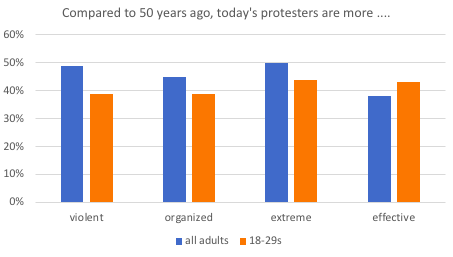
These results are ambiguous, because individuals can have varying opinions of the sixties and of today, but they are only asked to compare the two. A person could think that the protests of the 1968 were terribly violent and extreme, and today’s are worrying but not quite as bad. Or a person might think that the ’60s were violent and it’s great to see some of that righteous rage coming back. Or that neither were violent. By the same token, a person could feel that protesters in the ’60s were well organized, and today’s are even more so, or that both were badly organized. . … And we can multiply the possibilities.
Let’s assume (as a rough approximation) that you are enthusiastic about today’s protests if you think they are organized and effective but not extreme or violent, and that they are at least as good–by those criteria–as the protests of the late 1960s were. So measured, enthusiasm seems reasonably high for all Americans, but higher for youth.
I wouldn’t use these survey results to actually assess the social movements of the sixties vs. our time. I doubt that most people have thought deeply about the wide range of movements in these two rapidly changing periods. For instance, there is an interesting debate about whether the same forms of organization are necessary today as in 1968, but I wouldn’t call random phone numbers to ask the people who answer what comes immediately to mind on this question.
I do find these results interesting as a possible bellwether of support for social movement politics. On the whole, young people seem to perceive the current array of protest movements as reasonably organized, effective, nonviolent, and mainstream. That should encourage them to join.
See also: Why Civil Resistance Works; a sketch of a theory of social movements; the New Social Movements of the seventies, eighties, and today.
The six-page article, “Meeting the Challenges of a World Divided: Engaging Whole Bodies Politic” by Harold H. Saunders was published in Kettering Foundation‘s 2016 edition of their annual newsletter, Connections – Kettering’s Multinational Research. For this tenth article of the newsletter, Kettering drew from Saunders book, Politics is about Relationships: A Worldview for the Citizens’ Century, on the five challenges to citizens for more effectively participating in our global political world. Below is an excerpt from the article and Connections 2016 is available for free PDF download on Kettering’s site here.
From the article…

Our country and our world are deeply divided. Too many people have lost the capacity to listen thoughtfully, to talk respectfully, and to relate constructively. A culture of dialogue generated and sustained over time by citizens outside government is critical to peace and to equitable and sustainable economic, political, and social development.
The challenges of our troubled world require political—not just technical—responses. There are some things only governments can do—negotiate binding agreements, make and enforce laws, provide for the common defense, fund public projects and programs. But some things only citizens outside government can do—transform conflictual human relationships, modify human behavior, and change political culture. Only governments can negotiate peace treaties, but only people can make peace.
As John Gaventa wrote, “When aware of their rights and agency, and when organized with others, citizens have the power and capacity to bring about fundamental and lasting change. . . . While the idea of citizen driven change has been around for a long time, it still stands in sharp contrast to many other paradigms which dominate public affairs.”
The conceptual lenses we use to understand events determine how we act. Achieving a fresh way of understanding the world around us requires new conceptual lenses to bring a rapidly changing world into focus. Thus, we must spend some time reflecting on how we think about politics.
To act more productively, we must change our way of understanding how our public world works—a world that is falling behind in meeting its challenges. My aim is to help each of us see the world through new lenses and demonstrate that these can change how we act.
Five challenges top the human agenda at the beginning of the twenty-first century. Responses to all depend on citizens outside government as well as on the governments they constitute.
This is just an excerpt, you can read the rest of the article by clicking here.
About Kettering Foundation and Connections
 The Kettering Foundation is a nonprofit operating foundation rooted in the American tradition of cooperative research. Kettering’s primary research question is, what does it take to make democracy work as it should? Kettering’s research is distinctive because it is conducted from the perspective of citizens and focuses on what people can do collectively to address problems affecting their lives, their communities, and their nation.
Each issue of this annual newsletter focuses on a particular area of Kettering’s research. The 2016 issue of Connections, edited by KF program officer and senior writer/editor Melinda Gilmore; KF senior associate Philip Stewart; and KF vice president, secretary, and general counsel Maxine Thomas, focuses on our year-long review of our multinational research.
Follow on Twitter: @KetteringFdn
Resource Link: www.kettering.org/sites/default/files/periodical-article/Saunders-Connections-2016.pdf
Have you checked out the National Week of Conversation‘s site recently? There are currently over 70 events planned, either in person or online and more being added every day! Join the unprecedented National Week of Conversation starting next week on Friday, April 20th and going until Saturday, April 28th. This is a unique opportunity for Americans of different views to talk with each other and, more importantly, really listen to each other. We encourage you to go check out the site to sign up for an event or start your own conversation!
The National Week of Conversation is designed to:
NCDD is a proud organizing partner of NWOC, and our founding director Sandy Heierbacher is on NWOC’s core team, along with over 100 additional participating partners!
During the NWOC, Americans from all over the country will take a small step to help bridge the political divides in our country. They will do this by reaching out to people who have different political views and engaging them in civil and respectful conversation about the future of our nation. The goal of these conversations is to help people learn from each other, build relationships, and look for ways to reduce the growing polarization in our public life.
You can sign up at www.nationalweekofconversation.org to pledge your intention to participate in NWOC as an individual or organization (let them know that you are connected to NCDD as a partner organization!). Check out the event calendar to see if there are events near you that you’d like to participate in. We encourage folks to start planning an event during NWOC and add it here. If you’re not sure what model to use or topic to focus on, we recommend you check out the organizations listed here or look over the resources under NWOC’s six suggested topics here.
Here are a few events from our friends:
Learn more at NationalWeekofConversation.org and share your experience using #ListenFirst & #NWOC. Let us know if you have an event planned and share it with us in the comments below!