ALERT: CIVICS360 VIDEOS IMPACTED BY TEACHERTUBE OUTAGE

Good morning friends and colleagues. If you use Civics360, you likely noticed the following when you try to load a video:

504 error

Basically, TeacherTube is now down. We have reached out to them to get an ETA on when it will be back up and find out why this happened. Once it is back up we will let you know.

If you absolutely need access to a particular video today, I can send it to you directly to download as a last resort. Email me. 

We apologize for the issues that this causes and are working to get it fixed!

American Founders Month 2019: Mercy Otis Warren!

FMimage

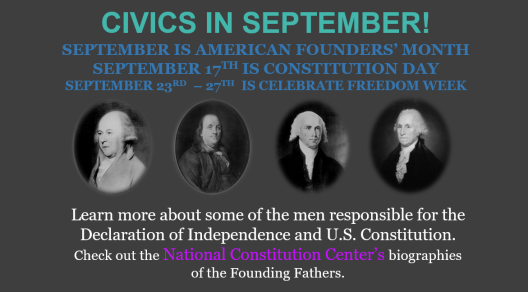
Check out the National Constitution Center’s biographies of the Founding Fathers! https://constitutioncenter.org/learn/educational-resources/founding-fathers

It’s Founders Month here in Florida! According to the Florida Department of Education,

Section (s.) 683.1455, Florida Statutes (F.S.), designates the month of September as American Founders‘ Month and s. 1003.421, F.S., recognizes the last full week of classes in September in public schools as Celebrate Freedom Week.

So what does this mean for our schools and kids and teachers? Basically, it’s time to do some learning about the men and women who have helped shape this state and this country. Here on our Florida Citizens blog, we’ll be doing at least two posts a week with a brief overview of a particular Founder, Framer, thinker, or shaper of this state or this nation and how they made an impact.

Sept 19 Warren

American Founders’ Month continues here in Florida. Today, we take a look at one of the most influential of those women who played a role in the establishment and early days of the United States: Mercy Otis Warren.

Mercy Otis Warren was one of the most well-read and literate residents of Massachusetts in her day, man or woman. A playwright and a historian, an eloquent essayist and inveterate letter writer, she was one of the loudest voices speaking out against the failures and perceived tyranny of British government in Massachusetts and the other colonies.

A long time friend to both Abigail and John Adams, she broke with her dear friend over the creation of the U.S. Constitution, which she opposed as a violation of the ideals she and Adams were strong advocates for during the Revolution. Indeed, she was one of those Anti-Federalists who wrote in response to the Federalist Papers; using the nom de plume ‘A Columbian Patriot’, she wrote powerfully on perceived flaws in the new Constitution, and as herself to her dear friend John Adams on how he had so betrayed what they fought for. Sadly, her relationship with the Adams family never truly recovered.

You can learn more about this fascinating woman through the National Woman’s Hall of Fame. 

Grab the Powerpoint slide featured in this post: Mercy Otis Warren AFM

we should be debating the big social and political paradigms

[The following post is inspired by Rogers Smith’s recent APSA presidential address, and I believe is consistent with it, but I incorporate some additional elements.]

Consider a sample of articles about politics, or society more generally. One might be an interpretation of some remarks by Thomas Jefferson. Another reports an experiment in which people are more likely to vote when contacted one way rather than another. A third is a critique of a prevalent word (say, “security”) from the perspective of Michel Foucault. A fourth shows that rational agents in a certain situation are better off when rules are externally imposed on them.

Each of these articles presumes, and contributes to, a larger paradigm that combines values, causal theories, and methods. Perhaps the interpreter of Jefferson believes that the United States is still founded on its written Constitution and that the intentions of the founders matter today. The experimentalist presumes that voting in a regime like the modern USA is a consequential act, and it would be good to increase voting by several percentage points if possible. The critic of “security” sees a world of pervasive injustice sustained by ideology, in the sense of distorting views that preserve the status quo. The rational-choice modeler thinks that all (or many) institutions can be analyzed as the interactions of utility-maximizing individuals.

(For the sake of space, I have omitted a classical Marxist, a deep feminist, a post-colonial theorist, a Prospect Theorist, a radical environmentalist, and many others who deserve places on the list.)

In these articles, you will not see much about their larger paradigms, worldviews or schemata. Their paradigms may not even be mentioned. Instead, you will see evidence in support of the specific claims of each article (whether in the form of statistics, quotations, or equations).

Of course, journals offer limited space, and there may not be room to present a whole paradigm. In addition, citing your scheme may only hurt you in the review process. Reviewers who happen to oppose your overall paradigm may be alienated, when they would have been persuaded by your detailed findings if presented alone.

For instance, imagine that you discover that texting people increases their turnout more than emailing them. That is more persuasive as a bare finding than as part of an argument for the significance and value of voting in a mass democracy within a capitalist market economy.

A certain form of positivism (or verificationism, or empiricism) is still widely influential. It holds that facts can be verified directly. Larger mental constructs are fashioned by us and are only valid to the extent that they match all the facts. If big, general ideas influence our beliefs, they are sources of bias. Therefore, we may need to disclose our paradigms as caveats, but we don’t want to focus on them.

Some people would hate to be described as positivists but end up in a similar place for a different reason. They presume that they have a right to their fundamental views as a matter of identity. “As a migrant from the global south, I explore the colonization of indigenous spaces …” This is not a disclosure of bias, nor a defense of a thesis; it is a claim to be recognized as a member of the scholarly community. To disagree is to deny the author’s place in the community.

I believe that the really important task is to select our worldviews, our big normative/conceptual schemes. It matters which of the available choices we adopt, and maybe we can create better ones. Therefore–as I think Rogers Smith argued–it is a real weakness in any intellectual community if the paradigms are implicit or merely stated, rather than explained, justified, and put into competition.

Within political science, many contrasting worldviews are available. You can walk down the hall of the APSA Annual Meeting past rooms in which everyone accepts the basic normative principles of contemporary electoral democracy, and other rooms in which people are quoting Slavoj Žižek about ideology.

It is hard to compare such worldviews or paradigms, because they have different normative, epistemic, and sometimes metaphysical premises. A finding within one paradigm does not disprove a different paradigm. A certain kind of relativism interferes with comparative assessment.

However, we can consider a whole body of specific findings along with their shared overall claims. We can ask whether this whole literature is coherent, whether it generates persuasive specific findings by its own lights, whether it informs practice in any useful way, whether it makes sense of other literatures, how it handles criticisms and rival views, whether it is responsive to new evidence and events, and whether its normative implications are defensible when fully articulated. Each paradigm has points of relative strength and weaknesses.

It would be helpful if people had that discussion in print, instead of always only writing within paradigms (at least for journal articles.)

See also trying to keep myself honest, how philosophy is supposed to work

AAC&U Webinar: Sept 19 2019

“The Confounding Promise of Community: Why It Matters More Than Ever for Student Success,” September 19, 2019; Online, 2:00-3:00 p.m. (ET)

In this webinar, I’ll be discussing my recent article in Liberal Education entitled, “Another Time for Freedom? Lessons from the Civil Rights Era for Today’s Campuses.” Other authors in the same special issue of Liberal Education will also share their work.

Webinar Registration
Cost: Free for AAC&U members; $99 for nonmembers
Check your institution’s membership status here

What is the role of community—as a concept, an outcome, and an entity—in a liberal education, and how can community contribute to student success? How do students experience community, on and off campus? This webinar will examine emerging definitions of community, ongoing efforts to create inclusive pathways for engagement, and ways community-based practices can advance inclusive excellence. From multiple institutional perspectives, presenters will explore how a collective understanding of community can shape a commitment to equity and student success.

All webinar registrants will be eligible for a 20% discount on copies of the new issue of Liberal Education, which fully explores the webinar topic. In this issue, authors—many of whom are webinar presenters—share research findings, commentary, and recommendations on the confounding promise of community. 

Moderator

Ashley Finley
Senior Advisor to the President and Vice President for Strategic Planning and Partnerships
AAC&U

Presenters

Geoffrey Buhl
Professor, Mathematics and General Education Chair
California State University Channel Islands

Leeva Chung
Professor, Communication Studies
University of San Diego

Marta Elena Esquilin
Associate Dean, Honors Living-Learning Community
Rutgers University-Newark

Jason Leggett
Assistant Professor of Politcal Science and Criminal Justice
Kingsborough Community College

Peter Levine
Associate Dean of Academic Affairs and Lincoln Filene Professor for Citizenship & Public Affairs
Tufts University’s Jonathan Tisch College of Civic Life

Another Reason to Attend the FCSS Annual Conference: The Exhibitor Hall!

agenda

Good morning friends! Don’t forget that the 2019 Florida Council for the Social Studies Annual Conference is coming soon (and you can register here!). Not only do we have some excellent sessions planned, but we also have some fine exhibitors joining us. Today, we’ll highlight just a few.

Teaching With Primary Sources
TPS waring

If you aren’t familiar with the work of Dr. Scott Waring and his folks in collaboration with the Library of Congress, you should be! They offer some excellent resources to support the use of primary sources in the classroom, and of course Dr. Waring also has his annual SOURCES conference! Be sure to stop by their table during the FCSS conference.

The Sikh Coalition

sikh

The Sikh Coalition have been generous supporters of FCSS over the years, and we are excited to have them joining us this year as well. They do some excellent work sharing educational resources and tools for folks interested in learning about the Sikh community, as well as on the importance of religious liberty, so integral to our lives as Americans. Check out their table during the FCSS conference!

Indiana University Center on Representative Government
IU

The Center on Representative Government, from Indiana University, are strong supporters of FCSS, and offer some excellent resources relating to civic education!

The Center on Representative Government is a non-partisan, educational institution that has developed an extensive array of free civics education resources and activities to improve the public’s understanding of the role of representative government, to strengthen civic engagement, and to teach the skills that are essential to sustaining our form of representative democracy.

At the core of the Center’s work is the belief that our nation’s great experiment of representative democracy has served us well for more than 200 years, but it fundamentally rests on an informed electorate that understands our system of government and participates in our civic life. Be sure to check out their table at the conference!

And More! 

We’ll highlight additional exhibitors and sessions over the course of the next few weeks. Be sure to check this space for more! Register for the conference today! 

Learn here about the keynote!

Check out some of the sessions!

National Issue Forums Institute Reports on Climate Forums

Over the last three years, deliberations have been occurring across the country on the 2016-released issue guide, Climate Choices, both at in-person forums in several states and online via Common Ground for Action deliberative forums. The guide was a collaborative effort between NCDD member organization, the National Issues Forums Institute (NIFI), and the North American Association for Environmental Education (NAAEE), and the article below reports on some of the takeaways from the forums. You can read the report below and find the original on NIFI’s site here.


Report on NIF Forum Activity: Climate Choices

When people gather with friends, neighbors, and fellow community members to deliberate on shared problems, they often report that they are exposed to ideas and perspectives they hadn’t previously entertained. They also often say that they leave the deliberative forums, not with completely changed minds, but “thinking differently” nonetheless.

Recent forums using the Climate Choices issue guide were no exception. In questionnaires returned after the forums, just under half of participants responded that they were “thinking differently about the issue.” For example, one participant from an Ohio forum said, “I now realize that everything we do to address climate change has other effects.” The questionnaires also show that slightly more than half of participants noted that they “talked about aspects of the issue they hadn’t considered before.” From a forum participant in Connecticut: “I hadn’t considered the possibility of rushing into poorly researched energy sources and possibly causing more harm than good.”

The Climate Choices issue guide was a joint effort of the National Issues Forums (NIF) and the North American Association for Environmental Education (NAAEE). NAAEE’s interest in producing the issue guide relates to their Environmental Issues Forums (EIF) initiative, in which they hope to encourage a nationwide network to hold forums on issues that affect the environment. Since its publication in 2016, people have held forums using the Climate Choicesguide in ConnecticutFloridaKansasMissouriOhio, and New Mexico, among other locales. More than 25 climate choices forums have also taken place online using the Common Ground for Action platform.

Some of the more interesting forum reports we hear about occur when multiple organizations work to coconvene forums. This was the case for a late 2017 forum that took place in Wichita, Kansas. Representatives from three different organizations partnered to put on a forum to deliberate about the environmental challenges facing Kansas and the world at large: the Kansas Association for Conservation and Environmental Engagement, the Kansas Alliance for Wetlands and Streams, and Kansas State University’s Institute for Civic Discourse and Democracy. Included in the group of 15 were representatives from county and municipal government and professionals from the energy and agriculture sectors, as well as local retirees and students. In this group we see people wrestling with trade-offs in a number of the options. According to the convenors, the group was enthusiastic about option 2 (Prepare and Protect Communities) but worried that possible actions would do little to address underlying environmental issues. In talking about Option 3 (Accelerate Innovation), the group was concerned about the number of unknowns and uncertain prospects for success associated with trying to innovate our way out of the problem.

Another interesting area of activity was Columbia, Missouri, where there were another six climate choices forums. Led by Christine Jie Li of the University of Missouri’s School of Natural Resources, three of these forums were at the Columbia Public Library, two at a local Episcopal church, and one with local students on the University of Missouri campus. The convenors of the Missouri forums report that participants felt anxious about environmental threats but were eager to take action. One participant said, “When I hear about climate change, I often feel overwhelmed and hopeless. It is such a huge overarching issue that it feels impossible to solve.” Another said, “I am curious to know my fellow citizens’ ideas and to work toward a community-supported decision.” Convenors from Missouri reported an increase in hope among participants after the forums with one participant saying, “I feel better and more optimistic that people are thinking about this.”

This article is based on analysis by Kettering Foundation staff of reports made available by the National Issues Forums Institute.

American Founders’ Month! Today: George Washington

FMimage

Check out the National Constitution Center’s biographies of the Founding Fathers! https://constitutioncenter.org/learn/educational-resources/founding-fathers

It’s Founders Month here in Florida! According to the Florida Department of Education,

Section (s.) 683.1455, Florida Statutes (F.S.), designates the month of September as American Founders‘ Month and s. 1003.421, F.S., recognizes the last full week of classes in September in public schools as Celebrate Freedom Week.

So what does this mean for our schools and kids and teachers? Basically, it’s time to do some learning about the men and women who have helped shape this state and this country. Here on our Florida Citizens blog, we’ll be doing at least two posts a week with a brief overview of a particular Founder, Framer, thinker, or shaper of this state or this nation and how they made an impact.

Sept 3 or 4 Washington

George Washington is perhaps the one Founding Father that most people, both here and abroad, may recognize by both name and image. From his placement on the one dollar bill and the quarter, to his name on numerous cities throughout the United States as well as our architecturally rich capital, Washington is everywhere. There is so much we could say about our first president, from his precedent-setting time as our First Citizen to his (varied) success as a military leader to his mixed feelings about slavery. Today, we bring you this link to Mount Vernon, on the life, legacy, and character of our first president.

You can download the PowerPoint slide on Washington here: George Washington. 

Our next post will discuss one of the first American feminists and a great patriot, Mercy Otis Warren. Watch this space for more!

And don’t forget to check out the resources provided by the Civics Renewal Network for more wonderful stuff for American Founders’ Month!

translations from Kuruntokai

Kuruntokai (The Short Collection) is an anthology of classical Tamil verse collected by Pooriko Nachinarkiniyar in the sixth or the seventh century CE. The poems are lyrics of love and longing. Apparently they offer layers of religious symbolism. Here are two translations of #36, giving some sense of the original:

Poem from the purple-flowered hills

Talaivi says to her friend—

He swore “my heart is true.
I’ll never leave you.”

My lover from the hills,
where the manai creepers
sometimes mount the shoulders of elephants
asleep among the boulders,
promised this on that day
when he embraced my shoulders, making love to me.

Why cry, my dear friend?

Paranar, Kuruntokai, verse 36, translated by A. Anupama
She Said

On his hills,
 the ma:nai creeper that usually sprawls
 on large round stones
 sometimes takes to a sleeping elephant.

At parting,
 his arms twined with mine
 he gave me inviolable guarantees
 that he would live in my heart
 without parting.

Friends, why do you think 
 that is any reason for grieving? 

 Paranar (Kuruntokai 36), translated by A.K. Ramanujan

Or #46 …

Poem from the fertile fields and fragrant trees

Talaivi says—

Don’t you think they have sparrows
wherever he has gone, with wings like faded water lilies,
bathing in the dung dust in the village streets
before pecking grain from the yards
and returning to their chicks in the eaves,
common as evening loneliness?

Mamalatan, Kuruntokai, verse 46, translated by A. Anupama
She Said

Don't they really have
in the land where he has gone
such things
as house sparrows

dense-feathered, the color of fading water lilies,
pecking at grain drying on yards,
playing with the scatter of the fine dust
of the street's manure
and living with their nestlings
in the angles of the penthouse

and miserable evenings,

and loneliness? 

 Ma:mala:tan (Kuruntokai 46), translated by A.K. Ramanujan

I’ll try a reply:

We used to watch sparrows like this one.
They'd look up at her, at me, hopeful,
Head tilted: crumbs? fly away?

Now it's only me. This one flutters up
To hunch under an eve and wait.
When the rain stops, maybe it will find a bite.

See also: when the lotus bloomed, nostalgia for now, voices

NCDD Podcast on International Day of Listening on Sept. 19

Have you listened to someone today? How about someone that you disagree with? If not, why not? Sometimes we focus more on speaking than on listening, though both are crucial to dialogue and deliberation. That is why NCDD is restarting their podcast series with a feature on the fourth annual International Listening Day taking place on Thursday, September 19th. The International Day of Listening (https://internationaldayoflistening.com/)  evolved in response to our modern-day “listening crisis” as one of many ways to remind us all of how to engage with one another even when we disagree, and even encourage us to actively listen precisely when we disagree.

The guests are Sheila Bentley and Jean Francios Mathieu, members of the International Listening Association (https://www.listen.org/) and designers of the International Day of Listening day will speak with NCDD intern, Annie Rappeport. They will share the origin story for the initiative, movements taking place all over the world and how everyone can participate around this year’s theme to “Be Bold and Listen for Common Ground”.

You can listen to this podcast episode by searching “NCDD Podcast” on Apple Podcasts (iTunes) and Google Play, and on Soundcloud at https://soundcloud.com/ncddpodcast/international-day-of-listening.

More about The International Day of Listening (IDL)

The IDL is a one-day event that is sponsored by the International Listening Association (ILA) and was initiated in 2016. The IDL takes place the third Thursday of September each year. The day promotes a variety of events from one-on-one conversations with friends and family to business or community meetings to governments and their citizens talking about mutual concerns. This year’s IDL theme is based on listening first for similarities – what we have in common. That’s what we mean by “listen for common ground”. Once two people have found common ground and priorities (and are surprised by the number of them), it is far easier to discuss differences, points of disagreement or conflict, in a mature and respectful way.

Fostering Information Ecosystems with Info Districts

Simon Galperin recently shared this article with us on info districts, “Towards a public choice for local news and information” and we wanted to lift it up here on the blog. The piece includes an excerpt from the full Info District report and “this guide — published thanks to support from the Reynolds Journalism Institute at the University of Missouri’s Missouri School of Journalism — outlines what a democratic process could look like if it was targeted at understanding a community’s information needs and mobilizing collective action to meet them”. You can read the article below and find the original version on Medium here.


Towards a public choice for local news and information

Information is power. But decisions about how information gets discovered, shared, and used are made by those already in power. In most places, the people who are most in need of information have little say in those decisions. Info districts is a proposal to change that.

The Community Information Cooperative’s “How to Launch an Info District” report is intended for people who want to organize their communities to change how decisions are made about what news and information gets produced, how it’s distributed, and — most importantly — why.

Social media platforms and the majority of our news media exist for profit. The products and services they provide maximize the extraction of information and wealth from our communities. Mission-driven news organizations and public institutions exist for our benefit but most resemble for-profit corporations in their decision making. Foundational issues are decided on by a handful of people usually far removed from the impact of their decisions.

If news and information is what fuels democracy then it should be guided by democracy.

For the Community Info Coop, the process is the product. We believe you cannot have a democratic outcome without a democratic process. This guide — published thanks to support from the Reynolds Journalism Institute at the University of Missouri’s Missouri School of Journalism — outlines what a democratic process could look like if it was targeted at understanding a community’s information needs and mobilizing collective action to meet them.

We do this work because we believe that news and information is a public good. We believe information ecosystems can empower people instead of scare and profit from them.

Redesigning those systems to improve the way we communicate with each other and hold our institutions accountable is an international project. Platforms, governments, foundations, media organizations, and technology companies require democratization if we are to sustain and expand democracy in the 21st century.

It is an imperfect project. And one without end. But it cannot be done without a local effort leading and sustaining the change. Info districts are one part of that effort.

We’ll return to “How to Launch an Info District” as we continue our work. We’ll add new resources, share new findings, and make it more practical.

The following is an excerpt from the guide to introduce you to the the info districts concept. For more detail, read the full guide here.

To support the development of this new vision for public media, reach us at connect@infodistricts.org. We’re actively seeking financial and coordinating support. To follow our work, subscribe to our newsletter here.