Join EvDem’s Monthly Twitter Chat for Young Leaders

We encourage our younger members to join the Twitter chat that our NCDD member organization Everyday Democracy hosts every 2nd Tuesday. It’s a great way to connect and get new ideas out there, so we encourage you to learn more in EvDem’s post below and join them today using the hashtag #EvDemChat! Save the date for next month’s chat on October 11th!


EvDem LogoTwitter Chat for Young Leaders

Everyday Democracy hosts a Twitter chat the second Tuesday of every month at 2pm ET.

September’s Twitter chat will highlight the work of young leaders organizing and creating change in their communities. Join us this month for a great discussion!

We’ll talk about:

  • What inspires you to do community change work
  • Strategies you use to engage people
  • How you’ve overcome barriers you’ve faced as a young leader
  • How you talk about racism and racial equity in your work
  • How do you make sure young people’s voices are heard

Details:

Date: Tuesday, September 13
Time: 2-3pm ET
Hashtag: #EvDemChat
Host: Everyday Democracy (@EvDem)

Join NCDD Confab Call on the Nevins Fellowship Program on Sept. 21st!

We encourage our NCDD member organizations to register to join us for a special Confab Call on Wednesday, September 21st from 12-1pm Eastern / 9-10am Pacific that can help your organization build capacity while helping the emerging student leaders of our field gain skills and experience in D&D work!mccourtney-logo

NCDD is hosting an exciting presentation and discussion with the McCourtney Institute for Democracy, who will be sharing about the incredible opportunity for organizations to host a D&D-trained student fellow at no cost next summer through their Nevins Democracy Leaders Program! You won’t want to miss it!

This is a rare and competitive opportunity for leading organizations in our field, and this Confab Call will be one of the best ways to find out more about how your group can take advantage of this program, so make sure to register today to save your spot on the call!

The Nevins Democracy Leaders Program was founded in 2014 after a gift from David Nevins, an NCDD Sustaining Member. The program provides Penn State students with education and ­training in transpartisan leadership skills by exposing them to a variety of viewpoints and philosophies, as well as teaching critical thinking along with the tools of dialogue and deliberation.

But the flagship work of fostering the next generation of democracy leaders centers on the yearly initiative to place Nevins Program students in unique fellowship position with organizations focused on D&D, transpartisan dialogue, and civic renewal – that means organizations like yours! Stipends and living expenses are provided to the students through the program so that organizations can bring these bright, motivated students into their work for a summer at no cost to them. It’s an amazing opportunity for everyone involved! You can get a better sense of what the program experience is like by checking out this blog post from a 2016 Nevins Fellow about their summer fellowship with the Close-Up Foundation.

NCDD is proud to have partnered last year with the McCourtney Institute to help identify organizations in the field that can host Nevins fellows, and we’re continuing the partnership this year. This Confab Call is the best way to get your organization plugged into the process, so be sure to register today to learn more about the program and how to apply!

On this Confab, McCourtney’s Senior Scholar John Gastil and Managing Director Christopher Beem will provide an overview of the Nevins program and its aims, discuss the training that the future fellows are going through, and share more about how your organization can take advantage of this great chance to help cultivate the next generation of D&D leaders while getting more support for your work – all for FREE! We can’t wait to talk more with you on the call!

About NCDD’s Confab Calls…

Confab bubble imageNCDD’s Confab Calls are opportunities for members (and potential members) of NCDD to talk with and hear from innovators in our field about the work they’re doing, and to connect with fellow members around shared interests. Membership in NCDD is encouraged but not required for participation. Register today if you’d like to join us.

Contribute to the Youth Scholarship Fund for NCDD 2016!

The 2016 NCDD national conference on Bridging Our Divides is getting closer and closer, and we couldn’t be more excited! But there’s still a lot of work to do in the lead-up to this amazing event, and1398790_744145238968706_3393677302500008784_o we need to ask for our NCDD community’s help with one important task!

As we recently announced, NCDD is offering scholarships to help make sure that young people, students, and others who otherwise wouldn’t be able to attend the NCDD 2016 conference can join us. Before our 2014 conference, we received an incredible $10,000 anonymous donation to help ensure we had plenty of resources to offer scholarships to young people and low-income folks – but we can’t count on that kind of support this year.

That’s why we are calling on our amazing NCDD community to donate to our NCDD 2016 Scholarship Fund to make sure that this year’s conference is brimming with the next generation of emerging D&D leaders. We are hoping to raise at least $10,000 for scholarships, if not more, by October 7th and we can’t do it without you! Whether you can give $5 or $500, please consider making a tax-deductible donation to the Scholarship Fund today.

Your tax-deductible donation will go directly to helping us provide travel reimbursements, shared hotel rooms, and registration for scholarship hopefuls. Plus, anyone who donates $50 or more will have their contribution acknowledged in the printed conference guidebook!

The Importance of Young People Attending NCDD 2016

YoungPeopleAtNCDD2014Our last NCDD conference in Reston, VA had more young people than any before it — a dynamic that was universally seen by the attendees as making the conference experience much more engaging and exciting. Ensuring that young people are involved in our conferences adds a great deal of fresh energy and perspectives to our field’s work, and it helps us diversify our field, spark new partnerships, bring in new volunteers and researchers, and foster mentoring relationships between emerging leaders and seasoned practitioners.

Additionally, NCDD recognizes that one of the important divides in our society that needs to be bridged is the divide between the younger generations and their elders whose are still in charge of the nation’s direction. That recognition is part of what animated our 2014 conference theme, Democracy for the Next Generation, and we continue to be committed to helping foster positive, collaborative relationships between older and younger people as a way to continue to strengthen our democracy. Being sure that younger folks are at the table for our conversation about about Bridging Our Divides is part of that ongoing commitment.

But maybe most importantly, engaging young people and students in our work helps us foster long-term resilience for the field of dialogue & deliberation. In coming years, we will continue to see many of the pillars and pioneers of the field exiting the work, and so it is critical for us to be making a conscious decision today to begin developing the D&D leaders and practitioners of tomorrow. Today’s younger generations will be charged with utilizing our methods to address some of society’s most pernicious issues and to bridge our most persistent divides, which is why it is so vital to ensure that we are intentionally investing in engaging and cultivating their leadership. They already have valuable insights and experiences that can help us forge new paths for our field, but we can’t tap into them if they aren’t with us!

That is why we feel it’s so important that we are successful in reaching our goal of $10,000 for the NCDD 2016 Scholarship Fund, and why we urge you to make a contribution now.

How You Can Support This Effort

IMG_1562We at NCDD are putting our money where our mouth is with incentives for students and young people to attend NCDD 2016: we have reduced the registration rate to just $250 for students (a $200 discount!), and we are offering even lower group rates for teachers and other practitioners who are bringing groups of students from their youth-oriented programs! So we’re counting on our NCDD community to join us in helping make sure every young leader in our field is able to join us at the conference.

There are several other ways that you can support youth and student engagement during NCDD 2016:

  1. Invite your friends and colleagues to support our scholarship drive and share this call for donations on social media using the buttons at the bottom of this post. Help us spread the word far and wide!
  2. Become a sponsor of NCDD 2016! Donations from our field-leading sponsors help us make our great NCDD conferences possible, and you or your organization could become a champion of youth engagement by sponsoring the NCDD 2016 Scholarship Fund. Learn more about being a sponsor at www.ncdd.org/sponsor.
  3. Encourage the promising young people who you work with, bright students at your school, or other young people who might be interested in attending to register to join us at NCDD 2016! They can apply for a scholarship by clicking here.
  4. Bring a group of young people or students to the conference yourself! The group rate is applied on a case-by-case basis, but at past conferences, a group that came with eight students received two free student spots on top of the cheaper student rate. The more youth you bring, the bigger the discount! Email NCDD’s Director Sandy Heierbacher at sandy@ncdd.org or our Conference Manager Courtney Breese at courtney@ncdd.org for info about group discounts.
  5. Recommend students or young people that we should reach out to! Send an email with their names and contact info to our Youth Engagement Coordinator Roshan Bliss at roshan@ncdd.org so he can invite them to come.
  6. Encourage ALL the students you know to take advantage of NCDD’s Student Membership rate, which is only $30/year for full access to all of our great NCDD membership benefits.
  7. At the conference, you can help the young people who are with us feel welcomed, valued, and engaged.
  8. And of course, you can make a donation to the NCDD 2016 Scholarship Fund by visiting at www.ncdd.org/donate. Or just use the form below!

Your tax-deductible donation will help us continue to cultivate the next generation of D&D leaders, and ensure the long term sustainability of our field. Won’t you contribute today?

Thank you for supporting NCDD’s efforts to engage our emerging leaders!

Contribute to our NCDD 2016 Scholarship Fundbumper_sticker_600px

Please complete the short form below to send in your donation. Be sure to put “Scholarship Fund” in the box where we ask if your donation is earmarked for a particular program!

  • If you'd like to donate a different amount than what's listed above, select a baseline from the list and then use this field to specify an additional amount for your contribution.
  • $0.00

Featured D&D Story: Facilitating Dialogue Circles at the Mixed Remixed Festival

Today we’re pleased to be featuring another example of dialogue and deliberation in action. This mini case study was submitted by Angelo John Lewis of Dialogue Circles via NCDD’s Dialogue Storytelling Tool. Do you have a dialogue story that our network could learn from? Add your dialogue story today!


ShareYourStory-sidebarimageTitle of Project:

Facilitating Dialogue Circles at the Mixed Remixed Festival

Description

Last June 10 and 11, I and four other facilitators participated in the annual Mixed Remixed Festival at the Japanese National Museum in Los Angeles. The festival bills itself as “the nation’s premiere cultural arts festival celebrating stories of the Mixed experience, multiracial and multicultural families and individuals through films, books, and performance.”

I and my colleagues saw our role as giving the festival participants and opportunity to share their stories in an audience of people whose experience was similar to their own. We did this by facilitating two dialogue circles and an additional workshop which gave participants an opportunity to write about and share their stories.

We were overwhelmed by the response! All told, about 125 people participated in our sessions and many said it was the first time they’d had an opportunity to reflect and freely share their experience of being biracial, bicultural, or other. The audience included people of mixed race heritage and people who were children or parents of mixed race kids. At the conclusion of our sessions, we challenged participants to declare the next step in their journey or what they planned to do differently after participating in the workshop. Some said they planned to organize similar discussions in their communities, while others said they’d now more freely proclaim their identity as “mixed” as opposed to a member of one cultural group; still others vowed to write about their experience.

Because the groups were so large, everyone didn’t get an opportunity to share their stories. We are now talking to the conference organizers to remedy this by offering teleconference dialogue sessions.

At the end of the day, our conference participation renewed our belief in the power of dialogue and our particular approach, which integrates personal storytelling.

Joining me were Roxanne Kymaani, Zachary Gabriel Green, Cindy Franklin, and S.Y. Bowman.

Which dialogue and deliberation approaches did you use or borrow heavily from?

Bohm Dialogue

What was your role in the project?

Primary facilitator

What issues did the project primarily address?

  • Interfaith conflict
  • Race and racism
  • Economic issues
  • Aging / elder issues
  • Youth issues

Lessons Learned

We learned several lessons:

  • The power of storytelling for breaking down barriers between people.  The focus on personal storytelling is a unique feature of the dialogue circle method and was particularly appropriate for this group.
  • Many people of mixed race heritage have insufficient opportunities to share their stories with others. They often feel that others expect them to choose ethnic or cultural sides despite their dual heritage and don’t truly feel comfortable when questions of identity are raised.
  • The importance of using large group dynamics in a setting when groups are particularly large. So while 15 or 20 participants would have been ideal, these particular groups were much larger. Therefore, we asked participants to raise their hands when they heard a speaker share something that mirrored their experience. This allowed for greater participation among our two groups, one of which was about 40 people and the other consisted of about 65.

Where to learn more about the project:

www.dialogue-circles.com

Checking In on the Nevins Democracy Leaders Program

As part of our commitment to cultivating the next generation of leaders in dialogue & deliberation, NCDD launched a partnership last year with one of our member organizations, the McCourtney Institute for Democracy, to help recruit for their Nevins Democracy Leaders Program. The program matches D&D-trained college students with D&D and transpartisan organizations that host them for fully funded summer fellowships which help them gain skills and experience needed to continue on in the field. It’s a great deal for the students and their host orgs. We wanted to share a check in about how it’s going for one of the eleven 2016 Nevins Fellows, Ethan Paul, during his fellowship with the Close-Up Foundation – an NCDD member organization.
If you’re part of an organization that would like to host a Nevins Fellow, then save the date for our Confab Call with the McCourtney Institute on Sept. 21st at 12pm Eastern where we’ll be talking about how to get involved in the next round of fellowships. Until then, check out Ethan’s piece below or find the original McCourtney blog post here.


Report from Nevins Fellow Ethan Paul

Mccourtney Institute LogoThis Friday marked the end of my third week spent as a Nevins Fellow in Washington DC interning with the Close-Up Foundation. Close-Up is a civic-education organization dedicated to cultivating civic skills, values and culture in the minds of America’s youth. These include: an understanding of and appreciation for democracy; an ability to develop and communicate one’s own political positions; and an awareness and sympathy for political and philosophical differences.

For these first few weeks, I have been shadowing the program in real-time, quietly observing students from a diverse set of backgrounds and life experiences interact, debate, deliberate and discuss. I watched students consider the benefits and drawbacks of the differing visions of government championed by Thomas Jefferson, Franklin Roosevelt, and MLK Jr. I listened to a student-led debate over the future of American energy policy, the civic purpose of war memorials and the need for prison sentencing reform. I witnessed primarily Spanish-speaking students from Texas deliberate with Georgian students over immigration and the different role that drugs play in their respective countries.

While this work has technically been laborious, it has been a needed and rewarding respite from the disheartening nature of today’s political debate, in which grandstanding, posturing and partisanship is prioritized ahead of finding the common ground.  In a world which consistently promotes cynicism and doubt, these kids and this program have given me hope in the human condition and the prospects for a healthy political dialogue.

I believe that if every child were to experience the essence of this program – that is, if they had to the chance to sit down across from someone with whom they disagree politically, whether that be for cultural, geographical, educational, or economic reasons, and actually put in the effort to understand the principles and experiences which make-up that person’s political perspective – we would have a thriving and elastic democracy, one that was able to respond quickly and effectively to political emergencies or controversial topics that today would put it under considerable stress, such as immigration reform or the unsustainable accumulation of federal debt.

If I took anything away from these first few weeks, it is that schools, at all levels, should place a greater emphasis on not only the nuts and bolts of politics, but deliberation and communication itself. It will not matter how able the rising generation is at math or science if we have no ability to cooperate effectively with each other and put aside our differences; it will not matter how many engineers we have trained if the political system has not created an environment in which engineers have available to them the resources needed to successfully utilize that training. For this to ever become a reality, however, both parents and school administrators will need to find the courage to allow open and honest dialogue about our country.

I have come to believe, from my experiences at Close-Up, that if skills promoting political and social efficacy are developed effectively through dialogue, any person, regardless of background, will have the ability to unlock the universal nascent potential lying dormant within themselves to make a positive and lasting difference on our society. When this is done, our differences will not be an impediment to progress, but rather a vehicle for reaching it; diversity will no longer be bemoaned as a source of division, but rather a source of unity and solidarity.

Close-Up has opened me to this truth, and I plan on carrying it, and acting upon it, into wherever the future takes me.

You can find the original version of this McCourtney Institute blog post at http://democracyinstitute.la.psu.edu/blog/report-from-nevins-fellow-ethan-paul.

PBP Releases Guide for Participatory Budgeting in Schools

Ensuring that younger generations have opportunities to practice the skills they need to make decisions together about substantive issues is vital to maintaining a democratic society. So we are thrilled to share that the Participatory Budgeting Project – an NCDD member organization – has created a new tool to help schools everywhere give students that opportunity with its new PB in Schools Guide, which is designed to help educators collaboratively launch participatory budgeting processes in their classrooms and school buildings. Learn more in the PBP announcement below or find the original here.


PBP-Logo-Stacked-Rectangle-web1PB in Schools Guide

We all want young people to become civically engaged. This can start now, in school! PBP has developed a free Guide for you to give students a direct experience in civic engagement through Participatory Budgeting.

The Guide shows how to get your school working with Participatory Budgeting (PB). The PB process creates an experiential learning environment for community engagement at a local level. Students are challenged to think about community needs and issues, exploring their environment. They are then empowered to design and implement a solution, taking shared ownership of their school community. They will gain a new attachment to their community; a sense of pride that comes with civic contribution. And they will build a stronger, more collaborative relationship with school administration, one another, and the community at large.

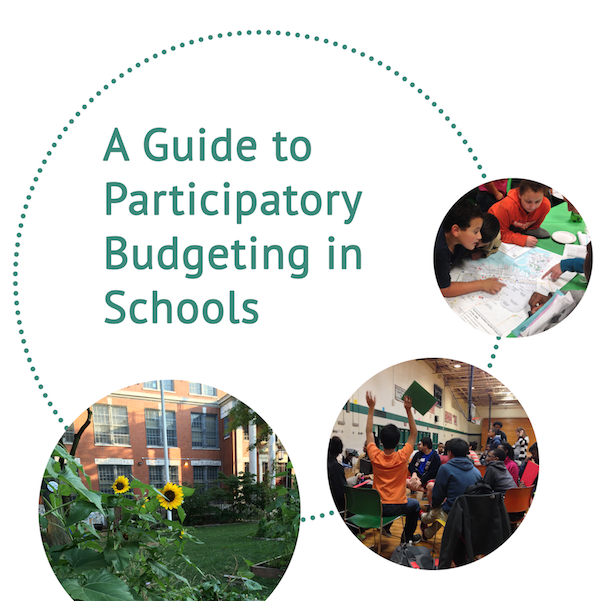
The Guide includes 18 lesson plans and 6 worksheets that are designed to take 45 minutes, once a week, over the course of a semester. You will find sections that explore:

  • Idea Collection
  • Proposal Development
  • Planning
  • VotingPB_Schools_Cover
  • Implementation and Beyond

Participatory Budgeting is great to bring into your classroom because:

  • It’s democracy in action.
  • It gives your students a positive civic engagement experience.
  • It serves as a bridge for your students to be engaged in politics and their community.
  • It strengthens the school community by building positive relations between students and the administration.
  • It shows students the benefits of getting involved.

By implementing Participatory Budgeting into classrooms, students will learn to:

  • Increase their ability to work collaboratively
  • Develop research, interviewing, and surveying skills
  • Develop problem-solving and critical thinking skills
  • Develop public presentation skills
  • Increase their awareness of community needs and their role in addressing those needs
  • Understand budgetary processes and develop basic budgeting skills
  • Identify ways to participate in governance
  • Increase concern about the welfare of others and develop a sense of social responsibility

The Guide’s game plan is effective and efficient as well as adaptive – modify it to fit your context. The Guide explains how to navigate idea collection, proposal development, an expo, a community vote, and implementation of winning projects.

PBP welcomes you to take the first step in bringing your school community closer and educating your students in an engaging democratic process by downloading our free Guide!

You can find the original version of this Participatory Budgeting Project announcement at www.participatorybudgeting.nationbuilder.com/pbinschools.

Enter Everyday Democracy’s Youth Grant Competition

We hope that our younger members will take note of a great opportunity that NCDD member organization Everyday Democracy recently announced. EvDem is offering grants for 18-30 year olds to attend their national convening in December of this year, and we encourage you to apply before the August 1 deadline! Learn more in EvDem’s announcement below or find the original version here.


Young Leaders Grant Opportunity

EvDem LogoThe next generation of leaders engaging people in creating positive change has already made waves in communities across the country.  Our goal is to attract 20-40 of those young leaders to take part in learning and networking at our upcoming national convening. Participants will learn, connect, and share their insights with changemakers of all ages.

Several young leaders will be awarded scholarships to enable them to attend the convening, and will have the opportunity to compete for grant money to support their leadership and organizing efforts in their local communities.

What we hope to accomplish:

  • Highlight the work of young leaders at our national convening
  • Provide opportunities for learning and networking among young leaders
  • Provide support for the critical work being done by young leaders across the country
  • Build our network among the next generation of changemakers

What is the grant competition?

Young leaders (ages 18-30) will have the chance to compete to win one of four all-expense paid scholarships to Everyday Democracy’s national convening in Baltimore, MD, December 8-10, 2016. The four finalists will present their work at the conference and compete for grants to support their work in their local communities.

By participating in this grant competition, young leaders will gain access to our tools, resources and coaching, as well as a national spotlight for the work they are doing.

How do I apply?

If you are interested in participating, send us a completed Intent to Apply form. We will follow up with you by providing the application guidelines and other details.

Through the application process, applicants will submit information telling us who they are, the work they are doing and what impact the convening and grant could have on their work.

The application process will likely include an essay and/or video submission. Submissions will be judged based on a demonstration of a commitment to the values of racial equity and inclusive community-building that Everyday Democracy champions. The submission details are still being determined. Those who submit an Intent to Apply will be the first to hear details on how to submit an application for the grant.

Who is eligible to apply?

Anyone from the U.S. who will be between the ages of 18-30 on December 1, 2016 who is doing great work to change their communities. Everyone who applies must be available and able to travel to the conference December 8-10, 2016 in Baltimore, MD.

Download the Intent to Apply form.

You can find the original version of this announcement from Everyday Democracy at www.everyday-democracy.org/news/young-leaders-grant-opportunity.

Become a Sponsor of NCDD 2016 Today!

NCDD is working hard on putting together our 2016 National Conference on Dialogue & Deliberation this October 14-16 in the Boston metro area. It’s shaping up to be our best conference yet, and like all of our conferences, NCDD 2016 will be a great opportunity to gain recognition while supporting the field by becoming a conference sponsor!

Looking to heighten the profile of your organization and work in the field? Being a sponsor is a great way to do it! NCDD conferences regularly bring together over 400 of the most active, thoughtful, and influential people in public engagement and group process work across the U.S. and Canada (plus practitioners from around the world), and being a sponsor can help your organization can reach them all.

Being an All-Star Sponsor ($3000), Co-Sponsor ($2000) or Partner ($1000) will earn you name recognition with potential clients, provide months of PR, and build respect and good will for your organization every time we proudly acknowledge your support as we promote the conference. Plus you’ll be providing the crucial support that NCDD relies on to make our national conferences so spectacular, including making it possible for us to offer more scholarships to the amazing young people and other deserving folks in our field. You can learn more about the details in our sponsorship document.

The earlier you commit to being an NCDD 2016 sponsor, the more exposure you earn as we begin to roll out our sponsor logos on our website. But the benefits go way beyond that – just look at all the perks you get for being a sponsor!

By supporting an NCDD conference, our sponsors are demonstrating leadership in D&D, showing commitment to public engagement and innovative community problem solving, and making a name for themselves among the established leaders and emerging leaders in our rapidly growing field. We expect to have between 400 and 450 attendees at NCDD 2016, and all of them will hear about our sponsors’ work!

When you sign on as a sponsor or partner of NCDD 2016, you’ll be joining an amazing group of peers you can be proud to associate with. To give you an idea, check out our sponsors and partners for our 2014 national conference in Reston:

SponsorLogosAsOf9-7-14

Interested in joining their ranks and sponsoring the 2016 National Conference on Dialogue & Deliberation? We encourage you to consider investing in yourself, in NCDD, and in the field by becoming a sponsor today! We would deeply appreciate your support – plus you get so many benefits.

Learn more about sponsor benefits and requirements here, or send an email to sandy@ncdd.org to let us know you are interested in supporting this important convening through sponsorship. And thank you for considering supporting the conference in this critical way!

Engaging D&D’s Young Leaders in NCDD 2016

As many of you know, NCDD’s 2014 conference in Reston, VA had more students and young people in attendance than any conference before it, and it made a huge difference – the energy and fresh thinking that young people bring to our conferences and to our field was and is inspiring and indispensable. NCDD continues to be committed to cultivating the next generation of leaders in our field, and that’s why we are aiming to have even more youth and student attendees at NCDD 2016 this Oct. 14th-16th in Boston!yardsign_300px

As part of that commitment, we are pleased to announce that NCDD is offering a super-low student registration rate of $250 (that’s $200 off!), and we have opened up our application for NCDD 2016 scholarships. These scholarships are intended to help young people in D&D and other deserving applicants who otherwise wouldn’t be able to attend by offsetting the costs of travel, housing, and registration as needed.

The scholarship application can be found at www.surveymonkey.com/r/NCDD2016-scholarship-app.

But we need our NCDD members’ help encouraging the promising and engaged young people and students in this field to attend the conference! Do you work with an outstanding young person who is passionate about the work of dialogue and deliberation? Are you connected to a student who is working to bridge divides in their community? Make sure to tell them about NCDD 2016 and encourage them to register today!

Also, please note that we are offering group discounts to incentivize teachers and other practitioners who are bringing groups of students or youth from their programs or organizations. The group rate will be worked out on a case-by-case basis, but the more Martins-Students-border-600pxpeople in your group, the bigger the discount! Contact our Conference Manager Courtney Breese at courtney@ncdd.org with questions about group rates.

We also encourage you to recommend young people you think NCDD should support to our Youth Engagement Coordinator Roshan Bliss at roshan@ncdd.org so we can reach out and invite them directly.

Lastly, don’t forget that NCDD offers a discounted Students & Young Professionals membership rate of just $30/year that is designed to make NCDD membership more affordable for students, recent graduates, and folks 35 and under still getting established in the field. We encourage you to learn more and sign up to become a member today at www.ncdd.org/join.

We are looking forward to another great intergenerational conference, and we’re counting on our members to help us make sure the best and brightest are there. We can’t wait to see you all in October!

Lessons in Listening to Students from Providence Youth

We recently came across a piece on a student-led, World Cafe-style event in Providence that provides a wonderful example of how schools can bridge the divide between youth and adults and teach deliberation, and we had to share it. The article below by Megan Harrington of the Students at the Center Hub describes the event, the students’ discussions, and their proposed solutions to issues in their schools, most of which are summarized in the open letter the students wrote after the event. We hope to see more processes engaging young people like this nationwide! You can read Megan’s piece below or find the original here.


#RealTalk: Providence Students Raise Their Voices

On a sunny Wednesday afternoon in April, over 100 high school students gathered at the Providence Career and Technical Academy cafeteria, talking with friends, setting up tables with sheets of paper and markers, and manning sign-in tables. They were members of the Providence Youth Caucus (PYC) – a coalition of Providence’s seven youth organizations -gathering to develop solutions to improve education in their public schools, which they would then share with relevant policymakers to advocate for change.

An entirely student-led event, the PYC Superintendent’s Forum began a little after 4pm, when student speakers took the microphone at the front of the room to lay the groundwork for the event. “Your thoughts and voices matter,” they said. “We’re going to take all of your ideas and present this data to the superintendent and city officials so we can make a difference.”

Key school leaders – including Providence Public Schools Superintendent Chris Maher – attended the event to hear the students’ insights.

After a round of icebreakers, the students quickly broke out into nine tables to discuss hot topics in education such as personalized learning, school culture, discipline, student voice, and the arts. Two facilitators – a conversation leader and a note-taker – led the discussions at each table, while the other participants rotated to a new topic table every 10 minutes.

The first table I sat down with discussed the value of arts education, the strengths and weaknesses of Providence high school art programs, and what an ideal arts education would look like.

Most students at the table felt arts programs were critical for students to develop new skills, express themselves creatively, and explore possible career paths. One student excitedly shared his experience in his school’s engaging graphic design class, but most students felt their schools’ arts programs were lacking or even for show. One young woman said she took a calligraphy class that lacked necessary pens and ink until a month into the semester, but “it was an arts class, so it counted.” Some students lamented that art studios were eliminated to make space for engineering labs, or arts funding was cut to continue funding sports. And, others commented, because higher standardized test scores meant more school funding in general, arts programs were often cut in favor of those courses that incorporated standardized testing. Overall, students seemed to be in agreement – improved arts programs were necessary at their schools.

At a neighboring table, students contested the importance of student voice in the classroom.

Most students agreed student voice was not being adequately heard in their schools. “If it was being heard, many of these changes would have already been made,” one young woman reasoned.

But why wasn’t student voice being heard? Some said the burden was on students. “We should make more of an effort to speak up, organize in our schools, and discuss these issues with our principals,” one young man commented. “But there are some students who are speaking up but aren’t being heard,” said another. Others in the group agreed. Veteran teachers were unaccustomed to incorporating student voice and made students feel like the classroom dynamic was adversarial. “Even student government can’t go in front of school leaders and be taken seriously,” one student chimed in.

And where did students feel their voice was most lacking? Curriculum issues struck a chord with many, leading to an animated discussion about non-white history. “The last time I heard about slavery was in 6th grade; all I’ve learned about since then are the ‘World Wars,’” noted one young woman. “Black History Month is the only time I learn about black history,” chimed in another student. Others expressed their frustration with the focus on European history: “Why can’t we have an AP African History or an AP South American History?” one student questioned. In contemplating solutions to this important issue, the Providence students concluded that it was important to have a diverse teaching staff to bring varying perspectives to history.

After students had visited a number of tables, the team facilitators shared the ideas collected over the hour with entire conference. Everyone cheered after each presentation, giving extra applause when they felt particularly inspired.

Like many of the students that night, I left feeling invigorated and inspired, excited to see where their discussion would lead in the future. The Providence Youth Caucus is scheduled to formally present their data from the Forum to the district’s school board and Superintendent Maher on July 27, 2016. Stay tuned for the results of their presentation!


Providence Youth Caucus is comprised of seven Providence student groups – Hope High Optimized (H2O), New Urban Arts, Providence Student Union, Rhode Island Urban Debate League, Youth in Action, YouthBuild Providence, and Young Voices. Learn more about their efforts by following them on Twitter at @pvdyouthcaucus.


You can find the original version of the above piece from Students at the Center Hub’s blog at www.studentsatthecenterhub.org/realtalk-providence-students-raise-their-voices.