Local Civic Challenge #1: Learn More About Your Local Gov

As a fantastic way to help folks further strengthen civic muscles, our friends at The Jefferson Center – an NCDD member org recently began offering a Local Civic Challenge. Every week they have a mini challenge for becoming more engaged with your local government and we will be lifting them up here on the NCDD blog. The first challenge is to get familiar with your local gov! Let us know in the comments below if you have additional great tips for getting familiar with our own city governments. We encourage you to flex those civic skills by checking out the post below, which you can find the original on the JC site here, and sign up to get it delivered to your email!


Local Civic Challenge #1: Get Familiar With Your Local Gov

To kick off the first week of the Local Civic Challenge, we want you to learn more about the ins and outs of your city government! That includes how it operates, who’s involved, and ways you can give feedback. Once you’re done, you’ll be more familiar with how the system works, and you might even have some ideas on the ways things could be improved.

Do you want the Local Civic Challenges delivered directly to your inbox? Sign up here.

1. Locate your city’s charter

In the United States, city charters usually define the organization, power, functions, and procedures of local government. Not all states allow local governments to create their own charters, so double check this list before your search.

2. Find out if your mayor is strong or weak

This isn’t a comment on your mayor’s effectiveness (that’s a different conversation), but their level of authority on local issues. In a “strong mayor” system, mayors are directly elected, and can make appointments and veto legislation. Meanwhile, most “weak mayors” are elected from within the city council, and do not have veto powers or executive authority on most matters. Yours may not be entirely one or the other, either!

3. Give some feedback

What’s one thing you think your local government is doing well? What could they improve on, and do you have any suggestions for them? Make a list, then head to your city’s website to find who to contact. Most have phone numbers and email addresses for different departments, from parks & rec to public works, so you can reach out to the right people.

4. Save the dates

If you don’t want to miss upcoming upcoming public meetings, see if your city has an upcoming events calendar or schedule published online.

5. Follow and like

Does your city or county use Facebook, Twitter, or Instagram? If you follow them, you can just catch important projects updates and events as you scroll! Plus, you can easily give feedback by messaging, liking, or commenting.

6. Get familiar with the voting system

Local elections in the US vary widely, but the most common are first-past-the-post voting and instant-runoff voting (often called ranked-choice voting). In first-past-the-post, the candidate with the most votes wins the election. In instant-runoff, voters rank the candidates in order of preference rather than voting for a single candidate. Ballots are counted and each voter’s top choice is recorded, and losing candidates (those with the lowest votes) are eliminated, and their ballots are redistributed until one candidate remains as the top choice of the majority of voters.

Was it difficult to find information about your city? Could your local government be more accessible? Let us know in the comments below!

Next week, we’ll explore how to join local offices, committees, and boards.

You can find the original version of this article on The Jefferson Center site at www.jefferson-center.org/local-civic-challenge-1-get-familiar-with-your-local-gov/.

Evolving Infogagement for More Democratic Public Life

As technology and the needs of our society continue to evolve, the ways in which we engage each other and utilize information when participating in public life will also continue to change. The paper, Infogagment: Citizenship and Democracy in the Age of Connection, written by NCDDer Matt Leighninger in collaboration with Philanthropy for Active Civic Engagement (PACE), was recently re-released to reflect the ways in which these changes are shaping. We encourage you to read more in the post below and find the full original report on PACE’s Medium site here.


Infogagement: Citizenship and Democracy in the Age of Connection

PACE LogoTable of Contents

Executive Summary

Our traditional notions about the “public square” are out of date. In thinking about information, engagement, and public life, we have generally put information first: people need to be educated, and then they will become politically involved (the original title of this PACE project was, accordingly, “Information for Engagement”). But as we interviewed leading thinkers and practitioners in the fields of journalism, civic technology, and public engagement, it became clear that the sources of information and the possibilities for engagement have diversified dramatically. Instead of a linear progression from education to involvement, public life seems to seethe and spark with connections and reactions that are often unexpected and always hard to map. Our Norman Rockwell image of public life has become something more like a Jackson Pollock painting.

Another question animating this PACE project was how to bring “new voices” — meaning young people, poor people, recent immigrants, and people of color — into the public square. But because public officials, journalists, technologists, and citizens (both new voices and established ones) are playing different roles, and interacting in different ways, this too is a more complex question than it first appears. The real challenge is figuring out what the new public squares might look like, how they can be equitable and democratic places, and how they should be built.

Through interviews and small-group discussions, we have identified and clarified a number of key trends:

  • Thinking of citizens mainly as voters, volunteers, and writers of letters to the editor is no longer sufficient. Civic engagement has changed radically over the last twenty years, spooling out into thick and thin strands of participation. “Thick” engagement happens mainly in groups, either face-to-face, online, or both, and features various forms of dialogue, deliberation, and action planning; “thin” engagement happens mainly online, and is easier, faster, and potentially more viral — it is done by individuals, who are often motivated by feeling a part of some larger movement or cause.
  • The institutions of journalism are going through a painful transition period, but new collaborative practices, “hyperlocal” innovations, and engagement activities (including the use of engagement as a revenue source) may be signaling the rebirth of the field. Meanwhile, in their profession, journalists are employing a greater range of skills and playing a wider range of roles.
  • Despite the early optimism, the new Internet-connected world of information and engagement has not (so far) been a more equitable and empowering environment for people of color, low-income people, and other marginalized groups. Addressing this challenge will require a better understanding of community networks, how they map cultural differences, and how they channel information and engagement.
  • Storytelling is more powerful and ubiquitous than ever: a much higher percentage of people can share their opinions and experiences, and hear the opinions and experiences of others, in ways that are more convenient, continuous, and public. By comparing notes on what we mean by storytelling — and listening — we might come to a better, shared understanding of why people want to take part in public life, and better recommendations for how to facilitate and support their efforts.
  • Big data, once the domain of experts, is now part of the public engagement picture. The opportunities and challenges of big data may require a set of intermediaries — people and organizations that can curate and interpret data for everyday citizens. The future of big data may depend less on the skill and expertise of these intermediaries, and more on whether citizens trust them.

In the past, discussions of information and engagement revolved around the wrong questions. “I’m pretty tired of the ‘How do we save newspapers?’ discussion, as well as the ‘What’s the latest techno gizmo that will save the world?’ discussion,” says Jon Funabiki, a journalism professor who directs the Renaissance Journalism center at San Francisco State. It doesn’t seem sensible or compelling to ask how we can bring back the past in the newspaper industry, or how we can realize an unrealistic future with technology.

Furthermore, we can’t keep thinking of the public square as a place that is dominated by civic professionals, where citizens occupy a limited set of predictable roles. That vision, which originated with Progressive thinkers like John Dewey, is no longer viable. To help communities build new public squares, we should focus on four questions:

1. What kinds of infogagement infrastructure and institutions at the community level would support the best flow of news, information, and engagement?

2. How can such an infrastructure support a high level of democratic engagement across the community, especially for people who have borne the brunt of past injustices and inequalities?

3. What should be the complementary, constructive, yet independent roles of journalists, public officials, and technologists?

4. What are the core democratic skills needed by people in each of these professions, and how can we provide them?

You can find the original version of this on the Medium site for Philanthropy for Active Civic Engagement (PACE) at www.medium.com/infogagement/infogagement-citizenship-and-democracy-in-the-age-of-connection-cdf849610381.

Ensuring Engagement is Inclusive and Fair

In order to have engagement that is fair and equitable to all members of society, it is vital to be intentional when designing and facilitating those processes by asking, “who shows up?”. NCDD member org the Participatory Budgeting Project recently shared this article on how to make PB inclusive and fair, and there are some great tips to keep in mind for all our work. We encourage you to read the post below and find the original on PBP’s site here.


Making PB Inclusive and Fair

Typically, when we want to know how inclusive and fair a Participatory Budgeting (PB) process is, we ask “Who shows up?” While this is a good starting point, it’s not enough. To meaningfully assess equity, we need to dig deeper.

Celina Su, Chair of Urban Studies at the City University of New York (CUNY) and Frankie Mercedes, former Communications Strategist with the Participatory Budgeting Project (PBP), joined forces to lead a stellar PBP Network Study Session, which addressed issues of equity and fairness in PB.

This blog post reviews the main points of their conversation, identifies common barriers to equal participation in PB, and suggests how to make PB more accessible to people with low incomes and to people of color.

“Who shows up?”

Public Agenda’s report on PB in North America found that during the PB vote, “In nearly all communities, black residents were overrepresented or represented proportionally to the local census among voter survey respondents.” In contrast, PBP’s internal evaluation data shows that white people, people with high or moderate incomes, and people with advanced degrees tend to be overrepresented in the steering committee and budget delegate role. The populations in the second group tend to have more time, flexibility, and financial security—factors that make them more likely to participate in more intensive aspects of PB.

To create truly inclusive PB processes, low-income residents and people of color must be well represented on the steering committee and as budget delegates. The steering committee sets the rules for a PB process, and these rules ensure an inclusive and fair process. When low-income people and people of color are not in the room, steering committees miss valuable ideas on how to create a fair process.

Here’s how you can make sure everyone shows up:

  • Publicize and do outreach for all phases of the PB process—not just for idea collection and the vote.
  • Provide 2-way transit fare for people who’ve identified need.
  • Offer free, on-site childcare and food at PB events to boost engagement of women, parents, and low-income residents.
  • Consider the location of PB events—Fancy venues or gentrified areas in a city may feel unwelcoming to some. Switch up the location of PB events to make sure that everyone feels welcome and feels ownership of their PB process.

“Who gets heard?”

Celina Su interviewed several PB participants about their experience in PBNYC, and she saw a pattern. People of color and people with low incomes felt that the PB process was frustrating and unfair. Highly organized groups, like parent-teacher associations from high-income neighborhoods, had a set agenda and dominated the budget delegate process.

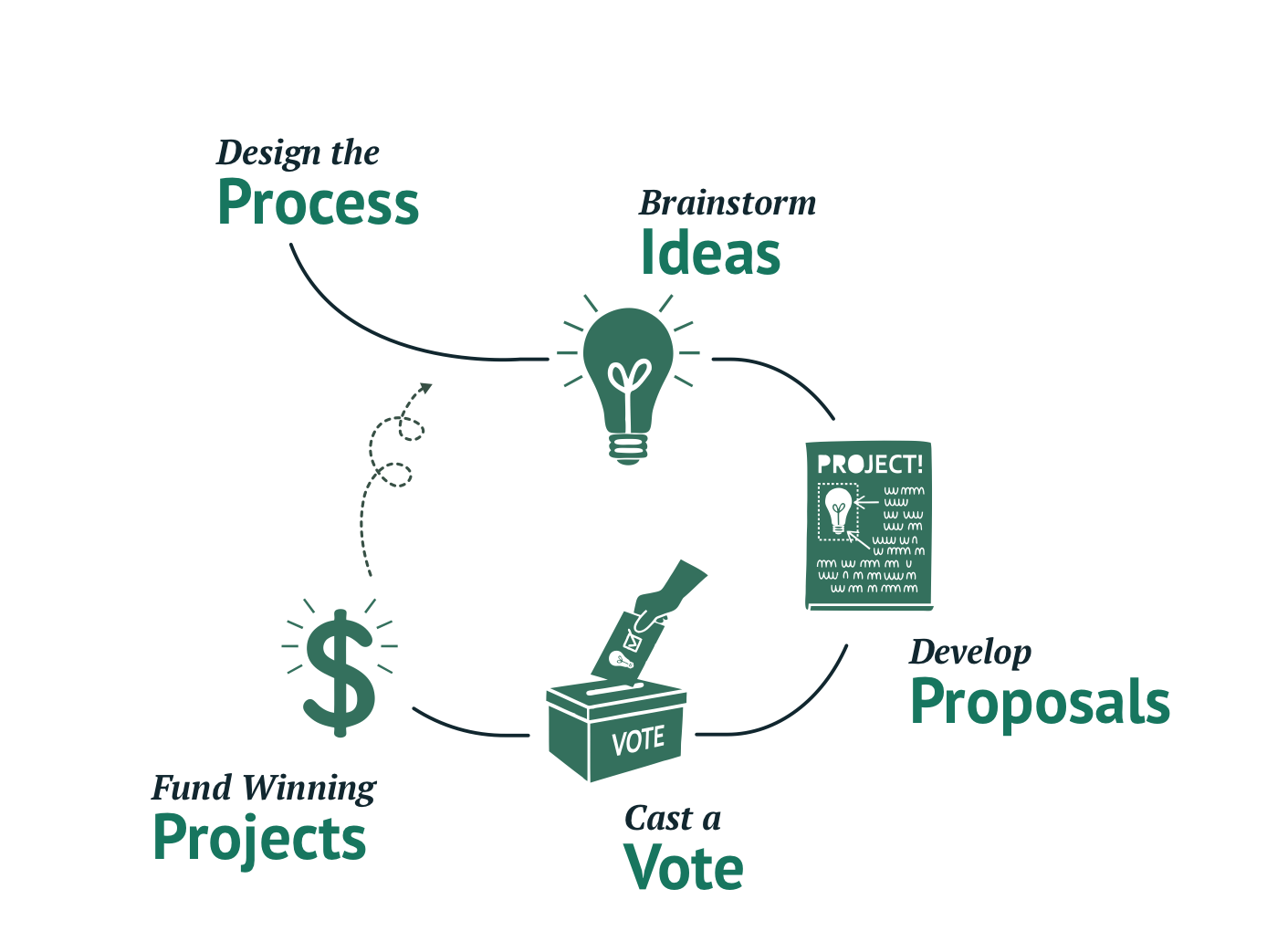
The budget delegate stage is a very important part of PB. As volunteers, budget delegates select ideas from the idea collection phase and turn them into proposals that PB participants vote on. While residents can voice any priority during the idea collection phase, budget delegates work with staff to determine which ideas are eligible for PB funding.

In many cases, PB funding comes from an elected official’s capital budget. This means that a PB proposal has to be a capital project in order it to be eligible for funding. A capital project is a physical purchase (e.g. computer), construction, or renovation (e.g. a building).

When residents think about what their community needs, they may not think of physical infrastructure; they might think of training, programs, or other non-physical investments. Residents may struggle to think of physical changes that can address their community’s most pressing needs—like quality education and job access. And, because low-income residents and people of color are often underrepresented as budget delegates, they don’t have the same opportunities to pick ideas and tweak non-eligible ideas so that they fit into PB’s rules. This is why projects that benefit marginalized communities can fall off the table during the budget delegate phase.

During Celina’s interviews, residents also said it was intimidating to talk with elected officials and city staff. Many people don’t have experience talking with elected officials or speaking in the language of government and law. Without sufficient support mechanisms, this imbalance fosters an environment that privileges those with more education and knowledge of government and law.

Here’s how you can make sure that everyone’s voice is heard:

  • Pay budget delegates and steering committee members

People who have the time and extra cash to volunteer tend to be of mid to high socioeconomic status. Paying residents for their time will incentivize people of all income backgrounds to participate in the time and energy intensive aspects of the PB process.

  • Provide space for in-group deliberation

In-group deliberation gives residents from similar backgrounds (e.g. public housing, immigrant, age group, etc.) the opportunity to discuss, solidify and agree on priorities. For example, non-English single language meetings have been very successful.

  • Offer training for government representatives

Government representatives should make themselves open and available to their community. Simple changes in tone and body language can mean the difference between intimidating residents and engaging them.

  • Bring in facilitators

Facilitators can help participants shape and develop their ideas and to ensure that certain groups don’t dominate speaking time.

“How does PB interact with society and government institutions?”

In her research on inclusion and PB in New York City, Celina notes that surveillance cameras are among the most popular projects in PBNYC. According to her report, they have “won funding every year so far.”

Celina sought to find out why cameras were so popular among NYC residents. She found that residents who wanted security cameras envisioned the cameras as part of a much broader program of public safety. Some residents’ vision of community safety included “greater police accountability and economic support as well as surveillance, and they crucially included bottom-up accountability and access to… [the video footage] captured by cameras.” But some residents were not aware that the New York City Police Department does not routinely make surveillance footage available to the public. On top of that, the economic and jobs programs that residents wanted did not qualify as capital projects and were therefore ineligible for PB funding. By the time PB voting began, NYPD-controlled surveillance cameras were the only thing left of residents’ vision for community safety.

Here’s some tips to equalize benefits from PB:

  • Make equity and inclusion an explicit goal of the PB process

PB is about making communities stronger and more civically engaged. PB participants want to help make that goal a reality. When PB leaders encourage participants to center equity, they create an environment where participants actively consider the needs of other residents.

  • Find or create a district profile

A district profile should describe the most important aspects of a community (e.g. educational achievement, income, ethnic composition). This will help residents identify what is going well in the district and locate areas for improvement. PBP’s list of community resources called Data for the People is a great starting point for gathering information about your community, as is the new tool developed by PBP, myPB.community.

  • Let participants know how government agencies implement PB projects

Some residents told Celina that they would not have voted for surveillance cameras had they known that the community would not have had control over the footage. It’s critical that PB participants understand the ramifications of what they are voting for so that they can make an informed decision.

As a tool, PB is susceptible to the same challenges faced by any other civic process. However, because it’s flexible and includes community involvement at high levels, PB leaders and residents have the opportunity to design a PB process that’s both inclusive and fair.

Want more info on PB and Inclusion? You can find more resources below:

Report: Celina Su’s Research on Inclusion in PB

PB Study Session: Equity and Inclusion in PB (Video)

PB Community Tools: Data for the People

PB Tool: Outreach Toolkit

PB Study Session: Budget Delegates (Video)

Report: Celina Su’s Research on PB

Blog Post: Black Power through Participatory Budgeting

You can find the original version of this post on the Participatory Budgeting Project’s site at www.participatorybudgeting.org/making-pb-inclusive-and-fair/.

DMC Hosts Third Annual Civic Institute on August 17th

The third annual Civic Institute is happening Friday, August 17th, hosted by NCDD member org the David Mathews Center for Civic Life. This will be one of the premier events dedicated to strengthening civic life in Alabama and will be a fantastic opportunity for those doing civic engagement work throughout the state.  DMC recently announced the session line up which you can read more below and on the DMC’s site here.


2018 Civic Institute: Be Together Differently

We’ve added new sessions to our third annual Civic Institute! Please join us Friday, August 17, for some deep conversations on strengthening civic life in Alabama – not for a day, but for the duration.

Each year, our hope at the Civic Institute is that Alabamians doing good, sustainable work in their neighborhoods and hometowns connect with each other in new ways. Every place has a unique story and faces a distinct set of challenges, yet across the state, the Mathews Center sees increasingly that Alabama residents and civic leaders often face similar issues. Through Alabama Issues Forums we see that when people desire to address an issue they all face – rather than politics or personalities – deliberative conversations can be especially suited for the uncommon and transformative experience of working together across difference. Wicked problems don’t tend to disappear overnight, and so the everyday habit of talking with each other as citizens – not circling issues, but working towards creating solutions we can all live with – often proves to be, simultaneously, one of the most effective and the most accessible approaches to sustainable community development.

At this year’s Civic Institute, we hope to find deeper ways to support Alabamians practicing such fundamental aspects of democracy as having sustained conversations on difficult issues, practicing innovations in journalism, bringing underrepresented groups to the table, and recognizing the potential each individual holds to make their communities better for everyone. More than ever, this year, we seek to continue modeling our call to listen first and to “pass the mic” by highlighting the following speakers and topics:

The Elephant in the Room: Talking About Difficult Issues: Talking about challenging issues in a divided political climate is hard. Listening to those we disagree with is difficult. Finding opportunities to bridge divides and discuss the “elephants in the room” in a productive, civil manner that prioritizes understanding over consensus is even more challenging. During this interactive session, learn from Alabama communities that are engaging citizens in deliberation on some of the most divisive public issues facing communities today. Discover tools and resources you can use to tackle the issues facing your community. Chris McCauley of Markstein will moderate; additional speaker details are forthcoming. This session is made possible by a generous donation from The Blackburn Institute at the University of Alabama.

“Public life is bigger than political life. We have narrowly equated the two in recent years, and we’ve impoverished ourselves in the process. Public life includes all of our disciplines and endeavors, including ourselves as citizens and professional people and neighbors and parents and friends. The places we’ve looked for leadership and modeling have become some of the most broken in our midst. And so it is up to us, where we live, to start having the conversations we want to be hearing and creating the realities we want to inhabit.”

– Krista Tippet, On Being

Who Remembers? Collective Memory and Public Life: The issue of monuments and memorials in public spaces divides communities around the nation, and people of goodwill on all sides of the issue struggle to hear each other productively.  In this facilitated discussion, participants will discuss what concerns them the most regarding this issue and whether they can imagine opportunities for deliberation within their communities and networks. This session will be moderated by Dr. Mark Wilson, Director of the Caroline Marshall Draughon Center for the Arts and Humanities at Auburn University. Our thanks to the Alabama Bicentennial Commission for generously sponsoring this session.

“A community is the mental and spiritual condition of knowing that the place is shared, and that the people who share the place define and limit the possibilities of each other’s lives. It is the knowledge that people have of each other, their concern for each other, their trust in each other, the freedom with which they come and go among themselves.”

– Wendell Berry

The Front Doors of Fellowship: Engaging with Difference Through Faith: What is the role of faith communities in public life? What do we find at the intersection of faith and civic engagement? How can we cultivate the physical and conceptual spaces that houses of worship occupy, in order to bring people together in new ways that connect our individual experiences and our rich inner lives with the work that we must all do, collectively, as a public? Faith communities, for many Alabamians, not only feed the spiritual life, they also serve as a hub of community life. This session will focus on stories, challenges, and opportunities in bringing faith communities together across divides to address key issues and challenges facing our hometowns and our state.

“The power of belonging creates and undoes us both; if spirituality does not speak to this power, then it speaks to little.”

-Pádraig Ó Tuama, Irish Theologian

Urban Perspectives on Civic Engagement in Alabama: The University of Alabama at Birmingham’s Woodlawn Project and Spring Hill College’s Foley Fellowship in Civic Leadership are experiential learning opportunities that seek to work alongside neighboring communities to better understand and address the complex effects that poverty and other related disparities have on their quality of life. The effectiveness of each project is rooted in its being tailored to fit the particular contexts in which each institution operates. Attendees of this session will take part in a dialogue that compares and contrasts the unique challenges, approaches, and learning outcomes that these programs have yielded working with community partners in urban contexts on opposite sides of the state.

“As we internalize the view of others, we change. And as our perception of others changes, we see possibilities for acting together that we didn’t see before.”

-Dr. David Mathews

Who’s Not At the Table? Engaging Youth in Civic Deserts: Over the past decade, civic engagement and volunteering rates among young Americans have declined across race, income, and education levels. However, youth and young adults living in “civic deserts” are disproportionately represented among the disengaged.  Civic deserts are communities that lack adequate opportunities for young people to learn about and participate in civic and political life. Over 40% of American youth and young adults live in “civic deserts.” In rural areas, the percentage of young people living in civic deserts climbs to nearly 60%. Youth in civic deserts are less engaged in politics, are less likely to vote in elections, and are less likely to believe in the influence of their own voice and the collective potential of their community. While the statistics can be harrowing, there are leaders, educators, and organizers across Alabama who are working to revive youth engagement within rural and urban civic deserts. By capitalizing on the assets within their community to create leadership opportunities, mentorship programs, career training, and youth programming, the guest speakers in our Engaging the Disengaged: Youth in Civic Deserts session are creating innovative avenues for youth engagement. This session is made possible thanks to the generous sponsorship of Alabama Public Television.

Passing the Mic: Representation & Empathy in Civic Media: The digital disruption of traditional news and media outlets has become an accepted, albeit cliche, archetype for the twenty-first century. The fourth estate that so many Americans revered throughout our history has been faced with growing distrust, diminished resources, and has struggled to translate its traditional structure and function into an increasingly viral model of news and journalism. At the same time, digital technologies have enabled millions to tell their own stories in a way that is diffuse, yet direct.

The rise of citizen journalism and social media has emerged as a critical component of what we today characterize as “civic media.” The centuries-long interpolation of citizen and journalist is newly-malleable, and calls for a radical reconceptualization of the citizen-journalist relationship. “I just want to be a voice for the voiceless,” is a refrain that is increasingly unable to bear the complex weight of citizens ready to speak for themselves. Why be a voice for the voiceless when you could just pass the mic?

This session will explore ways of passing the mic and equipping others to tell their own story through digital media as well as traditional journalistic outlets. From Twitter to the town square, we will consider examples of intergenerational cooperation amongst communities, local professors, and their students, as they reimagine what community journalism and self-representation can accomplish in our time.

To register, visit 2018civicinstitute.eventbrite.com. Please contact Rebecca Cleveland at rcleveland@mathewscenter.org if the cost of attending presents a burden; we have some scholarships available. To become a sponsor, contact Cristin Brawner at cfoster@mathewscenter.org. 

 You can find the original version of this announcement on the David Mathews Center blog at www.mathewscenter.org/2018-civic-institute-sessions/.

The Tonic to Heal our Ailing Democracy

It’s incredible how relevant this article still is on how to strengthen our weakened democracy, despite that some time has passed since it was published. Penned by Will Friedman, Executive Director of Public Agenda – an NCDD member org, he states that the tonic to remedy our ailing democracy is “not just more democracy, but better quality democracy”. As many communities around the country are going through their primaries, it is a vital time to practice this; as we all have roles to play in nursing our democracy back to good health. You can read the article below and was re-shared on the Deliberative Democracy Consortium‘s site here.


Fixing What Ails Democracy

What does it mean, this chaotic, disturbing, unpredictable electoral season? We’ll know more after the dust has settled, but we can’t afford to wait to make our best guess. We need a working theory to orient ourselves as we seek to minimize damage and prescribe a path that will move our democracy in a healthier direction.

One thesis has been powerfully articulated in an insightful and beautifully written essay by Andrew Sullivan for New York magazine. I agree with practically everything Sullivan had to say in this fascinating read — with the exception of his central thesis and conclusion!

Sullivan does not bury his lede — it’s all there in the title: “Democracies end when they are too democratic, and right now America is a breeding ground for tyranny.” His argument leads, ultimately, to a call for elites to assert themselves and save the people from themselves.

Yet it is the very non-responsiveness of elites to the needs and problems of great swaths of the public that is profoundly frustrating people in the first place. Asking political and economic elites to control rather than engage the public would only exacerbate that frustration.

In an analysis from the Rand Corporation, the factor best predicting support for Donald Trump was agreement with the statement, “people like me don’t have any say.”

Certainly elites have a role to play in fixing what’s broken in our public life, but if they assert themselves by disempowering people, they risk worsening the problem rather than solving it.

In a recent piece for The New York Times, Michael Lind counters Sullivan’s thesis, arguing for more democracy, not less. He describes the ways in which decisions that affect people’s lives are being made in increasingly distant and unapproachable ways:

Majorities need to be constrained when it comes to essential rights. But removing too many decisions from local to remote governments and from legislators answerable to voters to unelected judges, executive officials and treaty negotiators, is likely to create a democratic deficit that provokes a backlash against the system.

If we want to avert the sense of powerlessness among voters that fuels demagogy, the answer is not less democracy in America, but more.

In defining “more democracy,” Lind focuses squarely on political institutions and legal structures that enable citizens to have more influence on the decisions that affect their lives. Expanding citizen influence is crucially important; it can attenuate the public powerlessness and marginalization that fuel the antagonistic temper of the times. This expansion can emerge not only through traditional political reforms like decentralizing certain decisions and resources to the local level, but also through innovative experiments in community democracy like participatory budgeting.

But Lind’s appraisal is also an incomplete prescription in one important respect. Citizens now operate in an environment that inflames rather than informs public opinion.

We have a political culture and fractured media environment saturated with increasingly sophisticated spin, the cult of celebrity, and the conflation of incivility and authenticity.

We have access to more information than ever before, but that information often serves to reinforce our prejudices and assumptions. It’s never been easier to avoid alternative views and disconfirming data.

We have more ways of expressing ourselves than ever before, but it’s too easy to sound off irresponsibly, even anonymously, and avoid challenge and intellectual accountability.

Rather than a political culture of listening to and engaging people with different views, we have too much of a culture of dismissal, disdain and groupthink. As a result, we end up with a politics full of magic bullets, scapegoats, and focus-group-tested slogans.

To counter these inflammatory forces, we need a democratic culture and set of practices that help people encounter and weigh competing ideas and the choices we need to make as we face the future. Such structures will enable people to transform gut-level opinions and assumptions into what Dan Yankelovich calls “public judgment” — views that people have won, not received, through the hard work of thinking for themselves and talking with others.

What we truly need, then, is not just more democracy, but better quality democracy, with better resources for public conversation and judgment.

If there’s an upside to the current turmoil it’s that, despite the demagogic excess, important questions are swirling to the surface.

Why is the economy working so well for a small number of Americans and so poorly for so many? Is the disappearance of middle class jobs, and along with them the American Dream, inevitable or can we do something about it? If so, what? How can we better address our entrenched issues around race and ethnicity, and best adapt to our rapidly changing demographics? How can we work to make gridlock the exception rather than the norm?

We need more robust democratic conversation on questions like these — not just to “save the people from themselves” but to renew America’s democratic promise and set the nation on a better path.

You can find the original version of this article on the Deliberative Democracy Consortium site at http://deliberative-democracy.net/2017/06/16/fixing-what-ails-democracy/

Nevins Fellows Begin Internships – TWO with NCDD orgs!

We are very excited to share an update from Penn State’s McCourtney Institute for Democracy, that the new Nevins Fellows will be starting their summer internships! NCDD has partnered with the McCourtney Institute over the last few years to help connect students from their Nevins Democracy Leaders Program to internships with individuals and organizations in the D&D and public engagement field. We are extra proud to share that two of the fellows will be joining NCDD member orgs – the Participatory Budgeting Project and Everyday Democracy. Please join us in wishing all the Nevins Fellows the best of luck in their new roles – you will be great!

We encourage you to read the announcement below and find it on McCourtney’s site here.


Nevins Fellows Begin Summer Internships

This week, our new cohort of Nevins Fellows will start working with organizations around the country that advance democracy in a variety of areas.

Over the next two months, students will have the opportunity to learn what it looks like to engage in deliberation, outreach, and other processes that are essential to a healthy democracy.

Here’s what they are most looking forward to as they begin their internships:

Alexis Burke
Participatory Budgeting Project
Brooklyn, New York

I chose to work with The Participatory Budgeting Project because of their tangible effects on the communities they work with. Through the implementation of small d democracy, The Participatory Budgeting Project helps to foster community and democracy in the New York metropolitan area.

I’m most looking forward to connecting with The Participatory Budgeting Project’s team members as well as members of New York’s various communities. I can’t wait to gain hands-on experience implementing everyday democracy.

Maia Hill
City of Austin
Austin, Texas

I selected this organization because the mission aligns with some of the practices I believe need to be incorporated within all communities. This line of work would help me in the long run because I plan on going into politics and/or becoming a State Representative and in order for me to be an effective and efficient leader in that line of work.

Entering into this internship, I hope to gain a greater understanding of the importance of participatory democracy. I am looking forward to learning how to be active within community engagement and how to get minorities within between race, ethnicity, gender, etc. involved within local government to get the change that they want and need within their communities. This hands-on experience will definitely make a huge difference in how I can also be more involved with the current community I reside in here at Penn State.

Sophie Lamb
Everyday Democracy
Hartford, Connecticut

I chose Everyday Democracy because of their focus on the inequalities in the criminal justice system. I am fascinated by the differences between how legislation is written compared to how it is implemented. I am also excited to see the outreach the organization does and how they interact directly with different communities.

I am most looking forward to the opportunity to see how laws are implemented compared to the theoretical intention behind legislation, specifically in regards to the racial disparity in the criminal justice system. In addition, this internship will allow me to continue to improve on the research and writing skills that I have built during my time at Penn State.

Stephanie Keyaka
City of Baltimore
Baltimore, Maryland

I went to school in Baltimore City, so I have an extreme love for the community. What attracted me to this site was Councilman Cohen’s dedication to building a stronger democracy and legislating that is rooted in equality and justice. I wanted to do more for communities of people that look like me, and this site and the office’s mission aligned perfectly with my political aspirations.

It will be very interesting to use a racial equity lens to tackle public policy issues in Baltimore City. Urban and local politics are often overlooked, but can have be of extreme importance for the members of this community. I am hoping to better learn the ways in which local politicians can have an impact on the immediate lives of residents, especially in marginalized communities

You can find the original version of this announcement on McCourtney Institute’s site at www.democracyinstitute.la.psu.edu/blog/nevins-fellows-begin-summer-internships.

Listen to the Tech Tuesday Recording Featuring Mismatch

In case you missed it, we had another excellent Tech Tuesday last week featuring Mismatch, a creation of Allsides! Over 50 participants joined the call to learn more about this engaging platform that seeks to match people of diverse perspectives through video conferencing. This was a great opportunity to learn how this platform has been utilized in schools and the ways in which it has already transformed peoples’ lives. We strongly encourage you to check out the recording of the call to learn more about it!

On the call, John Gable and Jaymee Copenhaver of Allsides started off the conversation by sharing how polarization has shifted here in the US and that our country has never been as polarized as it is now. They pointed out the dangerous combination of the 24 hr news cycle, massive polarization, and increasing tendency for people to live in bubbles has people more extreme in their beliefs and significantly less tolerant.

Mismatch helps to address this because it connects classrooms across the country via video conferencing and allows students to hear from someone different from themselves. And they had some phenomenal results! Many of the students who participated found their nervousness was dramatically reduced afterward and 92% said they better understood the other person better. John and Jaymee shared the future goals for the platform; while it is currently being utilized in schools, they hope to expand its reach to libraries, orgs in the D&D field, and ultimately the broader world.

Some of our favorite quotes during the Tech Tuesday:

  • “We generally only see one POV, at Allsides they seek to empower the reader and show different points of view, so people can make their own decisions.”
  • “After talking with their match, students asked if they had been matched with someone “different” (Yes, they had) and found that they had more in common than they previously thought they would.”
  • “If we can have people meet each other, coming from diverse perspectives, and actually talk with each other – this is when we can change the course of history.”
  • “When you look at the tipping point, you really need about 5% to participate, have these transformative experiences, to really change things.”

We recorded the whole presentation if you were unable to join us, which you can access on the archives page here. We had several insightful contributions to the chat, which you can find the transcript of here. Access to the archives is a benefit of being an NCDD member, so make sure your membership is up-to-date (or click here to join).

Tech_Tuesday_Badge

Big thank you to John, Jaymee, and everyone who joined us on this informative call! We encourage you to check out the TechTues recording and learn more about Mismatch at www.mismatch.org/. To learn more about NCDD’s Tech Tuesday series and hear recordings of past calls, please visit www.ncdd.org/tech-tuesdays.

Finally, we love holding these events and we want to continue to elevate the work of our field with Confab Calls and Tech Tuesdays. It is through your generous contributions to NCDD that we can keep doing this work! That’s why we want to encourage you to support NCDD by making a donation or becoming an NCDD member today (you can also renew your membership by clicking here). Thank you!

Reminder to Join Tomorrow’s Tech Tues Feat Mismatch

In case you missed our announcement last week, the next NCDD Tech Tues is tomorrow Tuesday, May 22nd, featuring Mismatch! This FREE call will be from 3 – 4pm Eastern/Noon-1pm Pacific. Don’t miss out – register today to secure your spot!

Mismatch.org connects classrooms across the country via video conferencing and allows students to hear from someone different from themselves. It works like a dating service: teachers fill out some information about their school and area, and they are sent their perfect Mismatch. Students then use a conversation guide to talk one-on-one with students in another classroom. Through these conversations, students learn about how to talk civilly with someone who is different than them as well as important digital literacy skills. Recently, Mismatch was opened up to anyone who wanted to participate during the National Week of Conversation and offered conversations on a variety of different topics.

On this webinar, we will be joined by John Gable and Jaymee Copenhaver from Allsides, who have developed the Mismatch platform. They will introduce us to Mismatch and walk us through how it works, and how it has been used in schools and beyond.

About our presenters:
John Gable is CEO and co-founder of AllSides.com and AllSidesForSchools.org. John has 25 years of technology experience where he was the product manager, team or division lead for a number of iconic products including Netscape Navigator, Microsoft Office, and Checkpoint ZoneAlarm. He co-founded Kavi Corp (web-based collaboration, later sold to High Logic) and previously was a professional political campaigner and executive director in the 1980s working for Bush ’41, Mitch McConnell and the Republican National Committee.

Jaymee Copenhaver is the Partner Director and a writer for AllSides.com. She recently completed a year-long Media and Journalism fellowship with the Charles Koch Institute in Arlington, VA and is a December 2016 graduate of the University of Virginia where she studied Government and American Politics.

This will be a great chance to learn more about this engaging platform. Don’t miss out – register today!

Tech Tuesdays are a series of learning events from NCDD focused on technology for engagement. These 1-hour events are designed to help dialogue and deliberation practitioners get a better sense of the online engagement landscape and how they can take advantage of the myriad opportunities available to them. You do not have to be a member of NCDD to participate in our Tech Tuesday learning events.

Become a Sponsor of NCDD 2018 Today!

NCDD is working hard on putting together our 2018 National Conference on Dialogue & Deliberation this November 2-4 in Denver. It’s shaping up to be a phenomenal conference, and like all of our events, NCDD 2018 will be a great opportunity to gain recognition while supporting the field by becoming a conference sponsor!

Looking to heighten the profile of your organization and work in the field? Being a sponsor is a great way to do it! NCDD conferences regularly bring together over 400 of the most active, thoughtful, and influential people in public engagement and group process work across the U.S. and Canada (plus practitioners from around the world), and being a sponsor can help your organization can reach them all.

Being an All-Star Sponsor ($10,000+), Collaborator ($5,000+), Co-Sponsor ($3,000), Partner ($2,000), or Supporter ($1,000) will earn you name recognition with potential clients, provide months of PR, and build respect and good will for your organization every time we proudly acknowledge your support as we promote the conference. Plus you’ll be providing the crucial support that NCDD relies on to make our national conferences so spectacular, including making it possible for us to offer more scholarships to the amazing young people and other deserving folks in our field. You can learn more about the details in our sponsorship document.

The earlier you commit to being an NCDD 2018 sponsor, the more exposure you earn as we begin to roll out our sponsor logos on our website. But the benefits go way beyond that – just look at all the perks you get for being a sponsor!

This year, we are also offering some additional opportunities to sponsor, including sponsoring our Friday Showcase Reception, and purchasing ads in our conference guidebook. All of these options are outlined in our sponsorship doc, and if you have other ideas, we’re happy to discuss them!

By supporting an NCDD conference, our sponsors are demonstrating leadership in D&D, showing commitment to public engagement and innovative community problem solving, and making a name for themselves among the established leaders and emerging leaders in our rapidly growing field. We expect to have between 400 and 450 attendees at NCDD 2018, and all of them will hear about our sponsors’ work!

When you sign on as a sponsor or partner of NCDD 2018, you’ll be joining an amazing group of peers you can be proud to associate with. To give you an idea, check out the list of 2016 sponsors or the spread of our sponsors and partners for our 2014 national conference:

SponsorLogosAsOf9-7-14

Interested in joining their ranks and sponsoring the 2018 National Conference on Dialogue & Deliberation? We encourage you to consider investing in yourself, in NCDD, and in the field by becoming a sponsor today! We would deeply appreciate your support – plus you get so many benefits.

Learn more about sponsor benefits and requirements here, or send an email to sandy@ncdd.org to let us know you are interested in supporting this important convening through sponsorship. And thank you for considering supporting the conference in this critical way!

The Importance of Civics Education in our Country

While NCDD member org, Everyday Democracy, shared this article on the importance of civics education a while back, we wanted to lift it up because it is still so relevant. The article talks about how education in this country has shifted from preparing students to be more civically engaged, to training students for the workforce. While the latter is important, our democracy suffers when the people are not trained on how to be civic agents. The article stresses that in order for our democracy to thrive and for our communities to be stronger, people needed to have civics a part of modern education. You can read the article below or find the original on Everyday Democracy’s site here.


The Decline of Civic Education and the Effect on our Democracy

EvDem LogoWhen I was five years old, my parents dropped me off at Radnor Elementary School for my first day of Kindergarten. This was the first day of many years of public education for me.

My high school, like so many in our country, steers students towards science, technology, engineering, and math (STEM) fields. Personally, I was lucky enough to have great teachers who encouraged me to look beyond this narrow focus and find subjects that interested me, but my story is the exception rather than the rule.

In the past few decades, the focus of our public education system has turned sharply toward STEM as part of a broader reconceptualization of the role of public education. Whereas education was once seen as a public good designed to prepare students to participate in our democratic system, it is now seen as a primarily individual pursuit intended to help people develop employable skills and prepare to contribute to the workforce.

A little bit of history on the public education system

To better understand this monumental shift, it is important to understand where our public education system comes from. The history of public education in the U.S. is inseparable from the history of our nation, and I believe that their futures are intertwined as well.

Before the American Revolution, school was primarily for the lower and middle classes. Wealthy families hired tutors for their children, so only parents who could not afford tutors sent their children to school. A few colonies had experimented with state-supported education in the 17th century, but these early public education systems had mostly died out by the middle of the 18th century.

Under British rule, colonists had no reason to care whether or not their neighbors were sufficiently educated. There were plenty of ways for people with very little education to support their families and average colonists had very little political power.

The Revolution changed that: we fought a war for the idea of republican government, and now we needed citizens who could sustain it. In a letter discussing the soon-to-be-held Constitutional Convention, John Adams wrote that “the Whole People must take upon themselves the education of the Whole People and must be willing to bear the expenses of it.” This belief was widely shared amongst the founding fathers, who recognized that a people transitioning from subjects to citizens would need to be educated in order to serve the many functions required of them in the new republic.

After the Revolution, American citizens would need to decide who would represent them, know when their representatives had violated their trust, serve on juries, and possibly decide on Constitutional Amendments. Education had to reflect this reality by teaching history, rhetoric, and government in addition to literacy and arithmetic.

While some states headed the call of the founding fathers and created state-supported public education systems, most states needed more persuading. This persuading came in the form of widespread demographic changes.

From 1820 to 1860, the percentage of Americans living in cities nearly tripled. Caring for the poor residents of these cities was expensive, and the fact that many of them were Irish and German immigrants bred resentment. To cities looking to reduce poverty, assimilate immigrants into American culture, and keep people out of trouble, institutionalized education systems made a lot of sense. In 1918, Mississippi became the last state to embrace compulsory education; and no state has abolished its public school system since.

Civic education

The rise of public education was motivated by the need to prepare students to participate in American life as citizens, workers, and community members. While the early public education system took all three dimensions of their mandate very seriously, the rhetoric surrounding public education today has a very different focus.

You have probably heard some variation of the argument that American students are falling behind the rest of the world and we need to invest in science and math education so that our economy can stay competitive. You may have seen college majors ranked by post-graduation earning potential, or read about how educational attainment is a “signaling device” to employers, or heard some of the arguments for and against the “Common Core Standards.” These opinions are well-intentioned, but they all focus on a single educational outcome: career success.

To be clear, I believe that education ought to prepare students to participate in the workforce. I recognize that the increased economic opportunity that comes with educational attainment is a primary motivator for many students to attend school, and I am not suggesting that career success is not an important focus of our public education system. Instead, my argument is that our obsession with the economics of education comes at a substantial cost in terms of civic health, which in turn introduces new risks to our economic stability.

According to a 2015 study conducted by the Annenberg Public Policy Center at the University of Pennsylvania, only 31% of Americans can name the three branches of government (and 32% cannot name a single branch). In 2011, when Newsweek administered the United States Citizenship Test to over 1000 American citizens, 38% of Americans failed. This widespread civic illiteracy is not just shameful, it is dangerous.

How can we expect people to hold their representatives accountable when 61% don’t know which party controls the House and 77% can’t name either of their state’s senators? How can we expect Americans to exercise their rights when over one third can’t name any of the five rights protected by the First Amendment (freedom of speech, religion, the press, protest, and petition)?

Our democratic system depends on citizens to take an active interest in the affairs of our government, develop informed opinions about how our government should act, and chose representatives who share their beliefs about the direction our country should take. When legislators know that their constituents do not know or care what they are doing, it gives them an incentive to cater to the lobbyists and special interest groups who are scrutinizing the legislators’ actions. From 1964 to 2012, the percentage of Americans who believed that government is “pretty much run by a few big interests” increased from 29% to 79%, while the percentage of Americans who believed that it was run “for the benefit of the people” decreased from 64% to 19%.

Citizens of a Democracy do not have the luxury of refusing to care about their government. We the People are ultimately responsible for what our representatives do on our behalf using our collective power. Willful ignorance does not absolve us of this responsibility.

Civics education teaches students how to fulfill this essential responsibility, which is why the public pays for it. If education were all about training people for jobs, we would expect employers to pay for the basics and individual students to pay to train for more advanced jobs. Instead, we recognize that citizens need a certain amount of education to carry on our democratic traditions and that it is in the public’s interest to ensure the future stability of our country. Part of that stability is preparing people to get jobs and contribute back to society financially, but the main part is ensuring that people understand the role they play in our system and are able to play that role.

Strong civic health means stronger communities

There is also a growing body of research that suggests that communities with strong civic health have stronger economies, were more resilient during the financial crisis, and have higher rates of employment. When people come together with their neighbors to identify, discuss, and solve community problems, they build relationships and develop skills that ultimately help all of them economically as well as personally.

Nobody will make us be citizens. If we do not want to understand how government works or what it is doing, we can give our political power to someone else. There are plenty of countries who have vested that power in a monarch, party, oligarchy, aristocracy, technocracy, emperor, etc. Subjects in these countries have no need to trouble themselves with public affairs, and we could be like them; but, as Plato once wrote, “the heaviest penalty for declining to rule is to be ruled by someone inferior to yourself.”

In the United States, we the people have decided to take responsibility for governing, and we temporarily delegate some of that responsibility to our elected representatives and the unelected officers they select. We benefit tremendously from living in a democratic republic, but these benefits are not without cost.

For the last several decades, the focus of our education system as shifted from civics to job training, and we have all paid a steep cost. Special interest and lobbying groups have unprecedented power over our political system. A lack of knowledge about public affairs has made citizens more susceptible to political advertising, which has given the wealthy tremendous power to shape politics through campaign contributions and ad spending.  So few Americans trust the political system that nearly half of 2016 primary votes went to candidates promising anti-establishment revolutions.

If we really care about preserving our democracy for future generations, we will stop treating civics education as secondary to math and science instruction and put it back at the core of our school curricula.

You can find the original version of this article on Everyday Democracy’s site at www.everyday-democracy.org/news/decline-civic-education-and-effect-our-democracy.