Summer Resources from the NCDD Community

There have been several new resources recently released in the D&D field that have crossed the path of NCDD staff and we wanted to share a few of the key resources with you here on the blog. These resources will also be catalogued in the NCDD Resource Center and you can learn more about them over there. We know there are many more resources in the NCDD network out there, so let us know what else you are hearing about in the comments below!

NCDDers John Gastil and Katherine Knobloch, along with Justin Reedy, Mark Henkels, and Katherine Cramer wrote the recently published research article, Assessing the Electoral Impact of the 2010 Oregon Citizens’ Initiative ReviewThe report of how the Oregon’s CIR has impacted the electoral politics and voter behavior since it became part of the process in 2010. You can read the article here.

We are excited to let you know the Center for Public Deliberation at Colorado State University recently published the report, Inclusion Around the Cyclewritten by Samantha Maldonado a grad student of NCDD Board Member Martín Carcasson. The report offers strategies for inclusivity of non-dominant voices before, during, and after deliberative processes. You can read Samantha’s report here.

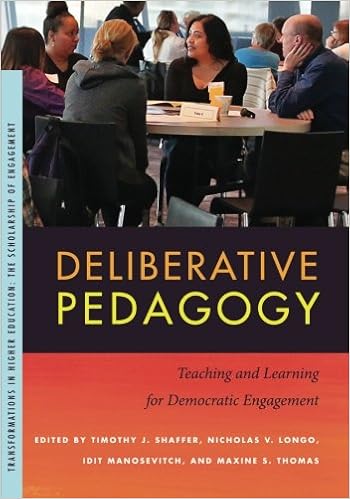
The book, Deliberative Pedagogy: Teaching and Learning for Democratic Engagement was edited by Timothy Shaffer, Nicholas Longo, Idit Manosevitch, and Maxine Thomas. This volume is written for faculty members and academic professionals involved in curricular, co-curricular, and community settings, as well as administrators who seek to support faculty, staff, and students in such efforts. The authors build upon contemporary research on participatory approaches to teaching and learning while simultaneously offering a robust introduction to the theory and practice of deliberative pedagogy as a new educational model for civic life. The book is available on AmazonSmile here and remember when you shop AmazonSmile, they will donate to NCDD on your behalf when you select for donations to go to “The National Coalition for Dialogue & Deliberation, Inc”!

National Civic League released their All-America Conversations Toolkit. All-America Conversations are designed to help cities and other groups understand residents’ aspirations for the community, the divisions facing the community and, most importantly, the small, specific actions that give people a sense of confidence that we can work across dividing lines. The toolkit can be found at: www.nationalcivicleague.org/all-america-conversations/.

We hope you will check out these great resources as part of your summer reading! We’re always impressed with the rich content coming from the D&D community.

Did we miss something? Let us know in the comments what other resources, reports, books, articles, etc. you are reading this summer, or anything you have published recently!


Kettering Explores How to Bridge Like-Minded Communities

We wanted to lift up this piece from NCDD member org, the Kettering Foundation, to tap the NCDD network thoughts on how people are sorting themselves and what are some best practices for bridging diverse groups. Amy Lee of Kettering sat down with Bill Bishop, coauthor of The Big Sort, in which he talks about the ways people are now sorting themselves into groups by like-minded lifestyles. In the interview, Lee expresses how much more problematic this can make it for people to view shared problems and come together in collaborative action to address issues. We want to know what are your thoughts on this? What are some best practices for bridging these like-minded communities?

Let us know in the comments section below. You can read the article and watch the interview below, as well as, find the original on Kettering’s site here.


Bill Bishop, coauthor of The Big Sort, was at the Kettering Foundation earlier this month to deliver the first Hodgkinson Lecture, named in honor of Harold L. (Bud) Hodgkinson, a renowned lecturer, writer, and analyst of demographics and education.

In a lively and spirited exchange, Bill helped us unpack some of the major themes in The Big Sort, specifically how people have “sorted” themselves out along lines of race, class, and ideology. Kettering, of course, sees this sorting as problematic because it makes it hard for already tough problems to come to be seen as shared problems. The “big sort” makes it much more difficult for people to deliberate across differences and make decisions together.

Kettering program officer Amy Lee caught up with Bill after the research session for some closing thoughts. You can watch those below and learn more about Bill Bishop’s work.

You can find the original version of this blog piece on Kettering site at www.kettering.org/blogs/bill-bishop.

NCDD Orgs Team up for Public Engagement Training

We wanted to let the NCDD network know about these training opportunities coming up with our friends at the Participatory Budgeting Project (PBP) and Public Agenda (PA). These two NCDD member orgs have teamed up to dive deep into public engagement skills at an in-person workshop in NYC, which also is part of PBP’s final module for their Summer Implementation Institute. Coming up this Weds July 26, is PBP’s final FREE webinar on breaking barriers for outreach during the Idea Collection phase – the third module in the Summer Implementation Institute. Next week, Public Agenda will doing a two-day workshop to strengthen public engagement strategy on July 31-August 1, with PBP presenting their session on the second day.

Coming up…

  • THIS Weds July 26: final FREE webinar with PBP, from 3pm – 5pm Eastern, 12pm – 3pm Pacific
  • July 31st: Public Agenda workshop in NYC
  • August 1st: Joint workshop with PBP and Public Agenda in NYC

To RSVP for the PBP webinar, click here. To register for the PA and/or PBP in-person NYC workshop[s], click here. For more on PBP’s Summer Implementation Institute, follow the hashtag #PBPInstitute on Twitter for more participant quotes, questions, and experiences! You can read the announcements from PBP and PA below or find the original on PA’s site here.


From the Participatory Budgeting Project

At the Participatory Budgeting Project, we’re wrapping up the first-ever PB Network Summer Implementation Institute with a final free webinar on Wednesday and an in-person session in NYC on August 1st.

On our final free webinar, we’re talking about outreach strategies used to generate ideas from non-English speakers, young people and court-involved people during Idea Collection!

Kenneth Tang from the Asian Pacific Environmental Network (APEN) and our West Coast Project Manager, Francesco Tena, will present on their local experience in two flagship PB processes: Oakland (the first process to do PB with federal funds in the U.S.) and Boston (the first youth PB process in the U.S.)

Join other PB-implementing staff and officials from across North America to:

  • Discuss record-breaking outreach strategies.
  • Dive into the challenges and benefits of using innovative outreach tactics in PB idea collection.
  • Collaboratively brainstorm ways to improve and expand outreach in communities where there are barriers to civic participation.
  • Receive tools and resources to use in your PB processes and in your work more broadly.

Likewise, if you’re interested in taking community leadership in government to the next level, join our in-person Steering Committees 101 workshop hosted in New York City next month, in partnership with Public Agenda. This session is focused on building and sustaining effective community leadership in democratic processes.

When: Tuesday August 1
Where: New York City
Cost: $200 REGULAR admission and $75 STUDENT admission. Or, check out the registration page for the full two-day workshop on public engagement with Public Agenda!
Register: Here

Hope to see you Wednesday and in August!

From Public Agenda

Looking for assistance with organizing and sustaining productive public engagement? Struggling to decide how to use online engagement tools? Frustrated with the standard “2 minutes at the microphone” public meeting? Need expert advice on bringing together a diverse critical mass of people?

Our Public Engagement team is leading a 1.5 day workshop on how you can hone an effective engagement strategy along with a special session led by our friends at the Participatory Budgeting Project (PBP).

On July 31, Public Agenda’s Matt Leighninger and Nicole Cabral will:

  • Provide an overview of the strengths and limitations of public engagement today;
  • Help you assess the strengths and weaknesses of public engagement in your community;
  • Explore potential benefits of more sustained forms of participation;
  • Demonstrate a mix of small group and large group discussions, interactive exercises, case studies and practical application exercises

On Aug 1, during Session 1, we’ll focus more squarely on options and next steps that participants can take in their communities. These sessions will help participants to:

  • Develop skills for planning stronger engagement systems;
  • List existing community assets that can be instrumental for sustained engagement;
  • Anticipate common challenges to planning for stronger systems;
  • Develop an initial set of next steps to pursue.

During the afternoon session of August 1, PBP will present “Steering Committees 101: Centering community experience & expertise.”

This PBP session is part of PBP’s first-ever Summer Implementation Institute hosted by the North American Participatory Budgeting Network, consisting of 4 modules. The in-person session in New York City is preceded by three online webinars. Each module focuses on a particular phase of participatory budgeting (PB) starting with the PB vote and working backwards through proposal development, idea collection, and building a PB process with community leaders. Along with registering for this in-person session, you can RSVP for the three webinars from PBP here.

The in-person session in New York City is focused on building and sustaining effective community leadership in democratic processes. Here, leaders in community engagement will come together to share experiences, discuss pain points, and solve challenges. This session stems from an asset-based approach to community leadership within PB and beyond. Although focused on PB, this session is applicable to all public engagement practices centered in community experience and expertise.

You can find the original announcement on Public Agenda’s website at www.publicagenda.org/pages/workshop-public-engagement-strategy-in-new-york-city.

Upcoming IAP2 Trainings with The Participation Company

Looking to increase your public engagement and facilitation skills? Check out the upcoming training opportunities from NCDD member org, The Participation Company (TPC)! Not only are they offering their Foundations in Public Participation certificate program and the recently revised IAP2’s Strategies for Dealing with Opposition and Outrage in Public Participation; there is a new course added on Facilitation for P2 Practitioners. The trainings earn participants a certificate in public participation with IAP2 and NCDD members receive a per day discount!

You can learn more about the TPC trainings in the announcement below or on their website here.


The Participation Company’s 2017 Training Events

If you work in communications, public relations, public affairs, planning, public outreach and understanding, community development, advocacy, or lobbying, this training will help you to increase your skills and to be of even greater value to your employer.

This is your chance to join the many thousands of practitioners worldwide who have completed the International Association for Public Participation (IAP2) certificate training.

Foundations in Public Participation (5-day) Certificate Program:

Planning for Effective Public Participation (3-days) and/or
*Techniques
 for Effective Public Participation (2-days)

  • October 16-20 – Orlando, FL (3-day Planning and 2-day Techniques)
  • October 30-November 3 – Arlington, VA (3-day Planning and 2-day Techniques)
  • November 6-10 – Walnut Creek, CA (3-day Planning and 2-day Techniques)

*The 3-day Planning training is a prerequisite to Techniques training

IAP2’s Strategies for Dealing with Opposition and Outrage in Public Participation (2-day): 

  • August 17-18 – Chicago, IL (2-day EOP2)
  • November 16-17 – Denver, CO (2-day EOP2)

Register online for these trainings at www.theparticipationcompany.com/training/calendar

Introducing TPC’s newest course offering “FP3”

Facilitation for P2 Practitioners – FP3 (3-day):

Building on best practices from both the International Association for Public Participation (IAP2) and the International Association of Facilitators (IAF), this course introduces the basics of facilitation in the public arena. Participants learn how to design and conduct successful facilitated public involvement events. It is designed as a small, intensive interactive learning opportunity. For more information go to https://theparticipationcompany.com/training/courses/facilitator-training/

Is your organization interested in hosting a training event? Host discounts are provided. Contact us at melissa[at]theparticipationcompany[dot]com.

Check our website for updates to the calendar.

More About the Trainings…

Foundations in Public Participation – The International Association for Public Participation (IAP2)
Public involvement and community engagement are constantly changing. IAP2’s highly respected training program has evolved with ongoing changes in demographics, people’s attitudes and expectations, and public policy.

Both new and experienced practitioners and managers of community engagement will benefit from the structure, proven techniques, and knowledge that you’ll learn in this highly interactive training course.

This course, Foundations in Public Participation, will let you hit the ground running, armed with the knowledge and confidence you need to plan and execute effective public initiatives with community engagement for any area in which you may be working. The course is divided into two modules, each focusing on one of the two major phases of public communication and participation: Planning and Techniques. Upon completion of both modules, you will receive a certificate of completion from IAP2.

Designed by successful practitioners who work with diverse populations and divergent circumstances throughout the world, this comprehensive new program is grounded in what you, your peers, and your mentors have told us about your training needs.

Strategies for Dealing with Opposition and Outrage in Public Participation
The world has changed since IAP2 first rolled out the course with Dr. Peter Sandman a few years ago. Global polls find people are more suspicious and distrustful of large institutions including government, business, media and even large non-governmental organizations.

Angry people can’t represent their interests very well in participate processes and thus ignoring their skepticism isn’t productive.

IAP2 has expanded and refreshed the course materials to help you work more effectively in this changed world. Way beyond just another conflict resolution training class, the newly renamed Strategies for Dealing with Opposition and Outrage in Public Participation helps people understand the human behavior and emotional intelligence of working with angry and cynical people under these tough circumstances. Doing so is foundational to the practice.

Conflict resolution training is needed to address the increasing trend of public anger in society. Growing global citizen outrage causes government gridlock, lawsuits, stopped projects, us vs. them attitudes, destroyed credibility, and loss of time and money. The newly updated Strategies for Dealing with Opposition and Outrage in Public Participation (formerly called Emotion, Outrage and Public Participation) is a conflict resolution training workshop that builds on IAP2’s global best practices in public involvement, the work of Dr. Peter Sandman, a foremost researcher and expert in public outrage and risk communication, and decades of lessons learned. This course will help you move people from rage to reason and engage stakeholders in building consensus for better decisions.

The Participation Company offers discounted rates to NCDD members. Visit www.theparticipationcompany.com/training/calendar for more information and on-line registration.

Lifting the Discourse Beyond the Political Circus

In these challenging times, it is imperative now more than ever to work towards #BridgingOurDivides instead of the current state of political toxicity and mud slinging. Which is why we wanted to share this piece written by David Nevins, President of the Bridge Alliance – an NCDD organizational member – who recently wrote the aptly-named blog piece about the terrible state of politics in the US. In the article, Nevins states how in order to fix our broken political system, we must hold ourselves and our leaders to a higher standard of civic engagement and accountability.

We encourage you to read the blog article below or find the original on the Bridge Alliance site here.


The Political Circus

In 2012 before the previous presidential election I wrote an article entitled, “The Political Circus”.

At that time I said:

“The suffocating partisanship that most Americans abhor will surely be on display for all to witness in the coming election season. The accusations and innuendos, the misinformation and vilifying of one party by the other will be the typical tactics and game plan employed by those on the left and those on the right.”

Unfortunately things have gotten much worse in five years. The vicious ‘winning-is-all’ climate, the ‘meant-to-mislead’ rhetoric, the extreme and polarizing factions along with the sheer lack of decency are tethering our nation to a new low.

As we watch the behaviors of so many of our leaders today posturing against each other with twisted facts and vitriolic disdain, solely to WIN the sacred trust of the electorate, we ought to be asking ourselves, “Is this particular behavior having the effect of raising or lowering the level of discourse and understanding between and among us as citizens?”

As the president of a cross-partisan organization called the Bridge Alliance, we support organizations working to build new solutions to fix a broken political system. These organizations are working to deliver on America’s promise of government by and for the people.

It is time for us to realize that we the people are as much to blame for this unacceptable behavior as the politicians. It is important to call out all behavior that is inappropriate whether from our President or from members of Congress, regardless of party affiliation.

This is something that all Americans should and must agree upon.

More and more we are separated in our own silos, communicating only with those who share our opinions, embracing information that supports our beliefs, to ignore or distort evidence contrary to our beliefs. Although understandable, this tendency can blind us from the facts and the truth.

As Americans it is time for us to see through the charade and step up to the plate and support leaders who want something better. The political circus will continue to be flagrantly displayed unless citizens of our country demand something better.

It will not be easy. We must demand that our leaders resist the natural inclination to focus on who’s right and who’s wrong or who wins and who loses. Instead, we must seek to better understand thoughts, beliefs and viewpoints that differ from our own, even fundamentally. This can give rise to new insights, greater awareness, and generate otherwise undetected solutions and remedies to stalemated problems and issues.

Our national challenges and problems are earnest, urgent, and serious. They are worthy of being debated in a manner consistent with our great history and heritage. Politicians, just like the rest of us, respond to incentives. It is imperative that incentives be developed and implemented that encourage productive dialogue and promote responsible decision-making.

It is up to us. The time is now.

We must raise our awareness, so we are all less susceptible to the common fallacy tactics operating both on the right and the left. If we choose to focus on what the issues are and how they can best be solved as we sift through the barrage of exaggeration, innuendo, and half-truths pressing into the political fray, we will find ourselves closer to the truth and to each other more than we can imagine.

The 80 organizations of the Bridge Alliance are organizing a real and rising movement to transform the political terrain beyond partisanship through the collective voice and actions of our members. We put country before personal or political interest and ask our friends, neighbors, colleagues, competitors, and elected officials to do the same. We develop and share best practices with others, regardless of the side of the aisle on which they sit. We provide essential infrastructure and investment for our member organizations to collaborate, connect on the projects that further our shared goals, and generate collective impact far greater than any one group could make on their own.

We must require a higher standard from our elected officials. A new paradigm of politics; one based on civil political discourse, critical thinking, and personal accountability can and should be demanded by the electorate of its leadership, and the time to do so is now.

You can find the original version of this Bridge Alliance blog article at www.bridgealliance.us/the_political_circus.

DDPE Graduate Certificate Offers NCDD Member Discount

We are pleased to share that the Dialogue, Deliberation, and Public Engagement (DDPE) Graduate Certificate program at Kansas State University will offer NCDD members a 10% discount! [Fun fact: the price of your annual NCDD membership pays for itself with JUST this discount and there are so many more benefits!] The DDPE program is an opportunity to strengthen skills and understanding around theory and practice of leading groups in collaborative decision-making. The deadline for registration is August 21st, so make sure you register ASAP before it’s too late. Please feel free to contact Timothy J. Shaffer, PhD at tjshaffer[at]ksu[dot]edu with any questions.

You can learn more about the K-State DDPE program below or find the original on KSU’s site here.


Dialogue, Deliberation, and Public Engagement Graduate Certificate

Designed to be a transformative experience for graduate students and professionals, this program covers the practice and theory of leading groups through collaborative decision-making. Through a series of four courses, students will learn:

  • approaches to participatory planning and collaborative decision-making that are supported by sound scholarship
  • communication and leadership skills for designing and leading productive meetings
  • dialogic practices for developing and maintaining constructive working relationships and managing conflict
  • proven frameworks selecting or designing engagement processes for organizations, stakeholders, or whole communities
  • a wide range of tools and techniques for engaging small and large groups to address conflicts, explore alternatives and inform policy
  • principles and practices that move groups toward sustainable action that changes lives

Courses are presented in a hybrid format, with some offered completely online and others having face to face interaction. Students will interact regularly with each other and leaders in the field, who serve as collaborating guest faculty. A capstone engagement project concludes the certificate. Recognized as one of the most valued parts of the program, it provides opportunities for coached practice with faculty and seasoned practitioners.

Students in the program may pursue a 12-hour graduate certificate by enrolling in the courses for credit. The DDPE program is also designed for individuals who desire noncredit professional development instead of academic credit.

Noncredit Registration Information
The information below is intended for those who do not wish to receive academic credit for DDPE courses. Program fees do not cover potential travel costs associated with the face-to-face components of the Process Models and Capstone Experience courses. A 10 percent discount is available for National Coalition for Dialogue and Deliberation members. Registrants who do not have a Kansas State University eID will be required to obtain one after registering for the program. Instructions for requesting an eID will be provided in the registration confirmation email.

Full program fee: $3,800.00

Individual course fees (courses must be taken in sequence):

  • Theoretical Foundations (online): $1,000
  • Process Models (online and face to face): $1,000
  • Core Skills and Strategies (online): $1,000
  • Capstone Experience (online and face to face): $1,000

REGISTER NOW

For questions about registering for noncredit, please contact the Conferences and Noncredit Programs registration office at 785-532-5569 or 800-432-8222. Business hours are 8 a.m. to 5 p.m. CDT Monday through Friday.

Careers in Dialogue, Deliberation, and Public Engagement
The DDPE prepares graduate students and professionals to better serve communities through effective facilitation, communication, and leadership. Those in the following careers will be well-served by the program:

– city managers
– mediators
– Extension professionals
– community and organizational development specialists
– conflict resolution professionals
– county and city planners
– public servants
– elected officials

Accreditation
Kansas State University is accredited by the Higher Learning Commission of the North Central Association of Colleges and Schools.

The graduate certificate in Dialogue, Deliberation, and Public Engagement is offered through the Department of Communication Studies in the K-State College of Arts and Sciences.

Informed by the growing field of academic research dedicated to improving public deliberation, this practice-oriented certificate answers a demand from practitioners for an in-depth, graduate-level treatment of public engagement. The longstanding noncredit version of the program was created collaboratively with the International Institute for Sustained Dialogue, the Kettering Foundation, the Centre for Citizenship and Public Policy, University of Western Sydney, and the Public Dialogue Consortium. Designed and championed by the late Barnett Pearce, the program has an international alumni base representing the United States, Canada, Australia, New Zealand, Italy, Denmark, Mexico, Colombia, Argentina, Bolivia and Haiti.

The original version of the DDPE program information at http://global.k-state.edu/artsci/ddpe/.

Everyday Democracy Announces New Local Anchor Partner

We are inspired to see long-standing dialogue efforts continue to grow and wanted to lift up this blog piece that NCDD member org, Everyday Democracy, shared recently announcing their new anchor partner with Community Partners. The local Florida organization has been using EvDem’s Dialogue-to-Change program for the last 16 years to address issues in Palm Beach County. Anchor partners work closely with EvDem to co-create and support efforts to build capacity for a Dialogue-to-Change program in their communities. To learn more about Evdem’s anchor program and how to become a partner, click here.

We encourage you to read more on EvDem’s blog below or find the original here.


One Community’s Journey From a Small Local Dialogue to Becoming a National Partner

EvDem LogoFor the last 16 years, residents in Palm Beach County, Fla., have been using Everyday Democracy’s Dialogue-to-Change process to work on issues of race, early childhood education, and building strong neighborhoods.

Not only have they done great work in West Palm Beach and surrounding communities— Housing Partnership, Inc (dba Community Partners) is now one of Everyday Democracy’s anchor partners. Anchor partners help Everyday Democracy carry out our work on a larger scale then we could alone, sharing a strong commitment to dialogue, engagement and racial equity, and committing to share knowledge and work together.

Community Partners first used Dialogue-to-Change to address an issue in their community in 2002. In Belle Glade, Fla., a young black man was found hanging from a tree. Residents were split along racial lines – white residents believed it was a suicide and black residents believed he was hanged. The court ultimately deemed it a suicide, but that didn’t resolve the tension in the community surrounding this tragic event.

In addition to becoming an anchor partner, Community Partners has since grown to more than 10 ongoing projects across the county. Everyday Democracy and Community Partners were among several presenters to train organizers from around the country in authentic community dialogue and engagement, and inform them about our anchor partner program, at NeighborWorks America’s Community Building and Engagement annual meeting in May.

Back in 2002, Barbara Cheives had already organized and trained facilitators for other dialogues in the area as the Executive Director of a nonprofit called Toward a More Perfect Union, and was called in to do some racial reconciliation work. She used our Dialogue-to-Change process to engage small groups in a structured dialogue process that let participants share stories and build trust.

She recalled one night after the dialogues seeing an older white gentleman from a sugar cane family and a black woman talking to each other long after the dialogues had ended. They were exploring each other’s point of views and what they saw in the streets of the towns they grew up in. That was just one of many bridges that were built from the dialogue-to-change program.

“I’ve seen real change, real discussion, and real action,” said Cheives.

Another participant in the race dialogues was a white male president of a national bank. After talking with other residents and seeing different perspectives, he noticed his own staff wasn’t very diverse. He immediately started taking action to hire candidates from many backgrounds, and that spread throughout the bank.

“The beauty of dialogue group is there’s no winning. It’s not a debate – we just have to listen to each other and come out with an action that works for the whole,” said Cheives.

In 2010, Palm Beach County residents joined across the county to discuss early childhood development, organized by a local organization called BRIDGES.

“We went into communities that have long been disenfranchised and they’re worried about food, safety, etc. – not necessarily getting their kids ready for kindergarten,” recalls Jaime-Lee Brown, Vice President of Community Services with Community Partners, one of the early organizers for the dialogues. “But everybody cares about their children. If we start with that conversation, then we can keep them engaged.”

Some of the actions that came out of that dialogue-to-change effort were kindergarten readiness toolkits and “kindergarten roundup” day where parents sat through a day of kindergarten so they could prepare their kids for the upcoming school year.

This led to dialogues and actions around building strong neighborhoods, which they are still working on today.

“What has really worked is to make sure that residents are gaining a voice, working toward a power balance, and engaging as a peer instead of speaking for the group,” says Brown.

Public engagement isn’t always easy, but it’s a necessary part of making communities work for everyone.

Some challenges organizers often face when engaging community members include: burnout, people are too busy, follow-up, and no new people attend meetings or events.

So how do we truly engage a community in decision-making?

Palm Beach County residents have put into practice the values Everyday Democracy looks for in anchor partners: commitment to relationships, incorporating an equity lens into the work, building local capacity for the community dialogue process, and creating sustainable change.

Everyday Democracy is looking for more local organizations interested in becoming anchor partners. Everyday Democracy helps to build the capacity of anchor partners to embed the work in their local communities and amplify the impact of our coaching and Dialogue-to-Change process, making sure everyone can have a voice and role in their community.

Learn more about Everyday Democracy’s anchor network, including how to become an anchor, or contact Valeriano Ramos at vramos[at]everyday-democracy[dot]org.

You can find the original version of this Everyday Democracy blog piece at www.everyday-democracy.org/news/one-community%E2%80%99s-journey-small-local-dialogue-becoming-national-partner.

Kettering and NIFI Offer CGA Training for Educators

We wanted to give educators in the NCDD network a heads up about the upcoming training from NCDD member org, Kettering Foundation, on using the online deliberation platform, Common Ground for Action. On August 15 & 16, Kara Dillard and Amy Lee of Kettering, will host a two-hour session training each day on how to use this online deliberation platform in the classroom; including: how to convene and moderate a forum, best practices, and classroom design ideas. The training on August 15th will be from 1-3pm Eastern/ 10am-12pm Pacific & on August 16th from 3-5pm Eastern/12-2pm Pacific. The announcement below was from the most recent NIFI Moderator’s Circle listserv email (sent June 28th) – contact NIFI to learn more about joining this list.

Make sure you register ASAP to secure your spot for the CGA Training for Educators here.


Calling All Teachers!

HIGH SCHOOL, MIDDLE SCHOOL, COLLEGE
LEARN ABOUT USING ONLINE FORUMS IN THE CLASSROOM
August 15 & 16, 2017

ENCOURAGING DIALOGUE IN THE CLASSROOM

Want to help students exchange views on the tough issues facing our country?

Want to help students use their critical thinking skills on current events?

Want to know more about using online forums in the classroom?

This August, over two consecutive days, Kettering and National Issues Forums Institute will host a moderator training session for K-12 and college faculty interested in using online Common Ground for Action (CGA) forums in the classroom.

The sessions will cover:
– How to set up a CGA forum
– The moderator’s responsibilities
– Hacks and tricks for moderating
– Practice exercises on setting up and moderating forums
– Q & A on integrating CGA forums into the classroom
– Potential assignments and evaluation metrics

WHEN: Tuesday, August 15, 1:00-3:00 pm (EDT) and Wednesday, August 16, 3:00-5:00 pm (EDT) REGISTER HERE

Participating is easy. You need a computer with internet access and speakers. A microphone is helpful, but not required. Register to participate and you’ll get an email with all the details.

Interested to learn more about the Common Ground for Action forum? Check out the video below from NIFI to find out how to participate in a CGA forum.

You can register for the CGA Moderators Training for Educators at http://conta.cc/2tqiIY2

Two Weeks Left for IAF Facilitation Impact Nominations

Know an organization that has had a profound facilitation impact? Nominate them within the next two weeks for the Facilitation Impact Awards with the International Association of Facilitators (IAF)! Submit the names of organizations you feel have had a positive impact through their facilitation within the last 24 months. Those who have had a measurable impact, will have an opportunity for global recognition because of how they have used and benefitted from facilitation. Make sure you get your nominations in by 11pm on Sunday, July 9th (GMT) in order for these fantastic facilitation orgs to be eligible. Follow #FacilitationAwards on Twitter for more!

You can read the announcement from IAF below or find the original version with more info on their site here.


2017 Facilitation Impact Awards – Honouring excellence in facilitation

About the awards
As a professional association with members in more than 65 countries, the International Association of Facilitators (IAF) is well placed to recognise the power of facilitation worldwide. For more than 20 years we have been strong advocates for the power of facilitation in helping organisations to address challenges and achieve results.

The Facilitation Impact Awards (FIA) honours organisations that have used facilitation to achieve a measurable and positive impact as well as the facilitator(s) who worked with them.

The awards are open to organisations of any size from the business, government, and not-for-profit sectors. The awards are for organisations that use and benefit from facilitation rather than firms that provide facilitation services.

The facilitators who worked with the organisation are included in the organisation’s submission. The facilitator may be an employee of the organisation or an external facilitator who provided services to the organisation.

Who may make a submission

  • A representative of the organisation being nominated or a facilitator involved in the delivery of the facilitation services may make a submission.
  • An area within an organisation—for example, a division, branch or section—may make up to two submissions in a submission period.
  • A facilitator may be nominated in up to five submissions in a submission period.
  • Members of the FIA core project team are not eligible to receive an award and must not prepare or help others to prepare submissions.
  • Evaluators may prepare and make a submission if they are nominated in the submission. Evaluators are not permitted to evaluate a submission if they are nominated in the submission.
  • Members of the broader FIA project team may prepare and make a submission.

Eligibility requirements
To be eligible for an award:

  • the nominated organisation must be a recognised entity under the laws of the respective country.
  • at least one facilitated process associated with the submission must have taken place within 24 months of the closing date for submissions.
  • the results included under the organisation impact criteria must have been achieved within 24 months of the closing date for submissions.
  • a facilitated process associated with the submission may have been nominated in the past but must not have received an award.

How to nominate
Complete a Facilitation Impact Award submission form available from our website. Forms are available in English, French, Portuguese and Spanish and nominations will be accepted in any of these languages. When completing your submission, make sure you address all the award criteria taking the scoring framework at Appendix 1 into account. Submit your completed form to FIA[at]iaf-world[dot]org by the closing date shown on the form. No nomination fees are payable.

You can find the original version of the IAF announcement at www.iaf-world.org/FIA.

IAP2 North American Conference in Denver this Fall

NCDD org member, International Association for Public Participation [IAP2], is holding their 2017 North American Conference from Sept 6-8 in Denver, Colorado. The conference “Pursuing the Greater Good – P2 for a Changing World” will be a three-day opportunity to dig deeper into public participation with fellow practitioners. Follow the hashtag #iap2nac2017 for extra conference happenings. Early bird registration is open until June 30th, so check out the conference and save your spot at this great rate!

You can read the announcement from IAP2 below or find the original on their site here.


2017 IAP2 North American Conference

This year’s theme, “Pursuing the Greater Good – P2 for a Changing World”, couldn’t be more timely, and once again, you have an opportunity to consider that theme from a variety of angles and share perspectives and insights.

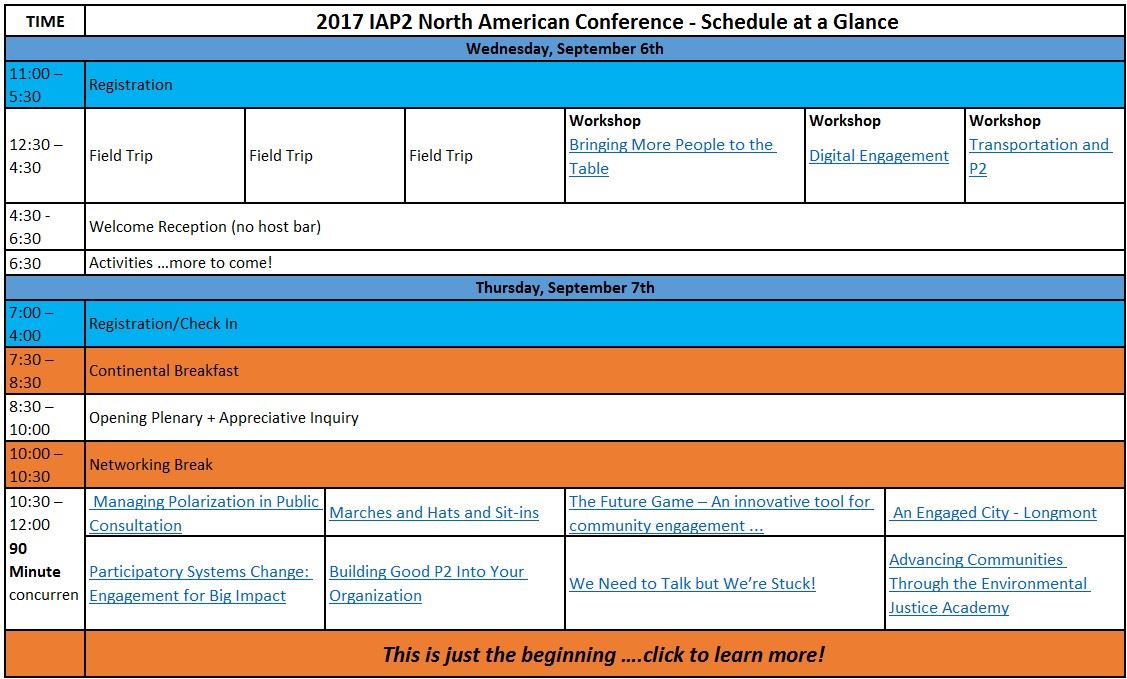
The pre-conference workshops cover three important topics for P2 professionals: “Bringing More People to the Table”, “Digital Engagement” and “Transportation and P2”.

Pathways are “deep dives” into specific topics; three-hour discussions where you get to set the agenda, co-create and co-host. Those taking part will be able to set the physical and intellectual environment where a small group of people can tackle big questions that ultimately contribute to the field. With Pathways, you can expect an experience that is in-the-moment, dynamic, engaging … and demanding!

Conference Schedule

From now through June 30, you can take advantage of the early-bird price: US $550 for members and $700 for non-members. For that, you get:

  • workshops or field trips, Wednesday, Sept. 6
  • the welcome reception, Wednesday, Sept. 6
  • all sessions and pathways
  • continental breakfast
  • lunch and lunchtime activities
  • the Core Values Awards gala, Thursday, Sept. 7 – dinner, entertainment and a chance to applaud the best in the business

Conference registration begins Wednesday at 11:00 a.m.

Conference Fees & Registration

2017 North American Conference Rates          Member Rate          Non-Member Rate
Early Bird Registration: Feb 1 – June 30                 $550                          $700
Regular Registration: July 1 – Sept 5                      $650                          $800
At the Door Registration                                        $750                         $900
Student and Americorps Members                         $350                            –

International Members: members residing outside the United States, email info[at]iap2[dot]org to request your registration code.

Hotel Westin Downtown Denver – At the base of the Colorado Rockies!

Why not play while you work? This beautiful hotel has many amenities including on-site dining, luxurious rooms, and easy access to surrounding attractions!

The IAP2 Conference Block rate guarantee of $189.00/night + tax expires at 5pm Mountain Time on Sunday, August 6. Reservations made after August 6 will be offered at that rate on a space available basis.

Arrive early, stay late! Conference rates will be provided two days before and after the scheduled conference dates based on availability. For extended reservations, call the reservation line at 888-627-8435 .

Cancellation policy: Individual reservations will automatically be billed for one night unless canceled 48 hours prior to arrival. An early departure fee of $50 will apply if a registered hotel guest checks out prior to the reserved checkout date.

To make a reservation call the reservation line at 1-888-627-8435 and ask for the “IAP2 Conference Block” or click on “Online Registration” here.

You can find the original announcement from IAP2 at: https://iap2usa.org/nac/