Kettering and NIFI Offer CGA Training for Educators

We wanted to give educators in the NCDD network a heads up about the upcoming training from NCDD member org, Kettering Foundation, on using the online deliberation platform, Common Ground for Action. On August 15 & 16, Kara Dillard and Amy Lee of Kettering, will host a two-hour session training each day on how to use this online deliberation platform in the classroom; including: how to convene and moderate a forum, best practices, and classroom design ideas. The training on August 15th will be from 1-3pm Eastern/ 10am-12pm Pacific & on August 16th from 3-5pm Eastern/12-2pm Pacific. The announcement below was from the most recent NIFI Moderator’s Circle listserv email (sent June 28th) – contact NIFI to learn more about joining this list.

Make sure you register ASAP to secure your spot for the CGA Training for Educators here.


Calling All Teachers!

HIGH SCHOOL, MIDDLE SCHOOL, COLLEGE
LEARN ABOUT USING ONLINE FORUMS IN THE CLASSROOM
August 15 & 16, 2017

ENCOURAGING DIALOGUE IN THE CLASSROOM

Want to help students exchange views on the tough issues facing our country?

Want to help students use their critical thinking skills on current events?

Want to know more about using online forums in the classroom?

This August, over two consecutive days, Kettering and National Issues Forums Institute will host a moderator training session for K-12 and college faculty interested in using online Common Ground for Action (CGA) forums in the classroom.

The sessions will cover:
– How to set up a CGA forum
– The moderator’s responsibilities
– Hacks and tricks for moderating
– Practice exercises on setting up and moderating forums
– Q & A on integrating CGA forums into the classroom
– Potential assignments and evaluation metrics

WHEN: Tuesday, August 15, 1:00-3:00 pm (EDT) and Wednesday, August 16, 3:00-5:00 pm (EDT) REGISTER HERE

Participating is easy. You need a computer with internet access and speakers. A microphone is helpful, but not required. Register to participate and you’ll get an email with all the details.

Interested to learn more about the Common Ground for Action forum? Check out the video below from NIFI to find out how to participate in a CGA forum.

You can register for the CGA Moderators Training for Educators at http://conta.cc/2tqiIY2

Two Weeks Left for IAF Facilitation Impact Nominations

Know an organization that has had a profound facilitation impact? Nominate them within the next two weeks for the Facilitation Impact Awards with the International Association of Facilitators (IAF)! Submit the names of organizations you feel have had a positive impact through their facilitation within the last 24 months. Those who have had a measurable impact, will have an opportunity for global recognition because of how they have used and benefitted from facilitation. Make sure you get your nominations in by 11pm on Sunday, July 9th (GMT) in order for these fantastic facilitation orgs to be eligible. Follow #FacilitationAwards on Twitter for more!

You can read the announcement from IAF below or find the original version with more info on their site here.


2017 Facilitation Impact Awards – Honouring excellence in facilitation

About the awards
As a professional association with members in more than 65 countries, the International Association of Facilitators (IAF) is well placed to recognise the power of facilitation worldwide. For more than 20 years we have been strong advocates for the power of facilitation in helping organisations to address challenges and achieve results.

The Facilitation Impact Awards (FIA) honours organisations that have used facilitation to achieve a measurable and positive impact as well as the facilitator(s) who worked with them.

The awards are open to organisations of any size from the business, government, and not-for-profit sectors. The awards are for organisations that use and benefit from facilitation rather than firms that provide facilitation services.

The facilitators who worked with the organisation are included in the organisation’s submission. The facilitator may be an employee of the organisation or an external facilitator who provided services to the organisation.

Who may make a submission

  • A representative of the organisation being nominated or a facilitator involved in the delivery of the facilitation services may make a submission.
  • An area within an organisation—for example, a division, branch or section—may make up to two submissions in a submission period.
  • A facilitator may be nominated in up to five submissions in a submission period.
  • Members of the FIA core project team are not eligible to receive an award and must not prepare or help others to prepare submissions.
  • Evaluators may prepare and make a submission if they are nominated in the submission. Evaluators are not permitted to evaluate a submission if they are nominated in the submission.
  • Members of the broader FIA project team may prepare and make a submission.

Eligibility requirements
To be eligible for an award:

  • the nominated organisation must be a recognised entity under the laws of the respective country.
  • at least one facilitated process associated with the submission must have taken place within 24 months of the closing date for submissions.
  • the results included under the organisation impact criteria must have been achieved within 24 months of the closing date for submissions.
  • a facilitated process associated with the submission may have been nominated in the past but must not have received an award.

How to nominate
Complete a Facilitation Impact Award submission form available from our website. Forms are available in English, French, Portuguese and Spanish and nominations will be accepted in any of these languages. When completing your submission, make sure you address all the award criteria taking the scoring framework at Appendix 1 into account. Submit your completed form to FIA[at]iaf-world[dot]org by the closing date shown on the form. No nomination fees are payable.

You can find the original version of the IAF announcement at www.iaf-world.org/FIA.

Stories and Reflections from Elevate Engagement

Last month, I had the great pleasure of attending Elevate Engagement, a conference hosted by the Agora Journalism Center at the University of Oregon and organized in partnership with NCDD member organization Journalism That Matters.

Over 130 participants took part in this conference, including many journalists, some engagement practitioners (NCDD member orgs the Jefferson Center and Healthy Democracy among them), activists, and others. Organizers used Open Space, World Cafe, Pro-Action Cafe, and other engagement techniques to discuss the question, “How do we elevate engagement for communities to thrive?”

Over the course of the four days, I heard a whole host of stories of journalists making efforts and succeeding in creating more quality engagement with the communities they serve. A couple examples I recommend checking out include:

  • The Evergrey organized a trip and conversation between King County, WA voters (who voted 74% for Clinton in 2016) and Sherman County, OR voters (who voted 74% for Trump).
  • Spaceship Media and the Alabama Media Group brought together women who voted for Trump in Alabama with women who voted for Clinton in California for an online dialogue on a variety of political issues.
  • KPCC, Southern California Public Radio, launched “Unheard LA – the stories of where you live,” a community-driven storytelling series that featured community members sharing their experiences in various formats (music, poetry, etc.). They also went a step further and shared what they learned when they stopped talking and started listening.

These are just a couple stories, out of many inspiring ones I heard in my time attending the conference. I found it noteworthy that some of these efforts incorporated good dialogue and facilitation practices, whether or not the journalists were knowledgable of these practices (some were, some were not). I also noted that for others, there was a strong desire to do more, but a sense of struggle or an uphill battle to achieve this kind of level of engagement.

Some of the challenges I heard were that this kind of quality engagement can take time, which does not always fit the realities of the newsroom. Others noted the need for additional resources, in terms of staff, time, and money to carry out more quality engagement. And for others, it really boiled down to finding good models and good partners to be able to engage communities which have traditionally been hurt and/or unheard by journalists and media outlets. The desire to be able to reconcile with communities who have been shut out, misrepresented, or harmed by media was a strong theme throughout the conference.

My own biggest takeaway was that journalists have a strong desire and sense of mission to build better engagement, but that many also think they need to take it on alone. I was joined by other NCDDers in sharing the message that our network has a wealth of skills, models, and experience for engagement, and that many (if not all!) of us are willing partners for journalists in these efforts. NCDD intends to continue our conversation with Journalism That Matters about this and to find further opportunities to connect journalists and engagement practitioners. Working together can help both of our fields achieve our goals and, more importantly, raise the voices of the people across our country.

For more information, check out the Elevate Engagement website where you can learn more about the conference and check out session notes. You may also want to take a look through #PDXengage17 on Twitter to catch videos, quotes, and other participant thoughts.

IAP2 North American Conference in Denver this Fall

NCDD org member, International Association for Public Participation [IAP2], is holding their 2017 North American Conference from Sept 6-8 in Denver, Colorado. The conference “Pursuing the Greater Good – P2 for a Changing World” will be a three-day opportunity to dig deeper into public participation with fellow practitioners. Follow the hashtag #iap2nac2017 for extra conference happenings. Early bird registration is open until June 30th, so check out the conference and save your spot at this great rate!

You can read the announcement from IAP2 below or find the original on their site here.


2017 IAP2 North American Conference

This year’s theme, “Pursuing the Greater Good – P2 for a Changing World”, couldn’t be more timely, and once again, you have an opportunity to consider that theme from a variety of angles and share perspectives and insights.

The pre-conference workshops cover three important topics for P2 professionals: “Bringing More People to the Table”, “Digital Engagement” and “Transportation and P2”.

Pathways are “deep dives” into specific topics; three-hour discussions where you get to set the agenda, co-create and co-host. Those taking part will be able to set the physical and intellectual environment where a small group of people can tackle big questions that ultimately contribute to the field. With Pathways, you can expect an experience that is in-the-moment, dynamic, engaging … and demanding!

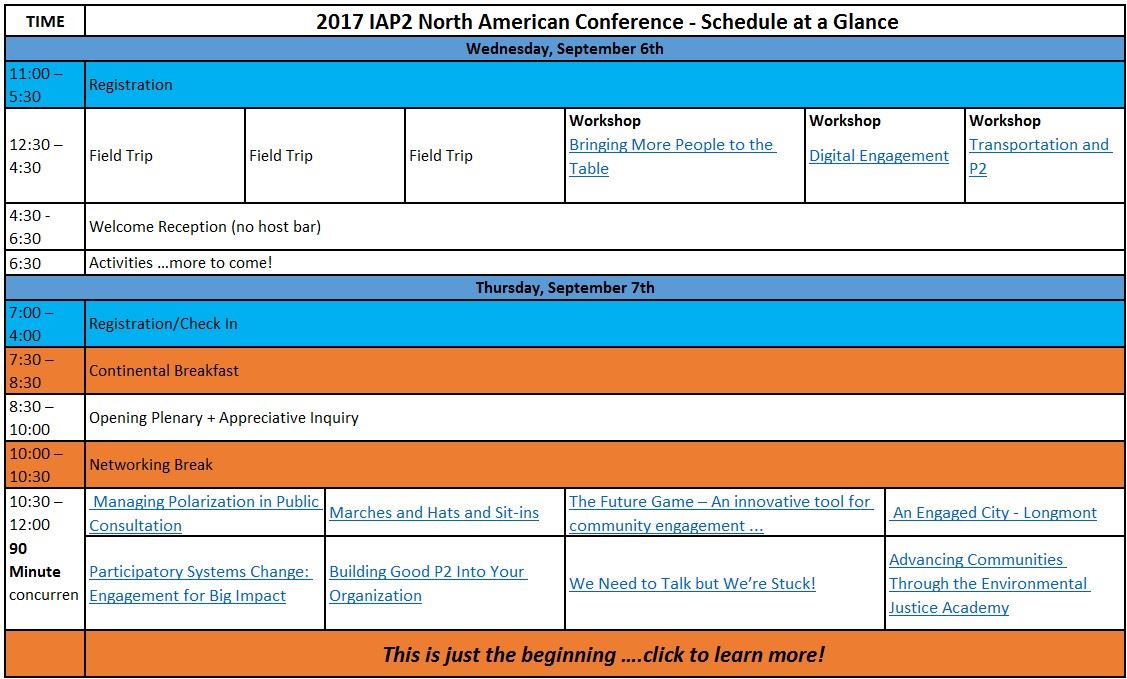
Conference Schedule

From now through June 30, you can take advantage of the early-bird price: US $550 for members and $700 for non-members. For that, you get:

  • workshops or field trips, Wednesday, Sept. 6
  • the welcome reception, Wednesday, Sept. 6
  • all sessions and pathways
  • continental breakfast
  • lunch and lunchtime activities
  • the Core Values Awards gala, Thursday, Sept. 7 – dinner, entertainment and a chance to applaud the best in the business

Conference registration begins Wednesday at 11:00 a.m.

Conference Fees & Registration

2017 North American Conference Rates          Member Rate          Non-Member Rate
Early Bird Registration: Feb 1 – June 30                 $550                          $700
Regular Registration: July 1 – Sept 5                      $650                          $800
At the Door Registration                                        $750                         $900
Student and Americorps Members                         $350                            –

International Members: members residing outside the United States, email info[at]iap2[dot]org to request your registration code.

Hotel Westin Downtown Denver – At the base of the Colorado Rockies!

Why not play while you work? This beautiful hotel has many amenities including on-site dining, luxurious rooms, and easy access to surrounding attractions!

The IAP2 Conference Block rate guarantee of $189.00/night + tax expires at 5pm Mountain Time on Sunday, August 6. Reservations made after August 6 will be offered at that rate on a space available basis.

Arrive early, stay late! Conference rates will be provided two days before and after the scheduled conference dates based on availability. For extended reservations, call the reservation line at 888-627-8435 .

Cancellation policy: Individual reservations will automatically be billed for one night unless canceled 48 hours prior to arrival. An early departure fee of $50 will apply if a registered hotel guest checks out prior to the reserved checkout date.

To make a reservation call the reservation line at 1-888-627-8435 and ask for the “IAP2 Conference Block” or click on “Online Registration” here.

You can find the original announcement from IAP2 at: https://iap2usa.org/nac/

NCDD Orgs Respond on How to Save American Democracy

As we grapple with a quickly changing political environment, many are struggling with the current state of American democracy and what are the best steps to repair our damaged system. Over the course of the year, several writers have expressed their beliefs that the way to improve our political system is to reduce public participation and increase political intermediaries/institutions.

In a direct response to these viewpoints, NCDD member org Healthy Democracy, recently published the article on their blog, Actually, More Public Participation Can Save American Democracy, which can be found here. The Deliberative Democracy Consortium, also a NCDD member org, wrote an immediate follow-up piece inviting the dialogue, deliberation, and public engagement community to respond to these claims and the writers themselves. For information on how to send your responses, read the DDC’s article on their blog here.

The article from Healthy Democracy can be found below or read the original on their blog here.


Actually, More Public Participation Can Save American Democracy

Lee Drutman of the New America Foundation, writing on Vox.com’s Polyarchy blog, makes a bold statement: more public participation isn’t the answer to our political woes because the reasonable, civically-minded voter is a myth. This is the latest in a trend of articles analyzing American politics and the role of citizens, beginning with Jonathan Rauch’s sprawling analysis for the Atlantic of our political system and its populist weaknesses.

Fortunately, Mr. Drutman’s analysis is narrowly focused and should not discourage those of us who have broader imaginations about democracy and the power of an active citizenry. Public participation is not limited to voting for or against representative policymakers, as Drutman asserts. Rather, civic life is a rich ecosystem of opportunities to participate in our grand experiment in self-governance. The individual voter is the building block of democracy. Civically-minded wise Americans exist across the land, and they are doing good, important work in their communities.

Drutman’s article relies on a series of assumptions that are, at the very least, not the whole picture. They are based largely on assumptions that Jonathan Rauch and Benjamin Wittes make in their recent Brookings paper advocating for an increased role of political intermediaries and a decrease in direct democracy. In their world, participation in politics is limited to the election of representatives; the sole result of a citizen exerting their political wisdom is to vote out politicians who prioritize interest groups over the people; and, finally, making politicians serve the people is the end goal of public participation. But in reality, citizenship and public participation encompass a wide array of powers and responsibilities. To be clear, I don’t take issue with the negative impacts of unbridled, reactive populism. Rather, I see clearly the vast and largely untapped potential of democratic wisdom at the citizen level.

The mythical citizen

Drutman articulates others’ assertion that there is a mythical wise citizen who will save our democracy by influencing politicians to serve the people. This citizen is “moderate, reasonable, and civic-minded” and if given more power would compel politicians to behave differently. It would indeed be naïve to assume that this magic citizen would influence American society so greatly that they could change the fundamental behavior of politicians. In that way, the author’s objection to this mythical citizen is easy to make.

And I agree that waiting for a perfectly reasonable, moderate, and civically minded voter to fix our Republic is a flawed strategy. Thankfully for all of us, public participation is much broader, deeper, and more creative than that. The various mechanisms of public participation build civic literacy, increase citizen power through knowledge and interaction with our political systems, and build bridging social capital among disparate groups. There are positive downstream impacts on our local, state, and national communities that come from citizens engaging in their communities in a meaningful way.

Drutman also addresses the role of political intermediaries. These intermediaries, which he defines as “politicians, parties, and interest groups” are the people who help people recognize what their interests are through cues. But this group is depressingly limited, and strikingly partisan. It ignores faith leaders, universities, media, community groups, advisory groups, citizens’ juries, and local government engagement folks. These groups, many of which are nonpartisan, provide moral leadership, knowledge, and granular information about voter interests that Drutman’s definition of intermediaries ignores.

The power of regular citizens

Drutman’s article forecloses the citizen’s ability to participate in democracy in ways that consider tradeoffs and the long-term view. There is a glimpse of possibility in his discussion of hybrid systems, citing Rauch and Wittes’s assertion that ““better decisions” come when specialist and professional judgment occurs “in combination with public judgment.” Unfortunately, Drutman rejects the concept by conjecturing that hybrid systems are not possible because they would not have a clear person who is “in charge” and holding the power. In fact, the entire field of democratic deliberation is devoted to creating hybrid systems that connect citizens with policy experts and allow them the time, space, and information to carefully consider policy choices.

Of course, power is held both formally and informally, and differently depending on the situation. In a classic representative system, elected policymakers have the ultimate power, and they can gather input in various forms. There are also stakeholder processes where groups can be given very strong recommending power, to the point where it would be politically infeasible to reject their advice. There is also direct empowerment of citizens, such as through ballot initiatives and referenda, where a majority vote of the people makes policy. Drutman’s claim that “voters are not policymakers” is simply not true in states, cities, and counties with direct democracy.

Creative solutions

In all of these cases, there are opportunities to merge technical expertise with citizen participation. The example with which I most familiar is the Citizens’ Initiative Review. This process, which was developed by Healthy Democracy, is a hybrid system in which a microcosm of representative citizens (reasonable, moderate, and civic-minded, by the way) examines a ballot measure. They draw upon the arguments of partisan intermediates (advocates for and against the measure) and the input of independent policy experts. Their goal is to provide to their fellow voters a clear statement that outlines the key facts about a ballot measure as well as the best arguments on each side.

The result of public participation in the Citizens’ Initiative Review is an artifact that can be used by voters to make civic-minded decisions when participating in direct democracy. The knowledge that a group of fellow citizens spent four days sorting through the issue on their behalf is an inspiring service, one that can compel not only the people in the room but those who read their statement and appreciate the service to be more civic-minded and engaged in their own lives.

Research by scholars in the political science, communication, and government fields affirms that the Citizens’ Initiative Review process is democratic, deliberative, and unbiased. Their analyses find that Citizens’ Statements are highly accurate and are a reliable source of information for voters. They also find that voters actually do use the statement when casting their ballots, and that voters who read the statement have more knowledge and are more confident in their knowledge.

This piece is not intended to be an advertisement for the Citizens’ Initiative Review, but the fact is that reforms like it are rare and most folks do not have the opportunity to witness these processes and their results. In our unique position as a deliverer of these reforms, we see the extraordinary transformation that regular people undergo when called to serve their fellow voters in this way. The vast majority of citizen participants leave with a better understanding of democracy, political values, and policy analysis—not to mention a deeper understanding of the policy topic under study.

It should be noted that one reason these reforms are rare is because they disrupt the work of partisan intermediaries who would prefer to deliver information to voters through a lens that suits their own ends, often at the expense of accuracy. In a refrain familiar to many political observers, partisan intermediaries’ assessment of the value of nonpartisan intermediaries corresponds closely with how well the information produced via nonpartisan means supports their partisan ends.

Democracy starts–but does not end–with politics

You see, citizen participation takes many forms. And participating in democracy does not fit neatly in the world of policy and politics. It is a common lament recently that hyperpartisanship has led to two Americas, and that our problem is that we refuse to talk to one another. Well, the first step to breaking down hyperpartisanship is to personally know people with politics that oppose your own. Any action that builds bridging social capital (social capital across heterogeneous groups) is an act of democracy. Then, when our democratic systems are stressed, we can draw upon that social capital for resilience. If we can see the other side as people, and don’t demonize, dehumanize, and disregard them based on partisan cues, we can stay engaged in democracy with one another.

In the close of his piece, Drutman calls on us to abandon the search for the mythical average citizen and seek an alternative. Since the author fails to articulate an alternative, I offer one here: let us expand our understanding of public participation to include the multitude of civic actions that add value to our democracy.

We can start in the realm of policymaking and politics with deliberative democracy. Well-designed deliberative processes (see the National Issues Forums, citizens juries, and the Citizens’ Initiative Review, among others) give voters a structured container to consult experts, consider tradeoffs, and deliberate the merits, consequences, and underlying values of policy choices. These processes take time, patience, and resources, but it is a worthwhile investment in the health of our democracy.

Let’s also work to build social capital through community work. A bank of social capital can give us the tools and relationships to better consider policy tradeoffs and impacts to our communities in the future. Additionally, an expanded conception of public participation gives voters opportunities to grow into more civically literate people. Not only can they better understand and act on their interests, they will be more likely to consider political problems creatively if they choose to enter representative politics. These kinds of programs are all around us. See Community Oregon, our experiment in building statewide urban-rural social capital in the state of Oregon, as well as other organizations that bring different types of people together to build connections across differences (e.g. Everyday Democracy, The Village Square, and many others).

The mythical citizen is all around us. She sings in a choir, volunteers her time, helps her neighbor with homework, and teaches her grandchild about the branches of government. She is doing democracy in her everyday life. She is serving her fellow citizens. She is our Plan B.

You can find the original version of this Healthy Democracy blog article at: https://healthydemocracy.org/blog/2017/06/13/actually-more-public-participation-can-save-american-democracy/

To respond to this article via the Deliberative Democracy Consortium blog, click here: http://deliberative-democracy.net/2017/06/15/we-invite-you-to-respond/

Save the Date for David Mathew Center’s 2017 Civic Institute

The NCDD member organization, David Mathews Center for Civic Life announced the date for their upcoming 2017 Civic Institute on August 18. The 2017 Civic Institute is a day-long opportunity to meet with fellow civic engagement enthusiasts and practitioners to explore the future of Alabama. Participants choose one of three event tracks to delve into deeper during Civic Institute, which are: building civic infrastructure, renewing civic education, and creating civic media. This event will also serve as the official launch of the three year forum series, What’s Next, Alabama? which will be an opportunity for Alabamians to envision the future of their communities. We encourage you to read more about the 2017 Civic Institute in the announcement from David Mathews Center below or find the original version here.


2017 Civic Institute – Save the Date: August 18, 2017

The 2017 Civic Institute is your chance to connect with civic-minded change-makers and thought leaders from across Alabama in a dialogue on our state’s past, present, and future. From the morning panel discussion on the “geography of economic prosperity” in rural and urban communities, to the keynote address by Dr. David Mathews, (President and CEO of the Kettering Foundation), the day will be packed with engaging speakers and interactive sessions centered around some of the most profound issues we encounter as Alabamians.

Participants are able to choose among three different learning tracks for the day, including: building civic infrastructure, renewing civic education, and creating civic media. Each track includes a deliberative forum in the morning, as well as an interactive workshop in the afternoon–all in addition to the panel discussion and keynote address, which will be delivered over lunch!

With our state’s bicentennial on the horizon, we believe that the Civic Institute is the perfect event to collectively ponder the power of our citizens and our communities to build the kind of Alabama they want to call home. To this extent, the Civic Institute will serve as the official, statewide launch of the DMC’s newest forum series, aptly titled, What’s Next, Alabama?

This series is a three-year endeavor, focused on what economic prosperity means in different communities across our state. The series will conclude in 2019, coinciding with Alabama’s bicentennial celebrations, and will frame the conversation about our future, even as we celebrate our past.

2017 Civic Institute Learning Tracks:

Building Civic Infrastructure:
This learning track is tailor-made for those wanting to engage their own communities in dialogue and deliberation around important local issues. The morning forum is an abridged “What’s Next, Alabama?” forum, entitled, “The State We’re In.” This will be a deliberative experience in which participants will ask, “where are we now” as a state? What is the story of Alabama at the start of the 21st century? How far have we come? How far do we have to go? Instead of focusing on the assets and challenges of a single locale, this forum will give participants the opportunity to embrace a statewide perspective in order to reimagine the productive potential of what binds us together collectively, and what sets us apart from each other idiosyncratically.

The afternoon workshop, “Building Civic Infrastructure,” will equip participants with the tools necessary to engage their own community in dialogue and deliberation. From naming and framing local issues, to convening and moderating forums, participants will receive a crash course in the building of a meaningful and durable civic infrastructure capable of supporting and sustaining a robust public life for its citizens. The aim of the workshop is to give participants everything they need to bring “What’s Next, Alabama?” forums to their own communities.

Renewing Civic Education:
This track is perfect for educators, government officials, and anyone else interested in transforming the idea of civic engagement into real action. This learning track begins with a deliberative forum on the state of civic education (and education more broadly) in Alabama. With renewed interest in civic education statewide, this forum will be an opportunity to discuss what civic education could and should look like beyond the classroom. How do we get young people to be active citizens in their own communities? How can we create synergy between the classroom and the community? Is there a curricular way to achieve this, or should we also broaden our own understanding of youth engagement to include students and young people playing an active role in local government? These are some of the questions that will frame the morning discussion.

The afternoon workshop, “Community as Classroom: Equipping Youth for Civic Leadership” will give attendees a chance to connect with–and learn from–local elected officials from all over the state that are breaking new ground when it comes to young people playing an active role in their communities. Participants will hear from local elected officials about how they are working side by side with youth to confront the epidemic of brain-drain, retain the young talent they have in their communities, and propel that next generation into civic leadership roles.

Creating Civic Media:
This track is ideal for those interested in the fields of media, journalism, art, technology, and public life. To begin, attendees will participate in a group discussion entitled, “Flipping the Script: A Dialogue on Media, Representation, and the Role of Alabama in the National Imagination.” This dialogue is meant to elucidate ideas about the role that our state plays–willingly or unwillingly–on the national stage. We will discuss the production of “Alabama” as an archetype in traditional media and popular culture, before being introduced to emergent forms of media that serve to disrupt the conventional representations of Alabama as a monolith. This dialogue will lead naturally into the afternoon workshop, where participants will get a hands-on primer into actually creating civic media that defies typification and demands nuance.

The afternoon workshop, “Creating Civic Media: Provoking Thought, Inviting Action” is a crash course in solutions-oriented journalism and restorative narratives, aimed at creating connections among citizens and journalists to bridge the gap between statewide or national media outlets and local stories that often go unnoticed. Participants will learn best practices for crafting an op-ed piece for their local newspaper, or for a larger outlet. This workshop will teach participants how to take a local story from abstract idea to published piece. This is your chance to connect with other journalists, writers, and active citizens to tell your community’s story, reframe the narrative, and flip the script.

You can find the original announcement from David Mathews Center at: www.eventbrite.com/e/2017-civic-institute-tickets-33344668802

Thanking Roshan for His Contributions to NCDD

We’re sad to announce that NCDD’s Blog Curator and Youth Engagement Coordinator, Roshan Bliss, is leaving NCDD this month to accept a position in Denver as a community organizer with a group called Together Colorado. Roshan has been with NCDD for over four years, and has left quite a mark on NCDD and our members who have worked with him.

Sandy and I first met Roshan as we were planning the 2012 NCDD Conference in Seattle. Roshan jumped in and served as our volunteer coordinator at the conference, and we were impressed by his energy, enthusiasm, and organization! He made the conference process smooth for us both, and we knew we had to scoop him up and get him involved with NCDD. He joined the team as our Blog Curator shortly thereafter.

Many of you may know him more recently as our Youth Engagement Coordinator, working hard at the 2014 and 2016 NCDD Conferences to bring students and young professionals to the conferences and engaging them in conversations with one another and with mentors for a mutual exchange of insights and guidance. Roshan has always been a strong advocate for creating more regular programming for students and newcomers to the field, and he took the lead in launching our new Emerging Leaders Initiative in 2016.

Roshan’s NCDD email address will remain active for now, and he’ll continue to work with NCDD periodically. Keiva Hummel, who has served as our Resource Curator for several years, will be taking on a new role of Communications Coordinator and taking over responsibility for the blog. She and I will also be working together to ensure the Emerging Leaders Initiative continues to develop and grow.

Roshan has done a lot for NCDD and our field, and he will continue to be an active member of our community. But we’ll miss working with him daily at NCDD! We’re thrilled for him and look forward to hearing more about the great work he will be doing. Please join us in thanking him for all of his contributions and congratulating him on this new and exciting opportunity!

Envisioning What We Can Do Together in NCDD

The NCDD network has been finding new ways to address the deep divisions in our world. Most recently, following the 2016 Presidential election, we’ve found our work to be more critical than ever. Our network has been thinking a lot about #BridgingOurDivides, and we think now is the time to get excited about what we can do together!

XS Purple NCDD logoThe Opportunities We See

Recently, NCDD has been working with the American Library Association on their newest project, Libraries Transforming Communities: Models for Change. This project brings training on numerous D&D methods to librarians eager to learn how they can apply them in their communities. And boy, are librarians eager! We’ve had at least 500 librarians participate in the project to date. This provides an exciting opportunity to introduce librarians to NCDD members, and NCDD’s hope is to expand this effort to include more direct connections between libraries and our members. These libraries will need some guidance and support as they get started with these community engagement efforts – and what better support system than NCDD members!

Our Confab Calls have been focused on new opportunities to connect and collaborate to bridge divides. Recent calls have featured Not In Our Town, which works with communities to address issues of hate and intolerance, and Journalism That Matters, bringing together journalists and public engagement practitioners to explore areas for collaboration. These are just the start of conversations about ways we can align our work to help our communities engage in dialogue on the issues important to them.

NCDD has also been talking with new folks and organizations about opportunities to connect to and tap into our membership. Information on new opportunities are coming soon from the 92nd Street Y’s Ben Franklin Circles, The Chisel, and others for our network to work with, connect to, and collaborate!

Finding new avenues for collaboration, whether with libraries, journalists, or other organizations and sectors is essential to expanding and sustaining the work of bringing people together across traditional lines to make decisions on the issues that affect them. We’re excited for what’s to come, new opportunities, and ways we can continue to help bridge the divides in our communities and nation.

Stay in the Loop!

Make sure you don’t miss out on these opportunities – be sure to join,  renew, or upgrade your membership in NCDD to stay in the loop! NCDD members hear about new events and work opportunities first and get access to special opportunities! Plus, being a member of NCDD gets you a seat at our table – our membership is at the heart of NCDD, and we consult and work with our membership to create programming, explore collaborations, and more!

If you’re currently a non-dues-paying member, the last day to upgrade your membership before the new changes to membership benefits take full effect is June 15th. Don’t keep waiting! We want you to continue to be a part of the future of NCDD and the dialogue & deliberation field, so join usrenew, or upgrade your membership today!

NCDD Members Win Big in Bridge Alliance Grant Competition

In case you missed it, we wanted to highlight the fact the a total of nine different NCDD member organizations were awarded grants as part of first round of the Bridge Alliance‘s Collective Impact competition. We think having so many NCDD members win grants in a competition aimed at helping transpartisan groups “to better collaborate on ways to fix political processes on the local, state, and national levels” is a huge testament to the powerful work that our network does. We invite you to join us in congratulating Bring it to the TableDavenport Institute, Essential Partners, Healthy Democracy, Institute for Local GovernmentLiving Room Conversations, National Institute for Civil DiscoursePublic Agenda, Village Square, and all of the other winners!
You can learn more in the Bridge Alliance’s announcement below (we’ve marked the NCDD member orgs with an asterisk) or find the original here.


The Bridge Alliance Collective Impact $500,000 Grant First-Round Projects, March 2017

Recognizing that organizations cannot effectively bridge the broad political divide alone, the Bridge Alliance is awarding up to $1 million in Collective Impact grants in 2017 to enable our member organizations to better collaborate on ways to fix political processes on the local, state and national levels. We are pleased to announce today the awarding of more than $525,000 in inaugural grants, to be shared by two dozen Bridge Alliance member organizations.

These joint projects will help members implement and test innovative approaches in our Alliance’s three core areas: expanding civic engagement and participation; improving governance; and reforming campaign and election processes. The programs are designed to generate tools, ideas and best practices for all Bridge Alliance members to use and to multiply the impact of each group’s work.

Additional grants will be awarded later this year, financed in partnership with Invest American Fund and others.

GOVERNANCE 

  • Improve the workings of state legislatures nationwide bybringingtogether legislators from across the country to study how to talk with others with opposing views and how to reach policy decisions without or with minimum acrimony.

Collaborating Bridge Alliance members: National Institute for Civil Discourse*; State Legislative Leaders Foundation; National Foundation of Women Legislators.  Grant amount: $50,000 in two phases.

  • Make local government meetings and decision making more effective by distributing a toolkit to make public meetings more productive and guide how people inside and outside of local government perceive and communicate with each other.

Collaborating Bridge Alliance members: Public Agenda*; Cities of Service; Institute of Local Government*. Grant amount: $45,000

CIVIC PARTICIPATION & ENGAGEMENT

  • Help people and groups find opposing forces who are willing to talk and stimulate dialogue between those of differing viewpoints by creating an online “matchmaking site” to help divergent Bridge Association members and others find each other for open conversations on difficult issues.

Collaborating Bridge Alliance members: AllSides, Living Room Conversations*, Digital Citizen. Grant amount: $65,000

  • Find out if voters can make better-informed decisions on initiatives and referenda, by expanding and testing new Citizen Initiative Review Panels’ voter information guides in a California demonstration project.

Collaborating Bridge Alliance members: Public Agenda*, Davenport Institute*, Healthy Democracy*. Grant amount: $60,000

  • Enable open conversation between leaders and groups with diverging views, with a test project in Utah to train civil discourse facilitators who will lead and teach others how to find common ground for discussion.

Collaborating Bridge Alliance members: Essential Partners*, Living Room Conversations*, Village Square*. Grant amount: $45,000

  • Improve government decision making and civic participation by better informing people of government procedures, successes and roadblocks, by creating, testing and distributing a new series of radio, TV and webcasts.

Collaborating Bridge Alliance members: AllSides, Living Room Conversations*, Bring it to the Table*, Coffee Party. Grant amount: $38,000

  • >Harness the power of social media to showcase positive acts of governing instead of just the negative, through research, tests and the participation of social media experts and companies

Collaborating Bridge Alliance members: Civil Politics, Living Room Conversations*, Village Square*. Grant amount: $25,000

  • Create a new model for Americans of different backgrounds and beliefs to come together in face-to-face conversations, with social media tools and guidelines to allow all Bridge Member groups, other organizations, and individuals to organize powerful “circles” and moderated dinners for cross-party dialogue and civil debate.

Collaborating Bridge Alliance members: 92Y, Village Square*. Grant amount: $90,000 in two phases

CAMPAIGNS AND ELECTIONS

  • Educate voters where new election processes are in place or under consideration, such as open primaries and ranked choice voting.

Collaborating Bridge Alliance members: Fair Vote, Open Primaries, Reconsider Media, Independent Voter Project. Grant amount: $35,000

  • Encourage and enable more people to run for public office, with social and other media outreach to potential candidates and the public at large, to foster a more representative, responsive, and functional government.

Collaborating Bridge Alliance members: Centrist Project, Independent Voting.org, Represent.Us. Grant amount: $60,000

You can find the original version of this Bridge Alliance announcement at http://www.bridgealliance.us/collective_impact1.

Phoenix Students Spend $26K in District-Wide PB Process

We are proud to share that the Participatory Budgeting Project – an NCDD member org – recently completed the first-ever school district-wide participatory budgeting in Phoenix, AZ, and it was a huge success. The process empowered over 3,500 students to deliberate and vote on how to spend $26,000 of district money, and the project’s success is already being looked to as a model for more school PB processes in the future. It’s a great win for teaching D&D practices to more young people! We encourage you to read more about how it went in the PBP blog update below or find the original here.


What Happens When Students Lead PB?

“Let’s rock and roll!” shouted Christopher Oglesby, Assistant Principal at Carl Hayden Community High School, to a team huddle of 30 spirited students. The group dispersed in all directions and prepared to welcome over 1,500 student voters to the gym.

This team of student leaders – along with school district staff, nonprofit partners, and volunteers – met just before the Phoenix sunrise to set up thousands of ballots and stickers, 40 voting booths, dozens of blue and gold posters, eight voter check-in stations, three display boards, and two official Maricopa County vote machines.

During this workshop, students, teachers, and staff from five public high schools in the Phoenix Union High School District (PUHSD) learned about PB, and began planning how students in each school would directly decide on how to spend part of the school district’s budget. Six months ago, in September of 2016, we kicked off  the school year in Phoenix with an introductory workshop on participatory budgeting (PB) – a democratic process in which local people directly decide how to spend part of a public budget.

PUHSD was the first school district in the U.S. to do school PB with district-wide funds. Since their introduction to PB in September, five schools have worked through six months of trainings, outreach efforts, idea collection events, and meetings with district staff to transform ideas about ways to improve their schools into project proposals. These student-led efforts culminated with an entire week of voting – five voting days that each began before the sun came up.

Making history in Phoenix made for deep learning about school PB

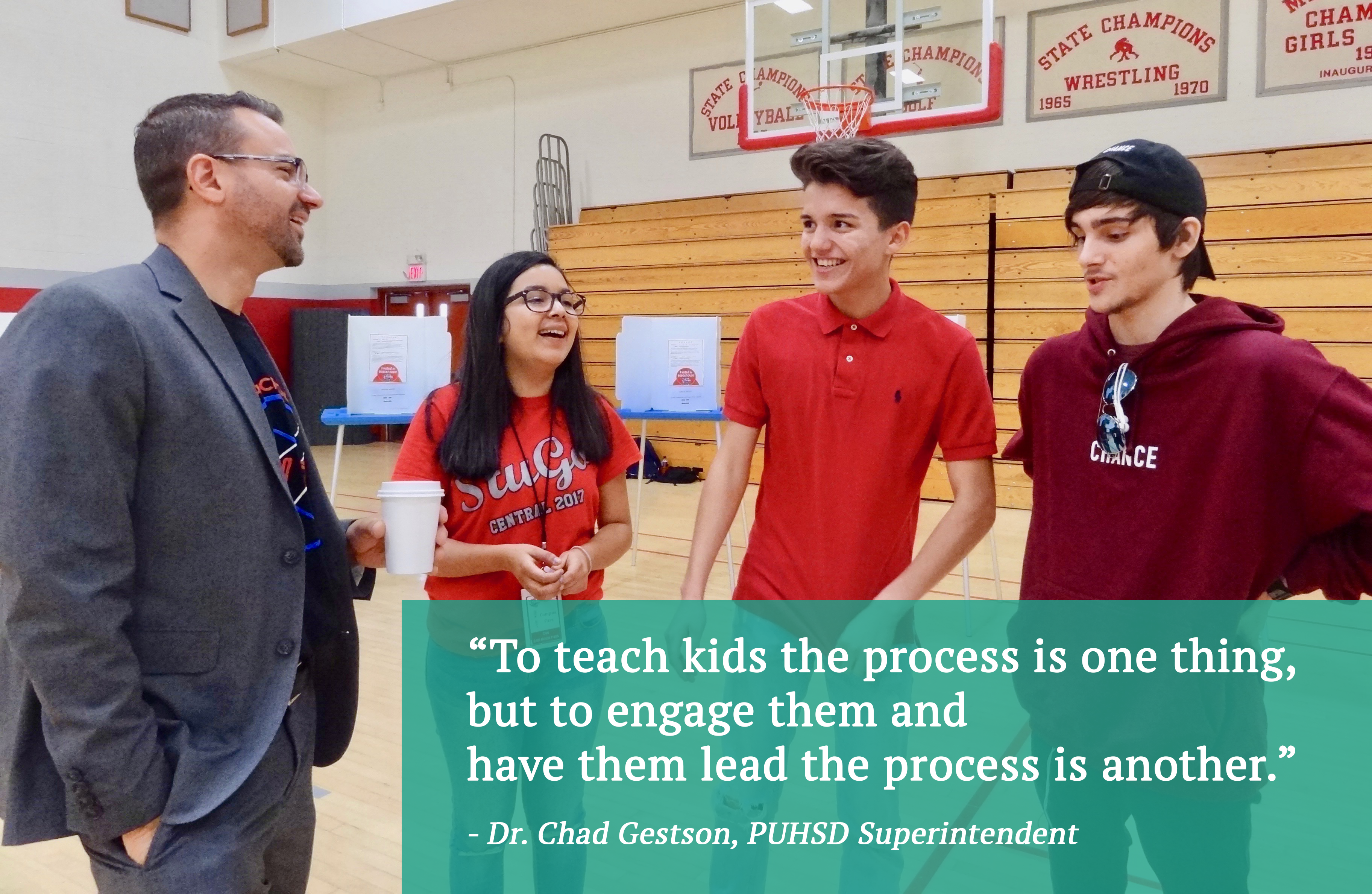
As the school district begins implementing winning projects at each school, we’re reflecting on the outcomes we’ve already seen beyond projects themselves. During Vote Week Dr. Chad Gestson, PUHSD Superintendent, said,

“If there are any schools or districts across the country that are thinking about doing school PB, in our opinion it’s a no-brainer.”

Impacts from this district-wide initiative underscore Dr. Gestson’s point, and highlight the potential for PB to create similar outcomes for students, teachers, school district staff, and beyond. When schools or school districts use PB to empower their students to decide how to spend the dollars that impact their daily lives, everyone wins.

Students

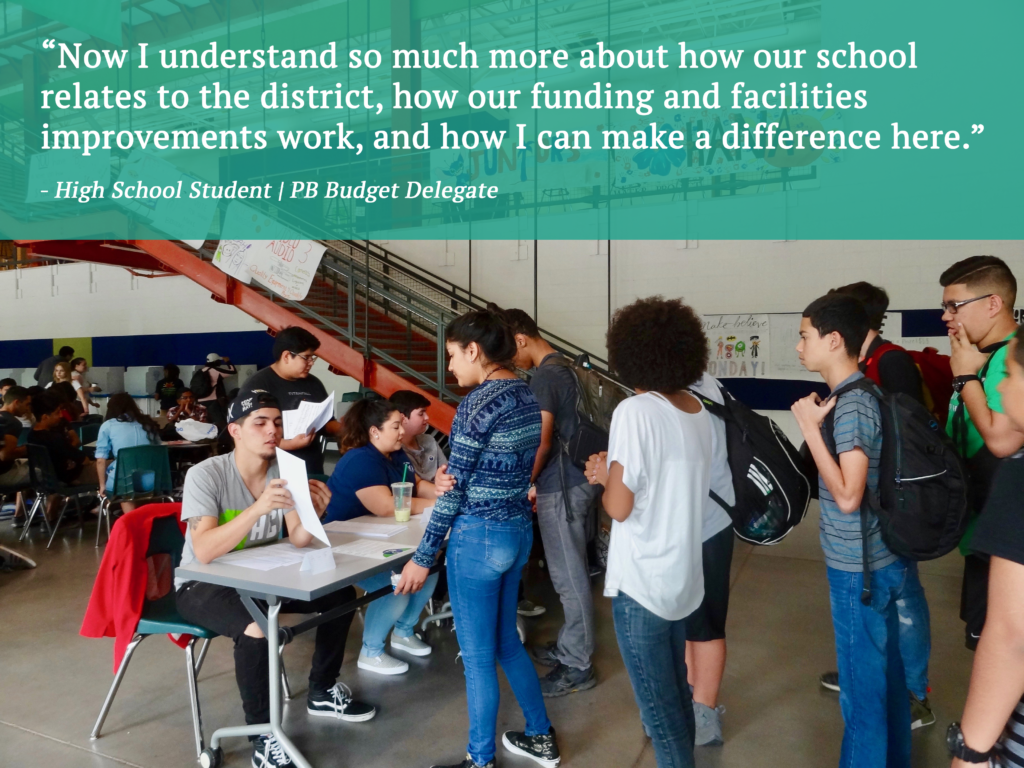
PB helped students build friendships across grade levels. Many students talked about the ways being involved in PB increased their own self-confidence and ability to talk with fellow students about how to improve their school.

Teachers

Teachers who stepped up to advise PB at each school developed stronger relationships with students outside their regular classes, and enjoyed seeing students learn and lead with great creativity and compassion throughout the PB process.

School District Staff

The PUHSD Executive Director of Logistics was so excited to see so much student interest in school maintenance and facilities that he’s planning to incorporate student input and participation into school improvement initiatives beyond the winning PB projects – including repainting some of the schools and renovating cafeterias.

Beyond PUHSD

City staff and community organizers from the City of Phoenix and the City of Tempe, and from as far away as Fresno, CA, and Toronto, Ontario attended a vote walkthrough and panel discussion with students, teachers, and staff involved in PB. These staff members and community organizers were excited by the work happening in the school district, and several are already planning for ways to bring PB to their communities!

And the winning projects are…

Drumroll, please!

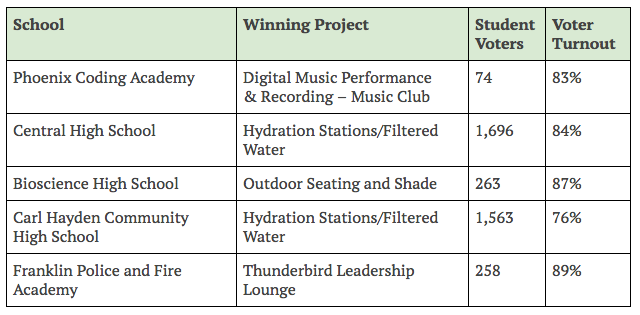
During Vote Week, 3,854 students in five public high schools – an average of over 80% turnout rate – directly decided how to spend $26,000 in school district funds. Students voted to fund music programs, filtered water stations, shade structures, and a study lounge.


Teamwork made this dream work

In any community, a successful PB process is built on strong collaboration.

PUHSD PB took teamwork to the next level, and established partnerships across Phoenix that have already inspired other school districts and cities to reimagine ways to work together.

During Vote Week, the Maricopa County Recorder’s Office generously partnered with PUHSD; they provided voting booths, official vote machines and ballots, and staff support for each voting day. In doing so, County Recorder Adrian Fontes and his office created a voting experience that embodied real democracy just as an election does – and in some ways did so even better.

Recorder Fontes has confidence that “there are other elected officials around the country just like [him] who would be more than happy to come on out and help support these sorts of elections with staff and equipment.”

“[PB] is part of education that’s not testable” he said, “isn’t this one of the most important aspects of our American democracy?”

Beyond support from an elected official, local partners from across Phoenix came together with commitment and creativity to support this student-driven initiative. This successful Vote Week was due in great part to the time, talent, and remarkable volunteers from the Center for the Future of Arizona, One Arizona, Mi Familia Vota, and Arizona State University.

Telemundo, NPR’s KJZZ, and Arizona PBS each covered Vote Week, and produced compelling news reports linked below:

Cronkite News AZ PBS’s coverage of Phoenix Union High School District PB process goes from 16:00 – 17:45 in this video.
More coverage of the first PB process with school district funds from 91.5 KJZZ.

What’s next for Phoenix?

We’ll wrap up this pilot year in PUHSD with a PB Celebration and Participatory Evaluation Workshop in May – where students, teachers, and staff from all five schools will come together to celebrate their work, reflect on what was challenging and what can be improved, and share ideas and plans for next year.

What’s next for you?

At PBP, we’re excited to see the movement for PB in schools continue to spread across Phoenix, and beyond! Our guide to PB in schools is supporting the growth of PB in schools around the world – download it here to take action.

How can we work together to bring PB to your community?

If you’re interested in more in-depth support from PBP to launch PB in your school, contact Ashley Brennan at ashley@participatorybudgeting.org.

You can find the original version of this Participatory Budgeting Project piece at www.participatorybudgeting.org/what-happens-when-students-lead-pb.