
PBP Announces PBNYC Results and Launches Data Tool

There are some exciting updates from NCDD member org – The Participatory Budgeting Project, who recently completed another successful round of participatory budgeting in NYC (PBNYC) and announced the launch of their new data tool, myPB. Over the last 7 years, the PBNYC process has allowed residents to decide on how to spend $210 million on 706 community projects. As part of a pilot program in NYC, PBP announced their new data tool, myPB, which allows residents to research their districts, find out if PB is in their communities, the status of PB projects, and more. We encourage you to read the post below and find the original version on PBP’s site here.


Participatory Budgeting in NYC: $210 million for 706 community projects

For the 7th straight year, New Yorkers just decided part of the city budget. We’re excited to share the impressive results from 2018 – and a new tool that brings past results of Participatory Budgeting in New York City (PBNYC) to your fingertips!

2018 Vote Results

More than 99,250 residents age 11 and older participated in the largest local civic engagement program in the US, deciding how to spend $36,618,553 across NYC. They developed hundreds of spending proposals and funded 124 community improvement projects for schools, parks, libraries, public housing, streets, and other public spaces.

The impacts of PB are even greater over time. Since 2012, New Yorkers have decided how to spend $210 million on 706 projects. PBNYC has also sparked over $180 million in additional spending on city-wide improvements such as school air conditioning and bathroom repairs.

PB is building the governing power of hundreds of thousands of everyday New Yorkers. As Council Member Carlos Menchaca reflected,“PB isn’t just about choosing winning projects, it is also about creating opportunities for civic participation and building stronger communities. New Yorkers are eager to lead the decision processes on topics that directly affect them.”

For more information on PBNYC Cycle 7 see the full results here and this video of highlights from the results announcement and celebration:

myPB – A New PB Data Tool

We’re thrilled to share not only 2018 vote results, but also a tool – myPB – that we’ve created to keep you updated on the status of projects and the impacts of PB.

Deciding how to spend public dollars through PB can be refreshing and exciting. Implementing the winning projects, however, can be frustratingly slow. Although staff share occasional updates about funded projects on the district level, there is no comprehensive, city-wide view of the status of PB-funded projects.

Now we have an exciting new data tool for tracking PB projects and outcomes: myPB.community. So far it includes all project data through 2017. We’re piloting it in NYC, with plans to include many more cities in the future—maybe yours?

Powered by NYC Open Data, community members can now use their smartphone or computer to:
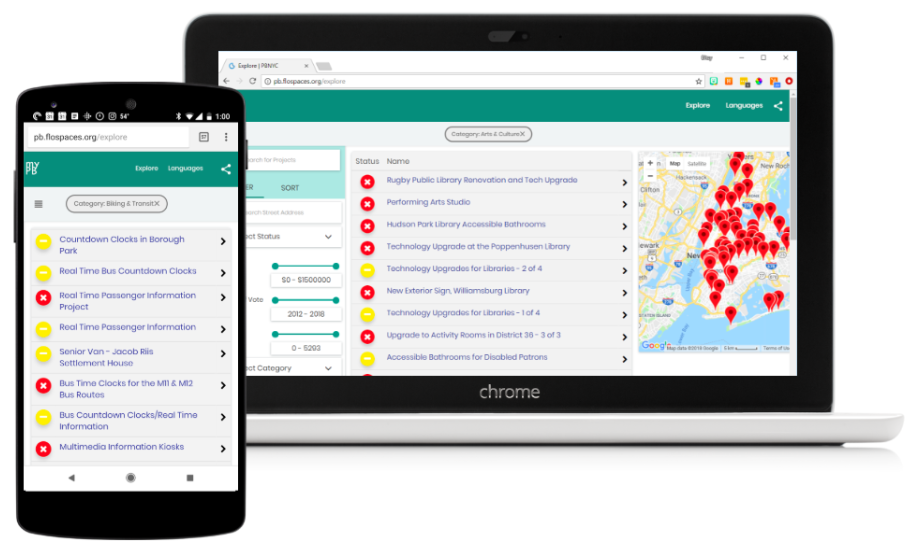
  • find their district,
  • see if their district has participated—or is participating in—PB,
  • contact their district office,
  • search, sort, and filter PB projects that made it to the ballot
  • share information on PB projects on social media,
  • and see how much money has been allocated to various city agencies and issues.

This award-winning data platform tells lots of stories, revealing city-wide and district-specific priorities.

In June 2018, myPB.community won awards in Mayor’s Civics and Open Data from NYC Open Data, for its use of open data to support civic work, like how policy groups and advocates across the city can use mypb.community to understand community needs.

Sorting projects by category indicates what people prioritize when it comes to improving their city.

Since 2012, the NYC School Construction Authority has implemented an overwhelming majority of PBNYC projects, followed by the Department of Parks and Recreation.

Community groups can get more specific information about needs and priorities in their district, to better advocate for specific neighborhood needs.

For example, of the 982 projects for libraries and schools on NYC ballots since 2012,

  • 236 mention ‘tech’
  • 61 mention ‘library’
  • 56 mention ‘bathroom’
  • 50 mention ‘air conditioning’
  • 41 mention ‘electric’
  • 20 mention ‘security’
  • 13 mention ‘ADA’
  • 11 mention ‘music’
  • 10 mention ‘water’

This breakdown lifts up top priorities for improving schools and libraries across the city.

You can find the original version of this blog post on The Participatory Budgeting Project’s site at www.participatorybudgeting.org/participatory-budgeting-in-nyc/.

Citizen Engagement is Vital Even for Smart Cities

As technology continues to grow and cities shift towards being “smart”, there are some learning opportunities for the ways in which cities go about acquiring data, the ways in which it is used, and the need to still genuinely engage the community. Which is why we wanted to share this piece written by Mary Leong of NCDD member org, PlaceSpeak, about the need for cities to be mindful of the ways in which technology is used when gathering insight on citizens and utilizing the information during city decision-making. She emphasizes the need to use a”citizen-first engagement approach” (as outlined by Meeting of the Minds) and engage the community to get real citizen feedback before implementing these smart city practices. You can find the article below and read the original version on the PlaceSpeak blog here.


No, Your City Can’t be “Smart” Without Citizen Engagement

In a recent piece from our friends at Meeting of the Minds, 4 Strategies to Fix Citizen Engagement, they asked several important questions: “Can a City really be described as ‘Smart’ if it makes changes without consulting with a diverse sample of the citizens affected by these changes before, during, and after projects are implemented? Will citizens adopt Smart Initiatives if they aren’t part of the decision-making process?”

As cities struggle to establish themselves as “smart”, they have rushed to implement IoT (Internet of Things) sensor networks which help to gain insight into the movements and habits of citizens. Sensors are gathering vast amounts of information about how citizens are engaging with their transportation needs, energy use and more – often without their explicit consent. A recent article in the Atlantic asks facetiously, “Why trouble to ask the ‘citizens’ what they want from urban life, when you can accurately surveil the real actions of city’s ‘users’ and decode what they’re actually doing, as opposed to what they vaguely claim they might want to do?”

While it is well-documented that social desirability bias or recall bias can lead respondents to provide inaccurate or false information in surveys or polls, exclusively relying on passive data – as opposed to proactive data collected through robust citizen engagement processes – only tells half the story. The challenge is twofold:

Firstly, it is crucial that smart cities do not become surveillance cities. Out of 52 agencies in the United States which use facial recognition, “only one…expressly prohibits its officers from using face recognition to track individuals engaging in political, religious, or other protected free speech,” found a report from Georgetown Law. Recent revelations from the ACLU also revealed that companies such as Amazon are actively marketing facial recognition technology to governments as an “easy and accurate” way to investigate and monitor “people of interest” – including undocumented immigrants, Black Lives Matter activists, or citizens exercising their right to protest. This unprecedented ability to surveil without accountability should be concerning to anyone with an interest in civic participation.

Secondly, the implementation of smart city technologies should incorporate citizen feedback and concerns. People are justifiably concerned about privacy issues – particularly individuals from groups or communities which may be disproportionately targeted. Furthermore, people are often unable to opt out, which can be a cause for concern for some. Just like with any large-scale initiative or project, it’s a lot harder to deal with the fallout from citizens after the decisions have been made – especially when large amounts of money have already been spent on infrastructure or technologies. In order to truly realize the potential of a “smart city”, decision-makers must include citizens in the decision to implement smart city solutions. By including the public in co-creating (“build with, not for”) and deciding on solutions that are appropriate for each community, they can be tailored to local unique challenges and needs.

The solutions highlighted in Meeting of the Minds call for a “citizen-first engagement approach”, with four factors:

  • Utilize mobile
  • Remove the burden for citizens
  • Consider offering rewards
  • Go beyond survey responses

We agree that these factors are necessary for invigorating smart cities everywhere and inspiring people to participate – while challenging decision-makers to go above and beyond. Instead of one-off online surveys or public meetings, online civic networks notify and keep people engaged on an ongoing basis. In contrast to social networks, where people are empowered to connect with like-minded individuals all across the world, civic networks are tied to place-based communities, such as streets, neighborhoods, schools, stratas/homeowner associations and more. By creating a central “hub” for citizens to engage continually with decision-makers and fellow community members, PlaceSpeak makes online democratic participation easy, convenient and habit-forming.

You can find the original version of this article on PlaceSpeak blog at www.blog.placespeak.com/your-city-cant-be-smart-without-citizen-engagement/.

NCDD Member Creates Racial Dialogues White Ally Toolkit

We are thrilled to share this excellent write-up by the Richmond-Times Dispatch on long-time NCDD member David Campt and his most recent racial dialogue work. Campt travels across the U.S. holding racial dialogue trainings using his White Ally Toolkit Workbook, which offers strategies for engaging in these conversations (learn more about the toolkit and purchase here). He speaks on the importance of white people having these conversations with fellow white people and emphasizes the need to communicate in a way that doesn’t attack but instead genuinely seeks to engage with each other. We encourage you to read the full article below or find the original version on the Richmond-Times Dispatch site here.


Williams: Racial dialogue is his specialty. His book details how white people should talk to each other about racism.

This post was shared with the permission of the Richmond Times-Dispatch.

Written by Michael Paul Williams

Coming of age in a polarized Detroit as black and white communities disengaged, David Campt became engrossed in the nature of conversation.

His hometown’s 1970s power struggle fueled his interest in terms of engagement as the outspoken Coleman Young, Detroit’s first black mayor, presided over a riot-torn city experiencing massive white flight to the suburbs. But his curiosity was also nurtured by a white teacher named Nathan Fine, who taught his students that people are far more alike than different.

“What he was trying to do is to get us to not replicate the kind of conflicts that we were watching on the news as fourth-graders,” Campt recalled. “The city’s in a certain amount of turmoil. And he’s trying to have a different kind of message, trying to get us to see the common humanity.”

Helping people find common humanity through dialogue would become a vocation for Campt, 56, a civic engagement specialist affiliated with the Richmond-based nonprofit Hope in the Cities. He put his tools to work last week moderating a meeting of Mayor Levar Stoney’s Monument Avenue Commission.

Issues don’t get much more contentious than the question of what to do with our Confederate statues.

“I have always thought about the monuments the same way I think about reparations, which is, what’s really important is the conversation about it,” Campt said during an interview Friday. “Where that lands has some significance, but what’s really important is how do institutions put the public in the position to engage each other. That’s what’s really important in these kind of big, divisive things.

“People are very focused on, ‘What’s the outcome?’ But my focus is, ‘What is the process? … What’s the engagement that you’re trying to foster?”

The tranquil commission meeting last week bore no resemblance to the verbal Molotov cocktails hurled about during a town hall-style meeting of the panel last August at the Virginia Historical Society, now called the Virginia Museum of History & Culture.

“He did a superb job helping focus the meeting while providing ample opportunities for those attending to engage in a variety of ways,” said Christy Coleman, the commission’s co-chair and CEO of the American Civil War Museum.

On Thursday, Campt — a faculty member with Hope in the Cities’ Community Trustbuilding Fellowship — will read from his new book, ”The White Ally Toolkit Workbook: Using Active Listening, Empathy, and Personal Storytelling to Promote Racial Equity,” at the Downtown YMCA.

Campt, a gregarious and towering presence at 6 feet 5 inches tall, promises that the event will be interactive and entertaining with a minimum of white guilt.

“A lot of people who do this kind of race work, they think that it is important that white people feel bad about themselves and bad about the history. I’m not sure that that’s the best strategy for having people learn.”

The toolkit seeks to dismantle the notion that “racial dialogue” in America involves a conversation between white people and people of color. It argues that some progress on race relations is best achieved when white people talk to one another.

This is imperative for several reasons. Campt cites 2017 public opinion polls in which 55 percent of white respondents said they face discrimination.

If we’re going to advance the conversation, “part of our arsenal has to be white folks talking to each other about race when there are no people of color in the room.”

There’s another reason whites must more effectively engage race matters: People of color have grown increasingly weary of the task.

Campt’s book states that it would be “neither fair nor feasible” for people of color to carry the burden of these conversations. Their ranks are too few and they “are increasingly fatigued by educating white people; they are already dealing with the additional burden of actually coping with racism.”

He said Friday that white allies of people of color have several built-in advantages in talking to fellow whites about race: racially biased whites might be more receptive and can’t legitimately accuse the “allies” of arguing their point out of self-interest.

But all of this will require a sharpening of their engagement tools.

“Part of what has happened is that allies have come to think that the way to talk to skeptics is to berate them, to call them names, to inundate them with facts — to basically use strategies that are not effective, that we know from science are not effective,” he said.

These inappropriate tactics have helped fuel a backlash. “We have given our allies bad advice about how to engage people.”

Campt said we must learn to talk across our divisions. As residents of the former capital of the Confederacy should know all too well, “different groups have had very different histories and senses of the history. And part of what the monuments represent is contention over what’s going to be our collective history.

“Well, our histories are very divergent,” Campt said. “Every group thinks its version of history is the right version. If we’re going to create a democracy that works, then what’s important is we try to come up with a collective history.”

The history that landed Campt in his role as a dialogue leader was circuitous.

He studied computer science on a scholarship at Princeton, but hated it. At age 20, with a degree at hand, he edited a magazine in New York and grappled with racism in all its contradictions.

“I’m afraid on the subway and people are afraid of me,” he recalled.

He moved to the West Coast to attend graduate school at the University of California, Berkeley. During his second year, he began working as a dialogue facilitator.

“I think I was a natural at that because of my obsession with how people talk to each other,” he said.

After earning a Ph.D. in city planning, he was chosen for the staff of President Bill Clinton’s Initiative on Race.

“It was a fantastic opportunity and a horrible experience,” Campt recalled.

Whatever ambitions Clinton had about racially progressive public policy weren’t shared by some of his staff members, who were more intent on campaign-style messaging than on fostering engagement, Campt said.

Then the Monica Lewinsky scandal exploded in 1998, with the race initiative as collateral damage.

“The extent to which he had any moral authority was diminished,” Campt said.

It’s difficult to imagine, but 20 years later, we’re even more divided. On many fronts, we have lost the capacity to engage each other.

If his book’s tools can encourage productive dialogue on race, “the toughest issue in American engagement, maybe we can talk to each other across ideological lines on other issues,” Campt said.

Our current breach is not only corrosive to democracy, it’s also eroding families.

“People don’t want to go home for Thanksgiving because they don’t want to be with their relatives, or they don’t want to have those encounters. That’s ridiculous.”

Too often, when white individuals hear something racist from a family member or friend, they stare at their shoes. That’s an understandable response, Campt says.

“You don’t want to damage that relationship. So you’re stuck in a quandary. You don’t know what to do. You don’t want to attack the person so you don’t do anything.”

He’s seeking to empower people to respond with practical conversation strategies.

“This is about a third choice,” he said. “Don’t attack. Don’t avoid. Engage. This is about how you engage.”

– Michael Paul Williams, mwilliams@timesdispatch.com, published May 14, 2018

This post was shared with the permission of the Richmond Times-Dispatch. You can find the original version of this article on the Richmond Times-Dispatch site at www.richmond.com/news/plus/williams-racial-dialogue-is-his-specialty-his-book-details-how/article_7d086bdd-4b7f-5c7d-9947-8f66af2bf287.html.

Ben Franklin Circle Reflections on Moderation in Politics

As part of our partnership with NCDD member org, Ben Franklin Circles (BFC), we are continuing to share stories coming from the Circles. In this most recent BFC post, Micah Towery lifts up reflections from the discussion that took place in the Circle he runs when they explored moderation; and how this virtue can play a role in our political lives. You can read the post below and find the original post on BFC’s site here.


Moderation as a Political Virtue

“Avoid extremes. Forbear resenting injuries so much as you think they deserve.”

Didn’t we already cover this idea with temperance? That was my first thought as I prepared to lead our Circle on the topic of moderation.

I read it again. Resentment? Injuries? That sounded pretty different from “Eat not to dullness and drink not to elevation.” Clearly, Franklin thought of this term differently than I was used to, but as a leader, I struggled to understand the difference between moderation and temperance.

Thankfully, facilitating a Ben Franklin Circle doesn’t mean having all the answers, and my own Circle helped me realize that Franklin is talking about this term as a particularly political virtue.

Here are some things I discovered about this virtue from our discussions.

1. Avoid extremes

Does being moderate mean being wishy-washy? Does it mean always taking the political middle ground? Certainly not. Some in our group brought up the great social reformers, especially those who used non-violence as a tactic. The Civil Rights movement was certainly not in the political ‘middle,’ and many people died for that cause. Clearly, there were strong convictions at work, but the Civil Rights movement still embodies Franklin’s virtue of moderation.

Another example of moderation that our Circle discussed were Truth and Reconciliation Commissions. These examples demonstrate the power of checking resentment without watering down conviction or pretending “I’m OK, you’re OK.”

2. Forbear resenting injuries so much as you think they deserve

In contemporary society, we’re often taught that strong feelings guide the way to our inner convictions. Indeed, a deep passion to set things right is a positive thing. It energizes us and can embolden us to make sacrifices or speak up when we are afraid. But what if strong feelings aren’t always a reliable guide? What if instead, they are passions that could turn destructive and blind us to self-examination?

I think Franklin’s virtue of moderation also requires us to examine our own positions soberly. What’s the line between resentment for personal slights and a deep passion to set things right?

It’s not always easy to see. As the social psychologist Jonathan Haidt has argued, our feelings often come first and rationalization comes later. Haidt says we’re caught in a kind of “moral matrix” and there is a deep and pleasurable tendency to join “teams” with similar matrices (cheering for your favorite sports team is a great example of this). In this sense, our deepest feelings, even those we share with others who we admire, could be blinding us from open dialogue across values systems.

We will always have disagreements with others, sometimes irreconcilable ones. Yet we must live together and confront mutual problems, as well.

Moderation is about honoring the general norm that civic engagement–necessary for our life together–cannot continue without our ability to check and examine our own strong feelings. Cultivating this virtue, then, means listening to others better and seeing ourselves more truly.

3. Practical civility

Going through Franklin’s 13 virtues, I have come to realize that these civic virtues are not puritanical rules. They are norms we must apply practically, but not obsessively enforce. They are habits of mind and body we should try to cultivate in ourselves and encourage in others.

If you visited Micah Towery in South Bend, you’d probably find him hanging out with neighbors or engaged in a side hustle. He formed and lead the first Ben Franklin Circle in South Bend. He teaches occasionally at Notre Dame and Goshen College. He has a book of poetry called Whale of Desire.

You can find the original version of this post on Ben Franklin Circles’ site at https://benfranklincircles.org/moderation/moderation-as-a-political-virtue.

Nevins Fellows Begin Internships – TWO with NCDD orgs!

We are very excited to share an update from Penn State’s McCourtney Institute for Democracy, that the new Nevins Fellows will be starting their summer internships! NCDD has partnered with the McCourtney Institute over the last few years to help connect students from their Nevins Democracy Leaders Program to internships with individuals and organizations in the D&D and public engagement field. We are extra proud to share that two of the fellows will be joining NCDD member orgs – the Participatory Budgeting Project and Everyday Democracy. Please join us in wishing all the Nevins Fellows the best of luck in their new roles – you will be great!

We encourage you to read the announcement below and find it on McCourtney’s site here.


Nevins Fellows Begin Summer Internships

This week, our new cohort of Nevins Fellows will start working with organizations around the country that advance democracy in a variety of areas.

Over the next two months, students will have the opportunity to learn what it looks like to engage in deliberation, outreach, and other processes that are essential to a healthy democracy.

Here’s what they are most looking forward to as they begin their internships:

Alexis Burke
Participatory Budgeting Project
Brooklyn, New York

I chose to work with The Participatory Budgeting Project because of their tangible effects on the communities they work with. Through the implementation of small d democracy, The Participatory Budgeting Project helps to foster community and democracy in the New York metropolitan area.

I’m most looking forward to connecting with The Participatory Budgeting Project’s team members as well as members of New York’s various communities. I can’t wait to gain hands-on experience implementing everyday democracy.

Maia Hill
City of Austin
Austin, Texas

I selected this organization because the mission aligns with some of the practices I believe need to be incorporated within all communities. This line of work would help me in the long run because I plan on going into politics and/or becoming a State Representative and in order for me to be an effective and efficient leader in that line of work.

Entering into this internship, I hope to gain a greater understanding of the importance of participatory democracy. I am looking forward to learning how to be active within community engagement and how to get minorities within between race, ethnicity, gender, etc. involved within local government to get the change that they want and need within their communities. This hands-on experience will definitely make a huge difference in how I can also be more involved with the current community I reside in here at Penn State.

Sophie Lamb
Everyday Democracy
Hartford, Connecticut

I chose Everyday Democracy because of their focus on the inequalities in the criminal justice system. I am fascinated by the differences between how legislation is written compared to how it is implemented. I am also excited to see the outreach the organization does and how they interact directly with different communities.

I am most looking forward to the opportunity to see how laws are implemented compared to the theoretical intention behind legislation, specifically in regards to the racial disparity in the criminal justice system. In addition, this internship will allow me to continue to improve on the research and writing skills that I have built during my time at Penn State.

Stephanie Keyaka
City of Baltimore
Baltimore, Maryland

I went to school in Baltimore City, so I have an extreme love for the community. What attracted me to this site was Councilman Cohen’s dedication to building a stronger democracy and legislating that is rooted in equality and justice. I wanted to do more for communities of people that look like me, and this site and the office’s mission aligned perfectly with my political aspirations.

It will be very interesting to use a racial equity lens to tackle public policy issues in Baltimore City. Urban and local politics are often overlooked, but can have be of extreme importance for the members of this community. I am hoping to better learn the ways in which local politicians can have an impact on the immediate lives of residents, especially in marginalized communities

You can find the original version of this announcement on McCourtney Institute’s site at www.democracyinstitute.la.psu.edu/blog/nevins-fellows-begin-summer-internships.

Calling All D&D Showcase Presenters for NCDD2018

NCDD is excited to announce that we’ll once again be holding our popular “D&D Showcase” during the 2018 National Conference on Dialogue & Deliberation, and we are looking for presenters!

The D&D Showcase is a lively cocktail networking event that provides an opportunity for select individuals and organizations in our field to share some of the leading ideas, tools, projects, and initiatives in dialogue & deliberation with conference participants all in one space. It’s a fun way for conference-goers to meet some of the movers-and-shakers in D&D and hear about the projects, programs, and tools that are making waves in our work.

How the Showcase will work

Showcase presenters display simple “posters” about their work, tools, or projects and bring handouts and business cards to share with participants who are interested in learning more or following up. Showcase presenters will be ready to succinctly express what’s important for conference participants to know about their resource, method, research, program, etc. and to elaborate and answer any questions people may have.

During the 90-minute Showcase event, conference participants will stroll around the ballroom, chatting with presenters, and checking out their displays and picking up handouts. We’ll also have finger foods and beverages available as well as a cash bar, adding to the social atmosphere of the session.

The Showcase is a great chance to strike up conversations with leaders in the field and other conference participants who are strolling around the room, perusing the “wares.”

You can get a good sense of what the Showcase is like by watching this slideshow from our 2012 conference in Seattle.

You can also see Janette Hartz-Karp and Brian Sullivan presenting at the 2008 Showcase event here (back when we called it the “D&D Marketplace”), and check out the video of Noam Shore, Lucas Cioffi, and Wayne Burke presenting their online tools here.

Becoming a Showcase Presenter

The conference planning team is hard at work planning NCDD 2018, and one of our upcoming steps includes selecting people and organizations who are passionate about sharing tools and programs we know will interest our attendees as presenters during the Showcase. If you are interested in having your tool, project, idea, or work being featured in the Showcase, please email our conference manager Keiva Hummel at keiva@ncdd.org and include: what it is you would like to showcase, a brief description of it, any links to where more information can be found, and any questions you have.

Please note that these slots are very competitive, and we will be favoring Showcase presentations that relate to the conference theme, Connecting and Strengthening Civic InnovatorsSo if your work, project, or tool focuses on helping to better bring the work of the dialogue, deliberation, and public engagement into greater visibility and widespread practice – we definitely want to hear from you!

If you are selected as a D&D Showcase presenter, you’ll be expected to:

  • Register for NCDD 2018 and attend the conference.
  • Prepare a quick spiel or “elevator speech” about your Showcase topic that will get people interested in learning more. Practice it until it comes out naturally. We suggest you prepare several introductions of different lengths (30 seconds, 1 minute, etc.) so you can adjust quickly to different circumstances during the Showcase.
  • Prepare a simple, visually interesting poster and bring it with you to the conference.
  • Bring handouts about your program, method, online tool, publication, etc. that include further details.
  • Have any laptop-dependent pieces of your Showcase presentation finished, functional, and ready to share (you’ll need to bring your own computer).
  • Show up for the Showcase session about 20 minutes early so we have time to make sure everyone is set up and has everything they need.

You can find more information and advice for Showcase presenters on our Conference FAQ page here.

We are looking forward to having another informative and inspirational D&D Showcase this year, so we hope you’ll consider applying to be a presenter or urging your colleagues who are doing ground-breaking and critical work in the field to do so. We can’t wait to see all of the cutting-edge projects showcased in November!

Save the Date for Civility Convening April 30 – May 1, 2019

We wanted to let folks know to save the date for the Civility Convening, happening April 30 – May 1, 2019 at the George Washington Masonic Memorial in Alexandria, VA. NCDD member Russ Charvonia, who is coordinating the event, shared this with us and wanted to let the network know they are currently seeking presenters; so we encourage you to learn more and apply to present! The event, also hosted with several non-profits, will be a great opportunity for those working to improve civility across the sectors of government, education, workplace, media (social and public), and family. You can read more about it in the announcement below or find the original on the Civility Convening site here.


The Urgency of Civility – A Springboard for Action

You are invited to attend a convening of organizations engaged in improving civility within our world. This important session is intended to open conversations around our various goals, and how we can leverage the strengths of each, while remaining independent.

Mission of the Convening: To positively impact current civility initiatives through the discovery of common understanding. With these new learnings, we can dramatically increase the probability of our collective effectiveness.

Goals of the Convening:

  • Building – By engaging in an active, constructive dialogue of discovery and learning, we may cross-promote and leverage existing civility initiatives.
  • Better –  With awareness and familiarity of current civility initiatives, we can design strategies to clarify and create a more legitimate viable product to build and improve civility in our world.
  • Together – This work will create strong relationships within this space, and build capacity within organizations and individuals actively engaged in the broad spectrum of civility.

Theme: Together, we can build capacity, create a better, more civil society, while working within the overarching promise of civility.

Meeting Format: The convening will begin with an informal reception the evening of April 29, 2019, and will formally open the morning of April 30, with facilitation of a wide range of topics within the civility space. The sessions on May 1 will feature a keynote speaker, plenary and breakout sessions on specific topics that are designed to meet the needs of the various participants. A farewell dinner will wrap up what is expected to be a very fruitful and worthwhile session.

Tracks: Participants will be able to choose a “track” or “ala carte.” Tracks include: Government, Education, Workplace, Media (social and public), and Family

This timely, important meeting of organizations engaged in the civility space is hosted by several organizations who all share the objectives of encouraging open dialogue, purposeful thought, and capacity building among all groups in pursuit of building a more civil society.

Request to be a presenter
If you are passionate about the topic of Civility and willing to share your passion, we want to hear from you.

The event tracks include: Government, Education, Workplace, Media (social and public), and Family. If you have a special passion for any of these topics please reach out to us.

This is a self-supporting conference. No person or organization is generating any profit from it. It is our intention to provide valuable and useful information, while keeping the costs reasonable and accessible.

You can find the original version of this information on the Civility Convening site at www.civilityconvening.org/.

Get NCDD2018 Tickets at “Super Early Bird” rate by Thurs!

WOW! It’s the five-month mark until the 2018 National Conference on Dialogue & Deliberation happening November 2-4 in Downtown Denver and we are getting so excited!! Last week we had over 100 proposals come in for workshop sessions at NCDD2018 and our conference team is now working through them. There are so many fantastic ideas that came in, we can’t wait to share with you what the line up will be! If you are interested in learning more about what NCDD conference have been like and what kind of workshops our innovative network has brought to the table in the past – make sure you check out our past conferences (and guidebooks!).

In addition to sharing our excitement about the upcoming conference, we wanted to give a friendly reminder that the “Super Early Bird” rate for tickets is available until tomorrow Thursday, May 31st! This is the only time that tickets for the conference will be available at this low rate, so make sure you secure yours before they go up on Friday. Whether you are have been working in dialogue, deliberation, and public engagement for many years or you are a newbie in the field – our conferences have something for everyone! Register for the conference by clicking here.

Our theme for this conference is, Connecting and Strengthening Civic Innovators, and it is our hope that we can come together to work on how to further amplify dialogue, deliberation, and public engagement work. There are so many valuable processes and resources that our extended community of practice offers, and we’d like to explore ways to make this work spread. Check out our ideas on the NCDD2018 page here for how we want to further build D&D power and deepen the impact of engagement work.

NCDD conferences are known for being energetic and transformational experiences where this incredible talking tribe can come and work together. They are opportunities which only come around every other year, so we hope you will join us in Denver this November!

Tuning in and Shifting Strategy with Ben Franklin Circles

As part of our partnership with NCDD member org, Ben Franklin Circles, we have been sharing stories from those participating in the circles and some of the key learning that has taken place during the process. Read the remarkable change that happened in Victoria Fann’s BF Circle when she decided to step back from facilitating and have the circle members take the rein. You can read the post below and find the original post on BFC’s site here.


The Spirit of Community

My Ben Franklin Circle in Weaverville, NC has been meeting since November 2017. Since I have been facilitating groups of various kinds since 1989, stepping into the role of facilitator for this group was easy for me. We met for the first four months with me asking most of the questions, reading the quotes and gently steering the conversation if we strayed away from the topic.

This seemed to work well, but something was missing. I had a gnawing feeling that there was a better way to structure our little group. Based on some words from his autobiography, I knew that Ben Franklin would heartily agree. For example, he writes, “Tell me and I forget, teach me and I may remember, involve me and I learn.”

Involvement was precisely what we needed!

The first small step in this direction took place at our February meeting. Instead of discussing the virtues in the order listed on the Ben Franklin Circle website, I decided to write each one of the remaining virtues on small slips of paper and fold them up. I brought those papers to the meeting and placed them in a hat. At the end or our discussion, I asked a member to draw out one of the slips of paper, saying that we would discuss whatever virtue was chosen.

This felt good—so good, in fact, that at the March meeting, I decided to take this idea a step further. Prior to the meeting, I wrote out that month’s virtue questions and quotes provided by the Ben Franklin Circle website onto small slips of paper, folded them and placed them into a bowl at our host’s house. I then invited members to draw one out and read it aloud to the group to prompt our discussion. I also encouraged members to add their own questions.

Franklin’s very own group, on which the BF Circles are based, encouraged a similar involvement from the members of the group as he writes here: “I should have mentioned before, that, in the autumn of the preceding year, I had form’d most of my ingenious acquaintance into a club of mutual improvement, which we called the JUNTO; we met on Friday evenings. The rules that I drew up required that every member, in his turn, should produce one or more queries on any point of Morals, Politics, or Natural Philosophy, to be discuss’d by the company; and once in three months produce and read an essay of his own writing, on any subject he pleased. Our debates were to be under the direction of a president, and to be conducted in the sincere spirit of inquiry after truth, without fondness for dispute, or desire of victory; and, to prevent warmth, all expressions of positiveness in opinions, or direct contradiction, were after some time made contraband, and prohibited under small pecuniary penalties.”

What we discovered during that meeting was that having the members chose the questions at random and read them to the group led to a much deeper level of conversation. I suspect this was because the playing field had been leveled and everyone felt more engaged and involved than when I was the one asking most of the questions. My leadership role softened as I yielded to this more community-based approach. Our trust of each other and our willingness to explore the outer edges of the virtue increased exponentially. Plus, there was almost a palpable feeling of relief among all of us once we shifted into this more egalitarian way of relating to each other. It was clear we’d been seeking it all along.

The lesson for me was a reminder of how important it is to tune into the specific needs of a situation without assumptions, agendas or formulas, but rather an open mind and a willingness to learn.

Though initially my “expertise” proved to be a hindrance, the group process itself became the catalyst that allowed the solution to emerge effortlessly.

Thank you, Ben Franklin.

Victoria Fann is a writer, transformational coach, group facilitator and workshop leader. Her Ben Franklin Circle meets in Weaverville, NC.

You can find the original version of this post on Ben Franklin Circles’ site at https://benfranklincircles.org/ben-franklin-circle-hosts/the-spirit-of-community.

Participedia.net Hosts Democratic Learning Webinar Series

NCDD is excited to share one of our partner organizations, Participedia.net has recently announced their first ever webinar series on Democratic Teaching and Learning starting in June. This free four-part series is open to anyone and will be a great opportunity to connect with Participedia researchers and collaborators around participatory democracy. We are proud to see many folks from the NCDD network collaborating on the sessions and we encourage you to register at the link below! Read the webinar schedule in the post and find the original on Participedia.net’s site here.


Democratic Teaching and Learning: A Webinar Series

Participedia proudly presents its first webinar series on Democratic Teaching and Learning, developed by Co-Chairs of our Teaching, Training and Mentoring Committee, Drs. Joanna Ashworth & Bettina von Lieres! Open to anyone interested in the field, this four-part webinar series will connect Participedia researchers and collaborators with shared interests in teaching methods, theories, and cases that support democratic participation. Join us and our rotating panel of experts for a lively exchange of knowledge about challenges and successes in the evolving field of participatory democratic innovations.

Schedule:

Session One – 8 am Pacific Time June 6, 2018
Participedia.net Teaching and Learning from Cases

Graham Smith (Westminster University) and Tina Nabatchi, (Syracuse University)
Moderator: Bettina von Lieres (University of Toronto).

  • What and How Do We Teach Using Participedia.net? Questions, Cases, and Opportunities?

CLICK HERE TO REGISTER FOR SESSION 1

Session Two – 8 am Pacific Time September 26, 2018
Understanding the Practice of Democratic Pedagogy

Tim Shaffer  (Kansas State University), Bettina von Lieres (University of Toronto).
Moderator: Joanna Ashworth (Simon Fraser University)

  • What is Democratic Pedagogy? Schools of Thought and Practice in Canada, US, UK and Beyond

Session Three – 8 am Pacific Time October 31, 2018
TITLE TBC What Works: Coaching and Mentoring Professionals in the Uses and Research of Public Participation.

Matt Leighninger (Public Agenda) and Julien Landry (Coady International Institute).
Moderator: Joanna Ashworth

  • Insights into working with seasoned and mid-career professionals from the public sector, NGOs and more.

Session Four – 8 am Pacific Time November 28, 2018
The Global Context of Participation

Lawrence Piper, (University of the Western Cape), John Gaventa (Institute of Development Studies) and Archon Fung (Harvard Kennedy School; Co-Founder Participedia).
Moderator: Bettina Von Lieres (University of Toronto).

  • How context shapes the teaching of democratic pedagogies: Reflections on Politics, conflict and power in South Africa, the Philippines and Beyond

Save the Date:
RSVP on Eventbrite: https://www.eventbrite.ca/o/participedianet-17316087019
RSVP on Facebook: https://www.facebook.com/pg/Participedia/events/

You can find the original version of this announcement on Participedia.net’s site at www.participedia.net/en/news/2018/05/21/democratic-teaching-and-learning-webinar-series.