tracking change in a group that discusses issues

Colleagues and I just ran a mini-experiment in which students at two very different universities held online discussions of the same controversial current issues. Before and after each discussion, we surveyed them to ascertain their social networks within their own class. We assumed that a group of people who discuss issues exhibit three layers of network ties that can change over time:

  1. Social networks: affective ties among the people, defined by friendship or respect.
  2. Networks of direct address: When person A asks person B a question or endorses B’s view, that creates a tie, and many ties create a network.
  3. Semantic (or epistemic) networks: Ideas connected by explanations. For instance, if A says that racism causes unequal health outcomes, then A has connected two ideas.

I am interested in tracking the relationships among these networks, because some patterns seem more desirable than others, and it would be useful to recognize the differences. For example, if people who are popular in social networks receive most of the direct addresses and determine the group’s epistemic network, then the discussion looks like a popularity contest. But if a new idea causes people to revise their opinions of whose views should be respected, that is evidence of learning.

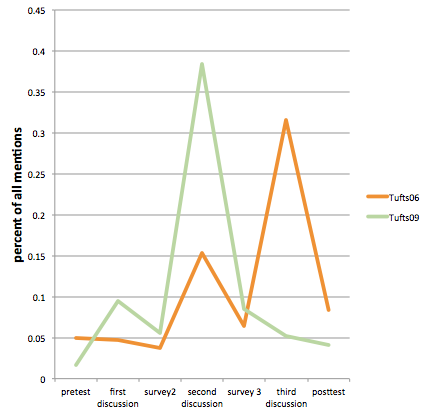
Here is a small illustrative finding from the data so far. Below I show the trajectory of two particular students within the Tufts University discussion thread. Both started off as somewhat less central than average in the class’s social network. At the start of the experiment, Tufts 06 was mentioned by three fellow students as a friend or an influencer, and Tufts09 got one mention. (Below I show the percentage of all mentions, to control for differences in the amount of text at each phase.)

Screen Shot 2016-05-15 at 12.11.56 PM

In the second discussion, which concerned the social determinants of health, Tufts09 posted the very first comment. She wrote, “the presentation given by Dr. [F.] was one of the best presentations given on social determinants of health that I have seen. … As a woman of black decent, I have taken these discussions and this knowledge very seriously, and I now view life with a completely different perspective. … When talking about the Flint, Michigan water crisis, it was shocking to hear that companies … are often built where the majority of the community is minority and low income. This infuriated me.”

Her comment was explicitly referred to by five other students and set the agenda for the whole discussion thread. When next surveyed, four students counted her as someone who had influenced them, up from one at the pretest. The number of mentions fell, however, to two at the end of the experiment.

It appears, then, that by making a forceful comment to start an online discussion—drawing on her own identity—Tufts09 may have gained social capital for a week or so. On the other hand, she did not need social capital before the second discussion to be influential in it.

Tufts 06 was the first to post in the the third conversation, writing: “As someone who has suffered from anxiety and depression, the topic of mental health stigma is incredibly important to me. In my family, nearly everyone on my mother’s side is on medication for anxiety, depression, OCD, or some combination of the three. We have had three suicides in our family (all before I was born) just because the treatments and attitudes toward mental health were not sufficient at the time those family members were suffering through their diseases.”

She received six mentions in the discussion thread, and in the subsequent survey, six students named her as influential (up from 3 at pretest). Again, she seemed to raise her social capital by making an influential point in the online dialog.

These are just two little anecdotes, and much remains to be explored. For instance: How typical is this kind of trajectory? Even in these two cases, did participation in the online discussion really cause social capital to rise? (The effect could be random or driven by some other factor.) And if these students were influential, was it because of what they argued, how they drew on their personal backgrounds, or simply the fact that they each posted first on the discussion thread?

Alabama Prisons: Why We Cannot Look Away from Alabama’s Shame (DMC Issue Guide)

The issue guide, Alabama Prisons: Why We Cannot Look Away from Alabama’s Shame, was a collaborative effort between David Mathews Center and AL.com, published 2014. The guide offers three approaches for deliberation to address the serious and widespread issues with the Alabama prison system. In addition to the guide, an eight and a half minute video was also created to summarize the realities of the Alabama prisons.

The guide offers three approaches for deliberation and within these approaches are five specific actions and consequences for each option. Below are the three approaches from the issue guide which were found on National Issues Forums Institute blog here. You can find more information about the issue guide, including the action/consequence of each approach and the brief video, on AL.com here.

From NIFI blog…

Approach One: “Increase Capacity and Improve Basic Conditions”
Alabama’s prison population far exceeds operational capacity, and conditions inside the facilities are raising constitutional questions. As a result, the Alabama Department of Corrections is now facing potential federal intervention and costly lawsuits. If the state does not significantly reduce overcrowding and improve basic conditions for inmates, then additional lawsuits may be filed and thousands of prisoners may be released. People want to feel safe in their communities, and many residents and lawmakers want to ensure that our prison system complies with the Constitution. If we want to avoid lawsuits, federal intervention and a potential release of prisoners, then we must increase capacity and improve conditions in the prisons. Our time line is limited and addressing difficult sentencing issues and root causes may take too long. If we want to solve this problem and stay tough on crime, then we must consider building new prisons, expanding existing facilities, and/or contracting with for-profit prisons.

Approach Two: “Address Root Causes through Education, Support and Rehabilitation”
Thousands of Alabamians are incarcerated every year, and the prison system is under stress. If we want to truly address the overcrowding issue, we cannot simply build more prisons. People must work to understand the root causes that lead residents to commit and re-commit crimes, and provide support to help remedy those deeper issues. Many people need educational support, community-based mentoring, substance abuse counseling and mental health services. Many offenders need access to educational services, job training and behavioral health support while incarcerated and after release. If we want to keep people out of prisons and avoid high recidivism rates, then we cannot ignore the real issues that drive individuals to break the law. By providing education, support and rehabilitation, we may also see benefits to communities, families, and the economy.

Approach Three: “Implement Alternative Approaches to Incarceration”
People who break the law must face consequences. Unfortunately, many Alabamians who break the law end up in state prison — resulting in overcrowding and dire conditions. Alabama’s increasing prison population is costing taxpayers a significant amount of money, and the long-term impact on communities and families is troubling. If we want to continue to punish criminal behavior and avoid the costly practice of mass incarceration, then we must consider alternatives to prison. Specifically, we must implement community corrections programs in every county, expand problem-solving courts and provide opportunities for restorative justice. We must also ensure that justice is applied in an equitable and consistent manner.

About DMC and the Issue Guides
The David Mathews Center—a non-profit, non-partisan organization—authors deliberative frameworks for people to carefully examine multiple approaches, weigh costs and consequences, and work through tensions and tradeoffs among different courses of action to current and historic issues of public concern.

David Mathews Center issue guides are named and framed by Alabamians for Alabama Issues Forums (AIF) during a biennial “Citizens’ Congress” and follow-up workshops. Alabama Issues Forums is a David Mathews Center signature program designed to bring Alabamians together to deliberate and take community action on an issue of public concern. Digital copies of all AIF issue guides, and accompanying post-forum questionnaires, are available for free download at http://mathewscenter.org/resources.

Follow DMC on Twitter: @DMCforCivicLife

Resource Link: www.nifi.org/en/groups/online-issue-framework-about-alabama-prison-reform

Economic Vitality: How can we improve our communities?

The 11-page issue guide (2016), Economic Vitality: How can we improve our communities?, was collaboration effort by the Southern Governors’ Association, Southern Economic Development Council, Consortium of University Public Service Organizations and Danville Regional Foundation. The Issue Guide was found on National Issues Forums Institute‘s blog and offers three options for participants to use for deliberation on the current economic situation in the US.

You can find the issue guide, moderator guide, and a post forum questionnaire, available for free download on NIFI’s site here.

Economic Vitality_coverFrom NIFI’s blog…

[Via Linda Hoke…]

Despite positive signs in terms of overall economic growth, the economy remains a key concern among many Americans. According to a Harris poll conducted in January 2016, Southerners were the most pessimistic about the future. For many in communities across the South, rapid change and an unclear future can create a sense of uneasiness, or even impending doom.

The Southern Governors’ Association, Southern Economic Development Council, Consortium of University Public Service Organizations and Danville Regional Foundation have partnered to develop materials designed to help communities come together to deliberate about the following key question: What should we do to improve economic vitality in our community? We encourage you to take a look at these materials to see if they can help your community – or a series of communities in your state – think through their options and paths forward.

We are glad to provide advice and assistance if you are potentially interested in holding a forum to help your community discuss the important issue of economic vitality. Please feel free to contact Ted Abernathy, Economic Development Advisor to the Southern Governors’ Association at ted[at]econleadership[dot]com or Linda Hoke, Director, Consortium of University Public Service Organizations at lhokesgpb[at]gmail[dot]com.

This issue guide presents three options for deliberation:

Option One: Make our community attractive to good and stable employers
This option holds that more attention is needed to the foundations that will make the community attractive to good and stable employers. This includes physical infrastructure such as airports and roads, as well as quality of life issues such as low crime rates and good schools. Annual surveys of business leaders identify these foundations as among the top factors influencing business location decisions. And, investments in infrastructure improvements such as broadband access offer rural communities the ability to overcome potential locational disadvantages in terms of accessing customers and employees. Without these investments, poorer or smaller communities may fall even further behind.

Option Two: Prepare workers and communities to be more self-reliant
This option holds that we need to do more to make workers and communities more self-reliant, to reflect the fact that employers- faced with global competition and the need to be more flexible – no longer provide the long-term security they once did. As a retired computer systems developer recently told Tulsa World as part of a series on the changing American dream, “There was a whole different atmosphere in the ’50s and ’60s as far as work went. Companies expected loyalty from you, but the company provided loyalty to their people.”

Option Three: Provide everyone in our community with opportunities for success
Unfortunately, many people who work hard and play by the rules still can’t get ahead because they have little access to opportunities for success, be it because of their lack of family support, lack of connections or simply their address. This option holds that we need to do more to ensure that everyone has opportunities for success.

About Issue Guides
This issue guides was done in the style of NIFI Issue Guides, which introduce participants to several choices or approaches to consider. Rather than conforming to any single public proposal, each choice reflects widely held concerns and principles. Panels of experts review manuscripts to make sure the choices are presented accurately and fairly. By intention, Issue Guides do not identify individuals or organizations with partisan labels, such as Democratic, Republican, conservative, or liberal. The goal is to present ideas in a fresh way that encourages readers to judge them on their merit.

Resource Link: www.nifi.org/en/groups/issue-guide-economic-vitality-how-can-we-improve-our-communities

Human Trafficking: How Can Our Community Respond to This Growing Problem? (NIFI Issue Guide)

The 8-page issue guide on National, Human Trafficking: How Can Our Community Respond to This Growing Problem? was posted on National Issues Forums Institute website and it was collective effort of a few groups. The guide was created in 2016 by the Maricopa Community Colleges Center for Civic Participation, Spot 127 Youth Media Center, the Office of Sex Trafficking Intervention Research, Arizona State University School of Social Work. The issue guide can be downloaded for free from NIFI’s site here, and also available is a moderator’s guide and information on Human Trafficking to inform deliberation participants.

From the guide…NIFI_HumanTrafficking_guide

Many Americans are unaware of the extent to which human trafficking is an issue in their communities. Others may be aware of some aspects of the problem, but may feel powerless to do anything about it. But as law enforcement and others document a growing industry in human trafficking across the country, what can and should our community do to combat the problem?…

This discussion guide was compiled by the Maricopa Community Colleges Center for Civic Participation, with support and guidance from Dr. Dominique Roe-Sepowitz, Director of the Office of Sex Trafficking Intervention Research, Arizona State University School of Social Work; and with input from the youth journalists at the Spot 127 Youth Media Center.

This issue guide presents three options for deliberation:

Approach One: “Focus on Families’ and the Community’s Roles”
According to this approach, many minors end up being trafficked after experiencing problems at home. This approach says we need to do more to help parents and families to be successful in providing safe and supportive homes. It also argues that community members in general need to do more to be informed about trafficking issues and engaged in looking for and reporting suspected trafficking situations.

Approach Two: “Focus on Schools, First Responders and Other Professionals”
This view says that professionals working in schools, medical and mental health professions, and emergency first responders are best suited to identify and respond to instances of human trafficking. It suggests having these professionals all be held accountable and provided support to more actively combat human trafficking.

Approach Three: “Reform Laws and Policies”
This approach says that we need to reevaluate how we arrest and prosecute crimes related to prostitution and gang activity in order to identify victims of human trafficking and get to the leaders and organizers of these criminal enterprises. Law enforcement reform should treat trafficking victims as victims in need of support, rather than criminals.

Below is a video produced by students at the KJZZ Spot 127 Youth Media Center for the Maricopa Community Colleges Center for Civic Participation:

NIF-Logo2014About NIFI Issue Guides
NIFI’s Issue Guides introduce participants to several choices or approaches to consider. Rather than conforming to any single public proposal, each choice reflects widely held concerns and principles. Panels of experts review manuscripts to make sure the choices are presented accurately and fairly. By intention, Issue Guides do not identify individuals or organizations with partisan labels, such as Democratic, Republican, conservative, or liberal. The goal is to present ideas in a fresh way that encourages readers to judge them on their merit.

Follow on Twitter: @NIForums

Resource Link: www.nifi.org/en/groups/human-trafficking-how-can-our-community-respond-growing-problem-issue-guide-maricopa

Informing or Engaging: What Is the Role of Higher Education in Strengthening Public Life? (Connections 2015)

The five-page article, Informing or Engaging: What Is the Role of Higher Education in Strengthening Public Life?, by Derek W. M. Barker was published Fall 2015 in Kettering Foundation‘s annual newsletter, “Connections 2015 – Our History: Journeys in KF Research”. Barker discusses how Kettering’s work over the last 20 years has explored the role of higher education and democratic citizenry. Kettering recognized the need for improved democratic processes to address the public’s deep frustration toward politics in this country and created a network of colleges to experiment deliberative practices within higher education. Below is an excerpt from the article. Connections 2015 is available for free PDF download on Kettering’s site here.

From the article…

KF_Connections 2015Higher education is a key institution in our democracy, charged with shaping the next generation of our citizenry. From Kettering’s perspective, future citizens need more than information if they are to be effective actors in public life. They need to be able to come together with other citizens—across partisan divides—and make a difference in their communities. However, a key challenge underlying Kettering’s research is how higher education views its civic role. That is, as these institutions have evolved, rather than an engaged citizenry, they have in most cases narrowed their role to developing an informed citizenry. To address this challenge, over time Kettering has developed a small network of college campuses that are experimenting with deliberative approaches to civic education and public forms of scholarship that integrate the civic aspirations of academics into their professional work.

Kettering’s research on higher education, of course, was part of the foundation’s shift from technical innovation to democracy and citizenship. At the beginning of this shift, the foundation faced a critical puzzle. The dominant narrative was that the public was apathetic and uninterested in politics. Low rates of voter turnout and opinion data on attitudes toward government reinforced this view. There seemed to be no demand for the type of democracy that Kettering saw as increasingly necessary to address our nation’s problems. A key insight helped shape Kettering’s research agenda for the next 20 years: perhaps what appeared as apathy and disinterest was in fact a deep sense of frustration and alienation. While the public may be disgusted with politics-as-usual, perhaps citizens could be reenergized by a different kind of politics worthy of their time and attention. Indeed, researchers in Kettering’s network found evidence for this hypothesis in a series of focus group reports of public attitudes toward politics. Following the landmark Citizens and Politics: A View from Main Street America study of the public-at-large published in 1991, the Harwood Institute found this phenomenon to be especially true of students in the 1993 study, College Students Talk Politics. While frustrated with politics-as-usual, college students were enthusiastic about working together in their communities and engaging in public discourse across partisan divides. As David Mathews wrote in his foreword to College Students Talk Politics, “This study found that students have retained a remarkable ‘instinct’ for democratic practice; there is a buried civic consciousness in students.”

Sparked by the idea that people had a latent potential for civic awakening, Kettering began thinking about the possibilities for higher education to provide the sorts of experiences that students seemed to want. The foundation became aware of the larger possibilities for higher education’s civic role by looking historically at the major movements in higher education, from the liberal arts colleges of the founding era, to land-grant and minority serving institutions founded after the Civil War, and community colleges in the 1950s. In “The Public and Its Colleges,” an article that appeared in the 1998 issue of the Higher Education Exchange, Claire Snyder-Hall observed that, in each case, the colleges evolved in the context of larger civic movements. They were responding to particular groups, each demanding not only technical knowledge or vocational training but also education as full participants in our democracy. Although it seems strange to speak in this way now, at the most transformative moments in its history, higher education has been itself a civic movement.

Stirrings within the Academy
While Kettering was just beginning to focus its attention on higher education in the 1990s, within the academy interest in civic engagement was also beginning to take shape. A consensus emerged that universities seemed to have narrowed their vision and lost their way. Based on interviews with faculty at the University of Minnesota, Harry Boyte observed a widespread disenchantment among academics with their disconnection from public life—even among academics who joined the profession with hopes of their ideas contributing to social change. Academics began talking once again about civic education and their democratic role. In 1999, a “civic movement” was formally declared with a document now known as the Wingspread Declaration, in which a group of college presidents committed to an expansive vision of an informed and engaged citizenry. By the turn of the millennium, nearly every campus had courses and offices devoted to civic engagement.

Although something was stirring in higher education, from Kettering’s point of view, what it actually meant for democracy had yet to be determined. Would this civic movement aim to educate students in their civic capacities, to participate in politics and public life, to negotiate conflict and work together across their differences? Or would it teach students to make a difference by using their knowledge as individuals through direct service? Arguably, both goals represent coherent and complementary visions for higher education and its civic mission. Indeed, during the formation of the civic movement in higher education, both visions were part of the conversation. However, Kettering realized the civic engagement movement had become more focused on the application of expert knowledge rather than the relational norms and habits needed to revamp our politics; in the categories of the philosopher Jürgen Habermas, it had prioritized instrumental reason over communicative rationality.

The civic education of college students, while much improved, has mostly emphasized individual community-service experiences. As Rick Battistoni, himself a proponent and practitioner of service learning, has argued in the 2014 issue of the Higher Education Exchange, such efforts are “a mile wide and an inch deep.” By emphasizing such programs, higher education sends students the signal that individual service is a more satisfying and direct way of making a difference than working through politics and public life. Students are taught to see communities as recipients of their expertise rather than ecosystems rich with their own civic assets. More than ever before, represent coherent and complementary visions for higher education and its civic mission. Indeed, during the formation of the civic movement in higher education, both visions were part of the conversation. However, Kettering realized the civic engagement movement had become more focused on the application of expert knowledge rather than the relational norms and habits needed to revamp our politics; in the categories of the philosopher Jürgen Habermas, it had prioritized instrumental reason over communicative rationality. The civic education of college students, while much improved, has mostly emphasized individual community-service experiences. As Rick Battistoni, himself a proponent and practitioner of service learning, has argued in the 2014 issue of the Higher Education Exchange, such efforts are “a mile wide and an inch deep.” By emphasizing such programs, higher education sends students the signal that individual service is a more satisfying and direct way of making a difference than working through politics and public life. Students are taught to see communities as recipients of their expertise rather than ecosystems rich with their own civic assets. More than ever before, students have opportunities to apply their knowledge in community contexts, but higher education seems to have reached its limit when it comes to educating their civic skills and capacities.

Similarly, academics in outreach and extension fields are talking about civic engagement more than ever before. However, what they mean by civic engagement remains unclear. Again, the dissemination of expert knowledge brings academics into communities and constitutes an important part of their civic mission. But might they also see a role for themselves in strengthening the civic capacities of communities? Reflecting on a series of research exchanges with cooperative extension and outreach professionals, David Mathews’ Ships Passing in the Night? posited a fundamental disconnect between the role of the university in disseminating technical knowledge and communities’ needs to come together to solve their own problems. Similarly, a recent study by Ted Alter, based on interviews at Penn State University, found that most faculty saw their civic role in terms of disseminating and applying their expert knowledge, while only a few saw themselves as strengthening civic life or addressing controversial issues…

If our goal is for the citizenry to be not merely informed, but also active and deliberative, what is the role of higher education? Reflecting upon 20 years of research on higher education, this is the question to which we have come.

About Kettering Foundation and Connections
KF_LogoThe Kettering Foundation is a nonprofit operating foundation rooted in the American tradition of cooperative research. Kettering’s primary research question is, what does it take to make democracy work as it should? Kettering’s research is distinctive because it is conducted from the perspective of citizens and focuses on what people can do collectively to address problems affecting their lives, their communities, and their nation.

Each issue of this annual newsletter focuses on a particular area of Kettering’s research. The 2015 issue, edited by Kettering program officer Melinda Gilmore and director of communications David Holwerk, focuses on our yearlong review of Kettering’s research over time.

Follow on Twitter: @KetteringFdn

Resource Link: www.kettering.org/sites/default/files/periodical-article/Barker_2015.pdf

Listening for, and Finding, a Public Voice (Connections 2015)

The four-page article, Listening for, and Finding, a Public Voice by Bob Daley was published Fall 2015 in Kettering Foundation‘s annual newsletter, “Connections 2015 – Our History: Journeys in KF Research”.

The article describes how the design of deliberative democracy by David Mathews, president of Kettering Foundation, and Daniel Yankelovich, president of Public Agenda; sought to address what it meant to have “a public voice”. From this inquiry came a series of deliberative forums around some of the more important current issues, and the results were then shared with policymakers. Kettering Foundation created, A Public Voice, a nation-wide broadcast that would act as the annual report of these deliberative forums, which first aired April 1991 and continues to today. Below is an excerpt from the article. Connections 2015 is available for free PDF download on Kettering’s site here.

From the article…

KF_Connections 2015The question was: If the public doesn’t offer infallible wisdom for policymakers, what does it offer? The exchange between Henry and Cheney marked the beginning of the foundation’s inquiry into a public voice—not, mind you, the public voice, but a public voice—that continues today.

In his 2012 book, Voice and Judgment: The Practice of Public Politics, Kettering Foundation senior associate Bob Kingston said researchers wanted “to learn more clearly how the public might find and exert its will in shaping its communities and directing its nation (which sometimes seems, paradoxically, more oligarchy than democracy).”

The research plan included a series of deliberative forums held throughout the country on urgent national issues followed by reporting outcomes to policymakers…

In 1990, it was suggested, Kettering could build NIF’s influence in Washington, and its underlying vision of politics, through a widely distributed, annual report of the forums not much different from the National Town Meetings.

To envision the celebration’s annual national town meeting as a program televised from coast to coast was an incremental step forward. Kettering’s goal was to reach political and media leadership with a message about deliberative democracy and the public voice. To attract congressional attention, the reasoning went, NIF had to be of interest to a significant public audience in congressional districts.

The best way to ensure congressional attention to a public voice, it was felt, was to have congressional participation in the video. The second best way, it was further felt, was to ensure that the discussion was widely seen by elected officials’ constituents.

After reviewing several options, public television—considered to command a reasonable, national audience—was targeted. The foundation’s senior associate Bob Kingston was executive producer; Milton Hoffman, experienced in public affairs, public television programs, was the producer; and senior associate Diane Eisenberg handled distribution.

A Public Voice ’91, a one-hour public affairs television program was taped on April 15, 1991, at the National Press Club. It was the first time A Public Voice was used formally to describe forum outcomes. Bob Kingston was the moderator. Four members of Congress, four members of the press, and four members of the public joined him.

By September 5, 1991, 123 public television stations and 49 cable systems had broadcast the program and it was being distributed by community colleges to their local public access channels. The program continued to be produced in much the same format as the first one from 1991 through 2007. At its peak, A Public Voice was broadcast by nearly 300 public television stations across the country every year.

The program was seen as the central thrust in the foundation’s campaign to bring a new sense of politics to the consideration of the nation’s political and media leadership. The video had a single purpose: to show that there is something we can call “a public voice” on complex and troubling policy matters. And this public voice is significantly different from the debate on these issues as it is recorded in the media and significantly different from the debate “as we hear it through the mouths of political leaders.”

About Kettering Foundation and Connections
KF_LogoThe Kettering Foundation is a nonprofit operating foundation rooted in the American tradition of cooperative research. Kettering’s primary research question is, what does it take to make democracy work as it should? Kettering’s research is distinctive because it is conducted from the perspective of citizens and focuses on what people can do collectively to address problems affecting their lives, their communities, and their nation.

Each issue of this annual newsletter focuses on a particular area of Kettering’s research. The 2015 issue, edited by Kettering program officer Melinda Gilmore and director of communications David Holwerk, focuses on our yearlong review of Kettering’s research over time.

Follow on Twitter: @KetteringFdn

Resource Link: www.kettering.org/sites/default/files/periodical-article/Daley_2015.pdf