Friends in the social studies, it’s always important to seek opportunities to network and grow in our learning, and an opportunity nears soon! On February 20, 2021, the Florida Council for the Social Studies will be hosting its first ever virtual conference! This conference, rescheduled after a delay caused by COVID-19, features a number of excellent sessions and opportunities for connecting, and over the next couple of weeks, I will be highlighting some of the more exciting sessions! But first, FCSS is excited to announce its two keynote sessions that connect to the conference theme: Living Through History: Making Good Trouble.
Dr. Charles Flanagan of the National Archives Center for Legislative Archives
To celebrate the 100th anniversary of the 19thamendment, hear FCSS keynote speaker Dr. Charles Flanagan highlight the impact this amendment has had on American society. “In Their own Words: Women’s Petition’s to Congress,” will highlight never before seen documents housed in the Archives for teachers to utilize with their students when they teach this important amendment.
Joseph Schmidt, Maine Department of Education
Courageous Conversations about Contentious Topics – If we don’t actively engage students in contentious conversations that our society is currently struggling with then what type of citizens are we preparing them to be? If we abdicate our responsibility as educators and school districts, then we cannot be surprised when we have people who struggle to engage with others both online and in person and I think most people agree that our society needs help in being better about that. That is why we need to allow them to practice this is a safe environment, because right now the environment outside of our classrooms is not a safe place to practice disagreeing with each other.
Good morning, friends. It has certainly been quite a couple of weeks for those of us who work in civic education, has it not? To address some of the events that have happened recently, and the sometimes complicated concepts that have been in the news, we have created three resources for you in our Civics in Real Life series. Each of these resources allow you to discuss current events with students in a manner that encourages deeper discussion and without a particular partisan stance. These take a ‘just the facts’ approach to historical and civics concepts and ideas. Click on each title to access the document.
Sedition What is the line between peaceful protest and the threat of sedition?
The 25th Amendment How is presidential power and succession addressed by the 25th Amendment?
Impeachment What is the purpose of impeachment and how does it work?
Be sure to check out the rest of the supports provided through our series. It is updated weekly, so be sure to check back often!
I’ve recently been exchanging with some friends on a list of favorite reads from 2020. While I started with a short list, it quickly grew: after all, despite the pandemic, there has been lots of interesting stuff published in the areas that I care about throughout the year. While the final list of reads varies in terms of subjects, breadth, depth and methodological rigor, I picked these 46 for different reasons. These include my personal judgement of their contribution to the field of democracy, or simply a belief that some of these texts deserve more attention than they currently receive. Others are in the list because I find them particularly surprising or amusing.
As the list is long – and probably at this length, unhelpful to my friends – I tried to divide it into three categories: i) participatory and deliberative democracy, ii) civic tech and digital democracy, and iii) and miscellaneous (which is not really a category, let alone a very helpful one, I know). In any case, many of the titles are indicative of what the text is about, which should make it easier to navigate through the list.
These caveats aside, below is the list of some of my favorite books and articles published in 2020:
Participatory and Deliberative Democracy
While I still plan to make a similar list for representative democracy, this section of the list is intentionally focused on democratic innovations, with a certain emphasis on citizens’ assemblies and deliberative modes of democracy. While this reflects my personal interests, it is also in part due to the recent surge of interest in citizens’ assemblies and other modes of deliberative democracy, and the academic production that followed.
CIRCLE has released a national survey of 2,645 eligible voters under 30 conducted between Nov. 3 and Dec. 2, 2020. Their release emphasizes that young people–especially those who supported Joe Biden–were highly engaged in the campaign, with nearly half talking to others about voting.
CIRCLE also notes the salience of anti-racism: “68% said they saw voting as a way to stop violence against people of color, 56% talked to peers about how racism affects society, and 57% say they took action for racial justice in their communities.“
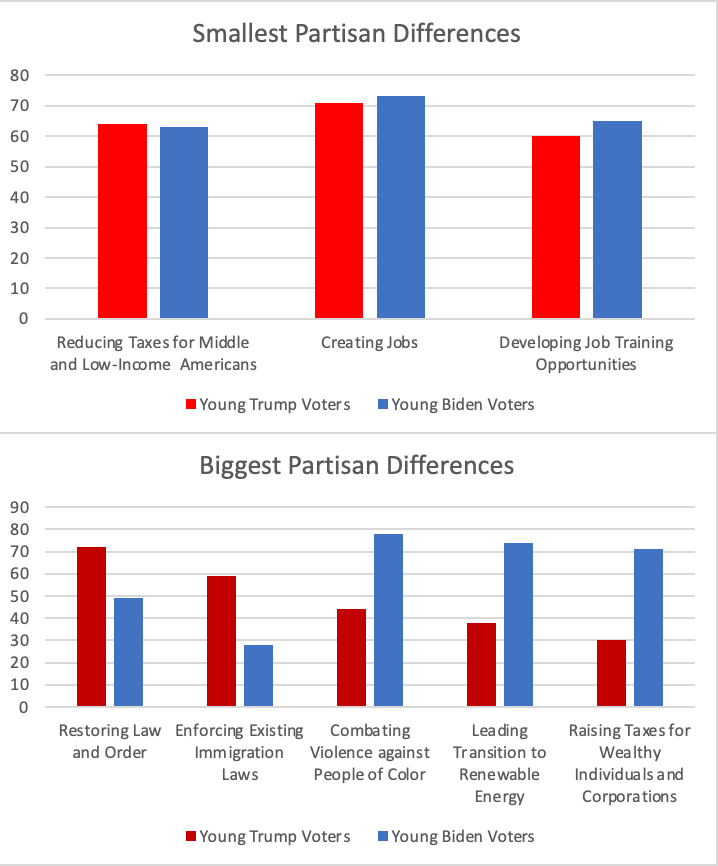
I was interested in the differences and similarities between young people who supported Trump and Biden (the latter being much more numerous). As shown below, they are indistinguishable on some economic issues. They differ a lot on “law and order,” immigration, racist violence, climate, and taxing the rich. However, it’s worth noting that 44% of young Trump voters favor reducing violence against people of color and more than a third want to move to renewable energy.
Hypothesis: People not only hold opinions about parties and specific issues; they also explicitly connect their various beliefs together to create more-or-less coherent logical structures. Understanding these structures yields insights about individuals that we would miss if we only knew a list of their opinions.
This thesis challenges a common assumption in political and moral psychology. Although scholars meticulously analyze the structure of the arguments in books, essays, and speeches, several streams of research suggest that ordinary people have no such structures–their political preferences are random, or chosen by elites, or driven by latent variables of which they are unconscious. I think that we won’t find the conscious structure in average people’s thinking unless we develop tools that can detect it.
Looking at some individuals
To that end, last summer I collected data from 100 Amazon Turk participants. I restricted the sample to liberal residents of the USA, in order to control the range of issues that would appeal to them so that I could analyze the small dataset effectively.
I showed each person a list of 30 ideas they might favor, about half of which leaned left. I simply asked, “Which of these would you like to see happen?” and encouraged them to be selective. Consistent with my effort to recruit liberals, they chose almost exclusively liberal items. For instance, 80% chose “health insurance for all” and zero chose “a return to traditional values.”*
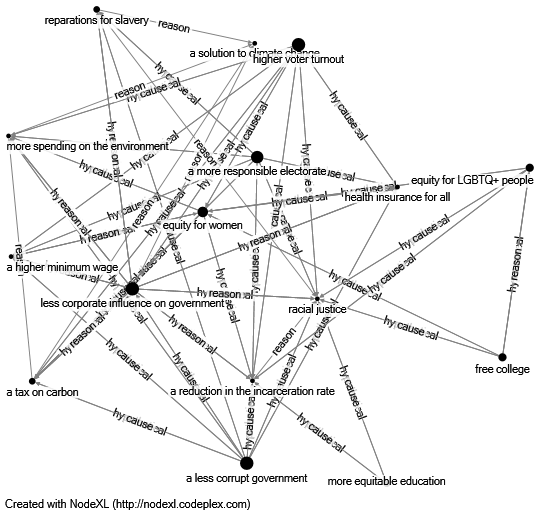
After subjecting respondents to a bit of explanation and training, I showed them their own chosen items in pairs (in random order). For each pair, I asked, “Are you in favor of X because you are in favor of Y?” Each time they said yes, that created a link between two nodes (or an edge between two vertices, if you prefer the technical language). From these responses, I was able to generate network maps for each person and for groups.
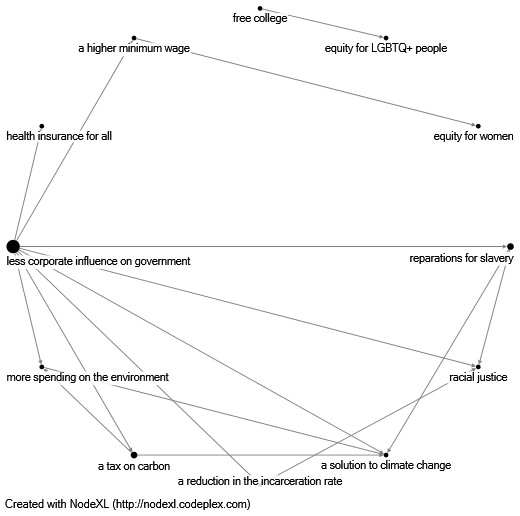
Here is one such map. This person is a white man, age 32. He places himself as far as possible to the left on a unidimensional ideology scale and he says that he agrees with AOC most often, followed by Bernie, then Warren, then Obama, and finally, Biden. He believes that eight things that he would like to see happen (e.g., health insurance for all) provide reasons to reduce corporate influence on government. He also sees an indirect link between reducing corporate influence and racial justice (by way of reducing incarceration) and an indirect link to the environment (by way of enabling a tax on carbon). However, he doesn’t connect political reform to free college or LGBTQ+ issues, although he cares about those issues and connects them.
In short, his network is highly centralized around reducing corporate influence. This seems like an important fact about how he thinks.
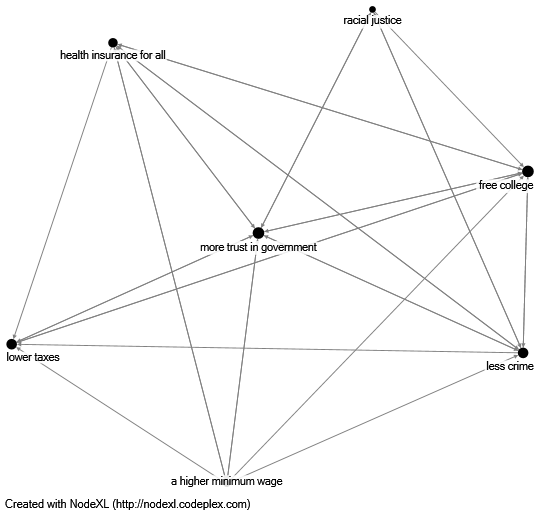
Below is another map, this time for a white woman, age 30, who ranks the Democratic politicians in precisely the opposite order as the man did (Biden first; OAC last). However, she ranks herself as a one on a 0-10 ideology scale, i.e., very liberal.
Her graph is more complex than the man’s. She is 3.6 times more likely than he was to see any given pair of ideas as a connection. Two-thirds of her arrows are double-headed. (She favors less crime because she favors more trust in government, and vice-versa.) You can move around her graph from one item to the next, and then onward. It is not centralized around any single node.
As noted, I first asked respondents whether each of their goals provided a reason for another goal. It was up to them what counted as a “reason.” I believe, however, that we can put ideas together in numerous ways, with a range of logical connectors. A justification is one link; a cause is another.
Therefore, I next showed respondents pairs of outcomes and asked whether each one would cause the other one. I included outcomes that they had not selected in the first place, because you might not select something as a high value even though it causes an outcome that you do value highly.
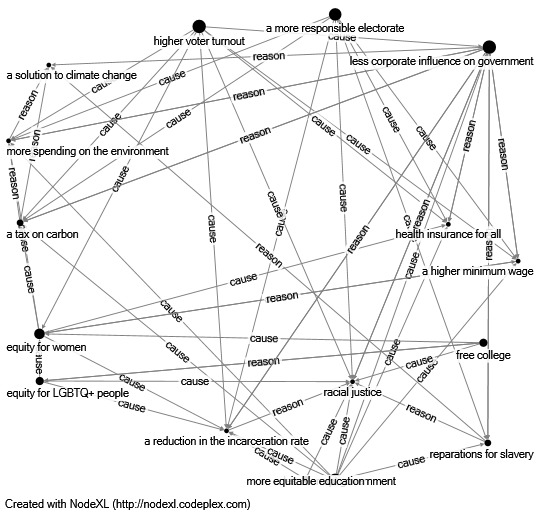
Here is the first respondent’s map with the causal connections added in:
It becomes complicated–perhaps too complicated to understand visually. But it’s clear that he believes higher voter turnout and a more responsible electorate are “upstream” factors–they cause many desirable outcomes–even though he did not initially choose them as his priorities. It makes sense to me that they are means to the ends he favors.
Finally, I showed respondents random pairs of items and asked, “Imagine x happened. Would that change your opinion by making you more supportive of y?” This produced another kind of connection (hypotheticals), which I can add to the first respondent’s map along with the causes and reasons:
Metrics suggest that this addition doesn’t actually change this person’s map very much, although it adds a few ideas at the end of arrows.
An example: the role of reparations in the mentality of the left
Months ago, I hypothesized that reparations for slavery play an important role in the thinking of left-liberal Americans. Progressives oscillate between hostility to the US government and desire to expand federal economic action. If the government paid reparations, progressives would trust it more and would therefore tilt to democratic socialism.
I can identify some individuals who may exhibit this logic. For instance, here is a 40-year-old white woman who favors a set of progressive outcomes and sees all of them as reasons to reduce corporate power over government (rather like the first man discussed earlier):
She did not select reparations as one of her original priorities, but she was asked whether actually seeing reparations happen in the world would make her more favorable toward other outcomes. She said it would make her more supportive of 10 things, including trust in government and civility. One can imagine that she thinks: if the government paid reparations, I would want people to trust it and would want citizens to be civil to each other, because the regime would be more legitimate. However, this is largely my inference about her responses, and it’s not a common pattern in the data.
These are three examples from the 100 cases that I collected. I have many more to look at, and I have IRB permission to interview selected respondents about their reasoning.
Aggregate results
I am also interested in examining the aggregate data. One evident finding is that people’s top priorities for how they would like to see the world change are not the same as the factors they see as most influential.
In my sample, the most frequently chosen goals are:
health insurance for all
a solution to climate change
a higher minimum wage
racial justice
more school choice
The items that are seen as having the most direct effects on other items are:
health insurance for all
a less corrupt government
less corporate influence on government
a more responsible electorate
more equitable education
And the items that have the most links of any kind to other items are:
health insurance for all
a less corrupt government
racial justice
more trust in government
economic growth
Healthcare hangs in there as the top priority however you slice it. However, better government and economic growth–which are not chosen as high priorities from a simple list–emerge when people think about various kinds of premises or causes for the things they do value.
Another method would be to measure the relationships between people’s networks of ideas and a different variable of interest. I was planning to look at self-placement on an ideological scale, but my sample clusters together too closely. Seventy-four percent rate themselves between 0 and 2 on a 0-10 scale.
Instead, I am using as the dependent variable how people rank AOC compared to other Democratic politicians. I chose that outcome because her ranking correlates most strongly with ideological placement, and also because the biggest negative correlation in the whole matrix is between her rankings and Joe Biden’s (-0.67). Plus, her rankings have a nice distribution: the median is 3 on a 1-5 scale. So I take her strong supporters and opponents to mark the ends of a meaningful spectrum within the US left.
If we simply correlate the priorities that people choose (or don’t choose) with their rankings of AOC, then the correlations that are significant are:
more school choice and racial justice (which were chosen by identical people*)
equity for LGBTQ+ people
(not choosing) economic growth
(not choosing) less crime
(not choosing) a reduction in government debt
These correlations make intuitive sense to me. Among liberals, those who care less about crime, deficits, and growth would like OAC best.
If you put all the choices together with the demographics and ideology in one linear regression model to predict support for OAC, it does a decent job (r-squared = 0.488).** However, none of the individual items (including ideology) are statistically significant. One could conclude that knowing which items people pick helps you to predict their opinion of AOC, but you need to know most of the items.
If, instead, you look at which items people thought were reasons for other items, the model is more predictive (r-squared = .608 with the same number of variables) and ten items become stat. sig. on their own (p <.05). Knowing that an individual sees one of these items as a reason for other items gives a basis to predict that this same individual likes (or dislikes) AOC.
That seems like confirmation of my original hypothesis. The structure of people’s beliefs–more than the things they support–predicts a consequential opinion. However, I am still working on the regression and other aggregate methods; suggestions are welcome.
YouGov reports: “One in five voters – including 45% of Republicans – approve of the storming of the Capitol building.” This is important and bad news. I do not want to minimize it, but I would put it in context.
A bit under half of Republicans support the riot in DC. Republicans represent about 29% of registered voters. Registered voters represent about two-thirds of adults. Adults represent about three-quarters of Americans. By the time you isolate Republican registered voters who support the riot, it’s down to about 6.6% of the population.
To be sure, some of the people in the other pie slices are also part of the problem. For instance, within the “other” slice are 2% of the registered Democrats and 21% of the registered Independents who support the riot. (A total of 10.1% of all Americans support the storming.) Most of that slice consists of people who don’t have an opinion, which is a problem in itself. And among the under-18s and the non-registered people, some probably hold views aligned with Trump.
Still, it is worth putting the hard-core problem in some degree of perspective. My guess is that the images from yesterday will basically become the capsule summary of the Trump years, except for a smallish and dwindling proportion of Americans.
(Survey data from YouGov. Registration percentages from Pew, 2018. Age distribution from Census, 2010.)
Good afternoon, friends. This post is simply a compilation of resources that can be used to teach about concepts, ideas, actions, or anything else connected to the events of 06 January 2021. We will add to these over time.
The SNF Agora Institute at Johns Hopkins University has published three cases about the choices and dilemmas that confront groups of people who strive to make social change. These are like business-school cases: they are factual narratives that conclude with moments of choice that are meant to be discussed in groups, whether in high school, college, or in movements and organizations.
I am proud to have played a role in the project from the start. We felt that cases are really useful for teaching and professional development, but most actual cases provided by business schools, schools of public policy, and wonderful initiatives like The Pluralism Project and Justice in Schools focus on individual protagonists. We were interested in voluntary groups that must deliberate before they can choose. David Moss’s excellent Case Method Project does some of what we intended, but its focus is on high schools and American history, whereas we wanted to serve social movements with some current examples.
These are free, and we would love to know how they work in various settings.
What objectives, targets, strategies, demands, and rhetoric should a nascent social movement choose as it confronts an entrenched system of white supremacy? How should it make decisions?
The Montgomery, Alabama, Bus Boycott of 1955–1956 is a classic example of a social movement episode that accomplished its immediate goals despite severe obstacles. It catapulted the 26-year-old Rev. Martin Luther King Jr. into international prominence and launched similar episodes in many American cities across the South and then also the North. By investigating their situation and choices, you can develop skills and insights to use as activists today.
Should a faith-based organization take on an issue not of its choosing? Can relational organizing help its leadership support a new mayor while also engaging their base and holding their coalition together?
This is a case study about an organization in Minnesota called ISAIAH, a faith-based organization that works to expand the power and influence of people who have often been overlooked, especially poor people and people of color.
This case examines what happened when, to support a new mayor with whom the organization wanted to work, ISAIAH became involved in a divisive issue—not of its own choosing—that revolved around garbage. ISAIAH faced at least three choices: 1) stay out of the fight over garbage; 2) use mobilizing techniques to help the mayor win the garbage issue; or 3) use relational organizing to enter into a power relationship with the mayor in the garbage fight—even though most of the people in ISAIAH’s networks didn’t care much about the issue.
Can faith-based organizers garner enough support to win universal preschool in a racially divided city? How should a grassroots group manage a disagreement with its own powerful coalition partners?
This case study is about the AMOS Project, an organization in Cincinnati, Ohio, and its grassroots efforts to pass legislation that would provide preschool education for most of the city’s children. AMOS’s grassroots efforts increased the political pressure to pay for the program, but at one point, the whole effort seemed likely to fall apart. How could a grassroots network of congregations manage a disagreement with allies in the business community and achieve its goals?
Below is an excerpt from a new article of mine in a special issue of The Bridge on “complex unifiable systems.” The Bridge is a quarterly journal of the National Academy of Engineering. The article and the whole special issue are available free. Several other contributions may also be interesting to civic and political people. I would cite this piece as: Peter Levine, “The Complexity of Civic Life,” The Bridge, vol. 50, no. 4 (Winter 2020), pp. 34-6
Imagine that some college students have volunteered to serve meals at a homeless shelter. They love the experience because they are helping others. During the reflection session after the meal, one student remarks, “Serving the homeless was so great! I hope this shelter will still be open 50 years from now so that my grandchildren can also serve here.”
The progressive educator who has organized this experience is horrified and says, “No! Our goal must be to end homelessness. You must think about root causes, not treat the most superficial symptoms. What are the fundamental causes of homelessness?”
Chastened, the students debate the root causes. Some argue that homelessness results from poverty, which, in turn, is a byproduct of capitalism. Others counter that the root cause is the cost of real estate, which is inflated by -zoning laws. They are deep into a discussion of capitalism and the state when the Brazilian legal theorist and former cabinet minister Roberto Mangabeira Unger happens to walk by.
“Stop this!” cries Unger. “You are looking for fixed, simple, law-like causal relationships. We human beings have made the social world. What we have made, we can also change—not just the components, but also the many ways they fit together and affect each other.”
Unger (who is famous for long speeches) continues, “By looking for root causes, you are limiting your imaginations, assuming that the only important changes are the hardest ones to accomplish. Be more creative. What if we got rid of all zoning and rent control but also gave everyone a voucher for free rent? What if public buildings were retrofitted to allow people to sleep comfortably in them at night? What if houses were shared, and homeless people occupied the temporarily empty ones? What if…?”
The Myth of the Root Cause
I have invented this fable and Unger’s words, but I am paraphrasing portions of his False Necessity (2004) to support a serious point.
A rootcause is a metaphor. The root is literally the vital part of a plant that is hidden from sight; digging it up will kill the whole organism. The word radical derives from the Latin word for root. The educator in my fable thinks he is radical because he directs his students to the deepest, least visible, and least tractable aspect of the problem, assuming that attacking a root is the way to a permanent solution.
But a social problem rarely has one root cause or leverage point. Many factors combine to determine results. The same variables that are outcomes are also inputs or causes. Virtuous and vicious circles and feedback loops are common phenomena that illustrate a broader point: any society is a complex network of causes and effects. Interventions are possible at multiple points.
Strategies and Skills for Networks of Causes
Like a root, a network is a metaphor (or mental model) for describing reality, but the difference is important. To improve a society viewed as a complex network requires particular skills and strategies—not those favored by would-be “radicals” who insist on focusing only on “the root.”
First, strategies should be tailored to an individual’s or organization’s location in the network. Management scholar Alnoor Ebrahim (2019) argues that organizations differ in how reliably they can predict outcomes in a system as a whole. They also differ in how much control they can exercise over their portions of the system.
These are two distinct dimensions. With low control but the ability to make reliable causal predictions, a wise strategy may be to identify a specific niche where the organization can operate effectively. …
It’s a bit odd that land reform is barely mentioned in most progressive agendas. Maybe that's because it is seen as challenging the presumed virtues of private property and capitalist markets. Yet secure access and tenure to land is essential for achieving so many progressive goals, from building new sorts of regional food systems to providing affordable housing and enabling local self-determination and personal well-being.
Severine von Tscharner Fleming put it well in the latest episode (#10) of my podcast Frontiers of Commoning: “At the root of peace is sufficiency and wholeness, and that means people having their needs met, people being fed. And that sufficiency and wholeness can be achieved only through a certain level of sovereignty over land and self-determination that is rooted in land.”
Severine is a young organic farmer, activist and organizer based in Maine who has had a remarkably productive career as an advocate for young farmers and land reform. She helped start Agrarian Trust, an organization dedicated to supporting land access for the next generation of farmers. In recent years, Agrarian Trust has started ten Agrarian Commons in the US, in an attempt to make community-supported, collectively stewarded farmland available to younger farmers. As the project notes: “With 400 million acres of land in the U.S. expected to change hands over the next two decades, the time for transformation in land ownership is now.”
Agrarian Trust is just one of many new ventures that Severine has helped set in motion. She also played a key role in starting Greenhorns, a grassroots cultural organization that produces a literary journal, radio show, blog, and other media for young farmers. She helped launch Farm Hack, a project that designs and builds farm equipment using open source principles.
More recently, Fleming pulled together Seaweed Commons, a network of people concerned about seaweed aquaculture and intertidal commoning. The project is focused on improving “the ecological literacy of stakeholders in the marine economy.” The challenge includes preventing toxic algae blooms, capturing the runoff of nutrients from salmon pens around the world, and ensuring ethical, environmentally responsible cultivation of seaweed for biofuels and aquaculture.
As you might imagine, Severine is a ball of creative energy and passionate commitment, precisely the traits needed to engage in and promote commoning. I find her work so inspiring because she has learned to fly by leaping off cliffs and flapping her wings. You develop different sorts of muscles that way!
Ian McSweeney, the organizational director of Agrarian Trust, also joined me in the podcast interview. Ian works from his farm and forest in New Hampshire, and thinks a lot about how to protect land from development, how to transfer it to new generations of farmers and ranchers, and how to assure that they have secure land tenure.
Ian talked in greater depth and detail about Agrarian Trust’s efforts to acquire land and steward it as commons. Ian comes to this challenge after years of work with the gritty complications of land tenure and conservation, and in trying to build new types of local food systems that are regenerative, diversified, and community-minded.
A big part of this challenge is finding ways to take land off the market and decommodify it. McSweeney explained: “We decommodify land by moving it out of private ownership into community-centered, nonprofit ownership. And then we restrict that land from being sold on the open market ever again. We also restrict the land from taking on debt beyond a 20% cap of the property’s value. We don’t want to put that land at risk.”
Fleming added that the pandemic is “intensifying the market pressures on land, especially in towns around cities. This has been a year when farmlands and farm properties have been sold within hours of being listed at prices far above what would normally be justified by farmland.”
“As farms are being gobbled up and sliced-and-diced into lifestyle properties and private sanctuaries, it becomes clear that the valley floor has only so much ag land. So if we want the farm, we need to save the farm. We have the re-negotiate the terms under which our land is being managed and do it in a way that is more holistic and meets the needs of present and future generations.”
Listen to the rest of the interview, including discussion of Greenhorns, Farm Hack network, and Seaweed Commons, here.