Restoring Opportunity: Perils and Promises for Education
Reply

As I’ve waded through the literature on deliberative theory, I’ve been struck by two disparate schools of thought: some authors focus their attention on political deliberation while others focus on moral deliberation.
The difference in focus is not trivial. Consider Amy Gutmann and Dennis Thompson’s explanation of where deliberation thrives:
In politics, disagreements often run deep. If they did not, there would be no need for argument. But if they ran too deep, there would be no point in argument. Deliberative disagreements lie in the depths between simple misunderstanding and immutable irreconcilability.
Gutmann and Thompson do write extensively about moral deliberation, but this passage hints at incentive for avoiding moral discussion in politics: moral disagreements seem more intractable.
Two people of opposing beliefs may never find common moral ground on an issue, but that doesn’t neccessarily preclude the possibility of reasonable having productive political debate on an issue.
To what extent, though, is it possible to disentangle moral and political interests?
On the topic of abortion, for example, even if people tried to restrict their comments to the political issues of funding and access, I suspect that most dialogues would still find their way to a fundamental, moral impasse.
Perhaps not all issues are so morally charged, though – in discussions of education, healthcare, and the environment are morality and politics so inseperable? Either way, I’m actually more interested in the related question: in general, should morality and politics be so intertwined?
Our political sensibilities seem to say no – as good citizens, we ought to have rousing debates over politics while also embracing the pluralistic nature of our fellow citizens’ views.
Yet separating morality from politics seems undesirable, even if it were possible. Discussing the environment without discussing environmental justice is inauthentic and unproductive. Discussing education without tackling the moral issues raised by deep, educational inequality fails to get to the heart of the mater.
The personal is indeed political and the political is fundamentally moral.
This brings me back to the excellent work of Diana Mutz in Hearing the Other Side.
Mutz illustrates an inherent tension in political theory: should a citizen’s social network be composed of people who are “politically like-minded or have opposing views?” While the ideals of political theory seems to indicate that the answer should be “both,” Mutz shows that this is not possible.
We must choose, she argues, between a homogenous network of people who agree politically or a heterogenous network of people who are apolitical:
A highly politicized mindset of “us” versus “them” is easy so long as we do not work with “them” and our kids do not play with their kids. But how do we maintain this same favor and political drive against “them” when we carpool together?
Her analysis is compelling, but I find myself fighting against believing it. I don’t want to think that political agency requires self-sorting into like minded groups and I don’t want to think that political action is impossible in heterogenous groups.
One thing I struggled with as I read her work is exactly what it means to be “like-minded.” I have many productive debates with my equally liberal friends. We agree – but we don’t agree. Does that that make us like-minded?
This idea of political “difference” here can perhaps be better understood as one of different moral views. That is, we can have productive political debate among people of different views, as long as they are morally “like-minded.”
Again, this may provide incentive for avoiding moral debate – just as Mutz demonstrates that social interaction across political difference must be apolitical. That would be a depressing conclusion – although, perhaps, an inevitable one.
But if taking morality out of politics lessens the value of political dialogue, we must find some way overcoming that challenge. Or, at least, as Mutz argues, we must greatly rethink our ideals of deliberation.


At the Clinton School for Public Service, on Monday, October 19, 2015 at noon.
I am so grateful for two lovely introductions, one from Dean Skip Rutherford of the Clinton School and a former student of mine studying there, Rob Pillow. This video includes only the talk and Q&A. If I can get their intros, I’ll post them too. The Clinton School folks are excellent at what they do and were wonderful hosts. Here’s the video of my book talk:
You can find the video on the Clinton School’s speakers site here.
If you’re interested in inviting me to speak with your group, visit my Speaking and Contacts pages.
(Washington, DC) This graph shows two trends: the number of US citizens between the ages of 18 and 29, and the number of 18-29s who voted.
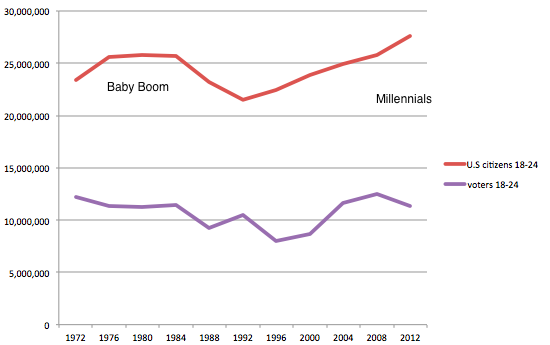
The number of young voters fell from 122 million 1972 to 114 million in 2012, despite an increase of about four million in the number of eligible citizens under 30. That means that young voters had considerably less clout in 2012 than in 1972. They cast 24% of all votes in 1972 but 19% in 2012.
On the other hand, the comparison would look better if one set 1976 against 2008, because the latter was a stronger year for youth turnout. In 2008, the size of the youth population also surpassed the previous highs of the 1970s, producing record numbers of youth and of young voters. But the youth share was still smaller in 2008 (at 16%) then in had been in the 1970s, because of rapid growth in older generations. And then 2012 saw a fall in turnout.
Our friends with the Participatory Budgeting Project – an NCDD member organization – recently announced that Palo Alto College will become the nation’s first community college to open a participatory budgeting process to students in Spring 2016. More young people being exposed to this powerful form of D&D is great news for our field and for the students themselves, and we commend PAC on taking this step! Learn more in PB’s post below or find the original here.
 We’re excited to share that Palo Alto College, a community college in San Antonio, is expanding its participatory budgeting process. Representatives from Palo Alto came to our conference in 2013 and were so inspired that they started a PB process for faculty and staff – the first at a community college in the US. In 2015, they’re opening the process us to students. With a budget of $25,000, the top projects will come to fruition in Spring 2016.
See below for an update from PAC’s blog on the first community college PB process in the US!
– — –
Palo Alto College students now have the opportunity to propose and vote on how institutional funds are used due to a worldwide project called Participatory Budgeting. Participatory Budgeting is a different way to manage public funds by engaging stakeholders to collaborate and decide how to spend public funds.
“Participatory Budgeting (PB) means a very simple way of showing transparency on how we spend our money, “ said Carmen Velasquez, PAC Participatory Budgeting Core Team Member.
PB started at Palo Alto College in 2013 with groups of faculty and staff. Since then, faculty and staff members have been able to work together to submit project ideas with budgets up to $5,000. Walking around campus, visitors can see the PB process firsthand, such as the Ray Ellison Center bike trail, Palomino Patio near Concho Hall, which were among the handful of projects proposed and voted by faculty and staff.
Now in its fourth cycle, the program has expanded and will now be available for student submissions starting in Fall 2015. A total of $25,000 has been set aside specifically for students to propose and turn ideas into action.
“What we are looking for are projects that benefit the college as a whole,” said Anthony Perez, Participatory Budgeting Core Team Member.
PAC sophomore Robert James Casillas said, “It will be cool to see something on campus and say ‘that was me, my idea or I had a say in that.’”
All PAC students currently enrolled will be allowed to take part in the voting process in the Fall 2015 semester, and the projects with the most votes will be funded and implemented in Spring 2016. However, only student groups and organizations will be able to propose and submit ideas this year.
Currently, Palo Alto College is the only community college in the United States taking part in the Participatory Budgeting process.
“I am really excited to see what the students come up with, I know they are going to be very creative,” said Velasquez.
For more information about Student Participatory Budgeting visit Student Life at Palo Alto College in Student Center Room 124 or call 210-486-3125.
You can find the original version of this PBP blog post at www.participatorybudgeting.org/blog/participatory-budgeting-for-community-colleges-palo-alto-college-in-san-antonio.
The 230-page book, Leading Great Meetings: How to Structure Yours for Success, by Dr. Richard Lent was published June 2015. This book discusses how providing structure to meetings can help to create more productive meetings and offers 32 tools to conduct better meetings.
More about the book…
 Recent advances in helping groups talk together to provide new ways to run effective meetings naturally…a structural approach. All meetings come with structures that affect how we behave in them. Structure includes how leaders frame a task, include different views, support dialogue, manage time, and reach decisions. In most meetings, this structure goes unconsidered and unseen, but it still has a powerful impact.
Leading Great Meetings: How to Structure Yours for Success, is designed to help leaders use structure to create more productive meetings. It provides 12 choices and 32 tools to plan and conduct a wide range of meetings from team meetings to board meetings. You can select from the choices and tools, the ones relevant to your situation. There also are stories, examples, even “blueprints,” so you can see how a structural approach works in action.
To see structure at work, consider the number of participants in a recent meeting. If there were more than 7 or 8 participants, then the chances are very good that some participants did not stay engaged. This is the effect of the structures in place when larger groups try to hold one conversation. Fortunately, there are simple processes (“tools”) that you can use to keep all engaged. This book shows you how. Other structures include how the task is framed, who attends, hierarchy, room arrangements, approach to discussions and decisions and many more.
Using the right meeting structure enables people to talk together more effectively without having to remember how to behave. Most recommendations for better meetings emphasize adopting rules or changing behavior. But when discussions get heated, people ignore the rules and good behavior is hard to maintain. Structure can create a naturally productive meeting. For more information go to http://amzn.to/1dZL67Q or visit www.meetingforresults.com.
About Dr. Richard Lent
Dr. Richard Lent has spent the last 20 years designing, facilitating and coaching leaders on more effective meetings. He facilitates meetings around the world in business, non-profit organizations and communities. Some of the organizations with which he has worked include the World Food Programme, UNICEF, Logitech, the WK Kellogg Foundation, Johnson & Johnson, and the International Red Cross. He received his Ph.D. from Syracuse University in Instructional Design, Development and Evaluation. He can be contacted at rick[at]meetingforresults.com.
Resource Link: www.meetingforresults.com
I am very excited that Northeastern is hosting a series of lectures by Cris Moore of the Santa Fe Institute. Moore has his background in physics, but he has also distinguished himself in the fields of mathematics, computer science, and network science.
Basically, he knows pretty much everything.
He began his lecture series yesterday with a talk on “computational complexity and landscapes.” Exploring qualitative differences between different types of algorithms, he essentially sought to answer the question: why are some problems “hard”?
Of course, “hard” is a relative term. In computer science, the word has a very specific meaning which requires some history to explain.
In 1971, Stephen Cook posed a question which remains open in computer science today: if a solution to a problem can be (quickly) verified by a computer can that problem also be (quickly) solved by a computer?
This question naturally sorts problems into two categories: those that can be solved in polynomial time (P) and those for which an answer can be can be checked in polynomial time (NP for ” nondeterministic polynomial time”).
Consider the famous Bridges of Königsberg problem. Euler, living in Königsberg in 1736, wanted to find a path that would allow him to cross each of the city’s bridges exactly once without ever crossing the same bridge twice.
Now you may start to appreciate the difference between finding a solution and checking a solution. Given a map of Königsberg, you might try a path and then try another path. If you find that neither of these paths work, you have accomplished exactly nothing: you still don’t have a solution but neither have you proven that none exists.
Only if you spent all day trying each and every possibility would you know for certain if a solution existed.
Now that is hard.
If, on the other hand, you were equipped with both a map of Königsberg and a Marauder’s map indicating the perfect route, it would be relatively easy to verify that you’d been handed a perfect solution. Once you have the right route it is easy to show that it works.
Of course, if the story were that simple, “P versus NP” wouldn’t have remained an open problem in computer science for forty years. Euler famously solved the Bridges of Königsberg problem without using the exhaustive technique described above. Instead, in a proof that laid the foundations of network science, Euler reduced the problem to one of vertices and edges. Since the connected path that he was looking for requires that you both enter and leave a land mass, an odd number of bridges meeting in one place poses problems. Eventually you will get stuck.
In this way, Euler was able to prove that there was no such path without having to try every possible solution. In computer science terms, we was able to solve it in polynomial time.
This is the fundamental challenge of the P versus NP dilemma: a problem which initially appears to be “NP” may be reducible to something that is simply “P.”
There are many problems which have not been successfully reduced, and there’s good reason to think that they never will be. But, of course, this is the typical NP problem: you can’t prove all NP problems can’t be reduced until you exhaust all of them.
As Cris Moore said, “the sky would fall” if it turned out that all NP problems are reducible to P.
To get a sense of the repercussions of such a discovery: a problem is defined as NP-hard if it is “at least as hard as the hardest problems in NP.” That is, other NP problems can be reduced, in polynomial time, to NP-hard problems.
That is to say, if you found a quick solution to an NP-hard problem it could also be applied as a quick solution to every NP problem. Thousands of problems which currently require exhaustive permutations to solve could suddenly be solved in polynomial time.
The sky would fall indeed.
His lecture series will continue on Thursdays through November 12.

Omri Boehm has written a troubling op-ed in the Stone summarizing the failure of human rights discourses to actuate political institutions, entitled “Can Refugees Have Human Rights?” Boehm worries the answer is “No.” Citing the most famous lines from Hannah Arendt’s discussion of refugees ( “If we should start telling the truth that we are nothing but Jews, it would mean that we expose ourselves to the fate of human beings who … are nothing but human beings.”) Boehm diagnoses a failure of modernity to find a metaphysical grounding for human rights, and suggests that this metaphysical failure is the blame for the institutional failure to protect refugees:
The truth is that we have never managed to vouch for human rights in sensible modern terms. One common strategy has been to appeal to nature rather than to God — on this view, human beings have inalienable natural rights — but in order to accept this alternative one must ascribe to nature qualities that science tells us it doesn’t have. […]
Modern political thinkers can meaningfully speak of the state as an instrument for defending the interests of its citizens. When they speak of the state as defending justice, or universal human rights, they are missing the necessary concepts.
This is a common refrain, and indeed it seems to have motivated more than its fair share of philosophical articles and monographs arguing for a return to metaphysical foundations long since rejected. But as I read Boehm, he does not mean to call for such a return. Rather, the failure of political theory in this regard has led to the failure of rhetoric and action. Indeed Boehm seems to regret that these categories can find no purchase among human beings who understand themselves to be the result of evolution, that there is no political theology worthy of the grand gestures of institutional inclusion declared as universal human rights. Call this tragic naturalism: after millennia of supernatural universalism, we can no longer delude ourselves. But we’ll probably always pine for the good old days.
Responding to Boehm, Eric Schliesser argues that the human rights tradition has offered itself as an alternative to democratic politics, calling human rights “political conversation stoppers.” He goes on to explain:
“Once they are invoked matters of principle are settled, and put aside, and all that remains is the technocratic discussion of solving the means by which to implement them. That is, while we often claim that rights generate duties, politically they are designed to generate obedience.”
On Schliessers’ view, human rights (unlike ordinary political rights) are meant to be uncontestable barriers to further inquiry; we must not quibble about slavery or bodily inviolability, but instead get busy abolishing slavery and securing bodily inviolability. Whereas ordinary political rights are constantly the subject of contestation and no entitlement is absolute.
This seems wrong to me. On my view, human rights aren’t political conversation stoppers, they’re a prerequisite for certain kinds of political conversations at all. Indeed, human rights are so foundational to certain kinds of political conversations that many people lay claim to them even where they don’t exist so as to begin or continue a difficult political conversation.
Let’s return to Arendt for a moment: in her analysis of the origins of totalitarianism, she spots a fervor for nation-states the was supported in part by the conviction that “people without their own national government were deprived of human rights.” If the only would-be “human” rights that exist are actually national rights, justiciable in one or another courtroom, then every human being needs a nation-state to protect her. “Human” rights sound nice, but they’re not the sorts of things that a lawyer can win a case on, and when you’re fighting the political head-winds of populist anti-migrant rhetoric, you need the courts.
So human rights are metaphysically ungrounded and politically ineffective. Too often we’re only able to give them salience retrospectively, in the context of historical genocide. Worst of all, just where you need them most, like when you belong to a group that has lost its political power–and must seek recognition for your vulnerability and powerlessness–you will find that no one is listening.
Now, it’s not at all clear why philosophers bemoan the metaphysics in situations like this. No one believes that the lack of a metaphysical ground is causing the political inefficacy of human rights. In the hypothetical world where a God exists to supply normative justification for a divine moral law that demands refugees be fed, sheltered, and protected, we would still have a Syrian refugee crisis. We would still have collective action problems, and states trying to avoid their fair share of supporting their burden of stateless persons, and budget limitations, and the fundamental fact that we only half-heartedly want to do the thing God demands. “Make me a humanitarian, Lord, but not yet! (And not before you make my economic competitors humanitarians, too.)” And we would still have difficulty determining which rights God intended to write into the structure of reality and who was charged to protect them.
Meanwhile, tragic naturalism may have some glimmers of hope. For one thing, it draws our attention to the ways in which many rights-claims start off ungrounded and develop institutional and political efficacy over time and through effort. The rights-claims in the Declaration of Independence are rhetorically grounded by God’s creation, certainly, but they were just as obviously not rights that any group of Christians has been able to find the normative purchase on previously.
It has become common, then, to point out that most rights-claims are self-founding. It’s the rights-claim that grounds the right. Of course, this suggests that human rights-claims are not actually universal or human rights but instead political rights-claims that seek to sidestep the claimant’s lack of the appropriate codified legal status. But it’s not clear why we’d reach for politics (and its “rights of citizens”) in those instances, since most who require the protection of a scheme of universal human rights are equally well barred from political participation.
Ayten Gündoğdu gives an excellent account of this in her recent book Rightlessness in an Age of Rights. Human rights have always had an aspirational quality, as we have seen among the Sans Papier movement in France where those designated economic migrants (and thus ineligible for refugee-status) continue to demand documentation and regularization. The movement has all the signs of a successful set of ungrounded rights: it is a political movement whose very existence assumes the capacity to engage in politics is not simply a matter for citizens. It is an illegitimate demand that seeks to legitimate itself and the demanders. In this sense, human rights-claimants are always engaged in a kind of political foundation, creating the institutional basis for their own eventual juridical protection.
Of course, such efforts at political foundation often fail. This isn’t a triumphalist account of human rights, as if the problem was resolved in 1948 and need not be revisited. We shouldn’t ignore that the refugee who points to her own vulnerability to justify her rights-claims (while failing somehow to qualify as an asylum-seeker) currently lacks institutional grounding, and that the migrancy crisis will only grow: 232 million people belonged to that category in 2013, and an estimated 9 million Syrians have fled their home since the beginning of the crisis.
When stateless migrants interrupt previous metaphysical and institutional conceptions of human rights by making unrecognized human rights-claims, this interruption does not stop a democratic conversation but start one. If what we want out of human rights is a way to bend democratic polities to some “higher law,” we’ll be disappointed. There never was a real conflict between democracy and human rights, and this goes back to the reason naturalism seems tragic: we’re disillusioned because the story was better than reality could ever be. But there’s no tragedy if we treat human rights as an opportunity to exchange reasons (including ungrounded reasons!) with our fellow-citizens (documented and undocumented) and engage in powerful acts of institutional co-creation with our vulnerable neighbors.
At Tufts on Wednesday, Danielle Allen made the following argument: the war on drugs lowers the chance that the police will solve any given murder by flooding a city with drug-related homicides. Once the homicide closure rate falls, there is a low chance that anyone who commits a murder will be caught. Under those circumstances, if you think someone might shoot you, you “shoot first,” as Allen said.
Right on cue, the New York Times reports from Baltimore: “as more people are being killed here, fewer killers are being caught. The homicide ‘clearance rate,’ the percentage of killings solved by the police, was 45.5 percent last year; today it is 32.8 percent, the police said. Nationally, the rate was 64 percent in 2013, the most recent year for which the Justice Department has statistics.”
I also found this trend line for Chicago:
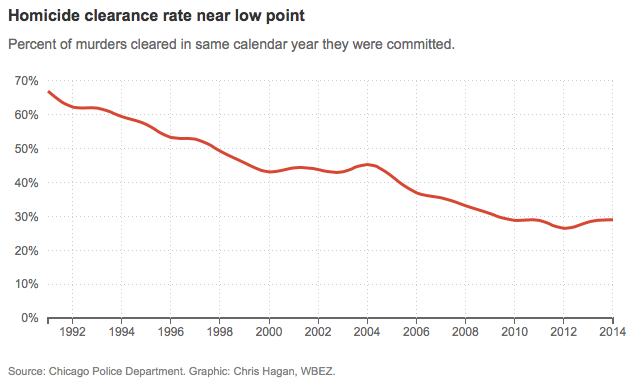
These are big declines. In 1992, if you committed homicide in Chicago, the odds were you were going to be prosecuted. In 2012-14, the odds were you would get away with it. That could plausibly change violence rates. If the police can’t protect you against murder, you may feel you have to do it yourself.
Two caveats, however. First, clearance rates are imperfect statistics, subject to being gamed by police departments. Second, even while homicide clearance rates were falling in Chicago, so were homicide rates. So that is not really evidence of a vicious cycle of declining clearance rate leading to growth in violence.
But despite those two caveats, there certainly seems to be a vicious cycle in the last few years in Baltimore and perhaps other big cities, and that is a really serious concern.
This morning, I had to call Jackson, MS. So, I dialed 9 to get an outside line, then hit 1. Actually, somehow — I don’t think I could repeat it, as I don’t know how I did it — I managed to hit the 1 button twice, as fast as a double-clicked mouse. I realized that I had made a mistake, so I hung up and redialed. It worked and I had to leave a message. No problem.
About 20 seconds after I hung up, I got a call from the University Police Department. I didn’t understand it at first, but I was asked about my 911 call. What? Suddenly, I realized that I had indeed, totally by accident, pressed those buttons, before I quickly hung up. I felt embarrassed for not even having realized what I had done. More importantly, I apologized to the dispatcher and to the two UPD officers who showed up at my door within about 45 more seconds.

Breathing like they had hurried, they kindly asked me if everything was alright. They didn’t for a second make me feel bad for having foolishly sounded an alarm. I was responsible for spiking at least three people’s adrenaline, though they looked quite calm. I felt my own adrenaline rise as I became aware of the magnitude of my dialing error. The fact that we need today to respond that fast to problems that arise on campuses around the United States rushed into my thoughts.

Beyond the violence that has occurred on campuses around the U.S., in Jackson and in Oxford protesters are calling for secession, threatening “to fight” if they can’t achieve their ends by political means. They complain of “Marxists” in politics and in education. They’re frightening and are reasons why now, of all times, we need all the more vigilance and prompt replies to 911 calls. I won’t be testing the system accidentally again, but I can testify to the impressive professionalism I witnessed from UPD.
I’m grateful to UPD, who revealed to me how well oiled their system is. I feel much safer on campus after that experience. I also plan to order a special dialing wand, like the one Homer Simpson needed, or at least to be infinitely more careful than I was this morning when I dial out.
I’m grateful to the three I spoke with for their generous understanding about my accidental dialing. I’m more grateful for their and the university’s serious and professional effort to be rapidly responsive when called upon. The next time I’m feeling cynical from witnessing people who seem not to care about others’ problems, I’m going to think about my experience today. The rest of us avoid danger, while some good, courageous people rush towards it for our safety.
For a little levity, Homer Simpson’s dialing problem:
