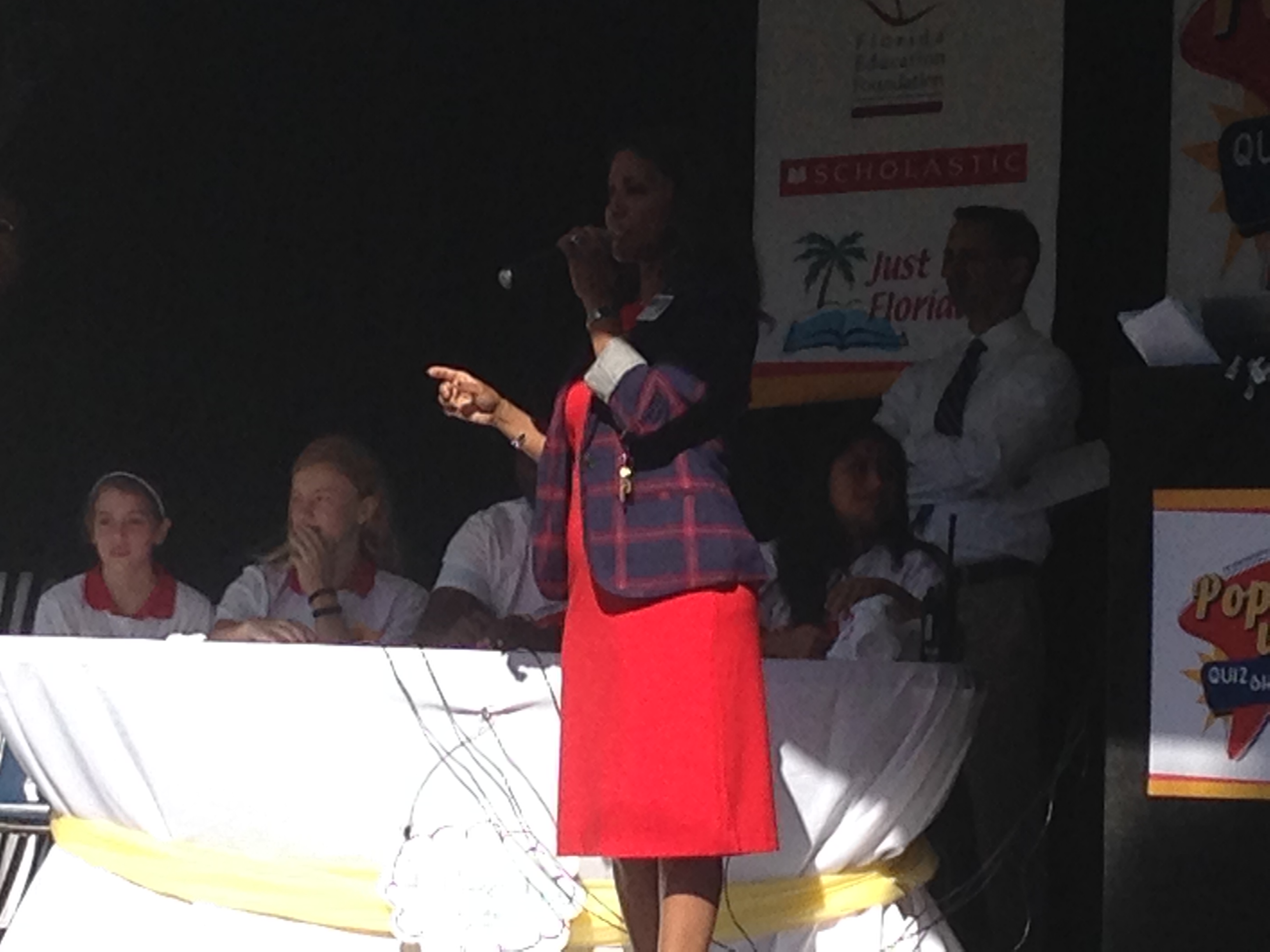
Just Read, Florida’s Civics Pop up Quiz Show

I had the distinct pleasure today to attend, at the invitation of one of the district social studies specialists (Tara Tillmanshofer, a fine leader!) the new JRF! Civics oriented pop up quiz game, which occurred at Lakeland Highlands Middle School in Polk County.
IMG_0100

Here, Hope Colle welcomes students to the show and reminds them of the importance of reading and of civics. Great point; you can’t be a completely engaged citizen without reading OR civics!

IMG_0103

The wonderful principal of the school, Ms. Kendrick, instructed the students on what to expect and how to behave during the show.

IMG_0101

One of the great civics teachers at the school, Mr. Winters, volunteered to be the emcee and read the questions to the students.

IMG_0107

The show consisted of two rounds, with two teams of four students each in each round. Here, we see Team Plead the Fifth and Team Phoenix as they get ready.

Round 1 Teams

The kids really did do a fantastic job with the quiz show. It was refreshing to see some strong level of knowledge relating to what were not necessarily easy questions. And thanks are due to the Florida Joint Center for Citizenship’s own Dr. Terri Fine for crafting the questions for the show! Check out these kids dropping some knowledge bombs, for example:

In the next round, Team Civicians and Team Roboboxers (hey, they are middle school kids!) clashed in an epic battle that came down to the final question!

So how did they select the players for the show? According to Mr. Winter, they actually held their own civics quiz bowl last week, and the top scorers across each class were asked to participate in the show. And the work and effort that these kids and their teachers put in to this is obvious. Kudos to everyone involved. I hope that we here at the FJCC can continue to assist our friends across the state in this sort of thing, and it is wonderful to see that great passion for civics reflected in the work of the schools, teachers, and students! If you have questions or comments, or want to know when the pop up quiz show might be coming near you, contact Hope Colle or Ashley Palelis. You can also just send me a note!


my political views in 10 minutes

Tufts has created and released this 10-minute video, based on a talk of mine. I found it a good exercise to write, memorize, and present everything that I hold most central for a general audience in that span of time. The presentation ranges from the individual networks of ideas that each of us brings into public life to strategies for enhancing civic engagement at the national level. It proposes a universal definition of good citizenship as well as a diagnostic account of our current condition in the US in 2015 and some suggestions for reforms. It’s my best shot at summarizing all of my life’s work so far (minus some thoughts about methodology in the human sciences and a critical argument about modernity that I have advanced in my books about Nietzsche and Dante). Of course, I have created none of this on my own but owe everything valuable to colleagues and collaborators.

Feminism and Nietzsche

It is no secret that Friedrich Nietzsche wrote a lot of problematic things about women.

Of course, he is hardly alone in this, but Nietzsche’s pointed and ironic style make many of his comments particularly brutal. He plays into many typical tropes about women:

“Women are all skilful in exaggerating their weaknesses, indeed they are inventive in weaknesses, so as to seem quite fragile ornaments to which even a grain of dust does harm,” Nietzsche writes in The Gay Science. Women are manipulative, dangerous creatures who only feign weakness in order to beguile man and “defend themselves against the strong and the ‘law of the jungle.'”

And, of course, women are not capable of real connection with others; they are shallow creatures. “Woman’s love involves injustice and blindness against everything that she does not love…Woman is not yet capable of friendship: women are still cats and birds. Or at best cows…,” he writes in Thus Spoke Zarathustra. Or, if you prefer: “Everything in woman is a riddle, and everything in woman has one solution—that is pregnancy. For the woman, the man is a means: the end is always the child.”

Thanks, Nietzsche.

Yet, none of this is a reason to throw out all of Nietzsche – he does make some more meaningful arguments – and some feminist scholars have even embraced his works.

In the collection of essays, Feminist Interpretations of Friedrich Nietzsche, Kelly Oliver and Marilyn Pearsall explain why a feminist would read Nietzsche in the first place:

How do feminist reconcile his apparent woman-hating aphorisms with the plethora of female figurations that ‘haunt’ his writings? Far from evading and ignoring femininity and maternity, as other canonical philosophers do, Nietzsche seems compelled to speak of them. His texts abound with references to women and the feminine, and specifically to feminists themselves. He continually deploys women as a trope – for life, for art, and for truth.

This argument is somewhat problematic in its own right: feminists should study Nietzsche because while other philosophers show their misogyny by ignoring women, Nietzsche at least has the decency to display his misogyny directly. But, it’s not quite as simple as that.

Oliver and Pearsall go on to describe the two approaches feminists take to reconciling with Nietzsche.  The first approach, which seems to me to be the most pervasive, is to generally write Nietzsche off as the terrible misogynist he portrays himself to be. A feminist philosopher might still salvage some worthwhile remarks from other portions of his works, but these readings all must start with outrage over his “privileging of masculinity and denigrating of femininity.”

The other approach – which I find myself drawn to – is to consider Nietzsche’s comments with irony as part of his esoteric approach. These feminist philosophers “view his sexual dualism with the context of Nietzsche’s anti-essentialism and anti-dualism. They cite his ironic treatment of an ‘eternal feminine’ or essential woman. They see his perspectivism as questioning the fixity of sexual difference in favor of social constructionism.”

At worst, this approach finds Nietzsche, as Maudemarie Clark argues, caught in a contrast between his philosophical beliefs and his own misogynistic sentiments.

At best, this approach credits Nietzsche with – rather than expressing his own misogynistic beliefs – exposing the misogynistic beliefs of society.

That last reading is perhaps too kind, but I find myself intrigued by the idea nonetheless.

When Nietzsche writes about women, I rarely read him has writing about women. From his work, I’m not sure he has every actually met a woman – rather it seems as though he looked the term up in a dictionary and found a social construct that would serve as a perfect foil for his ubermench.

Did Nietzsche really think such terrible things about women? Perhaps, though as feminist philosophers have noted many of his comments are dissonant with his deeper beliefs. But, one thing I am confident of is that Nietzsche did not invent these images of women.

He writes about women as beguiling, as shallow and manipulative, as weak but somehow strong in their weakness. These are tropes that have been oppressing women for centuries. Nietzsche’s writings bring them to light – and, as modern reader – seem to mock them.

Nietzsche writes like a little boy having a tantrum. But beneath all the pomp and circumstance, beneath his exhausted peacocking, Nietzsche strikes me as deeply ironic in all that he writes.

Words have the power to create, not simply reflect, Nietzsche argues, but his words create a dark reflection of society’s misogyny indeed.

facebooktwittergoogle_plusredditlinkedintumblrmail

Akron Millennials’ Advice on Engaging Youth in Civic Life

Engaging young people is often something that many in our field know we need to do, but aren’t sure how. So we wanted to share a recent post from the team at the Jefferson Center, an NCDD member organization, in which they share recommendations from Millennials about how local governments can increase young people’s participation. It comes as part of a broader project on engaging Millennials, and we encourage you to read more in the Jefferson Center post below or to find the original here.


JeffersonCenterLogoYoung People Don’t Vote

Young people don’t vote. Millennial turnout at the polls is dismal, especially for local and off-year elections. To be fair, young people have never turned out at the rate of older Americans. But even the turnout gains seen during President Obama’s election in 2008 have eroded, and quickly.

By their own admission, many young voters lack critical information about the relationship between government and the issues they care about most. Many distrust politicians and ignore the majority of candidates who fail to address their priority issues. Many feel government can’t solve the problems they see as most pressing.

We know, however, that young Americans care deeply about their communities, participating in volunteer and service activities at greater rates than older generations. What we don’t know, at least not yet, is how we can leverage that enthusiasm for community and country into more active participation in our democratic political system.

To begin answering that question, we’re exploring Millennial engagement in local elections and civic life with a pilot project in Akron, OH funded by the Knight Foundation. We’re working with major media outlets and student journalists to dive into Millennial perceptions of local government, local politics, and the role they see for themselves in local civic life as they negotiate student debt, underemployment, and more. You can read the first two articles from student journalists online in the Youngstown Vindicator, outlining Millennial priorities, and the Akron Beacon Journal, highlighting young people’s perspective on electoral politics.

We’ve also asked Akron’s Millennials to consider how we might stoke their participation in local civic life and politics more broadly. Their recommendations expressed a desire for a stronger participatory role for young people to help shape their community and their collective future

1. Educate young people about local government and their community.

  • Hire city staff whose principal responsibility is public and youth engagement.
  • Expand volunteer, internship, and mentoring opportunities for students within city government and community organizations.
  • Host mock City Councils in area schools that focus on city issues.

2. Improve City of Akron’s online presence.

  • Web interface encourages active conversation, presents a transparent budget and legislation in clear, accessible language, and highlights opportunities for direct participation.
  • Develop a City of Akron app that includes information about voting, updates on important city information, and reminders of community projects and events.

3. Create opportunities for young people to tangibly impact decision making.

  • Regularly host diverse youth “think tanks” with residents from around Akron to learn about issues and provide input for the City on appropriate courses of action.
  • Allocate a portion of the city budget for projects designed and voted on by young people (participatory budgeting).

We’re committed to working with Akron’s new mayor-elect and City Council to implement these recommendations and provide more support for youth engagement in politics. We’ll continue to share updates as we move forward.

You can find the original version of this Jefferson Center post at www.jefferson-center.org/u4d-akron.

Uniting the States? Brainstorming a Trajectory

When I was in graduate school, looking at the job market, I remember feeling perplexed at certain questions about the future of my career. Some colleges and universities ask you about your “research trajectory.” Finishing a dissertation prepares you with a stack of paper, but now it’s supposed to be nimble and fly like an arrow. I can just picture throwing an unbound dissertation from the top of some stairs, watching the pages fall in all directions. That’s one kind of a trajectory.

A photo of me reading at my desk in 2010, before I came to need glasses.

It wasn’t too hard to imagine things that I wanted to study next, but it’s a huge step in one’s academic career just to finish a major, final project. To be asked at that moment what your next one will be takes one aback. I’ve come to like that question, but somehow I hadn’t been expecting it at the time. It was exciting to think about what I might pursue over the course of my career, though. I had ideas about wanting to work on this or that topic, and some of them did come together.

I thought that I, like so many scholars you meet, would want to depart from the focus of my dissertation. While some steps have been diagonal or roundabout to this point, I have found myself actually returning to some of the issues and sources from that first project. I won’t get into that now, but the fascinating thing for me in writing has had to do with how each work builds on elements of the one before, even if in surprising ways.

Photo of the paperback and hardback editions of 'Democracy and Leadership.'My dissertation on John Rawls and John Dewey’s work focused on basic questions, after which my next project was much more centered on application. Then, Democracy and Leadership was a return to theory, especially to Plato, but with adaptations drawn from Dewey and some from Rawls. The last chapter of that prompted further focus on application, which resulted in Uniting Mississippi. While working on each of these earlier projects, I have had cause to return to Rawls and Dewey’s work, and noticed a concern that I believe is crucial, yet insufficiently explored in studying justice: especially the role of culture in enabling or impeding it.

So, I’ve been working in slow steps on A Culture of Justice for a few years now, longer than I expected. It is coming together, still needing work. That said, it is definitely a more theoretical project, even if I see and will note many possible applications. With my more applied writings, I’ve been striving to make them more and more accessible and publicly engaged. In addition, I’ve focused quite a bit on Mississippi, given that issues for democracy, education, and leadership are so striking here. At the same time, many of the issues I’ve studied are relevant beyond the South. Dean Skip Rutherford of the Clinton School highlighted that point for me. I thought it to be true, but he encouraged me to speak to a broader audience, beyond both Mississippi and the South.

Bust of Socrates.Given that, I’ve started rethinking some of the next projects that I want to pursue. In particular, I’m seeing a number of ideas come together for a next step after A Culture of Justice. The big picture challenge for democracy at the national level can be drawn from what I argued about Mississippi. That lesson was itself learned from Plato. Plato’s Socrates asked what could be a greater evil than that which makes the city many, instead of one? And, he continued, is there any greater good than that which binds it together and makes it one? Nothing and no. Unity is indeed vital for a good city.

For Plato, unity was important enough to trample on liberty. He thought leaders were justified even to lie to their own people for the sake of fostering unity. He was not democratic. In a democratic society, liberty is central. So how could a democracy be united, he wondered? Plato doubted that democratic societies could be wise enough to unite, to care about virtue, and to limit the will of the majority, when it wants vice and injustice.

John Rawls once noted that in many ways American democracy has been remarkably stable. I would suggest that he could only say that in a part of the country that did not fight for secession. We still have the scars of division from the Civil War showing in Mississippi. That said, I believe that Rawls was right when he explained that there are so many more things that unite Americans than that divide us.

A stack of newspapers.We focus so much on the latter, as that’s disagreement. It’s drama. It sells newspapers, or at least ads on their Web sites. The countless things I could mention that people accept as uncontroversial and obvious are so numerous that they would take entirely too long to list. Given that, we can say that in many ways, our hyper-polarized, divided society does live up to one key aspect of our nation’s billing. Indeed, it’s so easy to forget: the key virtue noted in Plato’s Republic is the one virtue mentioned in the name of our country: unity. Ours are the United States of America. Unity is primary. It is vital. But it is also not guaranteed.

So, I’m thinking about expanding from my project on Mississippi. I’ve adapted Faulkner’s line, and want to follow that next step. Faulkner said that to understand the world, you’ve got to understand a place like Mississippi. Ok, so I’ve given Mississippi a try. Next, I want to study the needs, forces, and factors Uniting the States of America. That may not be my title, but I’m working on it. Hell, I may go in a very different direction, but at present, this feels right.

The cover of 'Uniting Mississippi,' featuring University of Mississippi students participating in a 2012 candlelight vigil in Oxford, MS.While I’m an unabashed optimist — nothing ventured, nothing gained — I recognize that the “stability” that Rawls saw in the United States comes at a price of the massive incarceration of poor and otherwise disadvantaged people, the use of labor under the table, paid to people who do not have the protection of the police, and many other troubles that people face in the U.S. That said, a vision of progress takes recognition of our challenges, of what divides us. When we see the need for unity, for fighting problems like hyper-incarceration, we can fight for change. In that particular example, there is cause for hope, as Hillary Clinton, Bernie Sanders, and the Koch brothers, powerful voices on the Left and Right, all believe that we desperately need to combat hyper-incarceration.

These are just some sketched thoughts about the big picture next steps for my writing trajectory. If you have thoughts or questions for me, send me a tweet @EricTWeber or post on my Facebook Author page.

Othering

I’ve been noticing a troubling trend in the wake of our ongoing cycle of tragic news stories: othering.

Othering is by no means new, but I’ve been struck lately by the ease with which it slips out into the open, from people of all political backgrounds. One person might other Muslims while another might other Christians, but neither form of othering should be welcome in the good society.

Sociologist Steven Sideman has a great paper exploring the theory of othering, in which he explains the term:

An elaborated account of otherness assumes a social world that is symbolically divided into two antagonistic orders: a symbolic-moral order conferring full personhood and a respected civil status and its antithesis, a defiled order. Othering is a process in which certain persons and the spaces they occupy are excluded from what is considered to be the morally sanctified civil life of a community. 

Typically, as sociologist Stephen Sapp writes, othering is a “processes that dominant groups use to define the existence of secondary groups,” but I am inclined to agree with Sideman that “disadvantaged status in one or more social spheres does not necessarily mean subordination across all spheres.”

Our American red state/blue state rivalry is indicative of this: some liberals other conservatives just as some conservatives other liberals. It’s hard to say which group is dominant, but either way, we are unlikely to find a way out of our political gridlock until we stop othering each other.

Othering itself may be endemic to the human condition and may have its roots in less insidious thinking.

Sociologists Keith Maddox and Sam Sommers talk about the related field of implicit bias in terms of heuristics, or mental shortcuts: “Humans often rely on cognitive shortcuts to get things done. We categorize people and place them into preconceived notions.”

We literally could not function without these cognitive shortcuts: these are the same mental processes that allow us to navigate a subway system in a new city or recognize an object as a “table.” Humans categorize things to make sense of the world, and we’re very, very, good at doing so subconsciously.

This logic illustrates for Maddox and Sommers the problem of a “color-blind” approach to racial injustice. We can’t simply wash away our implicit biases: rather we must be made aware of them and we must work to confront them in ourselves.

Othering at times may be similarly implicit – I am certainly guilty of my own biases, and it’s easy to think of people different from oneself as an “other.”

But, just as color-blindness is not a solution, we must call ourselves out for our othering, and we must actively seek to not hold whole groups responsible for the actions of a few.

Following the recent attacks at a Planned Parenthood, it is fair to ask why white shooters seem to be perpetually treated more justly than unarmed black men. It is fair to point to the injustices in our system and to demand that all people be treated justly. But it is not fair to make jokes about registering Evangelicals or shutting down churches: we should never judge the whole by the actions of a few.

In the last few days, I have been heartened to see some of my pro-life friends share messages of support for Planned Parenthood. But, of course, I should hardly be surprised: regardless of how one feels about abortion, any reasonable person would be saddened by the shooting in Colorado. Only an extremists wanted that to happen, and we should never judge the whole by the actions of a few.

facebooktwittergoogle_plusredditlinkedintumblrmail

New Civics Certificate Program!

Well, we here at the Florida Joint Center for Citizenship got some great news recently. Last year, I told you about our effort to create a civics certificate program for pre-service social studies teachers. Well, it gives me great pleasure to announce that the program here at UCF has been approved! While the program is, for budgetary, personnel, and university reasons, currently limited to University of Central Florida students, we hope in the future to create a graduate version of the program that we can offer to practicing teachers. We also hope to establish this certificate in other academic institutions across the state!
So what will this program involve? Well, the idea behind the certificate is that it will
provide the content, skills, and pedagogies needed to deliver instruction for 7th grade Civics in Florida. This would, we hope, improve the teacher’s ability to prepare their kids for the Civics EOCA at the end of the course (NOT the naturalization test, mind you!). It will also, we believe, support US Government instruction in high school, especially as there is some overlap across the benchmarks. It is open to UCF students who meet the following requirements:

  • 3.0 GPA in major
  • Completion of POS 2041 (American National Government) with at least a C.
  • One page letter of intent: ‘Why does civics teaching matter?’
  • Admission (or pending admission) to Social Science Education BS program

The program sequence is focused on best preparing students for the course that they will hopefully teach, and it includes an internship component that focuses on local government. After all, what better practice can you get to teach civics than to actually see civics in action at the local level! The course sequence is provided below:

12 Credit Hours:

  • POS 4932: Teaching American Politics and Government
  • POS 3272: Civic Engagement
  • POS 4941: Internship in Florida Local Government
  • SSE 4932: Teaching Civics in Florida

We will be hosting an open house here at the Lou Frey Institute on Tuesday, 01 December at 5pm to talk more about this exciting new program! We hope to see you here. :)

open house flyer


how national policies sucked the power out of local government and disempowered citizens

Phillip Longman makes an extraordinarily important argument in an Atlantic article entitled “Why the Economic Fates of America’s Cities Diverged” (although I would be very curious what economic historians and other relevant experts think about it). Here is my restatement:

  1. When businesses are mostly local, local governments can regulate them. Citizens can also influence them directly by applying social pressure.
  2. When citizens have the experience of influencing economic institutions directly or through representative local governments, they feel empowered and want to act at the state and national levels as well.
  3. Between 1788 and about 1970, federal and state governments and courts instituted a remarkable series of policies explicitly designed to favor local firms. An economic outcome of these policies was a strong convergence of income and prices across the US, as each community captured a lot of its own wealth. Firms were also accountable to local governments, and business owners were highly active in local civic affairs.
  4. Since 1970s, all branches of government have removed those policies. Income and prices have diverged dramatically. Wealth has flowed to the big coastal cities.
  5. Local and state governments have become less capable of regulating businesses. Firms also receive less social pressure because they tend to locate in culturally friendly cities and do their business nationally. Big business leaders are uninvolved in local civic life but increasingly focused on Washington.

Carolyn Bouchard, a diabetic with a slowly healing shoulder fracture, hurried to see her doctor after Matt Bevin was elected governor here this month. Ms. Bouchard, 60, said she was sick of politics and had not bothered voting. But she knew enough about Mr. Bevin, a conservative Republican who rails against the Affordable Care Act, to be nervous about the coverage she gained under the law last year.

“I thought, ‘Before my insurance changes, I’d better go in,’ ” she said as she waited at Family Health Centers, a community clinic here.

Longman summarizes policies enacted to increase local control over business until 1970s–and their repeal since then. Consider, for example, the US Postal Service monopoly (which guaranteed equal prices and service for all addresses), heavy regulation of railroad, telegraph, and television companies, the Clayton Antitrust Act, the Robinson-Patman Act (against chain retail stores), the Miller-Tydings Act (against retail discounting), the Celler-Kefauver Act (antitrust provisions), Brown Shoe Co., Inc. v. United States (blocking a retail merger), and FCC regulations that mandated airline service to smaller markets and equal ticket prices per mile.

These were all policies that restrained national business competition but allowed geographical communities to compete against the big cities of the coasts. Once these rules were gone, capital became more mobile and consumers probably got the benefits of lower prices–but it became impossible to govern at the local level, and citizens were taught to be “sick of politics” because the politicians who were closest to them could no longer achieve much on their behalf.

See also: the Democrats’ problem is social capital; the European city as site of citizenship; and wealth-building strategies for communities.

Deliberation: A SUNY Broome & Windsor Middle School Collaboration

Deliberation: A SUNY Broome & Windsor Middle School Collaboration (2015), is an eight-minute video documenting the collaborative experience of students engaging in deliberation during the Fall 2014. The video shows the experience between SUNY Broome Civic Engagement Center and Windsor Middle School, where students used deliberation to better understand the American Revolution. Check out the video below or read more about in on NIFI’s blog here.

From NIFI…

Watch this eight-minute video about a collaboration between Windsor Middle School students and teachers; and State University of New York (SUNY), Broome, that introduced 7th and 8th graders to the practice of deliberating events in U.S. history as difficult choices among several possible approaches. The video was published to YouTube on June 24, 2015.

The following is excerpted from the YouTube description of the video:

“SUNY Broome and Windsor Central School District are working together to promote deliberative thinking and active participants in society. In Fall of 2014, with help from Lisa Strahley at SUNY Broome, Stefani Olbrys began deliberations with her 7th and 8th grade US History students using the American Revolution as the historical context.”

For more information about this project please contact:
Lisa Strahley, Chair of Teacher Education and Civic Engagement Coordinator,
SUNY Broome Community College
at strahleyla[at]sunybroome[dot]edu

About NIFI
NIF-Logo2014Based in Dayton, Ohio, the National Issues Forums Institute (NIFI), is a nonprofit, nonpartisan organization that serves to promote public deliberation and coordinate the activities of the National Issues Forums network. Its activities include publishing the issue guides and other materials used by local forum groups, encouraging collaboration among forum sponsors, and sharing information about current activities in the network. Follow on Twitter: @NIForums.

Resource Link: www.nifi.org/en/groups/watch-video-middle-school-students-deliberate-about-historical-choices